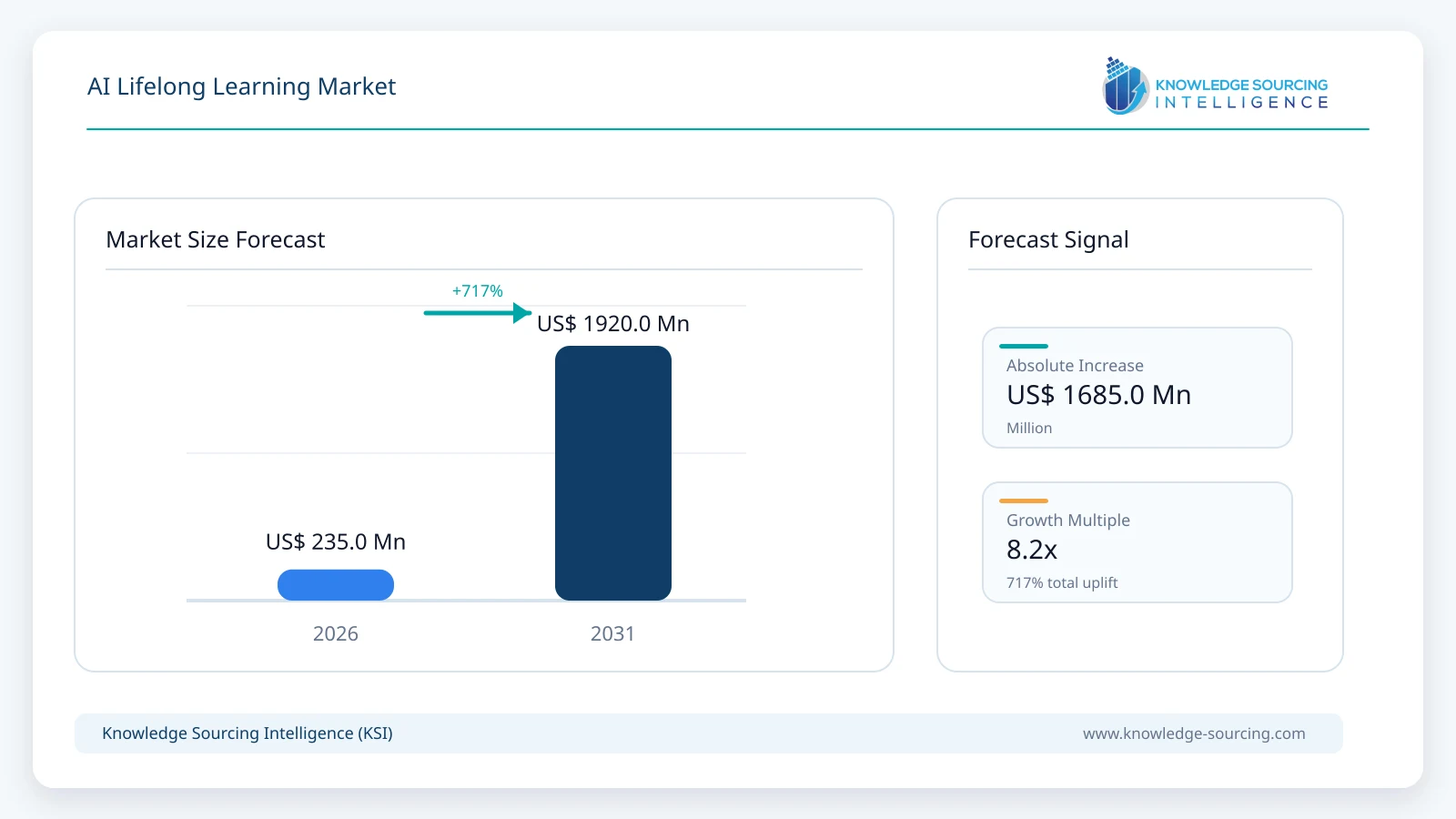
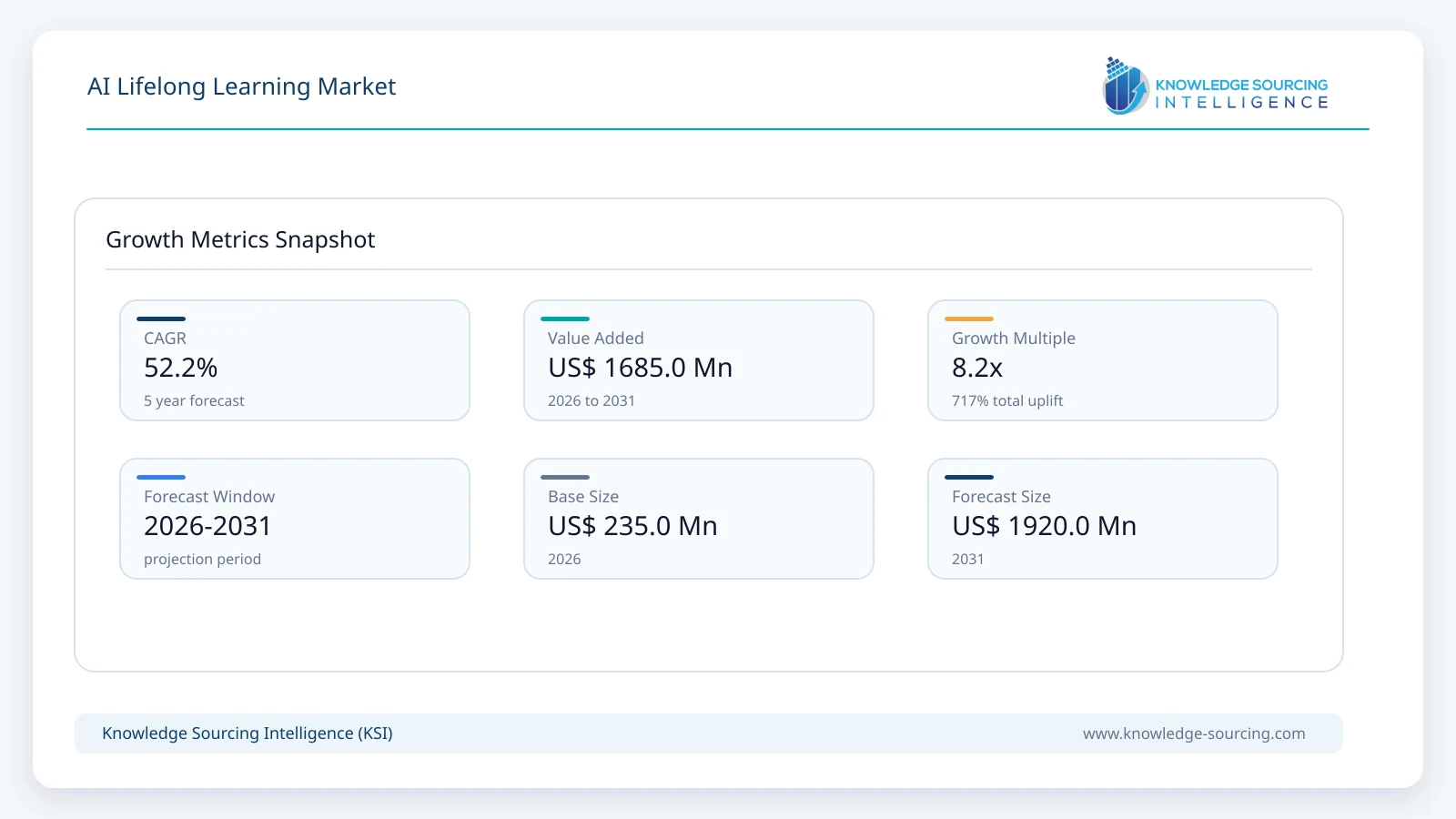
The AI Lifelong Learning Market is forecast to grow at a CAGR of 52.2%, reaching USD 1,920.0 million in 2031 from USD 235.0 million in 2026.
Highlights:
- 1Feedback-driven agent improvement is projected to gain share as deployment teams reuse production traces, evaluator results and human corrections to improve model behavior and supporting harnesses.
- 2Continual adaptation and retention licenses are estimated at USD 100 million in 2026 and USD 670 million by 2031, remaining the largest identifiable commercial revenue stream.
- 3Unsupervised continual learning increases from an estimated 28% of attributable market revenue in 2026 to 37% by 2031 as customers automate adaptation to evolving, sparsely labeled inputs.
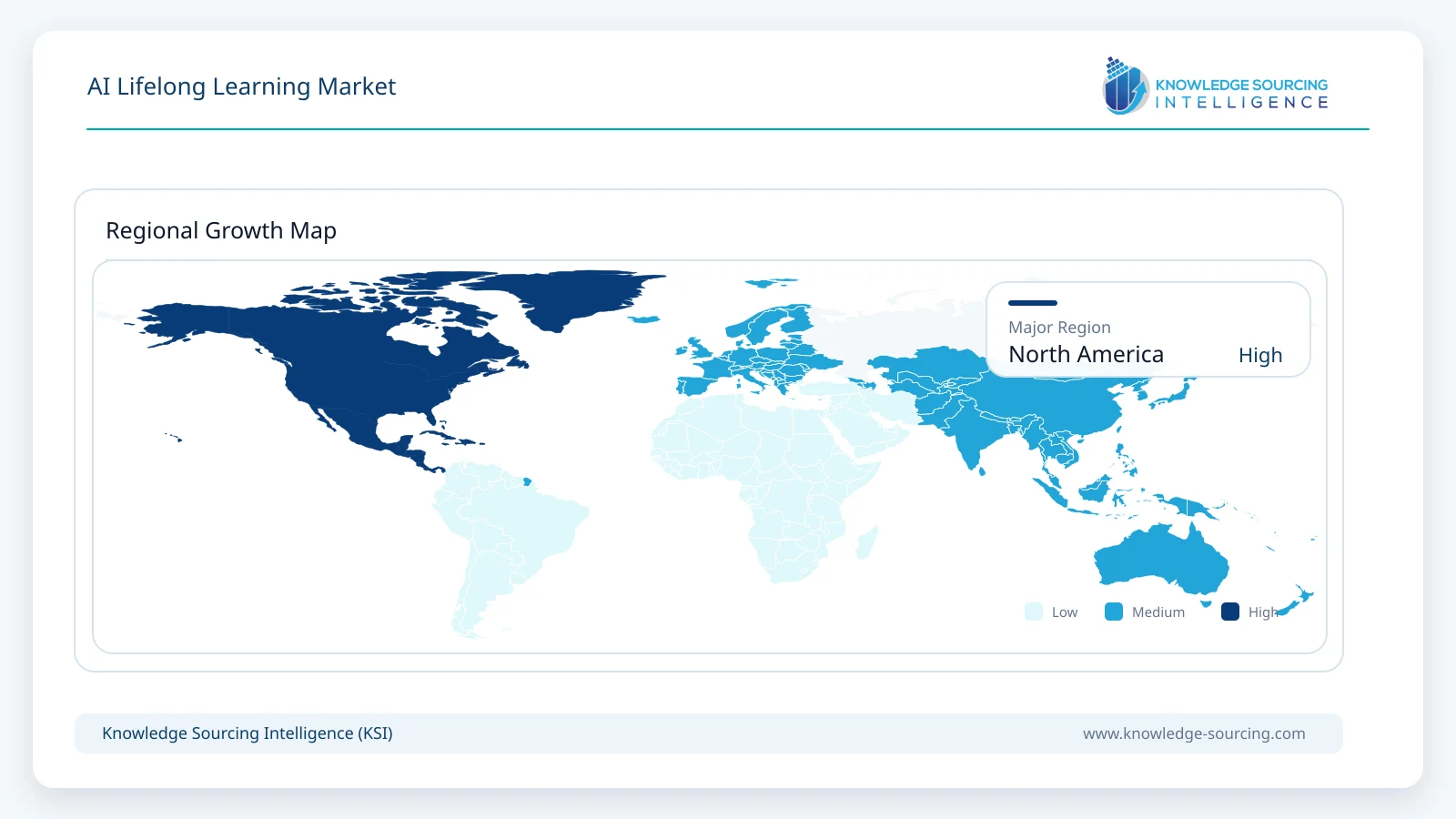
- 4North America is the largest regional market in 2026, while Asia Pacific is projected to grow more quickly as industrial AI and local enterprise model deployments expand.
- 5Model governance, regression testing and access controls are fundamental procurement requirements because production learning can introduce new errors or overwrite established expertise.
Continual learning is distinct from the periodic retraining used in conventional machine learning operations. Systems must retain earlier knowledge under successive updates, use replay or stability controls, and test whether performance on established tasks has regressed. Google Research has studied Nested Learning as a way to address forgetting, while NVIDIA NeMo supports agent feedback and optimization workflows and Microsoft Azure Machine Learning provides production monitoring that can inform update decisions.
The commercial market is at an early stage because vendors often bundle improvement capabilities within broader AI development and model-serving contracts. Databricks, LangChain, and infrastructure suppliers are turning agent traces, evaluations and feedback into more structured improvement cycles. Enterprise adoption is likely to depend on a transparent evidence trail linking each learning update to accepted task performance, oversight, and reliable rollback options.
Market Overview
The commercial problem addressed by post-deployment lifelong learning begins after an AI system has already demonstrated value in a defined task. Business data, user behavior, operating constraints, and domain terminology continue to change, but completely rebuilding a model after every change is expensive and can disrupt working applications. Continual-learning products decide what evidence to retain, how to perform incremental updates, and which previous capabilities must be checked before a revision is released.
Lifelong-learning architectures can use rehearsal of selected earlier examples, regularization that protects important parameters, selective adapters, or controlled agent-harness revisions. Enterprise agents also adapt through persistent procedures and verified feedback rather than model-weight changes alone. LangChain distinguishes model, harness, and context updates, while Databricks describes memory scaling as an additional path to better task completion from retained interaction histories.
Commercial suppliers range from model-platform providers to evaluation, observability, and agent development specialists. LangSmith Engine turns recurring execution failures into proposed fixes and evaluation cases; Databricks integrates Quotient AI expertise in continuous evaluation; and NVIDIA offers customizable agent optimization components. These capabilities are not interchangeable, and the total commercial value should reflect separately purchased lifelong-learning functionality rather than whole platform subscriptions.
Market Trends
Closed-loop agent improvement from production feedback
Production AI agents generate traces showing tool choices, user corrections, retries and failed outcomes, and suppliers are building workflows that convert those records into useful learning signals. LangChain launched LangSmith Engine in May 2026 to cluster failures and propose repairs, while its applied research programme is exploring improvements to model, harness and context components. This makes operational feedback an input to product development rather than merely a support log.
For enterprise buyers, practical value depends on separating a real performance improvement from a change that simply moves errors elsewhere. Accepted outcomes, cost per completed task, regression tests, and reviewable release histories are increasingly important evaluation criteria. High-volume agent deployments provide the data needed to automate this process, but also generate privacy and data-quality obligations.
Retention-aware updating and anti-forgetting techniques
New task data can cause AI models to lose performance on earlier tasks, especially when updates are based on narrow recent examples. Google Research introduced Nested Learning in November 2025 as an experimental approach to retaining previous capabilities across changes, reinforcing interest in replay, stability controls and multi-rate updates. Commercial products can incorporate these ideas in controlled fine-tuning and evaluation pipelines.
The adoption argument is strongest when an earlier model already meets demanding accuracy or compliance requirements. For example, risk-scoring and industrial inspection systems need to learn from new patterns without degrading previously approved decisions. Customers therefore assess learning systems using old-task retention alongside performance on new data, rather than a single post-update benchmark.
Persistent agent skills and knowledge consolidation
Long-running AI agents can acquire useful procedures, domain facts and workflow constraints that should remain available after individual sessions end. Databricks introduced Agent Memory in October 2026 to retain context and consolidate recurring information, while LangChain described persistent procedural memory as a route to reducing repeated mistakes. The spending opportunity sits in governed learning and consolidation, not in ordinary vector storage or document retrieval.
Model owners must distinguish transient user context from validated reusable skills and avoid promoting unreliable observations into permanent instructions. Versioning, provenance and controls for removing obsolete or sensitive information will influence enterprise uptake. Retained procedures also need periodic testing against changing applications and software interfaces.
Adaptive update platforms integrated with AI operations
Organizations rarely purchase continual learning as an isolated algorithm. Instead, capabilities are being embedded into model pipelines, evaluation systems, agent control planes and update services. NVIDIA NeMo supports monitoring and optimization linked to customization, while Azure Machine Learning documents model drift monitoring and event-driven retraining triggers.
The difference between general MLOps and lifelong learning is whether the incremental update actively balances new knowledge against retained capabilities. Platform suppliers that can demonstrate that balance, maintain audit logs and support controlled rollback may earn incremental revenue even when many underlying components are open source.
Segment Analysis
By Learning Mechanism: Replay and Retention-Aware Adaptation
Replay and retention-aware adaptation accounts for an estimated 30% of market revenue in 2026 and is projected to reach USD 499.20 million in 2031. Model owners reuse selected historical examples or protected representations when incorporating new tasks, reducing the risk that a recent dataset will overwrite earlier knowledge. Demand is particularly relevant to regulated predictive models and multi-client deployments with diverse historical distributions.
By Commercial Offering: Continual Adaptation and Retention Licenses
Continual adaptation and retention licenses represent approximately 43% of global 2026 revenue and are forecast at USD 670.00 million by 2031. Subscription buyers value integrated retention checks, update policies, experiment records and release controls. Although metered updates gain share, licenses remain attractive where enterprise governance requires stable ownership and predictable procurement.
By Deployment Model: Public Cloud and Managed Services
Public cloud and managed services contribute an estimated 48% of 2026 market revenue and are projected to reach USD 864.00 million in 2031. Managed update pipelines reduce operational complexity, while private and hybrid deployment options are gaining relevance for protected records, proprietary models and sensitive feedback.
By Learning Type: Unsupervised Continual Learning
Unsupervised continual learning accounts for approximately 28% of 2026 market revenue and is projected to reach USD 710.40 million by 2031. The segment benefits from adaptation to large changing data streams where manual task labels remain scarce. Supervised continual learning retains an important installed base, while reinforcement-based updates are used selectively where reliable rewards and simulation environments are available.
By Primary Application: Production AI Agent Improvement
Production AI agent improvement represents approximately 35% of 2026 market value and is forecast to reach USD 787.20 million by 2031. Complex agent deployments generate detailed traces and evaluation outcomes that can support continuing improvement in tool use, procedure selection and accepted completion rates.
By Customer Type: Large Enterprises
Large enterprises account for an estimated 55% of 2026 revenue and are projected to reach USD 1,017.60 million by 2031. These buyers operate multiple systems across changing data environments and typically require centralized approval, audit, model-risk and lifecycle policies. Software developers and application providers are projected to capture a growing share through embedded update tools.
By End-User Industry: IT, Software and Digital Services
IT, software and digital services represent 30% of estimated 2026 market revenue and are forecast to reach USD 652.80 million by 2031. Developer agents, customer-support automation and managed software platforms supply repeated feedback at scale. Financial services and industrial operators adopt more carefully where regression costs are higher.
Market Drivers
Growing deployment of persistent enterprise AI agents
Production agents are increasingly deployed across multi-step workflows rather than one-off question answering, creating a continuous stream of task results, corrections and operational feedback. LangChain and Databricks now describe products and research programmes that use these traces to improve agents. Businesses can justify paid improvement layers when they reduce repeat failures, improve accepted task outcomes and lower intervention costs across large agent populations.
Rising expense of repeated full model retraining
Organizations with established models face substantial costs in rebuilding, validating and redeploying systems whenever inputs change. Retention-aware adapters and incremental update workflows offer a more selective approach, particularly when previous task performance must remain stable. The benefit is strongest where training data is costly, models are customized for regulated workflows or the same system operates in many changing environments.
Greater availability of production feedback and evaluation data
Model and agent observability systems capture richer execution records than earlier software generations, including rejected outputs, tool failures and user corrections. When combined with trusted labels and evaluator results, these records create datasets for targeted improvement. LangSmith Engine and Databricks Quotient illustrate supplier investment in turning evaluation evidence into systematic performance changes.
Need to retain performance under changing data distributions
Industrial equipment, fraud patterns, consumer preferences and software interfaces evolve during a model’s service life. Updating solely on new observations can weaken performance on familiar tasks, while retaining old models unchanged limits responsiveness. Lifelong-learning approaches address both risks with retention benchmarks, replay, stability constraints and controlled updates that can be audited over time.
Expanding platform support for governed model adaptation
Enterprise AI stacks increasingly combine model customization, monitoring, evaluations and automated delivery pipelines. NVIDIA NeMo, Azure Machine Learning and related platforms provide enabling components, making continual improvement easier to operationalize. Buyers remain willing to pay for dedicated learning controls when those controls reduce manual coordination and provide measurable improvement without uncontrolled updates.
Market Restraints
Catastrophic forgetting and unstable update quality
Sequential training can degrade capabilities learned earlier, and a successful result on recent data may conceal regressions across historical tasks. Retention testing requires representative past examples and reliable evaluation suites, both of which can be expensive to maintain. Until suppliers demonstrate stable performance across longer learning histories, risk-sensitive buyers may restrict automatic updates.
Unclear commercial attribution within broader AI platforms
Continual-learning features are frequently bundled within model operations, agent development platforms, feedback tools and managed cloud contracts. Buyers often cannot identify which spending supports genuine sequential adaptation rather than routine monitoring or memory storage. This packaging creates pricing pressure on specialist providers and requires conservative revenue attribution for a standalone market estimate.
Privacy restrictions on storing production interactions
Learning from user corrections, enterprise records and agent traces introduces consent, confidentiality and data-retention questions. Sensitive inputs cannot always be reused for training, replay or shared evaluation sets, and cross-tenant contamination would create substantial risks. Enterprises therefore need access controls, data minimization and deletion procedures before expanding continual-learning programmes.
Testing, governance and rollback overhead
A model update that improves one workflow can undermine a previously approved use case or violate business constraints. Version tracking, audit evidence, regression suites and human approval remain necessary, especially in finance, healthcare and critical operations. These requirements increase implementation costs and can slow the cadence of otherwise technically feasible model updates.
Immature standards and competition from simpler updates
Open-source algorithms and established scheduled retraining pipelines can satisfy some business needs at lower direct software cost. Formal methods for comparing lifelong-learning quality across vendors remain fragmented, with results often dependent on task sequence and chosen benchmarks. Procurement may favor existing MLOps platforms until specialist offerings prove superior retained performance and total ownership economics.
Regional Outlook
North America
North America is the leading regional market, estimated at USD 98.70 million in 2026 and projected to reach USD 729.60 million in 2031. The United States accounts for most attributable spending, supported by major enterprise AI platforms, specialist agent tooling suppliers and early deployment of production feedback systems. Cloud availability and established model-risk practices help convert experimental improvement loops into paid, governed services.
Commercial opportunities are concentrated in software services, financial institutions and large corporate agent fleets that generate sufficient task histories to support meaningful update cycles. Microsoft, Google, NVIDIA, Databricks and LangChain contribute complementary pieces of the ecosystem, while buyers increasingly demand strong retention testing and oversight before enabling routine production updates.
Asia Pacific
Asia Pacific is projected to expand from USD 54.05 million in 2026 to USD 556.80 million in 2031, making it the fastest-growing major region during the forecast period. China, India, Japan and South Korea provide varied demand across local-language AI agents, industrial vision, predictive automation and robotics. Enterprises may favor regionally deployed models with controlled updates to meet data-sovereignty and operational requirements.
Growth is expected to benefit from a broadening developer ecosystem and higher volumes of feedback-rich AI applications, particularly in Indian software services and manufacturing operations across East Asia. Buyers still face challenges in integrating evaluation histories, legacy production systems and regulated data, so commercial uptake will depend on repeatable evidence of improvement rather than research demonstrations alone.
Competitive Landscape
AI lifelong learning competition spans model platforms, AI-agent development tools and specialists in evaluation and updating. Databricks and LangChain offer visible links between production agent behavior and improvement workflows, while NVIDIA and Microsoft supply model customization, operational monitoring and release mechanisms. Providers do not necessarily sell a separately priced lifelong-learning product; competitive assessment therefore focuses on direct improvement functionality rather than total platform revenue.
Product differentiation is expected to rest on supported update types, old-task retention performance, provenance of learning inputs and the ability to test and reverse changes. Open-source algorithms limit standalone pricing for some techniques, creating opportunities for integrated, enterprise-ready suppliers that combine governed workflows with measurable cost and accuracy benefits.
Recent Developments
October 2026: Databricks introduced Agent Memory on Agent Bricks in beta, with managed retention and consolidation of important agent facts and workflows.
May 2026: LangChain announced LangChain Labs, bringing production traces, evaluations and research partnerships into practical continual-learning programmes.
May 2026: LangChain introduced LangSmith Engine to identify recurring agent errors, draft proposed repairs and feed failure traces into future evaluations.
March 2026: Databricks announced the acquisition of Quotient AI to expand continuous evaluation and reinforcement-learning approaches for deployed agents.
February 2026: Databricks Research presented MemAlign, a memory-based approach to adapt automated judges using limited human feedback.
November 2025: Google Research introduced Nested Learning and the Hope proof-of-concept architecture to investigate learning updates without catastrophic forgetting.
Market Outlook
AI lifelong learning adoption is expected to accelerate as organizations move persistent AI agents and predictive systems from pilots into production operations requiring ongoing improvement. The KSI forecast anticipates that agent-feedback runtimes and metered update services will grow faster than conventional licenses, although retention controls and governed deployment remain central to procurement. Buyers will increasingly compare improvement per update with total retraining and oversight costs.
Technical progress in replay, parameter-efficient adaptation, adaptive memory and automatic evaluation will help more applications handle changing workloads. Nevertheless, production systems must preserve earlier capabilities, control private feedback and demonstrate that changes benefit real tasks. Commercial providers able to connect learning evidence to stable quality and compliant release processes are positioned to capture a larger share of incremental enterprise AI spending.
By 2031, North America is projected to retain the largest regional revenue share, while Asia Pacific captures more of the global total as regional AI ecosystems expand. Lifelong learning is likely to remain a cross-cutting capability embedded in AI development stacks rather than a single universal product category, favoring careful commercial definition and supplier comparison.
AI Lifelong Learning Market Scope:
| Report Metric | Details |
|---|---|
| Total Market Size in 2026 | USD 235.0 million |
| Total Market Size in 2031 | USD 1,920.0 million |
| Forecast Unit | USD Million |
| Growth Rate | 52.2% |
| Study Period | 2021 to 2031 |
| Historical Data | 2021 to 2024 |
| Base Year | 2025 |
| Forecast Period | 2026 – 2031 |
| Segmentation | Learning Mechanism, Commercial Offering, Deployment Model, Learning Type |
| Companies |
|
| Customization Scope | 15% Free Customization included with purchase — Request Custom Breakdown → |
| Sample & Data Access | PDF Sample, Excel Databook & Analyst Briefing — Download Free Sample → |
Market Segmentation
By Learning Mechanism
Replay and retention-aware adaptation
Regularization and stability controls
Parameter-efficient incremental updating
Feedback-driven agent improvement
Procedural skill consolidation
By Commercial Offering
Continual adaptation and retention licenses
Agent improvement and feedback runtimes
Verified incremental update jobs
Retained-skills consolidation modules
By Deployment Model
Public cloud and managed services
Customer-managed private cloud
On-premises infrastructure
Hybrid deployment
By Learning Type
Supervised continual learning
Unsupervised continual learning
Reinforcement continual learning
By Primary Application
Production AI agent improvement
Predictive-model adaptation
Industrial inspection and process AI
Robotics and autonomy
Fraud, risk and anomaly detection
By Customer Type
Large enterprises
Software and AI application developers
Cloud and managed AI operators
Research and public institutions
By End-user Industry
IT, software and digital services
Banking and financial services
Manufacturing and industrial
Healthcare and life sciences
Retail and consumer services
Public sector and other industries
By Geography
North America
United States
Canada
Mexico
South America
Brazil
Argentina
Chile
Rest of South America
Europe
Germany
United Kingdom
France
Italy
Spain
Netherlands
Nordic Countries
Rest of Europe
Asia Pacific
China
India
Japan
South Korea
Australia
Singapore
Rest of Asia Pacific
Middle East and Africa
United Arab Emirates
Saudi Arabia
Israel
South Africa
Rest of Middle East and Africa
Table of Contents
1. EXECUTIVE SUMMARY
1.1. Key Findings and Market Opportunities
1.2. Market Size and Forecast, 2026-2031
1.3. Strategic Outlook
2. MARKET SNAPSHOT
2.1. Market Overview
2.2. Market Definition
2.3. Scope of the Study
2.4. Market Segmentation
3. BUSINESS LANDSCAPE
3.1. Market Drivers
3.1.1. Growing deployment of persistent enterprise AI agents
3.1.2. Rising expense of repeated full model retraining
3.1.3. Greater availability of production feedback and evaluation data
3.1.4. Need to retain performance under changing data distributions
3.1.5. Expanding platform support for governed model adaptation
3.2. Market Restraints
3.2.1. Catastrophic forgetting and unstable update quality
3.2.2. Unclear commercial attribution within broader AI platforms
3.2.3. Privacy restrictions on storing production interactions
3.2.4. Testing, governance and rollback overhead
3.2.5. Immature standards and competition from simpler updates
3.3. Market Opportunities
3.4. Porter’s Five Forces Analysis
3.5. Industry Value Chain Analysis
3.6. Policies and Regulations
3.7. Strategic Recommendations
4. TECHNOLOGICAL OUTLOOK
4.1. Stability-Plasticity Tradeoff and Catastrophic Forgetting
4.2. Replay and Regularization Methods
4.3. Parameter-Efficient Incremental Updates
4.4. Agent Feedback and Trace-Based Improvement
4.5. Retained Procedural Skills and Memory Consolidation
4.6. Retention Evaluation and Rollback Controls
5. AI LIFELONG LEARNING MARKET BY LEARNING MECHANISM
5.1. Introduction
5.2. Replay and retention-aware adaptation
5.3. Regularization and stability controls
5.4. Parameter-efficient incremental updating
5.5. Feedback-driven agent improvement
5.6. Procedural skill consolidation
6. AI LIFELONG LEARNING MARKET BY COMMERCIAL OFFERING
6.1. Introduction
6.2. Continual adaptation and retention licenses
6.3. Agent improvement and feedback runtimes
6.4. Verified incremental update jobs
6.5. Retained-skills consolidation modules
7. AI LIFELONG LEARNING MARKET BY DEPLOYMENT MODEL
7.1. Introduction
7.2. Public cloud and managed services
7.3. Customer-managed private cloud
7.4. On-premises infrastructure
7.5. Hybrid deployment
8. AI LIFELONG LEARNING MARKET BY LEARNING TYPE
8.1. Introduction
8.2. Supervised continual learning
8.3. Unsupervised continual learning
8.4. Reinforcement continual learning
9. AI LIFELONG LEARNING MARKET BY PRIMARY APPLICATION
9.1. Introduction
9.2. Production AI agent improvement
9.3. Predictive-model adaptation
9.4. Industrial inspection and process AI
9.5. Robotics and autonomy
9.6. Fraud, risk and anomaly detection
10. AI LIFELONG LEARNING MARKET BY CUSTOMER TYPE
10.1. Introduction
10.2. Large enterprises
10.3. Software and AI application developers
10.4. Cloud and managed AI operators
10.5. Research and public institutions
11. AI LIFELONG LEARNING MARKET BY END-USER INDUSTRY
11.1. Introduction
11.2. IT, software and digital services
11.3. Banking and financial services
11.4. Manufacturing and industrial
11.5. Healthcare and life sciences
11.6. Retail and consumer services
11.7. Public sector and other industries
12. AI LIFELONG LEARNING MARKET BY GEOGRAPHY
12.1. North America
12.1.1. United States
12.1.2. Canada
12.1.3. Mexico
12.2. South America
12.2.1. Brazil
12.2.2. Argentina
12.2.3. Chile
12.2.4. Rest of South America
12.3. Europe
12.3.1. Germany
12.3.2. United Kingdom
12.3.3. France
12.3.4. Italy
12.3.5. Spain
12.3.6. Netherlands
12.3.7. Nordic Countries
12.3.8. Rest of Europe
12.4. Asia Pacific
12.4.1. China
12.4.2. India
12.4.3. Japan
12.4.4. South Korea
12.4.5. Australia
12.4.6. Singapore
12.4.7. Rest of Asia Pacific
12.5. Middle East and Africa
12.5.1. United Arab Emirates
12.5.2. Saudi Arabia
12.5.3. Israel
12.5.4. South Africa
12.5.5. Rest of Middle East and Africa
13. COMPETITIVE ENVIRONMENT AND ANALYSIS
13.1. Major Players and Strategy Analysis
13.2. Market Share Analysis
13.3. Mergers, Acquisitions, Agreements, and Collaborations
13.4. Competitive Dashboard
14. COMPANY PROFILES
14.1. Databricks, Inc.
14.2. LangChain, Inc.
14.3. Google LLC (Alphabet Inc.)
14.4. Microsoft Corporation
14.5. Amazon Web Services, Inc.
14.6. NVIDIA Corporation
14.7. International Business Machines Corporation
14.8. Arize AI, Inc.
14.9. Weights & Biases, Inc.
14.10. Predibase, Inc.
14.11. Scale AI, Inc.
15. APPENDIX
15.1. Currency
15.2. Assumptions
15.3. Base and Forecast Years Timeline
15.4. Key Benefits for Stakeholders
15.5. Research Methodology
15.6. Abbreviations





Frequently asked questions
What is the projected AI Lifelong Learning market size in 2031?
The AI Lifelong Learning Market is forecast to reach USD 1,920.0 million by 2031.
What is the Compound Annual Growth Rate (CAGR) forecast for this market?
The AI Lifelong Learning Market is forecast to grow at a CAGR of 52.2%.
What is the largest commercial revenue stream in this market?
Continual adaptation and retention licenses are the largest revenue stream.
Which region holds the largest AI Lifelong Learning market share in 2026?
North America is the largest regional market in 2026.
Which region is projected for the fastest growth in this market?
Asia Pacific is projected to grow more quickly.
What trend is noted in unsupervised continual learning revenue?
Unsupervised continual learning increases from 28% to 37% by 2031.
Cite this report
Knowledge Sourcing Intelligence. (Oct 2026). AI Lifelong Learning Market Size, Share & Growth Forecast (2026-2031). https://www.knowledge-sourcing.com/report/ai-lifelong-learning-market