
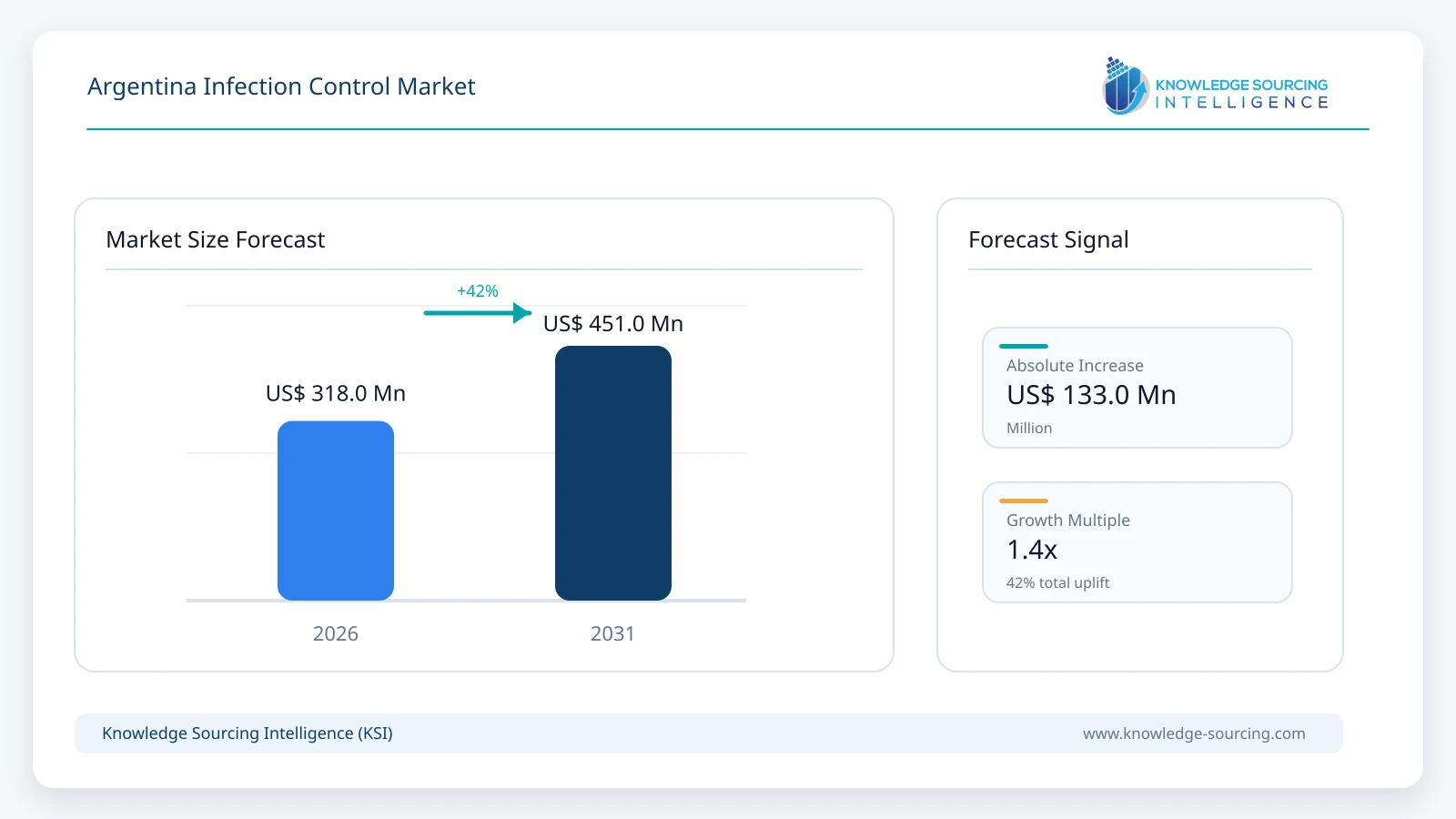
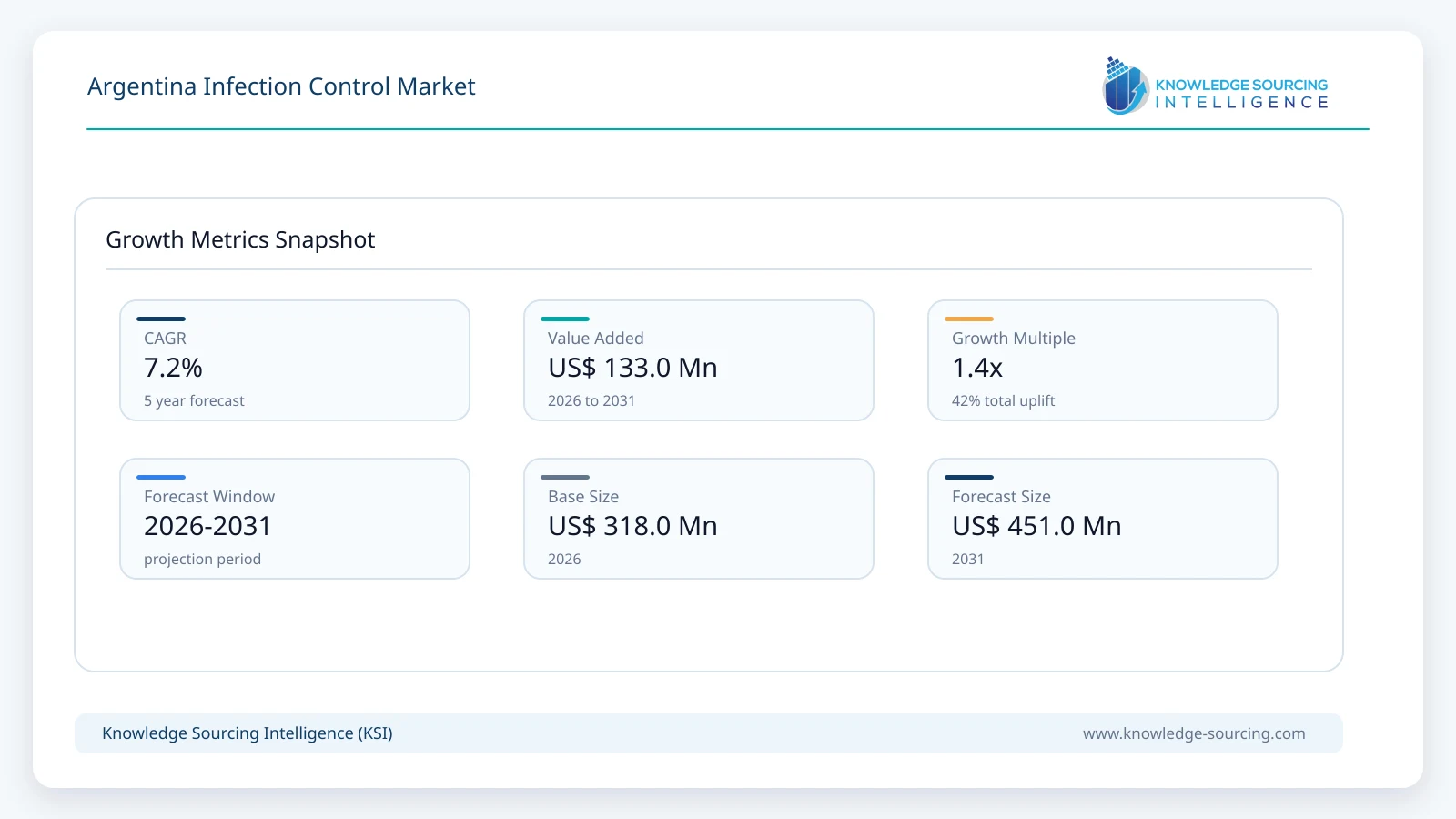
The Argentina Infection Control Market is expected to expand at a CAGR of 7.24%, reaching USD 451.0 million in 2031 from USD 318.0 million in 2026.
Highlights:
- 1Disinfectants represent approximately 57% of the market’s 2026 value, reflecting recurring institutional consumption.
- 2Healthcare contributes an estimated 72% of demand, led by hospitals and surgical services.
- 3Automated endoscope reprocessing is increasingly tied to procedure capacity and traceability.
- 4Validated cleaning cycles and documented sterilization assurance influence equipment selection.
- 5Buenos Aires Province and CABA concentrate demand; Córdoba has stronger forecast growth.
- 6Import costs and maintenance access remain decisive in sterilization-equipment purchasing.
Infection-control expenditure in Argentina spans disinfectant formulations, heat and low-temperature sterilization systems, and contracted sterilization services supplied to healthcare, food-and-beverage, and chemical-sector customers. Hospital procurement includes surface and instrument disinfectants, sterilants, reusable-device processing equipment, and related assurance products. Industrial demand is concentrated in sanitation processes where microbial contamination can affect product safety, validated production standards or plant availability.
The purchasing distinction lies between recurring chemical use and the longer replacement cycles of sterilization equipment. STERIS, Getinge, MATACHANA and Advanced Sterilization Products manufacture sterilization or endoscope-processing solutions, while Ecolab, Solenis/Diversey and B. Braun supply specialist infection-prevention and cleaning chemistries. Hospitals increasingly evaluate these systems together with technician training, instrument compatibility, service response, and process documentation rather than treating equipment acquisition as an isolated purchase.
Market Overview
Hospital infection-control programs in Argentina combine environmental disinfection, instrument decontamination, sterilization and microbiological surveillance. The Institute of Epidemiology at ANLIS reported 296 healthcare facilities participating in the national VIHDA network in its 2025 surveillance report, with 261 institutions supplying routine surveillance information. The network is not a count of all potential purchasers, but it demonstrates the institutional depth of infection-prevention monitoring. Hospitals must also distinguish between ordinary surface hygiene, high-level disinfection of selected instruments, and terminal sterilization of devices entering sterile tissue.
Sterile-processing departments must reconcile instrument compatibility with cycle throughput and equipment validation. STERIS offers vaporized-hydrogen-peroxide V-PRO systems for heat-sensitive devices, while Getinge has expanded automated cleaning and high-level disinfection through its Aquadis endoscope reprocessor. MATACHANA’s steam sterilizers address conventional heat-stable loads; its newer S1000 platform emphasizes lower resource consumption. The choice among these technologies depends on the instrument inventory, available utilities, annual procedure mix and evidence that the selected cycle can be reproduced in the institution’s operating conditions.
Chemical procurement is shaped by formulation efficacy, contact time, surface compatibility and regulatory status. ANMAT differentiates products registered for medical use from cosmetic formulations that have not been evaluated for wound disinfection or presurgical antisepsis. Ecolab’s hospital infection-prevention portfolio and Diversey’s Oxivir disinfectants illustrate the importance of specialized chemistry, while B. Braun supplies instrument detergents and high-level disinfectants. Argentina’s 2026–2029 national action plan for antimicrobial resistance and healthcare-associated infections reinforces the role of surveillance and prevention, although it does not mandate the purchase of any named product.
Market Trends
Endoscope Reprocessing Is Becoming More Automated
Flexible endoscopes require cleaning and high-level disinfection protocols that differ materially from routine disinfection of room surfaces. Reprocessing volumes tend to follow procedure scheduling, and delays can reduce the usable inventory available to endoscopy departments. Getinge introduced Aquadis Endo 110 in June 2026 with automated channel connections and a standard 20-minute processing cycle, positioning throughput and repeatability alongside microbial efficacy as purchasing criteria.
Automated equipment does not remove the need for manual pre-cleaning, compatible detergents or procedural verification. A hospital replacing a reprocessor must validate its existing endoscope models, staff workflow, water quality, and service support. Suppliers with equipment, compatible chemistry and technical support can therefore compete on process performance rather than the purchase price of one machine.
Low-Temperature Sterilization Broadens Instrument Compatibility
Advanced surgical instruments often incorporate polymers, adhesives, or complex channels that cannot tolerate conventional steam exposure. Vaporized hydrogen peroxide provides a validated low-temperature alternative for specific device configurations. STERIS’s V-PRO family and ASP’s STERRAD platform illustrate how suppliers pair cycle claims with compatible sterilants, indicators and device-specific instructions for use.
The premium for low-temperature systems is justified only where an institution handles sufficient eligible instrument volume and maintains reliable cycle validation. The expansion of endoscopic and minimally invasive procedures increases the potential application base, but the supported reprocessing pathway remains dependent on individual manufacturer instructions. Unsupported claims that every complex device can be treated by the same method can create significant clinical and purchasing risk.
Sterilization Assurance Is Shifting Closer to Real-Time Workflow
Biological indicators and process monitoring determine whether a completed cycle can be released for clinical use under validated procedures. ASP introduced its BIOTRACE Instant Read Steam System in 2025 and was selected to exhibit it at a September 2026 technology event, reflecting supplier attention to faster evidence of process performance. Such developments matter most where instrument-turnaround pressure makes long waits operationally costly.
Faster indicator readouts have to be assessed against the specific sterilization cycle, hospital quality system and applicable validation standards. Sterile-processing managers also consider documentation, inventory tracking and staff competency. These requirements favor suppliers able to integrate consumables and monitoring with existing cleaning and sterilization equipment.
Institutional Hygiene Contracts Favor Concentrated and Validated Chemistry
Hospital disinfectant buyers increasingly specify efficacy, dwell time, material compatibility and occupational exposure alongside the delivered price per liter. Concentrated formulations and ready-to-use wipes serve different needs: central stores may prefer economical bulk dispensing, while intensive-care rooms and procedure spaces often need rapid standardized application. The decision also depends on whether a product is registered for the intended healthcare use in Argentina.
Diversey’s accelerated-hydrogen-peroxide Oxivir portfolio demonstrates the competing emphasis on broad activity and surface compatibility. Ecolab’s healthcare business similarly links hospital disinfection with hand hygiene and instrument cleaning. Cost comparisons need to account for dilution accuracy, contact time, and cleaning labor; a nominally inexpensive formulation may be less economical when additional handling or repeated application is required.
Segment Analysis
By Product: Disinfectants
Disinfectants are expected to generate approximately USD 243.5 million by 2031, reflecting the continuing replacement of surface and instrument chemistries across hospitals, clinics and regulated industrial facilities. Demand encompasses professional-use products that can demonstrate appropriate efficacy for the intended application, not household cleaners sold for general domestic use. Within healthcare, recurring consumption makes the category less dependent on a major capital-equipment purchase cycle.
Product choice varies materially by task. Instruments may require enzymatic pre-cleaning followed by high-level disinfection or terminal sterilization, while environmental hygiene relies on surface-specific formulations and verified contact times. ANMAT’s distinction between medicinal antiseptics and cosmetic products makes appropriate registration and labeling commercially relevant. Ecolab, Solenis/Diversey and B. Braun address different portions of this requirement through specialist infection-prevention formulations.
The category will remain the largest product group even as investment in low-temperature systems increases. Suppliers that combine concentration control, dosing support and training with reliable local availability should be better positioned in multi-site institutional tenders than vendors competing exclusively on list prices.
By End-User Industry: Healthcare
Hospitals and surgical facilities represent the most technically demanding infection-control customers because sterile processing, isolation procedures, operating-room turnover and intensive-care sanitation draw on different products and validation practices. Healthcare purchases also involve recurring disinfectant supplies alongside sterilizer maintenance, biological indicators and replacement equipment. The national VIHDA program provides a structured basis for documenting healthcare-associated infections, strengthening the case for consistent processes within participating institutions.
The healthcare sector is projected to account for approximately USD 329.2 million in market value by 2031. Public and private institutions face different procurement constraints, but both must balance clinical reliability against consumable cost and equipment availability. Endoscope reprocessing and instrument sterilization give specialized suppliers a stronger role than in general facility cleaning, where a larger number of chemical vendors can compete.
Equipment manufacturers are likely to gain business where an integrated offering reduces training effort, downtime and validation complexity. Hospitals with limited technical staffing may favor externally supported maintenance, although the economics of contracting sterilization depend on transport distance, instrument turnaround and the ability to document chain of custody.
Market Drivers
Structured Surveillance of Healthcare-Associated Infections
Argentina’s national VIHDA program consolidates infection-surveillance information from participating institutions, and its 2025 report documented an expanding reporting network. Surveillance itself is not a product sale, but it gives hospitals a framework for identifying procedural weaknesses and prioritizing improvements in cleaning, instrument handling and environmental hygiene.
The national 2026–2029 action plan links infection prevention with antimicrobial-resistance control and specifies objectives for monitoring and institutional action. Product demand arises when hospital procurement translates identified gaps into validated disinfectant protocols, sterilizer replacement or reprocessing training, rather than from the announcement of a policy alone.
Growing Complexity of Reusable Medical Instruments
Flexible endoscopes and surgical instruments containing channels or heat-sensitive components require validated reprocessing methods matched to their construction. These devices increase the need for specialized detergents, washer-disinfectors and suitable sterilization cycles rather than additional conventional steam capacity in every facility.
Getinge’s Aquadis Endo 110 and ASP’s ULTRA GI cycle illustrate how suppliers are developing pathways for specific device classes. Commercial adoption depends on the hospital’s inventory of compatible instruments, procedure volume and service arrangements. Higher technical requirements support equipment and associated consumable revenue where those criteria are met.
Replacement of Aging Sterile-Processing Infrastructure
Sterilizer reliability affects the availability of surgical sets, particularly when hospitals maintain limited reserve instruments. Older heat and low-temperature machines can require expensive service parts, longer cycles or manual documentation. Replacement decisions therefore account for the cost of downtime and failed loads alongside the capital price.
New steam sterilizers emphasize energy and water efficiency, while integrated automated systems can reduce repeated handling. MATACHANA’s S1000 and Getinge’s Automatiq are examples of supplier investment in workflow performance, although local purchasing depends on budgets, import access and validation resources rather than product availability in foreign markets alone.
Expansion of Institutional Disinfection Protocols
Intensive-care areas, ambulatory facilities and processing plants consume disinfectants continuously, creating a recurring procurement base even when equipment purchases are deferred. Disinfection protocols specify concentration, dwell time and surface suitability, encouraging product comparisons based on the treated area and verified performance.
Professional formulations also support formal dispensing and training procedures, particularly in health systems managing multiple facilities. Manufacturers that provide dependable supply and instructions appropriate to local registrations can lower the risk of inconsistent use. Price increases may, however, prompt customers to optimize dosing rather than simply purchase more product.
Food and Pharmaceutical Process-Hygiene Requirements
Food processors and chemical manufacturers require controlled cleaning and disinfection where microorganisms could compromise product quality or plant operating conditions. Their demand differs from hospitals, but still involves professional sanitizers and, in selected processes, validated sterilization services or equipment.
The relevant purchasing base is limited to infection- and microbial-contamination control, not all industrial cleaning chemicals. Buyers evaluate residue management, chemistry compatibility, production downtime and audit requirements, generating a more selective opportunity for suppliers with industry-specific formulations and process expertise.
Market Restraints
Imported Sterilization Equipment and Currency Exposure
Many advanced reprocessing systems and proprietary sterilants are sourced internationally, exposing Argentine purchasers to foreign-currency pricing, shipping costs, and equipment-service lead times. Hospitals funding major projects in local currency may defer capital replacements even when the technical case is favorable.
A low-temperature system also requires validated compatible consumables and trained service personnel over its operating life. Buyers must therefore assess the full lifecycle cost rather than comparing sterilizer invoice prices, which can favor extending the life of existing equipment when budgets are constrained.
Complex Validation and Instrument Compatibility
A hospital cannot assume that a reprocessing cycle validated for one device is suitable for every endoscope or surgical tool. Material compatibility, lumen dimensions, sterilant penetration and manufacturer instructions all affect safe use, sometimes restricting the available instrument inventory that can be processed in a given machine.
Introducing a new system may require staff retraining, documented performance qualification and revised procedures. These costs can be substantial for small facilities with limited sterile-processing teams, slowing equipment adoption despite favorable cycle-speed claims.
Uneven Technical Service and Maintenance Capacity
Sterilization equipment depends on calibration, preventive maintenance and timely repair. Institutions distant from established service centers can face prolonged interruptions when a specialized sensor, pump or control module fails, particularly if replacement parts must be imported.
Buyers consequently weigh the proximity of technicians, stock of validated parts and availability of temporary capacity. Suppliers without a credible maintenance network may find it difficult to win contracts even when the original equipment performs well under factory conditions.
Fragmented Institutional Purchasing and Tender Pressures
Hospitals and clinics operate under a mixture of public, social-security and private financing arrangements. Procurement specifications, tender timing and payment conditions can differ across provinces and facility groups, limiting suppliers’ ability to standardize a national sales strategy.
Disinfectant contracts are particularly sensitive to price competition and substitution among qualified formulations. Maintaining margins may require documented use advantages and dosing programs, while high-value sterilization purchases can be postponed when facility investment priorities change.
Chemical Safety and Regulatory Qualification
High-level disinfectants and sterilants may involve oxidizing or other active chemistries that require controlled dilution, ventilation, handling, and disposal. ANMAT registration and use-specific labeling remain important because a general hygiene product does not automatically meet the clinical evidence expected for medical disinfection.
Chemical exposure, compatibility, and environmental requirements can narrow product selection or raise training costs. The strongest formulations are not necessarily those with the highest active-agent concentration; purchasing decisions also depend on verified antimicrobial performance under realistic contact time and soil conditions.
Regional Outlook
Buenos Aires Province and the Autonomous City of Buenos Aires
Buenos Aires Province and CABA together represent approximately 44% of the market in 2026, reflecting the concentration of specialist hospitals, major surgical centers, healthcare purchasing organizations and industrial production activity. High instrument throughput supports demand for larger sterilization systems and predictable maintenance programs, while multi-site healthcare buyers can negotiate standardized disinfection supply contracts.
Combined market value is expected to reach about USD 191.7 million by 2031. Growth is supported by recurring hospital hygiene purchases and technical replacements, although tender constraints and competing capital priorities can limit the pace of modernization. Suppliers with locally accessible field service and regulatory support are better placed to serve both premium private facilities and large public-sector procurement processes.
Córdoba Province
Córdoba is projected to expand at approximately 10.6% annually between 2026 and 2031, the strongest growth among the modeled provincial groupings. The province combines a substantial medical-services base with industrial demand, providing opportunities in institutional disinfectants and selective renewal of sterile-processing equipment. A smaller starting revenue base gives modernization projects greater influence on the regional growth rate.
Its projected share rises from approximately 12% in 2026 to 14% in 2031. The forecast assumes gradual expansion in validated reprocessing capacity and more structured procurement rather than a uniform increase in hospital spending. Installation schedules, the availability of maintenance partners and public-sector purchasing power remain critical to how quickly that potential is realized.
Competitive Landscape
Competition combines large multinational infection-prevention suppliers with specialized sterilization manufacturers. STERIS and Getinge supply hospital sterile-processing equipment and related solutions, while ASP specializes in low-temperature sterilization and endoscope reprocessing technology. MATACHANA, Belimed, MELAG, MMM Group and Tuttnauer address different sterilizer capacities and facility types; sales success depends on the instrument mix, installation constraints and service coverage rather than brand recognition alone.
Chemical suppliers compete on different economics. Ecolab, Solenis through Diversey, and B. Braun manufacture professional disinfectant or instrument-processing formulations, with product differentiation tied to registered use, cleaning efficacy, contact time, material compatibility and operator safety. A supplier offering both chemistry and process support can defend its institutional account more effectively than a company selling undifferentiated disinfectant volumes.
The market also separates equipment suppliers from hospitals and industrial customers that use their products. Global launches should not be treated as evidence of installation in Argentina without local confirmation. Competitive advantages in the domestic market are likely to depend on registered portfolios, dependable imports, technical training and the cost of maintaining validated performance across the equipment lifecycle.
Recent Developments
21 September 2026: Advanced Sterilization Products (ASP) announced its selection to exhibit the BIOTRACE Instant Read Steam System at the Vizient Innovative Technology Exchange, highlighting faster sterility-assurance workflows.
24 June 2026: ASP acquired a majority stake in UV Smart, expanding its position in high-level disinfection technology for reusable medical devices.
11 June 2026: Getinge launched the Aquadis Endo 110 automated endoscope reprocessor, designed for a 20-minute standard cycle and greater endoscopy-department throughput.
6 April 2026: ASP introduced CIDEZYME BIOCLEAN enzymatic detergent for flexible-endoscope reprocessing, extending its instrument-cleaning portfolio.
15 January 2026: ASP announced European CE marking of the ULTRA GI cycle for the STERRAD 100NX system in collaboration with FUJIFILM Healthcare Europe, broadening a validated duodenoscope-reprocessing pathway.
19 December 2025: Getinge introduced Automatiq automated sterile-reprocessing logistics modules designed to reduce manual handling in central sterile supply departments.
Market Outlook
Argentina’s infection-control requirements will remain anchored in continuous institutional disinfection, while specialized instrument-reprocessing equipment provides a smaller but more technically differentiated growth opportunity. Hospitals are likely to direct purchases toward verifiable clinical performance, dependable consumables and acceptable instrument turnaround, particularly as endoscopic and minimally invasive procedures place greater pressure on central sterile departments.
The expansion of national surveillance and antimicrobial-resistance prevention provides a durable policy context, but equipment replacements will still depend on financing and access to trained maintenance teams. Suppliers that combine clinically suitable products, clear documentation and local service should be positioned more favorably than those relying on global technology launches without an effective Argentine delivery network. The strongest opportunities will arise where prevention protocols are converted into measurable operational improvements.
Argentina Infection Control Market Scope:
| Report Metric | Details |
|---|---|
| Total Market Size in 2026 | USD 318.0 million |
| Total Market Size in 2031 | USD 451.0 million |
| Forecast Unit | Million |
| Growth Rate | 7.24% |
| Study Period | 2021 to 2031 |
| Historical Data | 2021 to 2024 |
| Base Year | 2025 |
| Forecast Period | 2026 – 2031 |
| Segmentation | Product, End-user Industry, Geography |
| Companies |
|
| Customization Scope | 15% Free Customization included with purchase — Request Custom Breakdown → |
| Sample & Data Access | PDF Sample, Excel Databook & Analyst Briefing — Download Free Sample → |
Market Segmentation
By Product
Disinfectants
Sterilization
Low-Temperature Sterilization
Heat Sterilization
Contract Sterilization
By End-user Industry
Healthcare
Food and Beverage
Chemical
By Geography
Buenos Aires Province
Autonomous City of Buenos Aires
Córdoba
Santa Fe
Cuyo
Mendoza
San Juan
San Luis
Northwest Argentina
Tucumán
Salta
Jujuy
Santiago del Estero
Catamarca
La Rioja
Northeast Argentina
Corrientes
Chaco
Misiones
Formosa
Patagonia
Río Negro
Neuquén
Chubut
Santa Cruz
Tierra del Fuego
Entre Ríos
La Pampa
Table of Contents
1. EXECUTIVE SUMMARY
1.1. Key Findings
1.2. Argentina Infection Control Market Size, 2026–2031
1.3. Product and End-User Outlook
1.4. Provincial Opportunity Summary
2. MARKET SNAPSHOT
2.1. Market Overview
2.2. Market Definition
2.3. Scope of the Study
2.4. Market Segmentation
2.5. Currency and Forecast Period
3. BUSINESS LANDSCAPE
3.1. Market Drivers
3.1.1. Structured Surveillance of Healthcare-Associated Infections
3.1.2. Growing Complexity of Reusable Medical Instruments
3.1.3. Replacement of Aging Sterile-Processing Infrastructure
3.1.4. Expansion of Institutional Disinfection Protocols
3.1.5. Food and Pharmaceutical Process-Hygiene Requirements
3.2. Market Restraints
3.2.1. Imported Equipment and Currency Exposure
3.2.2. Complex Validation and Instrument Compatibility
3.2.3. Uneven Technical Service and Maintenance Capacity
3.2.4. Fragmented Institutional Purchasing and Tender Pressures
3.2.5. Chemical Safety and Regulatory Qualification
3.3. Market Opportunities
3.4. Porter’s Five Forces Analysis
3.5. Industry Value Chain
3.6. Argentina Regulatory and Infection-Prevention Policy Outlook
4. TECHNOLOGICAL OUTLOOK
4.1. High-Level Disinfection
4.2. Steam and Low-Temperature Sterilization
4.3. Endoscope Reprocessing Automation
4.4. Sterilization Assurance and Monitoring
5. ARGENTINA INFECTION CONTROL MARKET BY PRODUCT
5.1. Introduction
5.2. Disinfectants
5.3. Sterilization
5.3.1. Low-Temperature Sterilization
5.3.2. Heat Sterilization
5.3.3. Contract Sterilization
6. ARGENTINA INFECTION CONTROL MARKET BY END-USER INDUSTRY
6.1. Introduction
6.2. Healthcare
6.3. Food and Beverage
6.4. Chemical
7. ARGENTINA INFECTION CONTROL MARKET BY GEOGRAPHY
7.1. Buenos Aires Province
7.2. Autonomous City of Buenos Aires
7.3. Córdoba
7.4. Santa Fe
7.5. Cuyo
7.5.1. Mendoza
7.5.2. San Juan
7.5.3. San Luis
7.6. Northwest Argentina
7.6.1. Tucumán
7.6.2. Salta
7.6.3. Jujuy
7.6.4. Santiago del Estero
7.6.5. Catamarca
7.6.6. La Rioja
7.7. Northeast Argentina
7.7.1. Corrientes
7.7.2. Chaco
7.7.3. Misiones
7.7.4. Formosa
7.8. Patagonia
7.8.1. Río Negro
7.8.2. Neuquén
7.8.3. Chubut
7.8.4. Santa Cruz
7.8.5. Tierra del Fuego
7.9. Entre Ríos
7.10. La Pampa
8. COMPETITIVE ENVIRONMENT AND ANALYSIS
8.1. Major Players and Strategy Analysis
8.2. Market Positioning and Supplier Capabilities
8.3. Mergers, Acquisitions, Agreements and Collaborations
8.4. Competitive Dashboard
9. COMPANY PROFILES
9.1. STERIS plc
9.2. Getinge AB
9.3. Advanced Sterilization Products (ASP; Fortive)
9.4. Ecolab Inc.
9.5. Solenis LLC (Diversey)
9.6. B. Braun SE
9.7. MATACHANA Group
9.8. Belimed AG
9.9. MELAG Medizintechnik GmbH & Co. KG
9.10. MMM Group
9.11. Tuttnauer Ltd.
10. APPENDIX
10.1. Currency
10.2. Assumptions
10.3. Base and Forecast Years
10.4. Key Benefits to Stakeholders
10.5. Research Methodology
10.6. Abbreviations





Frequently asked questions
What is the projected market value for Argentina's Infection Control Market in 2031?
Reaches USD 451.0 million in 2031, expanding at a 7.24% CAGR.
Which product segment holds the largest market share in Argentina?
Disinfectants represent approximately 57% of the market’s 2026 value.
What end-use sector drives the most demand for infection control?
Healthcare contributes an estimated 72% of demand, led by hospitals.
Which Argentine provinces are key for infection control demand and growth?
Buenos Aires and CABA concentrate demand; Córdoba has stronger growth.
What are critical factors for sterilization equipment purchasing in Argentina?
Import costs and maintenance access remain decisive in equipment purchasing.
Who are the major sterilization system providers mentioned in the market?
STERIS, Getinge, MATACHANA, and Advanced Sterilization Products are key players.
Cite this report
Knowledge Sourcing Intelligence. (Oct 2026). Argentina Infection Control Market - Strategic Insights and Forecasts (2026–2031). https://www.knowledge-sourcing.com/report/argentina-infection-control-market