
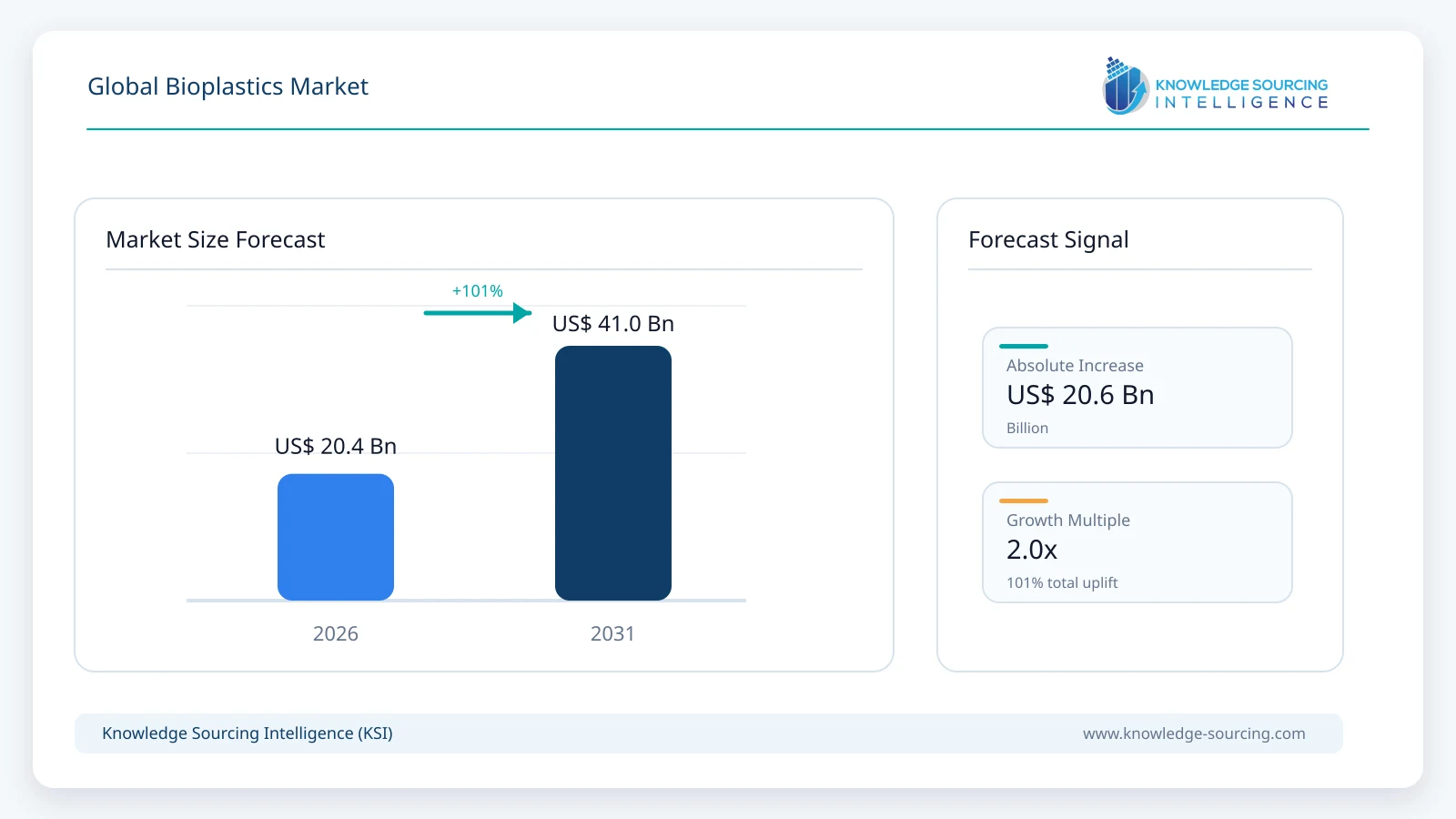
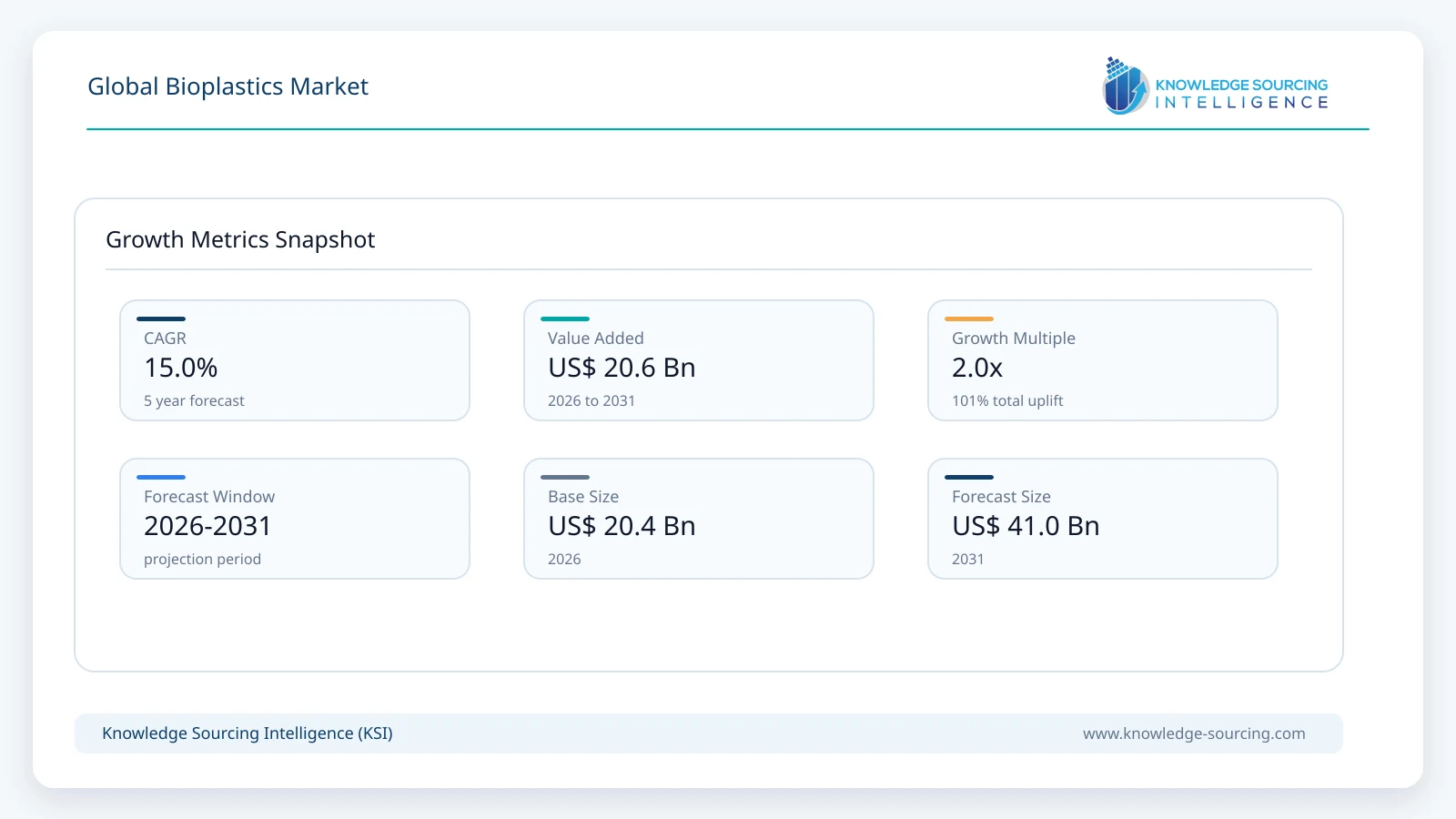
The global bioplastics market is forecast to grow at a CAGR of approximately 15.0%, reaching USD 41.0 billion in 2031 from USD 20.4 billion in 2026.
Highlights:
- 1Biodegradable bioplastics account for approximately 56% of the market in 2026, supported by PLA, PHA and biodegradable polyester applications.
- 2Packaging represents approximately 42% of global bioplastics demand in 2026, led by flexible packaging, food-service products and rigid containers.
- 3Asia Pacific is projected to grow at approximately 17% annually through 2031, supported by new capacity in China, Thailand, Japan and South Korea.
- 4Global bioplastics production capacity stood at approximately 2.31 million tonnes in 2025, with significant additional commercial capacity under development.
- 5Average industry capacity utilization was approximately 72% in 2025, making production ramp-up as important as announced nameplate capacity.
Market Overview
Bioplastics comprise plastics that are bio-based, biodegradable, or both and therefore do not constitute a single material family. PLA and PHA can combine renewable feedstocks with biodegradability under appropriate conditions, while bio-based polyethylene and selected polyamides replace fossil feedstocks without becoming biodegradable. Other polymers such as PBAT can qualify through biodegradability even where renewable-carbon content is limited. The market therefore differs from the narrower bio-based plastics market and from the biodegradable plastics market when either is considered independently. Recycled conventional plastics are excluded unless the underlying polymer itself meets the bioplastics definition. This distinction is commercially important because material selection depends on the intended application, processing requirements and end-of-life pathway rather than a generic sustainability label.
European Bioplastics and nova-Institute report global bioplastics production capacity of approximately 2.31 million tonnes in 2025, while actual production remained lower due to average capacity utilization of approximately 72%. Industry developments indicate continued capacity expansion through 2030, supported by investments across biodegradable and bio-based polymer production. However, the pace and scale of capacity additions vary by polymer type, production technology, regional investment activity, and commercial readiness. Market development is therefore closely linked to individual polymer volumes, operating utilization, feedstock availability, manufacturing capacity, and the transition of announced projects into commercial production. These factors continue to influence the availability, application potential, and adoption of bioplastics across packaging, agriculture, consumer goods, automotive, and other end-use industries.
The industry is also becoming more diversified. Packaging remains the largest application, but agriculture, fibers, automotive components, consumer products, electronics, coatings and other technical applications are expanding the addressable market. Different polymers serve these applications for different reasons. Compostable materials can provide an advantage where packaging or agricultural products are difficult to recover through conventional mechanical recycling, while bio-based durable polymers are used where manufacturers want renewable feedstocks without sacrificing established processing, durability or recyclability. This increasingly application-specific approach is likely to define market development through 2031.
Market Trends
Commercial capacity is moving from announcements toward operating plants. The bioplastics industry is entering a phase in which several previously announced investments are beginning to translate into physical production. NatureWorks opened its integrated Ingeo PLA manufacturing facility in Nakhon Sawan, Thailand, in April 2026, establishing an additional Asian production base alongside its existing operations. Braskem has expanded renewable ethylene capacity supporting its bio-based polyethylene portfolio, while other producers are developing new PLA, PHA and renewable-polymer platforms. Additional production improves regional resin availability and gives converters more confidence when qualifying materials for larger-volume applications, although successful commercialization still depends on achieving adequate plant utilization rather than simply installing nameplate capacity.
Material selection is becoming more closely aligned with the required end-of-life route. The industry is moving away from treating renewable, biodegradable and compostable polymers as interchangeable environmental alternatives. Compostable polymers are increasingly targeted toward applications where food contamination or product design makes conventional recycling difficult, while durable bio-based polymers are used where fossil-feedstock substitution and conventional recyclability are more important than biodegradation. BASF's continuing development of ecovio materials for flexible packaging illustrates how suppliers are designing products around specific composting, paper-recycling and barrier requirements. This approach improves the commercial credibility of bioplastics because material selection is based on the actual waste-management pathway rather than broad sustainability claims.
PHA is moving toward broader commercial use. PHA has attracted substantial interest because selected grades combine renewable feedstocks with biodegradation characteristics that differ from more established polymers. Historically, higher production costs and limited scale constrained adoption, but commercial platforms from companies including CJ Biomaterials and Kaneka are widening availability. Applications now extend across films, coated products, food-service items, consumer products and specialty packaging. Expansion remains dependent on manufacturing economics and plant utilization, making PHA one of the industry's more promising but also more execution-sensitive polymer families.
Durable bio-based polymers remain strategically important. Bioplastics growth is not limited to compostable products. Braskem's sugarcane-based polyethylene demonstrates the commercial relevance of drop-in materials that use renewable carbon while maintaining conventional polyethylene performance and processing characteristics. Bio-based polyamides address more technically demanding applications, while Avantium's PEF platform represents an emerging renewable polyester route for packaging, fibers and other applications. These materials expand the market beyond disposable products and allow manufacturers to address fossil-carbon reduction without requiring biodegradation as the end-of-life mechanism.
Segment Analysis
By Type - Biodegradable Bioplastics: Biodegradable bioplastics represent the larger material group within the current market and include PLA, PHA, PBAT, PBS, starch blends and related polymer systems. Their commercial strength comes primarily from applications where biodegradation or compostability can provide a defined functional advantage, including food-service articles, organic-waste bags, agricultural products and selected flexible and rigid packaging. PLA has the most established production and conversion ecosystem within this group, while PHA provides a faster-developing opportunity where broader biodegradation characteristics justify its higher cost. PBAT and other biodegradable polyesters are especially important in flexible structures and blends because they provide flexibility and toughness that more rigid materials may lack. Growth through 2031 depends increasingly on certification and proper end-of-life infrastructure because a biodegradable designation does not mean that every polymer degrades rapidly under every environmental condition.
By Application - Packaging: Packaging remains the principal commercial application because bioplastics can address several different packaging requirements rather than relying on one material proposition. PLA and biodegradable polymer blends are used in food-service articles, films, trays and selected flexible packaging, while bio-based polyethylene and emerging renewable polyesters can be incorporated into more durable packaging systems. Adoption is increasingly determined by whether the material fits an identifiable recycling, composting or renewable-carbon strategy. European packaging regulation also makes this distinction more important because renewable feedstock alone does not automatically satisfy recyclability or circularity requirements. Packaging therefore remains the largest market opportunity, but growth is likely to favor applications where bioplastics solve a specific material or end-of-life problem instead of merely replacing conventional polymer on a like-for-like basis.
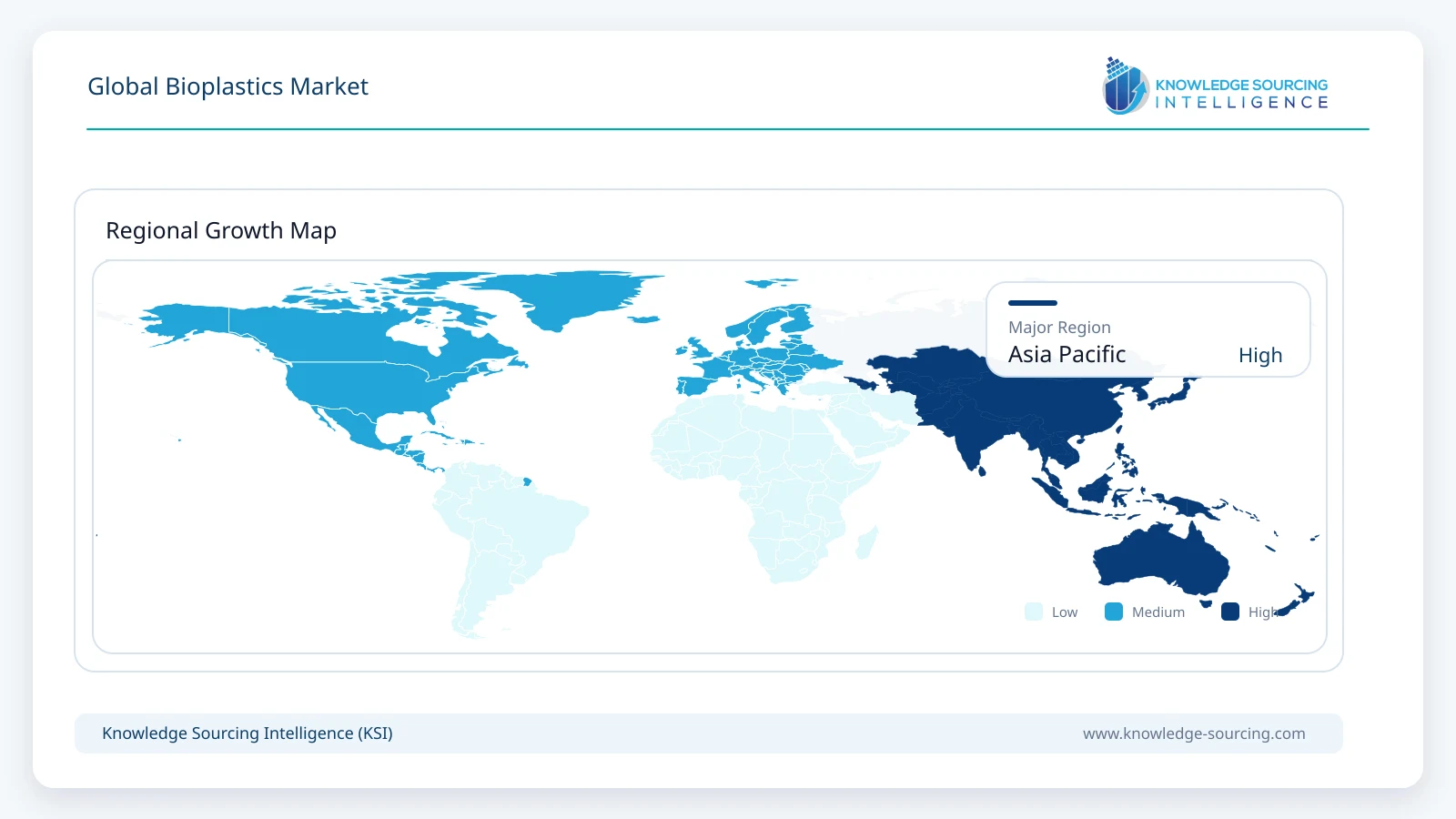
By Geography - Asia Pacific: Asia Pacific provides the strongest expansion opportunity as new production capacity increasingly complements growing regional demand. China has built significant capacity across PLA, PBAT and other biodegradable polymers, Thailand hosts major PLA facilities from NatureWorks and TotalEnergies Corbion, Japan maintains an established biomass-plastics policy framework, and South Korea has developed an important position through companies such as CJ Biomaterials. The region is therefore becoming both a major production base and a larger consumption market across packaging, electronics, automotive and consumer applications. Regional manufacturing expansion also reduces dependence on imported resin and supports local converter qualification, which can accelerate adoption once plants achieve stable commercial utilization.
Market Drivers
Expansion of Commercial Production Capacity: The global bioplastics industry remains very small relative to conventional plastics, but several polymer families have now reached sufficient technical maturity to support larger manufacturing investments. New PLA, PHA, bio-based polyethylene and other renewable-polymer facilities increase supply availability and can reduce some of the cost and logistics disadvantages associated with earlier small-scale production. The commercial benefit, however, depends on utilization. New resin plants require converter qualification, customer commitments and downstream product development before reaching efficient operating levels. Capacity expansion therefore remains one of the strongest market drivers while also creating competitive pressure on producers to establish sufficient demand for new output.
Regulation is Creating More Specific Material Requirements: Government policy increasingly focuses on measurable circularity and resource use rather than simply encouraging products marketed as sustainable. The European Union's Packaging and Packaging Waste Regulation creates more stringent requirements around packaging design, recycling and waste reduction, while the EU Bioeconomy Strategy supports broader commercialization of renewable materials. Japan continues to promote biomass plastics through its resource-circulation strategy. Such policies can support bioplastics, but they also require suppliers to show precisely how materials contribute to recycling, composting or renewable-carbon objectives. This favors technically validated applications and discourages generic environmental claims without a defined waste-management pathway.
Brand Owners are Seeking Alternatives to Fossil Carbon: Packaging, consumer-goods and automotive companies are increasingly evaluating the carbon source of materials alongside recycled content and end-of-life performance. Drop-in bio-based polymers offer one route because manufacturers can reduce fossil-feedstock dependence without substantially changing existing conversion equipment or product design. Compostable materials provide a different value proposition where organic recycling or biodegradation can address applications that are difficult to manage through traditional recycling. This creates demand across several polymer families rather than concentrating the market exclusively around biodegradable packaging.
Material Performance is Improving: Early bioplastics frequently faced limitations involving heat resistance, moisture barrier, flexibility, processing stability or durability. Polymer suppliers are increasingly addressing these limitations through material modification, blends, coatings and application-specific grades. Improved processing performance allows bioplastics to move beyond demonstration products into applications where converters and brand owners require predictable industrial performance. The ability to satisfy existing technical requirements while also offering renewable-carbon or end-of-life benefits is becoming increasingly important to commercial adoption.
Market Restraints
Production Cost Premium Remains Significant: Conventional polyethylene, polypropylene and PET benefit from massive global production systems, highly optimized feedstocks and mature conversion infrastructure. Most bioplastics remain substantially smaller in scale, while fermentation, purification, specialty raw materials and lower plant utilization can increase manufacturing costs. The cost disadvantage varies widely by polymer and should not be represented by one universal premium, but it remains a major constraint in commodity applications where resin represents a significant portion of finished-product cost.
Announced Capacity Does Not Equal Market Supply: Nameplate capacity can materially overstate the amount of bioplastic resin actually entering the market. Plants need stable feedstock, technical commissioning, converter qualification and adequate customer demand before achieving high utilization. The industry's current utilization data demonstrate this gap. Consequently, forecasts based solely on announced capacity can significantly overstate near-term revenue. The KSI model discounts new projects during their ramp-up periods and treats production utilization as an independent variable rather than assuming that installed capacity becomes immediate commercial volume.
Waste Infrastructure Remains Uneven: Compostable materials deliver their strongest end-of-life benefit where appropriate collection and industrial composting or organic-recycling systems are available. Where products are landfilled, incinerated or incorrectly introduced into conventional plastic recycling, the intended system benefit may be reduced. The market therefore depends not only on polymer technology but also on local waste-management infrastructure, certification, consumer communication and appropriate disposal practices.
Recycled Plastics Compete for the Same Sustainability Budgets: Companies seeking to reduce the environmental impact of plastics can choose among renewable polymers, recycled conventional resin, lightweighting, reuse, paper substitution and other approaches. Regulation increasingly mandates recycled content in some applications, making recycled petroleum-based resin a direct competitor to virgin bio-based materials. Bioplastics suppliers therefore need to demonstrate a specific functional, carbon or end-of-life advantage rather than relying solely on the renewable origin of the material.
Regional Outlook
Europe: Europe remains an important value market because of its mature conversion industry, early adoption of compostable products and regulatory focus on circular packaging. Germany, Italy, France and other European countries support applications across packaging, agriculture and technical polymers, while companies including BASF, Novamont, Futerro and Avantium maintain important industry positions. The market is evolving from broad sustainability claims toward stronger scrutiny of recyclability, compostability and waste-system compatibility as new EU packaging rules are implemented.
North America: The United States supports an established PLA ecosystem, food-service applications, packaging conversion and biopolymer innovation. Adoption varies considerably by state because composting infrastructure and regulation differ, while corporate sustainability programs also influence material selection. The region provides opportunities for both compostable applications and durable bio-based materials, although recycled-plastic mandates and relatively low conventional-resin costs create significant competition.
South America: Brazil gives the region strategic relevance through its sugarcane feedstock base and Braskem's renewable polyethylene operations. This creates a different regional market profile from areas dominated by compostable materials because the principal opportunity includes durable drop-in polymers capable of using existing polyethylene processing and recycling systems. Domestic consumption remains smaller than European and Asian demand, but the region is an important renewable-polymer production and export base.
Middle East and Africa: Bioplastics consumption remains relatively limited, with demand concentrated in packaging, food-service products and selected consumer applications. Imported-material costs and limited composting infrastructure constrain broader adoption, although government waste strategies and sustainability initiatives are gradually increasing interest. Longer-term opportunities may also emerge as established petrochemical producers evaluate lower-carbon and renewable-feedstock materials.
Competitive Landscape
The global bioplastics market remains fragmented according to polymer technology. NatureWorks and TotalEnergies Corbion maintain established positions in PLA, while Braskem holds a major position in sugarcane-based polyethylene. BASF and Novamont participate extensively in biodegradable and compostable polymer systems, while CJ Biomaterials and Kaneka are expanding commercial PHA platforms. Avantium is developing PEF through its FDCA technology, Futerro is pursuing additional integrated PLA capacity in Europe, and several Asian producers are expanding across PLA, PBAT, PBS and related biodegradable materials.
Competitive differentiation increasingly extends beyond resin price. Customers assess production scale, supply security, processing support, certification, food-contact requirements, lifecycle information and compatibility with specific recycling or composting systems. Converter relationships and application-development partnerships are particularly important because a polymer may require significant qualification before being adopted in packaging, automotive or other industrial applications. The market therefore combines competition between established material suppliers with technology-driven opportunities for newer producers capable of achieving reliable manufacturing scale.
Recent Developments
August 2026: The EU Packaging and Packaging Waste Regulation entered into application, establishing a harmonized framework covering packaging design, recyclability, reuse and waste reduction.
June 2026: The European Commission launched implementation initiatives under its Bioeconomy Strategy to support commercialization and investment in bio-based materials.
April 2026: NatureWorks opened its integrated Ingeo manufacturing facility in Nakhon Sawan, Thailand, establishing approximately 75,000 tonnes of annual PLA capacity.
April 2026: BASF expanded its ecovio portfolio with flexible-packaging grades designed for defined compostability and recycling pathways.
January 2026: Avantium reported continued start-up work at its FDCA flagship facility as it prepared for commercial PEF-related product sales.
Market Outlook
The global bioplastics market is expected to maintain strong expansion through 2031 as additional production capacity, improved material performance and increasingly specific renewable-carbon and end-of-life requirements create new commercial applications. Biodegradable polymers retain a major role where composting or controlled biodegradation provides a functional advantage, while durable bio-based materials expand the market into applications where conventional recycling and long service life remain essential. Packaging continues to provide the largest demand pool, but automotive, agriculture, fibers and other applications gradually diversify the industry's revenue base.
The principal forecasting uncertainty remains the conversion of announced capacity into economically utilized production. New plants require customer qualification and sufficient downstream demand before reaching efficient operating levels, while conventional and recycled plastics continue to provide strong cost competition. The revised KSI forecast therefore assumes staged commercialization rather than instantaneous capacity utilization and produces a market trajectory that is strong but more closely aligned with the physical development of the industry than the previous forecast.
Bioplastics Market Scope:
| Report Metric | Details |
|---|---|
| Total Market Size in 2026 | USD 20.4 billion |
| Total Market Size in 2031 | USD 41.0 billion |
| Forecast Unit | Billion |
| Growth Rate | 15.0% |
| Study Period | 2021 to 2031 |
| Historical Data | 2021 to 2024 |
| Base Year | 2025 |
| Forecast Period | 2026 – 2031 |
| Segmentation | Type, Application, Geography |
| Companies |
|
Market Segmentation
By Type
Biodegradable Bioplastic
Polylactic Acid (PLA)
Polyhydroxyalkanoates (PHA)
PBAT
PBS and PBSA
Starch Blends
Others
Non-Biodegradable Bioplastic
Bio-PE
Bio-PET
Bio-PA
Bio-PP
PEF and Others
By Application
Packaging
Flexible Packaging
Rigid Packaging
Agriculture and Horticulture
Textiles and Fibers
Automotive and Transportation
Consumer Goods and Household Applications
Electronics
Building and Construction
Coatings and Adhesives
Others
By Geography
North America
By Type
By Application
By Country
United States
Canada
Mexico
South America
By Type
By Application
By Country
Brazil
Argentina
Others
Europe
By Type
By Application
By Country
United Kingdom
Germany
France
Italy
Spain
Others
Middle East and Africa
By Type
By Application
By Country
Saudi Arabia
United Arab Emirates
Israel
Others
Asia Pacific
By Type
By Application
By Country
China
India
Japan
South Korea
Indonesia
Taiwan
Others
Table of Contents
TABLE OF CONTENTS
1. EXECUTIVE SUMMARY
2. MARKET SNAPSHOT
2.1. Market Overview
2.2. Market Definition
2.3. Scope of the Study
2.4. Market Segmentation
3. BUSINESS LANDSCAPE
3.1. Market Drivers
3.2. Market Restraints
3.3. Market Opportunities
3.4. Porter’s Five Forces Analysis
3.5. Industry Value Chain Analysis
3.6. Global Bioplastics Production Capacity and Utilization
3.7. Feedstock and Raw Material Outlook
3.8. Policies and Regulations
3.9. Strategic Recommendations
4. TECHNOLOGICAL ADVANCEMENTS
4.1. Fermentation and Bio-Conversion Technologies
4.2. Advanced PLA Processing and Modification
4.3. PHA Production Technologies
4.4. Bio-Based Drop-in Polymer Technologies
4.5. Compostability and Controlled Biodegradation
4.6. High-Barrier Bioplastic Packaging
4.7. Recycling and End-of-Life Compatibility
5. GLOBAL BIOPLASTICS MARKET BY TYPE
5.1. Introduction
5.2. Biodegradable Bioplastic
5.2.1. Polylactic Acid (PLA)
5.2.2. Polyhydroxyalkanoates (PHA)
5.2.3. PBAT
5.2.4. PBS and PBSA
5.2.5. Starch Blends
5.2.6. Others
5.3. Non-Biodegradable Bioplastic
5.3.1. Bio-PE
5.3.2. Bio-PET
5.3.3. Bio-PA
5.3.4. Bio-PP
5.3.5. PEF and Others
6. GLOBAL BIOPLASTICS MARKET BY APPLICATION
6.1. Introduction
6.2. Packaging
6.2.1. Flexible Packaging
6.2.2. Rigid Packaging
6.3. Agriculture and Horticulture
6.4. Textiles and Fibers
6.5. Automotive and Transportation
6.6. Consumer Goods and Household Applications
6.7. Electronics
6.8. Building and Construction
6.9. Coatings and Adhesives
6.10. Others
7. GLOBAL BIOPLASTICS MARKET BY GEOGRAPHY
7.1. Introduction
7.2. North America
7.2.1. By Type
7.2.2. By Application
7.2.3. By Country
7.2.3.1. United States
7.2.3.2. Canada
7.2.3.3. Mexico
7.3. South America
7.3.1. By Type
7.3.2. By Application
7.3.3. By Country
7.3.3.1. Brazil
7.3.3.2. Argentina
7.3.3.3. Others
7.4. Europe
7.4.1. By Type
7.4.2. By Application
7.4.3. By Country
7.4.3.1. United Kingdom
7.4.3.2. Germany
7.4.3.3. France
7.4.3.4. Italy
7.4.3.5. Spain
7.4.3.6. Others
7.5. Middle East and Africa
7.5.1. By Type
7.5.2. By Application
7.5.3. By Country
7.5.3.1. Saudi Arabia
7.5.3.2. United Arab Emirates
7.5.3.3. Israel
7.5.3.4. Others
7.6. Asia Pacific
7.6.1. By Type
7.6.2. By Application
7.6.3. By Country
7.6.3.1. China
7.6.3.2. India
7.6.3.3. Japan
7.6.3.4. South Korea
7.6.3.5. Indonesia
7.6.3.6. Taiwan
7.6.3.7. Others
8. COMPETITIVE ENVIRONMENT AND ANALYSIS
8.1. Major Players and Strategy Analysis
8.2. Market Share Analysis
8.3. Mergers, Acquisitions, Agreements, and Collaborations
8.4. Competitive Dashboard
9. COMPANY PROFILES
9.1. NatureWorks LLC
9.2. TotalEnergies Corbion
9.3. BASF SE
9.4. Novamont S.p.A.
9.5. Braskem S.A.
9.6. CJ Biomaterials
9.7. Kaneka Corporation
9.8. Avantium N.V.
9.9. Futerro S.A.
9.10. Mitsubishi Chemical Group Corporation
9.11. Toray Industries, Inc.
9.12. Arkema S.A.
9.13. PTT MCC Biochem Company Limited
9.14. Biome Bioplastics Limited
9.15. FKuR Kunststoff GmbH
9.16. BIOTEC Biologische Naturverpackungen GmbH & Co. KG
9.17. Cardia Bioplastics
9.18. RWDC Industries
9.19. Zhejiang Hisun Biomaterials Co., Ltd.
9.20. Kingfa Sci. & Tech. Co., Ltd.
10. APPENDIX
Navigate
Trusted by the world's leading organizations











