
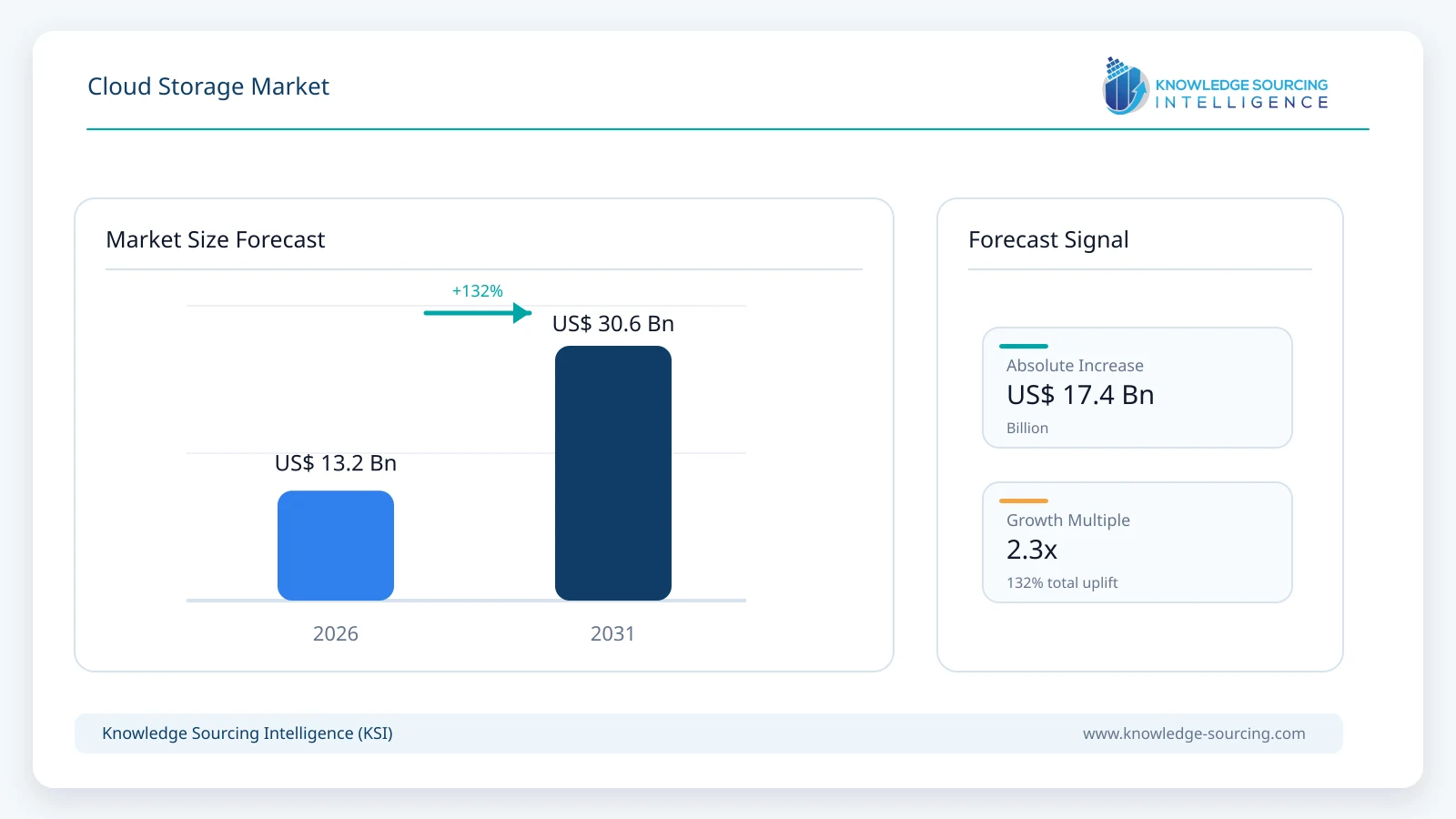
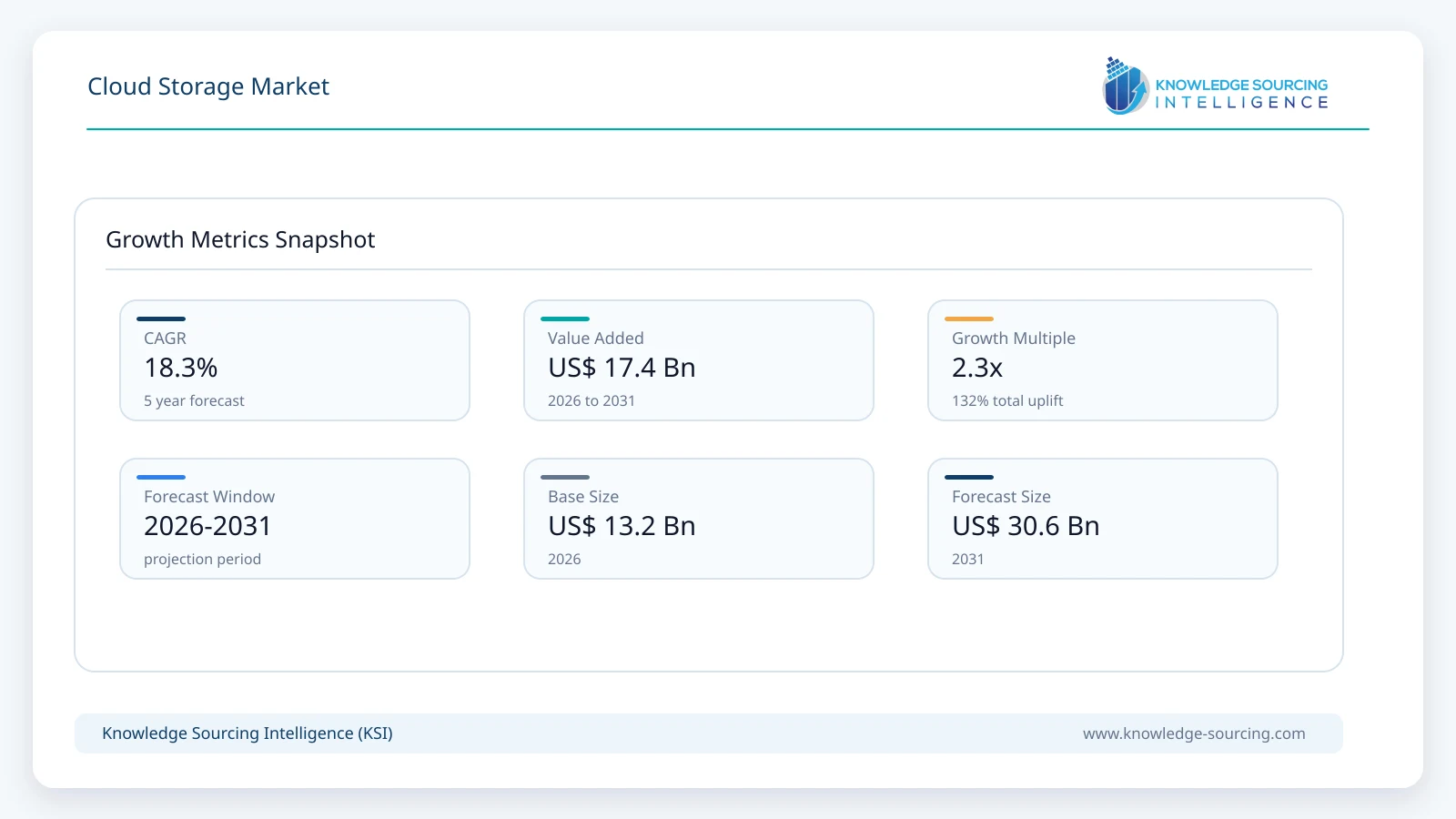
The Cloud Storage Market for the Media and Communication Industry is estimated to grow at a CAGR of 18.3%, reaching USD 30.6 billion in 2031 from USD 13.2 billion in 2026.
Highlights:
- 1Primary storage is the principal solution category, because working media assets and deep content libraries require accessible repositories before backup and recovery services are added.
- 2Large enterprises account for the majority of storage purchasing, reflecting multi-site broadcast operations, premium sports archives and communications networks with substantial data-retention obligations.
- 3Public cloud remains the leading deployment category in 2026, while hybrid deployments are expected to gain share as production teams balance local latency with scalable archives.
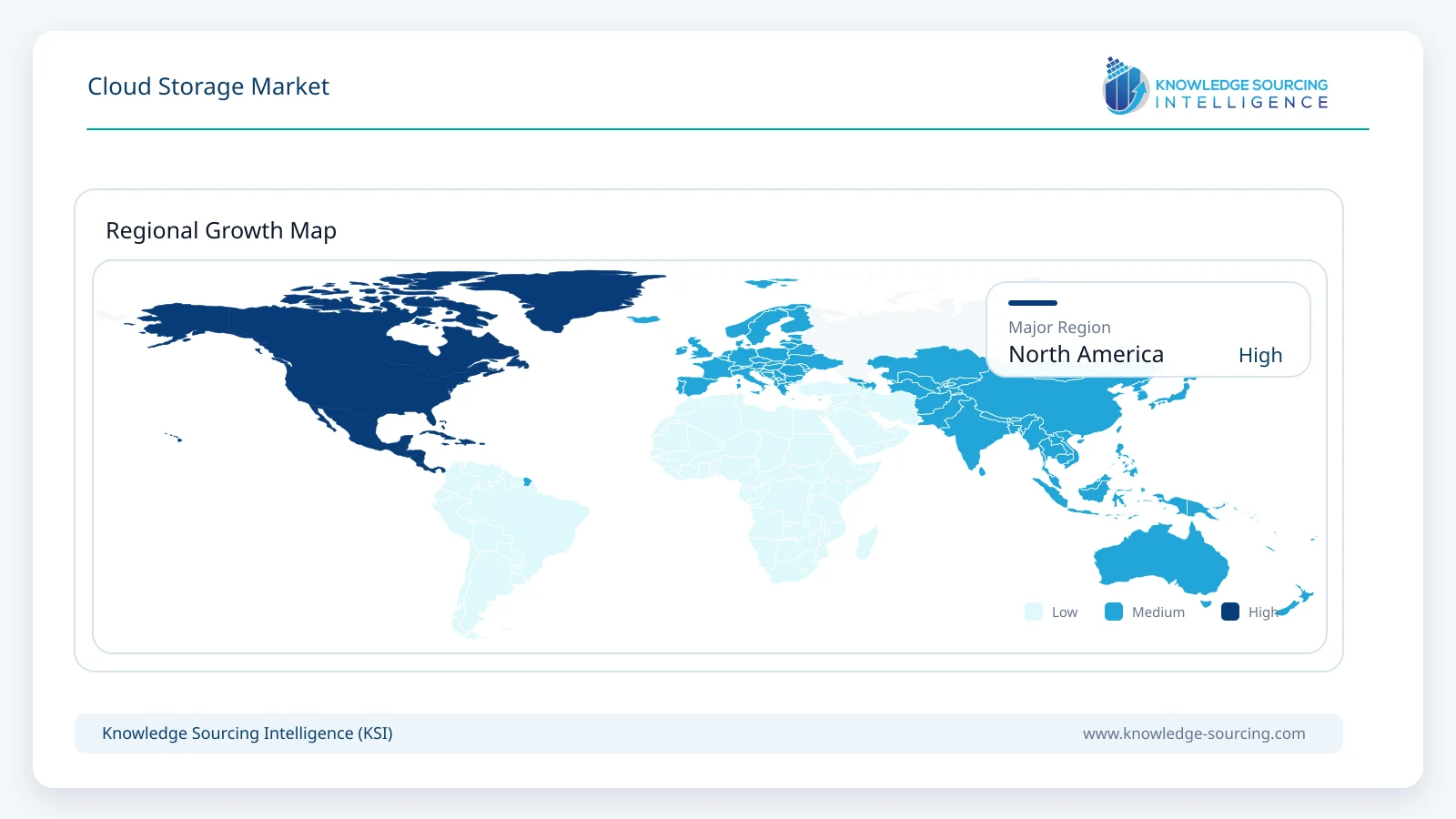
- 4North America leads regional expenditure owing to its concentration of production companies, broadcasters, rights holders and enterprise cloud buyers.
- 5Asia Pacific is the fastest-expanding major region in the outlook, driven by digital video production and localization workflows.
- 6Media-grade storage procurement increasingly considers file access, egress, retrieval and integration costs together rather than relying on the nominal price per stored gigabyte.
Cloud storage providers sell capacity, data access, and related support to media organizations and communications operators managing footage, artwork, audio, graphics, advertising assets, customer communications and operational records. Production repositories generally require frequent reads and high-throughput transfers, while content libraries and recovery copies are managed through colder storage tiers. The value of these services extends beyond retaining bytes: the storage system must work with media asset management, encoding, editing, security, and distribution applications.
Hyperscale object storage provides elastic capacity, but broadcasters frequently combine cloud repositories with local high-performance working storage. In October 2026, AWS introduced File Mover Express, an open-source application for transfers into Amazon S3, with resumable unattended processing and checksum validation. The release addresses a routine operational risk: time-critical footage often crosses between a production facility, a remote editor, and an archive, and a failed transfer can affect delivery schedules. Suppliers compete through transfer economics, retrieval performance, support for established editing tools, recoverability, and available media-specific partners.
Market Overview
Media cloud storage is distinguished by a mix of very large files, high concurrency and uneven data access. A single program can produce many camera originals, mezzanine masters, graphics versions and language-specific outputs, while live sports generates bursts of content that must be searchable immediately. Service providers therefore combine durable object storage with file access, caching, indexing, and lifecycle rules. Media organizations vary their storage class according to whether editors need near-instant playback or only occasional archival retrieval.
Amazon Web Services supports these workflows through Amazon S3 and its media application ecosystem. In October 2026, AWS detailed Formula 1's 12-petabyte video archive and an April upgrade that introduced natural-language archive discovery. Google Cloud documents media workflows requiring high aggregate read and write throughput into compute clusters, while Microsoft provides cloud and AI services for content production, management and distribution. These examples demonstrate that storage value increasingly depends on its interaction with production software rather than capacity alone.
Smaller object-storage providers are also influencing purchasing terms and workflow design. Backblaze has worked with media partners on time-addressable production and S3-compatible file streaming, allowing creative tools to access objects without moving entire archives into a separate file system. Integrators and managed service providers remain important when customers need to link cloud services to established media asset managers, identity controls and dedicated facility storage.
Market Trends
Time-Addressable Media Workflows Reduce File Transfer Delays
Live news and sports teams increasingly need simultaneous access to evolving recordings instead of waiting for complete files to be exported between organizations. Reuters and AWS demonstrated an IBC 2025 workflow using the open Time-Addressable Media Store interface and Amazon S3, showing how content can be shared as it is produced. This was a proof of concept, but it addresses a practical bottleneck in live editorial collaboration.
Backblaze's September 2026 work with LiveWyer, CuttingRoom and Drastic Technologies similarly tested common time-based objects for ingest, editing and distribution. A shared storage namespace can reduce redundant copies and speed editorial turnaround, although production-grade monitoring and rights handling remain essential.
Remote Editors Gain File-Like Access to Object Storage
Object repositories scale readily for large media estates, yet many creative applications still expect conventional file-system operations. That gap has encouraged interfaces that let editing teams work against stored objects without downloading complete source libraries. Cloud file streaming also helps facilities limit duplication across branch offices and freelancers.
Backblaze and Suite Studios announced an available S3-native file-streaming integration in September 2026. The product presents cloud objects through a familiar drive-like interface and transfers only file portions needed by applications. Similar approaches may shift expenditure from replicated local storage toward cloud read performance and access services.
AI Search Is Making Archive Retention More Commercially Useful
Broadcasters and sports-rights holders retain enormous video libraries, but manual logging often makes historical material expensive to reuse. Search that understands transcripts, images, and associated rights metadata can improve archival monetization and shorten the time required to assemble highlight packages. The operating requirement is an accessible repository with controlled metadata and application interfaces, not merely an AI model.
Formula 1's April 2026 Media Archive Discovery upgrade uses AWS technologies to convert natural-language prompts into targeted archive searches. Google Cloud's 2026 storage announcements also emphasized contextual metadata and high-throughput data access. When retrieval becomes faster and more reliable, customers have a stronger commercial reason to migrate and preserve valuable collections.
Hybrid Storage Tiering Becomes a Production Design Choice
High-bitrate multicamera production and finishing require predictable throughput, and some local workflows still perform better against dedicated facility storage. Cloud repositories are valuable for sharing approved assets, moving projects across sites, backup, versioning, and long-term retention. Hybrid systems therefore remain commercially relevant even when customers want cloud-first management.
Google's media guidance emphasizes throughput between object storage and compute clusters, while AWS pricing differentiates capacity, requests, data retrieval and transfer. Buying teams increasingly consider whole-workflow costs, including storage ingress design, repeated footage reads, archive restore frequency and resilience obligations.
Storage Observability Is Influencing Cloud Tier Decisions
A large archive may contain millions of objects whose costs depend on access frequency, storage class and the regions from which footage is retrieved. Storage teams therefore need evidence about actual reads, restores, and transfers before moving material into inexpensive cold tiers. Google Cloud made activity insights for Storage Insights datasets generally available in June 2026, allowing administrators to analyze object operations and cross-region activity alongside existing inventory information.
This visibility is relevant to broadcasters with recurring sports footage, multilingual versions, and seasonal content reuse. Frequent archival retrieval may outweigh savings from cheaper capacity, while nearly untouched masters can be preserved in lower-cost classes under controlled retention rules. Vendors that make activity, policy and cost data accessible can improve renewal economics, but the capability does not eliminate the need for rights metadata and operational testing.
Segment Analysis
By Solution: Primary Storage
Primary storage holds the working versions and retained masters that sustain daily media operations. News agencies, streaming companies and communications providers need repositories for ingestion, editorial review, encoded variants and business-critical media records. The category represents an estimated 75% of expenditure in 2026 because most organizations require a constantly accessible foundation before they can add specialized backup copies.
Demand grows with the number of language versions, edits, and distribution formats, but purchasing patterns are changing. Object storage is taking on more active tasks as editing tools stream selected file portions and automated applications query metadata without creating entire duplicate collections. The Formula 1 archive demonstrates the commercial value of improving access to historical footage, while AWS File Mover Express targets reliable ingest from facility systems into a cloud repository. Backup storage expands alongside primary capacity, though its revenue must reflect separately purchased recovery copies rather than duplicate billing for a single retained asset.
By Deployment Model: Hybrid Cloud
Hybrid storage is becoming more prominent among major production houses with existing edit suites, broadcast plants and content libraries. Facilities can retain latency-sensitive work on dedicated high-performance platforms while placing proxies, approved masters, analytics copies and archival material in cloud services. This avoids forcing every production task onto a single network or storage class.
The commercial advantage lies in coordinating lifecycle movement and access permissions across the two environments. However, poorly governed hybrid systems can create unexpected duplicate capacity and synchronization costs. Customers increasingly favor suppliers that integrate with familiar media asset managers and provide clear visibility into retrieval and transfer expenditure.
By Services: Integration
Integration engagements are purchased when storage must connect to existing production infrastructure, rights databases, transcoding applications, and identity systems. Unlike recurring cloud capacity charges, this revenue is driven by project complexity, content-migration schedules and the number of workflows that must remain available during cutover. The work can include metadata mapping, archive verification, policy automation and staff training.
AWS's February 2026 collaboration with qibb illustrates demand for coordinated media pipelines spanning storage and other services. Integrators that understand broadcast formats and operational recovery requirements can reduce project risk, while generic cloud migration services may struggle with live-production deadlines and content-rights controls.
By Enterprise Size: Large
Large enterprises dominate cloud storage expenditure because broadcasters, telecommunications groups, sports organizations and streaming platforms operate geographically distributed content supply chains. They typically manage multiple business units, large archives, regulated customer records and simultaneous delivery formats. In the estimated 2026 structure, large customers contribute roughly four-fifths of the total.
Contract decisions also differ from those of small creative businesses. Large buyers negotiate availability, geography, security, committed capacity, and exit costs alongside price, and may use more than one provider. Smaller studios often enter through managed collaboration products or specialist storage platforms, creating a faster-growth customer pool from a lower spending base.
Market Drivers
Growing Volume and Reuse of High-Resolution Media Assets
Camera masters, high-frame-rate sports feeds and multiple distribution versions create heavy demands on storage capacity and retrieval performance. Media companies also retain assets to meet licensing obligations and enable later re-editing, dubbing and monetization. Storage demand therefore depends on both new production and the accumulated library that organizations elect to preserve.
Formula 1's 12-petabyte AWS archive illustrates how long-running footage collections can become large operational data estates. Higher content reuse encourages investment in accessible cloud storage, lifecycle management and metadata services instead of simply replacing on-premises disks at the end of their useful life.
Expansion of Distributed and Cloud-Native Production
Newsrooms, documentary teams and postproduction suppliers increasingly work across facilities and contract teams, making repeated manual transfers inefficient. Parallel access to controlled master objects lets several users work on the same production timeline while reducing delays in receiving source footage and approved outputs.
Reuters and AWS's time-addressable media demonstration shows the operational rationale, while Backblaze's 2026 workflow partnerships target file access across cloud and editing tools. As more content moves through these shared architectures, storage services can capture additional recurring capacity and read-related usage.
Archive Discovery and AI-Based Content Localization
Unindexed archives often contain footage with continuing commercial value but high search and preparation costs. AI-assisted metadata extraction, speech transcription and scene recognition can help teams identify usable material, prepare language versions and build new packages. The business case depends on retaining the relevant content in a repository that applications can read securely.
Sports producers and broadcasters are increasingly embedding search into content libraries. Formula 1's updated archive search is a concrete example: the repository becomes more useful as staff can locate footage through language-based requests, supporting future archive preservation and access spending.
Increasing Importance of Business Continuity and Content Protection
Live production schedules and exclusive content rights leave limited tolerance for asset corruption, accidental deletion or ransomware interruption. Media businesses need recoverable versions of high-value masters and dependable access to files throughout production and distribution. Backup policies must also account for large datasets that are costly to duplicate or restore at short notice.
Cloud providers supply versioning, object-level access controls, and multiple storage classes, although customers must design recovery procedures correctly. As archives expand, organizations are more likely to pay for dedicated backup repositories, testing and storage lifecycle support rather than relying on a single operational copy.
Migration from Fragmented File Stores to Managed Storage Platforms
Mergers, expansion of streaming services and international production often leave media organizations with disconnected NAS, tape and cloud systems. Such fragmentation complicates access control, rights tracking and search, especially when different departments produce their own metadata and retention policies. Moving to coordinated cloud platforms can improve governance and reduce the effort of finding authorized assets.
The Qibb and AWS integration case demonstrates the need to connect specialized media applications rather than treating migration as a one-time data transfer. Integration and consulting providers benefit where customers require workflow redesign and careful cutover around live operations.
Market Restraints
Data Transfer and Retrieval Charges Can Change Project Economics
High-bitrate footage is expensive to move repeatedly between facilities, cloud regions, and external collaborators. A low headline storage rate can be offset by retrieval charges, internet transfer, API requests and copies across regions. Live editorial activity also makes access volumes less predictable than those of passive enterprise archives.
AWS prices capacity, API requests, retrieval and transfer under distinct conditions that differ by storage class and route. Backblaze and Wasabi address some buyers through alternative transfer and storage offers, but each contract still needs evaluation against expected read volume, integration effort, and incident recovery. Media procurement teams can limit overruns by analyzing representative event coverage, proxy access and archive restores before deciding which footage belongs in high-performance, standard or colder tiers.
Real-Time Editing Demands Consistent Throughput and Latency
Media finishing sessions impose tighter requirements on response consistency than the overall capacity of an object store suggests. Highly interactive applications depend on predictable file reads, while network congestion, fragmented formats and repeated seeks can interrupt editorial work even when storage capacity is available. Production teams must align cache placement, storage interfaces and compute location with each application before relying on a remote repository for finishing.
Google Cloud's documented media workload guidance treats aggregate I/O throughput and latency as critical for keeping processing resources productive. Some organizations will prefer hybrid systems over immediate full-cloud migrations until application compatibility and network resilience are proven.
Rights Management and Data Residency Complicate Multi-Region Access
Media assets carry distribution territories, talent permissions, and contractual restrictions that do not always align with the most convenient cloud region. Communications providers also hold customer data subject to privacy and retention requirements. The same project may involve footage rights and personal information governed by different policies.
Providers must support access restrictions, audit trails, encryption and carefully defined data-location controls. This creates additional design and legal review work for cross-border workflows, particularly when collaborators and editing operations extend across several jurisdictions.
Legacy Production Systems Create Migration and Integration Risks
Established broadcast applications, proprietary tape indexes and custom workflow automation can be tightly coupled to local file systems. Migrating footage without preserving timecode, embedded metadata, folder conventions and links into asset-management software can disrupt editorial operations or make historical content difficult to retrieve.
Production facilities commonly need staged migration, dual-running systems and verification of archival integrity. Such projects require specialist integrators and can delay cloud contracts when there is little tolerance for downtime during live schedules or major content releases.
Concentrated Cloud Supply and Platform Dependencies Limit Flexibility
Large cloud suppliers provide global reach and rich production ecosystems, but media customers can become dependent on proprietary workflow services and data transfer arrangements. A storage repository may be technically exportable while the surrounding media automation, identity architecture and application integrations remain difficult to reproduce elsewhere.
Time-addressable media interfaces and S3-compatible storage products can improve portability, yet equivalent performance, access controls and operational support still require testing. Large buyers increasingly negotiate exit procedures and demand interoperable data formats before expanding long-term archive commitments.
Regional Outlook
North America
North America is the largest estimated regional market, reflecting the concentration of major studios, sports-rights owners, broadcasters, streaming platforms and cloud infrastructure companies in the United States. High-value archives and established cloud procurement encourage spending on both production storage and specialist migration services. The Formula 1 archive initiative and the Reuters-AWS workflow demonstrate the technological direction, although the commercial customers and deployments have international reach.
U.S. enterprises are influential adopters of archive discovery and hybrid production systems, while Canada contributes broadcasters and post-production facilities that often collaborate with U.S. media groups. Regional competition includes hyperscalers, managed production infrastructure specialists and cloud object storage providers. Buyers place particular weight on content protection, low-latency workflows and predictable transfer charges.
Asia Pacific
Asia Pacific is expected to record the fastest regional growth through 2031, supported by rising digital video output, localized programming and greater use of cloud collaboration across media businesses. China, India, Japan and Australia have different procurement and regulatory characteristics, but each supports growing demand for shared asset libraries, scalable backup and cross-site production services. The location of available cloud regions, domestic supplier capability and negotiated storage contracts will influence adoption patterns.
The region's growth opportunity is concentrated in large broadcasters and operators alongside smaller production houses entering cloud collaboration for the first time. Higher traffic does not translate mechanically into storage revenue: pricing, local cloud adoption and the split between content delivery and retained media data determine realized spending.
Competitive Landscape
The competitive landscape includes hyperscale cloud providers, specialized object-storage vendors and suppliers of managed hybrid infrastructure. Amazon Web Services, Microsoft and Google Cloud offer broad storage services integrated with media production and analytics platforms. Their advantages include global regions, application ecosystems and the ability to combine content management with compute-heavy rendering, encoding and AI workflows. Enterprise relationships and compliance capabilities also support multi-year contracts.
Backblaze and Wasabi compete on accessible object storage and pricing clarity, while NetApp, Dell Technologies and Pure Storage supply hybrid data services that connect enterprise storage environments to cloud workflows. IBM, Fujitsu and Rackspace address enterprise managed-cloud needs; Box participates in cloud content collaboration rather than competing directly for every high-throughput broadcast archive. The relevant competitive position depends on the storage layer being purchased, not a broad company revenue ranking.
Differentiation is increasingly based on technical fit and total operating cost. Media customers compare throughput during finishing, availability of S3-compatible and time-addressable interfaces, migration support, data transfer obligations and rights-oriented governance. Suppliers with credible integrator networks and well-documented restoration behavior are better positioned for risk-sensitive broadcasting and archival workloads.
Recent Developments
12 October 2026: AWS detailed Formula 1’s 12-petabyte video archive on Amazon S3 and the archive-discovery enhancement deployed in April 2026, illustrating commercially deployed media search over retained assets.
8 October 2026: AWS released the open-source File Mover Express application, offering unattended, resumable and checksum-validated transfers from production systems to Amazon S3.
10 September 2026: Backblaze and Suite Studios made an S3-native file-streaming integration available for work with B2-hosted media without downloading complete source files.
3 September 2026: Backblaze reported a tested TAMS workflow with LiveWyer, CuttingRoom and Drastic Technologies for time-addressable ingest, editing and playback across interoperable tools.
9 June 2026: Google Cloud made storage activity insights generally available in Storage Insights datasets, improving inventory, tiering and cross-region access analysis.
20 February 2026: AWS and qibb presented integrated media orchestration workflows linking Amazon S3, processing, metadata generation and archive management.
Market Outlook
Media cloud storage spending through 2031 will depend on retaining valuable masters while making the existing archive useful across editing, discovery and distribution tasks. Production teams are likely to prefer repositories that support both programmatic object access and familiar creative-tool interfaces. Selected facilities will continue to keep demanding edit and finishing workloads on dedicated infrastructure, using cloud tiers for collaboration, recovery and distribution-ready masters. Reliable ingest, tiering policies and recovery testing will matter as much as a provider’s nominal capacity price.
The value chain will become more service-intensive as metadata automation, policy management and lifecycle orchestration gain importance. Hyperscalers will continue serving the largest cross-application accounts, but specialist object storage vendors can compete through transparent transfer economics and media-tool integrations. Asia Pacific should increase its contribution to new demand, while North America retains a large established base of professional media and communications buyers.
Market Scope:
| Report Metric | Details |
|---|---|
| Total Market Size in 2026 | USD 13.2 billion |
| Total Market Size in 2031 | USD 30.6 billion |
| Forecast Unit | Billion |
| Growth Rate | 18.3% |
| Study Period | 2021 to 2031 |
| Historical Data | 2021 to 2024 |
| Base Year | 2025 |
| Forecast Period | 2026 – 2031 |
| Segmentation | Solution, Deployment Model, Services, Enterprise Size |
| Companies |
|
| Customization Scope | 15% Free Customization included with purchase — Request Custom Breakdown → |
| Sample & Data Access | PDF Sample, Excel Databook & Analyst Briefing — Download Free Sample → |
Market Segmentation
By Solution
Primary Storage
Backup Storage
By Deployment Model
Public Cloud
Private Cloud
Hybrid Cloud
By Services
Integration
Consulting
Others
By Enterprise Size
Large
SMB (Small and Medium-sized business)
By Geography
North America
United States
Canada
Mexico
South America
Brazil
Argentina
Others
Europe
United Kingdom
Germany
France
Italy
Others
Middle East and Africa
Saudi Arabia
UAE
Israel
Others
Asia Pacific
China
India
Japan
Australia
Others
Table of Contents
1. EXECUTIVE SUMMARY
2. MARKET SNAPSHOT
2.1. Market Overview
2.2. Market Definition
2.3. Scope of the Study
2.4. Market Segmentation
3. BUSINESS LANDSCAPE
3.1. Market Drivers
3.1.1. Growing Volume and Reuse of High-Resolution Media Assets
3.1.2. Expansion of Distributed and Cloud-Native Production
3.1.3. Archive Discovery and AI-Based Content Localization
3.1.4. Increasing Importance of Business Continuity and Content Protection
3.1.5. Migration from Fragmented File Stores to Managed Storage Platforms
3.2. Market Restraints
3.2.1. Data Transfer and Retrieval Charges Can Change Project Economics
3.2.2. Real-Time Editing Demands Consistent Throughput and Latency
3.2.3. Rights Management and Data Residency Complicate Multi-Region Access
3.2.4. Legacy Production Systems Create Migration and Integration Risks
3.2.5. Concentrated Cloud Supply and Platform Dependencies Limit Flexibility
3.3. Market Opportunities
3.4. Porter’s Five Forces Analysis
3.5. Industry Value Chain Analysis
3.6. Policies and Regulations
3.7. Strategic Recommendations
4. TECHNOLOGICAL OUTLOOK
4.1. Object, File and Block Storage for Media Workflows
4.2. Media Metadata and Asset Discovery
4.3. Hybrid Archiving and Tiered Recovery
4.4. Time-Addressable and S3-Compatible Interfaces
4.5. Cloud Storage Security and Lifecycle Orchestration
5. CLOUD STORAGE MARKET FOR MEDIA AND COMMUNICATION INDUSTRY BY SOLUTION
5.1. Introduction
5.2. Primary Storage
5.3. Backup Storage
6. CLOUD STORAGE MARKET FOR MEDIA AND COMMUNICATION INDUSTRY BY DEPLOYMENT MODEL
6.1. Introduction
6.2. Public Cloud
6.3. Private Cloud
6.4. Hybrid Cloud
7. CLOUD STORAGE MARKET FOR MEDIA AND COMMUNICATION INDUSTRY BY SERVICES
7.1. Introduction
7.2. Integration
7.3. Consulting
7.4. Others
8. CLOUD STORAGE MARKET FOR MEDIA AND COMMUNICATION INDUSTRY BY ENTERPRISE SIZE
8.1. Introduction
8.2. Large
8.3. SMB (Small and Medium-sized business)
9. CLOUD STORAGE MARKET FOR MEDIA AND COMMUNICATION INDUSTRY BY GEOGRAPHY
9.1. North America
9.1.1. United States
9.1.2. Canada
9.1.3. Mexico
9.2. South America
9.2.1. Brazil
9.2.2. Argentina
9.2.3. Others
9.3. Europe
9.3.1. United Kingdom
9.3.2. Germany
9.3.3. France
9.3.4. Italy
9.3.5. Others
9.4. Middle East and Africa
9.4.1. Saudi Arabia
9.4.2. UAE
9.4.3. Israel
9.4.4. Others
9.5. Asia Pacific
9.5.1. China
9.5.2. India
9.5.3. Japan
9.5.4. Australia
9.5.5. Others
10. COMPETITIVE ENVIRONMENT AND ANALYSIS
10.1. Major Players and Strategy Analysis
10.2. Market Share Analysis
10.3. Mergers, Acquisitions, Agreements and Collaborations
10.4. Competitive Dashboard
11. COMPANY PROFILES
11.1. Amazon Web Services, Inc.
11.2. Microsoft Corporation
11.3. Google LLC
11.4. International Business Machines Corporation
11.5. Dell Technologies Inc.
11.6. NetApp, Inc.
11.7. Backblaze, Inc.
11.8. Wasabi Technologies, LLC
11.9. Pure Storage, Inc.
11.10. Rackspace Technology, Inc.
11.11. Fujitsu Limited
11.12. Box, Inc.
12. APPENDIX
12.1. Currency
12.2. Assumptions
12.3. Base and Forecast Years Timeline
12.4. Key Benefits for Stakeholders
12.5. Research Methodology
12.6. Abbreviations





Frequently asked questions
What is the projected market value for cloud storage in media by 2031?
The Cloud Storage Market will reach USD 30.6 billion in 2031, growing at 18.3% CAGR.
What is the primary solution category for media cloud storage?
Primary storage for working media assets and deep content libraries.
Which deployment category leads the media Cloud Storage Market?
Public cloud leads, with hybrid deployments expected to gain share.
Which region leads cloud storage expenditure for the media industry?
North America leads; Asia Pacific is the fastest-expanding region.
What factors influence media-grade cloud storage procurement decisions?
File access, egress, retrieval, and integration costs are key.
Which enterprise size accounts for the majority of storage purchasing?
Large enterprises account for most storage purchasing.
Cite this report
Knowledge Sourcing Intelligence. (Oct 2026). Cloud Storage Market for the Media and Communication Industry - Strategic Insights and Forecasts (2026–2031). https://www.knowledge-sourcing.com/report/cloud-storage-market-for-media-and-communication-industry