
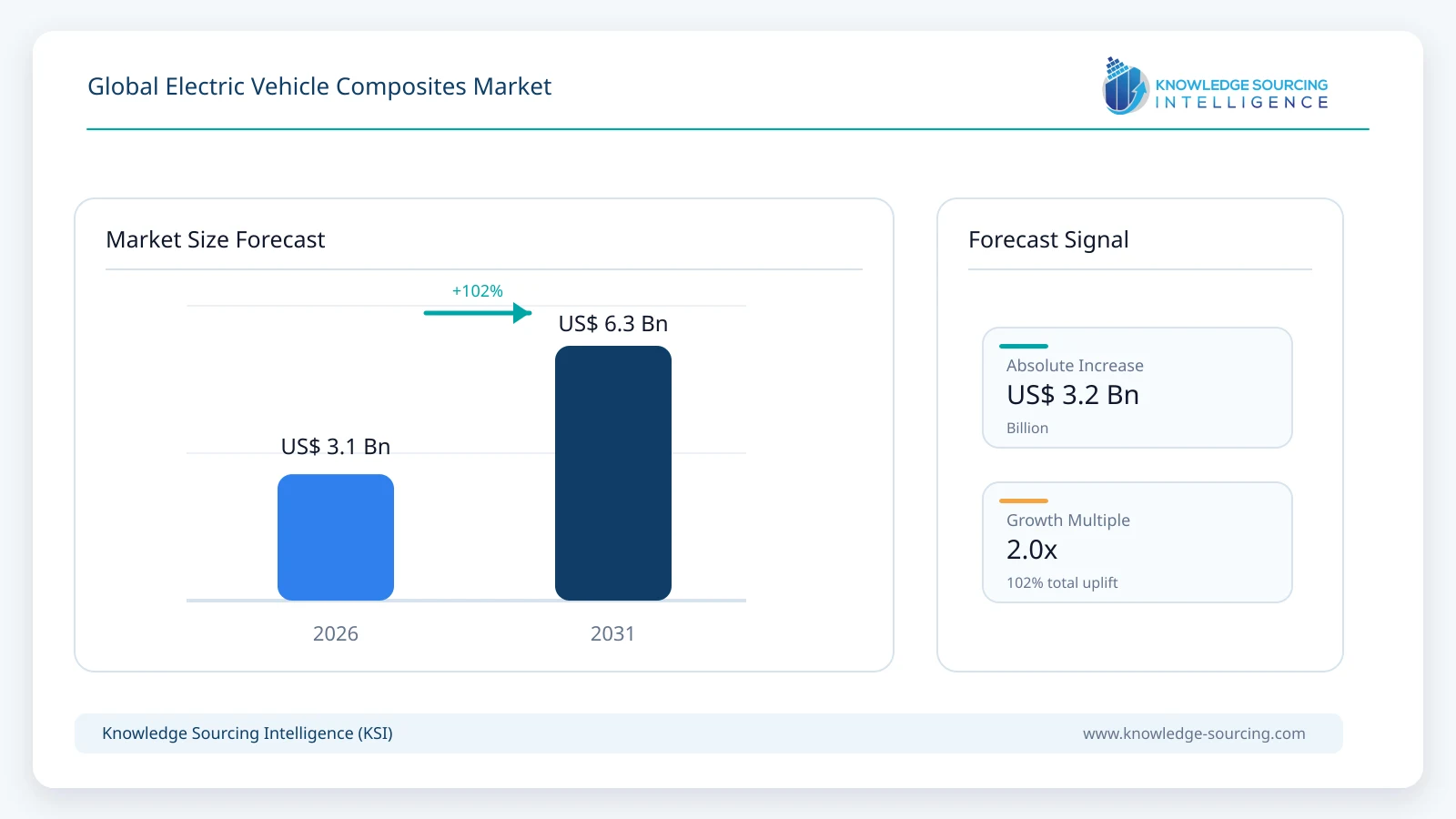
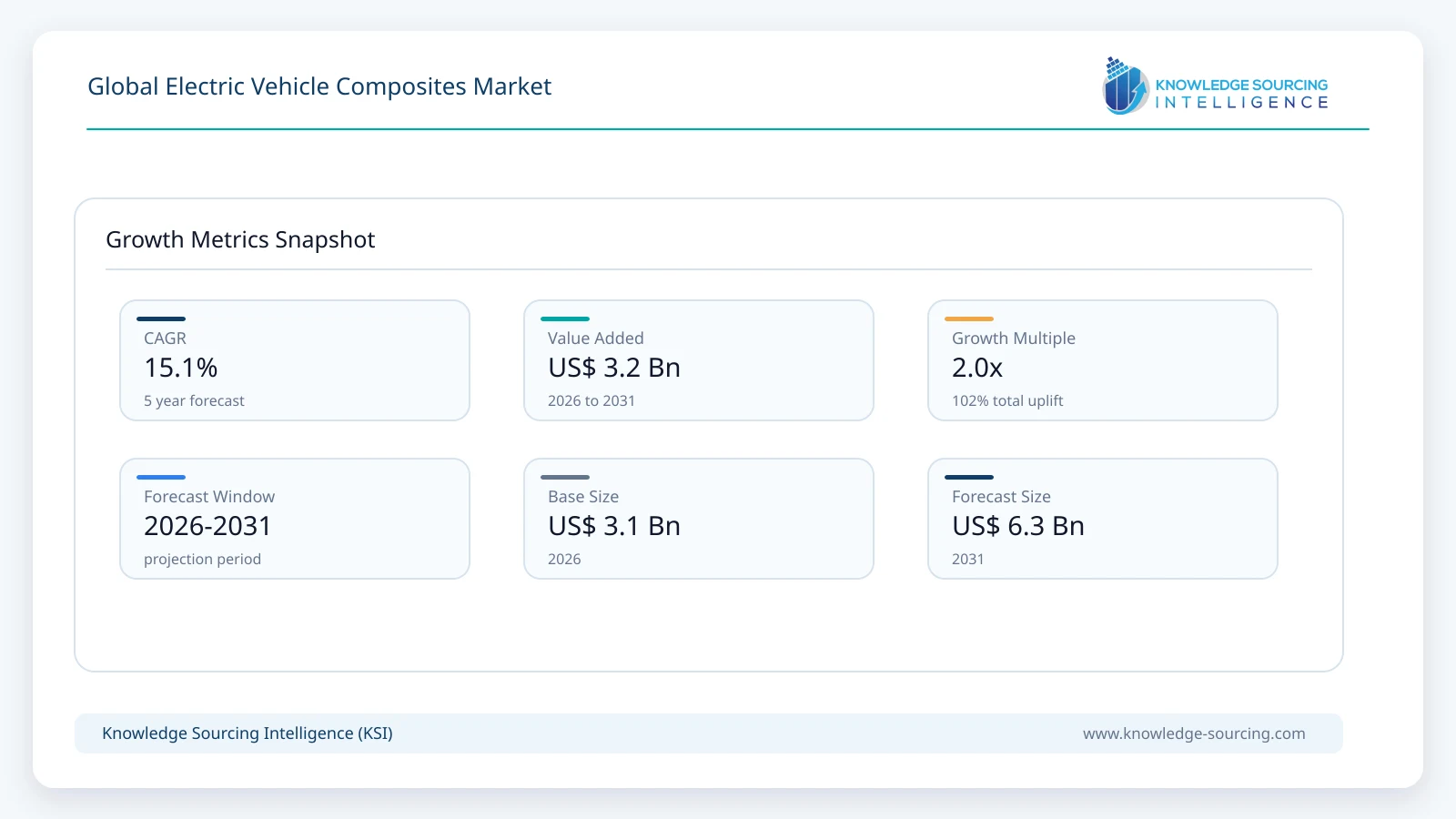
The global electric vehicle composites market is estimated at USD 3.15 billion in 2026 and is projected to reach USD 6.35 billion by 2031, at a CAGR of 15.1% during the forecast period.
Highlights:
- 1Electric vehicle production reaches a record scale as global electric-car sales approach 29% of total car sales in 2026.
- 2Battery housings and underbody protection remain among the strongest commercialization areas for automotive composites.
- 3Glass-fiber reinforced systems offer the clearest route to high-volume EV adoption because of cost and manufacturing speed.
- 4Carbon-fiber composites remain concentrated in premium, performance and highly weight-sensitive structural applications.
- 5Thermoplastic composites gain importance as OEMs prioritize recyclability, part consolidation and shorter manufacturing cycles.
- 6Composite-metal hybrid structures expand where crashworthiness, fire protection and cost cannot be met efficiently by a single material.
- 7Asia Pacific remains the largest manufacturing base because China accounts for the majority of global electric-vehicle production.
Lightweighting is structurally important in electric vehicles because battery systems add substantial mass relative to comparable internal-combustion vehicles. Reducing non-battery mass can support range, payload, handling and efficiency while helping engineers maintain crash performance. Composite materials address this requirement through higher specific strength and stiffness than many conventional materials, together with corrosion resistance and the ability to consolidate multiple functions into molded structures.
Battery systems have become one of the most visible adoption points. Teijin offers multi-material battery boxes with composite covers and trays, while Avient highlights continuous-fiber reinforced thermoplastics and long-fiber thermoplastics for battery covers, housings and underbody protection. Kautex secured a 2025 order for a thermoplastic-composite lower battery housing for a major multi-brand battery-electric vehicle platform, demonstrating that composite battery structures are moving into serial production rather than remaining confined to prototypes.
The market remains distinct from the broader automotive-composites industry because only material and component revenue attributable to electric vehicles is included. It is also distinct from the EV battery-enclosure market: this report follows composite material demand across multiple EV applications, whereas a battery-enclosure report evaluates the complete enclosure component across metals, composites and hybrid constructions.
Technology and Application Comparison
Composite Platform | Typical EV Applications | Commercial Strength | Principal Constraint |
Glass-Fiber Reinforced Thermosets | Battery covers, underbody shields, body panels | Cost-effective structural performance and flame-resistant formulations | Higher mass than carbon-fiber alternatives |
Long/Continuous-Fiber Thermoplastics | Battery housings, reinforcements, load floors | Shorter cycles, recyclability and part consolidation | Material/process qualification across high-volume programs |
Carbon-Fiber Reinforced Polymer | Premium structures, chassis, body panels | Very high specific stiffness and weight reduction | Fiber cost and cycle time |
Composite-Metal Hybrids | Battery trays, crash structures, frames | Balances stiffness, impact, fire performance and cost | Joint design and multi-material manufacturing complexity |
Specialty/Aramid Composites | Impact shields and localized protection | High impact and puncture resistance | Higher material cost and narrower application base |
Market Dynamics
EV Scale Makes Lightweighting a Larger Addressable Materials Opportunity
Global electric-car production reached nearly 22 million units in 2025, and the International Energy Agency expects electric cars to represent around 29% of global car sales in 2026. This larger production base increases the addressable demand for battery housings, structural reinforcements, underbody protection and composite body components. The opportunity is not simply a function of vehicle volume; battery-electric vehicles also create new structural packaging requirements that can be addressed through molded composite parts.
Battery Enclosures Are Accelerating the Shift from Demonstration to Serial Production
Battery housings require crash protection, fire resistance, sealing, electromagnetic shielding and structural stiffness while carrying a large mass low in the vehicle. This combination creates a strong case for composites and composite-metal hybrids. Kautex's 2025 OEM award for a thermoplastic-composite lower battery housing and Autoneum's 2026 composite battery-lid prototype demonstrate two different commercialization paths: structural metal replacement and multifunctional component integration.
Thermoplastics Improve the High-Volume Manufacturing Case
The historic limitation of advanced automotive composites has been cost and production speed. Continuous- and long-fiber thermoplastics can improve cycle times, enable overmolding and simplify part integration compared with traditional autoclave-based carbon-fiber processing. Avient highlights metal-replacement weight savings of up to 40% for selected continuous-fiber reinforced thermoplastic applications. These manufacturing attributes are important as EV composites move from low-volume premium vehicles toward mainstream platforms.
Cost, Repairability and Recycling Continue to Limit Broader Penetration
Composites compete against highly optimized steel and aluminium supply chains with established recycling, repair and joining processes. Carbon-fiber systems remain expensive for mainstream vehicle programs, while thermoset components can be harder to recycle. OEM adoption therefore depends on total system value rather than weight reduction alone. Composite suppliers increasingly need to demonstrate lower component count, integrated fire protection, corrosion resistance and manufacturability to justify displacement of incumbent metals.
Technological Outlook
Glass-Fiber Sheet Molding Compound
Glass-fiber sheet molding compound remains one of the most commercially mature composite routes for EV components. It supports relatively high production rates and can incorporate flame-retardant formulations needed for battery covers and nearby structures. Teijin has long supplied glass-fiber composite battery covers and underbody components in automotive programs.
Continuous-Fiber Reinforced Thermoplastics
Continuous-fiber thermoplastics combine structural reinforcement with thermoformability and overmolding compatibility. These materials can support battery housings, localized reinforcement and impact structures while enabling recyclable material architectures and shorter molding cycles than many thermoset systems.
Carbon-Fiber Reinforced Polymer
Carbon-fiber reinforced polymer provides the highest weight-reduction potential but remains concentrated where performance justifies cost. Applications include premium body structures, chassis components, suspension-related parts and localized battery structures. Higher-rate compression and resin-transfer processes are gradually expanding the addressable automotive base.
Composite-Metal Hybrid Structures
Hybrid structures combine composite covers, trays or panels with aluminium or steel frames. The design approach allows engineers to place each material where it performs most efficiently. A 2026 SAE paper from Tata Steel evaluated a composite-metal hybrid battery enclosure under side impact, shock and underfloor loading, reflecting growing engineering interest in this architecture.
Global Electric Vehicle Composites Market Segment Analysis
By Fiber Type
Glass fiber remains the primary high-volume reinforcement because it provides a strong balance of cost, mechanical performance, flame-resistance compatibility and established molding processes. Carbon fiber is more relevant in premium and performance vehicles where aggressive lightweighting has higher economic value. Aramid and other fibers are used selectively for impact, puncture and thermal-protection applications.
By Resin Type
Thermoset systems remain important in sheet molding compound and structural compression-molded components, particularly battery covers and body panels. Thermoplastics are gaining strategic importance because they support faster cycle times, welding, overmolding, recyclability and more flexible end-of-life strategies. The material choice is increasingly linked to production scale rather than mechanical performance alone.
By Application
Battery structures are among the most commercially significant applications because electrification creates a new large component that must satisfy crash, fire, sealing and weight requirements simultaneously. Body and chassis applications remain important for broader lightweighting, while underbody protection, load floors and reinforcement members offer opportunities for composites to combine impact resistance with corrosion-free operation.
By Vehicle Type
Passenger battery-electric vehicles provide the largest addressable volume because they dominate global EV production. Commercial electric vehicles create a smaller but attractive opportunity where payload and operating efficiency make weight reduction valuable. Premium performance EVs remain important for carbon-fiber adoption, while mass-market models increasingly favor glass-fiber and thermoplastic systems.
By Manufacturing Process
Compression molding and sheet molding compound processes remain important for high-volume structural parts. Injection and overmolding processes support long-fiber thermoplastics and integrated features. Resin transfer molding and higher-performance prepreg processes remain relevant for carbon-fiber structures, although cycle-time reduction is essential for broader automotive adoption.
Market and Demand Indicators
Indicator | Latest Development | Market Impact |
Global EV production | Nearly 22 million electric cars were produced globally in 2025. | Expands the volume base for EV-specific composite components. |
2026 EV demand | IEA now expects electric cars to reach about 29% of global car sales in 2026. | Supports continued scale-up of lightweight EV component demand. |
Serial composite enclosure | Kautex secured a 2025 order for a thermoplastic-composite lower battery housing on a major BEV platform. | Confirms composite enclosures are moving into serial production. |
Multifunctional battery cover | Autoneum presented a composite battery-lid prototype in June 2026 with optional flame and electromagnetic-shielding layers. | Shows part consolidation is becoming a key composite value proposition. |
Hybrid structures | A 2026 SAE study evaluated a composite-metal hybrid EV battery enclosure under structural and crash loads. | Supports multi-material rather than single-material design strategies. |
Asia Pacific Market Analysis
Asia Pacific is the most important manufacturing region for EV composites because China produced roughly three-quarters of the world's electric cars in 2025. The region combines high EV production volumes with major battery, polymer, glass-fiber and carbon-fiber supply chains. The country is the largest demand centre, while Japan and South Korea contribute advanced material suppliers and automotive engineering capability. India is emerging as a growing production base with Tata AutoComp and other suppliers expanding composite solutions for EV battery covers and structural applications.
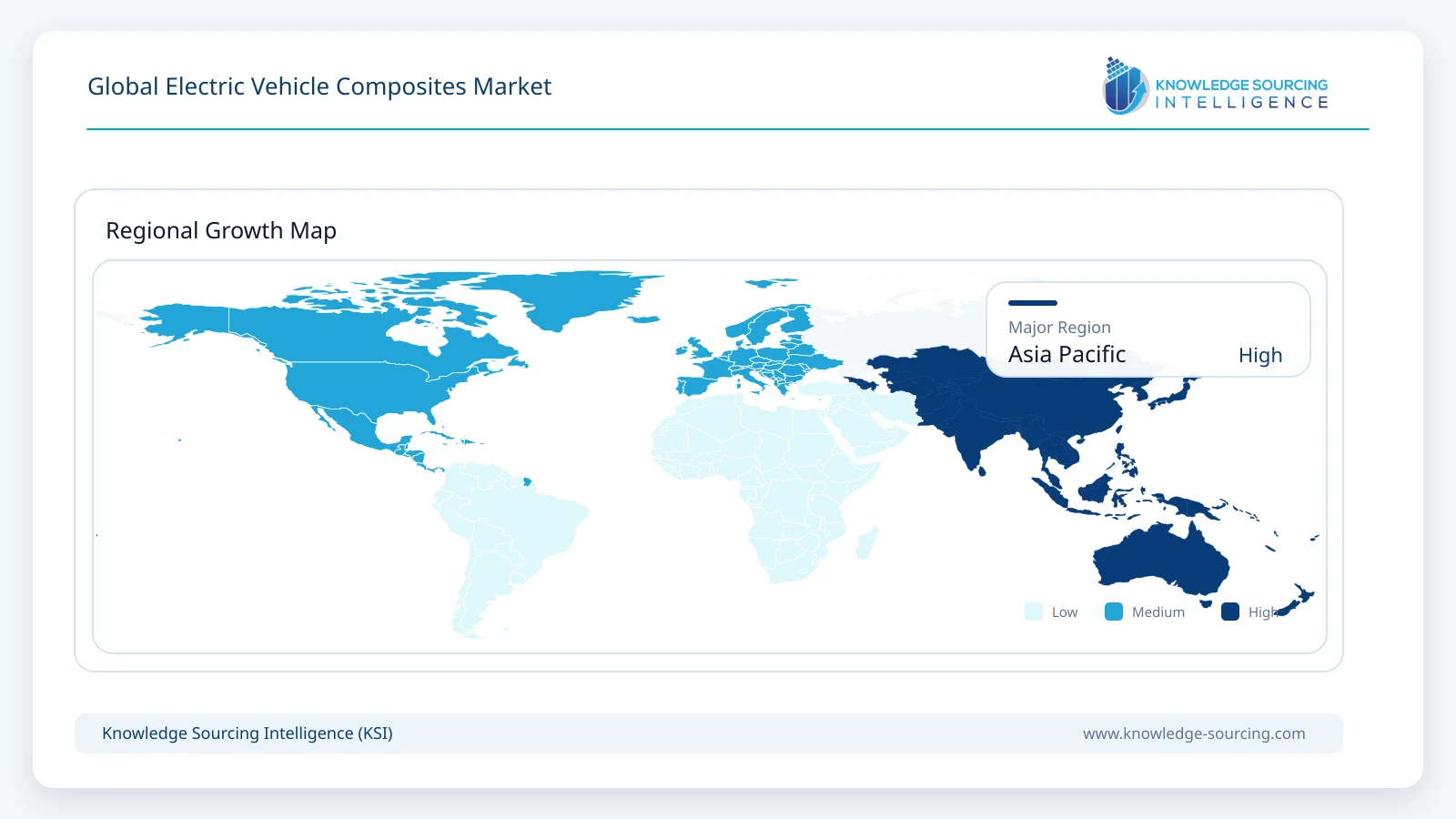
The region's commercial mix favors scalable glass-fiber and thermoplastic systems because high-volume platforms require competitive cycle times and cost. Carbon fiber remains more concentrated in performance applications, but higher-rate processing and local material capacity could gradually broaden adoption. Battery housings, underbody protection and structural reinforcements are expected to remain key regional applications through 2031.
Competitive Landscape
The competitive landscape spans fiber manufacturers, resin and compound suppliers, composite processors and Tier 1 automotive component companies. Teijin, SGL Carbon, Toray, Mitsubishi Chemical, Syensqo, Hexcel and Owens Corning provide advanced material platforms. Kautex, Autoneum, Tata AutoComp, Röchling and other processors convert materials into battery, structural and protective components. Avient and Covestro contribute engineered thermoplastic and polyurethane-composite systems targeted at metal replacement and EV battery structures.
Competitive advantage increasingly depends on moving beyond raw materials to validated automotive components. Suppliers that can combine material formulation, simulation, molding, joining, fire protection and serial-production capability are better positioned for OEM platform awards. High-volume recyclability and low-carbon material content are also becoming more important as vehicle manufacturers evaluate lifecycle emissions rather than vehicle-use emissions alone.
Recent Developments
August 2026: A Frontiers review assessed composite mold design and high-volume manufacturing routes for new-energy-vehicle battery enclosures.
June 2026: Autoneum presented a next-generation composite battery lid for battery-electric vehicle packs at Battery Show Europe.
February 2026: Avient highlighted new long-fiber composite performance developments for automotive applications as part of its advanced-mobility portfolio.
January 2026: SAE published a Tata Steel study on structural design and simulation of a composite-metal hybrid EV battery enclosure.
July 2025: Kautex Textron secured an OEM order for a thermoplastic-composite lower battery housing for a major multi-brand BEV platform.
Global Electric Vehicle Composites Market Scope:
| Report Metric | Details |
|---|---|
| Total Market Size in 2026 | Estimate USD 3.15 billion |
| Total Market Size in 2031 | USD 6.35 billion |
| Forecast Unit | USD Billion |
| Growth Rate | 15.1% |
| Study Period | 2021 to 2031 |
| Historical Data | 2021 to 2024 |
| Base Year | 2025 |
| Forecast Period | 2026 – 2031 |
| Segmentation | Fiber Type, Resin Type, Application, Vehicle Type, Manufacturing Process, Geography |
| Companies |
|
Market Segmentation
By Fiber Type
Glass Fiber
Carbon Fiber
Aramid and Other Fibers
By Resin Type
Thermoset
Thermoplastic
By Application
Battery Enclosures and Covers
Body and Chassis Structures
Underbody Protection
Interior and Load-Bearing Components
Electrical and Other EV Components
By Vehicle Type
Passenger Battery Electric Vehicles
Plug-in Hybrid Electric Vehicles
Commercial Electric Vehicles
Other Electric Vehicles
By Manufacturing Process
Compression Molding / SMC
Injection and Overmolding
Resin Transfer Molding
Prepreg and Other Processes
By Geography
North America
United States
Canada
Mexico
South America
Brazil
Argentina
Rest of South America
Europe
Germany
United Kingdom
France
Italy
Rest of Europe
Middle East and Africa
Saudi Arabia
United Arab Emirates
South Africa
Rest of Middle East and Africa
Asia Pacific
China
Japan
India
South Korea
Rest of Asia Pacific
Table of Contents
1. EXECUTIVE SUMMARY
2. MARKET SNAPSHOT
2.1. Market Overview
2.2. Market Segmentation
3. BUSINESS LANDSCAPE
3.1. Market Drivers
3.1.1. EV Scale Makes Lightweighting a Larger Addressable Materials Opportunity
3.1.2. Battery Enclosures Are Accelerating the Shift from Demonstration to Serial Production
3.1.3. Thermoplastics Improve the High-Volume Manufacturing Case
3.2. Market Restraints
3.2.1. Cost, Repairability and Recycling Continue to Limit Broader Penetration
3.3. Market Opportunities
3.4. Porter's Five Forces Analysis
3.5. Industry Value Chain Analysis
3.6. Automotive Safety and Material Requirements
4. TECHNOLOGICAL OUTLOOK
4.1. Glass-Fiber Sheet Molding Compound
4.2. Continuous-Fiber Reinforced Thermoplastics
4.3. Carbon-Fiber Reinforced Polymer
4.4. Composite-Metal Hybrid Structures
5. GLOBAL ELECTRIC VEHICLE COMPOSITES MARKET BY FIBER TYPE
5.1. Glass Fiber
5.2. Carbon Fiber
5.3. Aramid and Other Fibers
6. GLOBAL ELECTRIC VEHICLE COMPOSITES MARKET BY RESIN TYPE
6.1. Thermoset
6.2. Thermoplastic
7. GLOBAL ELECTRIC VEHICLE COMPOSITES MARKET BY APPLICATION
7.1. Battery Enclosures and Covers
7.2. Body and Chassis Structures
7.3. Underbody Protection
7.4. Interior and Load-Bearing Components
7.5. Electrical and Other EV Components
8. GLOBAL ELECTRIC VEHICLE COMPOSITES MARKET BY VEHICLE TYPE
8.1. Passenger Battery Electric Vehicles
8.2. Plug-in Hybrid Electric Vehicles
8.3. Commercial Electric Vehicles
8.4. Other Electric Vehicles
9. GLOBAL ELECTRIC VEHICLE COMPOSITES MARKET BY MANUFACTURING PROCESS
9.1. Compression Molding / SMC
9.2. Injection and Overmolding
9.3. Resin Transfer Molding
9.4. Prepreg and Other Processes
10. GLOBAL ELECTRIC VEHICLE COMPOSITES MARKET BY GEOGRAPHY
10.1. North America
10.1.1. United States
10.1.2. Canada
10.1.3. Mexico
10.2. South America
10.2.1. Brazil
10.2.2. Argentina
10.2.3. Rest of South America
10.3. Europe
10.3.1. Germany
10.3.2. United Kingdom
10.3.3. France
10.3.4. Italy
10.3.5. Rest of Europe
10.4. Middle East and Africa
10.4.1. Saudi Arabia
10.4.2. United Arab Emirates
10.4.3. South Africa
10.4.4. Rest of Middle East and Africa
10.5. Asia Pacific
10.5.1. China
10.5.2. Japan
10.5.3. India
10.5.4. South Korea
10.5.5. Rest of Asia Pacific
11. COMPETITIVE ENVIRONMENT AND ANALYSIS
11.1. Major Players and Strategy Analysis
11.2. Market Share Analysis
11.3. Product Development, Contracts and Collaborations
11.4. Competitive Dashboard
12. COMPANY PROFILES
12.1. Teijin Limited
12.2. SGL Carbon SE
12.3. Toray Industries, Inc.
12.4. Mitsubishi Chemical Group Corporation
12.5. Syensqo
12.6. Hexcel Corporation
12.7. Owens Corning
12.8. Avient Corporation
12.9. Covestro AG
12.10. Kautex Textron GmbH & Co. KG
12.11. Autoneum Holding AG
12.12. Röchling SE & Co. KG
12.13. Tata AutoComp Systems Limited
12.14. Mar-Bal, Inc.
12.15. Exel Composites Plc
12.16. ElringKlinger AG
12.17. PPG Industries, Inc.
12.18. SABIC
13. RECENT DEVELOPMENTS
14. APPENDIX
14.1. Currency
14.2. Assumptions
14.3. Base and Forecast Years Timeline
14.4. Abbreviations
Navigate
Trusted by the world's leading organizations











