
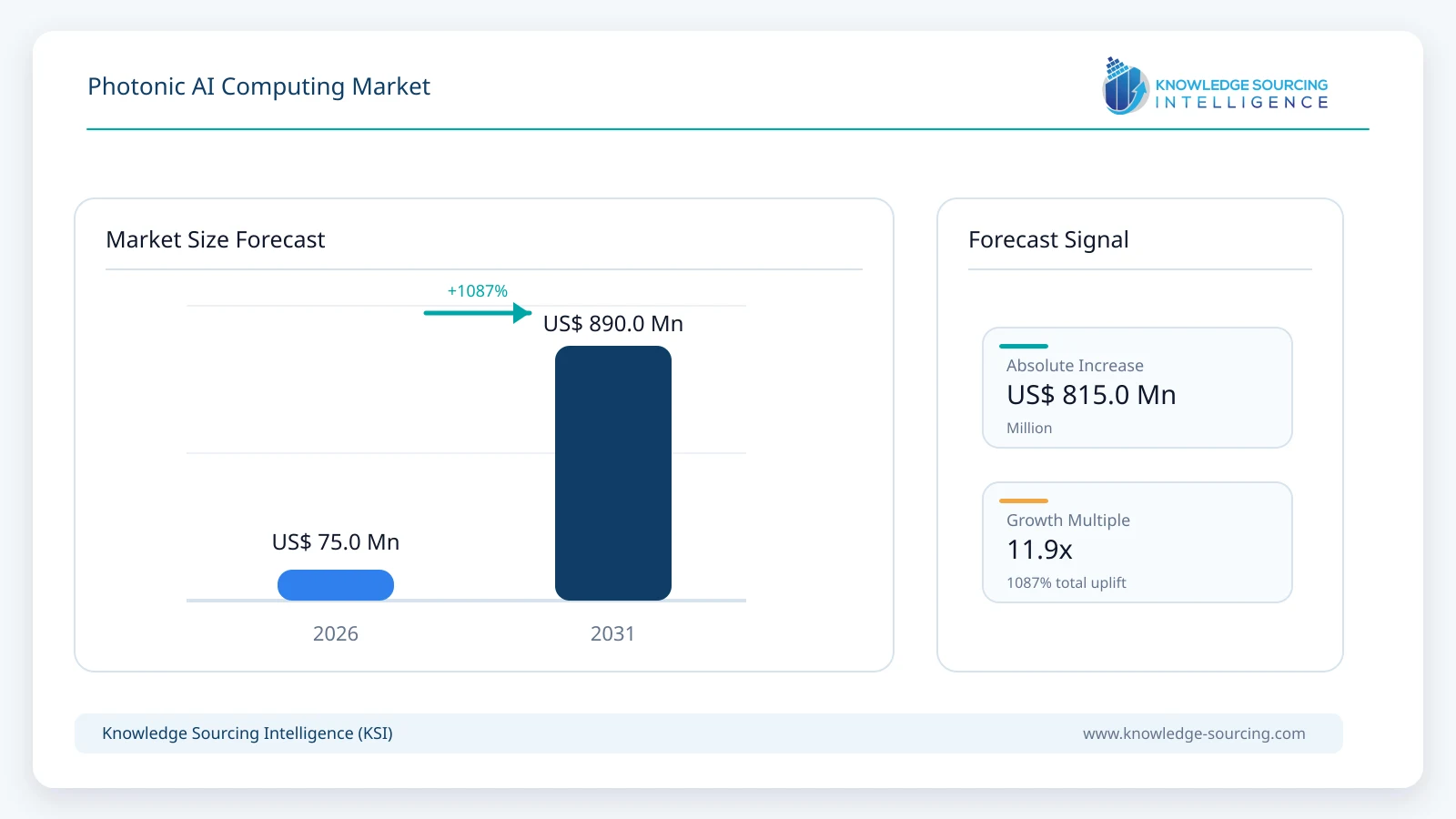
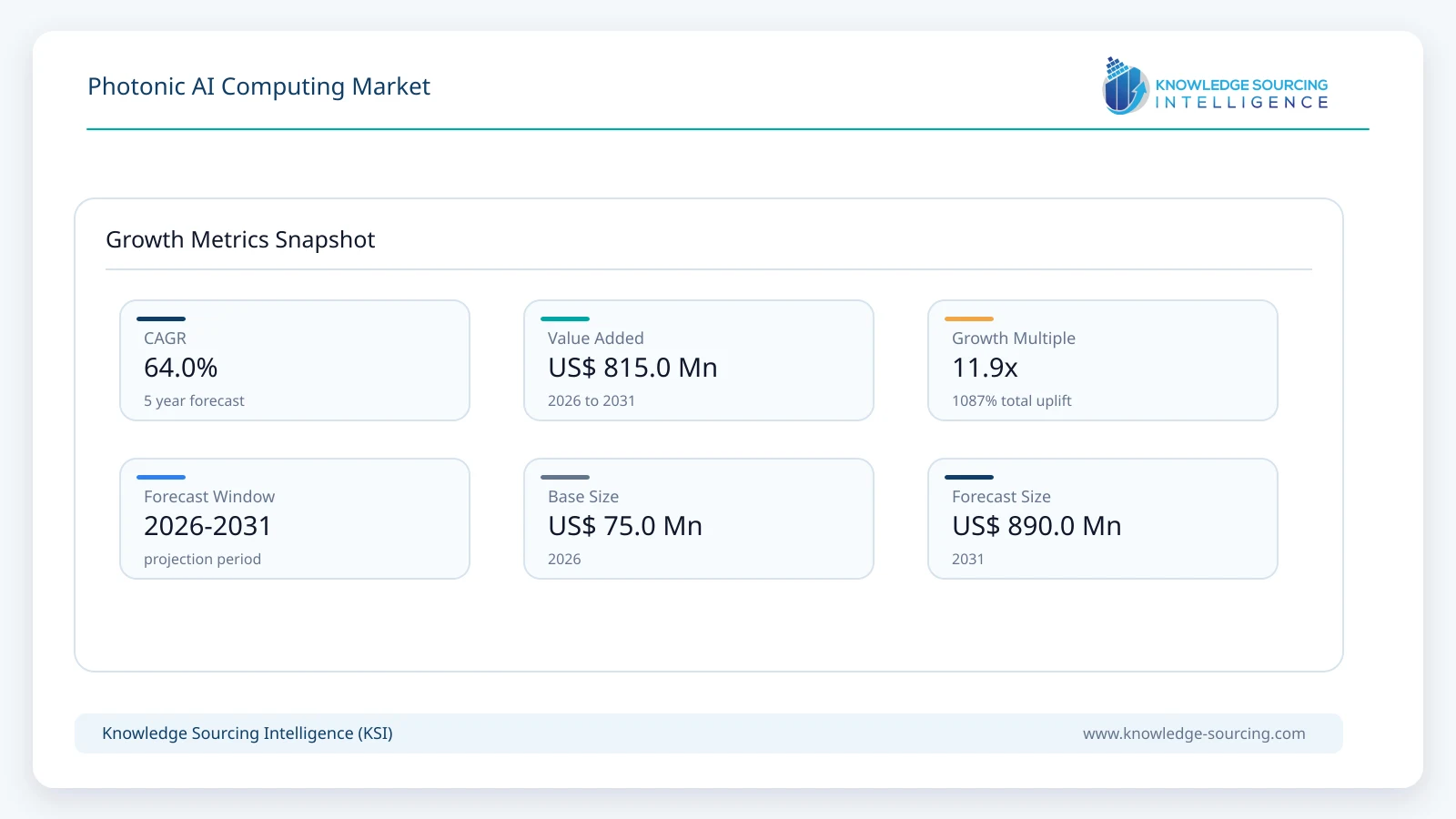
The Photonic AI Computing Market is forecast to grow at a CAGR of 64.01%, reaching USD 890 million in 2031 from approximately USD 75 million in 2026.
Highlights:
- 1Photonic processors, accelerator cards and computing servers account for approximately 57.3% of 2026 revenue, with evaluation equipment and integration services supporting early adoption.
- 2Integrated photonic matrix and tensor processors represent approximately 45.3% of 2026 value, supported by programmable chip-scale optical arithmetic.
- 3Research institutes and supercomputing centers account for approximately 30.7% of 2026 demand as specialist evaluation programs remain important purchasers.
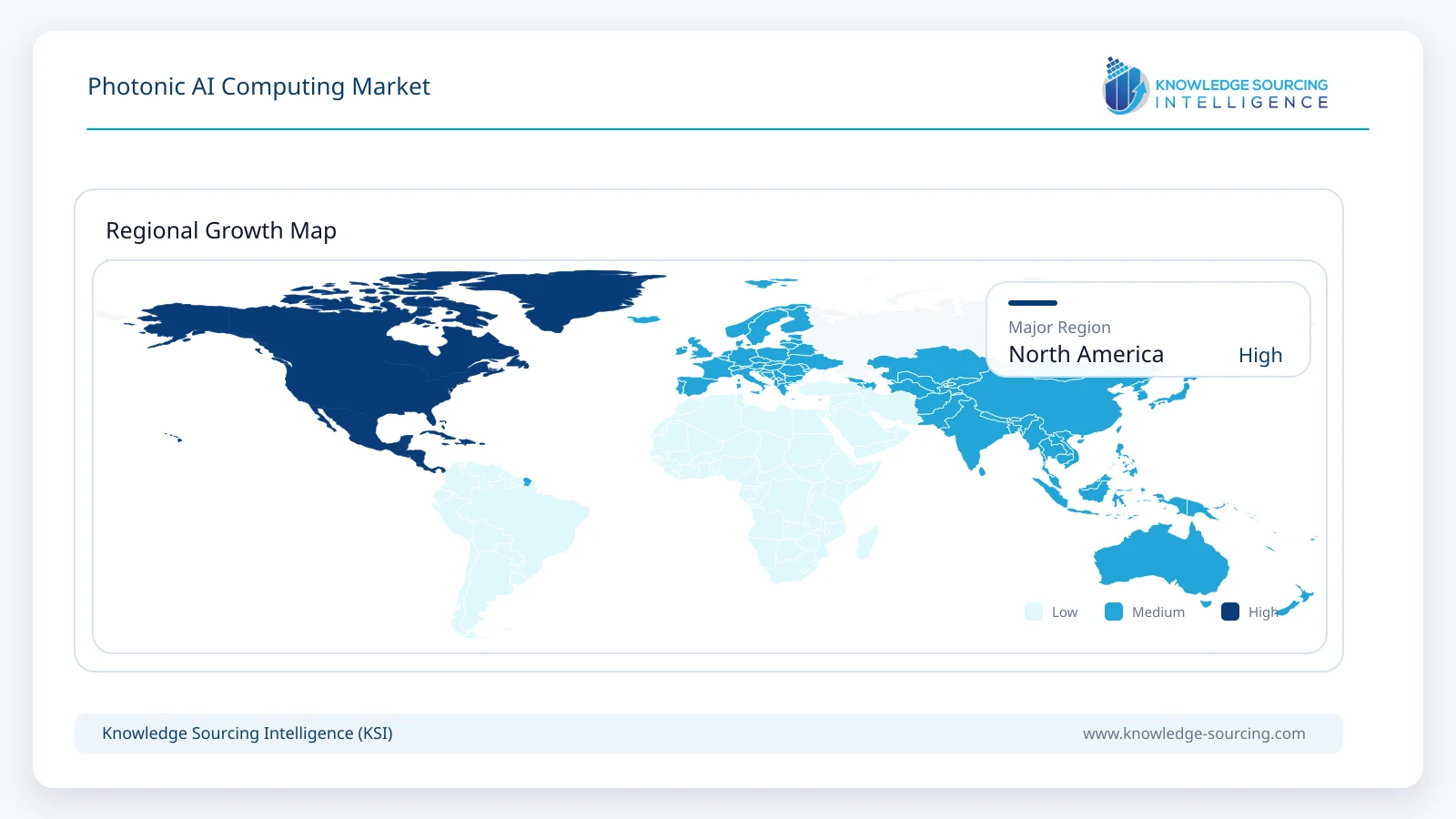
- 4North America is the largest regional market in 2026 at approximately 33.3% of global revenue, supported by photonic AI development and AI-infrastructure research.
- 5Asia Pacific is projected to grow fastest through 2031 as computing-card development, semiconductor integration and AI infrastructure investment expand.
The market comprises processors, accelerator cards, server platforms and directly associated software or technical services in which light performs AI-related computation rather than merely transporting data between electronic chips. Technologies include photonic matrix multipliers, optical nonlinear processing, free-space optical tensor operations and application-specific iterative computing.
Early product availability is creating a commercial category separate from silicon photonics networking. Q.ANT sells evaluation-access photonic processing servers, Lightelligence offers the PACE 2 optical matrix accelerator, and Lumai introduced the Iris family for language-model inference in April 2026. These companies target different computational functions, meaning their products should not be viewed as directly interchangeable GPU replacements. Lightmatter has demonstrated an advanced optical AI processor, but its near-term Passage commercial roadmap is centered on interconnects rather than separately monetized optical arithmetic.
Market Overview
Photonic AI processors aim to exploit optical interference, modulation and related physical processes to calculate mathematical transformations with high parallelism. In integrated architectures, optical waveguides and modulators represent matrix coefficients and input signals, while electronic circuits perform functions such as memory access, programming, conversion and control. Free-space optical designs use lenses and spatial light patterns to execute computationally intensive operations. Commercial benefits must therefore be assessed at full-system level, including the electrical costs of moving data into and out of the optical engine.
Q.ANT’s Native Processing Server integrates a photonic processing card with an x86 host, Linux software and conventional server interfaces. Its second-generation device targets nonlinear operations and has been used for diffusion and recurrent-network demonstrations. Lightelligence’s PACE 2 offers a configurable 128-by-128 optical matrix and a PCIe interface, allowing users to evaluate optical arithmetic inside existing computing environments. Lumai’s Iris Nova targets language-model inference and is available for customer evaluation, widening the commercial discussion beyond narrowly defined image and signal-processing tasks.
The market remains technically heterogeneous. Lightmatter demonstrated near-electronic precision across several AI models in peer-reviewed research, yet continues to prioritize photonic interconnect commercialization. Neurophos is developing densely integrated optical processing units but has not established production-scale sales. Microsoft Research has demonstrated analog optical AI and optimization computation without announcing a standalone commercial processor. These distinctions between products, evaluation systems and laboratory results are material to the pace of future adoption.
Market Trends
Commercial Evaluation Is Shifting Toward Real AI Workloads
The transition from isolated optical operations to practical models is becoming more visible as suppliers demonstrate inference tasks with recognizable architectures. Q.ANT showed diffusion and recurrent neural networks on its second-generation NPU in June 2026, while Lumai presented real-time operation of billion-parameter language models with its Iris system in April 2026.
Customer evaluation will depend on model accuracy, memory behavior, server-level energy consumption and software conversion effort rather than an optical operations-per-second figure in isolation. This favors vendors that provide complete development tools and support for established host environments.
Hybrid Optical-Electronic Integration Is Becoming the Commercial Baseline
Current products retain electronic memory, digital control, host processors and common server interfaces even when selected operations take place in light. Q.ANT uses a PCIe-based accelerator architecture, and Lightelligence supports its PACE 2 optical matrix processor through standard programmable interfaces.
Hybrid designs are more compatible with existing data centers but must control optical-to-electrical conversion losses. Device-level efficiency alone cannot establish system-level operating savings unless the benefit survives calibration, data transfer and host processing.
Workload-Specific Architectures Are Outpacing Universal Replacement Claims
Photonic processor developers increasingly select workload stages suited to optical arithmetic, including matrix-vector multiplication, nonlinear functions, computer vision, optimization and parts of generative inference. The September 2026 Nature Photonics assessment distinguishes cloud-scale processors from application-specific edge systems and identifies interface losses as a major challenge for scalable optical tensor cores.
Specialized deployment offers a practical route to adoption because buyers can benchmark one repeatable kernel without replacing the complete training and inference software stack.
Photonic Hardware Is Moving Toward Developer and Server Packaging
Server products, PCIe cards, evaluation boards and optical computing software development kits are reducing the gap between research hardware and deployment-ready systems. Q.ANT offers a rack-mountable Native Processing Server, Lightelligence provides its PACE 2 accelerator, and Optalysys markets a photonic compute-in-transit evaluation environment.
Commercial volumes remain small, but packaging improvements can make procurement and qualification more routine. Vendors able to combine optical devices with stable software interfaces and post-deployment support should gain an advantage as more customers progress beyond one-off pilots.
Benchmarking Is Becoming More Important Than Peak Device Claims
Photonic AI procurement increasingly depends on performance comparisons that include the host processor, analog-to-digital conversion, calibration, device drift, memory access and complete model execution. For language-model inference, matrix multiplication may be a suitable target for optics, but token generation also depends on memory bandwidth, attention operations and control logic. Buyers therefore require workload-specific results rather than comparing peak optical arithmetic directly with a standalone GPU specification. An independent demonstration under comparable numerical precision can establish a credible technical advantage more effectively than theoretical optical propagation speed.
The first commercial wave may favor inference kernels with predictable shapes and repeated use, because dedicated optical hardware is easier to configure efficiently for stable workloads. Model developers also need programming environments that map operations from common frameworks to optical devices, together with diagnostics for accuracy, device health and thermal behavior. Q.ANT’s software development resources and existing Linux-host approach address parts of this requirement, while Lightelligence’s programmable matrix device illustrates another integration path. If toolchains remain fragmented, commercial deployments could be restricted to research users and specialist integrators even when individual photonic circuits show attractive energy efficiency.
The difference between photonic computation and photonic transport will also shape purchasing decisions. Optical interconnect suppliers can benefit immediately from large GPU clusters without replacing the arithmetic engines. Optical computing vendors face the additional requirement of proving that photonic devices execute useful model operations at acceptable precision. This distinction makes a processor-only market inherently more uncertain than sales of optical networking components, but it also identifies a separate revenue opportunity if proven processing platforms achieve repeatable adoption.
Segment Analysis
By Offering: Photonic Processors, Accelerator Cards and Servers
Photonic processors, computing cards and rack-mountable servers form the principal commercial offering because customers require physical hardware to evaluate optical arithmetic on AI workloads. Optical processing is being packaged with host CPUs, development software, interfaces and equipment support, creating procurement units that go beyond laboratory components.
The offering is projected to reach approximately USD 625 million by 2031. Q.ANT’s server platform, Lumai’s Iris family and Lightelligence’s PACE 2 are examples of the product types expected to support this expansion. Their capabilities differ substantially, so revenue development will depend on application-specific qualification and repeat orders.
By AI Workload: Generative AI and Language-Model Inference
Generative AI inference is likely to become a larger opportunity as model serving places greater emphasis on energy per token and throughput under rack-power constraints. Optical systems are best suited to compute-heavy portions of inference, while conventional memory and electronic processing remain essential for other operations.
The segment is forecast to reach approximately USD 360 million in 2031. Lumai’s Iris evaluation system and Q.ANT’s generative workload demonstrations show the direction of product development, although supported model sizes and full-system economics must be validated under production traffic.
By Form Factor: Rack-Mountable Computing Servers
Rack-mountable photonic computing systems provide a practical integration route for cloud, enterprise and supercomputing customers that already use standardized server infrastructure. These platforms combine optical accelerator hardware with conventional control, networking and operating-system components.
The segment is expected to reach approximately USD 435 million by 2031. Growth depends on modular accelerator upgrades, robust cooling and calibration, and procurement evidence that optical co-processing lowers application-level costs.
Market Drivers
Rising AI Inference Energy and Rack-Power Constraints
Growing AI workloads are pushing operators to evaluate processors that perform matrix transformations with fewer electronic switching events. Photonic co-processors may reduce operating energy for suitable compute kernels when conversion, control and memory overhead are managed.
Commercial Availability of Photonic Server and Accelerator Platforms
Q.ANT’s rack-mountable NPS and Lightelligence’s PACE 2 provide physical systems that can be evaluated within existing electronic infrastructures. Lumai’s Iris Nova expands the field of photonic LLM-inference evaluation platforms.
Demand for Specialized Low-Latency AI Operations
Vision, physical AI and selected inference pipelines depend heavily on repeated linear algebra, nonlinear transformations and optimization steps. Optical engines offer a potential advantage for well-structured stages of these workloads.
Investment in Photonic Integration and Developer Tools
Product developers are investing in configurable photonic integrated circuits, evaluation cards and programming interfaces. The ability to access photonic kernels from C, Python or conventional AI frameworks can shorten the path from laboratory demonstrations to commercial pilots.
Expanding Cloud and Supercomputing Validation
Q.ANT’s deployments at LRZ and its commercial relationship with IONOS introduce a wider range of testing environments. These trials give customers practical benchmarks for throughput, power, stability and workload compatibility.
Market Restraints
Limited Production-Scale Workload Validation
Most optical AI processors remain in evaluation or early deployment. Operators need sustained performance measurements on their own model architectures before replacing established compute designs.
Electro-Optical Conversion and Memory Overhead
Analog optical computation requires conversion interfaces, calibration and digital memory or control. Such overhead can reduce or eliminate an apparent optical-kernel advantage at full-system level.
Precision, Noise and Reproducibility Constraints
Analog photonic architectures face noise, thermal sensitivity and finite effective precision. Engineers must establish acceptable end-to-end model quality rather than rely solely on peak optical operations.
Semiconductor Ecosystem and Integration Costs
Conventional GPUs benefit from mature software libraries, deployment practices and procurement channels. Photonic alternatives require specialized devices, packaging, developers and customer qualification.
Manufacturing Yield and Commercial Procurement Risk
Photonics platforms combine optics, electronics, controls and packaging, often in comparatively low production volumes. Supplier schedules, production cost and post-sale support remain important adoption constraints.
Regional Outlook
North America
North America represents the largest regional photonic AI computing revenue pool in 2026, supported by AI accelerator research, specialist chip development and advanced cloud-infrastructure customers. Lightmatter, Neurophos and Microsoft Research contribute to the regional technology base, although research milestones and optical-networking revenue cannot be treated as separate sales of photonic AI processors. The United States remains the main source of regional demand, followed by Canada and Mexico.
The North American market is projected to reach approximately USD 305 million by 2031. Expected growth is tied to commercial qualification of optical compute systems, design-program contracts and cloud deployment of purpose-built inference acceleration. Suppliers will need to demonstrate reliable model accuracy, measurable energy efficiency and integration with mainstream development workflows before large-scale replacement spending becomes realistic.
Asia Pacific
Asia Pacific combines a major semiconductor manufacturing base with growing AI computing demand and domestic photonic architecture development. Lightelligence’s PACE 2 product demonstrates how optical matrix processing can be commercialized as an accelerator card, while the region’s chip design, advanced packaging and AI infrastructure ecosystems can support future deployment in cloud and industrial systems. China, Japan, South Korea and India are important sources of prospective demand.
The region is forecast to reach approximately USD 310 million by 2031 and become the largest regional market by the end of the forecast period. Its growth depends on the commercialization of integrated optical chips, broadening access to hardware evaluation programs and qualification within data centers and industrial AI platforms. Country adoption will vary with domestic compute strategies, manufacturing capacity and software compatibility.
Competitive Landscape
Competition in photonic AI computing is led by specialist firms with different processing architectures and levels of commercialization. Q.ANT offers nonlinear photonic co-processing through its Native Processing Server, Lightelligence develops configurable integrated matrix accelerators, and Lumai is targeting LLM inference with its optical server family. Lightmatter has demonstrated significant optical compute research but is currently commercializing photonic interconnect products at larger scale, which should not be equated with direct processor revenue.
Neurophos is pursuing high-density photonic processing units, while Optalysys is developing programmable computation within optical data paths. LightSolver focuses on laser-based computational engines for optimization and related technical tasks, and Akhetonics is developing all-optical reasoning hardware. Microsoft Research and Q/C Technologies contribute optical-compute research and early development programs. The commercial shortlist therefore spans shipping equipment, evaluation-stage products and pre-commercial technologies rather than ten established large-scale photonic AI chip manufacturers.
Recent Developments
September 2026: Neurophos expanded its engineering operations in Austin and Sunnyvale following a USD 110 million Series A, preparing its metasurface-based optical processor for commercialization.
June 2026: Q.ANT demonstrated diffusion and recurrent neural-network workloads on its second-generation photonic processor at ISC High Performance.
May 2026: Q.ANT announced IONOS as the first commercial cloud customer for its Native Processing Server, expanding access beyond research-site evaluations.
April 2026: Lumai launched the Iris optical inference-server family and made Iris Nova available for evaluation on large-language-model workloads.
March 2026: Q.ANT deployed second-generation photonic processors at the Leibniz Supercomputing Centre for production-environment evaluation.
January 2026: Optalysys secured GBP 23 million to advance programmable photonic computing chips and support expansion into the United States.
Market Outlook
Photonic AI computing is expected to move from specialist evaluation and low-volume installations toward broader deployments of optical accelerators within hybrid computing systems. Processor cards and server products should account for the largest share of revenue as buyers prioritize hardware that can operate alongside conventional CPUs and GPUs. Generative inference and other compute-heavy workloads offer attractive opportunities, but adoption will depend on repeatable end-to-end results rather than isolated optical speed claims.
Asia Pacific is forecast to overtake North America by 2031 as integrated photonic computing moves closer to semiconductor production ecosystems and regional AI infrastructure customers. Software integration, packaging economics, optical precision and qualification times remain material adoption barriers. The strongest commercial position will likely be held by suppliers that provide stable hardware and developer environments, demonstrate supported model performance, and secure repeat purchases beyond research installations.
Photonic AI Computing Market Scope
| Report Metric | Details |
|---|---|
| Total Market Size in 2026 | USD 75 million |
| Total Market Size in 2031 | USD 890 million |
| Forecast Unit | Million |
| Growth Rate | 64.01% |
| Study Period | 2021 to 2031 |
| Historical Data | 2021 to 2024 |
| Base Year | 2025 |
| Forecast Period | 2026 – 2031 |
| Segmentation | Offering, Computing Architecture, Form Factor, AI Workload, Deployment Environment, Processing Function, End User, Geography |
| Companies |
|
| Customization Scope | 15% Free Customization included with purchase — Request Custom Breakdown → |
| Sample & Data Access | PDF Sample, Excel Databook & Analyst Briefing — Download Free Sample → |
Market Segmentation
By Offering
Photonic processors, accelerator cards and servers
Photonic compute software and IP licenses
Evaluation, integration and engineering services
By Computing Architecture
Integrated photonic matrix and tensor processors
Free-space optical tensor processors
Nonlinear photonic processing architectures
Optical resonator and iterative computing systems
By Form Factor
Rack-mountable computing servers
PCIe and add-in accelerator cards
Embedded photonic modules and development systems
By AI Workload
Conventional machine-learning inference
Generative AI and language-model inference
Physical AI, vision and optimization
AI training and model adaptation
By Deployment Environment
Hyperscale, neocloud and AI service providers
Enterprise and private AI infrastructure
Research and high-performance computing centers
Edge and embedded computing
By Processing Function
Optical matrix and tensor computation
Nonlinear and activation-function acceleration
Optical iterative and optimization processing
By End User
Cloud and AI infrastructure operators
Industrial technology and manufacturing
Research institutes and supercomputing centers
Semiconductor and software developers
Healthcare and life sciences
Robotics, mobility and other industries
By Geography
North America
United States
Canada
Mexico
South America
Brazil
Argentina
Chile
Rest of South America
Europe
Germany
United Kingdom
France
Netherlands
Italy
Spain
Sweden
Rest of Europe
Middle East and Africa
Saudi Arabia
United Arab Emirates
Israel
South Africa
Rest of Middle East and Africa
Asia Pacific
China
Japan
South Korea
India
Taiwan
Singapore
Australia
Rest of Asia Pacific
Table of Contents
1. EXECUTIVE SUMMARY
1.1. Key Findings
1.2. Photonic AI Computing Market Size, 2026-2031
1.3. Segment and Regional Outlook
2. MARKET SNAPSHOT
2.1. Market Overview
2.2. Market Definition
2.3. Scope of the Study
2.4. Market Segmentation
3. BUSINESS LANDSCAPE
3.1. Market Drivers
3.1.1. Rising AI Inference Energy and Rack-Power Constraints
3.1.2. Commercial Availability of Photonic Server and Accelerator Platforms
3.1.3. Demand for Specialized Low-Latency AI Operations
3.1.4. Investment in Photonic Integration and Developer Tools
3.1.5. Expanding Cloud and Supercomputing Validation
3.2. Market Restraints
3.2.1. Limited Production-Scale Workload Validation
3.2.2. Electro-Optical Conversion and Memory Overhead
3.2.3. Precision, Noise and Reproducibility Constraints
3.2.4. Semiconductor Ecosystem and Integration Costs
3.2.5. Manufacturing Yield and Commercial Procurement Risk
3.3. Market Opportunities
3.4. Porter’s Five Forces Analysis
3.5. Industry Value Chain Analysis
3.6. Policies and Regulations
3.7. Strategic Recommendations
4. TECHNOLOGICAL OUTLOOK
4.1. Integrated Photonic Matrix and Tensor Processing
4.2. Free-Space Optical Computing
4.3. Nonlinear Optical Processing
4.4. Optical Resonator and Iterative Computing
4.5. Hybrid Photonic-Electronic Integration
4.6. Programming, Calibration and Precision
5. PHOTONIC AI COMPUTING MARKET BY OFFERING
5.1. Introduction
5.2. Photonic processors, accelerator cards and servers
5.3. Photonic compute software and IP licenses
5.4. Evaluation, integration and engineering services
6. PHOTONIC AI COMPUTING MARKET BY COMPUTING ARCHITECTURE
6.1. Introduction
6.2. Integrated photonic matrix and tensor processors
6.3. Free-space optical tensor processors
6.4. Nonlinear photonic processing architectures
6.5. Optical resonator and iterative computing systems
7. PHOTONIC AI COMPUTING MARKET BY FORM FACTOR
7.1. Introduction
7.2. Rack-mountable computing servers
7.3. PCIe and add-in accelerator cards
7.4. Embedded photonic modules and development systems
8. PHOTONIC AI COMPUTING MARKET BY AI WORKLOAD
8.1. Introduction
8.2. Conventional machine-learning inference
8.3. Generative AI and language-model inference
8.4. Physical AI, vision and optimization
8.5. AI training and model adaptation
9. PHOTONIC AI COMPUTING MARKET BY DEPLOYMENT ENVIRONMENT
9.1. Introduction
9.2. Hyperscale, neocloud and AI service providers
9.3. Enterprise and private AI infrastructure
9.4. Research and high-performance computing centers
9.5. Edge and embedded computing
10. PHOTONIC AI COMPUTING MARKET BY PROCESSING FUNCTION
10.1. Introduction
10.2. Optical matrix and tensor computation
10.3. Nonlinear and activation-function acceleration
10.4. Optical iterative and optimization processing
11. PHOTONIC AI COMPUTING MARKET BY END USER
11.1. Introduction
11.2. Cloud and AI infrastructure operators
11.3. Industrial technology and manufacturing
11.4. Research institutes and supercomputing centers
11.5. Semiconductor and software developers
11.6. Healthcare and life sciences
11.7. Robotics, mobility and other industries
12. PHOTONIC AI COMPUTING MARKET BY GEOGRAPHY
12.1. North America
12.1.1. United States
12.1.2. Canada
12.1.3. Mexico
12.2. South America
12.2.1. Brazil
12.2.2. Argentina
12.2.3. Chile
12.2.4. Rest of South America
12.3. Europe
12.3.1. Germany
12.3.2. United Kingdom
12.3.3. France
12.3.4. Netherlands
12.3.5. Italy
12.3.6. Spain
12.3.7. Sweden
12.3.8. Rest of Europe
12.4. Middle East and Africa
12.4.1. Saudi Arabia
12.4.2. United Arab Emirates
12.4.3. Israel
12.4.4. South Africa
12.4.5. Rest of Middle East and Africa
12.5. Asia Pacific
12.5.1. China
12.5.2. Japan
12.5.3. South Korea
12.5.4. India
12.5.5. Taiwan
12.5.6. Singapore
12.5.7. Australia
12.5.8. Rest of Asia Pacific
13. COMPETITIVE ENVIRONMENT AND ANALYSIS
13.1. Major Players and Strategy Analysis
13.2. Market Share Analysis
13.3. Mergers, Acquisitions, Agreements and Collaborations
13.4. Competitive Dashboard
14. COMPANY PROFILES
14.1. Q.ANT GmbH
14.2. Lumai
14.3. Lightelligence
14.4. Lightmatter, Inc.
14.5. Neurophos, Inc.
14.6. Optalysys
14.7. LightSolver
14.8. Akhetonics
14.9. Q/C Technologies, Inc.
14.10. Microsoft Corporation
15. APPENDIX
15.1. Research Methodology
15.2. Currency and Units
15.3. Assumptions
15.4. Base and Forecast Years
15.5. Abbreviations





Frequently asked questions
What is the projected Photonic AI Computing market size by 2031?
The Photonic AI Computing Market is forecast to reach USD 890 million by 2031.
What is the projected CAGR for Photonic AI Computing through 2031?
The Photonic AI Computing Market is forecast to grow at a 64.01% CAGR.
Which region holds the largest market share in 2026?
North America holds the largest share at approximately 33.3% in 2026.
Which region is projected for the fastest growth through 2031?
Asia Pacific is projected to grow fastest through 2031.
What were the key product segments by revenue in 2026?
Processors, accelerator cards, and servers accounted for 57.3% of 2026 revenue.
Who were the primary demand sources in 2026?
Research institutes and supercomputing centers accounted for 30.7% of demand.
Cite this report
Knowledge Sourcing Intelligence. (Oct 2026). Photonic AI Computing Market Size, Share & Growth Forecast (2026-2031). https://www.knowledge-sourcing.com/report/photonic-ai-computing-market