
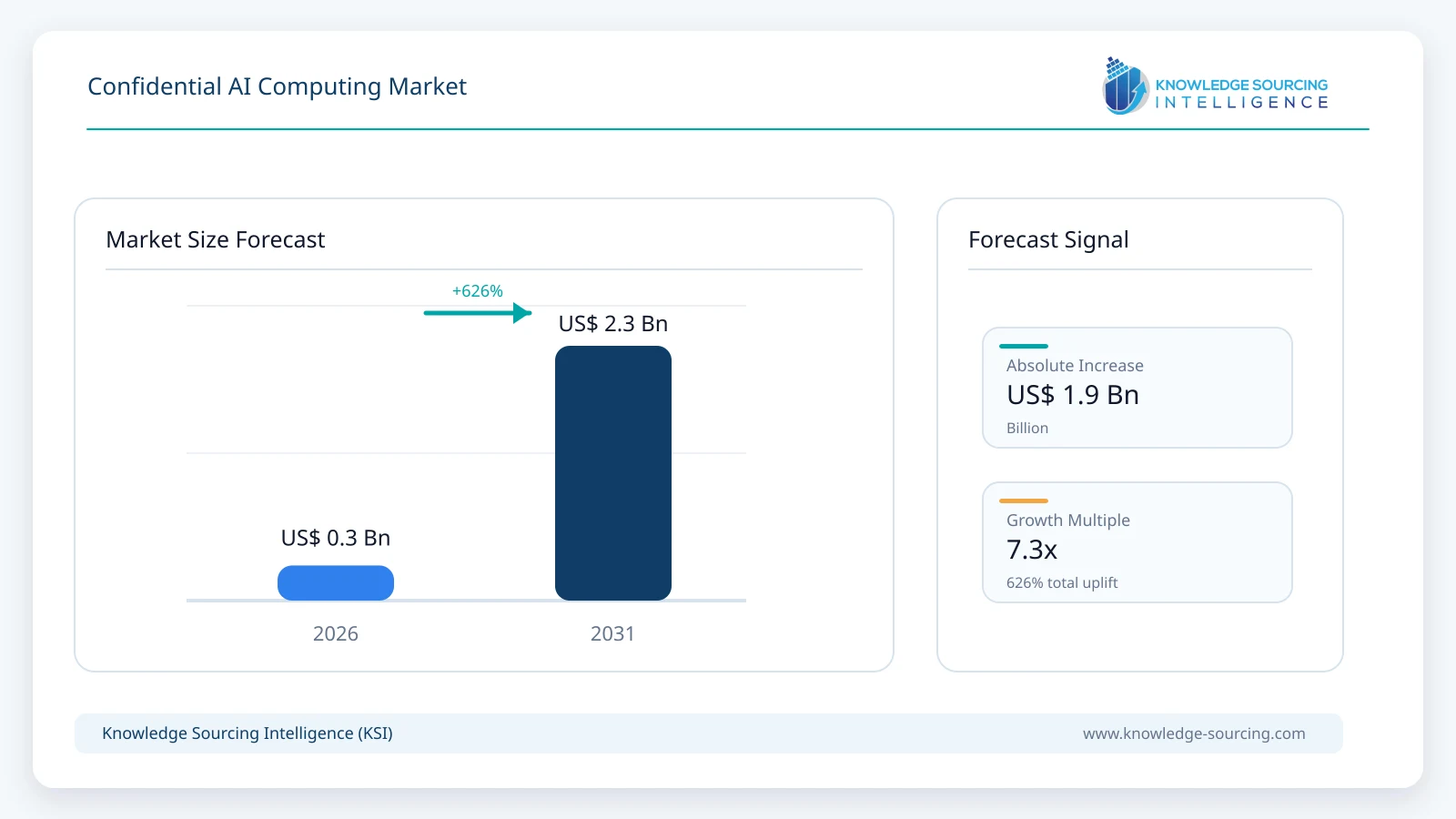
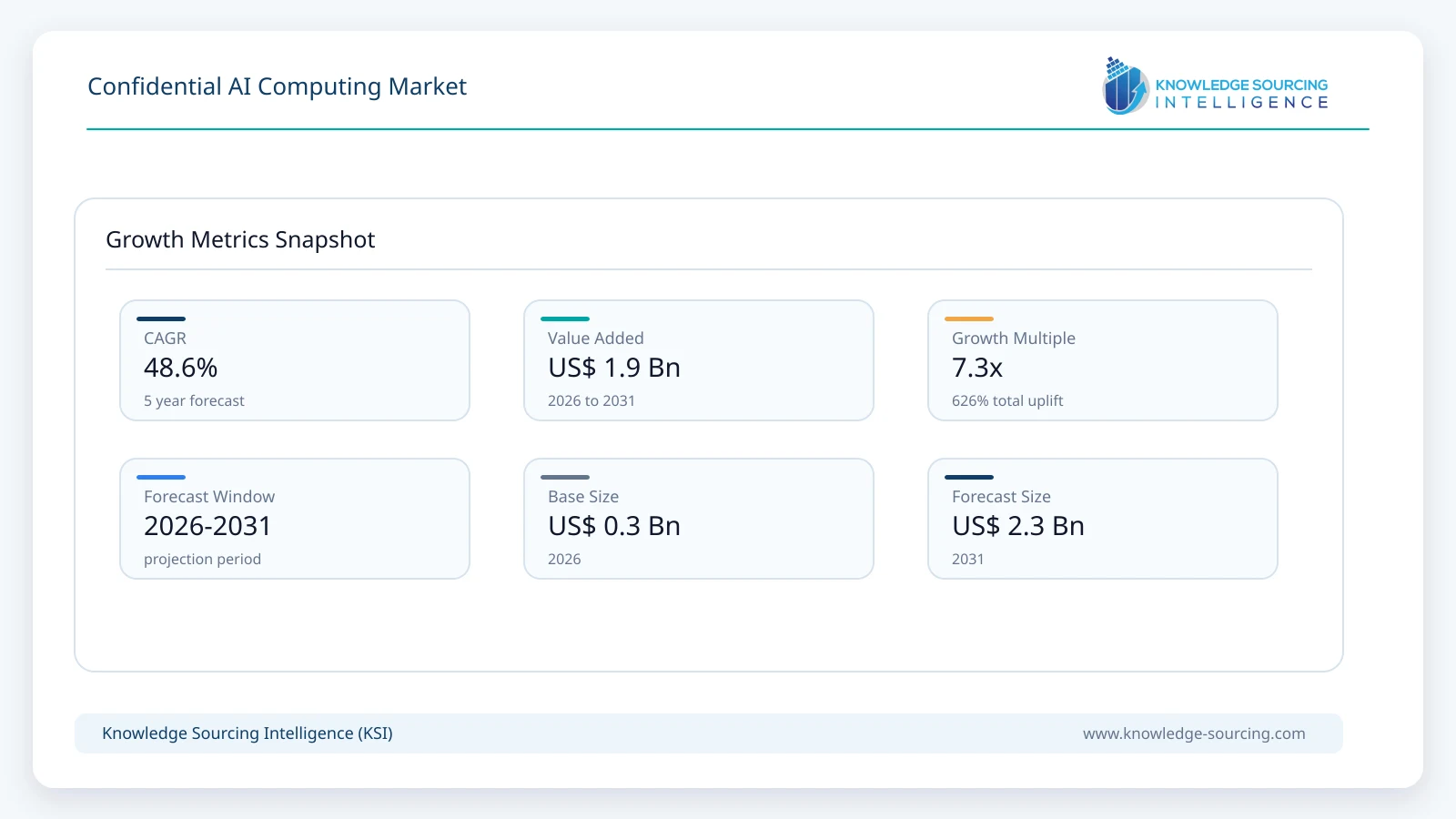
The Confidential AI Computing Market is projected to grow at a CAGR of 48.65%, increasing from approximately USD 0.31 billion in 2026 to USD 2.25 billion by 2031 during the forecast period.
Highlights:
- 1Protected AI inference represents approximately 45% of market revenue in 2026, reflecting demand to process confidential prompts and preserve model intellectual property during execution.
- 2GPU-backed confidential execution contributes approximately 45% of 2026 market value as supported NVIDIA accelerators become available through cloud and private infrastructure.
- 3Public-cloud deployment accounts for approximately 45% of 2026 revenue, while dedicated private deployments remain important where infrastructure and data ownership are tightly controlled.
- 4North America leads with approximately 43% of the global market in 2026, supported by hyperscaler infrastructure, security technology vendors and enterprise AI spending.
- 5Asia Pacific is expected to expand fastest among the three largest regions through 2031 as sovereign AI deployments, regulated workloads and advanced industrial AI adoption increase.
Confidential AI deployments combine hardware-based trusted execution environments with cryptographic verification of a workload before data or model assets are decrypted. CPU isolation technologies such as AMD SEV-SNP and Intel TDX can protect guest memory, while supported NVIDIA GPUs extend the trusted processing environment to accelerated model workloads. Attestation checks measured hardware and software states, enabling a customer or model provider to withhold secrets from an environment that fails a defined policy.
Cloud platforms have translated this architecture into deployable infrastructure. Microsoft Azure offers NCCadsH100v5 machines that join AMD SEV-SNP protections with an NVIDIA H100 GPU. Google Cloud supports H100-based A3 configurations and RTX PRO 6000 Blackwell-based G4 confidential instances, although their provisioning models, locations and associated charges differ. A confidential GPU should not be assumed to be available in every region or as a feature of every standard accelerator instance.
Commercial suppliers are also building management software around trusted workloads. Fortanix combines attestation, key management and policy enforcement for secure enterprise model deployment, while Edgeless Systems provides Privatemode AI for protected inference. These products address a practical issue for organizations using third-party models: the enterprise may need its data protected from the model vendor, while the vendor needs to prevent extraction of valuable model weights by the infrastructure operator.
Market Trends
Confidential GPU Availability Is Broadening the Workload Base
Google Cloud announced general availability of confidential G4 instances using NVIDIA RTX PRO 6000 Blackwell GPUs in October 2026, following a June preview. The expansion makes protected GPU execution more accessible for latency-sensitive inference and other enterprise AI workloads, while retaining hardware attestation and confidential virtual machine controls. Microsoft’s H100-backed confidential instances and NVIDIA’s multiprocessor protection technologies provide additional deployment paths beyond earlier CPU-only enclaves.
Commercial impact depends on cloud-region capacity, supported drivers, workload compatibility and measurable confidential-compute premiums. Customers may first move targeted applications such as secure summarization or sensitive document analysis rather than migrate an entire AI estate at once.
Attestation and Key Release Are Becoming Standard Procurement Requirements
Intel Trust Authority added composite GPU and virtual-machine attestation workflows covering supported NVIDIA H100 and B200 systems in June 2026. The ability to check CPU and GPU trust evidence together strengthens the controls used before a third-party model or sensitive dataset is made available inside a protected runtime. NVIDIA similarly provides attestation tooling to verify supported device and firmware configurations.
Enterprises evaluating confidential AI increasingly need operational evidence as well as encryption claims. Policies must identify acceptable firmware, drivers, software images and workload identities, while key services must reject unapproved states. This creates demand for specialist software and support that can be priced separately from raw compute.
Private Model Deployment Is Supporting Two-Way Trust
Fortanix introduced a confidential AI offering in March 2026 that allows enterprises to deploy protected proprietary models on premises while controlling sensitive input data. Cryptographically verified execution and gated model-key release are designed to address both the model owner’s concerns about weight extraction and the enterprise’s concerns about exposing regulated information. The approach could support new commercial arrangements for licensed models operated outside the model vendor’s cloud.
Adoption will depend on performance, secure lifecycle management, deployment support and contract terms. Confidential computing lowers exposure to certain privileged-host threats but does not remove application vulnerabilities, untrusted outputs or the need for data-access governance.
Confidential Containers Are Moving Into Enterprise AI Operations
Fortanix announced support for CNCF Confidential Containers in October 2026, extending its confidential AI platform into Kubernetes-oriented workloads. Confidential container frameworks can retain developer-facing deployment patterns while placing protected workloads in hardware-attested execution environments. NVIDIA describes related deployment choices spanning confidential bare metal, virtual machines and container-based operation, giving infrastructure owners several ways to balance control and orchestration.
The technical shift matters for organizations running many AI applications rather than a small number of dedicated secure VMs. Platform teams need repeatable policies for image measurement, device attestation and secret release if protected workloads are to move through automated production pipelines.
Confidential AI Computing Market Segment Analysis
By Offering
Confidential Cloud-Compute Premiums
Cloud confidential-compute premiums are a measurable revenue pool because certain providers charge additional fees when a supported AI accelerator or virtual machine is operated in confidential mode. Google Cloud publishes separate charges for confidential G4 and A3 accelerator instances, and its G4 offering includes a distinct NVIDIA confidential-computing license charge. These fees sit on top of ordinary VM and accelerator rental and therefore provide a clear boundary for market attribution.
Revenue from confidential cloud-compute premiums is projected to reach approximately USD 780 million in 2031. Adoption is expected to rise as protected accelerator availability improves and enterprises move more regulated inference workloads into supported cloud environments. Cloud consumption is not treated as market revenue when it is unrelated to the confidential protection feature.
By Processing Stage
Protected AI Inference
Protected inference is the leading processing-stage application because commercial AI services frequently handle sensitive prompts, client documents, proprietary model weights and regulated operational data during active execution. Financial institutions, healthcare organizations and government agencies can use attested environments to reduce exposure to infrastructure administrators and provide verifiable workload-integrity evidence.
The protected AI inference segment is projected to reach approximately USD 1.17 billion by 2031. Demand is supported by enterprise deployment of proprietary models, private agent workflows and confidential third-party inference services. The forecast attributes only protection-related spending rather than the full charge for executing a language model.
By Compute Architecture
GPU-Backed Confidential Execution
GPU-backed confidential execution is particularly important for transformer inference and model adaptation, where CPU-only isolation does not provide the throughput needed for many production workloads. NVIDIA’s Hopper and Blackwell confidential-computing capabilities, combined with supported CPU trusted execution technologies and attestation services, are expanding the set of accelerator configurations that can operate inside trusted boundaries.
GPU-backed confidential execution is forecast to generate approximately USD 1.43 billion in 2031. The forecast reflects increased protection-related premiums and security platform revenues associated with accelerated AI execution, rather than treating total GPU shipments or standard GPU-hour revenue as confidential AI sales.
Market Drivers
Increasing Use of Sensitive Enterprise Data
Banks, hospitals and other regulated organizations are deploying generative and predictive AI against transaction histories, clinical documents and customer records that cannot be handled casually in shared infrastructure. Confidential execution and attestation create an additional technical boundary for these workloads, supporting demand for protected AI instances and specialist management platforms.
Protection of Proprietary Model Weights
Model developers licensing high-value foundation and specialized models need to reduce the risk that deployment partners or privileged infrastructure operators can copy unencrypted weights. Policy-gated key release allows intellectual property to be unlocked only in approved environments, making certain on-premises and sovereign deployment arrangements more commercially feasible.
Expansion of Confidential GPU Options
Microsoft’s H100-enabled confidential VM range and Google Cloud’s confidential G4 launch demonstrate the movement from CPU-only protected computation toward accelerated AI deployment. Improved supported hardware, drivers and cloud provisioning should lower integration barriers for organizations that previously found confidential execution unsuitable for modern model workloads.
Sovereign AI and Cross-Organization Collaboration
Public-sector agencies and industrial consortiums increasingly want AI models to operate close to locally governed datasets. Confidential processing can help separate infrastructure administration from protected workload access and support joint analysis between parties that do not fully trust one another, provided governance and data-residency requirements are met independently.
Enterprise Adoption of Attestation-Aware Platforms
Security teams increasingly require verifiable evidence before allowing protected data or decryption keys into cloud or container-based workloads. Managed attestation, measured launch policies and integrated key services reduce operational complexity, encouraging purchases of commercial software and implementation services around the underlying trusted execution technology.
Market Restraints
Limited Hardware and Region Availability
Confidential GPU capability is not universal across accelerator types or cloud geographies. Supported instance families, provisioning modes, guest operating systems and driver stacks can restrict customers that need specific locations or fleet scale, slowing migration of large AI workloads.
Operational Complexity of Key and Attestation Policies
Confidential AI deployments require secure image measurements, trust policies, identity binding, device verification and recovery procedures. Incorrectly configured policies can prevent legitimate workloads from launching or permit inappropriate secret release, creating implementation cost and ongoing administrative burden.
Cost Premiums and Cloud Economics
Separate confidential-compute surcharges, software licensing and specialist integration increase expenditure relative to standard inference. Buyers may reserve protected execution for sensitive applications until incremental assurance can be linked to a clear operational, contractual or regulatory benefit.
Performance and Workload Compatibility Constraints
Protected execution changes trusted I/O paths and may restrict debugging, profiling or interoperability with specific accelerator and orchestration configurations. Although vendors report substantial optimization, performance and feature suitability must be established for each application and hardware generation.
Security Boundaries Do Not Eliminate Application Risk
Confidential computing does not independently prevent prompt injection, data exfiltration by an authorized application, weak access controls or unsafe model output. Buyers must implement software security, identity management and monitoring alongside hardware protection, limiting the value of solutions marketed as complete privacy guarantees.
Regional Outlook
North America
North America leads confidential AI computing demand because major cloud platforms, accelerator ecosystem companies and data-security specialists have established product and engineering operations in the region. Financial-services, healthcare, technology and public-sector users provide a broad base of applications requiring protected inference, data-in-use controls and third-party model confidentiality. Google Cloud, Microsoft, NVIDIA and Fortanix are among the suppliers shaping the region’s commercialization.
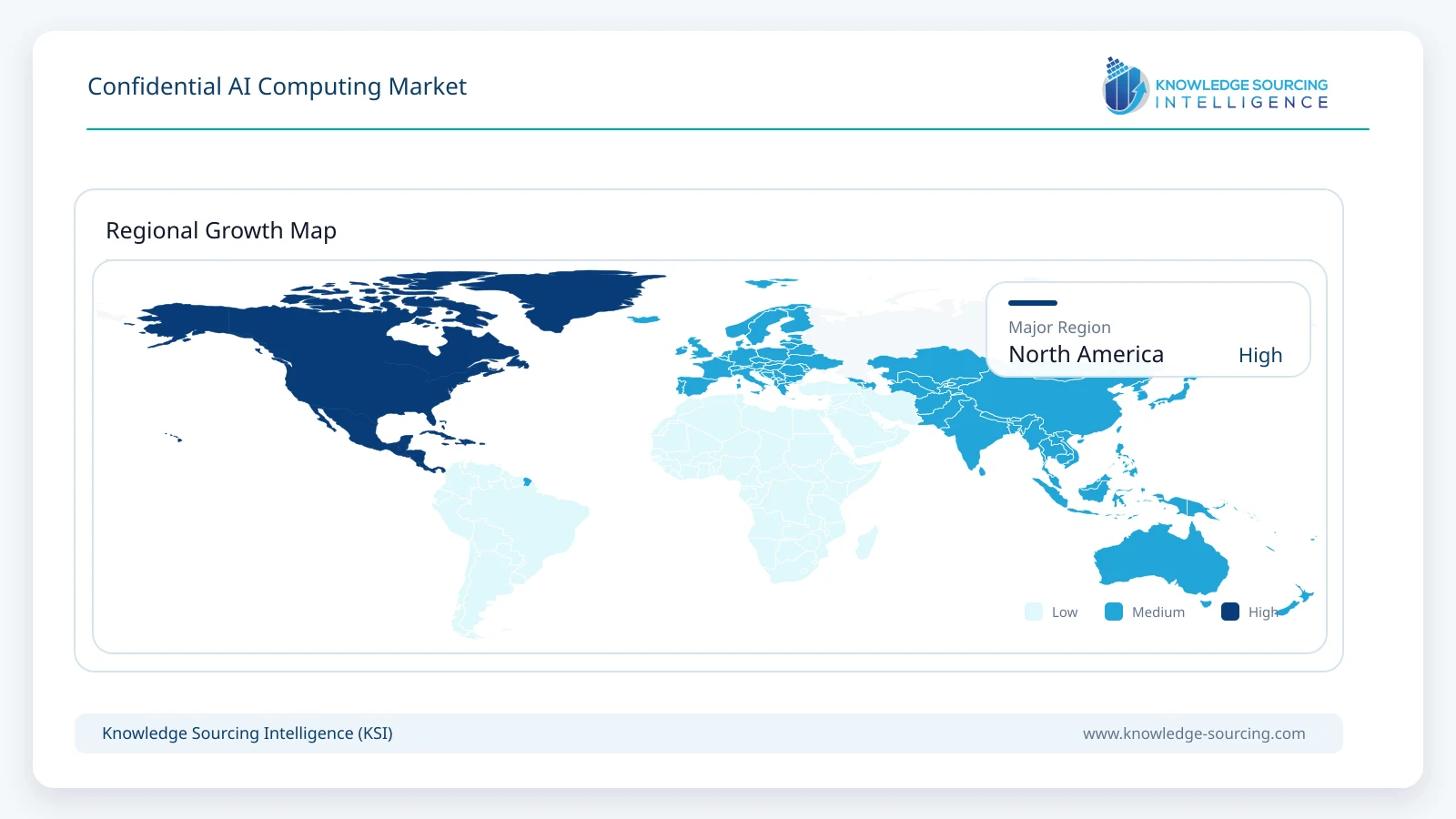
The North American market is projected to reach approximately USD 850 million in 2031. The United States accounts for the largest country allocation because hyperscaler investment and AI application adoption create a larger addressable customer pool than neighboring markets. Growth also depends on organizations progressing from pilots to recurring confidential workloads and paid attestation services.
Asia Pacific
Asia Pacific is expected to show the fastest expansion among the three largest regional markets as national AI infrastructure programs, enterprise modernization and regulated data workloads move toward confidential execution. Japan, South Korea, Singapore, India and Australia have potential demand for verifiable private AI in banking, health, government and specialized industrial deployments, while China has a substantial domestic demand pool subject to a different supplier and policy environment.
The Asia Pacific market is projected to reach approximately USD 520 million in 2031. Regional growth will depend on the availability of compliant confidential hardware, cloud zones, deployment partners and trusted key-management services. Fortanix and NTT DATA’s February 2026 collaboration on sovereign AI factories illustrates how platform providers and integrators are packaging these functions into enterprise deployment programs.
Competitive Landscape
The market brings together cloud operators, accelerator and processor developers, confidentiality software vendors and implementation partners. Microsoft and Google compete through managed confidential AI infrastructure, while NVIDIA, Intel and AMD provide hardware-rooted features and associated trust mechanisms. Fortanix, Edgeless Systems, Anjuna Security, Rafay and Decentriq contribute specialized confidentiality, privacy-preserving execution or sensitive-data collaboration capabilities.
Competition is increasingly tied to supported hardware breadth, policy automation, composable attestation, model portability and integration with existing AI operating environments. Suppliers that can simplify secure key release and enterprise lifecycle controls may capture software value beyond the incremental protected-compute premium. AWS Nitro Enclaves is relevant to protected CPU-side preparation and secret handling, but it should not be represented as a general equivalent to an attested GPU execution service.
Recent Developments
October 2026: Google Cloud made Confidential G4 instances with NVIDIA RTX PRO 6000 Blackwell GPUs generally available, expanding commercial access to protected GPU execution.
October 2026: Fortanix introduced CNCF Confidential Containers support for its Confidential AI platform, targeting Kubernetes-managed sensitive AI applications.
July 2026: NVIDIA discussed Blackwell confidential-computing performance improvements and attestation-enabled protection of model weights and data during inference.
June 2026: Google Cloud introduced Confidential G4 preview capabilities and Confidential GKE integration in its expanded protected AI infrastructure portfolio.
March 2026: Fortanix announced confidential inference support for licensed proprietary models running on enterprise-managed AI infrastructure.
March 2026: Edgeless Systems introduced its NVIDIA-enabled Privatemode AI initiative for European government and regulated-sector confidential inference.
Market Outlook
Confidential AI computing revenue is expected to expand as cloud providers commercialize confidential accelerator instances and enterprises establish repeatable policies for protected model execution. Adoption is likely to begin with inference against sensitive data and licensed private models before extending across more complex fine-tuning, AI agents and collaborative analytics. Vendor competition will center on deployment simplicity, trustworthy attestation and support for current GPU architectures rather than encryption features alone.
Over the forecast period, protected compute is likely to evolve from a narrowly configured security feature into a routine choice for selected high-value AI workloads. The pace of that transition will be governed by compatible hardware capacity, service economics and enterprise governance practices, with public cloud and private AI infrastructure both retaining commercial importance.
Confidential AI Computing Market Scope:
| Report Metric | Details |
|---|---|
| Total Market Size in 2026 | USD 0.31 billion |
| Total Market Size in 2031 | USD 2.25 billion |
| Forecast Unit | USD Billion |
| Growth Rate | 48.65% |
| Study Period | 2021 to 2031 |
| Historical Data | 2021 to 2024 |
| Base Year | 2025 |
| Forecast Period | 2026 – 2031 |
| Segmentation | Offering, Processing Stage, Compute Architecture, Deployment Model, Protection Objective, Organization Size, End User, Geography |
| Companies |
|
| Customization Scope | 15% Free Customization included with purchase — Request Custom Breakdown → |
| Sample & Data Access | PDF Sample, Excel Databook & Analyst Briefing — Download Free Sample → |
Market Segmentation
By Offering
Confidential Cloud-Compute Premiums
Managed Confidential AI Execution
Confidential AI Platforms and Attestation
Implementation and Specialist Services
By Processing Stage
Protected AI Inference
Confidential Training and Fine-Tuning
Protected Data Preparation and Analytics
By Compute Architecture
GPU-Backed Confidential Execution
CPU TEE-Backed AI Workloads
Hybrid CPU-GPU and Mixed-Trust Environments
By Deployment Model
Public Cloud
Private Cloud and On-Premises
Hybrid and Edge
By Protection Objective
Confidentiality of Enterprise Data
Protection of Proprietary Model IP
Secure Multi-Party AI Collaboration
By Organization Size
Large Enterprises
Medium-Sized Organizations
Small Organizations
By End User
Banking, Financial Services and Insurance
Healthcare and Life Sciences
Technology and AI Services
Government and Defense
Manufacturing and Automotive
Other Industries
By Geography
North America
United States
Canada
Mexico
South America
Brazil
Argentina
Rest of South America
Europe
Germany
United Kingdom
France
Italy
Spain
Netherlands
Rest of Europe
Middle East and Africa
Saudi Arabia
United Arab Emirates
Israel
South Africa
Rest of Middle East and Africa
Asia Pacific
China
Japan
India
South Korea
Australia
Singapore
Rest of Asia Pacific
Table of Contents
1. EXECUTIVE SUMMARY
1.1. Market Opportunity and Key Findings
1.2. Confidential AI Computing Market Size, 2026-2031
1.3. Technology and Deployment Outlook
1.4. Regional Opportunity Summary
2. MARKET SNAPSHOT
2.1. Market Overview
2.2. Market Definition
2.3. Scope of the Study
2.4. Market Segmentation
2.5. Currency, Base and Forecast Years
3. BUSINESS LANDSCAPE
3.1. Market Drivers
3.1.1. Increasing Use of Sensitive Enterprise Data
3.1.2. Protection of Proprietary Model Weights
3.1.3. Expansion of Confidential GPU Options
3.1.4. Sovereign AI and Cross-Organization Collaboration
3.1.5. Enterprise Adoption of Attestation-Aware Platforms
3.2. Market Restraints
3.2.1. Limited Hardware and Region Availability
3.2.2. Operational Complexity of Key and Attestation Policies
3.2.3. Cost Premiums and Cloud Economics
3.2.4. Performance and Workload Compatibility Constraints
3.2.5. Security Boundaries Do Not Eliminate Application Risk
3.3. Market Opportunities
3.4. Porter’s Five Forces Analysis
3.5. Industry Value Chain Analysis
3.6. Policies and Regulations
3.7. Strategic Recommendations
4. TECHNOLOGICAL OUTLOOK
4.1. Trusted Execution Environments
4.2. Confidential CPU and GPU Architectures
4.3. Composite Attestation and Key Release
4.4. Confidential Containers and AI Orchestration
4.5. Protection of Model Weights and Inference Data
5. CONFIDENTIAL AI COMPUTING MARKET BY OFFERING
5.1. Introduction
5.2. Confidential cloud-compute premiums
5.3. Managed confidential AI execution
5.4. Confidential AI platforms and attestation
5.5. Implementation and specialist services
6. CONFIDENTIAL AI COMPUTING MARKET BY PROCESSING STAGE
6.1. Introduction
6.2. Protected AI inference
6.3. Confidential training and fine-tuning
6.4. Protected data preparation and analytics
7. CONFIDENTIAL AI COMPUTING MARKET BY COMPUTE ARCHITECTURE
7.1. Introduction
7.2. GPU-backed confidential execution
7.3. CPU TEE-backed AI workloads
7.4. Hybrid CPU-GPU and mixed-trust environments
8. CONFIDENTIAL AI COMPUTING MARKET BY DEPLOYMENT MODEL
8.1. Introduction
8.2. Public cloud
8.3. Private cloud and on-premises
8.4. Hybrid and edge
9. CONFIDENTIAL AI COMPUTING MARKET BY PROTECTION OBJECTIVE
9.1. Introduction
9.2. Confidentiality of enterprise data
9.3. Protection of proprietary model IP
9.4. Secure multi-party AI collaboration
10. CONFIDENTIAL AI COMPUTING MARKET BY ORGANIZATION SIZE
10.1. Introduction
10.2. Large enterprises
10.3. Medium-sized organizations
10.4. Small organizations
11. CONFIDENTIAL AI COMPUTING MARKET BY END USER
11.1. Introduction
11.2. Banking, financial services and insurance
11.3. Healthcare and life sciences
11.4. Technology and AI services
11.5. Government and defense
11.6. Manufacturing and automotive
11.7. Other industries
12. CONFIDENTIAL AI COMPUTING MARKET BY GEOGRAPHY
12.1. North America
12.1.1. United States
12.1.2. Canada
12.1.3. Mexico
12.2. South America
12.2.1. Brazil
12.2.2. Argentina
12.2.3. Rest of South America
12.3. Europe
12.3.1. Germany
12.3.2. United Kingdom
12.3.3. France
12.3.4. Italy
12.3.5. Spain
12.3.6. Netherlands
12.3.7. Rest of Europe
12.4. Middle East and Africa
12.4.1. Saudi Arabia
12.4.2. United Arab Emirates
12.4.3. Israel
12.4.4. South Africa
12.4.5. Rest of Middle East and Africa
12.5. Asia Pacific
12.5.1. China
12.5.2. Japan
12.5.3. India
12.5.4. South Korea
12.5.5. Australia
12.5.6. Singapore
12.5.7. Rest of Asia Pacific
13. COMPETITIVE ENVIRONMENT AND ANALYSIS
13.1. Major Players and Strategy Analysis
13.2. Market Share Analysis
13.3. Mergers, Acquisitions, Agreements, and Collaborations
13.4. Competitive Dashboard
14. COMPANY PROFILES
14.1. Microsoft Corporation
14.2. Google LLC
14.3. NVIDIA Corporation
14.4. Fortanix Inc.
14.5. Intel Corporation
14.6. Advanced Micro Devices, Inc.
14.7. Edgeless Systems GmbH
14.8. Amazon Web Services, Inc.
14.9. NTT DATA Group Corporation
14.10. Anjuna Security, Inc.
14.11. Rafay Systems, Inc.
14.12. Decentriq AG
15. APPENDIX
15.1. Research Methodology
15.2. Data Sources
15.3. Definitions and Abbreviations





Frequently asked questions
What is the projected Confidential AI Computing market size by 2031?
The Confidential AI Computing Market is projected to reach USD 2.25 billion by 2031.
What is the Confidential AI Computing market's projected growth rate?
The Confidential AI Computing Market is projected to grow at a CAGR of 48.65% during the forecast period.
Which region leads the global Confidential AI Computing market in 2026?
North America leads with approximately 43% of the global market in 2026.
Which Confidential AI segment drives significant revenue in 2026?
Protected AI inference represents approximately 45% of market revenue in 2026.
Which region is expected to expand fastest through 2031?
Asia Pacific is expected to expand fastest among the largest regions through 2031.
What core technologies enable Confidential AI deployments?
Hardware TEEs, cryptographic verification, CPU isolation, and supported GPUs are key.
Cite this report
Knowledge Sourcing Intelligence. (Oct 2026). Confidential AI Computing Market Size, Share & Growth Forecast (2026-2031). https://www.knowledge-sourcing.com/report/confidential-ai-computing-market