
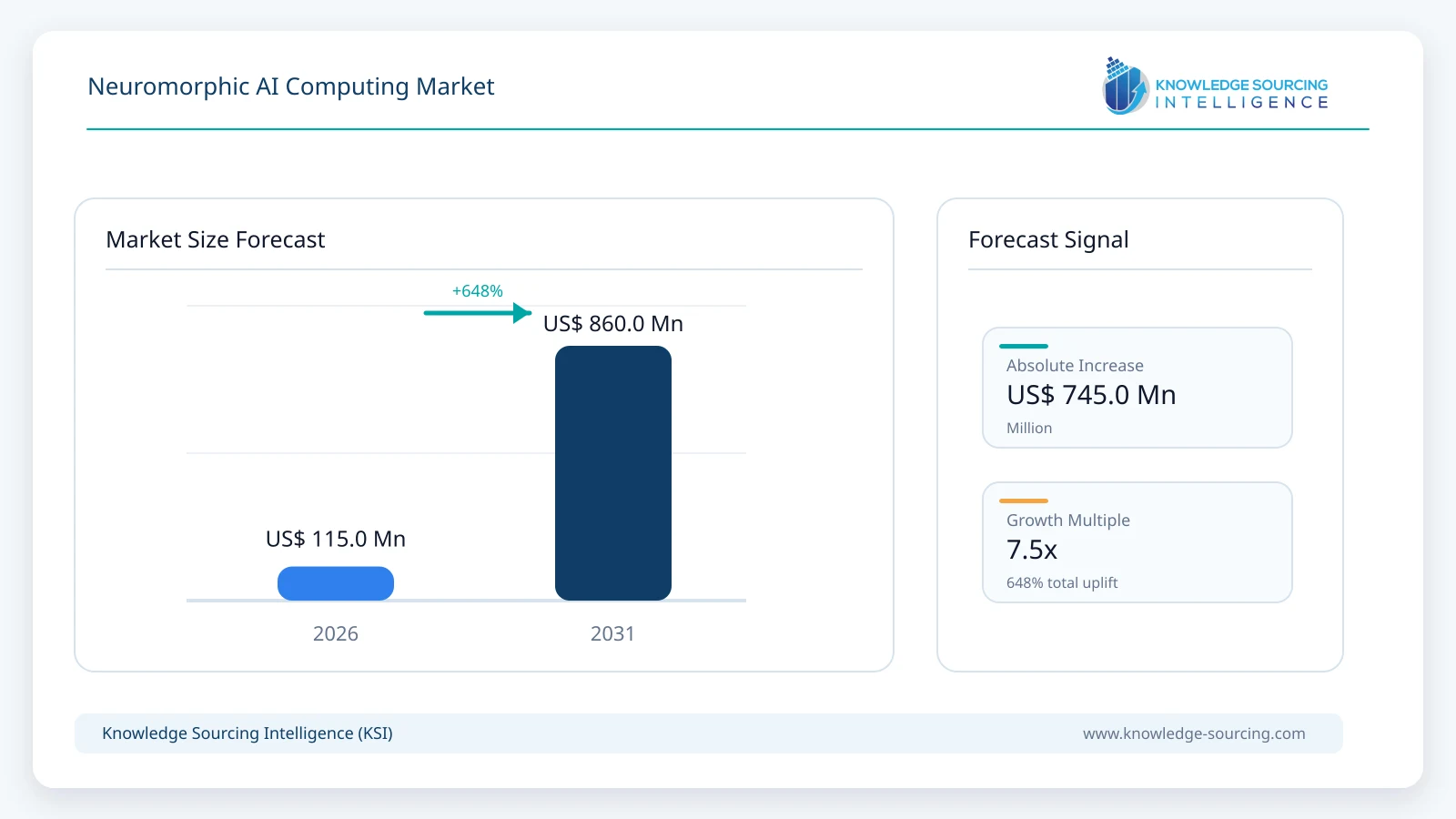
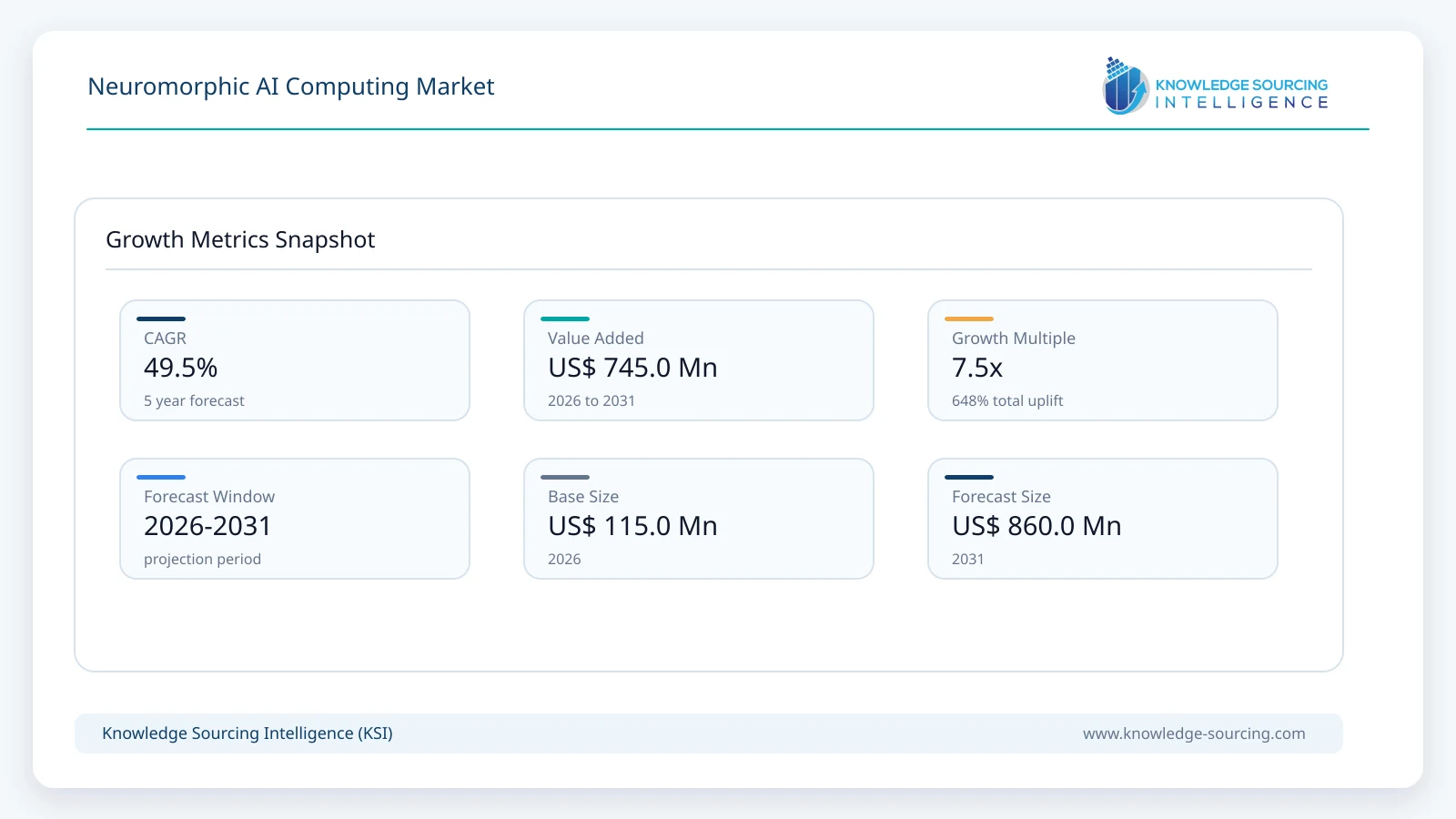
The neuromorphic AI computing market is forecast to grow at a CAGR of 49.5%, reaching approximately USD 860 million in 2031 from USD 115 million in 2026.
Highlights:
- 1Digital spiking neural processors represent approximately 42% of 2026 market revenue, supported by programmable event-driven inference and reusable embedded software toolchains.
- 2Neuromorphic processor and SoC products account for about 38% of 2026 spending, as chip-level design-ins become more important than one-off demonstrations.
- 3Sensor-adjacent and embedded deployments contribute approximately 41% of the 2026 market because always-on inference is most attractive in energy-constrained devices.
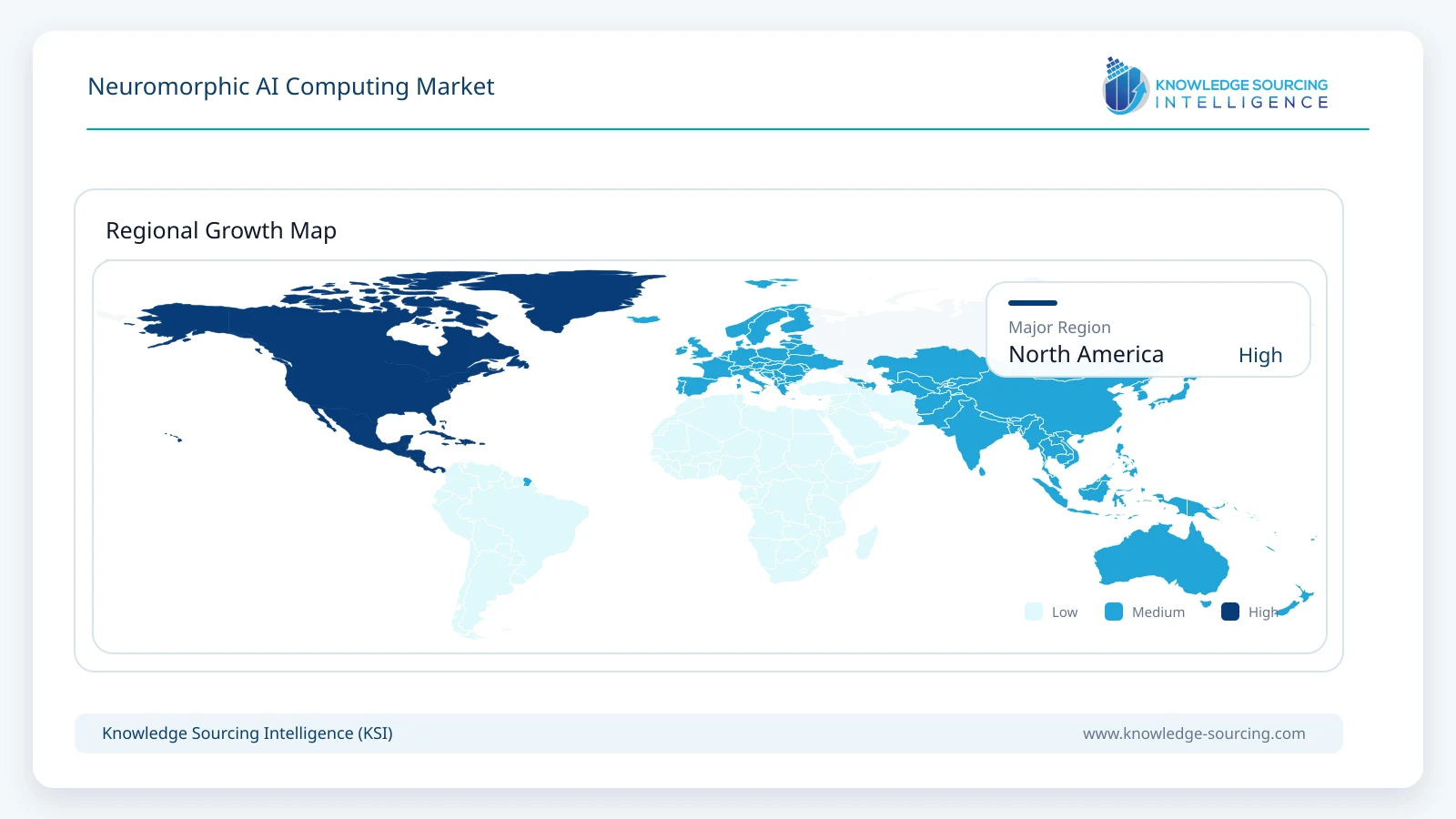
- 4North America accounts for roughly 36% of global 2026 spending, reflecting specialist IP developers, research customers and defense or industrial deployment programs.
- 5Asia Pacific is expected to deliver the fastest growth through 2031 as chip design, sensor-module integration and consumer-device manufacturing scale across China, Japan, India and South Korea.
Demand covers dedicated neuromorphic processors and system-on-chip devices, plug-in compute modules, many-core systems, licensable processor IP and directly associated enablement software. These products use event-driven information processing, spiking neural networks or related brain-inspired architectures to reduce repeated computation on largely unchanged signals.
Commercial adoption is concentrated where continuously operating sensors must recognize acoustic, motion, visual or biological events without the energy budget available to cloud-based AI. BrainChip has moved its AKD1500 family into initial production shipments and established additional module and IP licensing routes, while Innatera is embedding Pulsar microcontrollers into OEM-led intelligent sensing products. SynSense and POLYN serve specialized low-power sensing and analog-processing requirements, whereas SpiNNcloud addresses larger brain-inspired computing installations.
Market Overview
Neuromorphic computing replaces some conventional, regularly clocked processing steps with architectures that respond primarily to changes in input signals. Spiking neural networks carry information through discrete events, while mixed-signal approaches use analog circuits for selected calculations. The advantage is most commercially visible in short-response, low-data-volume tasks such as voice activity detection, vibration anomalies, gesture recognition and human-presence sensing, rather than in every type of deep-learning workload.
BrainChip’s AKD1500 platform offers a practical illustration of the shift toward packaged neuromorphic compute. Its June 2026 announcement covered initial production deliveries, and subsequent PCIe, M.2 and SPI form factors gave system designers different integration routes. Innatera’s Pulsar combines a spiking engine with a RISC-V controller and auxiliary processing, allowing OEMs to integrate local sensor intelligence without treating the neuromorphic accelerator as an isolated research chip.
Commercial products vary substantially in maturity and architecture. SynSense integrates event-driven vision sensing with spiking processing in Speck and applies recurrent spiking networks to biosignal workloads through Xylo. POLYN’s NeuroVoice uses analog neural signal processing but remained at engineering-silicon and evaluation stages during 2026. Intel’s Hala Point is an important technology demonstration, yet its research status makes it different from routine production procurement for consumer or industrial equipment.
Market Trends
Neuromorphic Chips Are Moving Into Practical Edge Form Factors
System developers increasingly need neuromorphic functions as ordinary engineering components, rather than specialized laboratory devices. BrainChip introduced a commercially available AKD1500 PCIe development card in September 2026 and expanded the family with an SPI-connected coprocessor in October. The availability of deployable modules, toolchains and straightforward host connections reduces the effort required to test continuous inference within existing MCU and industrial-PC designs.
Innatera’s Pulsar-based Joya EdgeCore module demonstrates the same shift in consumer hardware. A complete module for audio intelligence is a more accessible integration point for device manufacturers than independently implementing neuromorphic models, power management and peripheral interfaces.
Low-Power Audio and Event Vision Are Leading Initial Adoption
Always-on acoustic recognition, presence sensing and event-driven vision fit the event-processing strengths of neuromorphic chips. SynSense’s Speck integrates a dynamic vision sensor with a spiking processor, limiting activity to meaningful changes within the visual field. POLYN’s NeuroVoice approach compiles voice-detection networks into analog silicon, minimizing continuous microcontroller intervention during wake-word and human-voice detection.
Semiconductor IP Is Becoming an Important Commercial Route
Licensable neuromorphic cores allow established semiconductor design firms to incorporate specialized inference into their own system-on-chip products. BrainChip’s May 2026 agreement with ASICLAND expanded distribution of Akida IP, while its March licensing arrangement with EDGEAI targeted future low-power smart-metering devices. Such agreements broaden reach without requiring each supplier to manufacture every finished processor itself, although design wins do not automatically represent high-volume shipments.
Research-Scale Systems Are Informing Future Sparse AI Hardware
Many-core platforms continue to explore how event-driven and dynamically sparse computation could support more demanding applications. SpiNNcloud offers SpiNNaker2 hardware for large neuromorphic installations, while Intel’s Loihi 2-based Hala Point operates as an advanced research platform. These systems help validate software, scalability and energy-management techniques, but the route from research procurement to production-scale AI infrastructure remains longer than for embedded sensing chips.
Device economics are becoming more important as engineers compare dedicated neuromorphic chips with alternative low-power accelerators. A specialized processor may reduce the computation needed for a continuous sensor task, but designers must also account for host processor activity, memory requirements, firmware development, peripheral interfaces and qualification work. Suppliers that provide production-ready reference designs and tested model deployment paths can therefore create more value than vendors relying only on attractive accelerator benchmarks.
The business model is also changing as companies expand beyond development kits. Semiconductor IP licenses can place a neuromorphic architecture into the customer’s own chip, while modular board products allow faster evaluation within existing equipment. These commercial routes have different order sizes and renewal patterns: prototype boards provide early revenue, but high-volume processor shipments and repeated licensing programs are expected to contribute more significantly as the market develops.
Segment Analysis
By Offering: Neuromorphic Processors and SoCs
Neuromorphic processors and system-on-chip products form the largest offering category because high-volume opportunity ultimately depends on embedding event-driven compute into sensor modules, wearables, industrial nodes and intelligent endpoints. Device integration is progressing through standalone chips, MCU companions and processor designs licensed into customer-specific SoCs.
The segment is projected to reach approximately USD 447.2 million by 2031. Suppliers such as BrainChip, Innatera and SynSense are addressing distinct workloads, ranging from audio and anomaly detection to event-based vision and biosignal processing. Adoption depends on device-level cost, usable software frameworks and qualified manufacturing rather than computational performance claims alone.
By Architecture: Digital Spiking Neural Processors
Digital spiking designs lead the architecture split because they can support programmable event processing with relatively familiar semiconductor design, verification and software-development approaches. BrainChip’s Akida and SynSense’s digital spiking products illustrate the value of event-triggered data movement and inference within constrained power envelopes.
Digital spiking neural processors are estimated to reach approximately USD 395.6 million in 2031. Mixed-signal and analog approaches will remain important in narrow always-on sensing tasks, but broader commercial deployment needs a stable SDK, model conversion path and a practical route to OEM verification and long-lived software support.
By Application: Audio and Environmental Signal Recognition
Audio and environmental signal recognition is an early source of demand because voice activity, acoustic events, movement and vibration can be assessed from short temporal patterns rather than repeated high-resolution inference. Neuromorphic processors can reduce the energy needed for always-listening systems, particularly in consumer wearables, safety equipment and remote industrial monitoring nodes.
The application segment is projected to approach USD 232.2 million by 2031. Expansion will be supported by ambient-intelligence devices, industrial acoustic monitoring and low-power embedded products, while robotics and autonomous control applications are expected to grow faster from a smaller commercial base.
Market Drivers
Power Limits in Always-On Sensor Products
Battery-operated wearables, smart-home equipment and distributed monitoring nodes must collect and classify signals for long periods without frequent charging or continuous cloud connectivity. Event-driven processing concentrates computation on new inputs and can reduce the active processing burden when sensors remain quiet.
Growing Need for Fast On-Device Responses
Industrial safety devices, robotics and autonomous equipment require local interpretation of environmental changes. Neuromorphic architectures can respond to input events without waiting for large processing batches, improving suitability for low-latency detection and simple control tasks.
Commercial Availability of Dedicated Neuromorphic Silicon
Initial production shipments of BrainChip AKD1500 devices and Innatera’s commercially available Pulsar processors give OEMs physical components to evaluate, qualify and incorporate into products. This reduces the gap between research demonstrations and repeatable engineering procurement.
Expansion of OEM Licensing and Development Ecosystems
Semiconductor IP licensing arrangements, development boards and modular reference platforms let chip developers reach additional device manufacturers without controlling every downstream hardware assembly. ASICLAND, EDGEAI and electronics-design partners illustrate distribution routes beyond specialist research customers.
Demand for Private and Resilient Edge Intelligence
Sensitive audio, visual and biosignal applications benefit when decisions remain within the local device. Reduced uplink dependence can also improve system resilience in factories, mobility applications and remote assets with intermittent connectivity.
Market Restraints
Limited Production Scale and Supplier Breadth
The commercial neuromorphic processor market remains concentrated in a small group of semiconductor and system developers. Low unit volumes, qualification costs and limited publicly reported revenue can restrict purchasing confidence among high-volume OEMs.
Competition from Mature MCU and NPU Platforms
Conventional microcontrollers, low-power DSPs and integrated neural processors already serve many audio, vision and sensing tasks with well-understood software tools. Neuromorphic suppliers must prove lower total system power and cost, not merely theoretical efficiency.
Model Conversion and Developer Skills
Spiking and analog neural approaches require specialized training, model conversion or calibration flows. Device teams accustomed to mainstream machine-learning frameworks may need additional engineering resources before they can integrate and maintain neuromorphic workloads.
Qualification Requirements in Industrial and Mobility Systems
Industrial, medical and mobility devices often require detailed reliability evidence, stable software support and extended product lifecycles. Smaller neuromorphic suppliers can face long design-win cycles before evaluation units translate into recurring production orders.
Application-Specific Performance Tradeoffs
Event-driven computation is not uniformly better for dense matrix workloads or all generative AI tasks. Analog precision, workload sparsity, memory capacity and host communication overhead can reduce the benefit of specialized processors outside their intended use cases.
Regional Outlook
North America
North America leads the current neuromorphic AI computing market through a concentration of processor IP development, advanced semiconductor R&D and industrial or defense evaluation programs. BrainChip maintains a substantial United States commercial and engineering presence, while General Vision provides longstanding neuromorphic pattern-recognition IP. Universities, government laboratories and product-development teams contribute to demand for research systems and prototype platforms.
The region is projected to reach approximately USD 266.6 million in 2031. Growth will come increasingly from embedded processor adoption, OEM licensing and specialist industrial systems, while research-oriented installations remain a smaller and more selective revenue stream. Qualification and integration support are important to translating prototype performance into orders for finished devices.
Asia Pacific
Asia Pacific is positioned for the fastest growth as neuromorphic processing becomes available to manufacturers of wearables, household devices, industrial sensors and mobility components. China, Japan, South Korea, India and Taiwan provide significant electronics design and manufacturing capacity, while regional chip developers and IP licensees are evaluating architectures that bring inference closer to the sensor.
Asia Pacific revenue is projected to reach approximately USD 292.4 million by 2031, compared with an estimated USD 27.6 million in 2026. Innatera’s relationship with China-based Joya and BrainChip’s Korean semiconductor licensing activity show how regional product partnerships can translate new processor technology into manufactured modules and custom chips, although scale-up remains dependent on successful device qualification and repeat orders.
Competitive Landscape
The competitive landscape combines specialized neuromorphic semiconductor vendors, brain-inspired systems developers and established research organizations. BrainChip competes through its digital Akida architecture, licensable IP and expanding choice of packaged products. Innatera emphasizes Pulsar’s ultra-low-power sensor-edge use cases and OEM integration partnerships. SynSense targets event-based vision and biosignal interpretation through Speck and Xylo, while POLYN is developing analog neural front ends for extremely low-power audio and physical sensing.
SpiNNcloud addresses larger-scale research and sparse-computing workloads with many-core hardware, whereas General Vision offers established NeuroMem technology and ASIC licensing. Commercial differentiation increasingly depends on complete development tools, available silicon, straightforward processor interfaces and customer qualification support. Intel and IBM provide influential architectural research, but their research systems should not be mistaken for equivalent-volume merchant neuromorphic processor businesses.
Recent Developments
October 22, 2026: BrainChip introduced its AKD1500 SPI coprocessor, allowing existing microcontroller designs to add event-driven inference and local learning without replacing the host controller.
September 17, 2026: BrainChip launched an AKD1500 PCIe development card for workstations and industrial PCs, extending the reach of its neuromorphic chip to standard evaluation environments.
June 30, 2026: BrainChip announced commercial availability and initial production shipments of the AKD1500 processor, moving the platform beyond pre-production evaluation.
May 19, 2026: BrainChip signed a portfolio-wide IP distribution agreement with ASICLAND, extending availability of Akida technology through third-party SoC design services.
March 12, 2026: Innatera and Joya Design presented the Pulsar-powered EdgeCore audio module, demonstrating an ODM integration route for consumer and smart-home products.
March 9, 2026: POLYN Technology demonstrated NeuroVoice analog neuromorphic silicon at Embedded World, providing evidence of functional engineering chips for always-on audio applications.
Market Outlook
Neuromorphic computing revenue is expected to shift progressively toward production processors, MCU companions and embedded sensor-compute devices as development kits turn into qualified OEM products. Digital spiking architectures will retain a leading position through familiar manufacturing and software deployment routes, while analog front ends will address highly constrained audio and biosignal tasks where microwatt-scale operation is central to the product design.
Commercial momentum will remain uneven because the strongest economic gains occur in selected always-on workloads rather than across all AI inference. Broader device adoption will depend on robust software conversion tools, confirmed field reliability and repeatable manufacturing. Many-core research systems will continue influencing longer-term sparse AI computing, but near-term market expansion is more likely to come from smaller devices embedded into industrial and consumer products.
North America is expected to retain a strong position in processor IP, system development and research applications, while Asia Pacific gains share as device manufacturing partnerships expand. Competition will increasingly reflect proven energy savings at the complete system level, speed of OEM integration and dependable supplier execution rather than stand-alone benchmark claims.
Neuromorphic AI Computing Market Scope
| Report Metric | Details |
|---|---|
| Total Market Size in 2026 | USD 115 million |
| Total Market Size in 2031 | USD 860 million |
| Forecast Unit | Million |
| Growth Rate | 49.5% |
| Study Period | 2021 to 2031 |
| Historical Data | 2021 to 2024 |
| Base Year | 2025 |
| Forecast Period | 2026 – 2031 |
| Segmentation | Offering, Architecture, Deployment, Application, End User, Hardware Configuration, Sales Channel, Geography |
| Companies |
|
| Customization Scope | 15% Free Customization included with purchase — Request Custom Breakdown → |
| Sample & Data Access | PDF Sample, Excel Databook & Analyst Briefing — Download Free Sample → |
Market Segmentation
By Offering
Neuromorphic Processors and SoCs
Modules and Development Boards
Multichip Systems and Computing Platforms
Semiconductor IP and Design Licenses
Software and Deployment Services
By Architecture
Digital Spiking Neural Processors
Analog and Mixed-Signal Neuromorphic Computing
Many-Core Event-Driven Computing
Other Brain-Inspired Neuromorphic Circuits
By Deployment
Sensor-Adjacent and Embedded Devices
Industrial Edge Gateways and Controllers
Robotics and Autonomous Edge Platforms
Laboratory and Central Computing Systems
By Application
Audio and Environmental Signal Recognition
Event-Based Vision and Sensor Fusion
Industrial Anomaly and Condition Monitoring
Robotics and Autonomous Control
Healthcare and Biosignal Processing
Large-Scale Sparse Computing Research
By End User
Industrial and Infrastructure OEMs
Consumer Electronics and Wearable OEMs
Automotive and Mobility
Aerospace and Defense
Healthcare and Medical Devices
Research and Academic Institutions
By Hardware Configuration
Standalone Neuromorphic SoCs
MCU-Connected Coprocessors
Integrated Sensor-Compute Devices
Many-Core Boards and Rack Systems
By Sales Channel
Direct Component and System Sales
OEM Semiconductor IP Licensing
Integration and Development Partners
Research and Evaluation Procurement
By Geography
North America
United States
Canada
Mexico
South America
Brazil
Argentina
Rest of South America
Europe
Germany
United Kingdom
France
Netherlands
Italy
Rest of Europe
Middle East and Africa
Israel
United Arab Emirates
Saudi Arabia
South Africa
Rest of Middle East and Africa
Asia Pacific
China
Japan
South Korea
India
Australia
Taiwan
Rest of Asia Pacific
Table of Contents
1. EXECUTIVE SUMMARY
1.1. Market Opportunity and Key Findings
1.2. Neuromorphic AI Computing Market Size, 2026-2031
1.3. Technology and Regional Outlook
2. MARKET SNAPSHOT
2.1. Market Overview
2.2. Market Definition
2.3. Scope of the Study
2.4. Market Segmentation
3. BUSINESS LANDSCAPE
3.1. Market Drivers
3.1.1. Power Limits in Always-On Sensor Products
3.1.2. Growing Need for Fast On-Device Responses
3.1.3. Commercial Availability of Dedicated Neuromorphic Silicon
3.1.4. Expansion of OEM Licensing and Development Ecosystems
3.1.5. Demand for Private and Resilient Edge Intelligence
3.2. Market Restraints
3.2.1. Limited Production Scale and Supplier Breadth
3.2.2. Competition from Mature MCU and NPU Platforms
3.2.3. Model Conversion and Developer Skills
3.2.4. Qualification Requirements in Industrial and Mobility Systems
3.2.5. Application-Specific Performance Tradeoffs
3.3. Market Opportunities
3.4. Porter’s Five Forces Analysis
3.5. Industry Value Chain Analysis
3.6. Policies and Regulations
3.7. Strategic Recommendations
4. TECHNOLOGICAL OUTLOOK
4.1. Spiking Neural Networks and Digital Neuromorphic Cores
4.2. Analog and Mixed-Signal Neural Processing
4.3. Event-Based Sensors and Integrated Vision
4.4. On-Chip Learning and Model Conversion
4.5. Many-Core Neuromorphic Computing Platforms
4.6. Neuromorphic Processor Software Toolchains
5. NEUROMORPHIC AI COMPUTING MARKET BY OFFERING
5.1. Introduction
5.2. Neuromorphic Processors and SoCs
5.3. Modules and Development Boards
5.4. Multichip Systems and Computing Platforms
5.5. Semiconductor IP and Design Licenses
5.6. Software and Deployment Services
6. NEUROMORPHIC AI COMPUTING MARKET BY ARCHITECTURE
6.1. Introduction
6.2. Digital Spiking Neural Processors
6.3. Analog and Mixed-Signal Neuromorphic Computing
6.4. Many-Core Event-Driven Computing
6.5. Other Brain-Inspired Neuromorphic Circuits
7. NEUROMORPHIC AI COMPUTING MARKET BY DEPLOYMENT
7.1. Introduction
7.2. Sensor-Adjacent and Embedded Devices
7.3. Industrial Edge Gateways and Controllers
7.4. Robotics and Autonomous Edge Platforms
7.5. Laboratory and Central Computing Systems
8. NEUROMORPHIC AI COMPUTING MARKET BY APPLICATION
8.1. Introduction
8.2. Audio and Environmental Signal Recognition
8.3. Event-Based Vision and Sensor Fusion
8.4. Industrial Anomaly and Condition Monitoring
8.5. Robotics and Autonomous Control
8.6. Healthcare and Biosignal Processing
8.7. Large-Scale Sparse Computing Research
9. NEUROMORPHIC AI COMPUTING MARKET BY END USER
9.1. Introduction
9.2. Industrial and Infrastructure OEMs
9.3. Consumer Electronics and Wearable OEMs
9.4. Automotive and Mobility
9.5. Aerospace and Defense
9.6. Healthcare and Medical Devices
9.7. Research and Academic Institutions
10. NEUROMORPHIC AI COMPUTING MARKET BY HARDWARE CONFIGURATION
10.1. Introduction
10.2. Standalone Neuromorphic SoCs
10.3. MCU-Connected Coprocessors
10.4. Integrated Sensor-Compute Devices
10.5. Many-Core Boards and Rack Systems
11. NEUROMORPHIC AI COMPUTING MARKET BY SALES CHANNEL
11.1. Introduction
11.2. Direct Component and System Sales
11.3. OEM Semiconductor IP Licensing
11.4. Integration and Development Partners
11.5. Research and Evaluation Procurement
12. NEUROMORPHIC AI COMPUTING MARKET BY GEOGRAPHY
12.1. North America
12.1.1. United States
12.1.2. Canada
12.1.3. Mexico
12.2. South America
12.2.1. Brazil
12.2.2. Argentina
12.2.3. Rest of South America
12.3. Europe
12.3.1. Germany
12.3.2. United Kingdom
12.3.3. France
12.3.4. Netherlands
12.3.5. Italy
12.3.6. Rest of Europe
12.4. Middle East and Africa
12.4.1. Israel
12.4.2. United Arab Emirates
12.4.3. Saudi Arabia
12.4.4. South Africa
12.4.5. Rest of Middle East and Africa
12.5. Asia Pacific
12.5.1. China
12.5.2. Japan
12.5.3. South Korea
12.5.4. India
12.5.5. Australia
12.5.6. Taiwan
12.5.7. Rest of Asia Pacific
13. COMPETITIVE ENVIRONMENT AND ANALYSIS
13.1. Major Players and Strategy Analysis
13.2. Market Share Analysis
13.3. Mergers, Acquisitions, Agreements and Collaborations
13.4. Competitive Dashboard
14. COMPANY PROFILES
14.1. BrainChip Holdings Ltd.
14.2. Innatera Nanosystems B.V.
14.3. SynSense AG
14.4. SpiNNcloud Systems GmbH
14.5. General Vision Inc.
14.6. POLYN Technology Ltd.
14.7. Neuromorphyx (Nex Novus d.o.o.)
14.8. EDGEAI Co., Ltd.
14.9. Intel Corporation
14.10. IBM Corporation
15. APPENDIX
15.1. Currency
15.2. Assumptions
15.3. Base and Forecast Years
15.4. Research Methodology
15.5. Abbreviations





Frequently asked questions
What is the projected Neuromorphic AI Computing market size by 2031?
The Neuromorphic AI Computing Market is forecast to reach USD 860 million by 2031.
What is the growth forecast (CAGR) for this market?
The Neuromorphic AI Computing Market is forecast to grow at a 49.5% CAGR.
Which technology segment holds the largest market share in 2026?
Digital spiking neural processors represent approximately 42% of 2026 revenue.
Where are neuromorphic AI computing deployments concentrated in 2026?
Sensor-adjacent and embedded deployments contribute approximately 41% of the 2026 market.
Which region leads in neuromorphic AI computing spending in 2026?
North America accounts for roughly 36% of global 2026 spending.
Which region is expected to deliver the fastest growth through 2031?
Asia Pacific is expected to deliver the fastest growth through 2031.
Cite this report
Knowledge Sourcing Intelligence. (Oct 2026). Neuromorphic AI Computing Market Size, Share & Growth Forecast (2026-2031). https://www.knowledge-sourcing.com/report/neuromorphic-ai-computing-market