
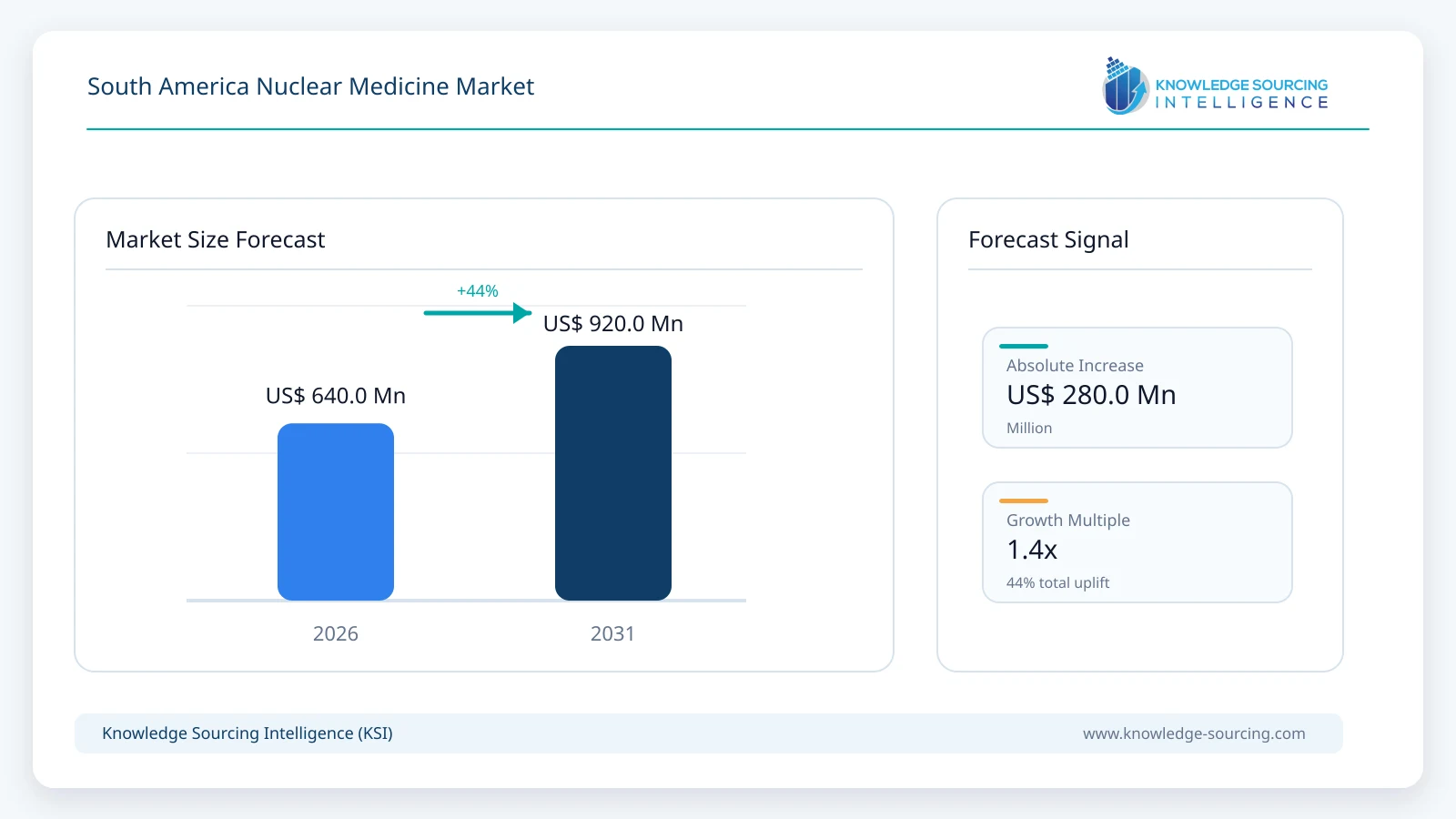
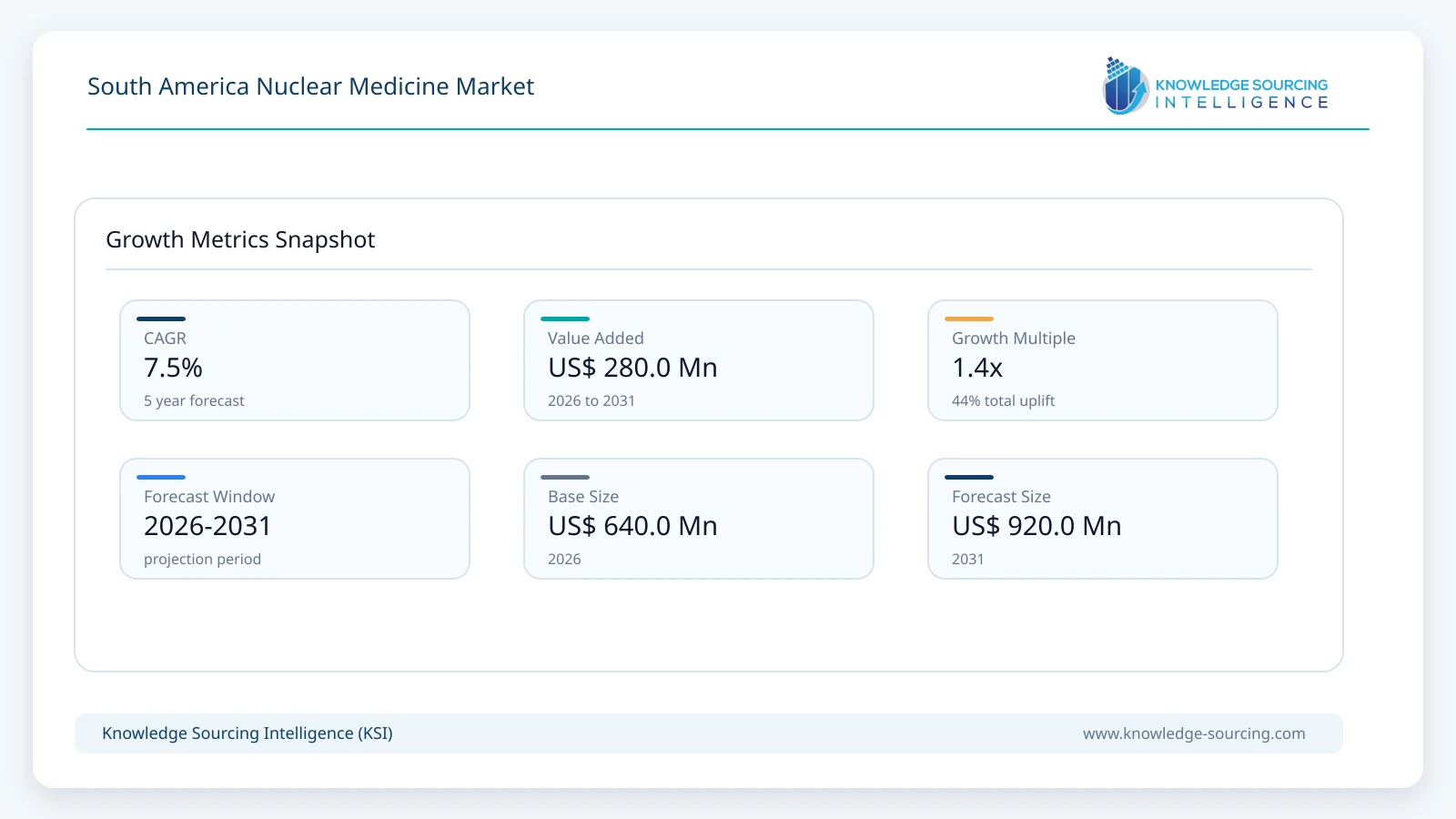
The South America nuclear medicine market is projected to increase from USD 640.0 million in 2026 to USD 920.0 million in 2031, representing a CAGR of 7.5% throughout the forecast period.
Highlights:
- 1SPECT accounts for approximately 62% of regional nuclear medicine revenue in 2026.
- 2PET is the fastest-growing imaging technology, supported by oncology and neurological applications.
- 3Brazil contributes approximately 44% of South America nuclear medicine revenue in 2026.
- 4Hospitals account for approximately 57% of market revenue due to integrated imaging infrastructure.
- 5Brazilian CNEN inputs support more than two million nuclear-medicine procedures annually.
- 6Isotope availability, imported equipment costs and specialist capacity remain the principal adoption constraints.
South America has a two-speed nuclear medicine landscape. Brazil and Argentina maintain established public-sector nuclear institutions, isotope production capabilities and specialized clinical centres, while access elsewhere is more concentrated in private hospitals and capital-city imaging networks. Brazil's IPEN/CNEN remains strategically important because it produces and distributes radiopharmaceuticals used across cardiology, oncology, neurology and other specialties. In February 2026, Brazil's nuclear regulator authorized operation of the IPEN Radiofarmácia responsible for technetium-99m generator production, reinforcing continuity of a supply chain that underpins routine SPECT imaging. Argentina's Comisión Nacional de Energía Atómica (CNEA), meanwhile, supports a network of nuclear medicine and radiotherapy centres and installed a cyclotron at INTECNUS in Bariloche in 2025 to strengthen local radiopharmaceutical production.
Demand is shifting gradually toward hybrid and quantitative molecular imaging. PET/CT capacity is expanding because fluorine-18 fluorodeoxyglucose (18F-FDG) and newer disease-specific tracers are increasingly used in cancer staging, treatment-response assessment and selected neurological pathways. SPECT remains the workhorse technology because of the broad availability and clinical versatility of technetium-99m. Equipment replacement also supports value growth as departments move toward cadmium zinc telluride (CZT) detectors, automated workflows, artificial intelligence-assisted reconstruction and more accurate quantification. These improvements raise clinical throughput and image quality, but the region still faces uneven access outside major cities and a dependence on imported scanners, parts and selected radioisotope inputs.
Selected Segment Estimates
Dimension | Selected Subsegment | 2026 Indicator | Forecast Interpretation |
Technology | SPECT | ~62% / USD 396.8M | Largest installed procedure base; grows steadily with detector and workflow upgrades. |
Technology | PET | ~38% / USD 243.2M | Fastest-growing technology; oncology and neurology expand tracer utilization. |
End User | Hospitals | ~57% / USD 364.8M | Lead revenue through integrated PET/CT, SPECT/CT and oncology pathways. |
Country | Brazil | ~44% / USD 281.6M | Largest market due to procedure scale, radiopharmacy and hospital infrastructure. |
Country | Argentina | ~27% / USD 172.8M | Strong specialized-centre network and domestic nuclear-technology capabilities. |
Technology | PET CAGR | ~9.5%, 2026-2031 | Higher-value tracers and hybrid imaging increase revenue faster than SPECT. |
Market Dynamics
Rising Cancer Burden Expands Molecular Imaging Requirements
Oncology is becoming a larger source of PET and SPECT utilization across South America. Brazil alone is expected to record approximately 781,000 new cancer cases annually during 2026-2028, according to the National Cancer Institute. Nuclear medicine supports staging, recurrence assessment, treatment selection and response monitoring for a growing range of tumors. Prostate cancer, breast cancer, lymphoma, lung cancer and neuroendocrine tumors are particularly relevant to molecular imaging. As oncology networks expand, PET/CT utilization rises alongside demand for disease-specific radiopharmaceuticals, while SPECT remains important in bone, cardiac and sentinel-node imaging.
Domestic Radiopharmaceutical Infrastructure Supports Procedure Availability
Short-lived isotopes make local production and distribution capacity critical. Brazil's CNEN network supplies roughly 430 clinics and hospitals and supports more than two million procedures per year, while Argentina has invested in cyclotron and radiopharmacy capabilities through its national nuclear institutions and specialized centres. These assets reduce some of the logistical constraints associated with importing short-half-life tracers and provide a platform for new radiopharmaceutical development. Public investment in production reliability and regulatory oversight therefore has a direct effect on the number of procedures that hospitals and diagnostic centres can perform.
Digital Detectors and Hybrid Imaging Raise Clinical Value per Installation
New molecular-imaging systems emphasize sensitivity, quantitative accuracy and workflow automation. CZT-based SPECT/CT platforms can improve count sensitivity and energy resolution, while newer PET systems use digital detectors, artificial intelligence-assisted reconstruction and larger axial fields of view to improve throughput and lower administered activity in selected protocols. These capabilities matter in South America because many nuclear-medicine departments must increase procedure throughput without proportionally increasing specialist staffing. Modernization therefore supports revenue not only through scanner replacement but also through software, service contracts and higher-complexity procedures.
High Capital Costs and Isotope Logistics Restrain Expansion Beyond Major Cities
Nuclear medicine requires more than imaging hardware. Facilities need radiation-shielded rooms, hot laboratories, trained physicians and technologists, quality-control systems, isotope transport procedures and regulatory approvals. PET adds cyclotron or radiopharmacy access because several tracers have short half-lives. Imported equipment and spare parts are exposed to exchange-rate volatility, while radioisotope production interruptions can affect procedure scheduling. These constraints keep advanced PET capacity concentrated in larger metropolitan areas and make SPECT the more accessible modality across a broader range of hospitals.
South America Nuclear Medicine Market Segment Analysis
By Technology
SPECT
SPECT remains the largest technology segment, contributing approximately USD 396.8 million in 2026. Its scale is supported by technetium-99m, which CNEN reports is used in more than 80% of the procedures supported by its Brazilian radiopharmaceutical network. SPECT is used across cardiology, bone imaging, thyroid and endocrine studies, renal function, pulmonary perfusion and selected oncology procedures. The installed base is mature, but replacement demand is strengthening as providers adopt SPECT/CT and CZT detector systems that offer improved sensitivity, faster acquisition and more reliable quantification. The segment is projected to grow at roughly 6.2% annually through 2031.
By Technology
PET
PET represents approximately USD 243.2 million in 2026 and is the faster-growing technology segment, with revenue projected to expand at about 9.5% annually through 2031. Oncology is the principal driver, supported by 18F-FDG and increasingly specialized tracers for prostate cancer and other indications. Neurology is becoming more relevant as PET is incorporated into pathways for neurodegenerative disease assessment and therapy eligibility. Growth is strongest where hospitals combine PET/CT capacity with reliable radiopharmaceutical access, and where public or private oncology networks can sustain the higher procedure cost relative to conventional imaging.
By End User
Hospitals
Hospitals account for approximately 57% of 2026 market revenue because major tertiary facilities combine nuclear medicine with oncology, cardiology, neurology, surgery and pathology services. Integrated clinical pathways create higher scanner utilization and support both routine SPECT and advanced PET procedures. Diagnostic imaging centres remain important, particularly in metropolitan private-health markets, but hospitals are more likely to justify high-capital hybrid systems, radiopharmacy infrastructure and multidisciplinary theranostic programs. Research institutions form a smaller commercial segment but play an outsized role in tracer development and specialist training.
Market and Demand Indicators
Indicator | Latest Development | Market Impact |
Brazil procedure base | CNEN inputs support >2 million procedures annually across ~430 clinics/hospitals. | Confirms a large recurring base for radiopharmaceutical and SPECT demand. |
Technetium utilization | Tc-99m is used in >80% of procedures supported by CNEN. | Keeps SPECT central to routine nuclear-medicine workflows. |
Cancer incidence | Brazil expects ~781,000 new cancer cases per year during 2026-2028. | Supports PET and SPECT utilization across diagnosis, staging and follow-up. |
Brazil radiopharmacy | IPEN Radiofarmácia received operating authorization in February 2026. | Supports continuity of strategic Tc-99m generator supply. |
Argentina infrastructure | CNEA supports a national network of specialized nuclear-medicine centres. | Creates a second major regional market for imaging and radiopharmacy. |
Technology cycle | New 2026 PET/MR and CZT SPECT/CT systems emphasize quantitative, AI-enabled workflows. | Raises replacement value and supports higher-complexity procedures. |
Brazil Market Analysis
Brazil accounts for approximately 44% of South America nuclear medicine revenue in 2026, equivalent to about USD 281.6 million. The country's lead is supported by the scale of the Unified Health System (SUS), large private hospital networks, domestic radiopharmaceutical production and the concentration of advanced oncology centres in São Paulo, Rio de Janeiro, Minas Gerais, Paraná and other major states. CNEN reports that its radioisotope and radiopharmaceutical inputs serve around 430 clinics and hospitals and contribute to more than two million procedures annually. Technetium-99m remains the backbone of routine nuclear imaging, while PET is expanding as oncology programs add higher-value diagnostic tracers and improve access to hybrid imaging.
Supply reliability is a central market issue. In February 2026, the Autoridade Nacional de Segurança Nuclear authorized operation of the IPEN Radiofarmácia responsible for technetium-99m generator production. CNEN subsequently implemented a 24% price adjustment for its radioisotope and radiopharmaceutical portfolio from August 2026, citing imported inputs, specialized labor and operating costs. At the same time, Brazil and China are developing cooperation around radiopharmaceutical research, industrial-scale production and equipment access. These developments support longer-term capacity, but they also highlight the cost sensitivity and regulatory complexity of maintaining a dependable nuclear-medicine supply chain.
Competitive Landscape
Competition spans imaging-system manufacturers, radiopharmaceutical companies and isotope suppliers. GE HealthCare, Siemens Healthineers and Philips compete in PET/CT and SPECT/CT platforms, while United Imaging is expanding its molecular-imaging portfolio internationally. Bracco, Curium, Lantheus, Cardinal Health, Jubilant Radiopharma, Telix Pharmaceuticals and Eckert & Ziegler participate in diagnostic radiopharmaceuticals, isotopes or related services. Local market access depends on regulatory approval, reliable distribution, equipment service coverage and the ability to support hospitals with training and lifecycle maintenance. Public nuclear institutions remain strategically important in Brazil and Argentina because isotope production and research capabilities directly affect commercial procedure availability.
Technology competition is increasingly centered on quantification, detector sensitivity, workflow automation and theranostics-readiness. GE HealthCare introduced StarGuide GX in 2026 with CZT-based SPECT/CT capabilities designed for a broad range of radionuclide energies, while Siemens Healthineers received U.S. clearance for the Biograph One PET/MR system with AI-enabled reconstruction. Lantheus also received approval for a new formulation of its PSMA PET agent PYLARIFY in 2026. Although these launches are not South America-specific, they indicate the technology and tracer direction that large regional centres increasingly evaluate during capital replacement and clinical expansion.
Recent Developments
2026: Brazil and China discussed broader nuclear cooperation, including ongoing collaboration in radioisotopes and radiopharmaceuticals.
September 2026: GE HealthCare announced StarGuide GX 4D CZT SPECT/CT, extending the technology cycle toward higher-sensitivity quantitative imaging.
August 2026: Brazil's nuclear regulator met HTA regarding the IPEN/CNEN radiopharmacy cooperation project and associated regulatory requirements.
June 2026: CNEN announced a 24% price adjustment for its radioisotope and radiopharmaceutical portfolio, effective August 2026, to sustain production.
February 2026: Brazil's nuclear regulator authorized operation of the IPEN/CNEN Radiofarmácia responsible for technetium-99m generator production.
January 2026: Siemens Healthineers received U.S. clearance for Biograph One PET/MR, combining functional and anatomical imaging with AI-enabled reconstruction.
January 2025: Argentina's CNEA installed a cyclotron at INTECNUS in Bariloche to produce radiopharmaceuticals locally.
South America Nuclear Medicine Market Scope:
| Report Metric | Details |
|---|---|
| Total Market Size in 2026 | USD 640.0 million |
| Total Market Size in 2031 | USD 920.0 million |
| Forecast Unit | Million |
| Growth Rate | 7.5% |
| Study Period | 2021 to 2031 |
| Historical Data | 2021 to 2024 |
| Base Year | 2025 |
| Forecast Period | 2026 – 2031 |
| Segmentation | Technology, Clinical Application, End-User, Geography |
| Companies |
|
Market Segmentation
By Technology
SPECT
PET
By Clinical Application
Oncology
Cardiology
Neurology
Endocrinology
Musculoskeletal and Bone Imaging
Other Applications
By End User
Hospitals
Diagnostic Centres
Research Institutes
By Country
Brazil
Argentina
Colombia
Chile
Rest of South America
Table of Contents
1. EXECUTIVE SUMMARY
2. MARKET SNAPSHOT
2.1. Market Overview
2.2. Market Segmentation
3. BUSINESS LANDSCAPE
3.1. Market Drivers
3.1.1. Rising Cancer Burden Expands Molecular Imaging Requirements
3.1.2. Domestic Radiopharmaceutical Infrastructure Supports Procedure Availability
3.1.3. Digital Detectors and Hybrid Imaging Raise Clinical Value per Installation
3.2. Market Restraints
3.2.1. High Capital Costs and Isotope Logistics Restrain Expansion Beyond Major Cities
3.3. Market Opportunities
3.4. Porter's Five Forces Analysis
3.5. Industry Value Chain Analysis
3.6. Regulatory Landscape
4. TECHNOLOGICAL OUTLOOK
4.1. SPECT and SPECT/CT
4.2. PET and PET/CT
4.3. Digital Detectors and Quantitative Imaging
4.4. Radiopharmaceutical and Theranostics Technology
5. SOUTH AMERICA NUCLEAR MEDICINE MARKET BY TECHNOLOGY
5.1. SPECT
5.2. PET
6. SOUTH AMERICA NUCLEAR MEDICINE MARKET BY CLINICAL APPLICATION
6.1. Oncology
6.2. Cardiology
6.3. Neurology
6.4. Endocrinology
6.5. Musculoskeletal and Bone Imaging
6.6. Other Applications
7. SOUTH AMERICA NUCLEAR MEDICINE MARKET BY END USER
7.1. Hospitals
7.2. Diagnostic Centres
7.3. Research Institutes
8. SOUTH AMERICA NUCLEAR MEDICINE MARKET BY COUNTRY
8.1. Brazil
8.2. Argentina
8.3. Colombia
8.4. Chile
8.5. Rest of South America
9. COMPETITIVE ENVIRONMENT AND ANALYSIS
9.1. Major Players and Strategy Analysis
9.2. Market Share Analysis
9.3. Mergers, Acquisitions, Agreements and Collaborations
9.4. Competitive Dashboard
10. COMPANY PROFILES
10.1. GE HealthCare
10.2. Siemens Healthineers
10.3. Koninklijke Philips N.V.
10.4. United Imaging Healthcare
10.5. Bracco
10.6. Curium Pharma
10.7. Lantheus Holdings, Inc.
10.8. Cardinal Health, Inc.
10.9. Jubilant Radiopharma
10.10. Telix Pharmaceuticals Limited
10.11. Eckert & Ziegler
10.12. Nordion (Sotera Health)
10.13. IBA Radiopharma Solutions
10.14. Spectrum Dynamics Medical
10.15. INVAP S.E.
10.16. China Isotope & Radiation Corporation (CIRC)
11. RECENT DEVELOPMENTS
12. APPENDIX
12.1. Currency
12.2. Assumptions
12.3. Base and Forecast Years Timeline
12.4. Research Methodology
12.5. Abbreviations
Navigate
Trusted by the world's leading organizations











