
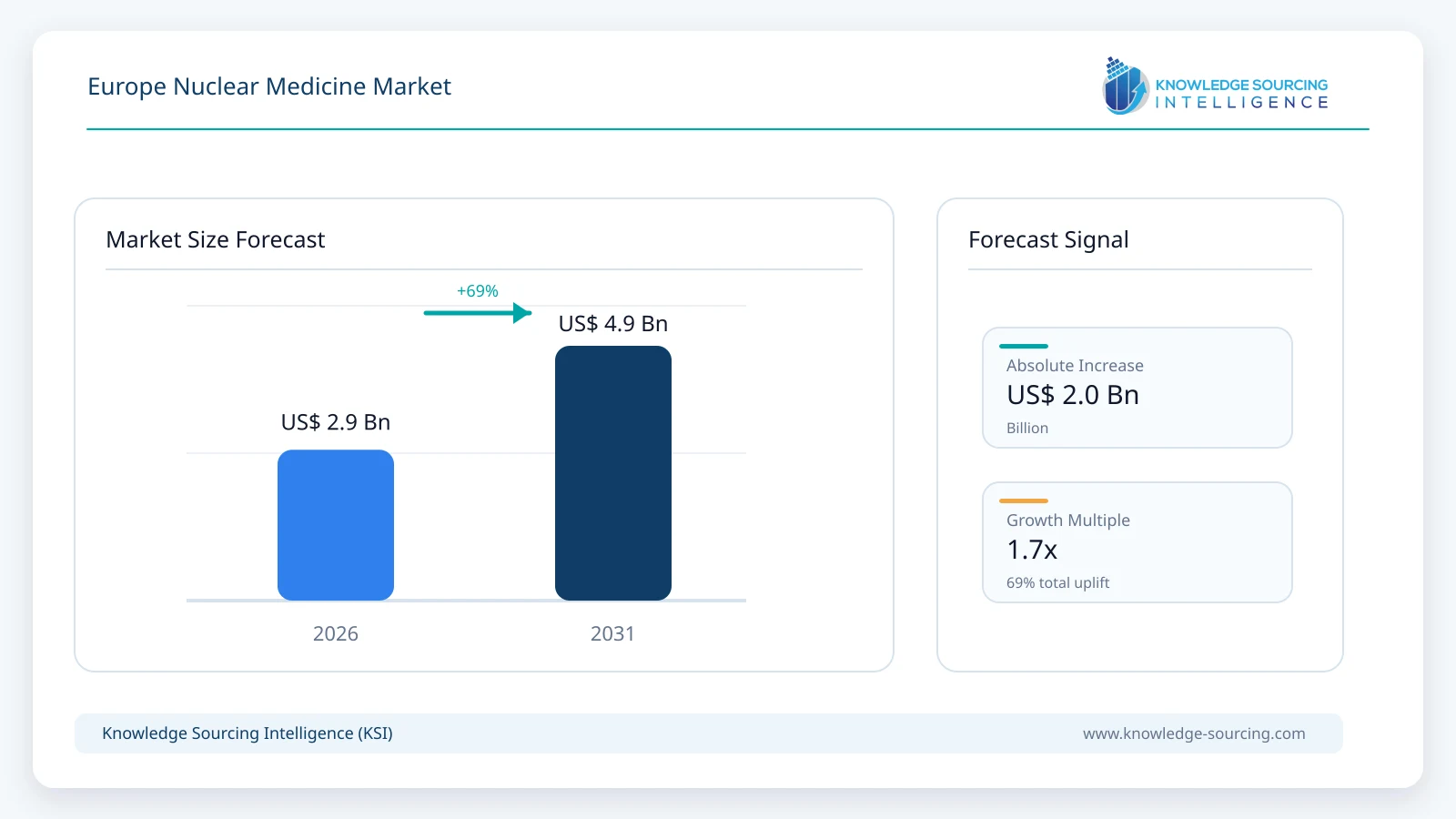
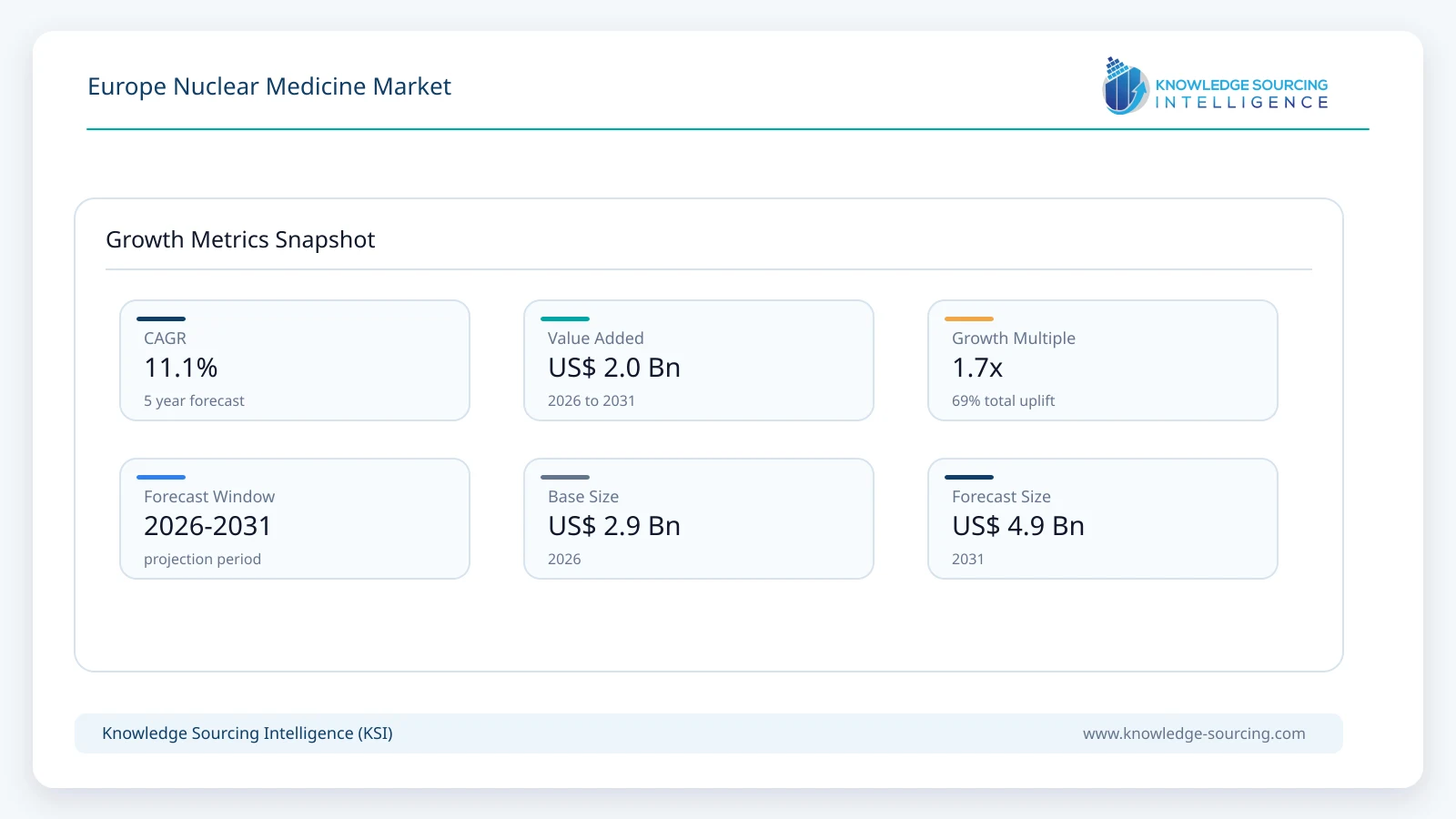
The Europe nuclear medicine market is projected to increase from USD 2.90 billion in 2026 to USD 4.90 billion in 2031, representing a CAGR of 11.1% during the forecast period.
Highlights:
- 1SPECT remains the largest technology segment, accounting for approximately 54% of 2026 revenue.
- 2PET records the faster growth as oncology, amyloid imaging and PSMA pathways expand.
- 3Germany contributes approximately 24% of European nuclear medicine revenue in 2026.
- 4Hospitals account for approximately 59% of market spending across Europe.
- 5More than 10 million nuclear medicine procedures are performed annually across the European Union.
- 6Europe is strengthening medical-isotope supply through the European Radioisotope Valley Initiative.
Market Overview
Europe has a highly developed nuclear medicine ecosystem spanning research reactors, isotope processors, radiopharmacies, cyclotrons, hospitals and specialist imaging centres. The European Commission states that more than 10 million procedures using medical radioisotopes are carried out annually in the European Union and that roughly 90% are diagnostic. Oncology accounts for up to 65% of procedures, while technetium-99m remains the principal diagnostic radioisotope. Europe also has a strategic supply role beyond its own patient base: the EU is the world's leading producer of medical radioisotopes and exports about half of its production. This supply position supports a broad installed base of SPECT and PET services but also creates pressure to modernise ageing production infrastructure and reduce strategic dependencies.
The demand mix is changing quickly. Conventional SPECT remains embedded in bone, cardiac, renal and endocrine imaging, but PET is expanding in cancer staging, treatment planning and neurological assessment. OECD data show continued growth in PET scanner availability across European healthcare systems, while professional societies are updating clinical guidance around amyloid PET, quantitative imaging and theranostic workflows. At the same time, radioligand therapy is creating higher-value patient pathways that combine diagnostic imaging, patient selection, dosimetry and therapeutic administration. This favours providers capable of integrating scanners, radiopharmacy logistics and specialised oncology services rather than treating nuclear medicine as a standalone imaging department.
Selected Segment Estimates
Dimension | Selected Subsegment | 2026 Indicator | Forecast Interpretation |
Technology | SPECT | ~54% / USD 1.57B | Largest installed procedure base; growth led by replacement and hybrid SPECT/CT. |
Technology | PET | ~46% / USD 1.33B | Fastest-growing imaging platform; oncology, amyloid and PSMA use increase value. |
End User | Hospitals | ~59% / USD 1.71B | Largest end-user group due to integrated oncology and radiopharmacy infrastructure. |
Country | Germany | ~24% / USD 696.0M | Largest national market; extensive tertiary-care and university-hospital network. |
Country | France | ~16% / USD 464.0M | Strong radiopharmaceutical production base and expanding theranostic capacity. |
Country | United Kingdom | ~15% / USD 435.0M | Large PET/CT network with growing oncology and neurological imaging demand. |
Market Dynamics
Drivers
Theranostics Is Increasing Revenue Per Nuclear Medicine Patient
Europe's strongest growth driver is the move from imaging-only nuclear medicine toward paired diagnostic and therapeutic pathways. PSMA imaging and lutetium-177 therapy in prostate cancer are the most visible examples, while somatostatin-receptor imaging and therapy remain established in neuroendocrine tumours. Novartis reported continued acceleration of Pluvicto adoption outside the United States during 2026, with new-patient growth in Europe contributing to a 62% constant-currency increase in ex-US second-quarter sales. Curium is also adding European lutetium-177 PSMA production capacity in France. These developments increase demand for PET imaging, dosimetry, radiopharmacy services and specialised treatment infrastructure even where scanner numbers grow only gradually.
Europe Retains a Strategic Medical-Isotope Production Base
The region's ability to produce and distribute short-lived radioisotopes is a structural advantage. In September 2026, the European Commission launched the European Radioisotope Valley Initiative to strengthen domestic production, improve supply resilience and reduce dependency on external suppliers. The policy reflects the operational importance of a just-in-time supply chain in which many products cannot be stockpiled. Investment in reactors, processing facilities, enriched stable isotopes, accelerators and radiopharmacies therefore supports both clinical availability and the competitiveness of European suppliers in global nuclear medicine markets.
PET Expands Beyond Oncology into Neurology and Quantitative Imaging
PET is moving beyond its established oncology role. Germany's nuclear medicine community updated its amyloid-brain PET guidance in 2026, reflecting the growing importance of biomarker-led dementia pathways. Digital PET, long axial field-of-view systems and improved quantitative reconstruction are also increasing sensitivity and throughput. The commercial impact is broader than capital equipment: higher PET utilisation raises recurring radiopharmaceutical demand, supports software and service revenue, and creates additional opportunities for imaging centres that can provide specialist interpretation and integrated longitudinal follow-up.
Market Restraints
Growth is constrained by capital intensity, specialist staffing requirements, reimbursement variation and radioisotope logistics. Nuclear medicine departments require shielded facilities, quality-control systems, radiation-protection expertise and trained physicians, technologists, physicists and radiopharmacists. Radioligand therapy adds further capacity constraints because patient scheduling must be coordinated with isotope delivery and radiation-safety procedures. Europe also faces ageing isotope-production assets and dependency on selected imported materials. These issues do not reduce clinical demand, but they can slow the conversion of demand into installed capacity and procedure growth, particularly outside large academic or tertiary centres.
Segment Analysis
By Technology - SPECT
SPECT accounts for approximately 54% of Europe nuclear medicine revenue in 2026, equivalent to about USD 1.57 billion. The segment remains the largest because technetium-99m is deeply embedded in routine nuclear medicine and is used across cardiac, bone, renal, pulmonary, endocrine, and oncological procedures. The installed base is mature, so growth is driven less by first-time adoption and more by replacement with hybrid SPECT/CT systems, digital detectors, quantitative workflows and improved software. The European Commission identifies technetium-99m as the workhorse of nuclear medicine diagnostics, reinforcing the durability of this segment even as PET grows faster.
By Technology - PET
PET represents approximately 46% of 2026 market revenue and expands faster than SPECT through 2031. Oncology remains the primary use case, but the addressable market is widening through PSMA imaging, amyloid PET, treatment-response assessment and broader use of quantitative biomarkers. Hybrid PET/CT remains the commercial core, while long axial field-of-view PET and PET/MR address selected high-end clinical and research applications. PET growth also has a stronger recurring-revenue effect because each scan depends on time-sensitive radiopharmaceutical production and delivery, creating value for cyclotron operators and radiopharmacy networks.
Market and Demand Indicators
Indicator | Latest Development | Market Impact |
EU procedure base | More than 10 million nuclear medicine procedures are performed annually in the EU. | Provides a large, established clinical demand base. |
Isotope policy | European Commission launched the European Radioisotope Valley Initiative in September 2026. | Supports supply security and investment in production capacity. |
Theranostics capacity | Curium announced a EUR 32 million Lu-177 PSMA production investment in France in June 2026. | Expands European radioligand-therapy supply. |
Radioligand adoption | Pluvicto ex-US sales grew 62% cc in Q2 2026 with accelerating European adoption. | Raises demand for PSMA imaging and therapy infrastructure. |
PET clinical expansion | German nuclear medicine guidance for amyloid PET was updated in 2026. | Supports broader neurological PET utilisation. |
Technology refresh | Vendors are advancing digital SPECT/CT, PET/CT, PET/MR and theranostic workflow platforms. | Increases replacement and software/service spending. |
Regional Outlook:
Germany Market Analysis
Germany is estimated to account for approximately 24% of European nuclear medicine revenue in 2026, equivalent to about USD 696.0 million. Its leadership is supported by a large university-hospital network, broad specialist expertise, strong medical-device manufacturing, and mature use of both SPECT and PET. Germany also has an active professional ecosystem around theranostics, cardiovascular nuclear medicine and neuroimaging. The German Society of Nuclear Medicine held its 64th annual meeting in April 2026, with sessions covering hybrid imaging in theranostics, new prostate-cancer tracers and dosimetry, while updated national guidance was published for amyloid PET and brain-perfusion SPECT during the year.
Future growth in Germany is expected to be weighted toward PET, radiopharmaceuticals and treatment-linked imaging rather than rapid expansion of basic SPECT capacity. Cancer imaging remains central, but neurological PET is gaining relevance as biomarker-led dementia pathways develop. University centres are also positioned to adopt higher-sensitivity PET systems and quantitative workflows earlier than smaller facilities. The main limiting factors are workforce capacity, reimbursement complexity and the need to coordinate radiopharmaceutical production with increasingly specialised clinical protocols.
Competitive Landscape
Europe's competitive landscape spans imaging equipment, isotope production, radiopharmaceutical manufacturing, radiopharmacy services and theranostics. Siemens Healthineers, GE HealthCare, Philips and United Imaging compete in PET/CT and SPECT/CT platforms. Curium, Novartis / Advanced Accelerator Applications, Bracco, Eckert & Ziegler, IBA and Telix participate in diagnostic or therapeutic radiopharmaceuticals and related production technologies. Europe also contains critical isotope-production and processing infrastructure operated through research reactors, national laboratories and specialised commercial suppliers.
Competition is increasingly organised around complete clinical pathways. Hospitals value not only scanner performance but also tracer availability, digital workflow, quantitative software, service coverage and the ability to support radioligand therapy. Curium's 2026 investment in a new lutetium-177 PSMA production line in France illustrates this shift toward vertically integrated supply. Equipment manufacturers are also positioning SPECT/CT and PET platforms specifically for theranostic workflows, creating stronger links between imaging, dosimetry and treatment planning.
Recent Developments
September 2026: The European Commission launched the European Radioisotope Valley Initiative to strengthen medical-isotope production and supply resilience.
July 2026: EMA and Nuclear Medicines Europe held their fifth bilateral meeting covering regulatory and supply topics relevant to nuclear medicines.
June 2026: Curium announced an investment of more than EUR 32 million in France for a European Lu-177 PSMA production line.
June 2026: Updated German guidance for amyloid brain PET and brain-perfusion SPECT was published.
May 2026: Novartis presented additional Pluvicto data supporting broader development of radioligand therapy in prostate cancer.
April 2026: EMA and the European Association of Nuclear Medicine held a bilateral meeting covering radiopharmaceutical guidelines and clinical-trial initiatives.
Europe Nuclear Medicine Market Scope:
| Report Metric | Details |
|---|---|
| Total Market Size in 2026 | USD 2.90 billion |
| Total Market Size in 2031 | USD 4.90 billion |
| Forecast Unit | USD Billion |
| Growth Rate | 11.1% |
| Study Period | 2021 to 2031 |
| Historical Data | 2021 to 2024 |
| Base Year | 2025 |
| Forecast Period | 2026 – 2031 |
| Segmentation | Technology, Clinical Application, End User, Country |
| Companies |
|
Market Segmentation
By Technology
SPECT
PET
By Clinical Application
Oncology
Cardiology
Neurology
Endocrinology
Musculoskeletal and Bone Imaging
Other Applications
By End User
Hospitals
Diagnostic and Imaging Centres
Academic and Research Institutes
By Country
Germany
France
United Kingdom
Italy
Spain
Rest of Europe
Table of Contents
1. EXECUTIVE SUMMARY
2. MARKET SNAPSHOT
2.1. Market Overview
2.2. Market Segmentation
3. BUSINESS LANDSCAPE
3.1. Market Drivers
3.1.1. Theranostics Is Increasing Revenue Per Nuclear Medicine Patient
3.1.2. Europe Retains a Strategic Medical-Isotope Production Base
3.1.3. PET Expands Beyond Oncology into Neurology and Quantitative Imaging
3.2. Market Restraints
3.2.1. Capital Intensity, Specialist Staffing and Radioisotope Logistics Limit Capacity Expansion
3.3. Market Opportunities
3.4. Porter's Five Forces Analysis
3.5. Industry Value Chain Analysis
3.6. Regulatory Landscape
4. TECHNOLOGICAL OUTLOOK
4.1. SPECT and SPECT/CT
4.2. PET and PET/CT
4.3. Digital Detectors and Quantitative Imaging
4.4. Theranostic Workflows
5. EUROPE NUCLEAR MEDICINE MARKET BY TECHNOLOGY
5.1. SPECT
5.2. PET
6. EUROPE NUCLEAR MEDICINE MARKET BY CLINICAL APPLICATION
6.1. Oncology
6.2. Cardiology
6.3. Neurology
6.4. Endocrinology
6.5. Musculoskeletal and Bone Imaging
6.6. Other Applications
7. EUROPE NUCLEAR MEDICINE MARKET BY END USER
7.1. Hospitals
7.2. Diagnostic and Imaging Centres
7.3. Academic and Research Institutes
8. EUROPE NUCLEAR MEDICINE MARKET BY COUNTRY
8.1. Germany
8.2. France
8.3. United Kingdom
8.4. Italy
8.5. Spain
8.6. Rest of Europe
9. COMPETITIVE ENVIRONMENT AND ANALYSIS
9.1. Major Players and Strategy Analysis
9.2. Market Share Analysis
9.3. Mergers, Acquisitions, Agreements and Collaborations
9.4. Competitive Dashboard
10. COMPANY PROFILES
10.1. Siemens Healthineers
10.2. GE HealthCare
10.3. Koninklijke Philips N.V.
10.4. United Imaging Healthcare
10.5. Curium Pharma
10.6. Novartis AG
10.7. Bracco
10.8. Eckert & Ziegler
10.9. IBA Radiopharma Solutions
10.10. Telix Pharmaceuticals Limited
10.11. Lantheus Holdings, Inc.
10.12. Cardinal Health, Inc.
10.13. Jubilant Radiopharma
10.14. Spectrum Dynamics Medical
10.15. Nordion
10.16. Nuclear Research and Consultancy Group (NRG)
11. RECENT DEVELOPMENTS
12. APPENDIX
12.1. Currency
12.2. Assumptions
12.3. Base and Forecast Years Timeline
12.4. Research Methodology
12.5. Abbreviations
Navigate
Trusted by the world's leading organizations











