
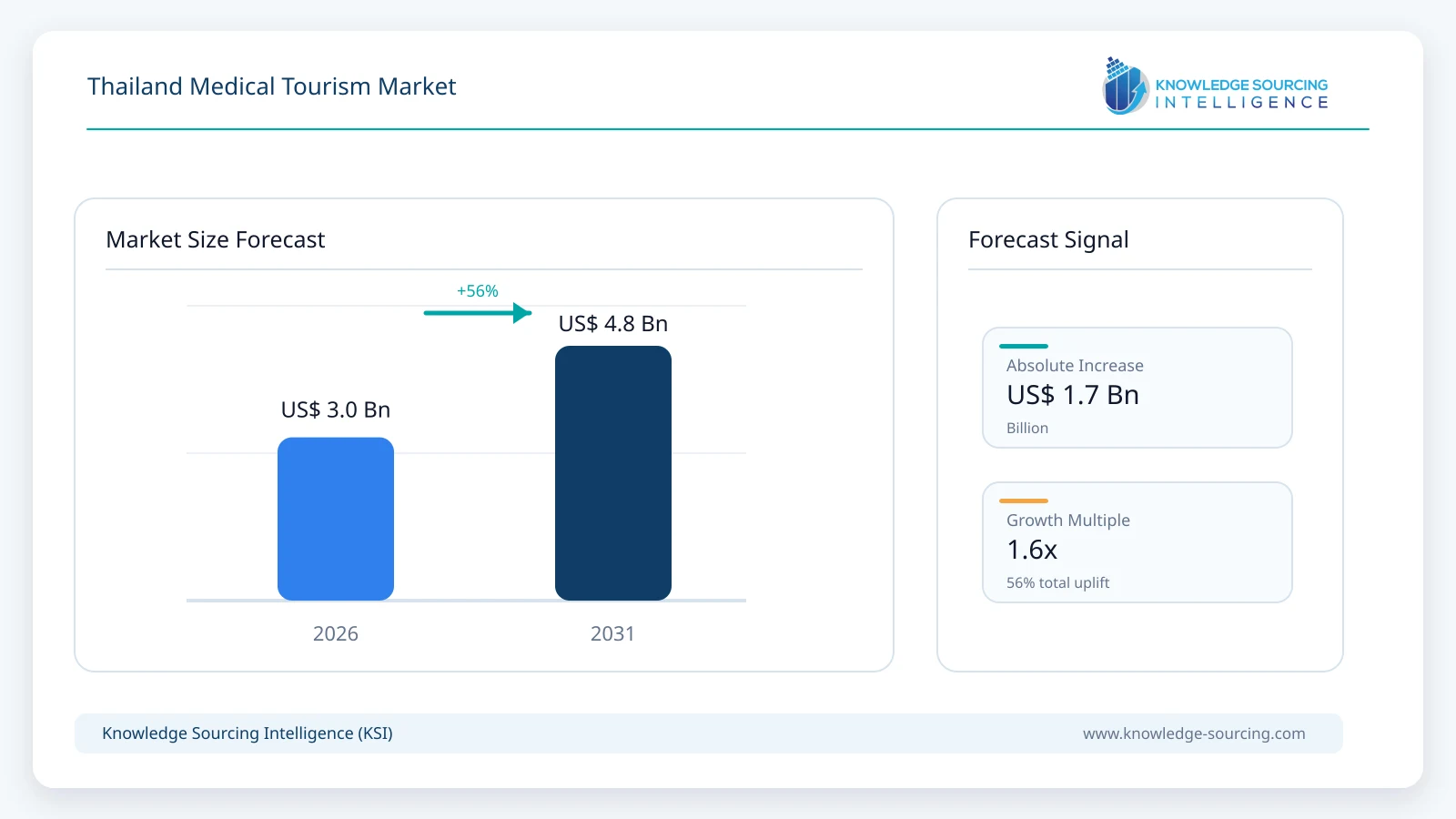
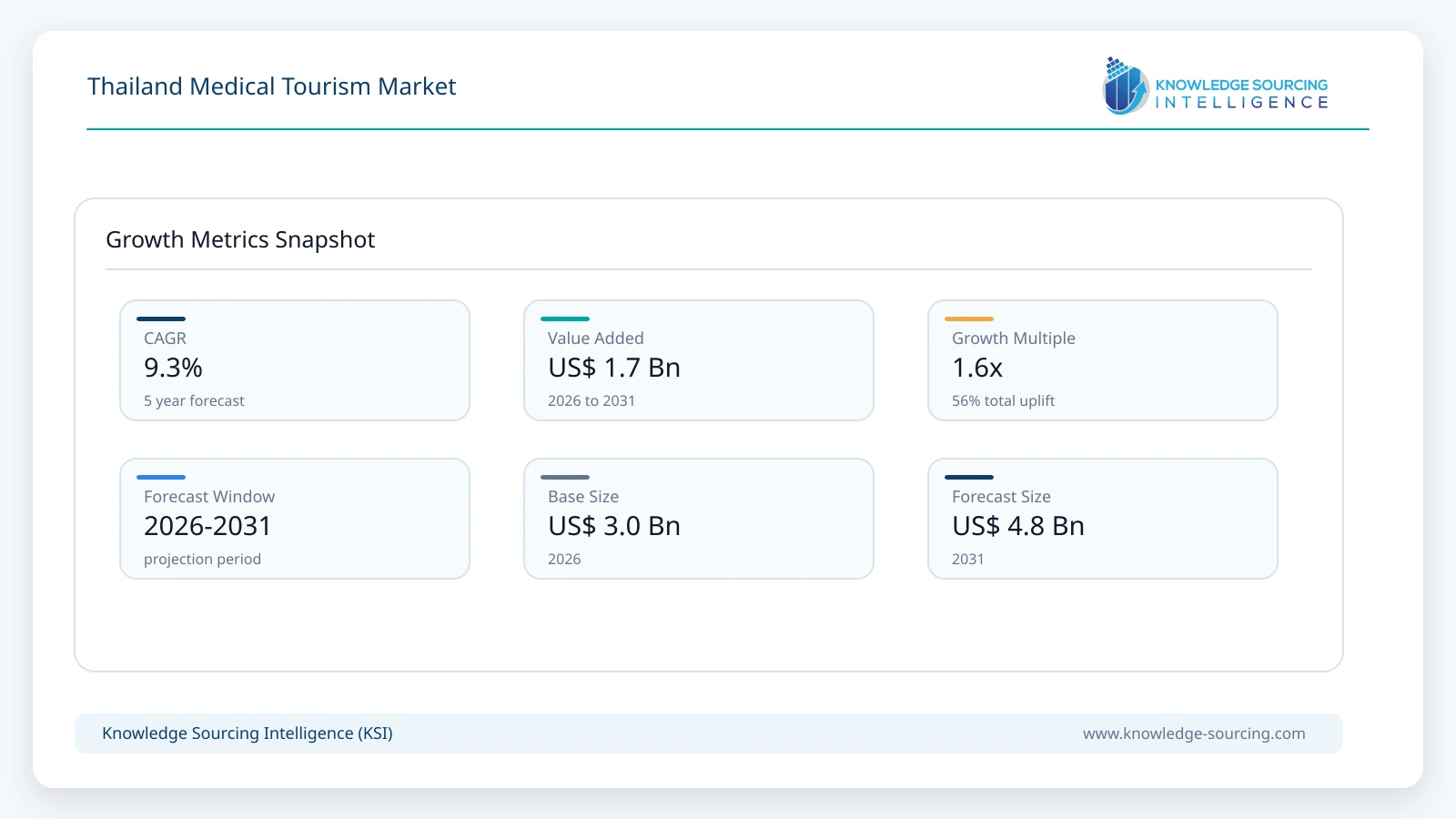
The Thailand Medical Tourism Market is projected to expand at a CAGR of 9.3%, reaching USD 4.76 billion in 2031 from USD 3.05 billion in 2026.
Highlights:
- 1Bangkok and Central Thailand account for approximately 74% of clinical medical-tourism revenue in 2026.
- 2Oncology generates about USD 0.72 billion in 2026 and remains the largest high-value treatment category.
- 3Private multispecialty hospitals capture roughly 78% of market revenue through integrated international-patient programs.
- 4The Middle East is the fastest-growing major source region as complex-care referrals and direct hospital relationships expand.
- 5Phuket is projected to be the fastest-growing destination cluster as new tertiary and oncology capacity enters the market.
- 6Thailand reported around three million medical tourists in 2024, although published patient counts vary materially by definition.
Thailand's medical-tourism proposition combines a deep private-hospital ecosystem with the logistics of a mature international tourism destination. Bangkok is the principal treatment hub, led by Bangkok Dusit Medical Services, Bumrungrad International Hospital, Praram 9 Hospital and other private providers that operate international patient departments, interpreter services, direct billing arrangements and referral channels across the Middle East, Southeast Asia, South Asia, China, Russia/CIS and Western markets. Phuket, Chiang Mai and selected eastern and southern provinces provide secondary clusters where treatment demand overlaps with large expatriate and tourist populations.
Current operating data show that international patients are economically important to Thailand's leading providers. BDMS reported that international patients represented 28% of its hospital revenue mix in 2025, while Bumrungrad has historically generated about two-thirds of revenue from international patients and treats patients from more than 190 countries. Praram 9 reported that international patients increased to 26% of hospital revenue in 2025 after strong growth in Middle Eastern demand. Bangkok Chain Hospital also generated more than THB 1.15 billion from international patients during the first nine months of 2025 despite weakness from Cambodia and Kuwait. These disclosures provide a stronger basis for a clinical-revenue estimate than broad medical-and-wellness tourism figures that can include hotels, spas, transport and non-medical visitor spending.
The supply base is also expanding beyond Bangkok. Thailand had 63 JCI-accredited medical institutions as of February 2025 according to the U.S. International Trade Administration, and a new 300-bed Songklanagarind specialty hospital in Phuket is planned for implementation during 2026-2029. Bumrungrad is investing more than THB 4.3 billion in a Phuket hospital scheduled to begin operations in 2027, while the Bangkok Hospital network opened the Bangkok-Phuket Cancer Institute in July 2026. These projects deepen the country's ability to serve complex international cases in tourism-heavy destinations and reduce the need for all high-value inbound demand to concentrate in central Bangkok.
Market Trends
International Patient Growth Is Moving toward Complex and Higher-Value Care
The most important structural change is the shift from high-volume basic treatment toward more complex, higher-revenue episodes of care. Hospital groups are investing in cancer centers, cardiovascular institutes, transplant capability, advanced orthopedics, robotic surgery, precision diagnostics and multidisciplinary case management. Praram 9 states that its international growth is increasingly tied to complex diseases and that higher case intensity is improving revenue per patient day. Bumrungrad is expanding its oncology infrastructure, while BDMS continues to build Centers of Excellence around cancer, heart, neurology, orthopedics and trauma. This raises revenue per international patient without requiring patient volumes to grow at the same rate as market value.
Medical Tourism Is Becoming a Hospital-Owned Cross-Border Patient Journey
Leading providers increasingly manage the full patient pathway rather than relying only on travel agents or independent medical-tourism facilitators. International patients can submit records before travel, receive specialist review, obtain preliminary treatment plans, arrange interpreters and airport transfers, coordinate insurance or government payment and continue follow-up after returning home. BDMS has highlighted digital patient journeys and international clinical alliances as part of its response to geopolitical risk, while Bumrungrad operates dedicated coordination teams and extensive interpreter support. The commercial benefit is higher conversion, stronger patient trust and better continuity for complex cases that require multiple visits.
Phuket Is Emerging as the Second Strategic Medical-Tourism Cluster
Phuket is developing from a tourism-linked elective-care market into a broader international healthcare cluster. Bangkok Hospital Phuket already treats tens of thousands of foreign patients each year and has expanded specialist capacity, including the Bangkok-Phuket Cancer Institute opened in July 2026. Bumrungrad's new Phuket hospital is planned as a premium secondary-care and wellness facility with 120 beds in the first phase and eventual capacity of 212 beds. The government-backed Songklanagarind Hospital project adds another 300-bed specialty facility. Together, these investments strengthen the Andaman region's ability to capture international patients who would otherwise travel to Bangkok or competing destinations.
Market Drivers
A Large Accredited Private-Hospital Base Supports International Trust
Thailand's private hospital sector provides a depth of infrastructure that few regional destinations can match. Major networks operate multiple tertiary hospitals, while independent flagship providers have built internationally recognized brands in complex care. JCI accreditation, specialist physician depth, advanced imaging, intensive care, transplant programs and multilingual patient services reduce the perceived risk of travelling for treatment. This matters particularly for oncology, cardiac procedures, neurosurgery and other high-acuity specialties where patients and payers place greater weight on outcomes, clinical governance and post-treatment support than on price alone.
Treatment Cost Differentials and Tourism Connectivity Remain Commercial Advantages
Treatment in Thailand can remain materially less expensive than in the United States and several other high-cost healthcare systems, while air connectivity, hotel capacity and destination familiarity reduce non-medical friction for patients and accompanying family members. Thailand's tourism infrastructure also allows hospitals to build medical travel around major international airports and established visitor corridors. The worldwide rollout of Thailand's e-Visa system from January 2025 simplified visa applications, while dedicated medical-treatment visa categories remain available for patients requiring longer stays. These factors are especially relevant to elective and scheduled procedures where patients can compare destinations in advance.
Capacity Expansion and National Promotion Are Broadening the Addressable Market
Hospital investment and destination marketing are reinforcing each other. TAT launched the Amazing Thailand Health and Beauty initiative in March 2025 to promote health, beauty and wellness services across ASEAN, while leading hospital groups are simultaneously adding new capacity and international referral relationships. The combination of destination-level promotion and provider-level investment helps Thailand acquire patients at multiple stages of the decision process. New hospital and specialty-center openings in Phuket are particularly important because they expand the country's addressable capacity without relying entirely on Bangkok's existing bed base.
Market Restraints
Dependence on Selected Source Markets Creates Geopolitical and Referral Risk
International demand is not evenly diversified. Middle Eastern government and self-pay patients are important to high-value Bangkok hospitals, while Cambodia, Myanmar, Laos and other neighboring markets support significant regional flows. BDMS disclosed that the Thailand-Cambodia border conflict reduced Cambodia's contribution to hospital revenue in 2025, and Bangkok Chain Hospital also reported pressure from border disruption and changes in Kuwait referral policy. Such events can affect volumes quickly because treatment travel depends on visas, flights, border access, government payment decisions and bilateral relationships. Providers are responding by widening source markets and building local follow-up partnerships, but concentration risk remains material.
Regional Competition and Post-Treatment Continuity Limit Unconstrained Growth
Thailand competes directly with Malaysia, Singapore, India, South Korea and increasingly the Gulf states for international patients. Cost advantages alone are becoming less durable as other destinations improve hospital capacity and as Middle Eastern countries invest in domestic specialist care. Patients also expect clearer package pricing, documented outcomes and reliable follow-up after returning home. Complex oncology, fertility and surgical cases can require repeated monitoring, so weak coordination with home-country physicians may reduce conversion. These factors support continued growth but argue against extrapolating the most aggressive double-digit forecasts indefinitely.
Segment Analysis
By Treatment Type - Oncology
Oncology is the largest high-value treatment segment and is projected to reach approximately USD 1.15 billion by 2031. Thailand's position is supported by private hospital investment in radiotherapy, precision diagnostics, surgical oncology and multidisciplinary care. BDMS has made cancer one of its principal Centers of Excellence, Bangkok Hospital Group opened the Bangkok-Phuket Cancer Institute in July 2026, and Bumrungrad is investing in additional oncology capacity. Cancer treatment also creates recurring revenue because international patients may require diagnostic work-up, surgery, systemic therapy, radiotherapy and follow-up rather than a single one-time procedure.
By Treatment Type - Fertility and Reproductive Treatment Is Expected to Grow Faster
Fertility and reproductive treatment is projected to expand at roughly 11.4% annually through 2031 from a smaller base. Thailand has established IVF clinics and hospital-based reproductive medicine programs serving regional and international patients, supported by relatively competitive treatment costs and strong tourism connectivity. Demand is driven by delayed parenthood, cross-border access to specialist care and patients seeking treatment combinations not readily available in their home markets. Growth remains sensitive to reproductive-health regulation and patient eligibility rules, so the segment is expected to expand faster than the overall market without becoming the largest category.
By Service Provider - Private Multispecialty Hospitals
Private multispecialty hospitals dominate clinical medical-tourism revenue because they can manage complex patients across diagnostics, surgery, intensive care, rehabilitation and multiple specialties within one institution or network. Their international departments also provide interpreters, insurance coordination, travel support and case management that smaller clinics may not replicate at scale. The segment is projected to exceed USD 3.6 billion by 2031 as large hospital groups add higher-acuity capacity and expand referral relationships with insurers, employers, governments and overseas healthcare partners.
By Service Provider - Specialty Clinics Are Growing Faster in Elective Niches
Specialty clinics are expected to grow faster in areas such as fertility, dentistry, cosmetic surgery, gender-affirming procedures, dermatology and selected ophthalmology services. These providers can offer focused physician brands, shorter treatment pathways and competitive pricing, which suits self-pay international demand. The fastest-growing clinics are increasingly adopting hospital-like international patient services, digital pre-assessment and multilingual coordination. Their overall revenue share remains below large hospitals because they do not capture the same high-acuity inpatient and intensive-care spending.
By Patient Source Region - East and Southeast Asia Remain the Largest Combined Base
East and Southeast Asia remain the largest combined source region by patient numbers and account for a substantial share of revenue through Cambodia, Myanmar, Laos, China and other neighboring markets. Short travel times, established referral patterns and familiarity with Thai healthcare support repeat demand. However, the source mix is uneven across providers: BDMS has significant CLMV and Asian exposure, while Bumrungrad and Praram 9 are more weighted toward high-value Middle Eastern and other long-haul international patients. The market therefore cannot be understood through a single national source-country ranking.
By Patient Source Region - Middle East Is the Fastest-Growing Major Revenue Pool
Middle Eastern patients are projected to grow at approximately 10.7% annually through 2031 and generate disproportionately high revenue per case because demand is concentrated in complex specialty treatment. Bumrungrad reported strong recovery across Saudi Arabia, the UAE, Oman and Qatar during 2025, while Praram 9 identified fly-in Middle Eastern patients as the principal driver of its international revenue growth. Thai providers are also building partnerships in Oman and other source markets to support referrals and follow-up. Growth is attractive but remains exposed to oil-market conditions, government referral policies and the expansion of domestic healthcare capacity in Gulf countries.
By Destination - Bangkok and Central Thailand
Bangkok and Central Thailand remain the dominant destination cluster because the capital contains the deepest concentration of tertiary hospitals, specialists, international airports, embassies, accommodation and referral infrastructure. The cluster includes flagship hospitals serving large international caseloads as well as specialist clinics in fertility, dental care, aesthetics and advanced diagnostics. Its share is expected to decline gradually as Phuket and other regional hubs expand, but Bangkok will remain the country's principal destination for complex cases through 2031.
By Destination - Phuket Is Expected to Record the Fastest Growth
Phuket is projected to expand at approximately 12.5% annually through 2031, faster than the national market. The growth case is based on visible capacity rather than tourism alone: Bangkok Hospital Phuket has expanded specialist services and opened a dedicated cancer institute, Bumrungrad is constructing a new international hospital scheduled for 2027, and the Songklanagarind specialty hospital project adds further tertiary capacity. Phuket also benefits from a large expatriate base and direct international connectivity, allowing new facilities to serve local, expatriate and fly-in international demand simultaneously.
Technology Outlook
Digital Pre-Arrival Assessment and Patient Navigation
International care increasingly begins before the patient boards a flight. Secure upload of medical records, remote specialist review, estimated treatment plans, appointment coordination and multilingual messaging can shorten decision time and reduce uncertainty. Large hospital groups are integrating these functions into their international patient operations and digital platforms. AI can assist document classification, translation and scheduling, but diagnosis and treatment planning remain physician-led. Providers that reduce administrative friction are better positioned to convert complex cases where patients compare several countries and hospitals.
Advanced Oncology, Robotics and Precision Diagnostics
Technology is raising the ceiling on the types of international cases Thailand can treat. New oncology centers combine advanced imaging, radiation therapy and multidisciplinary treatment planning, while robotic and minimally invasive surgery can shorten recovery for selected procedures. Molecular diagnostics, genomic testing and precision medicine are also becoming more relevant in cancer and inherited disease. These technologies are capital intensive and therefore favor large hospital networks and flagship providers, reinforcing the competitive advantage of organizations that can sustain specialist teams and equipment utilization.
Remote Follow-Up and Cross-Border Clinical Partnerships
Post-treatment continuity is becoming a competitive differentiator. Hospitals are using teleconsultation, digital record exchange and source-country clinical partners to monitor patients after they return home. BDMS has highlighted international partnerships in Oman as part of its cross-border strategy, while other providers are building referral relationships with chambers of commerce, insurers and overseas medical organizations. These networks can reduce patient anxiety, improve continuity and create repeat referrals, particularly for oncology, cardiac care, orthopedics and other specialties that require structured follow-up.
Competitive Environment
Thailand's competitive environment is led by two scaled listed hospital groups and a group of specialist or premium providers with meaningful international exposure. Bangkok Dusit Medical Services has the broadest national network and operates multiple brands across Bangkok, Phuket and other provinces. Bumrungrad has one of the strongest standalone international hospital brands and a highly international revenue mix. Bangkok Chain Hospital and Praram 9 compete through international centers and complex-care capabilities, while Thonburi Healthcare Group, Sikarin, Chularat, Ramkhamhaeng and other networks provide additional capacity across Bangkok and provincial markets.
Competition is increasingly based on clinical specialization, outcomes, physician reputation and source-market relationships rather than hotel-style service alone. Providers are expanding cancer, cardiovascular, transplant, neurology, orthopedic, fertility and preventive-care capabilities while strengthening digital patient journeys. International growth strategies also differ by hospital. Bumrungrad has a strong Middle Eastern and global self-pay base, BDMS is diversified across CLMV, Japan, Arab countries and expatriate markets, and Praram 9 is actively scaling Middle Eastern and Indonesian relationships. Specialty providers compete through narrower niches such as cosmetic surgery, fertility and dentistry.
The next stage of competition will be shaped by geographic expansion and network effects. Phuket is receiving major new investment, while hospitals are developing local follow-up partnerships in source countries. This allows Thai providers to extend the relationship beyond the hospital stay and defend demand as competing countries build their own advanced-care capacity. Market share is therefore likely to shift toward providers that combine specialist outcomes, trusted brands, digital coordination and cross-border referral networks rather than those relying only on low treatment prices.
Recent Developments
July 2026: Bangkok Hospital Group in Phuket opened the Bangkok-Phuket Cancer Institute to expand multidisciplinary oncology care for Thai and international patients.
May 2026: Praram 9 Hospital signed an MOU with the Indonesia-Thai Chamber of Commerce to strengthen healthcare access and international patient support for Indonesian patients.
February 2026: BDMS Wellness Clinic and Bangkok Rayong Cancer Hospital announced a healthcare collaboration with Neem Hospital and MODAWI in Oman to support cross-border care and health tourism.
February 2026: Bumrungrad held a Phuket health-tourism business forum ahead of the first phase of Bumrungrad International Hospital Phuket, scheduled to begin operations in 2027.
March 2025: The Tourism Authority of Thailand launched the Amazing Thailand Health and Beauty initiative to promote health, beauty and wellness tourism across ASEAN.
February 2025: Bumrungrad broke ground on its THB 4.3 billion Phuket hospital project, designed to serve Thai, expatriate and international patients.
Thailand Medical Tourism Market Scope
| Report Metric | Details |
|---|---|
| Total Market Size in 2026 | USD 3.05 billion |
| Total Market Size in 2031 | USD 4.76 billion |
| Forecast Unit | Billion |
| Growth Rate | 9.3% |
| Study Period | 2021 to 2031 |
| Historical Data | 2021 to 2024 |
| Base Year | 2025 |
| Forecast Period | 2026 – 2031 |
| Segmentation | Treatment Type, Service Provider, Patient Source Region, Destination |
| Companies |
|
| Customization Scope | 15% Free Customization included with purchase — Request Custom Breakdown → |
| Sample & Data Access | PDF Sample, Excel Databook & Analyst Briefing — Download Free Sample → |
Market Segmentation
By Treatment Type
Cancer / Oncology Treatment
Cardiovascular Treatment
Orthopedic and Spine Treatment
Cosmetic and Reconstructive Surgery
Fertility and Reproductive Treatment
Dental Treatment
Health Screening and Diagnostics
Neurology and Neurosurgery
Gender-Affirming and Other Specialized Surgery
Other Specialized Treatments
By Service Provider
Private Multispecialty Hospitals
Specialist Hospitals and Centers
Specialty Clinics
By Patient Source Region
East and Southeast Asia
Middle East
South Asia
Europe and Russia/CIS
North America, Oceania and Others
By Destination
Bangkok and Central Thailand
Phuket and the Andaman Region
Chiang Mai and Northern Thailand
Eastern Thailand
Other Thailand
Table of Contents
1. EXECUTIVE SUMMARY
2. MARKET SNAPSHOT
2.1. Market Overview
2.2. Market Definition
2.3. Scope of the Study
2.4. Market Segmentation
3. BUSINESS LANDSCAPE
3.1. Market Drivers
3.1.1. A Large Accredited Private-Hospital Base Supports International Trust
3.1.2. Treatment Cost Differentials and Tourism Connectivity Remain Commercial Advantages
3.1.3. Capacity Expansion and National Promotion Are Broadening the Addressable Market
3.2. Market Restraints
3.2.1. Dependence on Selected Source Markets Creates Geopolitical and Referral Risk
3.2.2. Regional Competition and Post-Treatment Continuity Limit Unconstrained Growth
3.3. Market Opportunities
3.4. Porter's Five Forces Analysis
3.5. Industry Value Chain Analysis
3.6. Policies and Regulations
3.7. Strategic Recommendations
4. TECHNOLOGICAL OUTLOOK
4.1. Digital Pre-Arrival Assessment and Patient Navigation
4.2. Advanced Oncology, Robotics and Precision Diagnostics
4.3. Remote Follow-Up and Cross-Border Clinical Partnerships
5. THAILAND MEDICAL TOURISM MARKET BY TREATMENT TYPE
5.1. Introduction
5.2. Cancer / Oncology Treatment
5.3. Cardiovascular Treatment
5.4. Orthopedic and Spine Treatment
5.5. Cosmetic and Reconstructive Surgery
5.6. Fertility and Reproductive Treatment
5.7. Dental Treatment
5.8. Health Screening and Diagnostics
5.9. Neurology and Neurosurgery
5.10. Gender-Affirming and Other Specialized Surgery
5.11. Other Specialized Treatments
6. THAILAND MEDICAL TOURISM MARKET BY SERVICE PROVIDER
6.1. Introduction
6.2. Private Multispecialty Hospitals
6.3. Specialist Hospitals and Centers
6.4. Specialty Clinics
7. THAILAND MEDICAL TOURISM MARKET BY PATIENT SOURCE REGION
7.1. Introduction
7.2. East and Southeast Asia
7.3. Middle East
7.4. South Asia
7.5. Europe and Russia/CIS
7.6. North America, Oceania and Others
8. THAILAND MEDICAL TOURISM MARKET BY DESTINATION
8.1. Introduction
8.2. Bangkok and Central Thailand
8.3. Phuket and the Andaman Region
8.4. Chiang Mai and Northern Thailand
8.5. Eastern Thailand
8.6. Other Thailand
9. COMPETITIVE ENVIRONMENT AND ANALYSIS
9.1. Major Players and Strategy Analysis
9.2. Market Share Analysis
9.3. Mergers, Acquisitions, Agreements and Collaborations
9.4. Competitive Dashboard
10. COMPANY PROFILES
10.1. Bangkok Dusit Medical Services Public Company Limited (BDMS)
10.2. Bumrungrad Hospital Public Company Limited
10.3. Bangkok Chain Hospital Public Company Limited
10.4. Praram 9 Hospital Public Company Limited
10.5. Thonburi Healthcare Group Public Company Limited
10.6. Sikarin Public Company Limited
10.7. Chularat Hospital Public Company Limited
10.8. Ramkhamhaeng Hospital Public Company Limited
10.9. Vejthani Hospital
10.10. Yanhee International Hospital
10.11. MedPark Hospital
10.12. Piyavate Hospital
10.13. Master Style Public Company Limited
10.14. Kamol Cosmetic Hospital
10.15. Dental Corporation Public Company Limited
10.16. Jetanin Institute for Assisted Reproduction
10.17. SAFE Fertility Group Public Company Limited
10.18. Vimut Hospital
11. APPENDIX
11.1. Currency
11.2. Assumptions
11.3. Base and Forecast Years Timeline
11.4. Key Benefits for Stakeholders
11.5. Research Methodology
11.6. Abbreviations





Frequently asked questions
What is the projected market value of Thailand's medical tourism by 2031?
The Thailand Medical Tourism Market is projected to reach USD 4.76 billion by 2031.
What is the CAGR for the Thailand medical tourism market (2026-2031)?
The Thailand Medical Tourism Market is projected to expand at a CAGR of 9.3%.
Which region accounts for most clinical medical-tourism revenue in 2026?
Bangkok and Central Thailand account for 74% of revenue.
Which is the largest high-value treatment category in 2026?
Oncology is the largest, generating approximately USD 0.72 billion.
Which type of facility captures most market revenue?
Private multispecialty hospitals capture 78% of market revenue.
Which destination cluster is projected for fastest growth?
Phuket is projected to be the fastest-growing destination cluster.
Cite this report
Knowledge Sourcing Intelligence. (Sep 2026). Thailand Medical Tourism Market - Strategic Insights and Forecasts (2026-2031). https://www.knowledge-sourcing.com/report/thailand-medical-tourism-market