
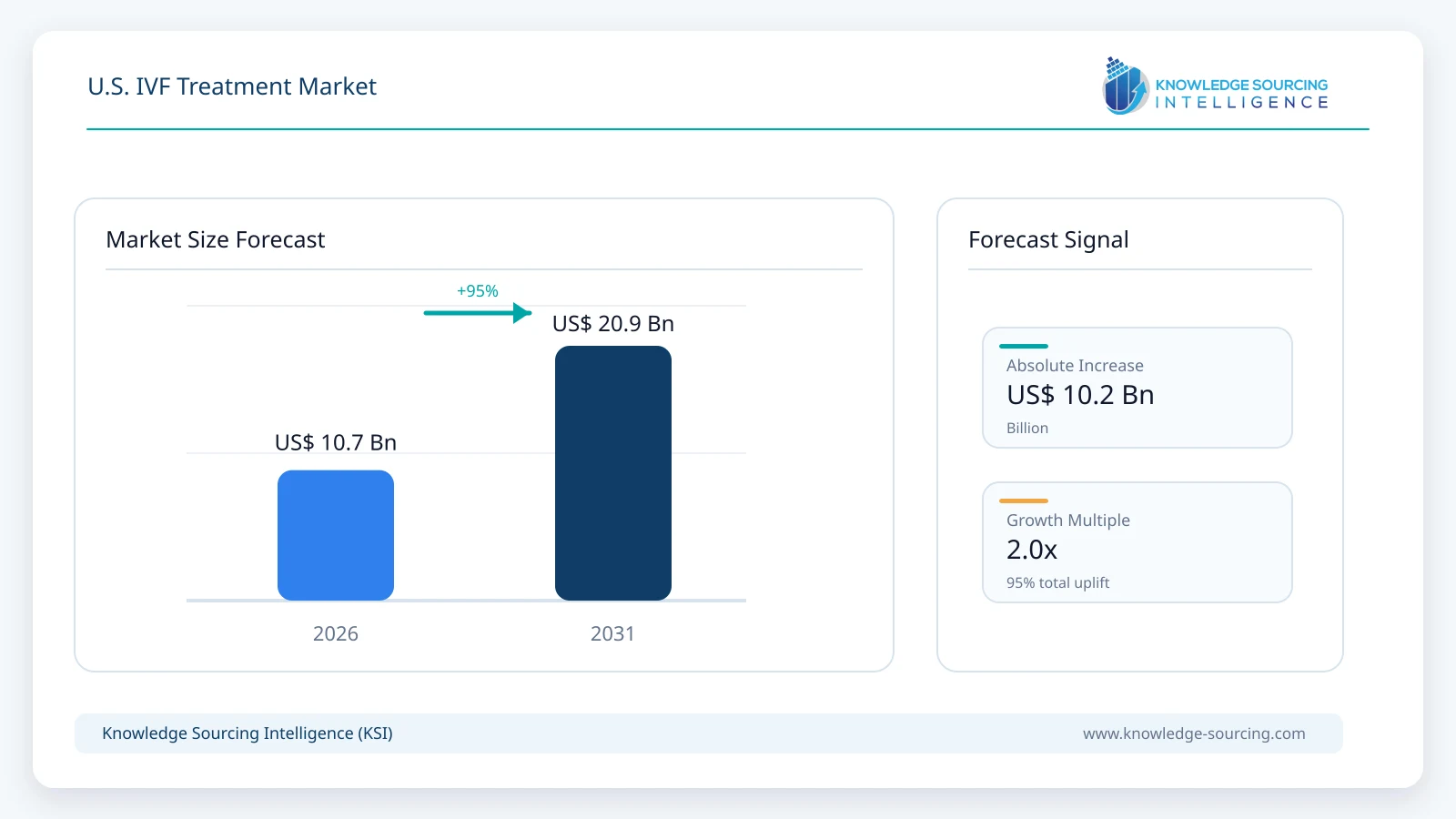
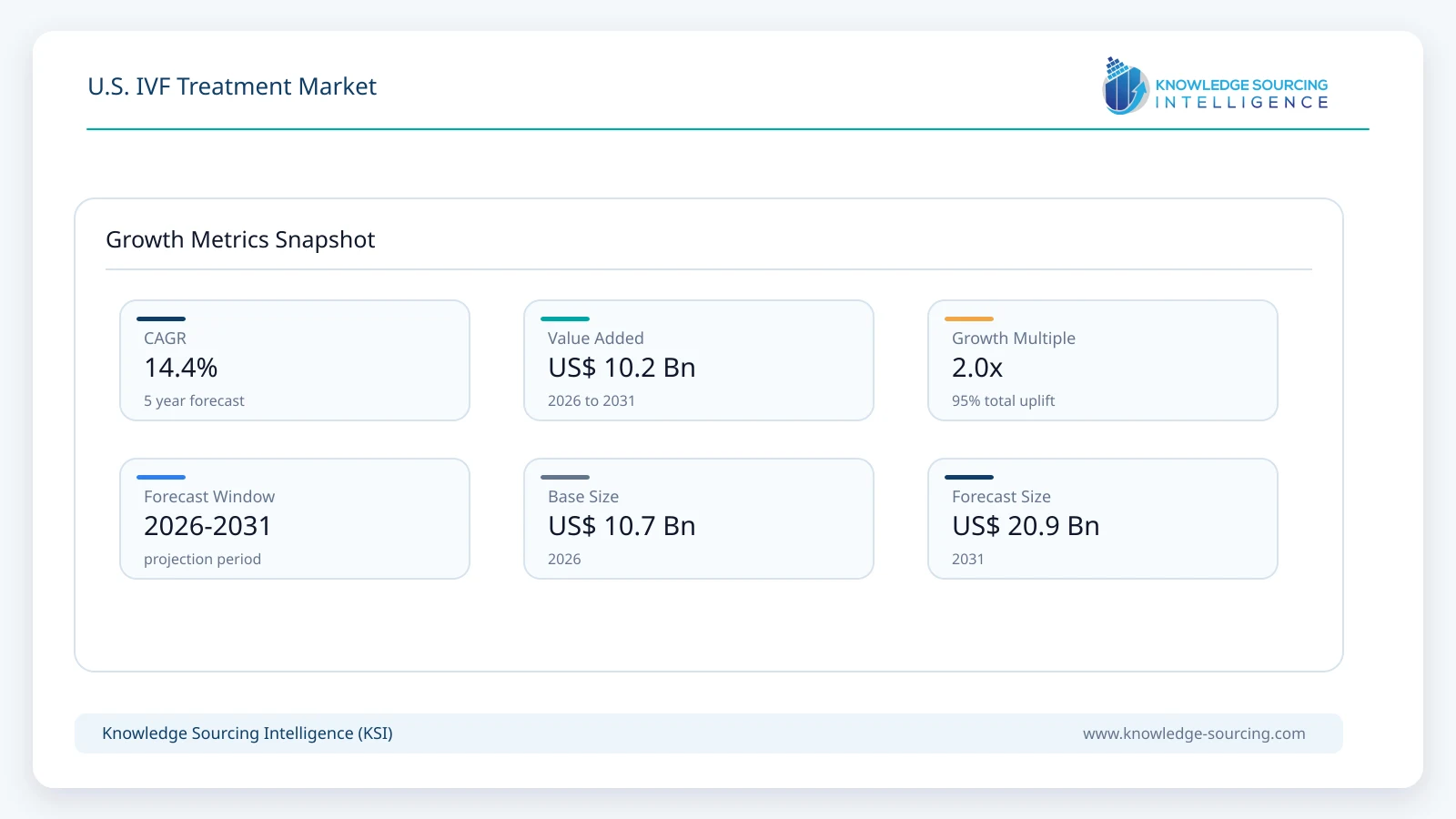
The U.S. IVF Treatment Market is estimated at USD 10.7 billion in 2026 and is projected to reach USD 20.9 billion by 2031, representing a CAGR of approximately 14.4% during the forecast period.
Highlights:
- 1Retrieval-led IVF treatment accounts for approximately 58% of U.S. market revenue in 2026.
- 2Frozen embryo transfer gains share as freeze-all strategies and vitrification remain widely used.
- 3Dedicated fertility networks generate the majority of treatment revenue through high-volume laboratory infrastructure.
- 4The West represents the largest regional revenue pool, supported by California and other high-income markets.
- 5SART reported 431,746 ART cycles across member clinics in its preliminary 2024 national summary.
- 6Insurance and employer fertility benefits are widening access, but out-of-pocket cost remains a major barrier.
IVF treatment in the United States is increasingly a multi-stage care pathway rather than a single laboratory procedure. A typical episode may include diagnostic work-up, ovarian stimulation, ultrasound and hormone monitoring, egg retrieval under anesthesia, fertilization using conventional insemination or ICSI, embryo culture, blastocyst development, biopsy for preimplantation genetic testing, cryopreservation, frozen transfer and medication. Because many patients require more than one retrieval or transfer, total realized spend can substantially exceed the advertised price of one IVF cycle. This makes patient-level treatment economics more useful for market estimation than counting clinics or applying a single average procedure price to all ART cycles.
The national procedure base remains large and relatively transparent. CDC reported 435,426 ART cycles on 251,542 unique patients in 2022, including 184,423 egg or embryo banking cycles, while SART's preliminary 2024 report records 431,746 total cycles among member clinics. The 2024 SART data also show a substantial volume of frozen-transfer activity and more than 23,000 donor-egg or donated-embryo recipient starts or thaws. This treatment mix supports recurring revenue beyond initial retrieval because frozen embryos may generate subsequent transfer cycles, storage fees and additional laboratory services over several years.
Commercial structure is also changing. Large fertility networks now combine local physician brands with centralized laboratory standards, genetics, procurement, revenue-cycle management, digital engagement and employer-network contracting. US Fertility supports more than 200 physicians across 135+ locations, while The Prelude Network reports more than 90 fertility clinics across North America. CCRM expanded through its 2026 combination with IRMS, and IVI RMA continues to build academic and regional affiliations. Scale does not remove the importance of physician reputation and laboratory quality, but it changes how clinics negotiate payer contracts, deploy technology and attract capital.
Market Trends
Frozen Transfer Is Becoming a Core Revenue Stream Rather Than a Follow-On Procedure
Vitrification and freeze-all treatment strategies have changed the commercial structure of IVF. Embryos created during one retrieval may be transferred in a later cycle, allowing clinics to separate stimulation and retrieval from endometrial preparation and transfer. SART's 2024 report shows tens of thousands of second and additional frozen thaw procedures, while donor treatment is also dominated by frozen material rather than fresh donor eggs. This creates a recurring treatment relationship and shifts laboratory requirements toward cryostorage, inventory management, electronic witnessing and thaw protocols. Frozen transfer is also important for patients using PGT because biopsy and genetic analysis generally require time between embryo creation and transfer.
Employer Fertility Benefits Are Becoming an Important Access Channel
Employer-sponsored fertility benefits are expanding the portion of treatment that is financed through organized benefit programs rather than entirely self-pay. Progyny reported 555 clients and about 6.7 million members at year-end 2025, with its fertility model billing bundled case rates for specialist, laboratory, anesthesia and care-management services while fertility medications are billed separately through Progyny Rx. Kindbody is similarly combining clinical care with employer and health-plan benefits and announced a next-generation integrated platform in 2026. This channel can increase treatment completion by reducing upfront financial barriers, but it also puts more pressure on clinics to demonstrate outcomes, standardized pricing and network participation.
Laboratory Standardization and Data Infrastructure Are Becoming Competitive Differentiators
Embryology laboratories are increasingly managed as data-intensive production environments. Electronic witnessing, time-lapse imaging, automated cryostorage management, AI-assisted embryo assessment and integrated laboratory information systems are being adopted to reduce identification risk, standardize workflows and improve traceability. The commercial significance is not limited to equipment sales. High-volume networks can spread laboratory quality systems, training and data analytics across multiple sites, potentially improving utilization and consistency. This supports consolidation because independent clinics must match not only physician expertise but also laboratory infrastructure and patient digital experience.
Market Drivers
Later Parenthood Sustains Demand for High-Intensity Fertility Treatment
The probability of age-related infertility rises as family formation is delayed, increasing the number of patients who require more intensive treatment rather than expectant management or basic ovulation induction. IVF is particularly important for diminished ovarian reserve, tubal-factor infertility, severe male-factor infertility and patients requiring genetic testing or donor gametes. The result is a structurally persistent demand pool even when the broader birth rate is low. The same demographic shift also increases fertility-preservation activity, which can later feed IVF treatment when stored oocytes are used.
Insurance Mandates and Employer Coverage Are Reducing the Upfront Access Barrier
Coverage remains fragmented, but the direction is toward broader access. ASRM noted in 2025 that 22 states had insurance mandates providing some level of infertility coverage, although benefits vary materially. New York requires large-group plans to cover three IVF cycles, while California's SB 729 requires large-group health plans to cover infertility diagnosis, treatment and fertility services and requires small-group plans to offer such coverage. Federal proposals such as the HOPE with Fertility Services Act would create a broader national standard if enacted. These policies do not eliminate deductibles, eligibility restrictions or self-funded employer exemptions, but they expand the population that can consider treatment without bearing the full cost upfront.
Scale Networks Are Expanding Capacity and Lowering Geographic Friction
The U.S. provider base remains fragmented, but national and multistate networks are extending advanced reproductive endocrinology and embryology into more metropolitan areas. US Fertility supports more than 135 locations, Prelude operates more than 90 clinics across North America and CCRM's 2026 combination with IRMS created a network spanning 34 U.S. and Canadian locations. Geographic expansion matters because IVF requires repeated monitoring visits over a relatively short treatment window. A network can place consultation and monitoring sites closer to patients while concentrating egg retrieval, embryology and cryostorage in high-volume laboratories.
Market Restraints
High Patient Cost Still Limits Treatment Initiation and Repeat Cycles
Cost remains the clearest structural restraint. ASRM places a single U.S. IVF cycle broadly at USD 15,000-25,000, and total patient cost can rise materially when medications, PGT, donor gametes, anesthesia, cryopreservation and repeated transfers are required. Coverage is not uniform and many self-funded employer plans fall outside state insurance mandates. Patients without meaningful benefits may therefore delay treatment, borrow, use financing products or stop after one unsuccessful cycle. Because cumulative live-birth probability often improves over multiple retrievals or transfers, financial discontinuation can directly reduce both utilization and clinical completion.
Workforce and Laboratory Capacity Can Constrain Expansion
IVF requires reproductive endocrinologists, embryologists, nurses, sonographers, laboratory technologists and specialized administrative teams. Adding a satellite consultation office is easier than replicating a full embryology laboratory, operating suite and cryostorage system. This creates capacity bottlenecks in fast-growing markets and raises the importance of centralized laboratory models. Recruiting experienced embryologists is especially important because laboratory quality affects fertilization, blastocyst development, biopsy, vitrification and thaw performance. Provider growth therefore depends on human-capital development as much as on physical clinic openings.
U.S. IVF Treatment Market Segment Analysis
By Cycle Type
Retrieval-Led IVF
Retrieval-led own-egg IVF remains the largest revenue segment because it contains the most resource-intensive part of the treatment pathway: stimulation monitoring, procedural egg retrieval, anesthesia, laboratory fertilization and early embryo culture. It accounts for a substantial share of treatment revenue because a large proportion of IVF cycles involve multiple clinical and laboratory procedures before embryo transfer. The distinction is important because modern IVF frequently separates embryo creation from transfer. Frozen embryo transfer is lower in revenue per event but is gaining importance as clinics increasingly use vitrification, PGT and single-embryo strategies. Donor egg and donor embryo cycles form a smaller volume segment but command higher realized spend because of donor recruitment, screening and third-party coordination.
By Fertilization Method
ICSI-Assisted IVF
ICSI-assisted IVF represents the major fertilization method in the U.S. market. It is standard for severe male-factor infertility and is also widely used in non-male-factor cycles, particularly when clinics seek to reduce fertilization failure risk or when embryos are intended for genetic testing. ICSI increases laboratory manipulation and embryologist time compared with conventional insemination, raising revenue intensity per retrieval. Conventional IVF remains clinically appropriate for selected patients with adequate sperm parameters, but its market share is lower in high-complexity clinic populations. The balance between the two methods is increasingly determined by patient indication, laboratory protocol and clinic practice style rather than by a simple technology replacement cycle.
By Provider
Dedicated Fertility Clinics and Networks
Dedicated fertility clinics and multistate networks generate the majority of U.S. IVF treatment revenue. Their advantage is concentrated reproductive endocrinology, embryology and cryostorage infrastructure, combined with higher procedure throughput than general hospitals. Large networks can also negotiate employer-benefit contracts, deploy common digital systems and centralize administrative functions. Academic medical centers remain strategically important for complex cases, research, physician training and patients requiring coordinated care with oncology, genetics or other specialties. Hospital-based programs generally have lower national volume share but retain strong positions in major metropolitan and referral markets.
By Region
West
The West is the largest regional revenue pool in 2026, led by California's population, income base, large fertility-clinic ecosystem and expanding insurance coverage. The Northeast is similarly intensive because New York, Massachusetts, New Jersey and other states combine dense provider networks with long-standing insurance mandates or strong employer benefit penetration. The South is gaining share as multistate networks expand in Texas, Florida, the Carolinas and other fast-growing population centers. The Midwest remains a substantial market but has lower clinic density outside major metropolitan areas, increasing the role of regional hubs and satellite monitoring models.
Competitive Environment
The U.S. market combines large physician-led fertility networks, private-equity-backed platforms, independent regional practices and academic fertility centers. US Fertility is one of the largest physician-led platforms and supports practices across more than 135 locations. The Prelude Network reports more than 90 clinics across North America. CCRM continues to expand its national footprint and combined with IRMS in 2026, while IVI RMA combines U.S. clinic operations with a global reproductive-medicine platform. Kindbody integrates direct clinical care with employer and health-plan benefits, creating a model that competes on both provider access and benefit administration.
Competition increasingly extends beyond clinic count. Patients compare physician reputation, CDC/SART outcomes, laboratory quality, wait times, price transparency, financing, insurance participation, genetic-testing capabilities, donor access and digital service. Networks with centralized laboratory protocols and procurement can gain operating leverage, but local physician relationships remain important. Academic centers such as NYU Langone, Weill Cornell, Columbia, UCSF and Stanford differentiate through complex-case expertise and integration with tertiary medical care. Benefit managers such as Progyny also influence patient routing by creating preferred clinic networks and bundled reimbursement structures.
Recent Developments
August 2026: CooperSurgical received FDA clearance for the Wallace Aspiration Pump, expanding its U.S. ART procedure portfolio.
June 2026: CCRM expanded its national clinical leadership structure to support network-wide innovation and education.
April 2026: IVI RMA North America and University of Utah Health announced a strategic affiliation to expand reproductive care and training.
March 2026: The bipartisan HOPE with Fertility Services Act was reintroduced in Congress to pursue a national fertility-coverage standard.
U.S. IVF Treatment Market Scope:
| Report Metric | Details |
|---|---|
| Total Market Size in 2026 | USD 10.7 billion |
| Total Market Size in 2031 | USD 20.9 billion |
| Forecast Unit | Billion |
| Growth Rate | 14.4% |
| Study Period | 2021 to 2031 |
| Historical Data | 2021 to 2024 |
| Base Year | 2025 |
| Forecast Period | 2026 – 2031 |
| Segmentation | Cycle Type, Fertilization Method, Provider, Region |
| Companies |
|
| Customization Scope | 15% Free Customization included with purchase — Request Custom Breakdown → |
| Sample & Data Access | PDF Sample, Excel Databook & Analyst Briefing — Download Free Sample → |
Market Segmentation
BY CYCLE TYPE
Retrieval-Led Own-Egg IVF
Frozen Embryo Transfer
Donor Egg / Donor Embryo IVF
BY FERTILIZATION METHOD
ICSI-Assisted IVF
Conventional IVF
BY PROVIDER
Dedicated Fertility Clinics and Networks
Hospital and Academic Fertility Centers
BY REGION
West
Northeast
South
Midwest
Table of Contents
1. EXECUTIVE SUMMARY
2. MARKET SNAPSHOT
2.1. Market Overview
2.2. Market Definition
2.3. Scope of the Study
2.4. Market Segmentation
3. BUSINESS LANDSCAPE
3.1. Market Drivers
3.1.1. Later Parenthood Sustains Demand for High-Intensity Fertility Treatment
3.1.2. Insurance Mandates and Employer Coverage Are Reducing the Upfront Access Barrier
3.1.3. Scale Networks Are Expanding Capacity and Lowering Geographic Friction
3.2. Market Restraints
3.2.1. High Patient Cost Still Limits Treatment Initiation and Repeat Cycles
3.2.2. Workforce and Laboratory Capacity Can Constrain Expansion
3.3. Market Opportunities
3.4. Porter's Five Forces Analysis
3.5. Industry Value Chain Analysis
3.6. Policies and Regulations
3.7. Strategic Recommendations
4. TECHNOLOGICAL OUTLOOK
4.1. Vitrification and Frozen Embryo Transfer
4.2. Preimplantation Genetic Testing
4.3. AI-Assisted Embryo Assessment and Time-Lapse Imaging
4.4. Electronic Witnessing and Laboratory Automation
5. U.S. IVF TREATMENT MARKET BY CYCLE TYPE
5.1. Introduction
5.2. Retrieval-Led Own-Egg IVF
5.3. Frozen Embryo Transfer
5.4. Donor Egg / Donor Embryo IVF
6. U.S. IVF TREATMENT MARKET BY FERTILIZATION METHOD
6.1. Introduction
6.2. ICSI-Assisted IVF
6.3. Conventional IVF
7. U.S. IVF TREATMENT MARKET BY PROVIDER
7.1. Introduction
7.2. Dedicated Fertility Clinics and Networks
7.3. Hospital and Academic Fertility Centers
8. U.S. IVF TREATMENT MARKET BY REGION
8.1. Introduction
8.2. West
8.3. Northeast
8.4. South
8.5. Midwest
9. COMPETITIVE ENVIRONMENT AND ANALYSIS
9.1. Major Players and Strategy Analysis
9.2. Market Share Analysis
9.3. Mergers, Acquisitions, Agreements and Collaborations
9.4. Competitive Dashboard
10. COMPANY PROFILES
10.1. US Fertility / Shady Grove Fertility
10.2. The Prelude Network
10.3. CCRM Fertility
10.4. IVI RMA North America
10.5. Kindbody
10.6. Boston IVF
10.7. Spring Fertility
10.8. ORM Fertility
10.9. HRC Fertility
10.10. Reproductive Partners Medical Group
10.11. NYU Langone Fertility Center
10.12. Weill Cornell Medicine Center for Reproductive Medicine and Infertility
10.13. Columbia University Fertility Center
10.14. UCSF Center for Reproductive Health
10.15. Stanford Medicine Fertility and Reproductive Health
10.16. Northwestern Medicine Center for Fertility and Reproductive Medicine
10.17. Johns Hopkins Fertility Center
10.18. Mayo Clinic Reproductive Endocrinology and Infertility
11. APPENDIX
11.1. Currency
11.2. Assumptions
11.3. Base and Forecast Years Timeline
11.4. Key Benefits for Stakeholders
11.5. Research Methodology
11.6. Abbreviations





Frequently asked questions
What is the projected U.S. IVF market size by 2031?
The U.S. IVF market is projected to reach $20.9 billion by 2031.
What is the estimated CAGR for the U.S. IVF treatment market?
The U.S. IVF Treatment Market is projected to grow at a 14.4% CAGR (2026-2031).
Which treatment type contributes most to U.S. IVF revenue?
Retrieval-led IVF treatment accounts for 58% of 2026 market revenue.
Which U.S. region holds the largest IVF treatment revenue pool?
The West represents the largest regional revenue pool.
What factors are expanding U.S. IVF market access?
Insurance and employer fertility benefits are widening access.
How is the U.S. IVF market's commercial structure evolving?
Large fertility networks are centralizing services and expanding scale.
Cite this report
Knowledge Sourcing Intelligence. (Oct 2026). U.S. IVF Treatment Market - Strategic Insights and Forecasts (2026-2031). https://www.knowledge-sourcing.com/report/u-s-ivf-treatment-market