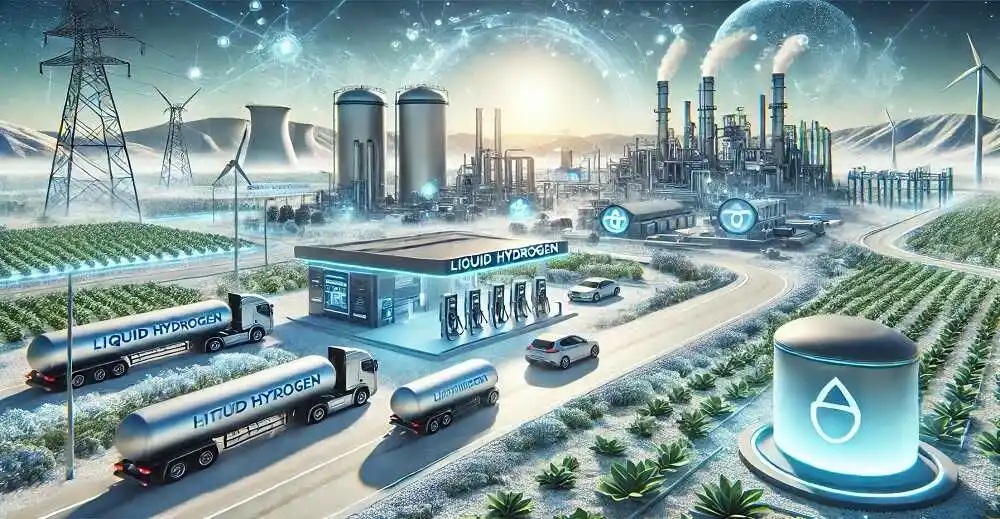
Clean energy is a form of energy that is generated without producing any form of pollution to nature. There are various types of clean energy being used across the globe, which include solar energy, wind energy, geoth...
- Automotive- In the automotive sector, liquid hydrogen plays a critical role. In the automotive sector, liquid hydrogen is used to power hybrid electric vehicles (HEVs). Liquid hydrogen is distributed along the fuel cell stack, which transforms the hydrogen into electrical energy. Various countries have introduced key policies and subsidy schemes to boost the utilization of hydrogen in commercial automotives, which includes buses and trucks.
- Aerospace- Liquid hydrogen is expected to propel the growth of renewable energy in the aviation sector. In the aviation sector, liquid hydrogen requires about 80% less fuel space and delivers the same levels of energy.
- Energy Storage- In the global energy sector, liquid hydrogen offers an efficient and optimum energy storage solution. Liquid hydrogen features a higher energy density as compared to the other forms of gaseous energy. Liquid hydrogen is also easier to transport and is also offers energy intensity.
- Industrial Sector- The utilization of liquid hydrogen in the industrial sectors, like steel making. Liquid hydrogen is among the most suitable and optimum alternatives for coal and various types of carbon-emitting fuels.
1. Increasing global demand for energy production
A major factor propelling the growth of the global liquid hydrogen market is the increasing global demand for energy across the global market. Liquid hydrogen offers critical applications global energy sector. The liquid hydrogen is generally used for the production of high-energy nuclear physics and bubble chambers. Liquid hydrogen is also used as a fuel source for internal combustion engines, or in fuel cells. The production of energy across the global market witnessed significant growth over the past few years. The Enerdata, in its report, stated that in the past few years, the production of energy increased in all the major companies. The agency stated that in 2022, the production of energy in China and the USA was recorded at 3,112 and 2,326 Mtoe respectively, whereas the production of energy in India was recorded at 700 Mtoe in 2022. The production of energy in China and the USA increased to 3,190 and 2,429 Mtoe respectively, whereas the energy production in India was recorded at 748 Mtoe. Figure 1: Production of Energy in the USA, China, and India, Mtoe, 2022 and 2023 Source: Enerdata
2. Introduction of key policies and investment opportunities for hydrogen production
With the increasing global demand for clean energy in the global energy sector, the demand for liquid hydrogen is expected to propel exponentially. Various countries and market leaders introduced key policies and investment schemes in the renewable energy sector, which are aimed at boosting the growth of global liquid hydrogen production. Various countries across the globe introduced key policies and investment opportunities in global renewable energy production. For instance, India introduced its National Green Hydrogen Mission, in March 2023, which aims to boost the green hydrogen production in the nation to about 5 million MT per annum. Similarly, the New Zealand Foreign Affairs & Trade, in its report stated that in June 2023, Japan revised its Hydrogen Basic Strategy, which aims to boost the production of hydrogen in the nation. Under its new strategy, the government introduced three new features, which include increasing the volume target to 12 million tonnes annually by 2040, aiming for 3.4 kg of CO2 emission for every 1kg of hydrogen produced, and attaining about 10% of the global electrolyzer market. The Government of Germany introduced the German Recovery Plan, which is aimed at expanding the production of hydrogen and limiting the nation's reliance on coal. Through this plan, the nation aims it develop the production capacity in the nation to 5GW by 2030, and further build a 5GW production facility by 2035 and 2040. The nation also aims to promote the utilization of hydrogen in the industrial sector. The plan also introduces a trade partnership with EUR 2 billion.3. Increasing production of hydrogen
The increasing production of hydrogen in the global market is expected to propel the growth of the global liquid hydrogen in the clean energy market. The global production of hydrogen witnessed significant growth over the past few years. The International Energy Agency, in its report, stated that in 2023, the total production of hydrogen was recorded at 97 Mt. The agency further stated that in 2023, the total installed capacity of water electrolyzers was recorded at 1.4 GW, and is expected to reach 5GW by 2024. Key Developments- In May 2024, Airbus, a global aerospace giant, introduced an innovative liquid hydrogen project. Under the GOLIAT or the Ground Operations of Liquid Hydrogen Aircraft project, the company received funding of EUR 10.8 million from the Horizon Europe Framework Programme of the EU. The main aim of the project is to enhance the adoption of LH2 or liquid hydrogen in the global aviation sector.
- In February 2024, FORVIA SE, a global leader in automotive suppliers, announced the partnership with FAW JIEFANG and Air Liquide, which is aimed at accelerating the utilization of liquid hydrogen in heavy mobility. The company aims to equip liquid hydrogen storage systems into heavy-duty trucks.
Have questions?
More Thought Articles
How EV Charger Manufacturers Can Capitalize on India’s Home Charging Revolution
India’s residential EV charging opportunity is expanding as policy support, EV adoption, and private parking infrastructure develop. Manufacturers can capture value beyond AC chargers through installation, smart charging, load management, solar integration, software, and after-sales services. Housing societies, automakers, and property developers offer scalable routes to residential charging customers.
Second-Life EV Battery Market in India: What Is Driving Demand from Manufacturers?
India’s second-life EV battery market is gaining relevance as electric vehicle adoption expands and batteries retain useful capacity after automotive service. Growing stationary-storage demand, battery data, refurbishment capabilities, EPR obligations, and critical-mineral policies are encouraging manufacturers to extend battery value through reuse before eventual recycling within India’s emerging circular battery ecosystem.
The Rise of Locally Manufactured Battery Separators in India’s EV Ecosystem
India’s battery industry is progressing from pack assembly toward domestic cell and material manufacturing, creating opportunities for lithium-ion battery separators. Policy support, ACC capacity expansion and R&D initiatives are strengthening the ecosystem. However, technical complexity, manufacturing yields, qualification requirements and economics mean localisation will likely advance gradually through coatings, testing and finishing.