
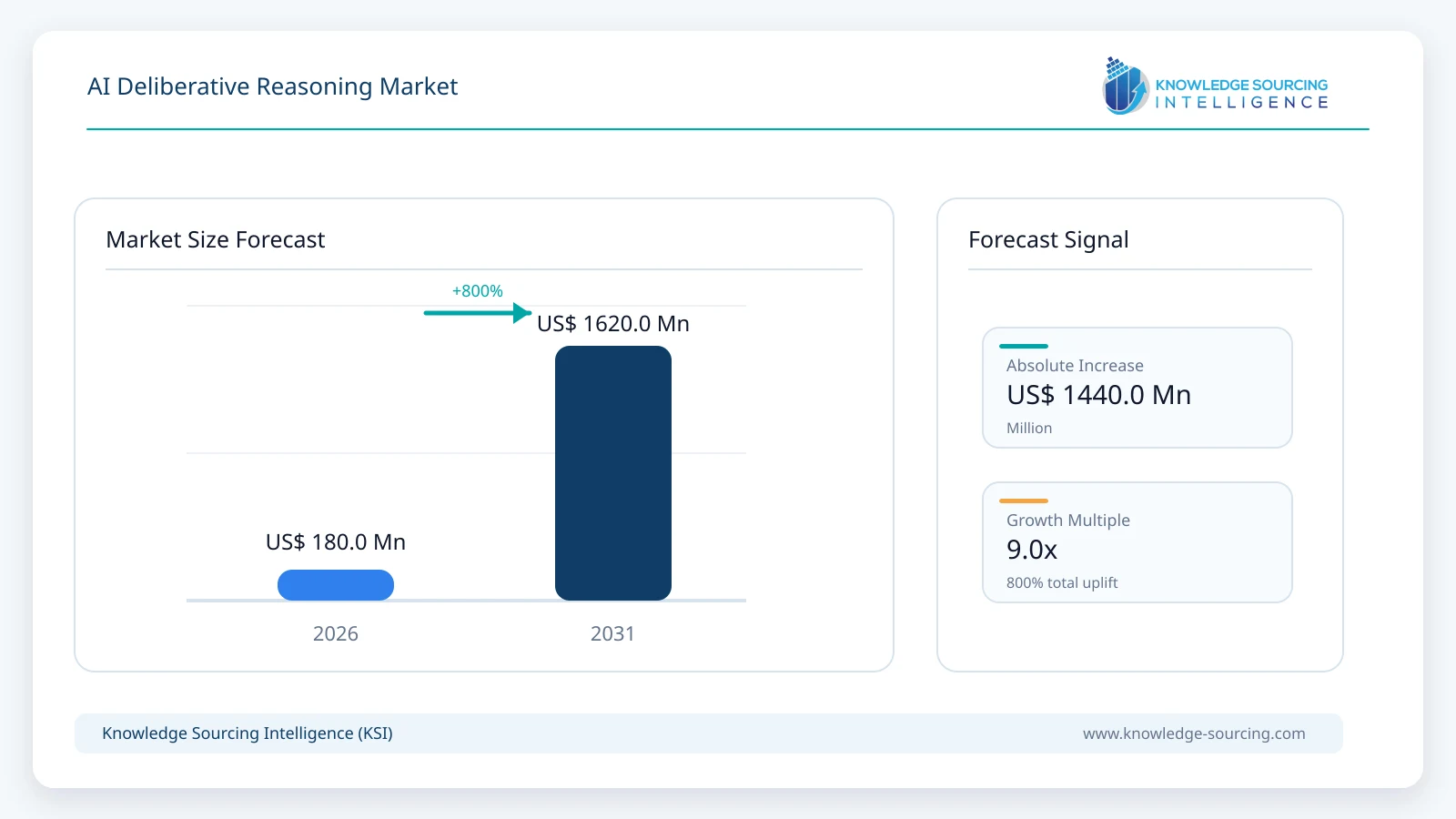
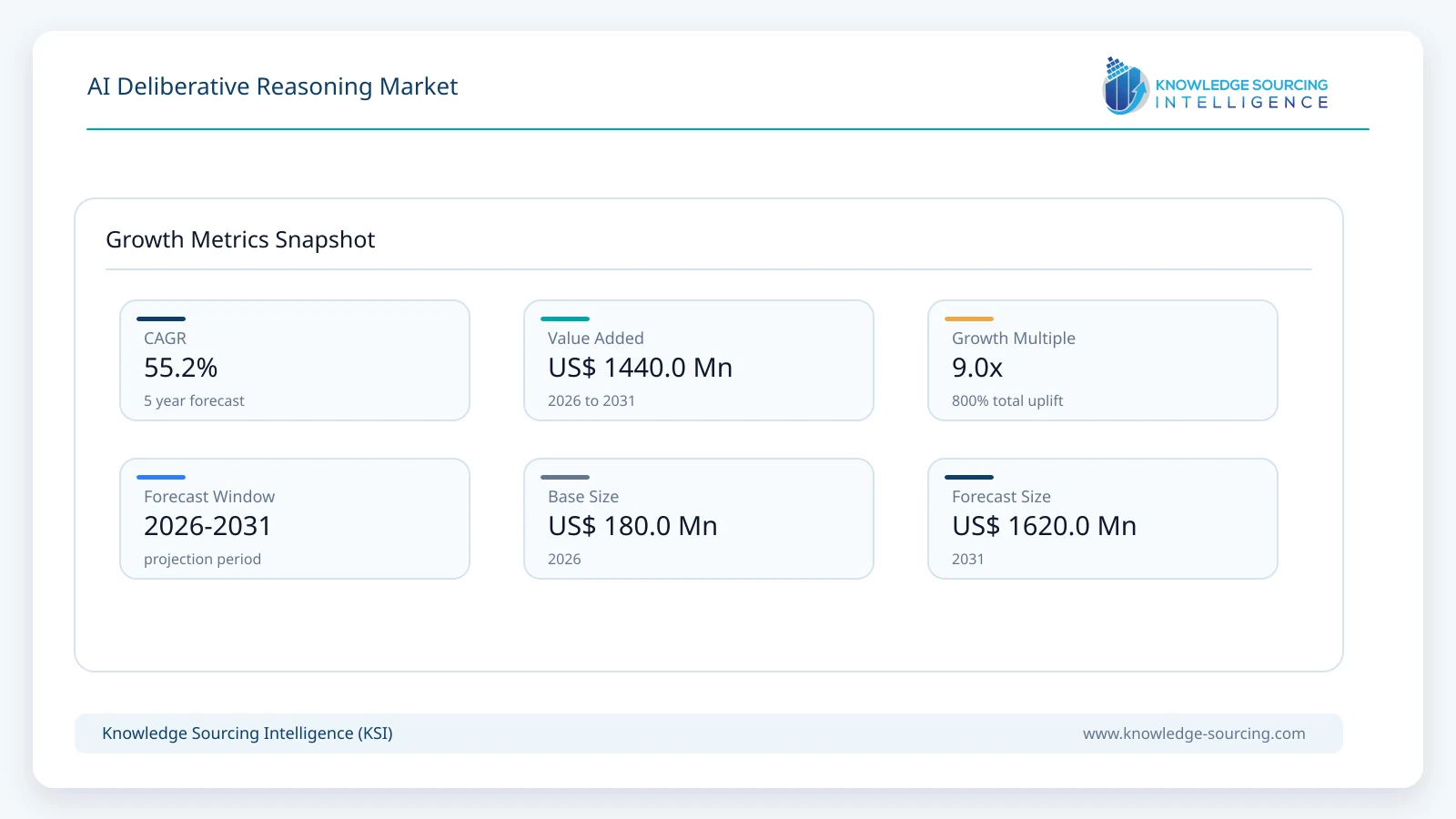
The AI Deliberative Reasoning Market is forecast to grow at a CAGR of 55.2%, reaching USD 1,620.0 million in 2031 from USD 180.0 million in 2026.
Highlights:
- 1AI deliberation spending is estimated at USD 180 million in 2026 and USD 1.62 billion in 2031, reflecting an emerging commercial layer within advanced reasoning.
- 2Multi-hypothesis evaluation accounts for 42% of modeled 2026 revenue, while tool-grounded deliberation gains share as applications need evidence checks.
- 3Metered structured-deliberation processing contributes approximately USD 105 million in 2026 and is projected to reach USD 1.01 billion in 2031.
- 4North America represents approximately USD 76 million in 2026, supported by frontier-model suppliers and enterprise software development.
- 5Asia Pacific expands from approximately USD 48 million in 2026 to USD 510 million in 2031 as regional model platforms and enterprise adoption scale.
Advanced reasoning APIs have made additional analytical effort a controllable purchase rather than an inseparable model characteristic. OpenAI provides model-dependent reasoning effort controls, Anthropic offers adaptive thinking in Claude, and Google supports selectable thinking levels in Gemini. Buyers can therefore test whether deeper analysis improves outcomes on specific request categories and reserve greater inference budgets for difficult development, complex research, or other high-consequence work.
Dedicated deliberation products also manage alternative generation, evaluation criteria and termination conditions across several model calls. These products compete on the ability to make longer computation useful, not simply to increase token consumption. Deployment demand is expected to broaden from experimental agent frameworks into governed services with cost ceilings, replayable decision paths and documented acceptance tests.
Market Overview
Deliberative reasoning creates economic value when an AI application must compare interpretations or candidate actions before giving a final result. A coding assistant may weigh alternate fixes against tests; a research assistant may compare conflicting documents; and a policy service may inspect an answer against formal constraints. Such workflows require more than a long response: they need selection rules, evidence handling, and a defined threshold for stopping analysis.
Model offerings have broadened the practical options for deeper analysis. OpenAI’s reasoning guide distinguishes effort settings by complexity and documents billable reasoning tokens, while Anthropic’s Claude Opus 4.6 offers adaptive thinking with selectable effort. Google’s Gemini models use thinking-level controls, and Meta’s Muse Spark family demonstrates demand for multimodal reasoning and agent tasks. The commercial challenge is selecting the deliberation path that improves accepted outcomes without multiplying inference costs on routine requests.
Enterprise buyers are beginning to assess deliberative systems using metrics that connect model output to operations: accepted solution rates, issue closure, factual support, decision consistency, latency and cost per verified task. Procurement therefore spans model APIs and the supporting infrastructure that coordinates evidence, constraints, and answer selection. Deliberation sold inside a broader service remains part of the underlying contract unless its price or usage can be attributed separately.
Market Trends
Configurable reasoning effort is shifting spending toward difficult requests
OpenAI, Anthropic, and Google provide ways to vary reasoning depth through model or API settings, allowing applications to allocate more processing to complex tasks. Engineering teams can apply stronger effort to unresolved bugs, inconsistent evidence or technical decisions while retaining cheaper execution for routine requests. This behavior supports revenue from deliberation-intensive workloads but puts pressure on providers to show that higher token expenditure improves task completion. The strongest commercial implementations use evaluation results to identify the request types that benefit from deeper processing.
Multiple candidate solutions are being assessed against shared criteria
For software design, policy interpretation, and scientific analysis, developers increasingly generate more than one plausible answer and score alternatives against common requirements. Deliberative systems can use factual evidence, expected risk or process constraints to choose a final recommendation rather than relying on first-response confidence. This creates demand for candidate-management and decision arbitration components that fit into existing applications. Commercial adoption depends on keeping comparison costs predictable and avoiding redundant model calls.
Tool-grounded deliberation is becoming more valuable
A model can reason extensively yet reach the wrong conclusion when its premises are incomplete. Developers therefore connect deliberation steps to search, code execution, data queries and policy stores, using retrieved evidence to challenge candidate outputs. Meta’s Muse Spark models and newer reasoning-oriented developer platforms demonstrate growing support for tool-using AI workflows. Organizations value these integrations most where a wrong result creates rework or review costs, but tool activity must remain separate from the attributable deliberation fee.
Private deployment and governance are shaping enterprise procurement
Financial services, healthcare and industrial engineering users often need controls over context, sensitive documents and decision records. Managed private runtimes and enterprise contracts can provide predictable capacity, reviewable selection criteria and contractual service requirements without exposing internal reasoning processes to every application user. Model vendors compete with cloud platforms and open-weight deployments on integration cost, throughput, and governance. Reproducibility and task-specific quality testing are increasingly important where AI recommendations affect regulated or costly decisions.
Segment Analysis
By Deliberation Mechanism: Multi-Hypothesis Evaluation
Multi-hypothesis evaluation is the largest modeled mechanism, accounting for approximately USD 75.6 million in 2026 and reaching USD 486 million in 2031. Developers use alternative candidate generation to compare code fixes, research explanations and operational decisions against requirements rather than committing to the first response. Constraint-aware and tool-grounded mechanisms gain relative weight as enterprise evaluation moves from general answer quality toward stronger evidence and process controls.
By Commercial Offering: Metered Deliberation Processing
Metered structured-deliberation processing accounts for approximately USD 105 million in 2026 and is projected to reach USD 1.01 billion in 2031. Model APIs allow developers to increase effort for difficult requests and associate incremental cost with those tasks. Dedicated runtime contracts and decision-arbitration services provide complementary paths for buyers seeking controlled deployment, although bundled processing and verification are assigned to one revenue stream only.
By Primary Application: Software Engineering and Code Review
Software engineering and code review are projected to account for approximately USD 437.4 million in 2031, versus USD 50.4 million in 2026. Higher-effort deliberation helps compare proposed changes, assess failure modes and decide whether generated code satisfies requirements. Research and complex analysis, projected at USD 405 million in 2031, represent another important application as organizations evaluate competing interpretations of large evidence sets.
Market Drivers
Increasing use of AI for difficult software engineering
Large software organizations are delegating increasingly complex debugging, migration and code-review work to reasoning models. Deliberative engines help examine multiple possible changes against test results and operational constraints before recommending a solution. OpenAI’s GPT-5.4 and later reasoning products emphasize more demanding software work, while Anthropic’s Opus releases focus on long-running coding tasks and output checking. Spending rises when additional consideration lowers rework, reduces reviewer intervention and improves the share of accepted fixes. Model vendors and software-platform providers can monetize that value through higher-effort API usage and application-specific contracts.
Greater demand for evidence-based enterprise decisions
Enterprise research, financial analysis, and regulated operations often involve ambiguous facts or competing interpretations. A deliberative engine can compare evidence, test assumptions, and apply established policies before delivering a recommendation. Such functionality is commercially relevant when a single incorrect decision creates high downstream cost. Teams are therefore evaluating accepted-outcome rates and source consistency alongside headline model benchmarks. Vendors able to attach decision-quality improvements to governed workflows are better positioned to earn incremental revenue than products that merely display extended reasoning text.
Growth of controllable reasoning APIs
Reasoning effort controls have made greater model deliberation accessible to software developers through familiar APIs. OpenAI documents several effort settings and usage-based reasoning tokens; Anthropic provides adaptive thinking; and Google exposes thinking-level choices for supported Gemini models. These mechanisms let application teams set resource budgets by task complexity rather than purchase a fixed advanced-model capability for all requests. The ability to measure extra processing, reserve it for valuable cases and track improvements creates a direct commercial channel for structured deliberation.
Improving availability of tool-using reasoning models
Reasoning systems now interact more readily with code interpreters, search tools and enterprise data sources. Meta’s Muse Spark family and leading frontier-model vendors combine advanced reasoning with tool-aware and agentic capabilities. During a deliberative task, tool results can supply evidence that eliminates weaker candidates or reveals missing assumptions. This improves the practical usefulness of comparative reasoning in technical work. Demand expands when tools remain governed, error handling is clear and the final recommendation can be evaluated against an explicit acceptance condition.
Broader enterprise investment in governed AI workflows
Companies deploying AI beyond pilot use are imposing budget limits, approval rules, audit trails and defined risk controls. A reusable deliberative runtime can apply common policies across several internal applications, avoiding repeated custom integration work. Dedicated managed and private deployments become attractive where workloads are continuous or sensitive. Model providers, cloud service firms and specialist orchestration vendors can sell these functions alongside advanced inference. Growth remains tied to identifiable deliberation software value rather than the full revenue of an enterprise AI platform.
Market Restraints
High inference cost and variable response time
Extended reasoning can multiply model calls, reasoning tokens and tool operations for one accepted answer. Complex deliberation therefore requires higher budgets and can create delays that are unacceptable in customer-facing services. Developers must distinguish tasks that benefit from greater effort from those where a simpler model is sufficient. Revenue growth depends on cost per resolved task, not rising token volumes alone. Applications without strong evaluation data risk overspending on elaborate reasoning processes that deliver little additional value.
Limited evidence of stable gains across all task types
Longer or more elaborate reasoning does not consistently produce better results in every domain. Candidate selection can amplify shared errors if alternative responses rely on the same incorrect premises. Enterprises need task-specific tests, careful baselines and repeatable acceptance criteria before committing to paid deliberation layers. This verification burden slows procurement, especially for applications with infrequent decisions or difficult-to-measure outcomes. Vendors must demonstrate material improvements under production conditions rather than relying only on benchmark performance.
Bundling within general reasoning-model contracts
Many frontier-model providers sell reasoning capacity as part of an integrated API or software subscription, leaving limited visibility into distinct deliberation revenue. An enterprise may pay for a high-effort model call without separately purchasing candidate arbitration or policy-aware selection. This restricts the addressable standalone software layer and increases competition for specialist products. Customers may prefer native model capabilities when external runtimes introduce additional implementation cost, latency or procurement complexity.
Information-security and governance constraints
Deliberative applications often inspect detailed enterprise documents, source code, contractual rules and records of alternatives considered. Data residency, retention controls, privilege management and audit requirements can prevent unrestricted use of public model endpoints. Some organizations must keep sensitive evidence within private infrastructure while ensuring tools do not expose more context than needed. Such controls increase engineering and compliance expenditure and can slow deployments of multi-step reasoning services.
Complex integration with production systems
Deploying a deliberative engine requires orchestration across model APIs, evidence stores, business rules and evaluation services. Failures in one component may invalidate a final choice or create expensive repetition. Application teams also need predictable termination rules and safe fallback behavior when evidence is inconclusive. These requirements increase the cost of moving from demonstrations to production services. Open-source frameworks and native platform features can further limit the price customers are willing to pay for a separate deliberation runtime.
Regional Outlook
North America
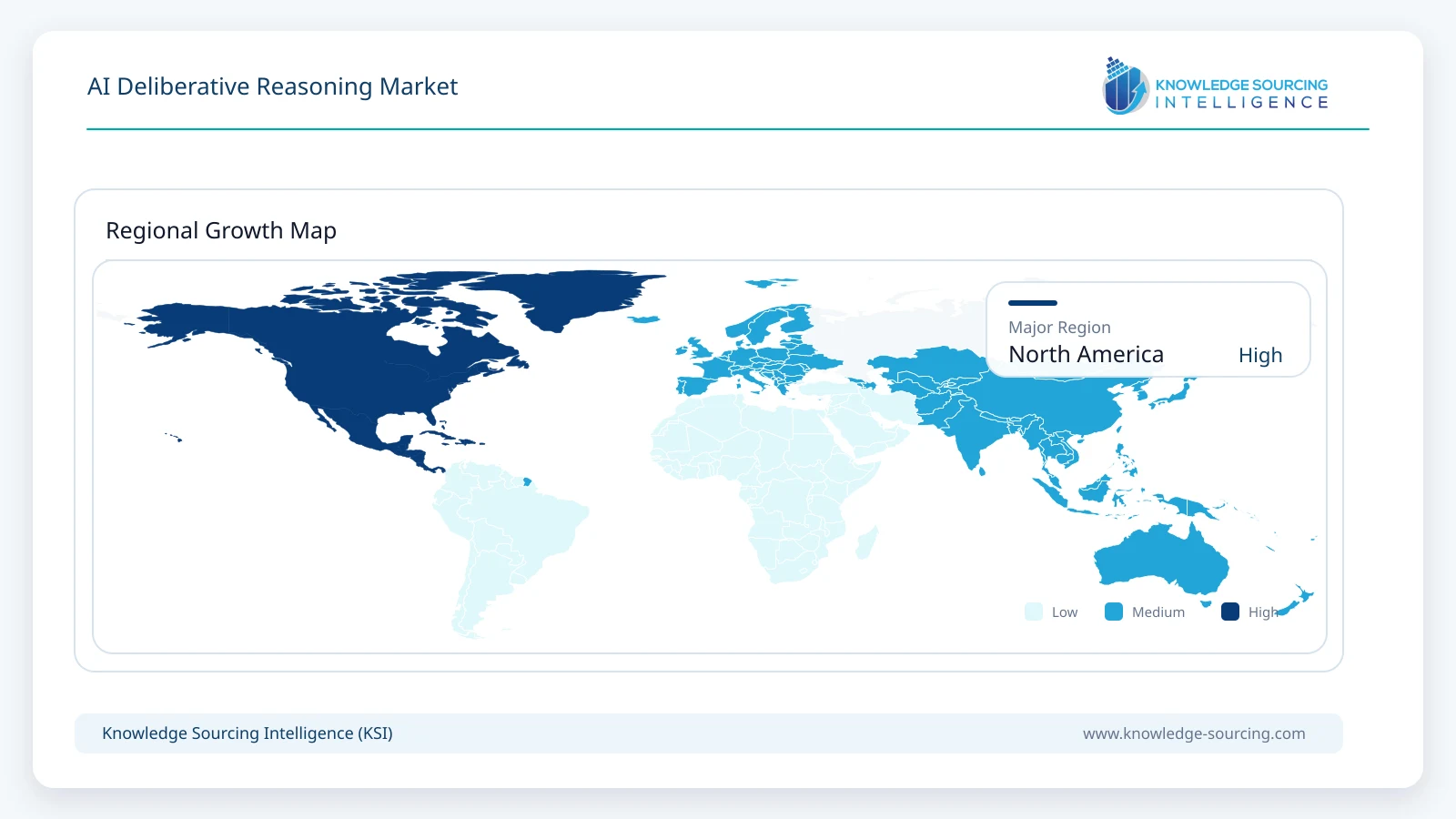
North America is estimated to account for USD 76 million in 2026, making it the largest regional market for attributable AI deliberative reasoning spending. Frontier-model developers, cloud providers and enterprise software firms in the United States are central to the commercialization of configurable high-effort reasoning. Demand is concentrated in coding, research and professional workflows that can demonstrate a return from additional analysis. Enterprise customers increasingly link model selection to task-specific evaluations, governance requirements and unit costs.
The North American market is projected to reach approximately USD 615 million by 2031 as paid deliberation expands across software providers and large enterprise applications. The United States contributes most regional revenue, while Canada provides demand from AI research and commercial application development. Competitive pressure is expected to remain intense because model vendors can bundle deeper reasoning into established APIs, requiring independent orchestration providers to demonstrate better decision selection or enterprise controls.
Asia Pacific
Asia Pacific is estimated at USD 48 million in 2026 and is projected to reach USD 510 million by 2031, making it the fastest-growing regional market in the model. China, India, Japan, South Korea and Singapore support demand through regional model development, software engineering and business-process digitization. Enterprises are evaluating deeper reasoning for technical analysis, multilingual workflows and complex customer or operational decisions, although procurement and model-access conditions differ substantially by country.
The Asia Pacific opportunity is supported by increasing availability of cloud AI services and local reasoning-model ecosystems. Large application developers can add controlled deliberation to existing products while managing inference cost through selective use of higher-effort settings. Growth depends on service localization, predictable pricing and integration with regional data infrastructure. Country-level adoption is not uniform, and sensitive workloads may require private deployment or local provider relationships.
Competitive Landscape
Competition combines frontier reasoning-model developers, enterprise cloud platforms and vendors providing orchestration or managed inference. OpenAI, Anthropic, Google and Meta influence underlying model capabilities, while Microsoft and Amazon Web Services provide channels for governed enterprise deployments. Hosted model providers can offer production capacity and throughput optimization, but the direct competitive test is whether a supplier can charge for identifiable deliberation processing or selection functions. Open-weight alternatives and native model features restrain standalone software pricing, making task-specific evidence of better decisions an important differentiator.
Recent Developments
3 September 2026: OpenAI launched GPT-6 Astra for advanced reasoning, coding, computer use and research through supported products and APIs.
9 July 2026: Meta introduced Muse Spark 1.1 and a public preview of its Model API, with a Thinking mode for more demanding reasoning.
9 July 2026: OpenAI began deploying GPT-5.6 Sol as a higher-capability reasoning model for complex coding, research and professional tasks.
16 April 2026: Anthropic released Claude Opus 4.7, emphasizing difficult software engineering and more consistent validation of outputs.
8 April 2026: Meta introduced Muse Spark, a multimodal reasoning model with tool use and multi-agent orchestration.
5 February 2026: Anthropic introduced Claude Opus 4.6 with adaptive thinking and selectable effort controls through its API.
Market Outlook
Deliberative reasoning revenue is expected to expand as high-value AI applications begin selecting reasoning effort and comparing candidate answers according to explicit quality targets. Organizations will increasingly reserve deeper computation for unresolved software defects, difficult research questions and policy-sensitive choices while using simpler inference for routine requests. That selective deployment should support faster growth in attributable deliberation revenue than in basic model usage.
Commercial suppliers will be assessed on accepted outcome rates, reproducibility, governed integration and total cost per completed task. Dedicated runtimes and private deployments should become more important as enterprises standardize evaluation policies, but model-vendor bundling will continue to pressure separate licensing. The strongest providers will connect additional processing to operational improvement while preventing redundant model calls and unnecessary verification expense.
AI Deliberative Reasoning Market Scope:
| Report Metric | Details |
|---|---|
| Total Market Size in 2026 | USD 180.0 million |
| Total Market Size in 2031 | USD 1,620.0 million |
| Forecast Unit | USD Million |
| Growth Rate | 55.2% |
| Study Period | 2021 to 2031 |
| Historical Data | 2021 to 2024 |
| Base Year | 2025 |
| Forecast Period | 2026 – 2031 |
| Segmentation | Deliberation Mechanism, Commercial Offering, Deployment Model, Deliberation Intensity |
| Companies |
|
| Customization Scope | 15% Free Customization included with purchase — Request Custom Breakdown → |
| Sample & Data Access | PDF Sample, Excel Databook & Analyst Briefing — Download Free Sample → |
Market Segmentation
By Deliberation Mechanism
Multi-hypothesis evaluation
Constraint and policy-aware reasoning
Tool-grounded deliberation
Outcome-weighted answer selection
By Commercial Offering
Metered structured-deliberation processing
Dedicated deliberation runtimes
Decision arbitration and trace checking
Deployment and integration services
By Deployment Model
Multitenant model APIs
Dedicated managed cloud
Private cloud
On-premises deployment
By Deliberation Intensity
Moderate multi-step deliberation
High-effort comparative reasoning
Extended policy-aware deliberation
By Primary Application
Software engineering and code review
Research and complex analysis
Enterprise decision support
Policy and compliance decisions
Scientific and technical problem solving
By Customer Type
AI developers and software providers
Large enterprises
Cloud and model service providers
Research and public institutions
By End-user Industry
Information technology and software
Financial services
Professional and scientific services
Healthcare and life sciences
Manufacturing and engineering
Other industries
By Geography
North America
United States
Canada
Mexico
South America
Brazil
Argentina
Chile
Colombia
Rest of South America
Europe
Germany
United Kingdom
France
Netherlands
Italy
Spain
Nordic Countries
Rest of Europe
Middle East and Africa
Saudi Arabia
United Arab Emirates
Israel
South Africa
Rest of Middle East
Rest of Africa
Asia Pacific
China
Japan
India
South Korea
Australia
Singapore
Rest of Asia Pacific
Table of Contents
1. EXECUTIVE SUMMARY
1.1 Research Highlights
1.2 Market Size and Forecast, 2026-2031
1.3 Strategic Market Outlook
2. MARKET SNAPSHOT
2.1 Definition and Commercial Scope
2.2 Market Dynamics
2.3 Pricing and Adoption
3. BUSINESS LANDSCAPE
3.1 Market Drivers
3.1.1 Increasing use of AI for difficult software engineering
3.1.2 Greater demand for evidence-based enterprise decisions
3.1.3 Growth of controllable reasoning APIs
3.1.4 Improving availability of tool-using reasoning models
3.1.5 Broader enterprise investment in governed AI workflows
3.2 Market Restraints
3.2.1 High inference cost and variable response time
3.2.2 Limited evidence of stable gains across all task types
3.2.3 Bundling within general reasoning-model contracts
3.2.4 Information-security and governance constraints
3.2.5 Complex integration with production systems
3.3 Market Opportunities
3.4 Porter's Five Forces Analysis
3.5 Industry Value Chain Analysis
3.6 Policies and Regulations
3.7 Strategic Recommendations
4. TECHNOLOGICAL OUTLOOK
4.1 Reasoning-Effort Control
4.2 Hypothesis Generation and Arbitration
4.3 Tool-Grounded Reasoning
4.4 Constraint and Policy-Aware Deliberation
4.5 Termination and Cost Control
4.6 Outcome Evaluation and Feedback
5. AI DELIBERATIVE REASONING MARKET BY DELIBERATION MECHANISM
5.1 Multi-hypothesis evaluation
5.2 Constraint and policy-aware reasoning
5.3 Tool-grounded deliberation
5.4 Outcome-weighted answer selection
6. AI DELIBERATIVE REASONING MARKET BY COMMERCIAL OFFERING
6.1 Metered structured-deliberation processing
6.2 Dedicated deliberation runtimes
6.3 Decision arbitration and trace checking
6.4 Deployment and integration services
7. AI DELIBERATIVE REASONING MARKET BY DEPLOYMENT MODEL
7.1 Multitenant model APIs
7.2 Dedicated managed cloud
7.3 Private cloud
7.4 On-premises deployment
8. AI DELIBERATIVE REASONING MARKET BY DELIBERATION INTENSITY
8.1 Moderate multi-step deliberation
8.2 High-effort comparative reasoning
8.3 Extended policy-aware deliberation
9. AI DELIBERATIVE REASONING MARKET BY PRIMARY APPLICATION
9.1 Software engineering and code review
9.2 Research and complex analysis
9.3 Enterprise decision support
9.4 Policy and compliance decisions
9.5 Scientific and technical problem solving
10. AI DELIBERATIVE REASONING MARKET BY CUSTOMER TYPE
10.1 AI developers and software providers
10.2 Large enterprises
10.3 Cloud and model service providers
10.4 Research and public institutions
11. AI DELIBERATIVE REASONING MARKET BY END-USER INDUSTRY
11.1 Information technology and software
11.2 Financial services
11.3 Professional and scientific services
11.4 Healthcare and life sciences
11.5 Manufacturing and engineering
11.6 Other industries
12. AI DELIBERATIVE REASONING MARKET BY GEOGRAPHY
12.1 North America
12.1.1 United States
12.1.2 Canada
12.1.3 Mexico
12.2 South America
12.2.1 Brazil
12.2.2 Argentina
12.2.3 Chile
12.2.4 Colombia
12.2.5 Rest of South America
12.3 Europe
12.3.1 Germany
12.3.2 United Kingdom
12.3.3 France
12.3.4 Netherlands
12.3.5 Italy
12.3.6 Spain
12.3.7 Nordic Countries
12.3.8 Rest of Europe
12.4 Middle East and Africa
12.4.1 Saudi Arabia
12.4.2 United Arab Emirates
12.4.3 Israel
12.4.4 South Africa
12.4.5 Rest of Middle East
12.4.6 Rest of Africa
12.5 Asia Pacific
12.5.1 China
12.5.2 Japan
12.5.3 India
12.5.4 South Korea
12.5.5 Australia
12.5.6 Singapore
12.5.7 Rest of Asia Pacific
13. COMPETITIVE ENVIRONMENT AND ANALYSIS
13.1 Competitive Structure
13.2 Market Share Analysis
13.3 Product and Technology Differentiation
13.4 Strategic Developments
14. COMPANY PROFILES
14.1 OpenAI
14.2 Anthropic
14.3 Google DeepMind
14.4 Meta Platforms
14.5 Microsoft
14.6 Amazon Web Services
14.7 Alibaba Cloud
14.8 DeepSeek
14.9 Mistral AI
14.10 Cohere
14.11 xAI
14.12 Together AI
15. APPENDIX
15.1 Research Methodology
15.2 Abbreviations and Definitions
15.3 Coverage and Data Tables





Frequently asked questions
What is the projected AI Deliberative Reasoning market size by 2031?
The AI Deliberative Reasoning Market is forecast to reach USD 1,620.0 million by 2031.
What is the Compound Annual Growth Rate (CAGR) for this market?
The AI Deliberative Reasoning Market is forecast to grow at a CAGR of 55.2%.
Which segment holds the largest revenue share in 2026?
Multi-hypothesis evaluation accounts for 42% of modeled 2026 revenue.
Which region leads the market in 2026, and which is growing fastest?
North America leads in 2026; Asia Pacific expands significantly to 2031.
What drives the economic value of AI deliberative reasoning?
The AI Deliberative Reasoning Market creates value by comparing interpretations or candidate actions before final results.
How is AI deliberative reasoning deployment expected to evolve?
Deployment will broaden into governed services with cost ceilings and replayable paths.
Cite this report
Knowledge Sourcing Intelligence. (Oct 2026). AI Deliberative Reasoning Market Size, Share & Growth Forecast (2026-2031). https://www.knowledge-sourcing.com/report/ai-deliberative-reasoning-market