
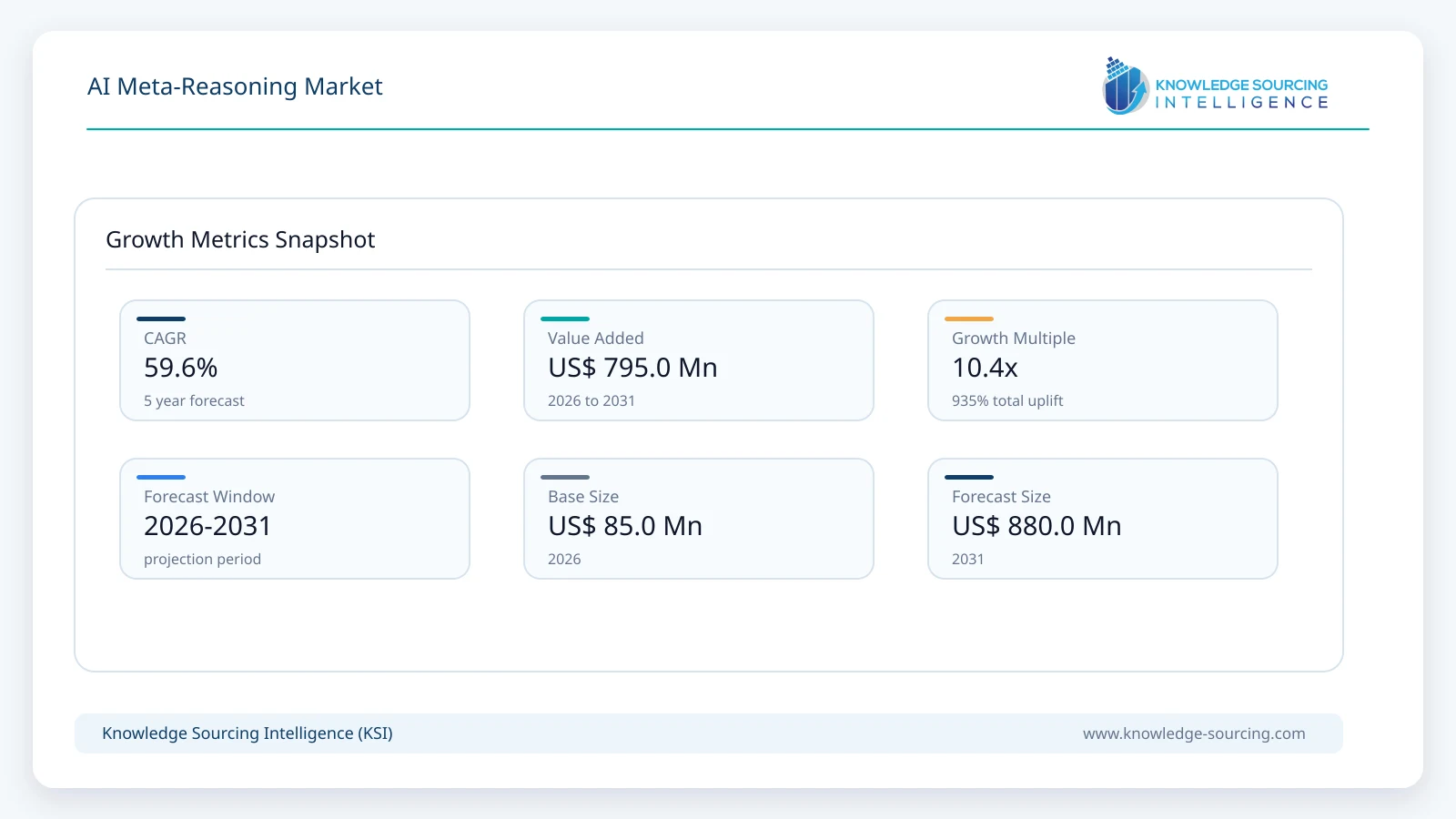
The AI Meta-reasoning Market is forecast to grow at a CAGR of 59.6%, reaching USD 880.0 million in 2031 from USD 85.0 million in 2026.
Highlights:
- 1Adaptive model and reasoning strategy selection represents a substantial share of commercial demand, but is measured separately from underlying inference charges.
- 2Complexity and reasoning-effort gating represents 36% of modeled 2026 revenue; model and strategy selection increases to 32% by 2031.
- 3Metered meta-control requests contribute USD 37.5 million in 2026 and are projected to generate USD 406 million by 2031.
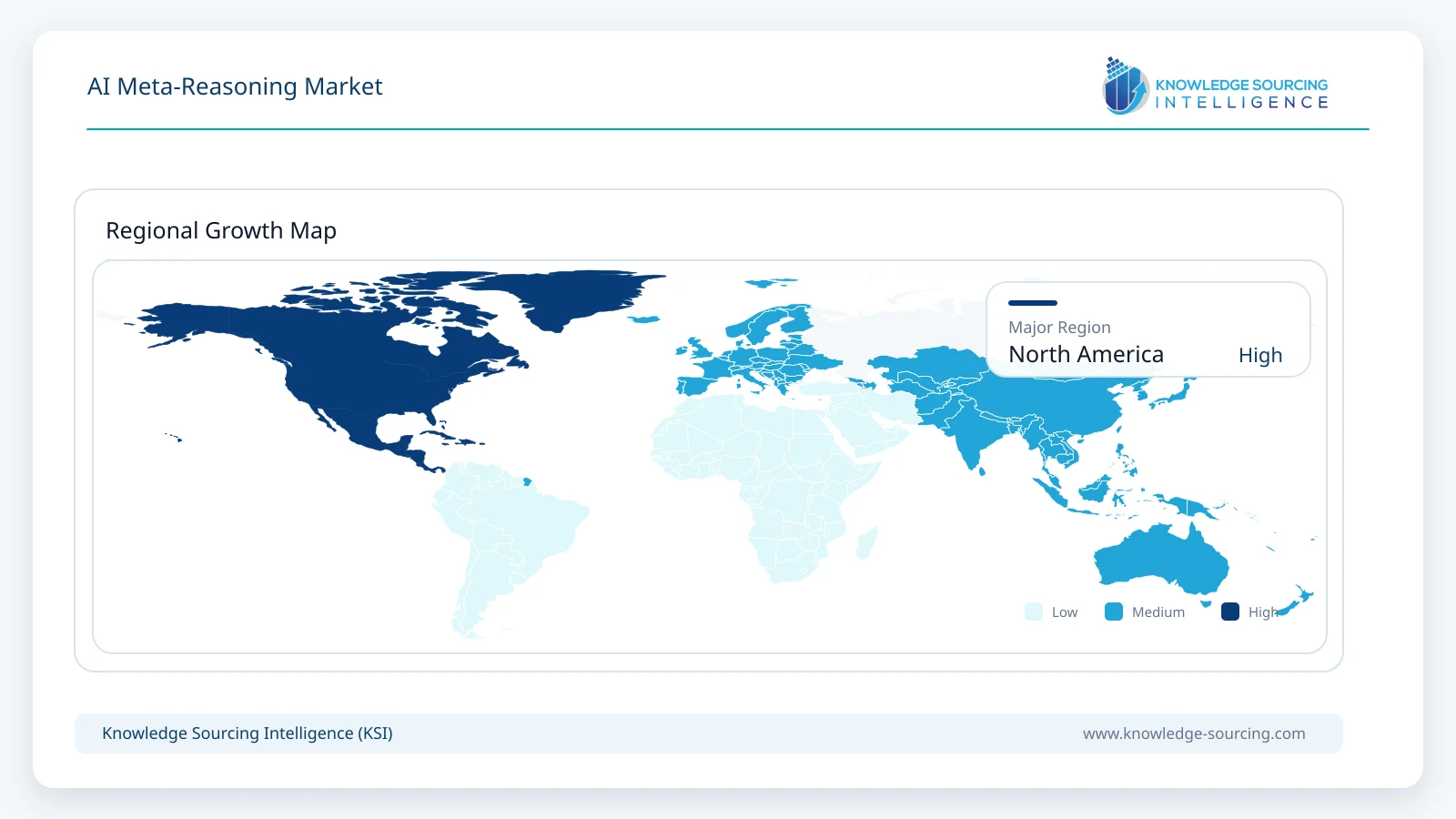
- 4North America remains the leading region, while Asia Pacific contributes the greatest share of incremental revenue through 2031.
- 5Growth requires reliable evidence that supervisory decisions reduce the cost of successfully completed tasks rather than merely increasing orchestration overhead.
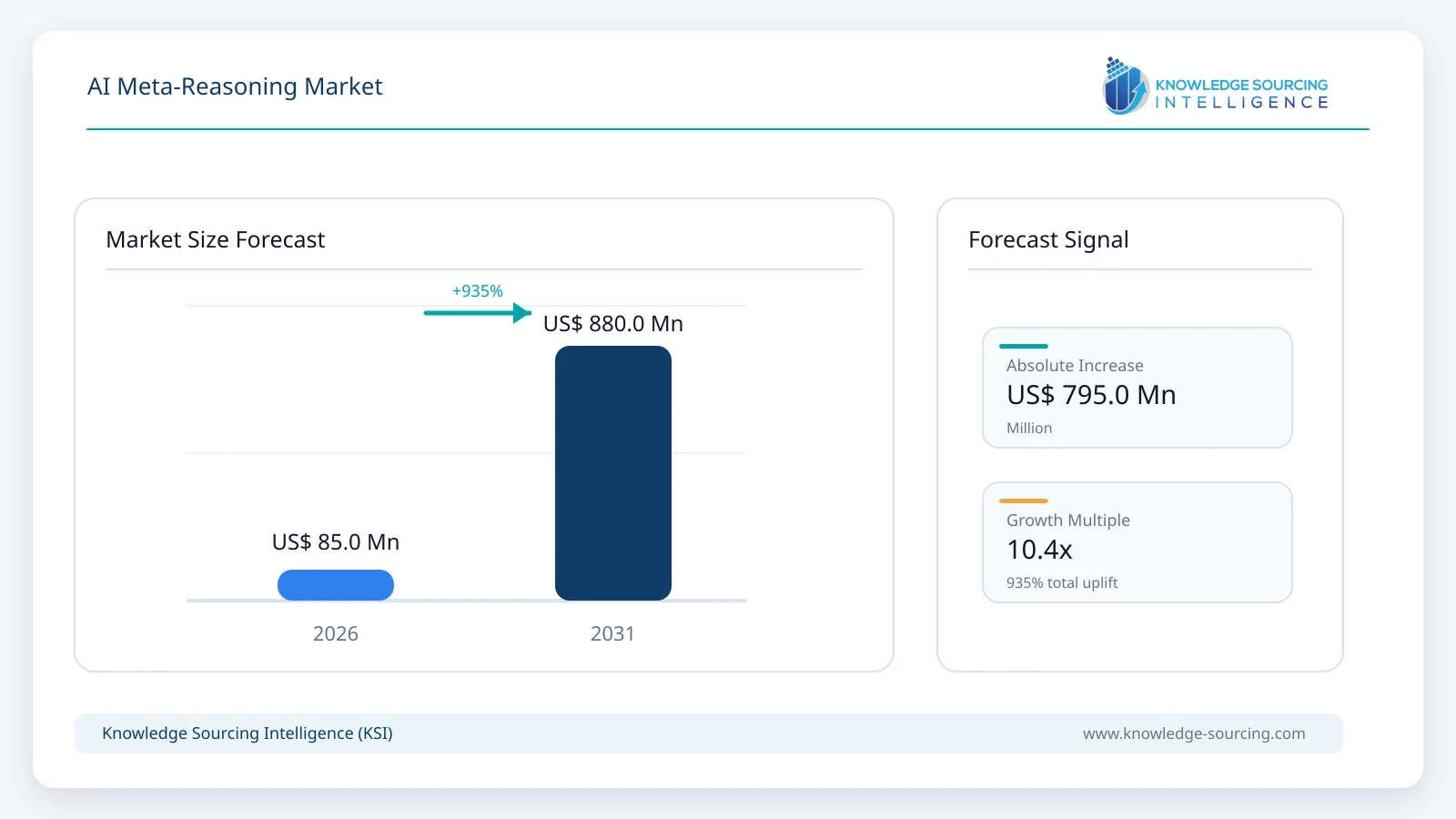
Model-selection technology is entering production workflows where several alternatives differ in response quality, latency, and usage price. Amazon Bedrock offers intelligent prompt routing as a separately priced service, while Not Diamond selects models against quality, cost, and latency objectives. Anthropic allows Claude applications to adjust effort while the model determines when deeper thinking is useful. These examples establish a purchase case for supervisory control, even when the underlying reasoning model comes from another vendor.
Long-running agents create additional control decisions after an initial route has been selected. A software-engineering agent may have to decide whether to retry a failing test, ask another model to investigate, seek external evidence, or stop after reaching an acceptable answer. Google Cloud, Microsoft and specialized orchestration vendors are making these functions more explicit. Customers can evaluate their contribution using successful tasks per dollar, completion time, and the share of runs that require manual recovery.
Market Overview
Meta reasoning differs from the model reasoning that produces a final answer because it governs how that reasoning is organized and resourced. A controller can classify the incoming request, predict when a more expensive model is warranted, allocate additional attempts to uncertain stages, and stop work when evidence is sufficient. These supervisory decisions can sit inside an API, in an agent runtime or in a specialist gateway that serves several model providers.
Enterprise procurement increasingly involves a mix of proprietary frontier models, smaller models and tool-using agents. Assigning one model to every task can waste expensive reasoning effort on routine questions, while aggressive cost routing may reduce acceptance rates on harder work. A meta-reasoning controller addresses the tradeoff by applying rules and observed performance to task categories. AWS Intelligent Prompt Routing and Not Diamond provide practical examples of model-choice controls, although their offerings differ in coverage and commercial packaging.
Long-horizon development and analysis workloads expose the limits of simple one-time routing because complexity changes after each tool result. Research on agentic meta-reasoning shows how a separate controller can select among continuing work, restarting a branch or ending a run. The commercial opportunity is strongest where these choices are instrumented, audited and connected to measurable results. Businesses also require limits on data movement, allowed models, and action permissions before delegating high-value decisions.
Market Trends
Reasoning Effort Is Becoming a Managed Operating Setting
Reasoning model APIs increasingly give developers controls that differentiate inexpensive routine responses from deeper processing of difficult tasks. Anthropic introduced adaptive thinking in Claude Opus 4.6 with adjustable effort levels, and OpenAI made multiple reasoning-effort settings available for GPT-5.4. Application operators can combine those controls with task complexity classification, budget limits and observed error rates. The resulting value comes from allocating effort selectively rather than maintaining the maximum setting throughout every workflow.
Model Choice Is Being Evaluated Against Application Outcomes
Prompt routers are moving beyond fixed provider preferences toward measured decisions about model quality, price and latency. Amazon Bedrock predicts which model in a supported family can meet response requirements at an efficient price, while Not Diamond offers trained and configurable model routers. Specialized systems can also use task-specific evaluations to determine when the cheapest model is not suitable. Buyers will compare routing policies using accepted task outcomes, not only reported token savings.
Agent Controllers Are Extending Beyond the First Model Call
Autonomous coding and research applications repeatedly face decisions about which partially completed step deserves additional work. Meta-reasoning research published in September 2026 describes a controller that reviews accumulated progress, tests alternatives and assigns remaining computational budget to selected work. Microsoft’s agent harness provides implementation components such as planning, checkpoints and telemetry. Together, these developments support control policies that are updated throughout a run instead of selected only at its beginning.
Early Stopping and Risk Controls Are Becoming More Quantifiable
Reasoning steps can be expensive without necessarily improving the final result, particularly when the problem is already solved or cannot be resolved from available information. Apple’s 2026 Conformal Thinking research explores risk-calibrated thresholds for stopping early and limiting computational waste. Production platforms can adapt similar principles using their own quality tests and permitted failure rates. Commercial adoption will depend on validation against real workloads rather than a universal stopping rule that assumes all tasks carry equal risk.
Segment Analysis
By Meta-Control Mechanism: Complexity and Effort Gating
Complexity classification and reasoning-effort gating represents the largest modeled 2026 mechanism, with revenue of approximately USD 30.6 million, expanding to USD 246.4 million by 2031. The function predicts whether additional thinking is likely to improve task completion and then applies an appropriate budget. Adoption is strongest among high-volume AI application developers who can benchmark quality at multiple effort levels. Over time, model and strategy selection grows faster as customers combine different providers and specialized reasoning techniques within a single application.
By Commercial Offering: Metered Meta-Control Requests
Metered supervisory decisions contribute approximately USD 37.5 million in 2026 and are projected to generate USD 406 million by 2031. Charging is associated with separately identifiable decisions that classify a request or select a route, not the subsequent model tokens themselves. The segment expands through higher controlled-request volumes, while individual decision prices remain sensitive to competition and customer willingness to build internal routing policies. Contracted runtime software adds a second material revenue channel for private and dedicated deployments.
By Primary Application: Autonomous Agent Oversight
Software engineering and coding agents hold an estimated 31% share of 2026 demand, with frequent opportunities to route investigation, code generation, tool calls, and tests. Long-horizon autonomous agent oversight is projected to rise from USD 17 million in 2026 to approximately USD 220 million in 2031 as enterprises apply supervisory policies throughout extended tasks. Planning quality, stop conditions, escalation, and budget adherence are all commercially valuable when a failed agent run can consume multiple expensive model invocations.
Market Drivers
Rising Use of Long-Horizon AI Agents
Long-horizon AI agents must repeatedly choose between continuing a line of reasoning, seeking evidence, switching tools, and ending a run. Coding and research deployments expose these decisions because their execution paths change as intermediate results arrive. A supervisory controller can keep track of work completed and route remaining effort toward the most promising next step. As enterprises expand such agents, the demand for paid decision policies, progress summaries and bounded compute orchestration increases.
Growing Availability of Configurable Reasoning APIs
Frontier model providers increasingly expose reasoning depth and effort as settings that developers can control. Anthropic’s adaptive thinking and OpenAI’s reasoning-effort options make it easier to attach operational policies to task types without creating new models. Organizations can select effort according to complexity and accepted response quality, increasing the economic value of a meta-controller that learns which settings to apply. The benefit is clearest for applications serving a broad range of request difficulties.
Pressure to Reduce Cost per Accepted Result
Inference spending is rising as agents generate multiple intermediate steps and use expensive frontier models repeatedly. Cloud prompt routing and specialist model-selection products provide mechanisms for shifting eligible requests toward cheaper models while preserving quality requirements. Enterprise teams increasingly measure accepted outcomes and latency alongside total inference expenditure. A meta-reasoning layer that reduces wasted computation can justify a separate fee when its own overhead remains below the avoided cost.
Maturing Evaluation and Trace Infrastructure
Production-quality decision controllers require evidence of whether a routing or stopping policy improves results. Model evaluations, trace records and structured feedback allow teams to compare alternative strategies on representative tasks and identify regressions. Braintrust and major cloud platforms document operational controls for model-quality measurement and review, while research explores budget-aware reasoning policies. These foundations make meta-control policies easier to test, audit and revise after deployment.
Demand for Governed Decision Paths
Regulated businesses increasingly require limits on model selection, permitted data destinations, maximum spend and human intervention thresholds. Unsupervised agents can inadvertently send sensitive tasks to unsuitable models or continue work after an acceptable outcome has been reached. Meta-reasoning policies create a place to enforce business constraints before each computational decision. Such controls support adoption in banking, healthcare administration and large enterprises where predictable oversight matters as much as model performance.
Market Restraints
Difficulty Separating Meta-Control Revenue From Model Spending
Meta-reasoning functionality is often bundled into reasoning-model APIs, agent development frameworks and cloud gateways. A provider may not report the portion of revenue attributable to choosing reasoning depth or model routes, making separate procurement and pricing difficult to demonstrate. Enterprises can also use features without a standalone license. This limits the immediately addressable market and places pressure on independent vendors to show differentiated control rather than repackage baseline inference.
Uncertain Returns Across Different Workloads
A controller trained on one task distribution may choose an inferior model or terminate reasoning too early on another. Quality improvements observed in research benchmarks may not transfer to a company’s internal codebase, legal documentation or scientific workflows. Enterprises need carefully designed comparisons across difficulty bands and clear performance thresholds. Where routing decisions are unreliable, the resulting rework can eliminate apparent compute savings and delay commercial adoption.
Added Latency and Controller Overhead
Supervisory decisions may require additional model calls, policy checks, tracing and evaluation before substantive work begins. For low-cost or real-time tasks, that overhead can be larger than the inference savings. Persistent controllers must also maintain execution state and handle model outages. Providers therefore need lightweight decision paths and sensible fallbacks, particularly for high-volume consumer services and latency-sensitive enterprise applications.
Security and Data-Governance Constraints
Cross-provider model routing can create additional data residency, access-control and confidentiality challenges. Agent supervisors may inspect task context, intermediate traces and internal documents to choose the next step. Customers must be able to restrict eligible models, minimize retained content and record why a particular routing or escalation decision occurred. Deployment requirements can favor private installations and lengthen sales cycles for smaller software providers.
Competition From Open-Source and Native Controls
Organizations can implement task classification, fixed budget thresholds and early stopping through application code or open-source agent frameworks. Model providers may embed increasingly capable adaptive reasoning policies directly into standard token charges, reducing demand for third-party controllers. Specialist suppliers must sustain an advantage through real-world evaluations, portability and reliable governance. Vendor differentiation becomes difficult when a product only adds a simple routing rule to existing infrastructure.
Regional Outlook
North America
North America holds the largest modeled revenue position in 2026 at approximately USD 34.9 million, reflecting early adoption among frontier-model suppliers, cloud infrastructure providers and enterprise software developers. The United States accounts for the majority of regional purchasing, supported by production deployments of coding agents, analytical workflows, and managed model APIs. Commercial buyers are particularly focused on reducing the operating cost of expensive multi-step workloads without compromising task accuracy.
North American AI meta-reasoning revenue is projected to reach approximately USD 334.4 million in 2031 as routing controls become routine elements of managed enterprise AI environments. Supplier competition includes cloud-native intelligent routing, model-provider effort settings and independent strategy controllers. North American customers are also expected to demand stronger evaluation evidence, audit records and cost attribution before allocating separate budgets to new meta-reasoning tools.
Asia Pacific
Asia Pacific is projected to be the fastest-growing major regional market, increasing from approximately USD 23.0 million in 2026 to USD 281.6 million in 2031. China, India, Japan and South Korea contribute important developer communities, enterprise AI deployments and cloud-model ecosystems. Large-scale application traffic creates opportunities for lower-cost model selection and careful allocation of advanced reasoning, especially where multilingual workloads and local data requirements constrain available model choices.
Regional growth is supported by wider adoption of agentic software engineering, financial analytics and private AI infrastructure across both mature and emerging economies. Enterprises increasingly need supervisory controls that switch between approved model endpoints, preserve regional processing requirements and apply different reasoning budgets to routine and high-value tasks. The commercial market should benefit most where vendors demonstrate local-language accuracy and measurable savings rather than treating routing as a basic API convenience.
Competitive Landscape
The AI meta-reasoning market includes three supplier groups: foundation-model providers with adaptive reasoning controls, cloud platforms offering intelligent model selection, and specialist routing or orchestration vendors. Amazon Bedrock and Google Cloud connect routing decisions to managed infrastructure; Anthropic and OpenAI allow applications to vary reasoning effort; Not Diamond and Portkey provide independent routing functions. Microsoft and LangChain support agent harnesses where step-control logic can be built, while Braintrust helps developers compare model choices and monitor quality.
Competitive differentiation increasingly depends on measurable improvements in accepted tasks per dollar, the reliability of escalation and stopping decisions, and the ability to enforce customer-specific rules. Independent providers face bundling pressure from large cloud and model platforms, but may be attractive to organizations operating several model families. The market is therefore likely to remain fragmented across supervisory routing, model controls and dedicated agent-runtime functions.
Recent Developments
22 October 2026: Google Cloud introduced Agent Compute Engine and expanded agent governance, identifying model-routing policies and token-cost controls as upcoming preview capabilities rather than already generally available tools.
29 September 2026: Researchers published Thinking Before Thinking, demonstrating a controller that chooses agent work and stopping decisions within a fixed compute budget; the result is a research contribution, not a commercial product launch.
22 July 2026: Microsoft released its Agent Framework Harness with planning, tool loops, memory and telemetry, creating an implementation route for instrumented task-control decisions.
July 2026: Apple Machine Learning Research presented Conformal Thinking, evaluating risk-controlled stop decisions for reasoning workloads at ICML 2026; the work illustrates potential savings from more selective deliberation.
14 May 2026: Amazon Bedrock introduced Advanced Prompt Optimization with comparative evaluations and cost/latency reporting across selected models, expanding tooling for evidence-led strategy selection.
5 March 2026: OpenAI released GPT-5.4 with controllable reasoning effort and improved agent tool-use capabilities, broadening the range of effort-control policies available to application developers.
Market Outlook
AI meta-reasoning adoption is projected to expand as the number of decisions within each agent run increases and enterprises deploy several models with different cost and quality profiles. Supervisory software will increasingly determine when to use an expensive reasoning model, whether to continue exploratory work, and when to stop after reaching an acceptable outcome. Commercial value will be linked to reliable improvements in task completion per unit of expenditure, rather than to the length of a model’s reasoning trace.
Dedicated runtimes and metered control decisions should develop into the principal spending categories where model choice, budget management and escalation are separately measured. Large platform vendors will embed many control capabilities directly into their inference services, while specialist suppliers will compete on cross-provider independence and task-specific optimization. Enterprise requirements for auditability and data residency will support more private deployment options, particularly for sensitive decision workflows.
Market maturity will depend on whether independent controller decisions outperform simple policies under representative production conditions. Buyers are expected to validate quality thresholds, monitor policy drift, and reject arrangements that count underlying inference spending twice. Vendors that make their supervisory decisions transparent and link them to measurable business outcomes will be better placed to earn durable software revenue through 2031.
AI Meta-Reasoning Market Scope:
| Report Metric | Details |
|---|---|
| Total Market Size in 2026 | USD 85.0 million |
| Total Market Size in 2031 | USD 880.0 million |
| Forecast Unit | USD Million |
| Growth Rate | 59.6% |
| Study Period | 2021 to 2031 |
| Historical Data | 2021 to 2024 |
| Base Year | 2025 |
| Forecast Period | 2026 – 2031 |
| Segmentation | Meta-Control Mechanism, Commercial Offering, Deployment Model, Decision Trigger |
| Companies |
|
| Customization Scope | 15% Free Customization included with purchase — Request Custom Breakdown → |
| Sample & Data Access | PDF Sample, Excel Databook & Analyst Briefing — Download Free Sample → |
Market Segmentation
By Meta-Control Mechanism
Complexity and Reasoning-Effort Gating
Model and Strategy Selection
Intermediate Reasoning-State Monitoring
Stop, Restart and Escalation Control
By Commercial Offering
Metered Meta-Control Requests
Controller Runtime Licenses
Decision-Monitoring Events
Deployment and Integration Services
By Deployment Model
Multitenant API and Managed Gateway
Dedicated Managed Cloud
Private Cloud
On-Premises Deployment
By Decision Trigger
Task-Complexity Prediction
Uncertainty and Confidence Signals
Compute-Cost and Latency Thresholds
Quality and Policy Thresholds
By Primary Application
Software Engineering and Coding Agents
Enterprise Research and Analysis
Long-Horizon Autonomous Agents
Scientific and Technical Reasoning
Regulated Decision-Support Workflows
By Customer Type
AI Application Developers and ISVs
Large Enterprises
Cloud and Model Service Providers
Research and Public Institutions
By End-User Industry
Information Technology and Software
Banking and Financial Services
Professional and Scientific Services
Healthcare and Life Sciences
Manufacturing and Engineering
Other Industries
By Geography
North America
United States
Canada
Mexico
South America
Brazil
Argentina
Chile
Colombia
Rest of South America
Europe
Germany
United Kingdom
France
Netherlands
Italy
Spain
Nordic Countries
Rest of Europe
Middle East and Africa
Saudi Arabia
United Arab Emirates
Israel
South Africa
Rest of Middle East
Rest of Africa
Asia Pacific
China
Japan
India
South Korea
Australia
Singapore
Rest of Asia Pacific
Table of Contents
1. EXECUTIVE SUMMARY
1.1. Research Highlights
1.2. Market Size and Forecast, 2026-2031
1.3. Strategic Outlook
2. MARKET SNAPSHOT
2.1. Market Overview
2.2. Market Definition
2.3. Scope of the Study
2.4. Market Segmentation
3. BUSINESS LANDSCAPE
3.1. Market Drivers
3.1.1. Rising Use of Long-Horizon AI Agents
3.1.2. Growing Availability of Configurable Reasoning APIs
3.1.3. Pressure to Reduce Cost per Accepted Result
3.1.4. Maturing Evaluation and Trace Infrastructure
3.1.5. Demand for Governed Decision Paths
3.2. Market Restraints
3.2.1. Difficulty Separating Meta-Control Revenue From Model Spending
3.2.2. Uncertain Returns Across Different Workloads
3.2.3. Added Latency and Controller Overhead
3.2.4. Security and Data-Governance Constraints
3.2.5. Competition From Open-Source and Native Controls
3.3. Market Opportunities
3.4. Porter's Five Forces Analysis
3.5. Industry Value Chain Analysis
3.6. Policies and Regulations
3.7. Strategic Recommendations
4. TECHNOLOGICAL OUTLOOK
4.1. Task Complexity Estimation
4.2. Dynamic Model and Strategy Routing
4.3. Effort and Compute-Budget Allocation
4.4. Intermediate State Evaluation
4.5. Risk-Based Stopping and Escalation
4.6. Supervisory Agent Controllers
5. AI META-REASONING MARKET BY META-CONTROL MECHANISM
5.1. Introduction
5.2. Complexity and reasoning-effort gating
5.3. Model and strategy selection
5.4. Intermediate reasoning-state monitoring
5.5. Stop, restart and escalation control
6. AI META-REASONING MARKET BY COMMERCIAL OFFERING
6.1. Introduction
6.2. Metered meta-control requests
6.3. Controller runtime licenses
6.4. Decision-monitoring events
6.5. Deployment and integration services
7. AI META-REASONING MARKET BY DEPLOYMENT MODEL
7.1. Introduction
7.2. Multitenant API and managed gateway
7.3. Dedicated managed cloud
7.4. Private cloud
7.5. On-premises deployment
8. AI META-REASONING MARKET BY DECISION TRIGGER
8.1. Introduction
8.2. Task-complexity prediction
8.3. Uncertainty and confidence signals
8.4. Compute-cost and latency thresholds
8.5. Quality and policy thresholds
9. AI META-REASONING MARKET BY PRIMARY APPLICATION
9.1. Introduction
9.2. Software engineering and coding agents
9.3. Enterprise research and analysis
9.4. Long-horizon autonomous agents
9.5. Scientific and technical reasoning
9.6. Regulated decision-support workflows
10. AI META-REASONING MARKET BY CUSTOMER TYPE
10.1. Introduction
10.2. AI application developers and ISVs
10.3. Large enterprises
10.4. Cloud and model service providers
10.5. Research and public institutions
11. AI META-REASONING MARKET BY END-USER INDUSTRY
11.1. Introduction
11.2. Information technology and software
11.3. Banking and financial services
11.4. Professional and scientific services
11.5. Healthcare and life sciences
11.6. Manufacturing and engineering
11.7. Other industries
12. AI META-REASONING MARKET BY GEOGRAPHY
12.1. North America
12.1.1. United States
12.1.2. Canada
12.1.3. Mexico
12.2. South America
12.2.1. Brazil
12.2.2. Argentina
12.2.3. Chile
12.2.4. Colombia
12.2.5. Rest of South America
12.3. Europe
12.3.1. Germany
12.3.2. United Kingdom
12.3.3. France
12.3.4. Netherlands
12.3.5. Italy
12.3.6. Spain
12.3.7. Nordic Countries
12.3.8. Rest of Europe
12.4. Middle East and Africa
12.4.1. Saudi Arabia
12.4.2. United Arab Emirates
12.4.3. Israel
12.4.4. South Africa
12.4.5. Rest of Middle East
12.4.6. Rest of Africa
12.5. Asia Pacific
12.5.1. China
12.5.2. Japan
12.5.3. India
12.5.4. South Korea
12.5.5. Australia
12.5.6. Singapore
12.5.7. Rest of Asia Pacific
13. COMPETITIVE ENVIRONMENT AND ANALYSIS
13.1. Major Players and Strategy Analysis
13.2. Market Share Analysis
13.3. Mergers, Acquisitions, Agreements, and Collaborations
13.4. Competitive Dashboard
14. COMPANY PROFILES
14.1. Amazon Web Services
14.2. Google Cloud
14.3. Not Diamond
14.4. Anthropic
14.5. OpenAI
14.6. Portkey
14.7. Microsoft
14.8. LangChain
14.9. Braintrust
14.10. Martian
15. APPENDIX
15.1. Currency
15.2. Assumptions
15.3. Base and Forecast Years Timeline
15.4. Key Benefits for Stakeholders
15.5. Research Methodology
15.6. Abbreviations





Frequently asked questions
What is the projected AI Meta-Reasoning market size by 2031?
The AI Meta-Reasoning Market is forecast to reach USD 880.0 million by 2031.
What is the AI Meta-Reasoning market's compound annual growth rate?
The AI Meta-Reasoning Market is forecast to grow at a 59.6% CAGR.
Which region holds the largest AI Meta-Reasoning market share?
North America remains the leading region.
What is the primary function of AI meta-reasoning?
The AI Meta-Reasoning Market governs AI reasoning organization and resource allocation.
What is a significant revenue segment by 2031?
Metered meta-control requests will generate USD 406 million by 2031.
What was the AI Meta-Reasoning market size in 2026?
The AI Meta-Reasoning Market was USD 85.0 million in 2026.
Cite this report
Knowledge Sourcing Intelligence. (Oct 2026). AI Meta-Reasoning Market Size, Share & Growth Forecast (2026-2031). https://www.knowledge-sourcing.com/report/ai-meta-reasoning-market