
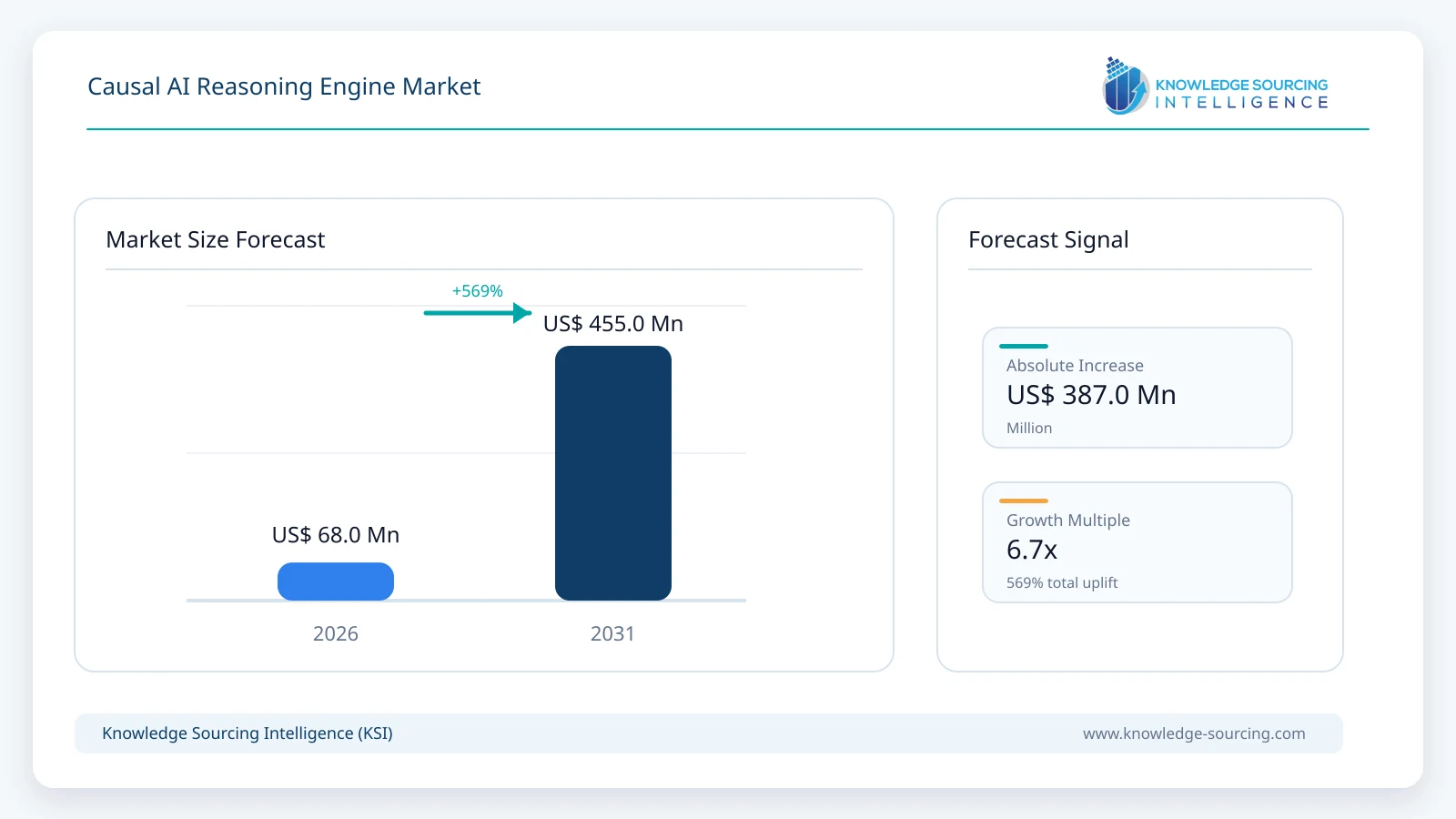
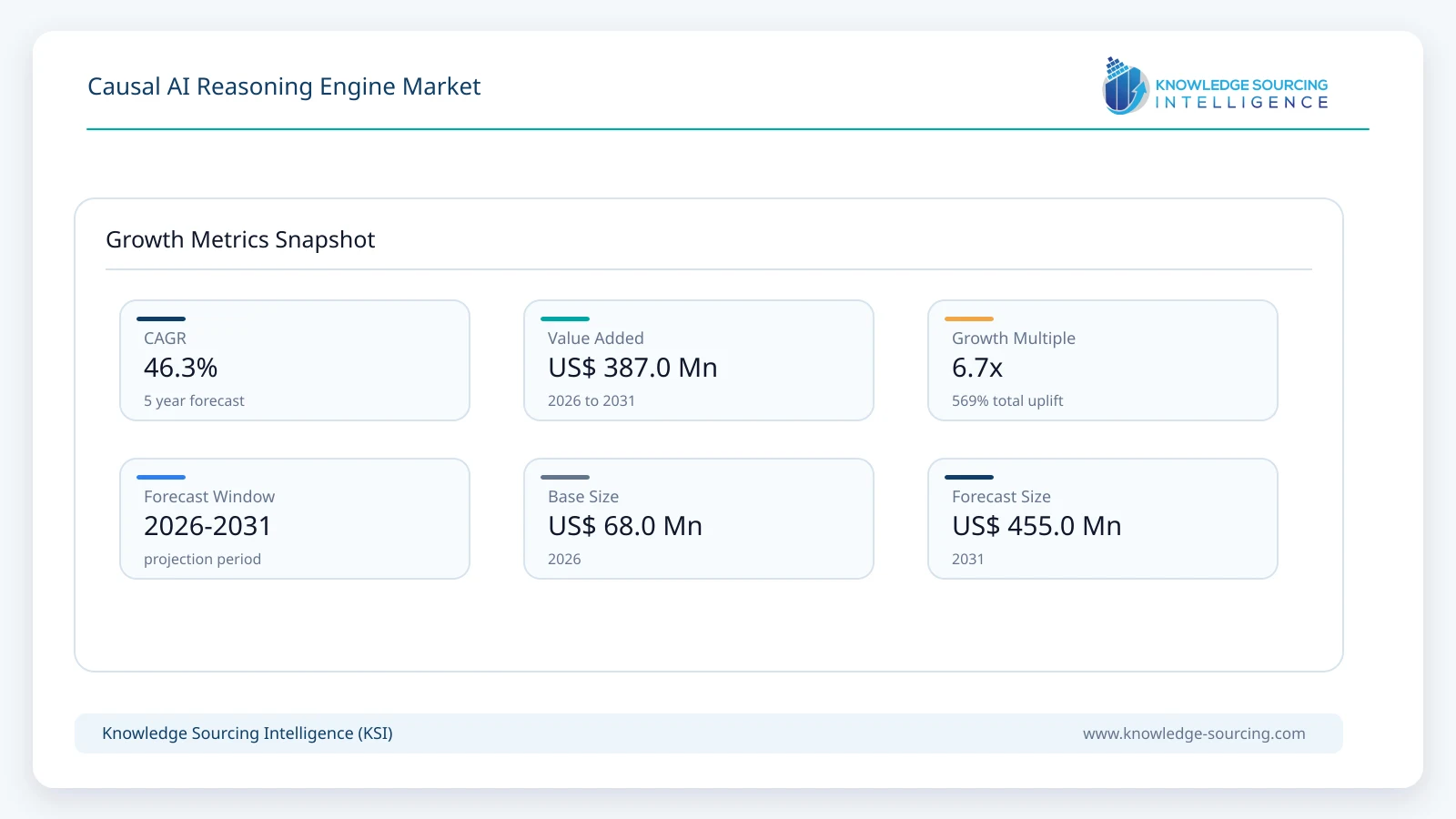
The causal AI reasoning engine market is estimated at USD 68 million in 2026 and projected to reach USD 455 million in 2031, growing at a CAGR of 46.3% during the forecast period.
Highlights:
- 1Dedicated causal reasoning platform licenses are projected to contribute USD 225 million by 2031, reflecting reuse of models across enterprise decision workflows.
- 2Counterfactual and intervention simulation is forecast to reach USD 122.85 million by 2031 as buyers prioritize decisions rather than descriptive analytics.
- 3Healthcare and life sciences are projected to account for USD 127.40 million in 2031, driven by mechanisms and intervention analysis.
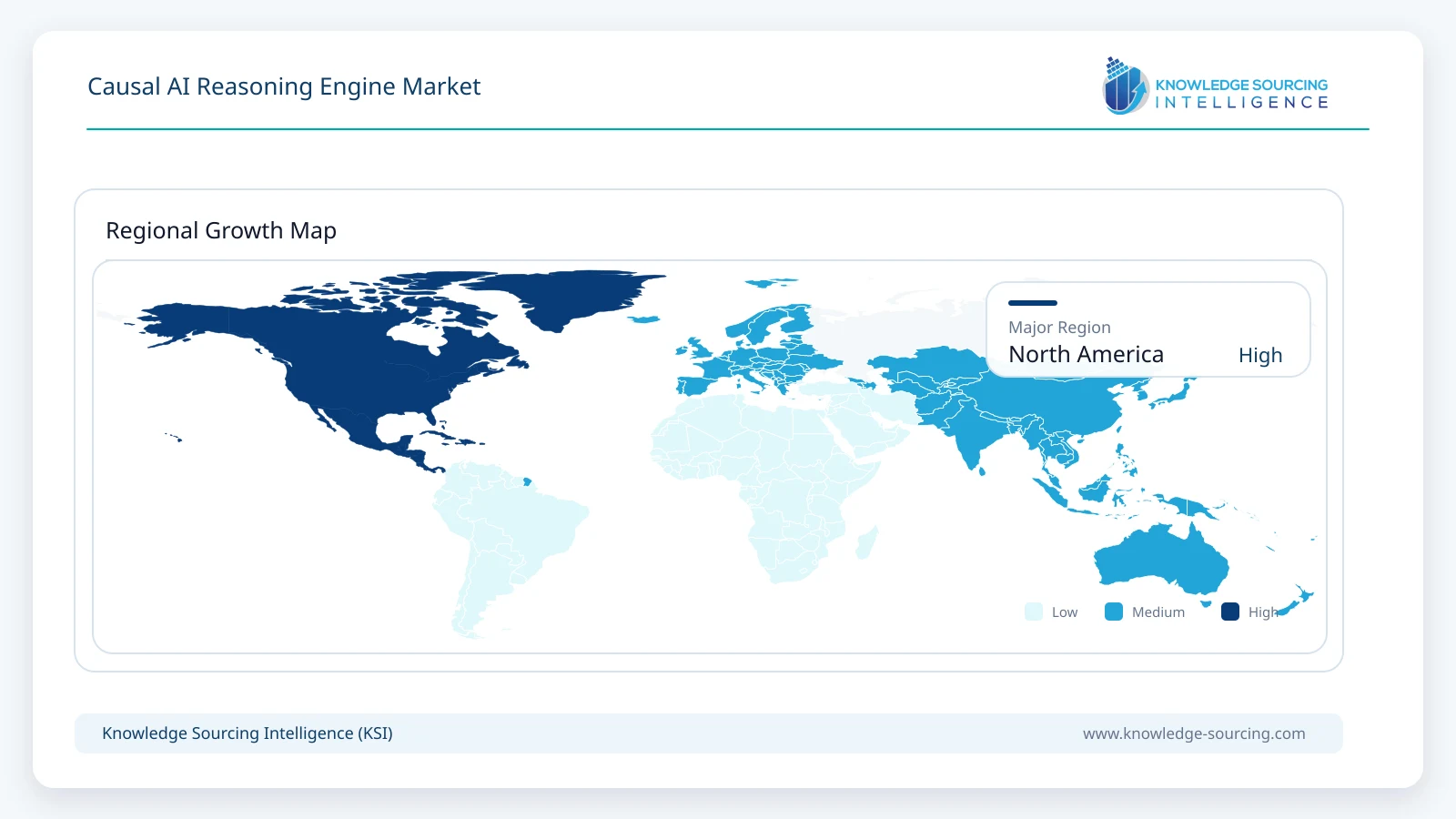
- 4North America is projected to remain the largest market at USD 177.45 million in 2031, while Asia Pacific expands most quickly.
- 5Specialist vendors must distinguish verified causal models from correlation-based feature explanations and avoid double counting bundled agent, observability and analytics revenue.
Commercial revenue comes from dedicated causal reasoning platforms, licensed domain-specific reasoning modules, metered engine services and directly related implementation work. The market includes inference over causal structures and intervention-aware decisions, rather than all predictive AI, analytics or generic language-model spending.
Commercial systems combine structural causal models, directed graphs, Bayesian inference, knowledge graphs and agent-oriented interfaces to answer questions that ordinary pattern recognition cannot settle. Causely reasons over live software-service dependencies to locate operational failure paths; Alembic provides intervention simulation for allocation decisions; and Geminos combines causal models with organizational knowledge in an enterprise decision layer. These examples demonstrate different uses of a shared capability rather than a single interchangeable product class.
Customers increasingly require confidence checks on assumed causal links before using an engine for automated action. Product evaluations therefore examine model traceability, intervention stability, observed decision lift, integration burden and the distinction between a causal explanation and a verified causal effect. Vendors can monetize reusable models and recurring decisions, but the market cannot be measured by assigning the full value of adjacent AI agents or analytics suites to the causal layer.
Market Overview
Enterprise causal reasoning is becoming an operational software capability as companies require recommendations supported by identifiable mechanisms. The workflow typically begins with data preparation and a proposed graph of dependencies, then tests causal assumptions, evaluates interventions and passes justified recommendations into an application or human decision process. Organizations with stable, frequently recurring decisions are the strongest candidates because validated models can be reused rather than rebuilt for every question.
Product architectures differ by domain. Scientific platforms reason over molecular and disease relationships, observability engines traverse service dependencies to identify faults, and commercial decision systems estimate incremental response to spending or pricing changes. Aitia uses disease-focused digital twins; Causaly connects scientific literature to directional relationships; and Dynatrace uses topology-aware cause analysis for service reliability. These products are commercially distinct from ordinary dashboards that merely describe which metrics move together.
Market Trends
Causal Models Are Becoming Inputs to AI Agents
Agentic workflows increasingly need a grounded model before an automated system recommends a high-impact action. Causely exposes causal dependency models to external agents through MCP, helping investigate software incidents without relying solely on free-form log interpretation. Geminos similarly positions causality alongside knowledge graphs and language-based reasoning. The combination can reduce unsupported recommendations, although causal correctness still depends on the quality of the underlying model. For procurement teams, the distinction is whether an agent can reliably trace each action through a maintained causal structure and preserve supporting evidence for later audit.
Counterfactual Simulation Is Moving into Operating Decisions
Decision applications are shifting from retrospective explanations toward comparing the expected consequences of alternative actions. Alembic introduced real-time recomputation for enterprise budget scenarios in March 2026, allowing users to examine changes in allocation before committing capital. causaLens applies causal tools within business-facing digital workers, including healthcare commercial operations. Buyers value repeatability and measurable business effects more than the volume of scenarios generated. Adoption will therefore favor implementations that compare simulated outcomes with later observed performance, helping business teams refine decision rules and reject models whose intervention estimates do not generalize.
Biomedicine Is Expanding Mechanism-Based Reasoning
Biopharma researchers need to connect disease mechanisms, candidate targets and supporting experiments before selecting expensive development pathways. In September 2026, Aitia and Ono Pharmaceutical announced work using Gemini Digital Twins to explore neurological diseases. Causaly has linked scientific knowledge-graph reasoning with Microsoft workflows. The segment benefits from high decision value, but validation requirements and specialist data access also limit deployment speed. Research organizations must often align disparate clinical datasets, literature evidence and laboratory findings before a model can support a decision, making implementation services an important but bounded revenue stream.
Causal Discovery Performance and Evidence Quality Are Improving
Causal discovery software is being optimized for datasets containing numerous variables, missing values and mixed measurement types. RootCause.ai published its SPARC-fast findings in September 2026, showing an emphasis on processing efficiency and structural validation. Faster discovery helps teams explore candidate causal graphs, but neither speed nor correlation-based explanations alone establish that an intervention will deliver the predicted result. Supplier differentiation will increasingly depend on controlled tests and documented assumptions. Teams evaluating automated graph discovery should therefore examine false-positive links, sensitivity to missing data, plausible alternative structures and reproducibility on datasets that differ from development benchmarks.
Segment Analysis
By Causal Reasoning Function: Counterfactual and Intervention Simulation
Counterfactual and intervention simulation is expected to reach USD 122.85 million in 2031, representing 27% of the market. It evaluates alternative actions under an explicit causal model, giving management teams a stronger basis for selecting policies, treatments or budgets. Alembic supplies decision simulation for enterprise allocations, and Aitia uses causal digital twins to explore disease interventions.
By Commercial Offering: Dedicated Causal Reasoning Platforms
Dedicated causal reasoning platform licenses are forecast at USD 225 million in 2031. Customers buy reusable modeling, evidence management and decision workflows rather than stand-alone mathematical algorithms. causaLens, Geminos and specialized scientific providers illustrate how a causal layer can be embedded within wider enterprise processes. Contract value depends on production scope, integrations and recurring decision volume.
By End-User Industry: Healthcare and Life Sciences
Healthcare and life sciences are projected to generate USD 127.40 million in 2031. Pharmaceutical researchers use disease graphs, mechanistic modeling and simulated interventions to prioritize targets, while healthcare commercial teams can assess which actions influence adoption and patient or provider outcomes. Aitia, Causaly and causaLens provide examples of this demand, though clinical evidence requirements distinguish scientific reasoning from validated medical advice.
Market Drivers
Increasing Demand for Intervention-Aware Decisions
Organizations want to know which changes will improve a business outcome, not merely which variables forecast it. Causal reasoning engines formalize candidate interventions and evaluate expected effects under defined assumptions. This is especially useful in spending allocation, industrial operations and life sciences, where acting on a misleading correlation can be costly. Repeatable decisions support ongoing subscriptions and higher switching costs once the causal workflow has been validated. Finance and operations teams are particularly interested in comparing feasible actions under shared budget, staffing and regulatory constraints instead of choosing from unconstrained theoretical outcomes.
Expansion of Agentic Workflows with Grounded Reasoning
AI agents can plan and execute tasks, but generic language-model reasoning does not guarantee knowledge of real system dependencies. Causely connects a live operational causal model to agents, while causaLens incorporates causal reasoning into digital workers. Enterprise adoption supports demand for causal APIs and modules that constrain automated decisions using domain evidence and explicit dependency structures.
Greater Need for Root-Cause Diagnosis in Complex Systems
Cloud services, microservices and distributed applications create interdependent incidents that are difficult to diagnose from alarms alone. Dynatrace and Causely apply topology-informed causal analysis to identify upstream issues and downstream effects. Greater infrastructure complexity increases the value of reusable causal models, especially when investigations are frequent and downtime affects revenue or service quality.
Growth of Scientific Mechanism Discovery
Life sciences teams increasingly combine mechanistic hypotheses with multi-omics and published evidence to target the biological causes of disease. Aitia’s digital twin collaborations and Causaly’s scientific knowledge graph demonstrate demand for engines that connect hypotheses to testable evidence. High-value R&D decisions can justify specialized causal reasoning even when data integration and expert review remain expensive.
Improvement in Model Efficiency and Integration
New causal discovery tools and interfaces make specialist capabilities easier to attach to existing systems. RootCause.ai has emphasized faster discovery over mixed datasets, and vendors increasingly expose causal output to agent frameworks and enterprise tools. Lower setup burden can broaden adoption beyond research groups, although strong validation remains necessary before models can direct operational action.
Market Restraints
Difficulty Demonstrating Genuine Causality
Observational data can contain hidden confounders, selection bias and reverse causality that make plausible causal graphs unreliable. A reasoning engine can produce a consistent explanation while still predicting the wrong effect of an intervention. Buyers therefore require experiments, sensitivity testing or expert review, extending procurement cycles and limiting willingness to automate critical decisions. Prospective customers also need to separate predictive accuracy from causal identification; a system that forecasts an outcome well may still perform poorly at estimating the effects of changing a policy.
Cost of Domain Data and Model Validation
Causal models must reflect meaningful business mechanisms, not just statistical associations. Clinical biology, financial exposures and industrial processes require specialist knowledge, clean records and monitoring for changed relationships. These costs can exceed license fees during initial deployments, especially where the source systems lack standardized event definitions or data governance.
Bundling Within Larger AI and Analytics Platforms
Causal features are often included inside observability, decision intelligence, scientific research or agentic products without separately reported revenue. Customers may perceive the capability as part of a broader software subscription, restricting the price of an independent engine. Suppliers need measurable incremental value and transparent packaging to avoid losing causal reasoning revenue to bundled enterprise platforms.
Restricted Data Sharing and Deployment Constraints
Health information, commercial decision data and sensitive infrastructure telemetry may be unsuitable for unrestricted cloud processing. Enterprises often require private deployments, governance and access controls before introducing causal agents. These requirements raise infrastructure costs and extend integration work, even when on-premises or private-cloud models are technically available.
Risk of Overstated Explainability and Model Drift
An interpretable causal graph is not automatically a validated explanation of real-world effects. Business processes, service dependencies and treatment practices can change faster than models are refreshed, weakening recommendations. Vendors must track structural assumptions, refresh evidence and establish human review points, which increases ongoing operating expense and limits unattended use.
Regional Outlook
North America
North America represents the largest causal AI reasoning engine market, supported by enterprise AI spending, software infrastructure, financial services and biomedical research. Regional revenue is modeled at USD 27.20 million in 2026 and projected to reach USD 177.45 million in 2031. US buyers account for most regional spending, while Canadian research and cloud-oriented users contribute to specialized deployments.
North America has an established group of direct providers across several applications. Causely and Dynatrace support causal diagnosis in digital infrastructure, Alembic targets enterprise decision simulation and Aitia serves research-intensive life sciences. Customer decisions depend increasingly on measurable intervention effects, workflow integration and privacy controls rather than the general availability of machine learning tools.
Asia Pacific
Asia Pacific is projected to be the fastest-growing regional market, rising from USD 14.96 million in 2026 to USD 118.30 million in 2031. Demand is developing across manufacturing, electronics, financial services, pharmaceutical research and large digital platforms. China, Japan and India are important customer groups, while Singapore and South Korea contribute specialized enterprise and scientific adoption.
Industrial maintenance and production planning create opportunities for causal systems that can link observed changes to process outcomes. In pharmaceutical research, regional companies are also connecting external causal-model specialists with local development programs, illustrated by the Aitia and Ono collaboration. Data localization, varied software procurement practices and the need for domain-specific validation will determine how quickly pilots become recurring production contracts.
Competitive Landscape
The competitive environment includes pure-play causal reasoning providers, scientific knowledge-graph platforms, enterprise decision systems and observability vendors with causal engines embedded in their broader products. causaLens, Geminos and Alembic emphasize business action and intervention models; Aitia and Causaly focus on biomedical evidence; Causely and Dynatrace specialize in operational cause analysis. These participants are not interchangeable, and only revenue attributable to causal reasoning is counted in this market.
Competitive advantage depends on validated domain models, integration with customer workflows, clear representation of uncertainty and economical deployment. Open-source causal inference libraries reduce entry costs for expert teams, but sustained enterprise use typically needs controls for access, testing, model updates and auditability. Large AI platforms can add causal features, increasing pressure on independent vendors to demonstrate that their engines produce better decisions rather than merely more elaborate explanations.
Recent Developments
19 March 2026: Alembic introduced Version 3.0 of its causal AI platform, adding real-time causal recomputation and scenario analysis for enterprise budget and revenue decisions.
2 June 2026: Causaly announced a Microsoft collaboration linking scientific computation with knowledge-graph reasoning for life sciences research decisions.
1 September 2026: Aitia and Ono Pharmaceutical announced a collaboration using Gemini Digital Twins to identify neurological disease targets.
17 September 2026: Causaly made its evidence-grounded scientific research capabilities available in Microsoft 365 Copilot workflows.
21 September 2026: RootCause.ai published its SPARC-fast causal discovery engine results, addressing performance on mixed-type and wide datasets.
Market Outlook
Causal AI reasoning engines are expected to expand as enterprises progress from general-purpose AI answers toward action-oriented systems supported by explicit causal models. Growth will be strongest where a repeatable decision can be tied to measurable operating improvement, including root-cause diagnosis, scientific prioritization and intervention simulation. Dedicated platforms remain important, while domain-specific modules and metered interfaces increase as software suppliers embed causal reasoning within existing applications.
New commercial opportunities will emerge from connecting causal models to agent execution, but autonomy must be matched by model testing and safeguards. Buyers will increasingly compare vendors through observed decision lift, quality of causal evidence, operating cost and integration reliability. Providers that maintain validated, domain-specific causal structures are positioned more strongly than those offering only correlation-based explanations under a causal AI label.
Causal AI Reasoning Engine Market Scope
| Report Metric | Details |
|---|---|
| Total Market Size in 2026 | USD 68 million |
| Total Market Size in 2031 | USD 455 million |
| Forecast Unit | Million |
| Growth Rate | 46.3% |
| Study Period | 2021 to 2031 |
| Historical Data | 2021 to 2024 |
| Base Year | 2025 |
| Forecast Period | 2026 – 2031 |
| Segmentation | Causal Reasoning Function, Commercial Offering, Deployment Model, Reasoning Architecture, Primary Application, Customer Type, End-User Industry, Geography |
| Companies |
|
| Customization Scope | 15% Free Customization included with purchase — Request Custom Breakdown → |
| Sample & Data Access | PDF Sample, Excel Databook & Analyst Briefing — Download Free Sample → |
Market Segmentation
By Causal Reasoning Function
Structural causal model and graph reasoning
Counterfactual and intervention simulation
Causal discovery and hypothesis validation
Root-cause and impact-chain diagnosis
Causal decision optimization
By Commercial Offering
Dedicated causal reasoning platforms
Domain-specific causal engine modules
Metered engine APIs and embedded execution
Causal engine integration and validation
By Deployment Model
Multitenant cloud SaaS
Private cloud and VPC
On-premises and self-hosted
Hybrid managed deployments
By Reasoning Architecture
Structural causal models and directed graphs
Knowledge graph and rule-based hybrids
Probabilistic and Bayesian causal networks
Agentic LLMs with causal tool use
By Primary Application
Enterprise scenario and decision planning
IT root-cause and reliability diagnosis
Scientific and drug-discovery research
Marketing intervention and incrementality
Financial and risk decisioning
Industrial operations and maintenance
By Customer Type
Large enterprises
Mid-sized enterprises
Software vendors embedding causal engines
Research and public-sector institutions
By End-User Industry
Healthcare and life sciences
Information technology and telecommunications
Banking, financial services and insurance
Manufacturing and engineering
Retail, marketing and consumer businesses
Energy, public sector and other industries
By Geography
North America
United States
Canada
Mexico
South America
Brazil
Argentina
Chile
Colombia
Rest of South America
Europe
Germany
United Kingdom
France
Netherlands
Italy
Spain
Rest of Europe
Middle East and Africa
United Arab Emirates
Saudi Arabia
Israel
South Africa
Rest of Middle East and Africa
Asia Pacific
China
Japan
India
South Korea
Australia
Singapore
Rest of Asia Pacific
Table of Contents
1. EXECUTIVE SUMMARY
1.1. Research Highlights
1.2. Market Size and Forecast, 2026–2031
1.3. Strategic Market Outlook
2. MARKET SNAPSHOT
2.1. Definition and Scope
2.2. Commercial Revenue and Pricing
2.3. Market Dynamics
2.4. Segmentation Structure
3. BUSINESS LANDSCAPE
3.1. Market Drivers
3.1.1. Increasing Demand for Intervention-Aware Decisions
3.1.2. Expansion of Agentic Workflows with Grounded Reasoning
3.1.3. Greater Need for Root-Cause Diagnosis in Complex Systems
3.1.4. Growth of Scientific Mechanism Discovery
3.1.5. Improvement in Model Efficiency and Integration
3.2. Market Restraints
3.2.1. Difficulty Demonstrating Genuine Causality
3.2.2. Cost of Domain Data and Model Validation
3.2.3. Bundling Within Larger AI and Analytics Platforms
3.2.4. Restricted Data Sharing and Deployment Constraints
3.2.5. Risk of Overstated Explainability and Model Drift
3.3. Market Opportunities
3.4. Porter’s Five Forces Analysis
3.5. Industry Value Chain Analysis
3.6. Policies and Regulations
3.7. Strategic Recommendations
4. TECHNOLOGICAL OUTLOOK
4.1. Causal Structure Discovery and Validation
4.2. Directed Graph and Structural Models
4.3. Counterfactual and Intervention Engines
4.4. Graph/LLM Hybrid Reasoning
4.5. Operational Deployment and Model Monitoring
5. CAUSAL AI REASONING ENGINE MARKET BY CAUSAL REASONING FUNCTION
5.1. Structural causal model and graph reasoning
5.2. Counterfactual and intervention simulation
5.3. Causal discovery and hypothesis validation
5.4. Root-cause and impact-chain diagnosis
5.5. Causal decision optimization
6. CAUSAL AI REASONING ENGINE MARKET BY COMMERCIAL OFFERING
6.1. Dedicated causal reasoning platforms
6.2. Domain-specific causal engine modules
6.3. Metered engine APIs and embedded execution
6.4. Causal engine integration and validation
7. CAUSAL AI REASONING ENGINE MARKET BY DEPLOYMENT MODEL
7.1. Multitenant cloud SaaS
7.2. Private cloud and VPC
7.3. On-premises and self-hosted
7.4. Hybrid managed deployments
8. CAUSAL AI REASONING ENGINE MARKET BY REASONING ARCHITECTURE
8.1. Structural causal models and directed graphs
8.2. Knowledge graph and rule-based hybrids
8.3. Probabilistic and Bayesian causal networks
8.4. Agentic LLMs with causal tool use
9. CAUSAL AI REASONING ENGINE MARKET BY PRIMARY APPLICATION
9.1. Enterprise scenario and decision planning
9.2. IT root-cause and reliability diagnosis
9.3. Scientific and drug-discovery research
9.4. Marketing intervention and incrementality
9.5. Financial and risk decisioning
9.6. Industrial operations and maintenance
10. CAUSAL AI REASONING ENGINE MARKET BY CUSTOMER TYPE
10.1. Large enterprises
10.2. Mid-sized enterprises
10.3. Software vendors embedding causal engines
10.4. Research and public-sector institutions
11. CAUSAL AI REASONING ENGINE MARKET BY END-USER INDUSTRY
11.1. Healthcare and life sciences
11.2. Information technology and telecommunications
11.3. Banking, financial services and insurance
11.4. Manufacturing and engineering
11.5. Retail, marketing and consumer businesses
11.6. Energy, public sector and other industries
12. CAUSAL AI REASONING ENGINE MARKET BY GEOGRAPHY
12.1. North America
12.1.1. United States
12.1.2. Canada
12.1.3. Mexico
12.2. South America
12.2.1. Brazil
12.2.2. Argentina
12.2.3. Chile
12.2.4. Colombia
12.2.5. Rest of South America
12.3. Europe
12.3.1. Germany
12.3.2. United Kingdom
12.3.3. France
12.3.4. Netherlands
12.3.5. Italy
12.3.6. Spain
12.3.7. Rest of Europe
12.4. Middle East and Africa
12.4.1. United Arab Emirates
12.4.2. Saudi Arabia
12.4.3. Israel
12.4.4. South Africa
12.4.5. Rest of Middle East and Africa
12.5. Asia Pacific
12.5.1. China
12.5.2. Japan
12.5.3. India
12.5.4. South Korea
12.5.5. Australia
12.5.6. Singapore
12.5.7. Rest of Asia Pacific
13. COMPETITIVE ENVIRONMENT AND ANALYSIS
13.1. Competitor Positioning
13.2. Commercial Differentiation
13.3. Market Share Analysis
13.4. Recent Corporate Developments
14. COMPANY PROFILES
14.1. causaLens
14.2. Causely
14.3. Alembic Technologies
14.4. Aitia
14.5. Causaly
14.6. RootCause.ai
14.7. Geminos
14.8. Howso
14.9. Dynatrace
14.10. Lifesight
15. APPENDIX
15.1. Research Methodology
15.2. Forecast Conventions
15.3. Abbreviations





Frequently asked questions
What is the projected market size for Causal AI Reasoning Engines by 2031?
The Causal AI Reasoning Engine Market is projected to reach USD 455 million by 2031.
What is the compound annual growth rate (CAGR) for the market?
The Causal AI Reasoning Engine Market is projected to grow at a 46.3% CAGR (2026-2031).
Which industry vertical is forecast to be the largest segment?
Healthcare and life sciences will lead, reaching USD 127.40 million by 2031.
Which region is projected to be the largest market by 2031?
North America is projected largest, reaching USD 177.45 million in 2031.
What is a key driver for Causal AI Reasoning Engine market growth?
Companies require recommendations supported by identifiable mechanisms.
What is the forecast for dedicated causal reasoning platform licenses?
Dedicated licenses are projected to contribute USD 225 million by 2031.
Cite this report
Knowledge Sourcing Intelligence. (Oct 2026). Causal AI Reasoning Engine Market Size, Share & Growth Forecast (2026-2031). https://www.knowledge-sourcing.com/report/causal-ai-reasoning-engine-market