
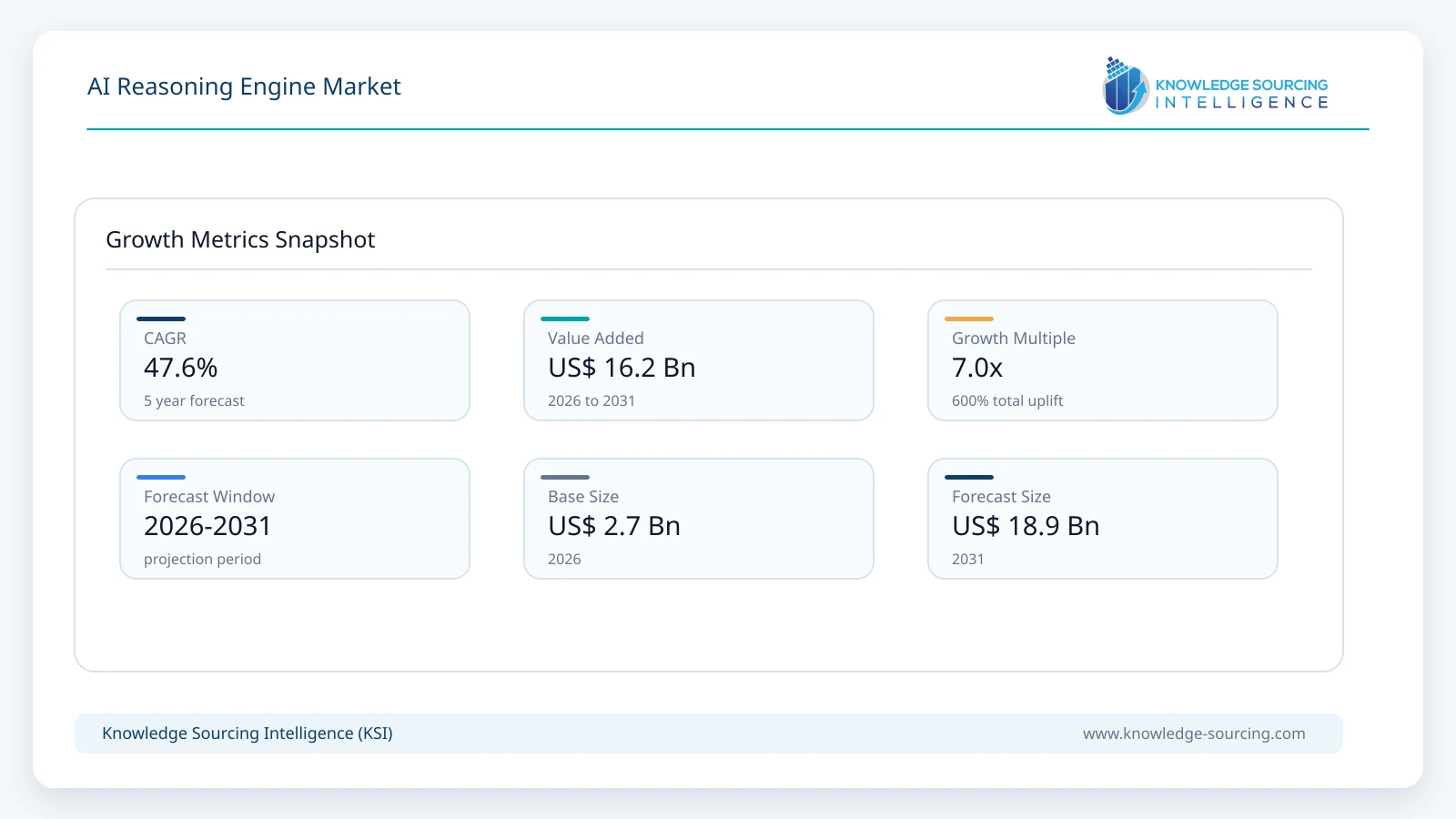
The AI reasoning engine market is estimated at USD 2.70 billion in 2026 and projected to reach USD 18.90 billion by 2031, advancing at a CAGR of 47.6% during the forecast period.
Highlights:
- 1Multi-step deliberation is the largest modeled reasoning function, generating USD 850 million in 2026 and reaching USD 5.25 billion by 2031.
- 2Metered reasoning API revenue is estimated at USD 1.80 billion in 2026 and USD 12.60 billion in 2031, supported by complex production workloads.
- 3Software engineering and code reasoning account for USD 710 million in 2026; agentic workflow planning is forecast to reach USD 4.10 billion in 2031.
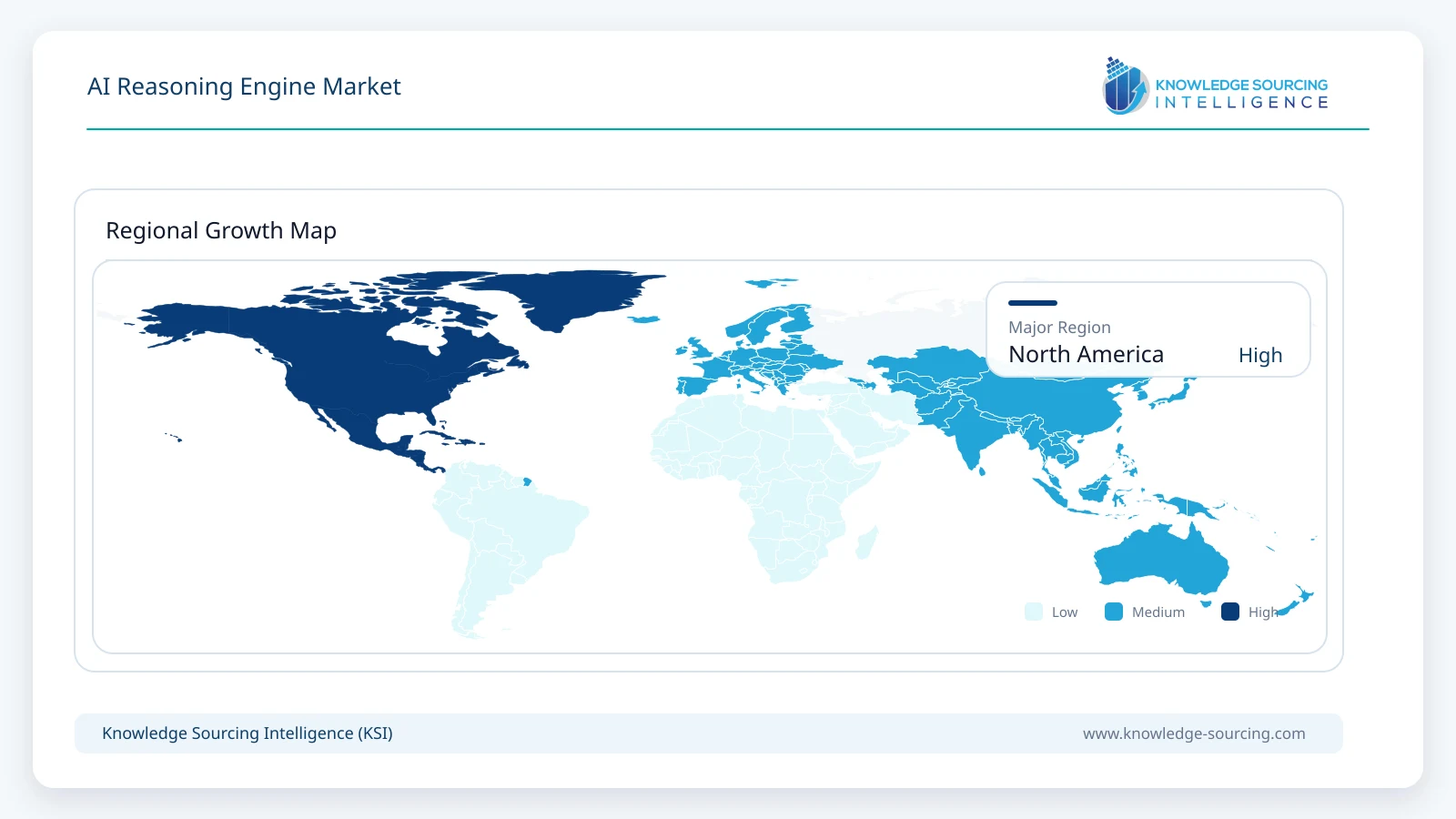
- 4North America is estimated at USD 1.06 billion in 2026 and USD 6.93 billion in 2031, supported by model suppliers and enterprise developers.
- 5Asia Pacific is forecast to rise from USD 670 million in 2026 to USD 5.12 billion in 2031 as local platforms and enterprise adoption expand.
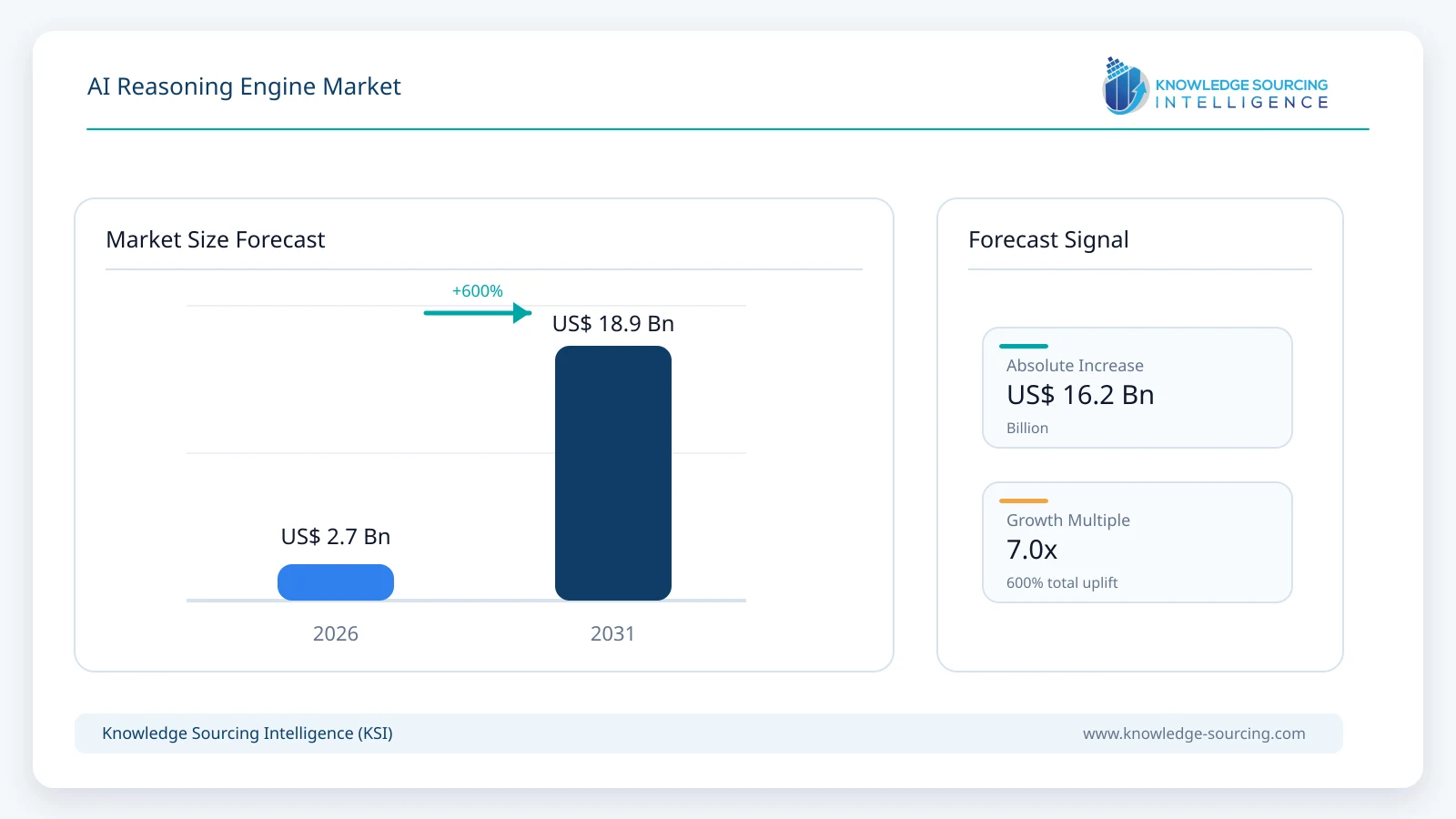
This market measures revenue attributable to advanced reasoning computation, multi-step planning and verification engines delivered through metered interfaces, enterprise platforms and specialist software deployments.
Advanced reasoning now reaches customers through both hosted model interfaces and private enterprise installations. OpenAI introduced GPT-5.4 with adjustable reasoning effort in March 2026; Anthropic added adaptive thinking controls with Claude Opus 4.6 in February; and Google released Gemini 3.1 Pro for demanding tasks.
The commercial opportunity depends on reliable decisions per unit of reasoning cost, not simply the number of generated tokens. Longer deliberation can improve complex task performance while raising latency and computing expense. Buyers are therefore comparing model-level accuracy, task success under constraints, tool-call reliability and auditability.
Market Overview
Reasoning engines extend standard language-model execution by allocating additional computational steps to decompose an objective, test intermediate possibilities and combine evidence into a defensible result. At the software layer, these capabilities may involve dynamic reasoning budgets, planning with tool calls, constrained logical procedures and separate verification passes.
Commercial suppliers are differentiating how computation is allocated. Anthropic provides adaptive thinking and selectable effort levels, while OpenAI exposes reasoning effort in its model interfaces and bills reasoning tokens within output usage. Amazon Nova 2 supports optional extended thinking, and Google supplies Gemini reasoning models to developers and enterprises.
Reasoning models also increasingly operate alongside conventional software rather than replace deterministic controls. A financial risk engine may use a model to identify candidate explanations, retrieve supporting records and recommend further checks while leaving calculations and compliance rules to approved systems. NVIDIA Nemotron models and Cohere Command A+ support private deployment and customization for such workflows.
Market Trends
Adaptive Reasoning Budgets Are Becoming a Commercial Requirement
Providers are giving developers more control over the amount of computation used for complex requests because unrestricted deliberation raises token costs and response times. Anthropic introduced adaptive thinking with Claude Opus 4.6, while OpenAI supports multiple reasoning-effort settings in its API. Amazon Nova 2 offers selectable levels for extended thinking.
Revenue increasingly depends on how well these controls translate reasoning capability into accepted business outcomes. An engine that solves the same problem with fewer attempts or shorter internal analysis can be attractive despite a higher model price. Providers are building task-level observability and routing rules around effort choices, which makes accuracy, latency and metered cost inseparable dimensions of the product.
Verification and Evidence-Based Reasoning Are Gaining Importance
High-stakes AI deployments require a distinction between fluent answers and conclusions supported by checked evidence. Multi-pass review, grounded retrieval, schema constraints and tool-executed calculations are being combined with model reasoning to reduce unsupported assertions. Google Gemini 3.1 Pro and NVIDIA Nemotron 3 Super illustrate rapid improvements in difficult analytical and agentic tasks, but published benchmark scores do not replace application-specific validation.
Enterprise buyers are introducing controls that retain relevant evidence, record model and tool versions and escalate uncertain results. This creates demand for integrated verifier functions and audit-ready workflows, especially in regulated businesses. Model suppliers and independent platform vendors compete to package such features without forcing customers to build their entire assurance process from individual model calls.
Private and Open-Weight Reasoning Models Are Expanding Deployment Options
Open-weight reasoning models allow organizations to execute selected analytical workloads in customer-controlled cloud or on-premises infrastructure. NVIDIA released Nemotron 3 Super in March 2026 with an emphasis on complex agents and efficient inference, while Cohere released Command A+ in May with private deployment support. Mistral AI also offers reasoning-oriented models through open and enterprise channels.
Commercial value in this segment is created through dedicated platform capacity, deployment integration and support rather than counting free model downloads as sales. Suppliers must demonstrate reliable tools, model evaluation, operational monitoring and sustainable total cost. Larger buyers may maintain both private engines for protected tasks and hosted frontier models for work that requires broader capability.
Tool-Aware Planning Is Connecting Reasoning to Operational Systems
Enterprise agents increasingly require models to decide when to inspect a record, call a calculator, query a system or request approval before proceeding. GPT-5.4, Gemini 3.1 Pro and Anthropic Claude 4.6 provide reasoning abilities suited to long, tool-rich workflows. Reasoning engines complement the actual automation layer by selecting and checking action sequences, rather than being identical to every computer-use or browser-execution product.
Demand is strongest where enterprises need reliable completion of multi-stage tasks such as incident investigation, software maintenance and controlled financial analysis. Planners that explain uncertainty, handle tool failures and return to a valid task state reduce supervision costs. Procurement decisions increasingly distinguish the quality of reasoning from the separate cost of execution tools and software integrations.
Segment Analysis
By Reasoning Function: Multi-Step Deliberation
Multi-step deliberation is the largest distinct function because complex coding, quantitative analysis and expert knowledge work require more than one-pass text generation. A deliberative engine can explore alternatives, identify dependencies, reconsider an intermediate result and produce a more robust conclusion. Providers expose this capability through advanced reasoning models, reasoning-budget controls and differentiated tiers for difficult workloads.
The segment is estimated at USD 850 million in 2026 and projected to reach USD 5.25 billion in 2031. Growth is driven by paying deployments that selectively apply deeper computation to high-value problems. Verification, planning and retrieval-grounded reasoning remain distinct modeled functions, although a single application may use several capabilities; the revenue model allocates each commercial charge to its dominant function once.
By Commercial Offering: Metered Reasoning APIs
Metered reasoning APIs represent the main direct commercial channel as developers integrate structured analysis into applications without operating model infrastructure. Input, output and reasoning-related computation form the billing basis, while private deployment contracts have different economics. OpenAI and Anthropic publish reasoning-capable API models; Google and AWS distribute comparable capabilities through their cloud environments.
API-attributable reasoning revenue is estimated at USD 1.80 billion in 2026 and USD 12.60 billion by 2031. The forecast reflects increasing chargeable task volume offset partly by lower realized costs per completed task. Only the paid reasoning portion of mixed-model workloads is included, and usage already allocated to a fixed enterprise platform contract is excluded from separate API revenue.
By Engine Architecture: Deliberative Language Model Engines
Deliberative language-model engines dominate early revenue because frontier providers have incorporated more complex reasoning directly into their models. The architecture combines learned reasoning behavior, dynamic compute allocation and structured output control. It is straightforward for developers to access through an API, although reliability can still vary with prompt complexity, tool availability and unseen operating conditions.
This architecture is estimated at USD 1.51 billion in 2026 and USD 9.50 billion by 2031. Hybrid planners, constrained logic and multi-model verification are projected to expand as businesses require greater traceability and precise control.
Market Drivers
Growing Demand for Reliable Complex Decision Support
Enterprises are applying reasoning engines to problems requiring evidence comparison, dependency checking and structured judgment. In software operations, engineering and finance, a plausible but unchecked answer can cause costly rework. Reasoning systems that can revisit intermediate steps and request tool verification provide a stronger basis for operational adoption. This shifts commercial buying criteria from general model fluency to measurable success on difficult domain tasks.
Expansion of Agentic Software and Multi-Step Workflows
Software agents increasingly coordinate several applications, documents and specialized tools within one request. An effective planner must decide what information is missing, which system to query and when the task is complete. Google, OpenAI and Anthropic have released models emphasizing agentic reasoning and tool use. As organizations scale workflows beyond demonstrations, they require paid reasoning capacity capable of handling branching tasks and recovery from execution failures.
Improvement in Reasoning Model Efficiency
The cost of advanced deliberation matters because longer internal processing consumes substantial computing resources. NVIDIA Nemotron 3 Super and Cohere Command A+ demonstrate attempts to improve reasoning efficiency and private deployment economics. Adaptive effort controls from major hosted providers let customers reserve intensive computation for difficult requests.
Enterprise Requirements for Auditable Analytical Results
Financial institutions, healthcare organizations and public bodies increasingly need to trace why an AI-assisted conclusion was accepted. Verifier passes, structured calculations, controlled tools and source-grounded analytical outputs help align reasoning systems with established review procedures. While no reasoning engine can replace organizational accountability, paid platforms that record intermediate decisions and support escalation are better suited to production than unconstrained chat-style interactions.
Growth of Private Reasoning Deployments
Organizations with protected data or tight latency requirements can use privately deployed reasoning-capable models rather than transmitting every analytical request to a shared endpoint. NVIDIA, Cohere and Mistral provide relevant open or enterprise models, while cloud providers support dedicated environments. Private deployment expands addressable contracts through integration, capacity reservation, governance and support, though open weights alone do not represent vendor revenue.
Market Restraints
High Computational Cost of Difficult Reasoning
Extended deliberation and repeated verification can substantially increase billable output tokens, GPU utilization and response latency. Developers must balance task accuracy against cost, particularly when a workflow includes unsuccessful attempts, retries or large tool results. Commercial demand therefore depends on intelligent selection of reasoning depth rather than simply maximizing internal steps. Lower-cost non-reasoning models can remain preferable for routine classification and summarization.
Uncertain Accuracy and Verification Boundaries
Reasoning-oriented models can produce confident but flawed intermediate assumptions or fail after apparently coherent steps. High evaluation scores on public benchmarks do not guarantee dependable behavior on private enterprise records, changing APIs or unusual edge cases. Buyers need domain validation, test cases and deterministic checks before permitting consequential actions. Such implementation requirements delay deployment and limit immediate expansion into regulated use cases.
Revenue Bundling and Attribution Difficulties
Cloud platforms and AI vendors frequently include advanced reasoning within broader model subscriptions, productivity bundles and agent services. Customers may not receive an invoice line specifically labeled reasoning engine, complicating supplier comparisons and total addressable market estimation. The market must isolate identifiable reasoning-capability charges rather than treat total generative AI subscription revenue as directly addressable. This also constrains standalone pricing power for engine vendors.
Data Security, Governance and Decision Accountability
Complex reasoning workflows may require access to sensitive financial, technical or personal information, and their tools can affect live records. Enterprise buyers must enforce permissions, audit access and determine who approves any proposed action. Organizations that cannot meet residency or control requirements may restrict hosted use and demand slower private deployment. Governance therefore affects contract timing as well as the acceptable engine architecture.
Rapid Model Substitution and Price Compression
Open-weight reasoning models and continuous improvements to general foundation models increase competitive pressure on specialized reasoning providers. A customer can substitute a cheaper engine when the required task success rate is maintained, particularly for well-defined analytical workflows. Providers must justify differentiated verification, integration and enterprise support as token prices decline. The forecast consequently relies on expanding workloads and contract penetration rather than permanent premium pricing.
Regional Outlook
North America
North America is estimated to generate USD 1.06 billion of AI reasoning engine revenue in 2026, reflecting concentration of major model developers, cloud providers and enterprise software buyers. The United States is the principal market for reasoning APIs applied to code development, cybersecurity analysis, financial operations and complex business workflows.
North America is projected to reach USD 6.93 billion in 2031 as advanced reasoning becomes a regular component of enterprise decision software rather than a selectively purchased experiment. Large organizations are expected to adopt deeper evaluation, adaptive effort routing and dedicated deployment for sensitive tasks.
Asia Pacific
Asia Pacific is estimated at USD 670 million in 2026, supported by Chinese model platforms, Japanese industrial users, Korean technology companies and expanding enterprise AI activity in India and Southeast Asia. Providers such as Alibaba Cloud and DeepSeek influence availability of reasoning-oriented models, while local cloud ecosystems shape procurement and deployment choices. Scientific computing, software development, manufacturing analytics and multilingual enterprise knowledge are relevant early applications.
Asia Pacific revenue is forecast to reach USD 5.12 billion in 2031, implying faster modeled growth than North America from a smaller base. China and India contribute deployment scale, while Japan, South Korea, Singapore and Australia create demand for advanced enterprise reasoning and private hosting. The competitive mix will depend on language performance, regional infrastructure, commercial API prices and national data policies.
Competitive Landscape
Competition involves frontier reasoning-model developers, cloud distribution platforms, open-weight model suppliers and enterprise orchestration vendors. OpenAI, Anthropic and Google provide commercially accessed reasoning models, while Microsoft and AWS distribute models through enterprise cloud relationships. NVIDIA, Cohere and Mistral offer privately deployable capabilities. xAI, DeepSeek and Alibaba Cloud expand the available set of reasoning engines, though commercial participation and distribution vary substantially by provider and market.
Supplier advantage depends on task accuracy at an acceptable cost, developer integration, evidence controls and reliable enterprise support. Open models can improve buyer flexibility without creating direct licensing revenue, while a hosted API may generate recurring token sales even where source weights are not distributed. Procurement increasingly evaluates verified workflow completion, supported jurisdictions and the ability to adjust reasoning effort to different problem classes.
Recent Developments
September 2026: AWS confirmed the availability of xAI Grok 4.6 through Amazon Bedrock, including configurable reasoning effort for complex coding and agent tasks.
May 2026: Cohere launched Command A+, an open enterprise model combining reasoning, multilingual capabilities and tool use with private deployment options.
April 2026: OpenAI introduced GPT-5.5, expanding model capabilities for sustained planning, coding, research and tool-based work; API availability followed on April 24.
March 2026: NVIDIA released Nemotron 3 Super, an open hybrid reasoning model designed for long-context, multi-agent execution and efficient inference.
February 2026: Google released Gemini 3.1 Pro in preview for developers and enterprises, targeting complex analysis, coding and reasoning tasks.
February 2026: Anthropic introduced Claude Opus 4.6 with adaptive thinking and selectable reasoning effort to control intelligence, latency and cost.
Market Outlook
AI reasoning engines are expected to become a routine technology layer in enterprise systems that must compare evidence, plan work and validate complex outcomes. The strongest demand should come from software engineering, decision support and supervised multi-agent tasks where additional reasoning delivers a measurable reduction in rework.
Growth will be moderated by token price competition, the practical limits of model reliability and the difficulty of measuring reasoning as a separately priced service. Providers that combine adaptive compute, transparent evaluation, safe tool integration and support for hybrid deployment are better positioned for durable commercial adoption.
AI Reasoning Engine Market Scope
| Report Metric | Details |
|---|---|
| Total Market Size in 2026 | USD 2.70 billion |
| Total Market Size in 2031 | USD 18.90 billion |
| Forecast Unit | Billion |
| Growth Rate | 47.6% |
| Study Period | 2021 to 2031 |
| Historical Data | 2021 to 2024 |
| Base Year | 2025 |
| Forecast Period | 2026 – 2031 |
| Segmentation | Reasoning Function, Commercial Offering, Engine Architecture, Deployment Model, Primary Workload, Buyer Type, End-User Industry, Geography |
| Companies |
|
| Customization Scope | 15% Free Customization included with purchase — Request Custom Breakdown → |
| Sample & Data Access | PDF Sample, Excel Databook & Analyst Briefing — Download Free Sample → |
Market Segmentation
By Reasoning Function
Multi-Step Deliberation
Tool-Aware Planning
Verification and Critique
Retrieval-Grounded Analytical Reasoning
Neuro-Symbolic and Constrained Reasoning
By Commercial Offering
Metered Reasoning APIs
Enterprise Reasoning Platforms
Specialist Deployment and Validation Services
By Engine Architecture
Deliberative Language Model Engines
Hybrid Tool-Integrated Planners
Logic-Constrained and Neuro-Symbolic Engines
Multi-Model Verification Systems
By Deployment Model
Multitenant Cloud APIs
Dedicated Cloud and Customer VPC
On-Premises Installations
Edge and Embedded Execution
By Primary Workload
Software Engineering and Code Reasoning
Enterprise Knowledge and Decision Analysis
Scientific and Technical Reasoning
Financial, Risk and Compliance Reasoning
Agentic Workflow Planning
Other Reasoning Workloads
By Buyer Type
Hyperscale and AI Platform Providers
Large Enterprises
Midmarket and Growth Organizations
Public Sector and Research Institutions
Application Developers and ISVs
By End-User Industry
Technology and Software
Banking and Financial Services
Healthcare and Life Sciences
Manufacturing and Engineering
Government and Defense
Retail, Media and Communications
Other Industries
By Geography
North America
United States
Canada
Mexico
South America
Brazil
Argentina
Chile
Colombia
Rest of South America
Europe
Germany
United Kingdom
France
Netherlands
Sweden
Italy
Rest of Europe
Middle East and Africa
United Arab Emirates
Saudi Arabia
Israel
South Africa
Rest of Middle East and Africa
Asia Pacific
China
India
Japan
South Korea
Singapore
Australia
Taiwan
Rest of Asia Pacific
Table of Contents
1. EXECUTIVE SUMMARY
1.1. Research Highlights
1.2. Market Size and Forecast, 2026-2031
1.3. Strategic Market Outlook
2. MARKET SNAPSHOT
2.1. Definition and Scope
2.2. Market Dynamics
2.3. Commercialization and Adoption
3. BUSINESS LANDSCAPE
3.1. Market Drivers
3.1.1. Growing Demand for Reliable Complex Decision Support
3.1.2. Expansion of Agentic Software and Multi-Step Workflows
3.1.3. Improvement in Reasoning Model Efficiency
3.1.4. Enterprise Requirements for Auditable Analytical Results
3.1.5. Growth of Private Reasoning Deployments
3.2. Market Restraints
3.2.1. High Computational Cost of Difficult Reasoning
3.2.2. Uncertain Accuracy and Verification Boundaries
3.2.3. Revenue Bundling and Attribution Difficulties
3.2.4. Data Security, Governance and Decision Accountability
3.2.5. Rapid Model Substitution and Price Compression
3.3. Market Opportunities
3.4. Porter’s Five Forces Analysis
3.5. Industry Value Chain Analysis
3.6. Policies and Regulations
3.7. Strategic Recommendations
4. TECHNOLOGICAL OUTLOOK
4.1. Deliberative Reasoning and Dynamic Compute
4.2. Tool-Aware Planning and Execution
4.3. Retrieval-Grounded Analytical Reasoning
4.4. Verification, Critique and Confidence Checks
4.5. Logic-Constrained and Neuro-Symbolic Reasoning
4.6. Private Model Serving and Evaluation
5. AI REASONING ENGINE MARKET BY REASONING FUNCTION
5.1. Multi-Step Deliberation
5.2. Tool-Aware Planning
5.3. Verification and Critique
5.4. Retrieval-Grounded Analytical Reasoning
5.5. Neuro-Symbolic and Constrained Reasoning
6. AI REASONING ENGINE MARKET BY COMMERCIAL OFFERING
6.1. Metered Reasoning APIs
6.2. Enterprise Reasoning Platforms
6.3. Specialist Deployment and Validation Services
7. AI REASONING ENGINE MARKET BY ENGINE ARCHITECTURE
7.1. Deliberative Language Model Engines
7.2. Hybrid Tool-Integrated Planners
7.3. Logic-Constrained and Neuro-Symbolic Engines
7.4. Multi-Model Verification Systems
8. AI REASONING ENGINE MARKET BY DEPLOYMENT MODEL
8.1. Multitenant Cloud APIs
8.2. Dedicated Cloud and Customer VPC
8.3. On-Premises Installations
8.4. Edge and Embedded Execution
9. AI REASONING ENGINE MARKET BY PRIMARY WORKLOAD
9.1. Software Engineering and Code Reasoning
9.2. Enterprise Knowledge and Decision Analysis
9.3. Scientific and Technical Reasoning
9.4. Financial, Risk and Compliance Reasoning
9.5. Agentic Workflow Planning
9.6. Other Reasoning Workloads
10. AI REASONING ENGINE MARKET BY BUYER TYPE
10.1. Hyperscale and AI Platform Providers
10.2. Large Enterprises
10.3. Midmarket and Growth Organizations
10.4. Public Sector and Research Institutions
10.5. Application Developers and ISVs
11. AI REASONING ENGINE MARKET BY END-USER INDUSTRY
11.1. Technology and Software
11.2. Banking and Financial Services
11.3. Healthcare and Life Sciences
11.4. Manufacturing and Engineering
11.5. Government and Defense
11.6. Retail, Media and Communications
11.7. Other Industries
12. AI REASONING ENGINE MARKET BY GEOGRAPHY
12.1. North America
12.1.1. United States
12.1.2. Canada
12.1.3. Mexico
12.2. South America
12.2.1. Brazil
12.2.2. Argentina
12.2.3. Chile
12.2.4. Colombia
12.2.5. Rest of South America
12.3. Europe
12.3.1. Germany
12.3.2. United Kingdom
12.3.3. France
12.3.4. Netherlands
12.3.5. Sweden
12.3.6. Italy
12.3.7. Rest of Europe
12.4. Middle East and Africa
12.4.1. United Arab Emirates
12.4.2. Saudi Arabia
12.4.3. Israel
12.4.4. South Africa
12.4.5. Rest of Middle East and Africa
12.5. Asia Pacific
12.5.1. China
12.5.2. India
12.5.3. Japan
12.5.4. South Korea
12.5.5. Singapore
12.5.6. Australia
12.5.7. Taiwan
12.5.8. Rest of Asia Pacific
13. COMPETITIVE ENVIRONMENT AND ANALYSIS
13.1. Major Players and Strategy Analysis
13.2. Market Share Analysis
13.3. Mergers, Acquisitions, Agreements and Collaborations
13.4. Competitive Dashboard
14. COMPANY PROFILES
14.1. OpenAI
14.2. Anthropic
14.3. Google (Alphabet)
14.4. Microsoft Corporation
14.5. Amazon Web Services (Amazon)
14.6. NVIDIA Corporation
14.7. Cohere
14.8. xAI
14.9. Mistral AI
14.10. DeepSeek
14.11. Alibaba Cloud
14.12. IBM Corporation
15. APPENDIX
15.1. Currency
15.2. Assumptions
15.3. Market Estimation Methodology
15.4. Research Sources
15.5. Abbreviations





Frequently asked questions
What is the projected market size of AI Reasoning Engines by 2031?
The AI Reasoning Engine Market is projected to reach USD 18.90 billion by 2031.
What is the compound annual growth rate (CAGR) for this market?
The AI Reasoning Engine Market is forecast to grow at a strong 47.6% CAGR (2026-2031).
Which reasoning function represents the largest market segment?
Multi-step deliberation is the largest, reaching USD 5.25 billion by 2031.
What is the primary revenue driver for AI Reasoning Engines?
Metered reasoning API revenue will reach USD 12.60 billion by 2031.
Which region is estimated to dominate the market?
North America leads with USD 6.93 billion projected by 2031.
Which emerging region shows significant market growth?
Asia Pacific is forecast to expand to USD 5.12 billion by 2031.
Cite this report
Knowledge Sourcing Intelligence. (Oct 2026). AI Reasoning Engine Market Size, Share & Growth Forecast (2026-2031). https://www.knowledge-sourcing.com/report/ai-reasoning-engine-market