
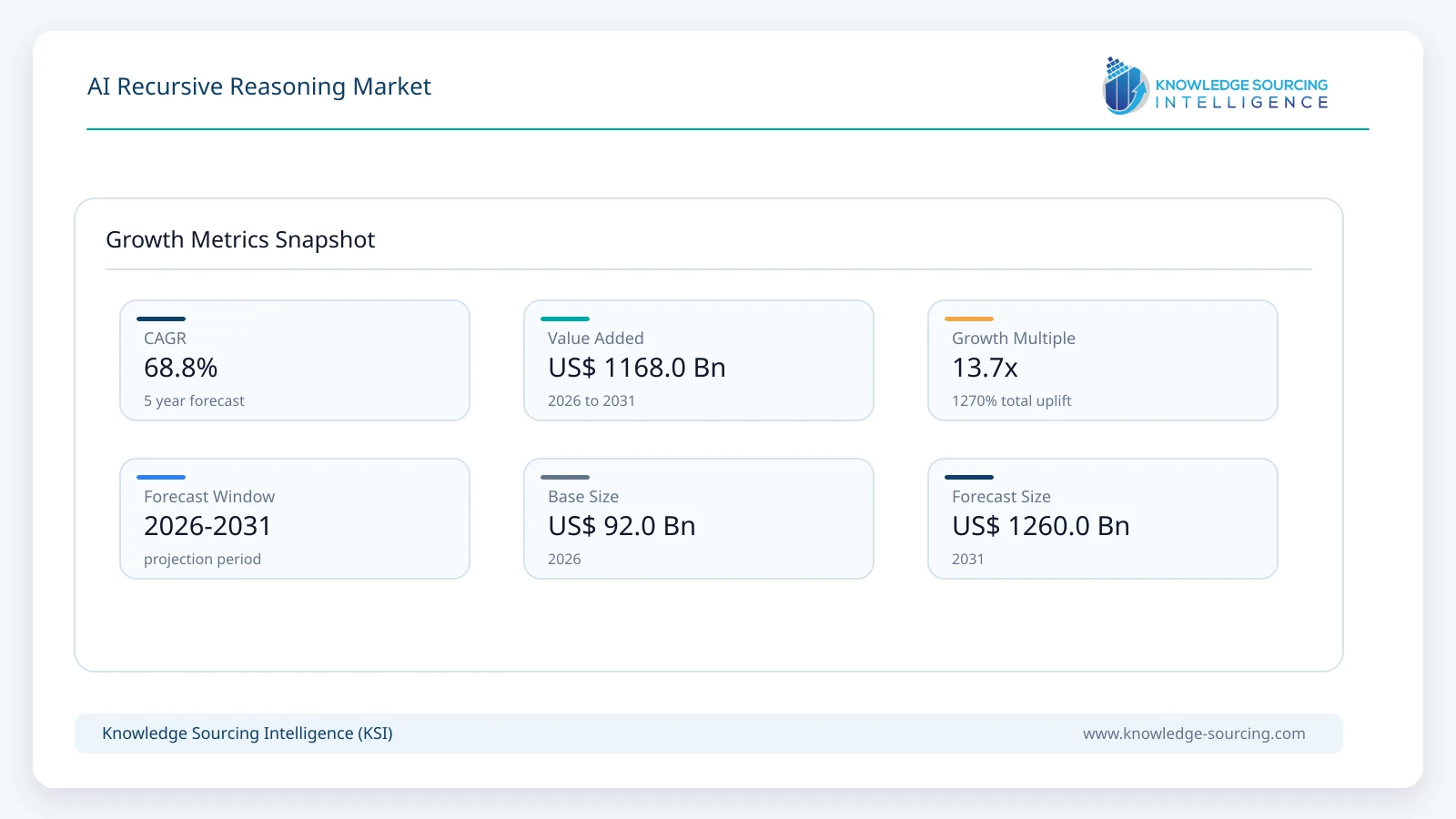
The AI recursive reasoning market is estimated at USD 92 million in 2026 and forecast to reach USD 1,260 million in 2031, expanding at a CAGR of 68.8% during the forecast period.
Highlights:
- 1External recursive model calls account for 58% of global 2026 revenue and are forecast to reach approximately USD 781 million by 2031.
- 2Metered recursive subcalls represent the largest paid offering and are forecast to generate USD 580 million in 2031.
- 3Long-context research and synthesis accounts for approximately 32% of 2026 market revenue, supported by enterprise document analysis.
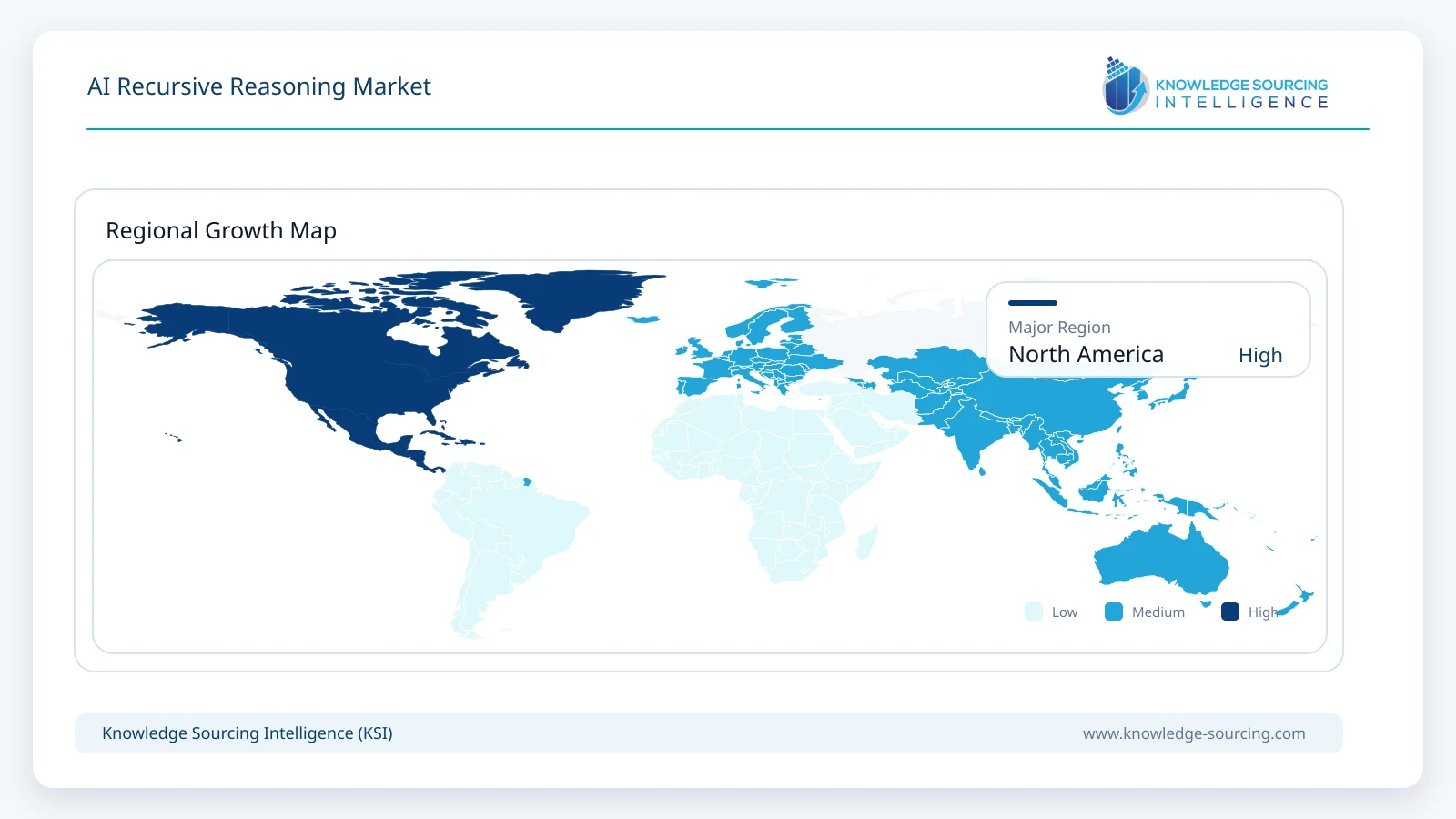
- 4North America contributes an estimated USD 39.56 million in 2026 and is forecast to reach USD 491.40 million in 2031.
- 5Asia Pacific is the fastest-growing regional market in the model, increasing from USD 23.92 million in 2026 to USD 390.60 million in 2031.
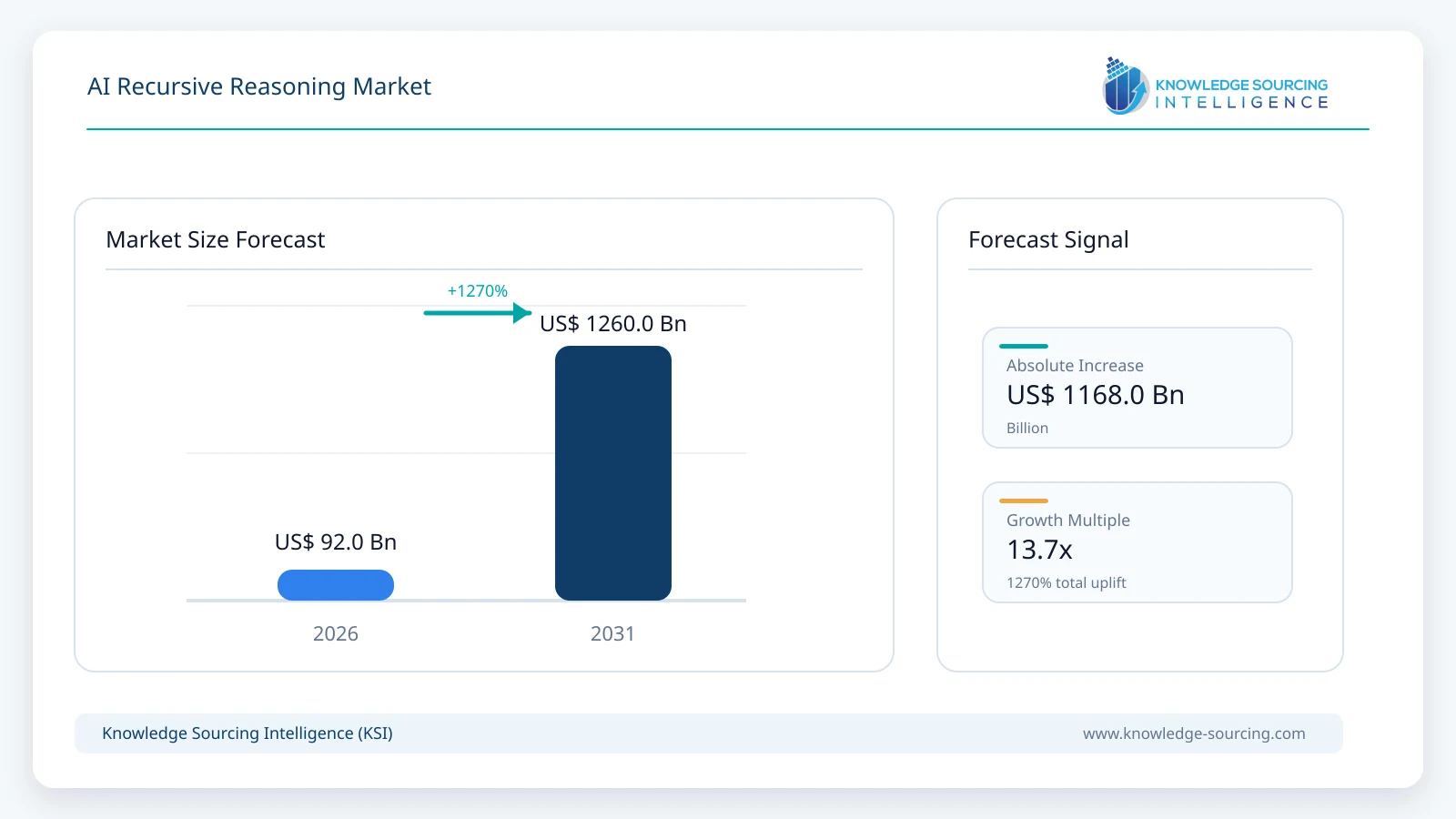
Growth reflects adoption of explicit recursive submodel calls, native recurrent reasoning and commercially managed verification loops across enterprise AI applications. Procurement increasingly favors systems that connect additional reasoning cycles to measurable task completion and provide limits on cost, recursion depth and data access.
Recursive language-model systems can treat extensive input collections as externally addressable data instead of transferring every document into one model prompt. MIT researchers proposed repeated model calls over programmatically selected context, while Prime Intellect has used an RLM-based harness for extended coding and research tasks. Such designs support long-context retrieval and repository analysis, although the additional subcalls can create substantial cost variability if delegation rules and cancellation limits are weak.
Native recursive architectures address a different opportunity by refining answers through repeated small-network computations. Sapient’s HRM-Text and Tiny Recursive Model research demonstrate alternatives to large autoregressive reasoning traces for selected structured tasks. The commercial outlook combines adoption of these compact architectures with a larger market for software controls and private execution environments supporting recursive model calls.
Market Overview
Recursive reasoning is becoming a distinct execution method for AI systems that encounter tasks too large, interdependent or error-sensitive for a single generation. Conventional chain-of-thought models generate a sequential reasoning trace, whereas recursive language-model runtimes selectively call further models to inspect evidence or solve bounded subtasks. Native recurrent models instead repeat internal state updates before settling on an output. Both approaches can improve effective reasoning depth, but their infrastructure requirements and revenue mechanisms differ considerably.
MIT’s RLM design places long inputs in an external code environment and allows models to inspect selected portions. DSPy provides an RLM module that exposes input variables to a sandboxed Python execution environment, while Daytona documents multi-level recursive agent systems that assign separate sandboxes to delegated coding work. Prime Intellect launched Prime Agent in August 2026 with recursion integrated into a coding harness. For buyers, execution controls, evidence traceability and reliable termination are as important as model accuracy.
Recurrent latent reasoning is developing alongside recursive API orchestration. Sapient released HRM-Text in May 2026, extending hierarchical recurrent computation to a compact language model. Research on Tiny Recursive Models demonstrated that repeated state refinement can be effective for constrained symbolic problems. The performance evidence remains workload-dependent: Apple’s July 2026 work on reflective program search found that uncontrolled recursion does not always improve results, highlighting the need to measure execution quality rather than simply increase iteration counts.
Market Trends
External-Context Recursion Is Changing Long-Document Analysis
Long-document reasoning increasingly requires selective processing of source material rather than repeatedly passing an entire evidence corpus to the model. Recursive language models expose documents as program-accessible variables, enabling the model to search, divide and revisit sections only when needed. The MIT work demonstrated processing beyond conventional model context limits, offering a practical direction for enterprise repositories and scientific literature review.
DSPy’s RLM implementation makes this execution pattern accessible within a structured AI application framework. Its approach separates external data storage from model token inputs and allows recursive subcalls through a Python environment. The resulting commercial demand centers on managed recursion policies, program execution isolation and tracing that enterprise teams can operate reliably.
Native Recurrent Models Are Extending Reasoning Beyond Large Token Traces
Native recurrent reasoning models use iterative internal-state updates to refine outputs without necessarily generating long visible chains of tokens. Sapient’s hierarchical recurrent models and HRM-Text release demonstrate how smaller model architectures can be optimized for certain multi-step tasks. Tiny Recursive Model research has further shown strong results on structured puzzle benchmarks using compact networks.
The commercial opportunity lies in deploying specialized reasoning functions where accuracy, latency and device resources determine purchasing decisions. Model suppliers must still demonstrate results on varied real workloads before such compact architectures can replace general-purpose reasoning APIs, particularly for open-ended language generation.
Recursive Coding Agents Are Creating Demand for Isolated Execution
Coding agents are increasingly expected to inspect large repositories, delegate independent changes and combine verified edits. Prime Intellect’s August 2026 Prime Agent uses an RLM-based harness, while Symbolica’s Agentica research applied recursive delegation to abstract reasoning tasks. Such approaches produce multiple model calls and code-execution sessions per accepted task, making resource limits and observability essential.
Daytona’s documented recursive-agent architecture gives parent and child tasks separate sandboxes, and E2B provides isolated environments for agent execution. These offerings illustrate how recursion creates recurring demand for controlled runtime services even when model calls are supplied by third-party API providers.
Verification Policies Are Becoming a Core Competitive Variable
Verifier-guided recursion allocates additional steps to weak answers and stops when further work adds insufficient value. Apple’s self-reflective program search research assessed uncertainty signals and found that carefully selected programs can outperform basic recursive execution under similar time budgets. Recursive systems therefore need policies for candidate evaluation, depth ceilings and output acceptance.
Enterprise buyers can compare recursive configurations through accepted-answer rates, cost per completed task and reproducibility across repeated runs. Verification products that remain independent of the underlying foundation model can develop differentiated commercial value, although embedded model verification must not be billed twice.
Segment Analysis
By Recursive Execution Architecture: External Recursive Model Calls
External recursive model calls represent approximately 58% of the 2026 market because RLM orchestration can be introduced around existing hosted language models without building a new foundation architecture. The segment is forecast to reach USD 781.20 million by 2031 as long-context enterprise workflows and nested coding tasks generate attributable recursive execution demand.
Prime Intellect’s RLM harness, DSPy’s recursive module and Daytona’s sandbox reference design provide examples of how model delegation can be packaged. Competitive advantage increasingly depends on reducing unproductive calls, managing intermediate data and governing recursion depth rather than simply supporting additional tool invocations.
By Commercial Offering: Metered Recursive Subcalls
Metered recursive subcalls account for USD 36 million in 2026 revenue and are projected to reach USD 580 million by 2031. The commercial meter applies only to incremental submodel execution specifically attributable to recursive problem decomposition, excluding base-model responses and any nested inference already billed under the same contract.
The segment benefits when developers can assign bounded subtasks to cheaper or more specialized models. Usage-based offerings must include per-task budgets and audit trails, since unconstrained model nesting can erase any cost savings from selective context handling.
By Deployment Model: Dedicated Private Cloud
Dedicated private-cloud installations account for approximately 25% of the 2026 market and are forecast to reach USD 365.40 million by 2031 as enterprises seek control over delegated model calls and sensitive documents. Private deployment simplifies data residency controls when recursive processing creates intermediate task artifacts across multiple submodels.
Organizations adopting isolated runtimes need policies for sandbox disposal, secrets handling and permission inheritance. Providers that integrate these safeguards with throughput reservations and execution observability are positioned to serve financial services, healthcare and research buyers.
By Primary Application: Long-Context Research and Synthesis
Long-context research and synthesis leads application demand, accounting for approximately 32% of modeled market revenue in 2026 and reaching USD 390.60 million by 2031. Enterprises use recursive context inspection to reconcile findings across extensive contracts, technical records, document repositories and scientific source collections.
The application is particularly attractive where the answer requires pinpointing inconsistent details across files rather than producing general summaries. Evidence-linked outputs, reproducibility and measured accuracy remain central adoption criteria, especially where poor retrieval can propagate through downstream recursive steps.
Market Drivers
Demand for Long-Context Evidence Processing
Enterprise repositories increasingly exceed the practical attention span of a single model invocation, especially when questions require comparisons across many documents. Recursive context inspection allows AI applications to examine selected sections, delegate local checks and return consolidated findings. MIT’s RLM research and DSPy’s implementation provide technical evidence for this design, supporting paid execution and orchestration demand in research-intensive organizations.
Expansion of Recursive Software Engineering Agents
Large software changes frequently require analysis of dependent modules, test results and separate implementation tasks. Recursive coding systems distribute work to bounded subtasks and reconnect the outputs through parent agents. Prime Intellect’s Prime Agent and Daytona’s multi-sandbox architecture illustrate demand for reliable recursive execution, with buying decisions tied to accepted patches and lower engineering rework.
Commercialization of Recurrent Reasoning Models
Small recurrent architectures can support deep iterative refinement without depending entirely on long visible reasoning tokens. Sapient’s HRM-Text and earlier hierarchical models are broadening the range of workloads on which compact recursive inference can be tested. Specialized licensing and embedded deployments should gain traction where device resources, response latency and structured-task accuracy outweigh general-purpose fluency.
Improving Isolation and Orchestration Tooling
Recursive agents create multiple transient execution states and model calls that must remain observable and securely separated. Commercial sandbox platforms and developer frameworks are turning these requirements into reusable services. Daytona, E2B and Modal offer relevant execution infrastructure, while DSPy provides program structure for model delegation, reducing implementation effort for developers.
Demand for Verifiable Multi-Step Decisions
Regulated and high-consequence applications require AI systems to substantiate results with evidence and tests, not only confident natural-language output. Recursive verification can revisit uncertain claims, compare candidate solutions and stop when a threshold is reached. Apple’s reflective program-search research emphasizes selective verification, providing a basis for monetizable reliability controls and managed task-level quality policies.
Market Restraints
High Cost and Unpredictable Recursive Call Growth
Recursive subcalls can multiply API tokens, sandbox sessions and request latency, particularly when a parent model delegates work repeatedly without a firm limit. The economics become less attractive when additional steps do not materially improve task completion. Enterprises therefore require budgets, cancellation triggers and accurate per-task attribution before replacing simpler inference flows.
Inconsistent Gains Across Task Types
Recursive reasoning is not uniformly better than direct model execution. Apple’s July 2026 research reported that recursion can reduce quality for selected tasks within a model’s context window and that reflective program selection may offer a stronger alternative. Buyers need independent workload testing before committing to broad deployment or premium recursive-processing charges.
Security and Data-Governance Exposure
Every recursive call can create new data transfers, intermediate files, model prompts and executable code. Unisolated REPL environments and overly permissive child agents increase risks around secrets, data residency and unintended tool use. Sandboxed execution, restricted capabilities and trace logging add cost and complexity, particularly in regulated enterprise environments.
Immature Monetization and Open-Source Substitution
Several important recursive architectures are released as research code or open-source modules, and customers can assemble recursive workflows using general-purpose model APIs. Standalone suppliers must demonstrate additional operational value to sustain subscription or licensing revenue. The small current base of explicitly priced recursive offerings also limits transparent benchmarking of realized prices.
Reproducibility and Production Reliability
Deep recursive systems may produce different subtask paths between repeated runs, making diagnosis and approval harder. Intermediate failure, context mismatch and verifier errors can compound across nested execution. Buyers need stable replay, versioned evaluation datasets and rollback policies before relying on recursive reasoning in production decisions or high-volume automation.
Regional Outlook
North America
North America is the largest regional AI recursive reasoning market, with an estimated USD 39.56 million in 2026 and a projected USD 491.40 million in 2031. United States-based research groups, model API suppliers and AI application developers support early commercial adoption. MIT’s RLM research, Prime Intellect’s recursive-agent work and Symbolica’s Agentica development demonstrate an active ecosystem connecting model execution to technical products.
The United States contributes the majority of regional revenue because enterprise developers are adopting complex coding agents, legal and research document tools, and managed inference services. Canada adds demand from enterprise software and applied AI research, while Mexico provides a smaller but growing customer base. Competition increasingly turns on execution governance and demonstrated cost per completed task rather than access to general-purpose models alone.
Asia Pacific
Asia Pacific is projected to be the fastest-growing regional market, increasing from USD 23.92 million in 2026 to USD 390.60 million by 2031. China, India, Japan and South Korea are important markets for localized AI applications, compact models and engineering automation. Regional developers are evaluating open-weight model frameworks and recurrent reasoning methods to reduce dependence on expensive hosted frontier inference.
India is forecast to increase its contribution within Asia Pacific as software-services companies and AI developers adopt recursive processing in code modernization and enterprise knowledge work. China and South Korea support demand for local inference environments and specialized hardware-efficient models, while Japan emphasizes dependable industrial and research applications. A greater share of private model deployment may support the region’s expansion.
Competitive Landscape
The competitive environment brings together specialized recursive reasoning developers and infrastructure suppliers whose products provide recursive execution controls. Prime Intellect markets RLM-based agent research and related execution tools, Sapient develops compact hierarchical recurrent models, and Symbolica demonstrates recursive delegation through Agentica. Daytona and E2B supply controlled code environments that help operators run recursive agents without exposing unrestricted host systems.
General-purpose model API providers support this ecosystem by offering the models invoked by recursive applications, while specialist firms differentiate through execution policies and managed recursion. DSPy contributes an open development framework for recursive modules, giving commercial runtime providers and enterprise developers a common implementation route. Competition will favor suppliers that can link iterative processing to verified task outcomes, predictable cost and reliable operating controls.
Recent Developments
August 5, 2026: Prime Intellect launched Prime Agent, a coding harness built around Recursive Language Models and a continual-execution design.
July 2026: Apple Machine Learning Research published work on self-reflective program search for long context, identifying conditions where basic recursion underperforms.
May 18, 2026: Sapient Intelligence released HRM-Text, a 1.15-billion-parameter hierarchical recurrent reasoning language model.
May 11, 2026: MIT researchers released a revised Recursive Language Models study, extending the evaluation and native-model findings.
February 10, 2026: Symbolica published Agentica-based recursive delegation results on ARC-AGI-2 tasks.
January 1, 2026: Prime Intellect outlined Recursive Language Models as an approach to managing very long agent contexts.
Market Outlook
AI recursive reasoning adoption is expected to expand as developers connect model subcalls, compact recurrent architectures and verification rules to enterprise application outcomes. The market is forecast to reach USD 1.26 billion in 2031, with metered recursive execution accounting for the largest commercial revenue stream. Task-specific recursion offers a route to more accurate responses and longer effective working contexts without increasing every model call equally.
Dedicated recursive runtimes and small-model licensing should broaden the market beyond experimental research code as organizations require controlled environments and lower-cost specialist reasoning. Suppliers that integrate budgets, evidence traces and reliable stopping conditions will be better positioned than products that simply add more reasoning cycles. Native recurrent systems may prove especially valuable in constrained and structured workloads as evaluation moves beyond academic benchmarks.
Commercial expansion will depend on whether recursion delivers consistently higher accepted-task rates at a defensible cost and latency. Unrestricted subcalls, open-source substitutes and regulatory data controls remain material constraints. Buyers are likely to adopt recursive execution selectively, making performance monitoring and clear revenue attribution central features of sustainable market growth.
AI Recursive Reasoning Market Scope
| Report Metric | Details |
|---|---|
| Total Market Size in 2026 | USD 92 million |
| Total Market Size in 2031 | USD 1,260 million |
| Forecast Unit | Billion |
| Growth Rate | 68.8% |
| Study Period | 2021 to 2031 |
| Historical Data | 2021 to 2024 |
| Base Year | 2025 |
| Forecast Period | 2026 – 2031 |
| Segmentation | Recursive Execution Architecture, Commercial Offering, Deployment Model, Underlying Model Class, Primary Application, Customer Type, End-User Industry, Geography |
| Companies |
|
| Customization Scope | 15% Free Customization included with purchase — Request Custom Breakdown → |
| Sample & Data Access | PDF Sample, Excel Databook & Analyst Briefing — Download Free Sample → |
Market Segmentation
By Recursive Execution Architecture
External recursive model calls
Native recurrent latent reasoning
Verifier-guided recursive search
By Commercial Offering
Metered recursive subcalls
Dedicated recursive runtime contracts
Native recurrent-model licensing
Verification and depth-control services
By Deployment Model
Multitenant hosted API
Dedicated private cloud
On-premises and edge
Hybrid managed deployment
By Underlying Model Class
Hosted proprietary foundation models
Hosted open-weight foundation models
Purpose-built small recursive models
By Primary Application
Long-context research and synthesis
Software engineering and code agents
Symbolic and scientific problem solving
Multi-step workflow planning
Structured decision support
By Customer Type
AI application developers and ISVs
Large enterprise users
Cloud and model-platform providers
Research and public-sector buyers
By End-User Industry
Information technology and software
Banking and financial services
Scientific research and professional services
Healthcare and life sciences
Manufacturing and engineering
Other industries
By Geography
North America
United States
Canada
Mexico
South America
Brazil
Argentina
Rest of South America
Europe
Germany
United Kingdom
France
Netherlands
Italy
Spain
Rest of Europe
Middle East and Africa
United Arab Emirates
Saudi Arabia
South Africa
Israel
Rest of Middle East and Africa
Asia Pacific
China
Japan
India
South Korea
Australia
Singapore
Rest of Asia Pacific
Table of Contents
1. EXECUTIVE SUMMARY
1.1. Research Highlights
1.2. Market Forecast, 2026–2031
1.3. Strategic Market Outlook
2. MARKET SNAPSHOT
2.1. Market Definition and Boundaries
2.2. Revenue Model and Key Indicators
2.3. Adoption and Pricing Landscape
3. BUSINESS LANDSCAPE
3.1. Market Drivers
3.1.1. Demand for Long-Context Evidence Processing
3.1.2. Expansion of Recursive Software Engineering Agents
3.1.3. Commercialization of Recurrent Reasoning Models
3.1.4. Improving Isolation and Orchestration Tooling
3.1.5. Demand for Verifiable Multi-Step Decisions
3.2. Market Restraints
3.2.1. High Cost and Unpredictable Recursive Call Growth
3.2.2. Inconsistent Gains Across Task Types
3.2.3. Security and Data-Governance Exposure
3.2.4. Immature Monetization and Open-Source Substitution
3.2.5. Reproducibility and Production Reliability
3.3. Market Opportunities
3.4. Porter’s Five Forces Analysis
3.5. Industry Value Chain Analysis
3.6. Policies and Regulations
3.7. Strategic Recommendations
4. TECHNOLOGICAL OUTLOOK
4.1. External-Context Recursive Language Models
4.2. Recurrent Latent-State Inference
4.3. Hierarchical Reasoning and Adaptive Depth
4.4. Verifier-Guided Search and Reflection
4.5. Sandbox Isolation and Recursion Budgets
4.6. Quality, Latency and Cost Instrumentation
5. AI RECURSIVE REASONING MARKET BY RECURSIVE EXECUTION ARCHITECTURE
5.1. External recursive model calls
5.2. Native recurrent latent reasoning
5.3. Verifier-guided recursive search
6. AI RECURSIVE REASONING MARKET BY COMMERCIAL OFFERING
6.1. Metered recursive subcalls
6.2. Dedicated recursive runtime contracts
6.3. Native recurrent-model licensing
6.4. Verification and depth-control services
7. AI RECURSIVE REASONING MARKET BY DEPLOYMENT MODEL
7.1. Multitenant hosted API
7.2. Dedicated private cloud
7.3. On-premises and edge
7.4. Hybrid managed deployment
8. AI RECURSIVE REASONING MARKET BY UNDERLYING MODEL CLASS
8.1. Hosted proprietary foundation models
8.2. Hosted open-weight foundation models
8.3. Purpose-built small recursive models
9. AI RECURSIVE REASONING MARKET BY PRIMARY APPLICATION
9.1. Long-context research and synthesis
9.2. Software engineering and code agents
9.3. Symbolic and scientific problem solving
9.4. Multi-step workflow planning
9.5. Structured decision support
10. AI RECURSIVE REASONING MARKET BY CUSTOMER TYPE
10.1. AI application developers and ISVs
10.2. Large enterprise users
10.3. Cloud and model-platform providers
10.4. Research and public-sector buyers
11. AI RECURSIVE REASONING MARKET BY END-USER INDUSTRY
11.1. Information technology and software
11.2. Banking and financial services
11.3. Scientific research and professional services
11.4. Healthcare and life sciences
11.5. Manufacturing and engineering
11.6. Other industries
12. AI RECURSIVE REASONING MARKET BY GEOGRAPHY
12.1. North America
12.1.1. United States
12.1.2. Canada
12.1.3. Mexico
12.2. South America
12.2.1. Brazil
12.2.2. Argentina
12.2.3. Rest of South America
12.3. Europe
12.3.1. Germany
12.3.2. United Kingdom
12.3.3. France
12.3.4. Netherlands
12.3.5. Italy
12.3.6. Spain
12.3.7. Rest of Europe
12.4. Middle East and Africa
12.4.1. United Arab Emirates
12.4.2. Saudi Arabia
12.4.3. South Africa
12.4.4. Israel
12.4.5. Rest of Middle East and Africa
12.5. Asia Pacific
12.5.1. China
12.5.2. Japan
12.5.3. India
12.5.4. South Korea
12.5.5. Australia
12.5.6. Singapore
12.5.7. Rest of Asia Pacific
13. COMPETITIVE ENVIRONMENT AND ANALYSIS
13.1. Market Structure and Vendor Positioning
13.2. Commercial Partnerships and Research Ecosystem
13.3. Competitive Differentiation and Market Share Analysis
14. COMPANY PROFILES
14.1. Prime Intellect
14.2. Sapient Intelligence
14.3. Symbolica AI
14.4. Daytona
14.5. E2B
14.6. Modal Labs
14.7. OpenAI
14.8. Anthropic
14.9. Google Cloud
14.10. Databricks
15. APPENDIX
15.1. Research Methodology
15.2. Abbreviations and Definitions
15.3. Regulatory and Technical References





Frequently asked questions
What is the projected market size for AI Recursive Reasoning by 2031?
The AI Recursive Reasoning Market is forecast to reach USD 1,260 million by 2031.
What is the compound annual growth rate (CAGR) for 2026-2031?
The AI Recursive Reasoning Market is expanding at a 68.8% CAGR during the forecast period.
Which segment is forecast to be the largest revenue source by 2031?
External recursive model calls will reach approximately USD 781 million by 2031.
Which segment accounts for the largest paid offering by 2031?
Metered recursive subcalls are forecast to generate USD 580 million in 2031.
Which region is the fastest-growing in the AI Recursive Reasoning market?
Asia Pacific is the fastest-growing regional market.
What factors drive enterprise AI application growth for recursive reasoning?
Explicit submodel calls, recurrent reasoning, and commercially managed verification loops.
Cite this report
Knowledge Sourcing Intelligence. (Oct 2026). AI Recursive Reasoning Market Size, Share & Growth Forecast (2026-2031). https://www.knowledge-sourcing.com/report/ai-recursive-reasoning-market