
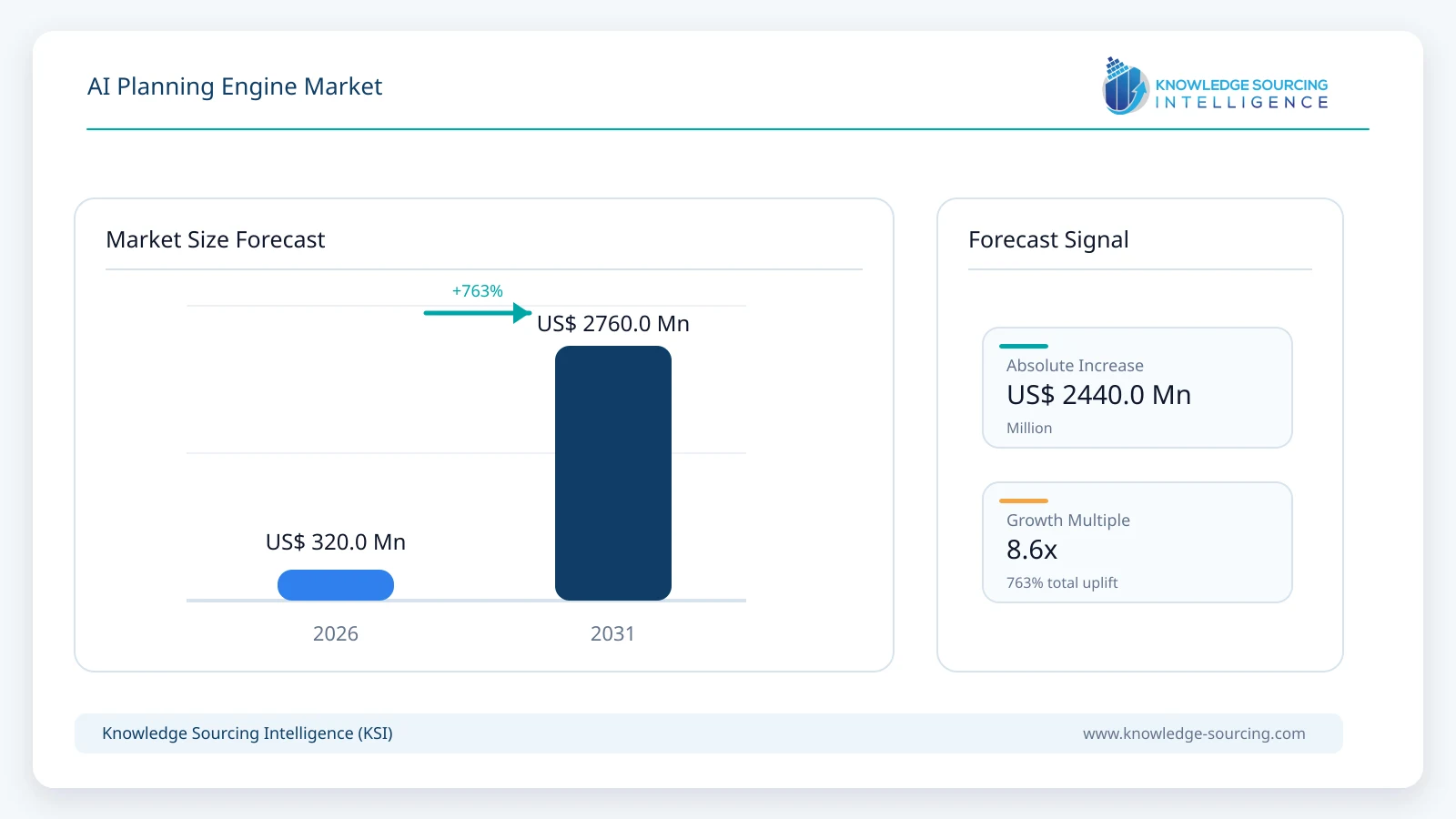
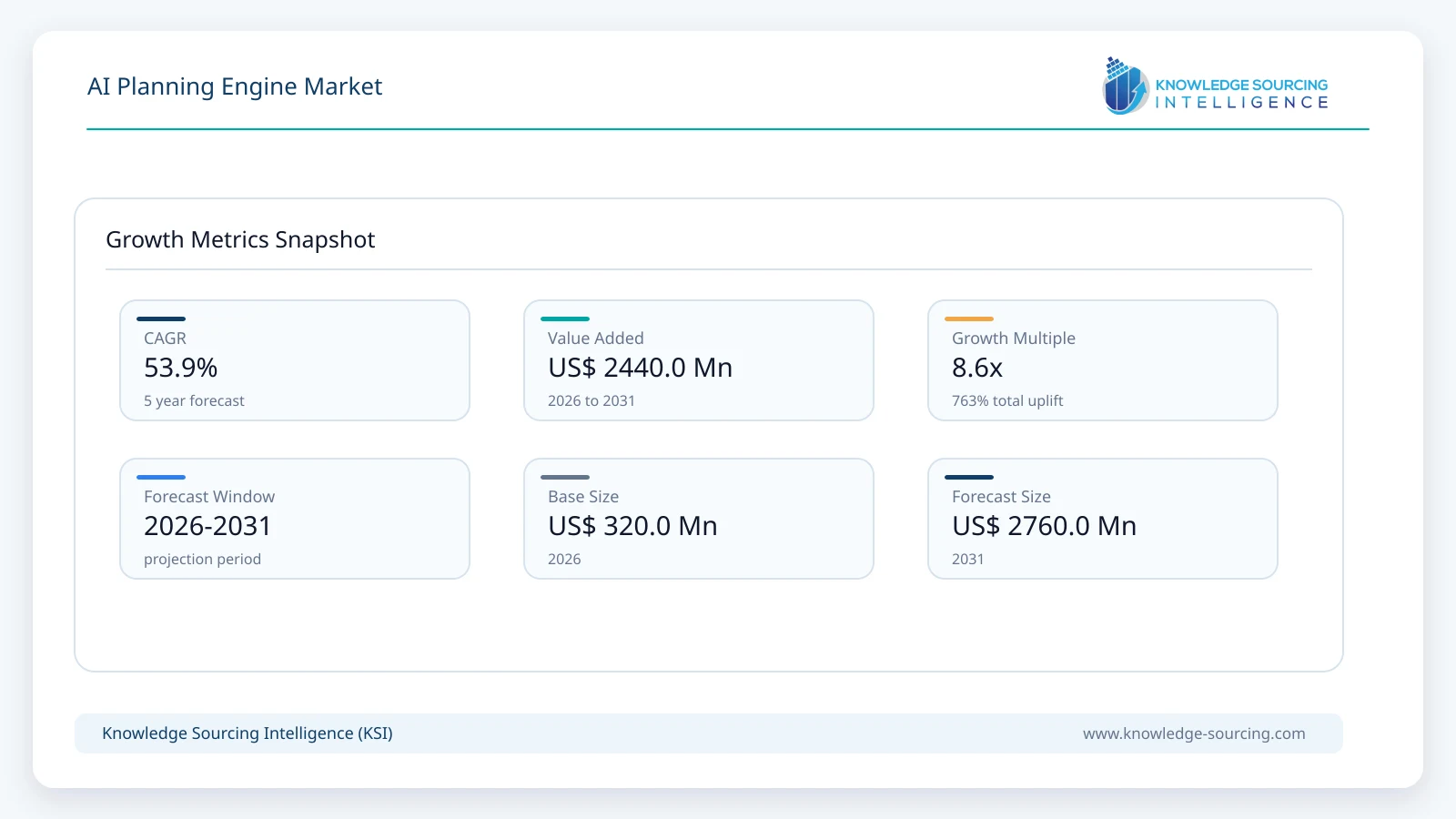
The AI planning engine Market is forecast to grow at a CAGR of 53.9%, reaching USD 2,760.0 million in 2031 from USD 320.0 million in 2026.
Highlights:
- 1Dynamic replanning and recovery is projected to reach USD 800.4 million by 2031 as production agents encounter changing conditions and incomplete tasks.
- 2Metered planning calls are forecast at USD 1.65 billion in 2031, the leading commercial offering as planning becomes a measurable runtime function.
- 3Language-model-native planners remain significant, while hybrid neural-symbolic planning grows as organizations require enforceable rules and constraints.
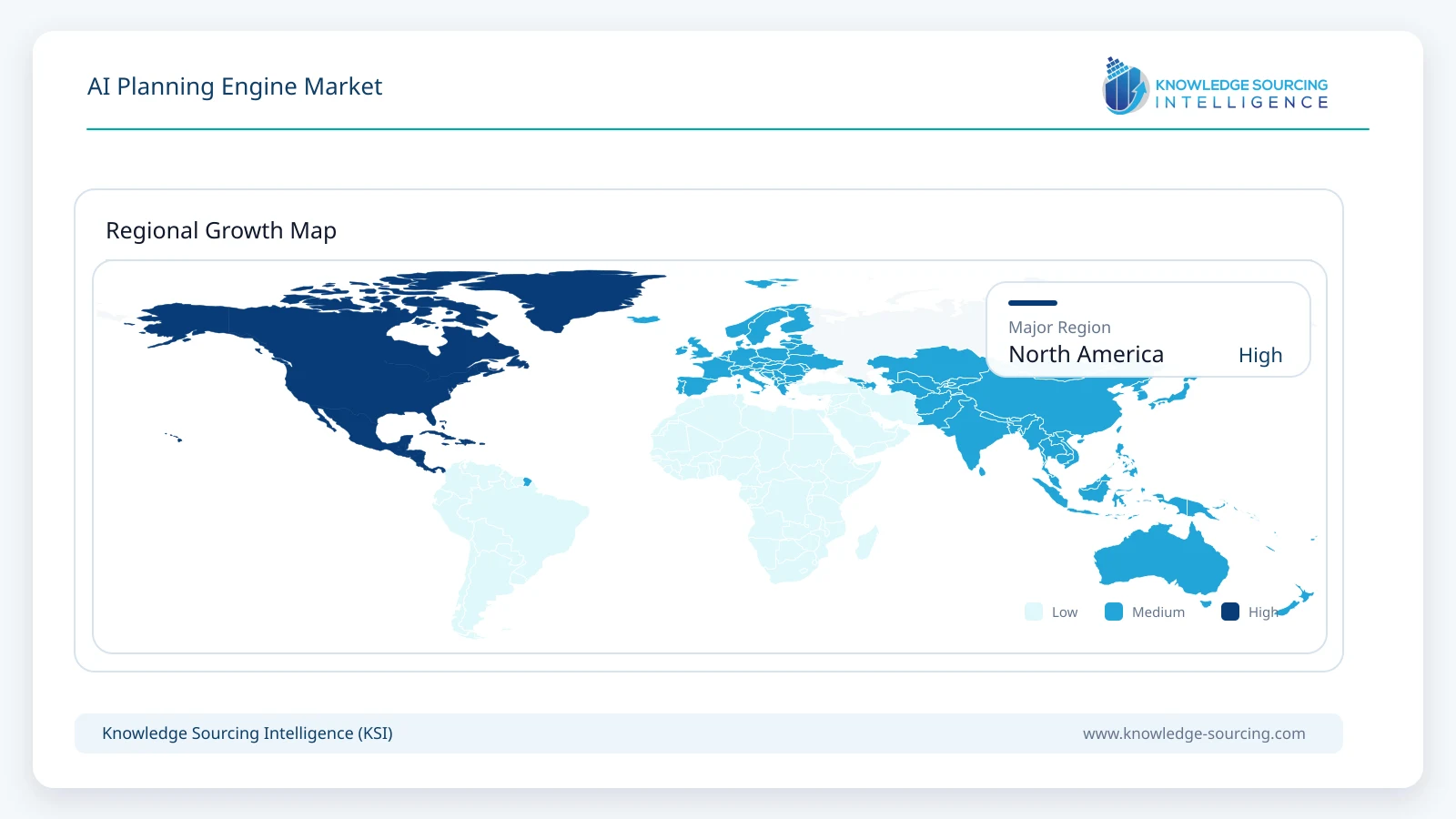
- 4North America is projected to reach USD 966 million in 2031; Asia Pacific expands to USD 938.4 million and records the fastest modeled growth.
- 5Customer-controlled private cloud and hybrid deployments expand as enterprises place planning controls alongside sensitive operational systems.
Revenue covers separately attributable planning calls, planning-control software licenses, dedicated planning runtimes and implementation services directly linked to building and optimizing plans. The market is distinct from ordinary foundation-model responses, task execution fees and subscriptions for complete agent applications.
enterprise agent systems increasingly need to identify dependencies before invoking tools, monitor completed and pending steps, and revise execution paths when data or approvals change. Microsoft Agent Framework offers plan-versus-execute operating modes and to-do tracking, while LangChain Deep Agents emphasizes task breakdown, work delegation and persistent context. Managed platforms from Google, OpenAI and IBM are extending the infrastructure within which these planning functions operate.
Commercial purchasing is shifting toward measured planning effectiveness: the proportion of tasks completed, unnecessary tool calls avoided, time lost to replanning, and the ability to reconstruct why an agent chose a particular route. Planning engines have stronger pricing power when they prevent workflow failure or coordinate expensive specialist resources, but embedded open-source planning components restrict the revenue attributable to basic task-list generation.
Market Overview
AI planning engines translate goals into execution sequences with explicit tasks, dependencies, available tools and criteria for completion. Language-model planners can generate and revise task lists from natural-language instructions, while graph-based and symbolic techniques apply constraints or approved pathways. A commercially useful engine combines the two approaches where a flexible model must act within operating rules.
Planning is increasingly separated from execution within enterprise agent stacks. Microsoft Agent Framework provides graph workflows and a harness with task tracking; Google Agent Development Kit supports conditional routing, parallel execution and human review; LangChain Deep Agents supplies planning and delegation primitives. OpenAI’s Agents SDK supports long-running work across files and tools, while IBM focuses on controlled operation across heterogeneous agents. Salesforce Agentforce also uses a unified planning and execution architecture that combines model-based decisions with graph controls.
Products compete on how well planning decisions survive interruptions, conflicting instructions, changing evidence and cost limits. Customers typically evaluate the planning engine alongside a model provider, orchestration runtime and enterprise systems, making contract attribution important. Pricing often appears as usage-based computation or an allocated share of a broader agent-platform agreement, rather than a separately advertised planning-only subscription.
Market Trends
Plan-and-Execute Architectures Are Becoming More Explicit
Enterprise developers are separating the stage that defines tasks from the stage that invokes business tools, improving traceability when an agent takes many steps. Microsoft Agent Framework now distinguishes plan and execute modes and keeps a structured to-do record. The separation allows teams to review proposed actions before execution, control sensitive operations, and distinguish planning errors from failed tool calls. For systems integrators, separating proposal, approval, and execution also clarifies contractual responsibility when a sequence is adjusted. Planning suppliers can then charge for the managed decision layer rather than for every downstream business action.
Dynamic Replanning Supports Long-Running Work
Long-horizon workflows expose plans to changing data, tool failures, and new user requirements. Planning engines must revise unfinished steps without repeating completed financial transactions or losing previous approvals. OpenAI’s updated Agents SDK and Google’s Agent Executor emphasize persistent harnesses and resumable execution, making reliable replanning more commercially valuable as agents progress from demonstrations to production. Recovery also needs checkpoints, clear completion markers and procedures for revising dependent tasks. Enterprises favor tools that can preserve completed work when a later stage fails, particularly when agents handle large document sets or extended software projects.
Multi-Agent Plans Are Being Combined with Governance
Complex tasks increasingly require a planner to assign work to specialist agents and account for dependencies between their results. IBM watsonx Orchestrate brings cross-platform agent visibility and controls, while Google’s workflow tools combine parallel agents with approval paths. Buyers seek governance over who can receive a task, what data they can use, and whether their outputs are verified before the next plan step. Specialist delegation creates a need to reconcile results produced at different times and with different permissions. Planning control products that record those dependencies and route exceptions to a supervisor are better suited to large enterprise environments.
Hybrid Planning Combines Flexible Reasoning with Fixed Constraints
Enterprises are adding explicit decision graphs and validation rules where a language-model-generated plan could violate operating limits. Graph workflows in Google ADK support deterministic routing alongside agent-selected paths, enabling teams to reserve fixed controls for high-risk steps. This mixed approach is attractive in regulated operations, where execution flexibility cannot override audit or approval requirements. Formal validation is particularly useful when the system must respect budgets, service-level constraints or mandated reviewer sign-off. That requirement can increase the importance of interoperable planning software even when underlying language models improve.
Segment Analysis
By Planning Function: Dynamic Replanning and Recovery
Dynamic replanning and recovery is projected at USD 800.4 million by 2031, representing 29% of market revenue. The segment covers revision of task dependencies and execution strategy following new information, tool failure or changed objectives. Deployment demand is strongest where a stopped process must resume without duplicate actions, including service operations, research and multistep software delivery.
By Commercial Offering: Metered Planning API and Decision Calls
Metered planning API and decision calls are forecast to reach USD 1.65 billion in 2031 as more planning activity is billed through software and model-enabled endpoints. Revenue attribution includes paid plan-generation and replanning decisions, but excludes separately billed execution, baseline model output and verification services already recorded under another market category.
By Engine Architecture: Hybrid Neural-Symbolic Planners
Hybrid neural-symbolic planners are expected to generate USD 717.6 million in 2031, or 26% of the total. These engines combine flexible task formulation with formal rules, dependency constraints and checkable plan structures. Enterprises use the architecture when planning must incorporate policy, process sequence, resource availability or human approval before automation begins.
By Primary Application: Software Engineering and Digital Delivery
Software engineering and digital delivery is projected to account for USD 662.4 million in 2031. Planning tools break feature requests into code changes, tests, reviews and deployment tasks while adjusting work after build or validation failures. Adoption is supported by coding agents that need persistent task state and the ability to delegate independent steps safely.
Market Drivers
Expansion of Multi-Step Agent Workflows
Businesses increasingly expect AI applications to complete multistep assignments rather than return isolated answers. Planning engines translate objectives into bounded actions, choose dependencies and maintain a record of progress. Commercial demand follows the deployment of agents in IT support, software development and internal business operations, where correct task sequencing can reduce rework and improve completion rates. The greatest benefit arises when the sequence spans multiple applications and requires updates after intermediate results.
Growing Need for Reliable Recovery and Replanning
Production agents face failed APIs, missing approvals and changing source material after work has started. Dynamic replanning engines preserve completed steps and select a new route that avoids repeating risky actions. As customers place agents inside business-critical workflows, recoverability becomes a purchasing criterion and increases demand for dedicated planning logic and monitored runtime controls. Value is highest when interruption recovery avoids restarting work that has already consumed staff time or system capacity.
Broader Availability of Planning Development Frameworks
Microsoft Agent Framework, Google ADK and LangChain Deep Agents are making planning and coordination functions easier to embed in applications. The growing developer ecosystem lowers implementation barriers for enterprises and specialist vendors. Commercial opportunity shifts toward managed planning capacity, advanced controls and support where clients need operational guarantees beyond open-source libraries. Enterprise procurement therefore increasingly differentiates community code from software with uptime, compliance and support commitments.
Enterprise Controls for Complex Agent Collaboration
Multi-agent assignments require planners to distribute tasks without violating permissions, budget limits or separation-of-duties requirements. Corporate buyers increasingly need explicit supervision, approval gates and traceability across specialist agents. A planning engine that integrates these controls can support more valuable use cases than a simple autonomous to-do list, particularly in financial and regulated settings. Such controls help expand deployment from low-consequence assistance into financially significant operating processes.
Pressure to Improve Cost per Completed Task
Repeated model calls, unnecessary tool execution, and poorly selected task paths can raise the expense of autonomous operations. Planning engines can reduce wasted steps by evaluating dependencies and routing work to appropriate specialists. Customers are therefore comparing total cost per successfully resolved task, encouraging adoption of metered planning controls with measurable operational outcomes. Providers can defend pricing more effectively when evaluations show fewer retries rather than only faster plan generation.
Market Restraints
Planning Errors Can Propagate Across Workflows
An incorrect initial plan can route an agent toward unsuitable tools, omit required approvals or trigger costly repeated work. Errors are harder to isolate when several agents depend on the same upstream decision. Buyers require reviewable plan states and tests before allowing a planner to control consequential actions. Independent acceptance testing becomes especially important when agent plans affect customer accounts or production systems.
Attribution Is Difficult in Bundled Agent Platforms
Planning is often integrated into model inference, orchestration frameworks and broader enterprise agent subscriptions. Customers may not see a separately charged planning line, limiting supplier monetization and creating revenue-reporting ambiguity. Vendors need transparent metering or distinct software contracts to justify a standalone commercial value. As a result, planning-only supplier revenue can grow more slowly than total agent deployments.
Latency and Model Cost Increase with Replanning
Large plans can require repeated reasoning passes, constraint checks and specialist-agent coordination. Frequent replanning raises token use, tool calls and response time, especially under dynamic input conditions. Enterprises may reduce planning depth or restrict its use to higher-value assignments when the added cost exceeds the benefit. Budget-sensitive customers may favor simpler predefined workflows over unlimited autonomous plan revisions.
Open-Source Substitution Limits Basic Planner Pricing
Planning lists, delegation patterns, and graph workflows are available in widely used development frameworks. Customers can implement many basic capabilities without buying a separate software license. Specialist providers must differentiate through recovery, auditing, constraint enforcement, operational support, or domain-specific knowledge. The resulting competitive pressure makes enterprise-specific integration and measurable resilience essential differentiators.
Security and Accountability Limit Autonomous Decisions
Planning engines may schedule actions that touch regulated data, money movement, production systems or customer records. Enterprises need authorization limits and human confirmation at appropriate stages. Without sufficient traceability, approved execution policies and rollback procedures, adoption can remain confined to low-risk tasks. Governance demands are strongest when a generated plan crosses organizational boundaries or involves external parties.
Regional Outlook
North America
North America is estimated at USD 124.8 million in 2026 and is forecast at USD 966 million in 2031, remaining the leading regional market. The United States contributes the majority of regional revenue through concentrated cloud platforms, developer toolchains and enterprise agent deployments. Demand is particularly visible in software engineering, managed cloud workflows and large-scale IT service operations where customers already pay for advanced AI capabilities.
North American vendors are integrating planning controls with existing agent development, runtime monitoring and security systems. Microsoft, OpenAI, IBM and major cloud providers give enterprises a path from experimentation to supported deployment, while specialist framework suppliers compete on adaptable planning structures. Commercial growth depends on customers paying for attributable planning activity rather than treating every agent invocation as planning revenue.
Asia Pacific
Asia Pacific is forecast to rise from USD 86.4 million in 2026 to USD 938.4 million by 2031, representing the fastest modeled regional expansion. China, India, Japan, South Korea and Australia contribute a combination of local AI application development, enterprise modernization and manufacturing use cases. Regional adoption benefits from growing software-service capacity and demand for automation that can coordinate changing operational tasks.
Asian enterprises are testing planning-enabled agents in software delivery, multilingual customer operations and industrial processes where task dependencies must be managed across several systems. India and Southeast Asian markets offer growing demand for implementation and managed services, while Japan and South Korea emphasize operational reliability. Differences in data localization, language coverage and model access will encourage region-specific deployment architectures.
Competitive Landscape
The AI planning engine market comprises infrastructure platforms that embed planning into agent runtimes and specialist suppliers providing orchestration and planning frameworks. Microsoft, Google, OpenAI and IBM compete through supported enterprise platforms, while LangChain and CrewAI offer developer-centered approaches to task sequencing and delegation. Salesforce, ServiceNow, UiPath and Anthropic provide planning functions within agent-facing products or development tooling.
Competition centers on dependable plan revision, auditability, constraint handling, interoperability and cost per completed task. Large-platform providers benefit from established distribution and integrated runtime security, but planning-specific contracts are not always publicly separated. Specialist vendors gain traction when their architecture can be adopted across model providers without requiring customers to replace existing agent applications.
Recent Developments
29 September 2026: Google documented Agent Development Kit graph workflows covering branching, parallel execution, routing and human approval.
29 June 2026: Salesforce engineering detailed its Unified Planner architecture for Agentforce, unifying planning and execution across interaction modes.
05 May 2026: IBM announced the next generation of watsonx Orchestrate, positioning a common multi-agent control plane for enterprise deployments.
22 April 2026: Google launched Gemini Enterprise Agent Platform for developing and governing agents that execute complex multistep work.
15 April 2026: OpenAI updated its Agents SDK with a longer-horizon agent harness, configurable memory and sandbox-aware orchestration.
02 April 2026: Microsoft Agent Framework 1.0 GA united AutoGen and Semantic Kernel concepts, with multi-step orchestration and plan/execute agent-harness patterns.
Market Outlook
AI planning engines are expected to become a more valuable layer of enterprise agent software as organizations automate tasks that involve several tools, owners, and approval stages. Dynamic replanning, plan validation, and hybrid constraint enforcement should capture more spending than simple task decomposition. Suppliers able to demonstrate reliable completion and measurable savings can support differentiated contracts or usage-based planning charges.
The forecast anticipates increasing adoption of managed planning services and private execution controls, alongside persistent pressure from open-source planning frameworks. Enterprise buyers will continue to assess planning functions as part of the full agent architecture, requiring providers to quantify which decisions, contracts, and runtime charges belong specifically to the planning engine rather than to general inference or workflow execution.
AI Planning Engine Market Scope:
| Report Metric | Details |
|---|---|
| Total Market Size in 2026 | USD 320.0 million |
| Total Market Size in 2031 | USD 2,760.0 million |
| Forecast Unit | USD Million |
| Growth Rate | 53.9% |
| Study Period | 2021 to 2031 |
| Historical Data | 2021 to 2024 |
| Base Year | 2025 |
| Forecast Period | 2026 – 2031 |
| Segmentation | Planning Function, Commercial Offering, Planning Engine Architecture, Deployment Model |
| Companies |
|
| Customization Scope | 15% Free Customization included with purchase — Request Custom Breakdown → |
| Sample & Data Access | PDF Sample, Excel Databook & Analyst Briefing — Download Free Sample → |
Market Segmentation
By Planning Function
Goal Decomposition And Task Planning
Dynamic Replanning And Recovery
Multi-agent Task Delegation
Constraint-aware Planning
Plan Verification And Simulation
By Commercial Offering
Metered Planning API And Decision Calls
Planning Control-module Licenses
Dedicated/private Planning Runtimes
Planning Implementation And Optimization
By Planning Engine Architecture
Language-model-native Planners
Hybrid Neural-symbolic Planners
Multi-agent Graph Planners
Tree Search And Optimization Planners
Domain-specific Planning Engines
By Deployment Model
Multitenant Cloud Services
Customer-controlled Private Cloud
On-premises Software
Hybrid And Managed Private Deployment
By Primary Application
IT And Service Operations
Software Engineering And Digital Delivery
Enterprise Process Coordination
Research And Analytical Projects
Customer-facing Processes
Industrial And Field Operations
By Customer Type
AI Developers And Independent Software Vendors
Large Enterprises
Cloud And Managed Service Providers
Public Sector And Research Buyers
By End-user Industry
Information Technology And Software
Banking, Financial Services And Insurance
Manufacturing And Engineering
Healthcare And Life Sciences
Retail And Consumer Services
Other Industries
By Geography
North America
United States
Canada
Mexico
South America
Brazil
Argentina
Chile
Rest Of South America
Europe
United Kingdom
Germany
France
Netherlands
Italy
Spain
Rest Of Europe
Middle East And Africa
United Arab Emirates
Saudi Arabia
Israel
South Africa
Rest Of Middle East And Africa
Asia Pacific
China
India
Japan
South Korea
Australia
Singapore
Rest Of Asia Pacific
Table of Contents
1. EXECUTIVE SUMMARY
1.1. Market Opportunity and Key Findings
1.2. Global AI Planning Engine Market Size and Forecast, 2026–2031
1.3. Strategic Market Outlook
2. MARKET SNAPSHOT
2.1. Market Definition and Scope
2.2. Commercial Planning Functions and Revenue Boundary
2.3. Research Assumptions and Forecast Period
3. BUSINESS LANDSCAPE
3.1. Market Drivers
3.1.1. Expansion of Multi-Step Agent Workflows
3.1.2. Growing Need for Reliable Recovery and Replanning
3.1.3. Broader Availability of Planning Development Frameworks
3.1.4. Enterprise Controls for Complex Agent Collaboration
3.1.5. Pressure to Improve Cost per Completed Task
3.2. Market Restraints
3.2.1. Planning Errors Can Propagate Across Workflows
3.2.2. Attribution Is Difficult in Bundled Agent Platforms
3.2.3. Latency and Model Cost Increase with Replanning
3.2.4. Open-Source Substitution Limits Basic Planner Pricing
3.2.5. Security and Accountability Limit Autonomous Decisions
3.3. Market Opportunities
3.4. Porter’s Five Forces Analysis
3.5. Industry Value Chain Analysis
3.6. Policies and Regulations
3.7. Strategic Recommendations
4. TECHNOLOGICAL OUTLOOK
4.1. Goal Decomposition and Hierarchical Planning
4.2. Dynamic Replanning and State Recovery
4.3. Neural-Symbolic Constraint Enforcement
4.4. Multi-Agent Task Graph Coordination
4.5. Plan Verification and Monitoring
5. AI PLANNING ENGINE MARKET BY PLANNING FUNCTION
5.1. Goal decomposition and task planning
5.2. Dynamic replanning and recovery
5.3. Multi-agent task delegation
5.4. Constraint-aware planning
5.5. Plan verification and simulation
6. AI PLANNING ENGINE MARKET BY COMMERCIAL OFFERING
6.1. Metered planning API and decision calls
6.2. Planning control-module licenses
6.3. Dedicated/private planning runtimes
6.4. Planning implementation and optimization
7. AI PLANNING ENGINE MARKET BY PLANNING ENGINE ARCHITECTURE
7.1. Language-model-native planners
7.2. Hybrid neural-symbolic planners
7.3. Multi-agent graph planners
7.4. Tree search and optimization planners
7.5. Domain-specific planning engines
8. AI PLANNING ENGINE MARKET BY DEPLOYMENT MODEL
8.1. Multitenant cloud services
8.2. Customer-controlled private cloud
8.3. On-premises software
8.4. Hybrid and managed private deployment
9. AI PLANNING ENGINE MARKET BY PRIMARY APPLICATION
9.1. IT and service operations
9.2. Software engineering and digital delivery
9.3. Enterprise process coordination
9.4. Research and analytical projects
9.5. Customer-facing processes
9.6. Industrial and field operations
10. AI PLANNING ENGINE MARKET BY CUSTOMER TYPE
10.1. AI developers and independent software vendors
10.2. Large enterprises
10.3. Cloud and managed service providers
10.4. Public sector and research buyers
11. AI PLANNING ENGINE MARKET BY END-USER INDUSTRY
11.1. Information technology and software
11.2. Banking, financial services and insurance
11.3. Manufacturing and engineering
11.4. Healthcare and life sciences
11.5. Retail and consumer services
11.6. Other industries
12. AI PLANNING ENGINE MARKET BY GEOGRAPHY
12.1. North America
12.1.1. United States
12.1.2. Canada
12.1.3. Mexico
12.2. South America
12.2.1. Brazil
12.2.2. Argentina
12.2.3. Chile
12.2.4. Rest of South America
12.3. Europe
12.3.1. United Kingdom
12.3.2. Germany
12.3.3. France
12.3.4. Netherlands
12.3.5. Italy
12.3.6. Spain
12.3.7. Rest of Europe
12.4. Middle East and Africa
12.4.1. United Arab Emirates
12.4.2. Saudi Arabia
12.4.3. Israel
12.4.4. South Africa
12.4.5. Rest of Middle East and Africa
12.5. Asia Pacific
12.5.1. China
12.5.2. India
12.5.3. Japan
12.5.4. South Korea
12.5.5. Australia
12.5.6. Singapore
12.5.7. Rest of Asia Pacific
13. COMPETITIVE ENVIRONMENT AND ANALYSIS
13.1. Competitive Benchmarking
13.2. Strategic Initiatives and Product Positioning
13.3. Market Share Analysis
14. COMPANY PROFILES
14.1. OpenAI
14.2. Microsoft Corporation
14.3. Google LLC (Alphabet Inc.)
14.4. Amazon Web Services, Inc.
14.5. International Business Machines Corporation
14.6. LangChain, Inc.
14.7. CrewAI, Inc.
14.8. Salesforce, Inc.
14.9. ServiceNow, Inc.
14.10. UiPath, Inc.
14.11. Anthropic PBC
15. APPENDIX
15.1. Research Methodology
15.2. Assumptions and Definitions
15.3. Data Tables and Glossary





Frequently asked questions
What is the projected market size for AI Planning Engines by 2031?
The AI Planning Engine Market is forecast to reach USD 2,760.0 million by 2031.
What is the Compound Annual Growth Rate (CAGR) for this market?
The AI Planning Engine Market is forecast to grow at a CAGR of 53.9%.
Which commercial offering leads the market by 2031?
Metered planning calls are forecast at USD 1.65 billion in 2031.
Which region is projected to dominate the market by 2031?
North America is projected to reach USD 966 million in 2031.
What primary factor drives AI planning engine market growth?
Enterprise agents increasingly need dependency identification and execution path revision.
What deployment models are expanding for AI planning engines?
Customer-controlled private cloud and hybrid deployments are expanding.
Cite this report
Knowledge Sourcing Intelligence. (Oct 2026). AI Planning Engine Market Size, Share & Growth Forecast (2026-2031). https://www.knowledge-sourcing.com/report/ai-planning-engine-market