
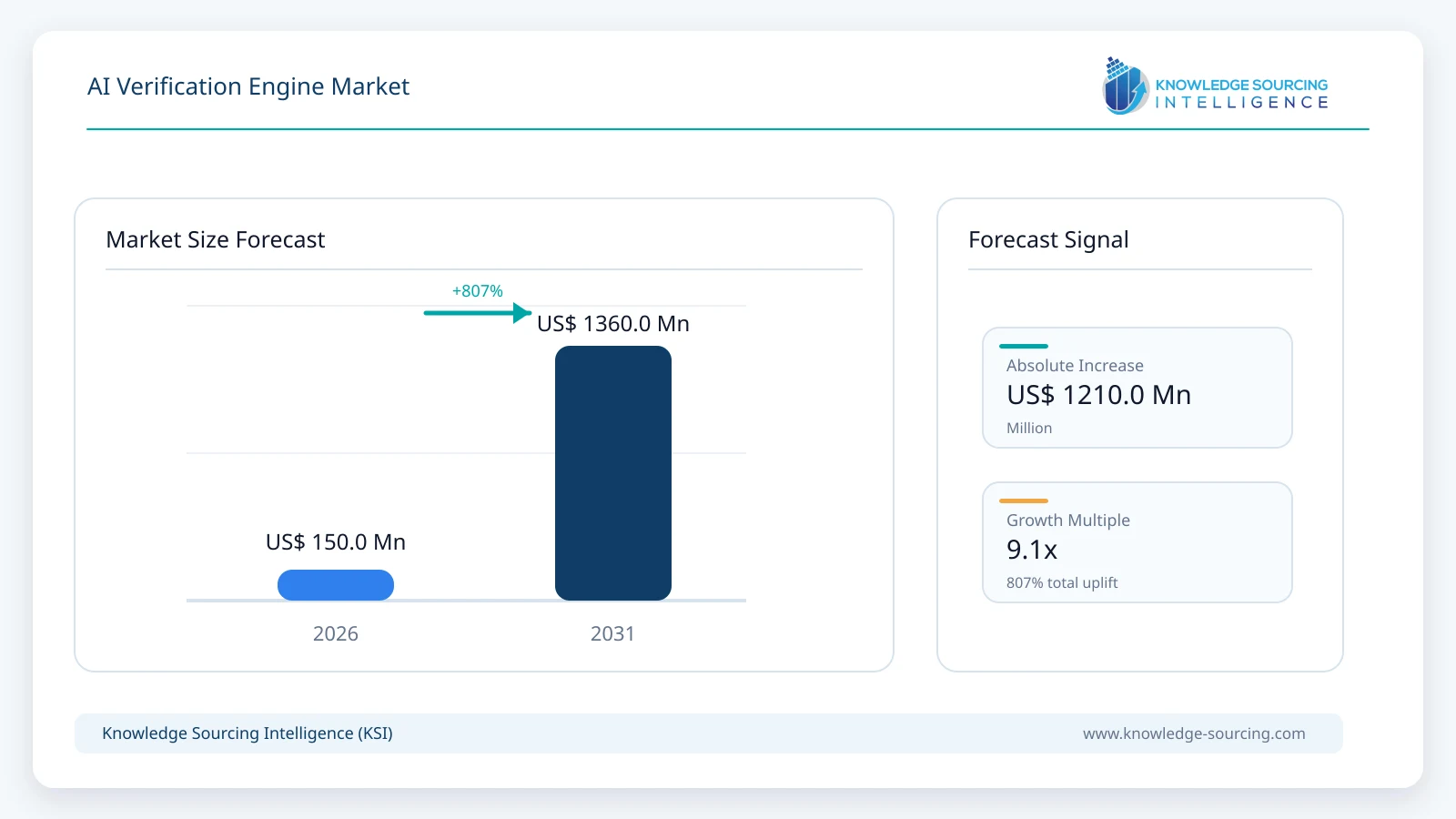
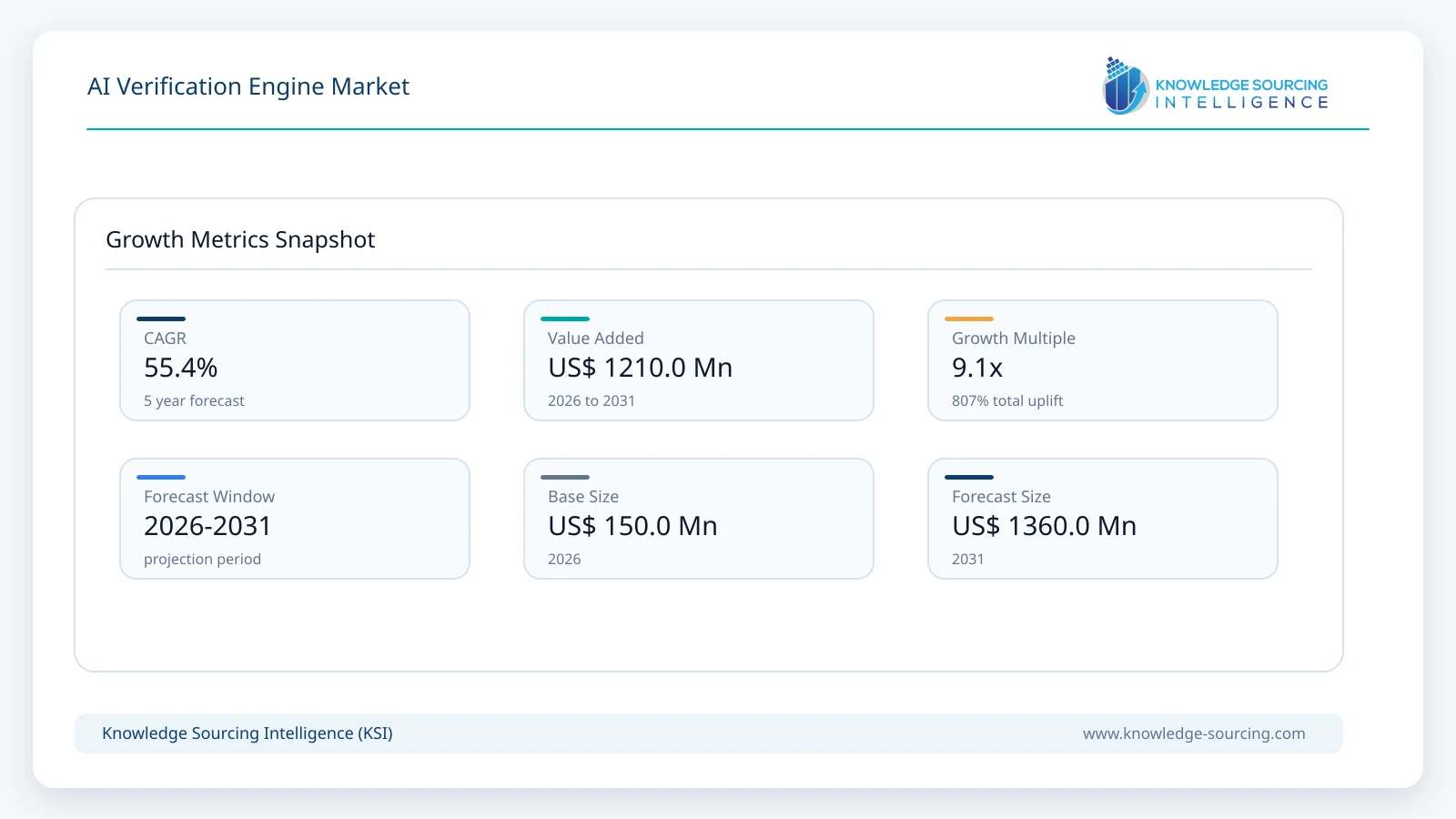
The AI Verification Engine Market is projected to expand at a CAGR of 55.4%, increasing from USD 150.0 million in 2026 to USD 1,360.0 million by 2031.
Highlights:
- 1Source-grounded claim verification is the largest functional group, representing 42.0% of modeled 2026 revenue and reaching USD 510 million by 2031.
- 2Metered online verification contributes USD 70 million in 2026 and is projected to reach USD 750 million in 2031 as production call volumes increase.
- 3Real-time pre-response checks are projected to reach USD 780 million in 2031 as AI applications add validation before serving answers.
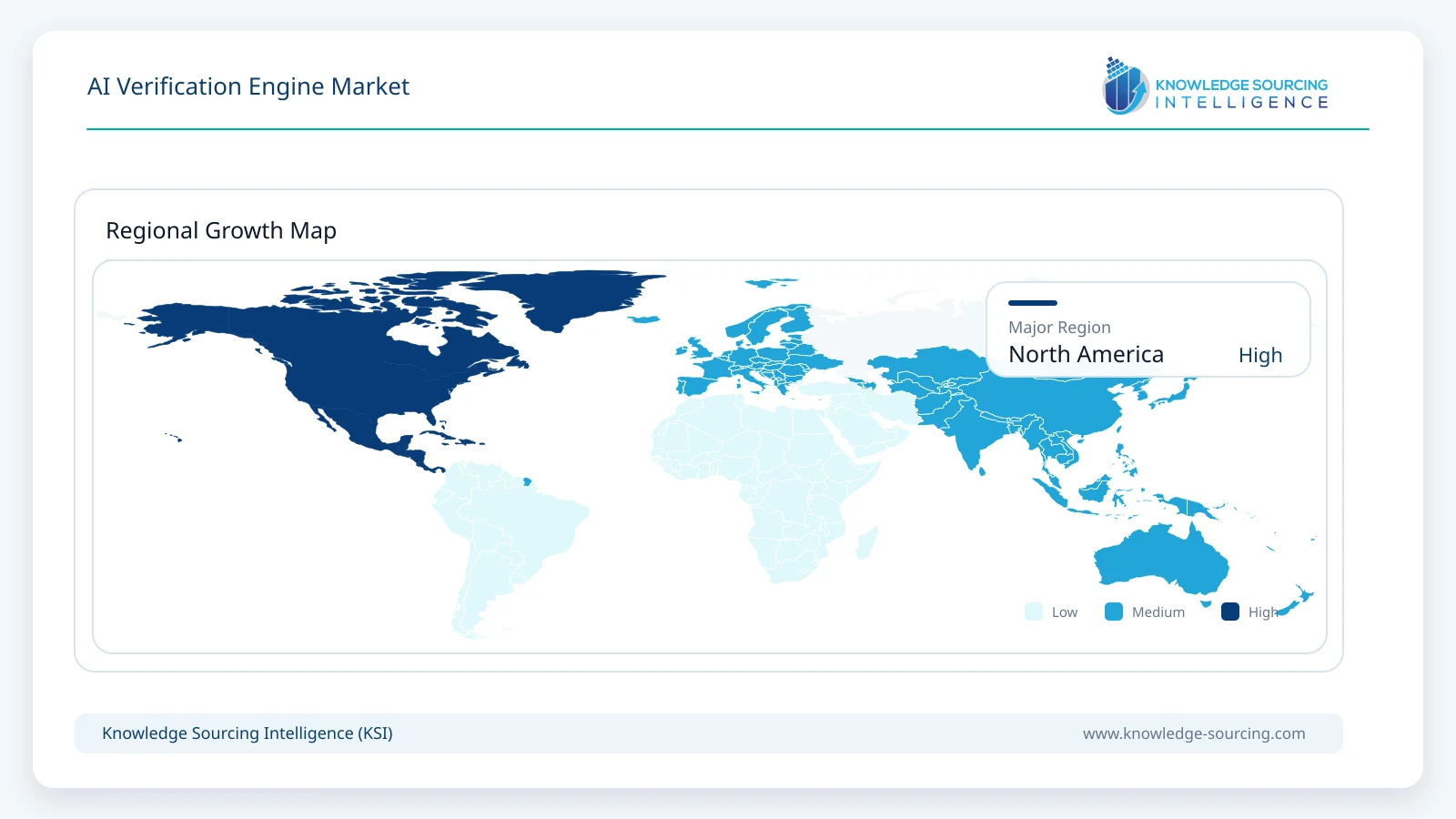
- 4North America is the largest regional market, forecast to reach USD 520 million by 2031; Asia Pacific reaches USD 390 million and expands more rapidly.
- 5Vendors compete on evaluator precision, available evidence, integration latency and verifiable error-reduction economics rather than generic safety claims.
The AI Verification Engine Market covers software and services that assess generated claims and agent decisions for accuracy, consistency, policy compliance, and reliability. Applications include paid output-checking calls, formal-policy validation, dedicated verification software, and related implementation services. Verification focuses on evaluating generated outputs and agent decisions rather than performing the underlying foundation-model inference, distinguishing verification activities from ordinary model operations.
Product differentiation is developing around the type of evidence a verifier can use and the consequence of a failed result. AWS Automated Reasoning checks apply formal logic to answers tested against defined business rules, whereas Google Cloud provides grounding checks with support scores and references. Microsoft offers groundedness detection for source-backed responses; specialist systems from Vectara and Patronus AI focus on factual consistency and hallucination assessment. These approaches address related problems but have different evidence requirements and guarantees.
Enterprise buyers increasingly need verification that runs inside production workflows and produces reviewable findings. Developers can combine low-latency claim checks with more rigorous review of selected high-consequence outputs, while evaluation vendors help create reusable tests from observed failures. The commercial opportunity depends on charging specifically for these verifier functions, not counting complete AI application subscriptions or general-purpose monitoring services.
Market Overview
AI verification engines inspect the output of a generative model or agent and determine whether the result satisfies a stated requirement. Evidence-based systems compare claims with retrieved documents, while logical verifiers test responses against explicit policies and constraints. Model-based judges assess aspects that are harder to express as deterministic rules, such as completeness or whether a response follows the expected task. Organizations typically combine these methods according to the consequences of a wrong answer.
Google Cloud provides a check-grounding API that returns a support score and supporting citations for generated statements. Microsoft separates fast groundedness detection from a reasoning mode that explains the unsupported portions of an answer. Vectara uses its Hughes Hallucination Evaluation Model to assess factual consistency, and Patronus AI supplies hallucination evaluators that inspect a model answer against retrieved context. The variety of implementations shows why verification should not be measured as one generic guardrail feature.
Production buyers generally separate three questions: whether the verifier catches failures, whether it introduces unacceptable delay, and whether it produces evidence suitable for review. A high detection rate can still be economically unattractive when false positives force expensive human intervention. Dedicated providers therefore compete with cloud-native features through better calibration, domain-specific testing, and integration into developer pipelines. The result is a distinct but overlapping revenue layer within the wider AI reasoning ecosystem.
Market Trends
Formal Verification Is Moving Closer to Production AI Responses
Formal-rule engines can test whether a generated answer follows business-policy constraints that are more precise than ordinary language prompts. AWS added source-linked policy references and refinement workflows to Bedrock Automated Reasoning during 2026, reducing the manual effort required to maintain formal checks. Commercial adoption is most relevant where the organization can translate domain rules into consistent assertions, rather than expecting mathematics to establish the truth of every open-ended statement.
Evidence-Based Grounding Is Becoming a Runtime Requirement
Enterprise retrieval systems now assess whether a generated statement is supported by the documents supplied to the model. Google Cloud exposes claim support scores and citations through its grounding API, while Microsoft offers groundedness detection with explanation and correction options. Buyers increasingly view these checks as production controls for knowledge assistants because a plausible unsupported answer can create downstream correction work even when the underlying search results are appropriate.
Specialized Evaluator Models Are Lowering Unit Costs
AI systems producing large volumes of responses cannot economically route every claim through the largest general-purpose reasoning model. Galileo described specialist evaluator development through Luna Studio in May 2026, while LangChain introduced managed Tuned Evaluators in August 2026. The commercial implication is a tiered market in which inexpensive routine assessment handles common traffic and deeper verification is reserved for uncertain or high-value cases.
Agent Verification Is Extending Beyond Final Answers
Autonomous agents must be checked for tool selection, policy adherence, and completion of intermediate tasks, not just the wording of a final response. LangSmith Engine and Arize Phoenix increasingly use traces and evaluator outputs to identify failures and turn them into repeatable tests. Verification revenue may therefore attach to particular decision points and tool results, but only when separately attributable from the core agent execution or observability contract.
Segment Analysis
By Verification Method: Source-Grounded Claim Checking
Evidence-backed claim verification is estimated at USD 63 million in 2026 and projected to reach USD 510 million by 2031. Organizations use these tools to compare answers with retrieved documents, identify unsupported assertions, and record supporting citations. Google Cloud, Vectara, Microsoft and Patronus AI provide commercially relevant examples of this function, although their architectures and billing methods differ.
By Commercial Offering: Metered Verification APIs
Metered online verification APIs account for USD 70 million in 2026 and are forecast to reach USD 750 million by 2031. The ability to purchase individual checks aligns verification cost with AI application traffic. Dedicated contracts and formal-policy verification remain important where buyers require controlled deployment or reusable rules rather than relying solely on consumption-based services.
By Deployment Model: Multitenant Cloud APIs
Multitenant cloud APIs contribute USD 91 million in 2026 and are expected to reach USD 810 million in 2031. Hosted access supports fast integration and elastic verification volume. Private-cloud, on-premises, and hybrid deployments remain important for regulated data and proprietary business rules, especially when organizations cannot transmit source documents to a public verifier.
By Verification Timing: Real-Time Pre-Response Validation
Real-time pre-response checks represent USD 77 million in 2026 and are projected to reach USD 780 million in 2031. This segment verifies outputs before end users receive them and can trigger correction or escalation. Pre-release tests and retrospective production assurance complement the real-time layer by finding systematic defects and updating test suites.
By Primary Application: Enterprise RAG and Knowledge Assistants
Enterprise retrieval and knowledge assistants represent USD 55 million in 2026, reaching USD 390 million in 2031. These applications generate summaries and answers from changing internal documents, making evidence matching commercially valuable. Agent and tool-use workflows are an additional growth area because verifiers can inspect decisions that have operational consequences beyond text accuracy.
By Customer Type: Direct Enterprise Buyers
Direct enterprises contribute USD 45 million in 2026 and are forecast to reach USD 420 million by 2031. Buyers in financial services, professional services and healthcare typically require traceable checks aligned with their own policies and document collections. Software vendors, cloud providers and public institutions form separate buyer classes based on who purchases the verification service.
By End-User Industry: Information Technology and Software
Information technology and software is the largest end-user industry, estimated at USD 55 million in 2026 and USD 480 million by 2031. Application developers integrate checks into customer-facing assistants, code workflows, and agent products before serving results at scale. Financial services and healthcare are important adoption markets where the economic cost of unsupported or inconsistent outputs is comparatively high.
Market Drivers
Rising Volume of Production AI Outputs
Increasing numbers of enterprise assistants and agents create more model-generated claims and decisions requiring automated checks. Human review does not scale linearly with usage, making pay-per-check verification attractive when its unit cost is below the cost of downstream correction. The demand is particularly visible in document-intensive knowledge assistants and production agent workflows.
Higher Demand for Auditable Enterprise AI
Enterprises need to explain why a generated result was accepted, rejected, or escalated. Source-grounded checking, retained evaluator scores, and formal-rule findings provide reviewable evidence for operational controls. The EU AI Act and voluntary risk-management guidance add attention to AI accountability, although neither makes purchasing a particular verification engine mandatory.
Growth in Agentic Decision and Tool-Use Workflows
AI agents can select tools, retrieve data, and act across connected business systems, creating failures that are not visible in the final sentence alone. Trace evaluation and step-level verification enable teams to inspect instructions, handoffs, and tool outputs. Suppliers such as LangChain and Arize are developing practical workflows that convert these observed failures into reusable tests.
Improved Economics of Specialized Evaluators
Smaller domain-focused verifier models and managed evaluation services can lower the processing expenditure per result. Galileo and LangChain have described approaches to reducing the operational burden of evaluator development and execution. Lower unit costs make continuous verification more feasible for high-volume applications, even when deep reasoning remains reserved for selected cases.
Commercialization of Formal-Policy Checking
Formal verification becomes more useful when enterprise policies can be represented as reliable rules and linked back to source documents. AWS Automated Reasoning checks illustrate how software can test policy consistency and identify ambiguous translations. Structured domains such as eligibility decisions and business approvals offer the clearest initial commercial use cases for this approach.
Market Restraints
Verification Accuracy and False-Positive Costs
An evaluator that incorrectly flags valid answers can create review work and undermine user confidence. Accuracy also varies by domain, language and the evidence supplied to the check. Buyers therefore need calibrated measures of precision and recall rather than an unsupported claim that a single score guarantees factual correctness.
Additional Runtime Latency and Processing Spend
A second inference or formal-check step adds compute expense and may slow the application. Verification is harder to monetize for low-value tasks when model providers already bundle basic safeguards. Vendors need to show how selective verification or lower-cost specialist models preserve the economics of the original workflow.
Ambiguity in Evidence and Business Policies
Formal checks are only as reliable as the rules and translations supplied to them, while grounding tools cannot independently establish that a retrieved document is true. Conflicting company policies, outdated sources, and unclear instructions require manual interpretation. Product value therefore depends on sound evidence preparation and maintenance.
Bundling and Open-Source Substitution
Cloud platforms include some validation inside broader AI offerings, and developer teams can use open-source evaluators without purchasing a dedicated license. These alternatives place pressure on standalone verification prices. Specialist vendors must offer better calibration, deployment controls, or managed operations to maintain independently measurable revenue.
Data Protection and Procurement Complexity
Verification can require access to prompts, retrieved documents, and agent traces containing confidential information. Security, residency, retention and audit expectations increase deployment complexity for financial, healthcare and public-sector buyers. Private options may improve suitability but generally introduce additional engineering and contract costs.
Regional Outlook
North America
North America is estimated at USD 59 million in 2026 and is projected to reach USD 520 million by 2031, retaining the largest regional revenue base. The United States drives most demand through cloud AI suppliers, evaluation platform developers, and enterprises deploying internal knowledge assistants. AWS, Microsoft, LangChain, Arize and specialist verification companies contribute to a developed supplier ecosystem in which production integration and evidence retention are important purchasing criteria.
U.S. customers increasingly distinguish between basic platform guardrails and paid validation for regulated or high-value workloads. Canada contributes demand from enterprise software and research users, while Mexico remains a smaller market with growing adoption through regional cloud services. North American spending is expected to favor advanced evaluator capabilities and large-scale API consumption rather than only one-time assurance projects.
Asia Pacific
Asia Pacific is modeled at USD 33 million in 2026 and forecast to reach USD 390 million in 2031, making it the fastest-growing major region in this scenario. China, India, Japan, South Korea and Australia account for most regional opportunities, supported by expanding enterprise AI deployment and developer demand for multilingual source-grounded validation. The region benefits from adoption of hosted evaluation services alongside country-specific model and infrastructure ecosystems.
Regional buyers must also address language variation, data residency and differences in enterprise rule structures. These conditions create opportunities for regionally deployed verifier systems and calibrated domain models rather than a uniform global service. India and China are modeled as important incremental markets, while Japan, South Korea and Australia provide more mature enterprise assurance requirements. Vendor share will depend on integration access and the cost of reliable checking at production volume.
Competitive Landscape
The AI verification engine market includes integrated cloud functions and independent specialist platforms. AWS competes through formal-policy checks, Google Cloud through grounding assessment, and Microsoft through groundedness detection. LangChain, Arize and Galileo connect evaluation with development and production traces; Vectara and Patronus AI offer specialist factual-consistency checking. Braintrust, Giskard and Cleanlab contribute additional evaluation or trustworthiness approaches that buyers may combine with existing model stacks.
Competitive strength depends on independently measurable verifier performance, price per accepted output, explanation quality, supported languages and deployment flexibility. A provider with broad AI infrastructure does not automatically earn the revenue assigned to this market; only paid verification functionality is in scope. Specialist firms can differentiate through domain-focused calibration and interoperability, but cloud bundling limits the amount of spending available to standalone products.
Recent Developments
September 24, 2026: LangChain expanded LangSmith Engine with proactive red teaming and automated testing of proposed agent fixes, extending trace-based analysis into verification before deployment.
August 18, 2026: LangChain introduced managed Tuned Evaluators beginning with Perceived Error, reducing the need for customers to configure and maintain their own model-as-judge infrastructure.
August 3, 2026: Amazon Web Services described automated refinement for Bedrock Automated Reasoning policies, allowing formal-logic changes to be proposed and reviewed against failed tests.
June 2026: Arize introduced Phoenix Intelligence (PXI), a beta AI engineering assistant in Phoenix that can analyze traces and create evaluators with user approval.
May 20, 2026: Galileo detailed Luna Studio for specialist small-model evaluators, addressing the cost of running multiple verification metrics over production agent traces.
February 23, 2026: AWS added source-document references to Automated Reasoning policies, improving the traceability of formal rules back to the source material.
Market Outlook
AI verification spending is expected to move from limited pre-deployment quality checks into selective production validation as enterprises rely more heavily on AI-generated answers and actions. The strongest growth is modeled in metered API checks and agent-step assurance, although customers will keep different review thresholds for routine content and high-consequence decisions. Vendors able to connect verification results to fewer rework cycles and lower operational exposure are better positioned to earn dedicated budgets.
Formal-policy verification and domain-specific evaluator models are likely to become more prominent where clear decision rules and reliable reference evidence exist. Broad claims of guaranteed correctness will remain difficult for open-ended tasks, so successful commercial offerings will document what was checked and where uncertainty remains. Integration across cloud and application frameworks will shape adoption without eliminating the need for separate modeling of verification revenue.
AI Verification Engine Market Scope:
| Report Metric | Details |
|---|---|
| Total Market Size in 2026 | USD 150.0 million |
| Total Market Size in 2031 | USD 1,360.0 million |
| Forecast Unit | USD Million |
| Growth Rate | 55.4% |
| Study Period | 2021 to 2031 |
| Historical Data | 2021 to 2024 |
| Base Year | 2025 |
| Forecast Period | 2026 – 2031 |
| Segmentation | Verification Method, Commercial Offering, Deployment Model , Verification Timing |
| Companies |
|
| Customization Scope | 15% Free Customization included with purchase — Request Custom Breakdown → |
| Sample & Data Access | PDF Sample, Excel Databook & Analyst Briefing — Download Free Sample → |
Market Segmentation
By Verification Method
Source-grounded claim checking
Logical consistency and contradiction detection
Formal policy and rule verification
Agent-step and tool-result verification
Candidate and multi-model answer judging
By Commercial Offering
Metered verification APIs
Dedicated verifier platform contracts
Formal-policy checks
Implementation and assurance services
By Deployment Model
Multitenant cloud APIs
Private cloud and dedicated tenant
On-premises software
Hybrid deployment
By Verification Timing
Real-time pre-response validation
Pre-release and offline evaluation
Retrospective production assurance
By Primary Application
Enterprise RAG and knowledge assistants
Autonomous agents and tool-use workflows
Business decision and analytical outputs
Software development and technical outputs
Scientific and specialist research
By Customer Type
AI application developers and ISVs
Direct enterprise buyers
Cloud and model service providers
Government, education and research buyers
By End-user Industry
Information technology and software
Banking, financial services and insurance
Healthcare and life sciences
Professional and scientific services
Manufacturing and engineering
Public administration and other industries
By Geography
North America
United States
Canada
Mexico
South America
Brazil
Argentina
Rest of South America
Europe
United Kingdom
Germany
France
Netherlands
Italy
Spain
Rest of Europe
Middle East and Africa
United Arab Emirates
Saudi Arabia
Israel
South Africa
Rest of Middle East and Africa
Asia Pacific
China
India
Japan
South Korea
Australia
Singapore
Rest of Asia Pacific
Table of Contents
1. EXECUTIVE SUMMARY
1.1. Research Highlights
1.2. Market Size and Forecast, 2026-2031
1.3. Strategic Market Outlook
2. MARKET SNAPSHOT
2.1. Definition and Commercial Scope
2.2. Revenue and Adoption Structure
2.3. Buyer and Application Overview
3. BUSINESS LANDSCAPE
3.1. Market Drivers
3.1.1. Rising Volume of Production AI Outputs
3.1.2. Higher Demand for Auditable Enterprise AI
3.1.3. Growth in Agentic Decision and Tool-Use Workflows
3.1.4. Improved Economics of Specialized Evaluators
3.1.5. Commercialization of Formal-Policy Checking
3.2. Market Restraints
3.2.1. Verification Accuracy and False-Positive Costs
3.2.2. Additional Runtime Latency and Processing Spend
3.2.3. Ambiguity in Evidence and Business Policies
3.2.4. Bundling and Open-Source Substitution
3.2.5. Data Protection and Procurement Complexity
3.3. Market Opportunities
3.4. Porter’s Five Forces Analysis
3.5. Industry Value Chain Analysis
3.6. Policies and Regulations
3.7. Strategic Recommendations
4. TECHNOLOGICAL OUTLOOK
4.1. Evidence-Grounded Claim Checking
4.2. Formal Logic and Rule Engines
4.3. Model-as-Judge Evaluation
4.4. Tool and Agent-Trace Verification
4.5. Calibration, Confidence and Human Escalation
5. AI VERIFICATION ENGINE MARKET BY VERIFICATION METHOD
5.1. Source-grounded claim checking
5.2. Logical consistency and contradiction detection
5.3. Formal policy and rule verification
5.4. Agent-step and tool-result verification
5.5. Candidate and multi-model answer judging
6. AI VERIFICATION ENGINE MARKET BY COMMERCIAL OFFERING
6.1. Metered verification APIs
6.2. Dedicated verifier platform contracts
6.3. Formal-policy checks
6.4. Implementation and assurance services
7. AI VERIFICATION ENGINE MARKET BY DEPLOYMENT MODEL
7.1. Multitenant cloud APIs
7.2. Private cloud and dedicated tenant
7.3. On-premises software
7.4. Hybrid deployment
8. AI VERIFICATION ENGINE MARKET BY VERIFICATION TIMING
8.1. Real-time pre-response validation
8.2. Pre-release and offline evaluation
8.3. Retrospective production assurance
9. AI VERIFICATION ENGINE MARKET BY PRIMARY APPLICATION
9.1. Enterprise RAG and knowledge assistants
9.2. Autonomous agents and tool-use workflows
9.3. Business decision and analytical outputs
9.4. Software development and technical outputs
9.5. Scientific and specialist research
10. AI VERIFICATION ENGINE MARKET BY CUSTOMER TYPE
10.1. AI application developers and ISVs
10.2. Direct enterprise buyers
10.3. Cloud and model service providers
10.4. Government, education and research buyers
11. AI VERIFICATION ENGINE MARKET BY END-USER INDUSTRY
11.1. Information technology and software
11.2. Banking, financial services and insurance
11.3. Healthcare and life sciences
11.4. Professional and scientific services
11.5. Manufacturing and engineering
11.6. Public administration and other industries
12. AI VERIFICATION ENGINE MARKET BY GEOGRAPHY
12.1. North America
12.1.1. United States
12.1.2. Canada
12.1.3. Mexico
12.2. South America
12.2.1. Brazil
12.2.2. Argentina
12.2.3. Rest of South America
12.3. Europe
12.3.1. United Kingdom
12.3.2. Germany
12.3.3. France
12.3.4. Netherlands
12.3.5. Italy
12.3.6. Spain
12.3.7. Rest of Europe
12.4. Middle East and Africa
12.4.1. United Arab Emirates
12.4.2. Saudi Arabia
12.4.3. Israel
12.4.4. South Africa
12.4.5. Rest of Middle East and Africa
12.5. Asia Pacific
12.5.1. China
12.5.2. India
12.5.3. Japan
12.5.4. South Korea
12.5.5. Australia
12.5.6. Singapore
12.5.7. Rest of Asia Pacific
13. COMPETITIVE ENVIRONMENT AND ANALYSIS
13.1. Market Share Analysis
13.2. Competitive Benchmarking
13.3. Strategies of Key Participants
14. COMPANY PROFILES
14.1. Amazon Web Services (Amazon)
14.2. Google Cloud (Alphabet)
14.3. Microsoft Corporation
14.4. LangChain, Inc.
14.5. Arize AI
14.6. Galileo
14.7. Patronus AI
14.8. Vectara, Inc.
14.9. Braintrust
14.10. Giskard
14.11. Cleanlab
15. APPENDIX
15.1. Research Methodology
15.2. Assumptions and Definitions
15.3. Sources and Abbreviations





Frequently asked questions
What is the projected AI Verification Engine market size and growth rate by 2031?
Market to reach $1,360.0 million by 2031 with a 55.4% CAGR.
Which functional group represents the largest share of the market?
Source-grounded claim verification is the largest functional group.
Which region is forecast to be the largest market by 2031?
North America is the largest, projected to reach $520 million by 2031.
Which segment demonstrates significant projected growth by 2031?
Metered online verification is projected to reach $750 million by 2031.
What is the primary function of an AI Verification Engine?
The AI Verification Engine Market assesses generated claims and agent decisions for accuracy and compliance.
What are the key competitive differentiators for vendors?
Vendors compete on precision, evidence, integration latency, and error-reduction economics.
Cite this report
Knowledge Sourcing Intelligence. (Oct 2026). AI Verification Engine Market Size, Share & Growth Forecast (2026-2031). https://www.knowledge-sourcing.com/report/ai-verification-engine-market