
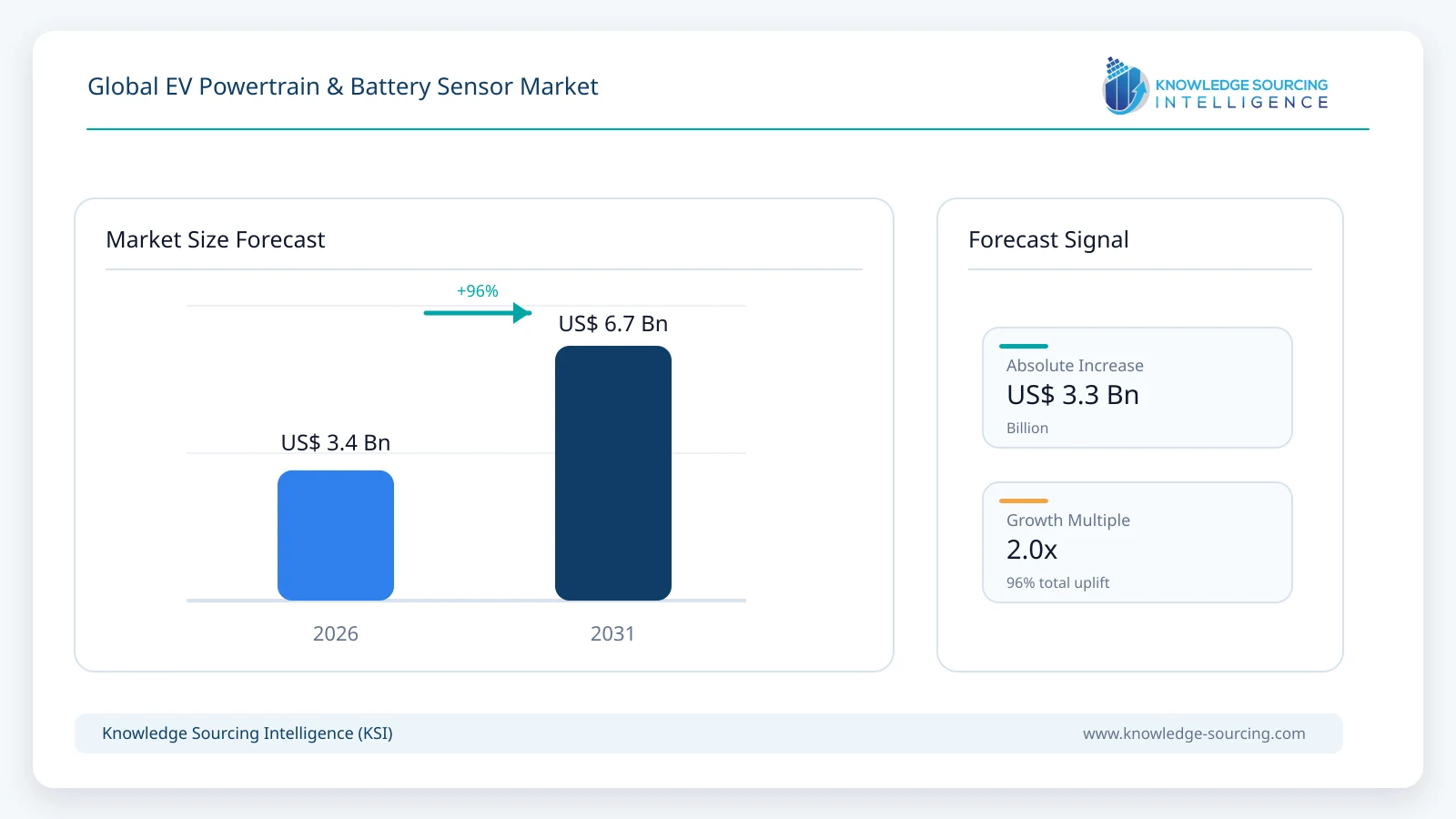
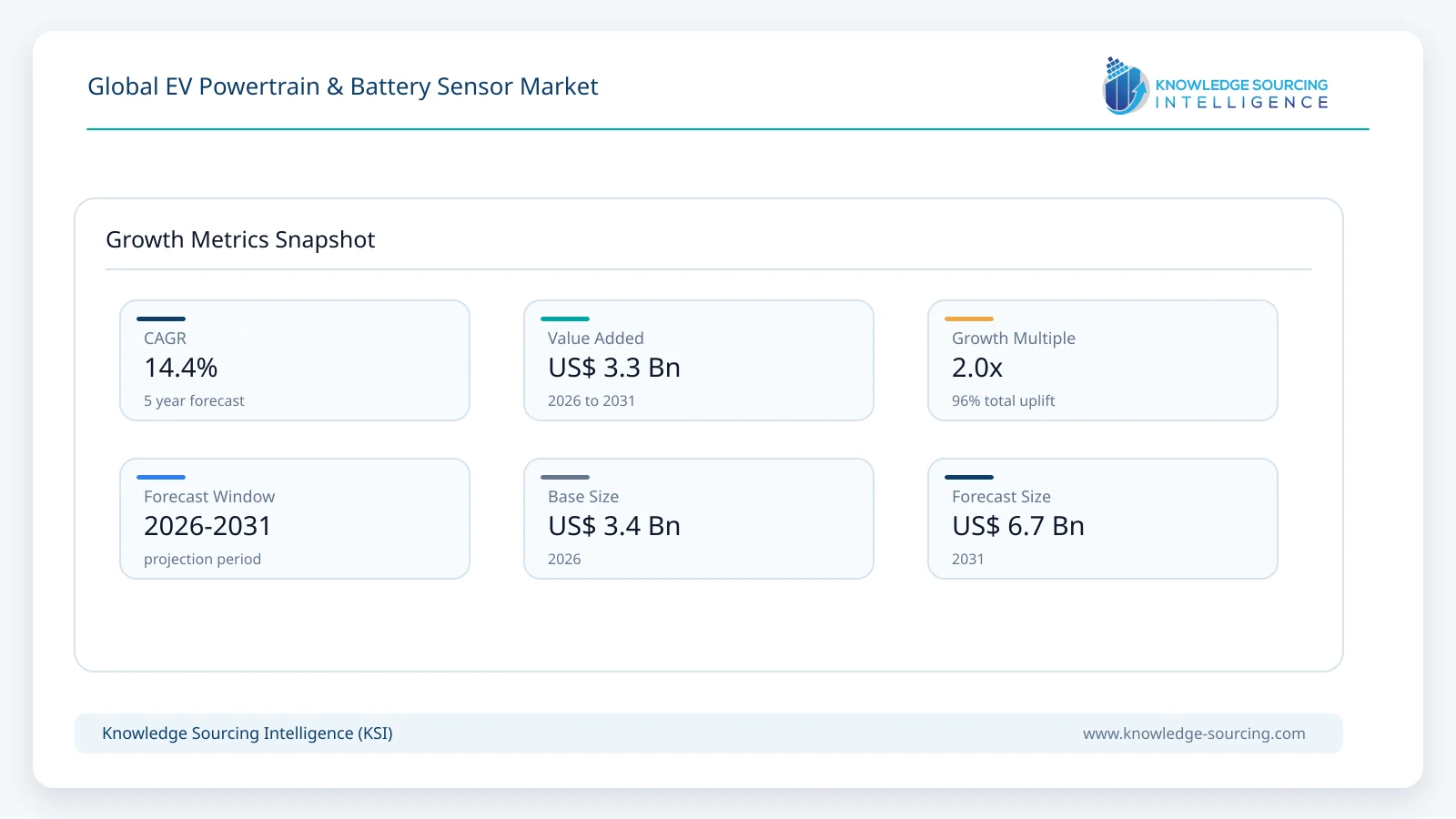
The global EV powertrain and battery sensor market is projected to rise from USD 3.40 billion in 2026 to USD 6.65 billion by 2031, registering a CAGR of 14.4% during the forecast period.
Highlights:
- 1Global electric-car sales are expected to reach about 23 million units in 2026, expanding the annual demand base for EV-specific sensors.
- 2High-voltage current sensing is becoming more demanding as 800 V systems and silicon carbide inverters increase switching speed and electromagnetic noise.
- 3Battery packs require distributed temperature, current, voltage and pressure sensing to support safety, state estimation and thermal management.
- 4Motor rotor-position sensing is becoming more compact as electric drive units pursue higher power density and tighter packaging.
- 5Digital current-sensor outputs are gaining interest where electrically noisy power-electronics environments can degrade conventional analog signals.
- 6EV thermal systems increasingly combine pressure and temperature sensing as heat-pump architectures and low-GWP refrigerants evolve.
- 7ASIL-ready sensing and diagnostic redundancy are becoming more important as sensor signals feed safety-critical battery and propulsion functions.
- 8Asia Pacific remains the largest manufacturing base because China dominates global EV production and continues to localize automotive sensor supply.
Market Overview
Electrification changes the automotive sensor mix. Internal-combustion vehicles require extensive exhaust, fuel and engine sensors, whereas battery-electric vehicles shift sensing demand toward electrical current, voltage, temperature, position and thermal-system variables. The result is not necessarily a simple increase in every type of sensor, but a change toward devices that can operate accurately around high voltage, high current, strong electromagnetic interference and rapidly changing thermal conditions.
The traction inverter is one of the most sensor-intensive high-value systems. Current sensors provide real-time feedback for motor torque control, power conversion and protection. Rotor-position sensors tell the inverter where the motor rotor is located so switching can be synchronized accurately. Temperature sensors protect power modules and windings, while voltage measurement supports system monitoring and diagnostics. Similar sensing requirements appear in onboard chargers and DC-DC converters.
Battery packs create another large sensor opportunity. Battery management depends on cell voltage and temperature information, while pack-level current sensors support state-of-charge and state-of-health calculations. Pressure and gas-related sensing can provide additional information around thermal events or pack integrity. Thermal-management systems also require pressure and temperature sensing to control coolant and refrigerant circuits efficiently.
EV Sensor Technology Comparison
Sensor Category | Primary EV Application | Critical Measurement Requirement | Technology Direction |
Current / Voltage Sensors | Battery pack, inverter, OBC, DC-DC converter | High accuracy, galvanic isolation, fast response | Hall, TMR, shunt and digital-output sensing |
Temperature Sensors | Battery cells/modules, inverter, motor, charger | Fast response and wide automotive temperature range | NTC, RTD, IC and contactless sensing |
Pressure Sensors | Battery pack and thermal-management circuits | Accuracy, media compatibility and leakage detection | Integrated pressure + temperature and MEMS designs |
Position / Speed Sensors | Traction motor rotor and actuator systems | Precise angular position at high speed | Resolver, inductive, Hall and TMR sensing |
Pack Safety / Condition Sensors | Battery enclosure and high-voltage system | Early indication of impact, abnormal pressure or thermal conditions | Multi-sensor monitoring and redundant diagnostics |
Market Dynamics
EV Production Creates a Direct Volume Base for Electrification-Specific Sensors
The International Energy Agency expects global electric-car sales to reach approximately 23 million units in 2026, representing close to three in ten new cars sold. Each electric vehicle requires battery, inverter, motor and thermal-system sensing that does not exist in the same form in a conventional powertrain. Higher production therefore creates a direct demand multiplier for high-voltage current, temperature and motor-position sensors.
800 V Architectures and Wide-Bandgap Semiconductors Raise Sensor Performance Requirements
Silicon carbide and gallium nitride devices switch faster than conventional silicon power semiconductors and allow higher power density, but they also create more demanding electromagnetic environments. Current sensors must provide high bandwidth, low noise and strong isolation while preserving signal integrity. Melexis introduced a digital-output current sensor in June 2026 specifically to improve measurement robustness in electrically noisy high-power automotive systems.
Battery Safety and Thermal Management Increase Sensor Redundancy
Battery safety depends on identifying abnormal electrical and thermal conditions early. Pack architectures increasingly use multiple temperature points, high-accuracy current measurement and diagnostics around contactors and thermal systems. Pressure and combined pressure-temperature sensors also support refrigerant and coolant control. As battery packs become more energy dense, redundant measurement and functional-safety readiness become more important.
Sensor Cost Pressure Remains High Despite Increasing Technical Requirements
Automotive sensors are produced at large scale and face continuous cost-down pressure from vehicle manufacturers. Suppliers must add accuracy, isolation, functional-safety diagnostics and higher temperature capability without allowing sensor content to materially increase vehicle cost. Localization in China and other high-volume EV markets is therefore becoming strategically important for both cost and supply continuity.
Technology Outlook
Digital High-Voltage Current Sensing
Digital current sensors can reduce the impact of noise between the sensing element and the receiving microcontroller. Melexis introduced the MLX91229 in June 2026 with a sigma-delta digital output for currents from 200 A to 2,000 A, targeting traction inverters and other high-power automotive systems. Digital transmission can become more important as high-voltage platforms use faster switching and denser packaging.
TMR and High-Bandwidth Magnetic Sensing
Tunneling magnetoresistance (TMR) sensors offer high sensitivity and bandwidth for power-conversion applications. Allegro MicroSystems introduced a production-ready 10 MHz TMR current sensor in October 2025 for electric vehicles and other high-frequency power systems. Higher bandwidth supports more accurate control and protection in silicon carbide and gallium nitride power stages.
Integrated Pressure and Temperature Sensing
Thermal-management systems increasingly need to measure several variables at the same physical point. Sensata launched an R290 pressure-plus-temperature sensor in September 2026 for electrified-vehicle thermal systems using propane refrigerant. Combining pressure and temperature can simplify system integration while supporting leakage control, heat-pump performance and diagnostics.
Compact Rotor Position Sensing
Motor miniaturization makes sensor placement more difficult, particularly when end-of-shaft measurement is unavailable. Melexis expanded its pico-resolver family in September 2026 with a 5 V version designed for compact motor applications. Inductive and magnetic sensing technologies are likely to continue gaining relevance as electric motors become smaller, faster and more tightly integrated.
Segment Analysis
By Sensor Type
Current and voltage sensors are core components in batteries and power electronics, where accuracy directly affects efficiency, protection and state estimation. Temperature sensors are used across battery modules, inverters and motors. Position and speed sensors are concentrated in electric drive systems, while pressure sensors serve thermal-management and selected battery-pack applications. Sensor architectures increasingly combine several measurements or diagnostic functions inside one package.
By EV System
Battery systems use the broadest range of electrical and thermal sensing. Traction inverters require fast current and temperature feedback, while electric motors depend on precise rotor-position and winding-temperature information. Onboard chargers and DC-DC converters add further high-voltage current and thermal sensing, and vehicle thermal systems rely on pressure and temperature devices to control heat pumps and coolant circuits.
By Vehicle Type
Passenger battery-electric vehicles provide the largest volume opportunity because of their global sales scale. Plug-in hybrids require many of the same high-voltage sensors but may operate with smaller battery packs. Commercial EVs use higher-power electrical systems and can require more robust or redundant sensing. Electric two- and three-wheelers add significant unit volume but typically have lower sensor content per vehicle.
By Voltage Architecture
400 V systems remain widespread, while 800 V platforms are expanding in vehicles designed for faster charging and higher sustained power. Higher voltage increases insulation and isolation requirements and often coincides with silicon carbide power electronics. This creates demand for current and voltage sensors with higher bandwidth, stronger electromagnetic immunity and more robust diagnostics.
By Sales Channel
OEM demand dominates because most powertrain and battery sensors are embedded during vehicle manufacturing and validated as part of safety-critical systems. The aftermarket is smaller and is concentrated in replacement sensor modules rather than semiconductor-level devices. Long vehicle qualification cycles favor suppliers with automotive quality systems and established OEM relationships.
Market and Demand Indicators
Indicator | Recent Evidence | Market Relevance |
EV demand base | IEA expects approximately 23 million electric-car sales in 2026. | Provides the principal annual production base for electrification-specific sensor demand. |
Current-sensor localization | Melexis introduced its first locally manufactured current-sensor IC in China on September 15, 2026. | Shows sensor supply chains localizing around the world's largest EV market. |
High-power current sensing | Melexis launched a digital current sensor on June 25, 2026 for 200-2,000 A automotive power systems. | Supports higher-voltage, higher-switching-frequency EV power electronics. |
Thermal-system sensing | Sensata launched an R290 pressure + temperature sensor for electrified vehicle thermal management on September 2, 2026. | Shows new refrigerants and heat-pump architectures creating additional sensor requirements. |
High-temperature components | TDK began mass production in February 2026 of automotive NTC thermistors rated to +175 C. | Supports sensing near hotter power modules and next-generation automotive electronics. |
Sensor-sector consolidation | Infineon completed its acquisition of ams OSRAM's non-optical analog/mixed-signal sensor portfolio on July 1, 2026. | Demonstrates strategic investment in automotive and industrial sensing capabilities. |
Asia Pacific Market Analysis
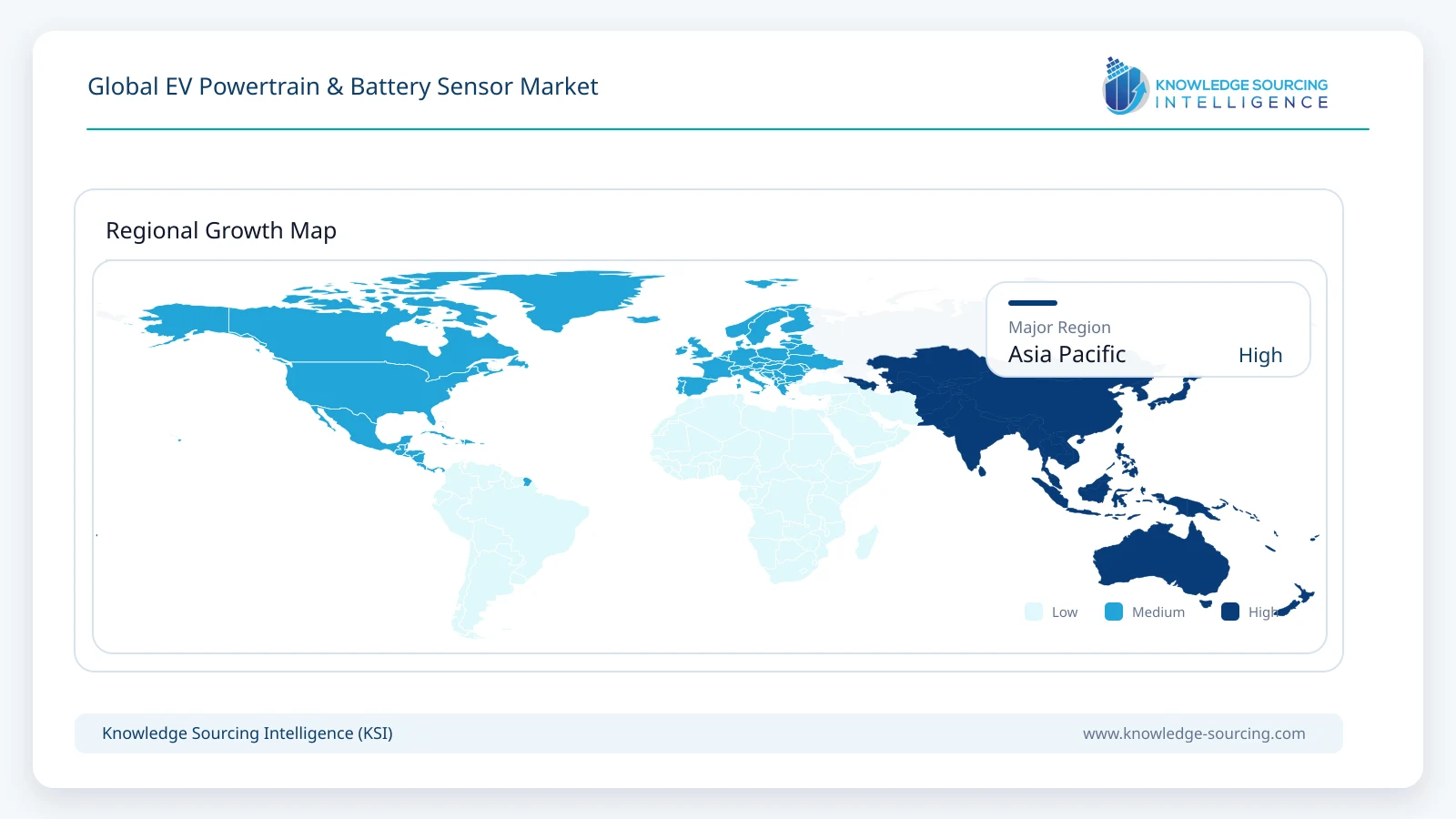
Asia Pacific is the largest manufacturing region for EV powertrain and battery sensors because China produces the majority of the world's electric vehicles and contains a dense ecosystem of battery, inverter, motor and electronics suppliers. High production volumes encourage local manufacturing of current, position and thermal sensors, while shorter vehicle-development cycles create demand for rapidly scalable automotive-qualified components.
China is also becoming more important as a local sensor-production base rather than only an end market. Melexis introduced the MLX91241 in September 2026 as its first integrated circuit manufactured through a localized production model in China. The company has also expanded local technical and commercial operations in India, where two-wheeler electrification and broader vehicle electrification are creating additional demand for current and position sensing.
Japan and South Korea remain major sources of automotive sensor technology through companies such as TDK, Denso, Murata and other semiconductor and component suppliers. Through 2031, regional competition is expected to focus on automotive functional safety, localization, high-temperature capability and the ability to support high-voltage silicon carbide power electronics.
Competitive Landscape
The competitive landscape combines diversified automotive semiconductor companies with specialist sensing suppliers. Infineon, NXP, STMicroelectronics, Texas Instruments and onsemi provide sensor ICs alongside power and control semiconductor portfolios. Melexis and Allegro MicroSystems have strong positions in magnetic current and position sensing, while Sensata Technologies, TDK, Bosch and Denso contribute pressure, temperature and module-level sensing solutions.
Competition is moving toward system-level capability rather than standalone sensing accuracy. Suppliers are differentiating through functional-safety diagnostics, integrated isolation, digital interfaces, multi-parameter sensing, compact packaging and local manufacturing. Automotive qualification and long-term availability remain critical because sensors are deeply embedded inside battery and drivetrain control systems and cannot be substituted easily after vehicle validation.
Recent Developments
September 17, 2026: Melexis introduced the MLX91224 and MLX91225 isolated current-sensor platform for automotive and industrial applications, supporting measurement up to 100 A RMS with ASIL B readiness.
September 15, 2026: Melexis launched the MLX91241 current sensor, its first integrated circuit produced through a localized manufacturing model in China.
September 2, 2026: Sensata Technologies launched an R290 pressure + temperature sensor designed for low-GWP refrigerant use in electrified-vehicle thermal-management systems.
September 1, 2026: Melexis expanded its MLX90381 pico-resolver family with a 5 V variant for compact automotive and mobility motor applications.
July 1, 2026: Infineon completed its acquisition of the non-optical analog/mixed-signal sensor portfolio from ams OSRAM, strengthening its automotive sensor portfolio.
June 25, 2026: Melexis launched the MLX91229 digital-output current sensor for high-power EV systems operating from 200 A to 2,000 A.
June 11, 2026: Melexis announced that FINEST had selected its current-sensor ICs for high-performance traction inverters on next-generation EV platforms.
February 17, 2026: TDK announced high-reliability automotive NTC thermistors rated to +175 C, with mass production beginning in February 2026.
February 10, 2026: Allegro MicroSystems introduced the ACS37017 high-accuracy magnetic current sensor for electrified vehicles and other high-voltage power-conversion systems.
EV Powertrain & Battery Sensor Market Scope
| Report Metric | Details |
|---|---|
| Total Market Size in 2026 | USD 3.40 billion |
| Total Market Size in 2031 | USD 6.65 billion |
| Forecast Unit | Billion |
| Growth Rate | 14.4% |
| Study Period | 2021 to 2031 |
| Historical Data | 2021 to 2024 |
| Base Year | 2025 |
| Forecast Period | 2026 – 2031 |
| Segmentation | Sensor Type, EV System, Vehicle Type, Voltage Architecture, Sales Channel, Geography |
| Companies |
|
Market Segmentation
By Sensor Type
Current and Voltage Sensors
Temperature Sensors
Pressure Sensors
Position and Speed Sensors
Other EV-Specific Sensors
By EV System
Battery Pack and Battery Management
Traction Inverter
Electric Motor
Onboard Charger and DC-DC Converter
Thermal Management System
Other High-Voltage Systems
By Vehicle Type
Passenger Battery Electric Vehicles
Plug-in Hybrid Electric Vehicles
Commercial Electric Vehicles
Electric Two- and Three-Wheelers
By Voltage Architecture
Below 400 V
400-799 V
800 V and Above
By Sales Channel
OEM
Aftermarket
By Geography
North America
United States
Canada
Mexico
South America
Brazil
Argentina
Rest of South America
Europe
Germany
United Kingdom
France
Italy
Rest of Europe
Middle East and Africa
Saudi Arabia
United Arab Emirates
South Africa
Rest of Middle East and Africa
Asia Pacific
China
Japan
India
South Korea
Rest of Asia Pacific
Table of Contents
1. EXECUTIVE SUMMARY
2. MARKET SNAPSHOT
2.1. Market Overview
2.2. Market Segmentation
3. BUSINESS LANDSCAPE
3.1. Market Drivers
3.1.1. EV Production Creates a Direct Volume Base for Electrification-Specific Sensors
3.1.2. 800 V Architectures and Wide-Bandgap Semiconductors Raise Sensor Performance Requirements
3.1.3. Battery Safety and Thermal Management Increase Sensor Redundancy
3.2. Market Restraints
3.2.1. Sensor Cost Pressure Remains High Despite Increasing Technical Requirements
3.3. Market Opportunities
3.4. Porter's Five Forces Analysis
3.5. Industry Value Chain Analysis
3.6. Functional Safety and Automotive Qualification Requirements
4. TECHNOLOGICAL OUTLOOK
4.1. Digital High-Voltage Current Sensing
4.2. TMR and High-Bandwidth Magnetic Sensing
4.3. Integrated Pressure and Temperature Sensing
4.4. Compact Rotor Position Sensing
5. GLOBAL EV POWERTRAIN & BATTERY SENSOR MARKET BY SENSOR TYPE
5.1. Current and Voltage Sensors
5.2. Temperature Sensors
5.3. Pressure Sensors
5.4. Position and Speed Sensors
5.5. Other EV-Specific Sensors
6. GLOBAL EV POWERTRAIN & BATTERY SENSOR MARKET BY EV SYSTEM
6.1. Battery Pack and Battery Management
6.2. Traction Inverter
6.3. Electric Motor
6.4. Onboard Charger and DC-DC Converter
6.5. Thermal Management System
6.6. Other High-Voltage Systems
7. GLOBAL EV POWERTRAIN & BATTERY SENSOR MARKET BY VEHICLE TYPE
7.1. Passenger Battery Electric Vehicles
7.2. Plug-in Hybrid Electric Vehicles
7.3. Commercial Electric Vehicles
7.4. Electric Two- and Three-Wheelers
8. GLOBAL EV POWERTRAIN & BATTERY SENSOR MARKET BY VOLTAGE ARCHITECTURE
8.1. Below 400 V
8.2. 400-799 V
8.3. 800 V and Above
9. GLOBAL EV POWERTRAIN & BATTERY SENSOR MARKET BY SALES CHANNEL
9.1. OEM
9.2. Aftermarket
10. GLOBAL EV POWERTRAIN & BATTERY SENSOR MARKET BY GEOGRAPHY
10.1. North America
10.1.1. United States
10.1.2. Canada
10.1.3. Mexico
10.2. South America
10.2.1. Brazil
10.2.2. Argentina
10.2.3. Rest of South America
10.3. Europe
10.3.1. Germany
10.3.2. United Kingdom
10.3.3. France
10.3.4. Italy
10.3.5. Rest of Europe
10.4. Middle East and Africa
10.4.1. Saudi Arabia
10.4.2. United Arab Emirates
10.4.3. South Africa
10.4.4. Rest of Middle East and Africa
10.5. Asia Pacific
10.5.1. China
10.5.2. Japan
10.5.3. India
10.5.4. South Korea
10.5.5. Rest of Asia Pacific
11. COMPETITIVE ENVIRONMENT AND ANALYSIS
11.1. Major Players and Strategy Analysis
11.2. Market Share Analysis
11.3. Product Development, Localization and Partnerships
11.4. Competitive Dashboard
12. COMPANY PROFILES
12.1. Infineon Technologies AG
12.2. Melexis N.V.
12.3. Allegro MicroSystems, Inc.
12.4. Sensata Technologies Holding plc
12.5. Robert Bosch GmbH
12.6. DENSO Corporation
12.7. TDK Corporation
12.8. NXP Semiconductors N.V.
12.9. STMicroelectronics N.V.
12.10. Texas Instruments Incorporated
12.11. onsemi
12.12. Murata Manufacturing Co., Ltd.
12.13. Vishay Intertechnology, Inc.
12.14. TE Connectivity Ltd.
12.15. LEM Holding SA
12.16. Honeywell International Inc.
12.17. Schaeffler AG
12.18. FORVIA HELLA
13. RECENT DEVELOPMENTS
14. APPENDIX
14.1. Currency
14.2. Assumptions
14.3. Base and Forecast Years Timeline
14.4. Abbreviations
Navigate
Trusted by the world's leading organizations











