
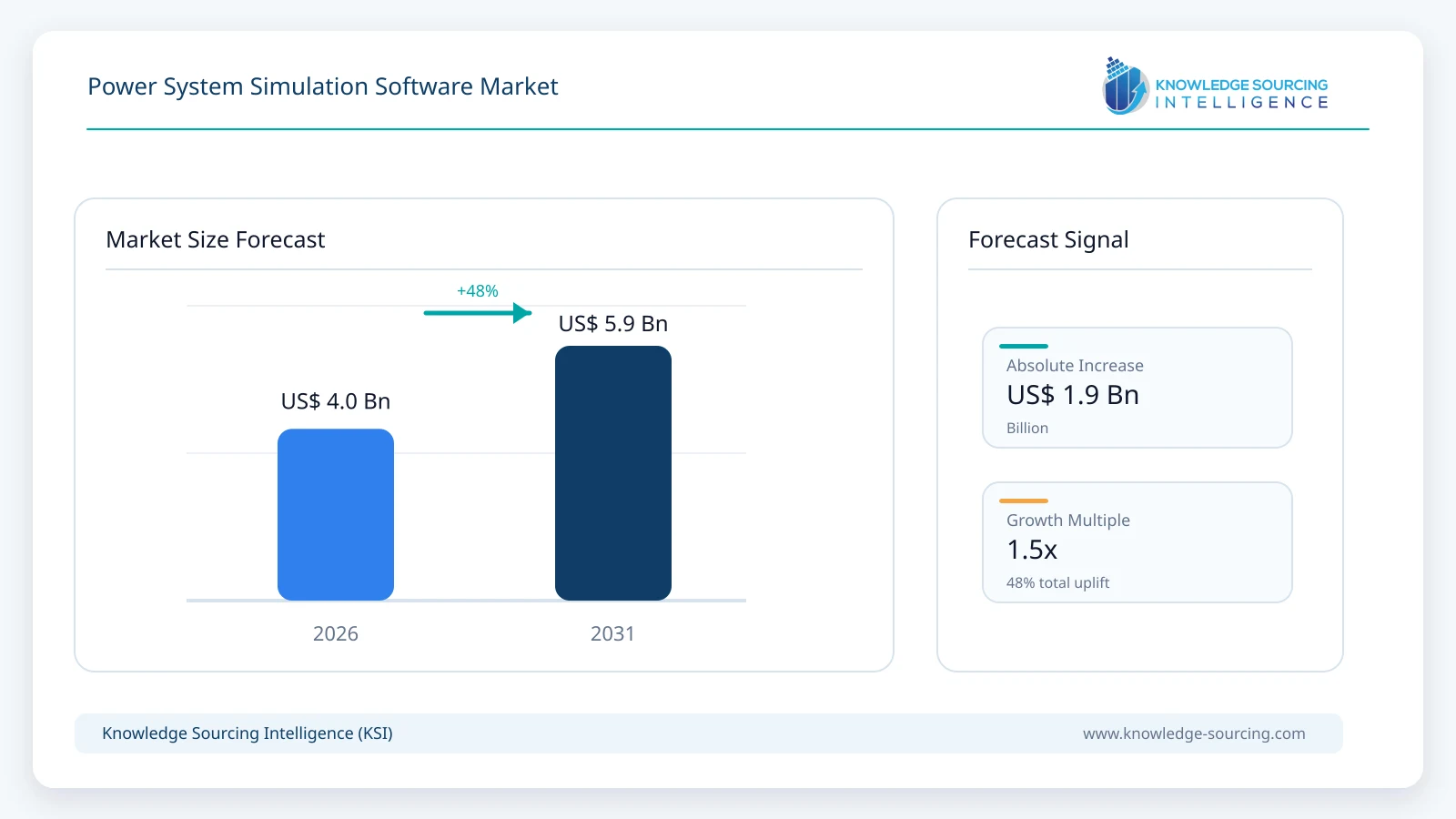
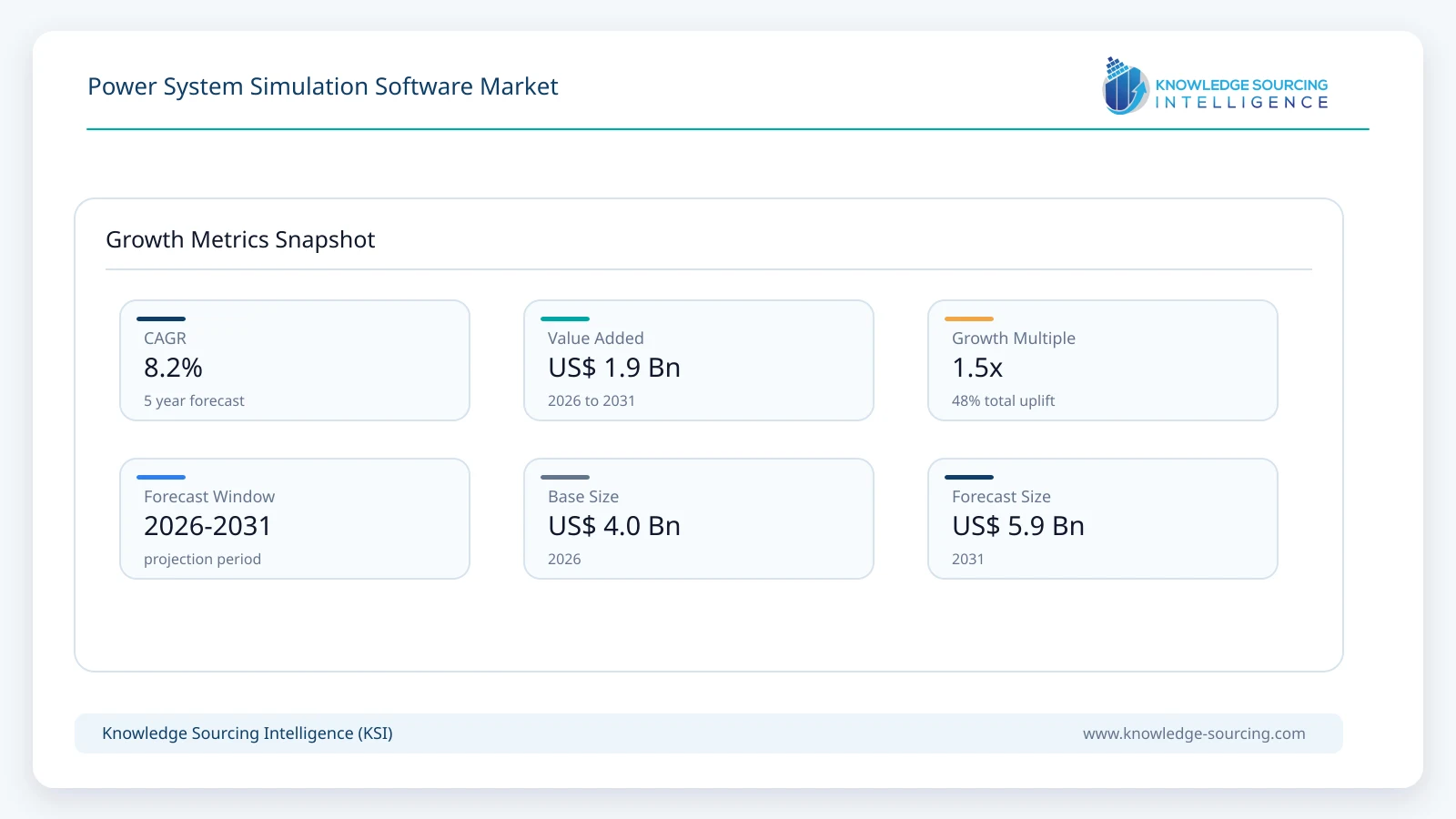
The Power System Simulation Software Market is forecast to grow at a CAGR of 8.2%, reaching USD 5.92 billion in 2031 from USD 3.99 billion in 2026.
Highlights:
- 1The increasing penetration of solar PV, wind, battery storage, HVDC, and other inverter-based resources creates the necessity to perform dynamic and electromagnetic-transient modeling in more detail.
- 2The real-time simulation allows the utilization users to connect real protection, control, inverter, and power-electronics equipment to simulated networks.
- 3The advanced platforms have combined aspects of load flow, fault analysis, stability, renewable-energy studies, network planning, and dynamic simulation into common software architectures.
The power system simulation software market is changing electrical-system planning away from engineering calculations based largely on the historical operating conditions to more sophisticated digital modeling environments. Power-system models help engineers assess the network's performance before the lines, substations, renewable-energy factories, battery systems, industrial loads, and other infrastructure are built.
The overall utility of the tech ecosystem can range from steady-state power-flow analysis, short-circuit calculations, dynamic and transient stability studies, electromagnetic-transient analysis, harmonic analysis, contingency assessment, protection coordination, and even renewable-energy modeling. ETAP's power-system analysis portfolio spans network analysis, dynamics and transients, renewable-energy studies, optimization, and distribution analysis.
Power-flow and load-flow studies are the basis, as they determine voltage profiles, power transfers both magnitude and direction, losses, equipment loading, and system operating conditions. Short-circuit analysis evaluates fault currents and equipment-duty requirements for devices such as circuit breakers, transformers, and cables; stability studies focus on the way generators and motors respond to disturbances in the system along with inverter-based resources and other controllable power sources.
Additionally, with the rapid integration of power electronics, inverter-based renewable generation, HVDC systems, FACTS equipment like SVC and STATCOMs, battery energy storage systems, and advanced protection and control schemes in conventional power grids, electromagnetic-transient simulation becomes particularly critical for studies on modelling individual component operation with unprecedented accuracy. For instance, EMTP combines load-flow, stability, and EMT simulation in one tool, while detailed inverter-based renewable models are also modeled.
Further, the market is transitioning from standalone engineering-analysis software to an integrated digital power-system modeling environment that combines planning and operational studies, renewable modeling capabilities, real-time simulation, automation, and hardware-in-the-loop testing.
Power System Simulation Software Market Key Highlights
Power-flow analysis is fundamental in the assessment of the voltage levels, equipment loading, active and reactive power flows, losses, and network operating conditions.
Market Dynamics
Market Drivers
Increasing Renewable-Energy Integration: The increased use of variable generation and inverter-based electrical characteristics introduces additional complexity in power-system studies as solar and wind generation expand. The growing penetration of renewable resources necessitates that engineers analyze voltage stability, transient performance, fault behavior, harmonics, in addition to grid-code compliance and interaction with conventional generators. The demand for improved accuracy in renewable modeling is on the rise as utilities continue to connect ever-larger amounts of variable generation to transmission and distribution networks.
The increasing need for electricity and grid expansion: Rising global electricity demand is putting pressure on utilities to strengthen transmission and distribution infrastructure while keeping the system reliable. Electricity demand is expected to keep spiking through 2027, powered by electrification, industrial activity, cooling, EVs & data centers. The investments are facilitated by the simulation software, which enables utilities to test future network configurations, assess whether existing infrastructure can accommodate new loads, and identify bottlenecks under various contingency conditions.
Increasing Need for Grid Reliability and Resilience: Contingency and fault analysis is becoming more vital with extreme weather, aging infrastructure, distributed generation, and ever-more connected grids. Simulation software is used by engineers to simulate equipment failures, generator disturbances, short-circuit scenario analysis, voltage instability, and the recovery of a system with a disturbance. ETAP Transmission Analysis package is designed to perform transmission load flow, contingency analysis, voltage stability, short-circuit calculations, and fault analysis.
Increasing Adoption of Power Electronics: Traditional electricity systems include ever-increasing numbers of power-electronic devices, such as solar inverters, battery converters, HVDC converters, STATCOMs (static synchronous compensators), FACTS (flexible AC transmission) devices, EV chargers, and variable-speed drives. Such devices respond in far shorter timescales than conventional electromechanical apparatuses. Therefore, utilities as well as equipment manufacturers need EMT and real-time simulation to analyse fast transient performance. RTDS simulates EMT in real time while allowing detailed testing of power electronics and protection devices.
Market Restraints & Opportunities
The market offers a competitive edge over traditional engineering approaches in terms of thorough equipment models, precise network data, and necessary computational resources. As a result, the deployment of advanced dynamic system environments can be difficult for smaller utilities and engineering firms.
This challenge creates an interoperability problem, where keeping the models accurate across different software is complex and time-consuming. Utilities may require transferring network models from planning, protection, and operational to real-time simulation systems.
Cloud-based deployment is a set of attributes that offers a way to minimize local computing infrastructure compulsion and lets engineering teams work from different places together simultaneously. Additionally, cloud architectures can handle larger computational workloads, allow for centralized model management, and provide a mechanism to automate study execution and scenario-based planning.
More digital protections, inverter controls, DERMS (distributed energy resource management systems), grid-forming inverters, and new levels of automation stimulate a need for more hardware-in-the-loop, which is expected to promote the market in the coming years.
Key Developments
August 2026: Gamma Technologies teamed with Gotion Illinois to fast-track development of next-generation batteries utilizing its GT-AutoLion physics-based simulation platform. Gotion utilized the software across cell, module, and pack design to evaluate thermal-runaway propagation, thermal management, mechanical-electrochemical interactions, and emerging sodium-ion and solid-state chemistries.
February 2026: Schneider Electric and ETAP released a physics-based digital twin to bridge electrical-system design with real-time grid operations. It integrates with One Digital Grid and EcoStruxure ArcFM Web to allow utilities to run contingency scenarios, validate protection coordination, and perform arc-flash studies.
October 2025: OPAL-RT released SPS Software, a tailored SimPowerSystems platform. The product maintained 100 percent compatibility with previous SPS models and had releases that matched MATLAB/Simulink, first on Windows, and later extended model support to Linux Ubuntu and MATLAB Online.
Market Segmentation
The market is segmented by simulation type, deployment model, application, end user, and geography.
By Simulation Type: Load Flow & Power Flow
Power Flow & Load Flow simulation is the most basic simulation type in the power-system simulation software market since many transmission, distribution, and generation-planning studies generally require steady-state conditions of the network.
Load-flow models calculate voltage magnitude and angle, active and reactive power flows, equipment loading, system losses, and network constraints. These studies are used by engineers to evaluate new substations, transmission lines, generators, renewable-energy plants, industrial loads, and reinforcement projects on the grid.
ETAP's Load Flow module delivers power-flow analysis and voltage-drop calculations, while its Unified Unbalanced Power Flow offers integrated AC and DC network analysis. Similarly, EMTP also offers an unbalanced multiphase load-flow solver capable of solving transmission and distribution networks with extremely large case sizes.
While advanced dynamic and EMT studies are gaining traction, the segment remains important because power-flow calculations provide the operating point used for more complicated simulations.
By Deployment Model: On-Premise
The on-premises segment represents a key deployment model due to the need for utility and engineering organizations to have local control over sensitive network models, operational data, cybersecurity environments, and potentially also engineering workflows.
Transmission and distribution may include substation, generator, protection system modeling, network topology representation, equipment ratings, as well as critical infrastructure details. As a result, simulation scenarios are commonly kept within the safe bounds of enterprise and engineering environments.
On-premises development is likewise appropriate for high-performance simulation requirements where engineers need proprietary computing assets for redundancy investigations, dynamic recreations, and large-scale network examination.
Meanwhile, cloud deployment is more appealing than ever for collaborative planning, centralized model management, and scalable computing. This means the market is evolving to hybrid environments where sensitive core models stay on controlled infrastructure and only some analytical workloads are put onto clouds.
By Application: Transmission System Reinforcement
Transmission system reinforcement is a key application area since utilities need to know how and where lines, transformers, substations & other infrastructure must be reinforced to serve increasing electricity demand and renewable generation.
Transmission simulation is used by planners to test the resilience of their grids against anticipated futures, including load scenarios, generation expansions, interconnections and outages, voltage constraints and congestion under various contingency conditions before an irreversible investment in long-lived capital is made.
The transmission-analysis software, ETAP Transmission Network, supports diverse types of analyses, including transmission load flow, contingency analysis, voltage stability and short-circuit analysis along with grid-code harmonic assessment.
EMTP is used for large transmission-system simulation in a modular approach, with transmission lines, substations, generator sites, HVDC converters, and controls modelled in detail.
This application is becoming more critical, as utilities interconnect large renewable-energy projects in remote locations. It enables planners to use simulation tools to find out if the existing transmission capacity can accommodate new generation and to diagnose the requirement for upgrades prior to construction.
Regional Analysis
North America Market Analysis
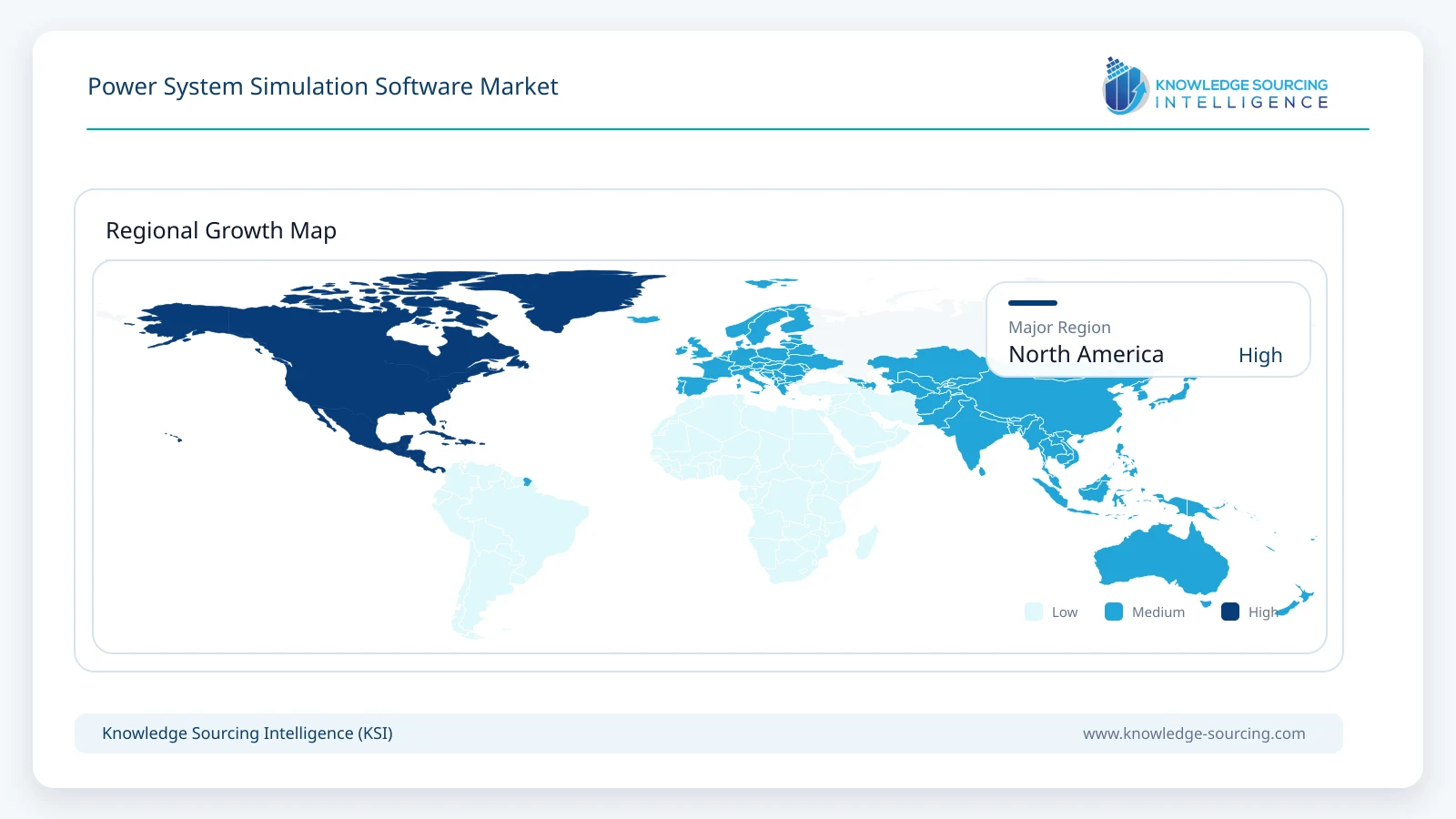
The North America region has a mature market for power-system simulation software for network planning and compliance studies. This is due to utilities, independent power producers, and transmission operators having enough data available on the usage potential of engineering companies serving this space.
South America Market Analysis
South America is emerging as a major application market for the growth path ahead, with electricity systems that include abundant hydroelectric resources coupled with rapidly expanding solar and wind generation. Brazil represents the biggest opportunity due to its large transmission network, sizable hydropower generation fleet, renewable-energy expansion, and geographically spread-out generation resources.
Europe Market Analysis
Europe market is advancing in this software technology, driven by renewable-energy expansion, cross-border trading of electricity, the development of offshore wind energy generation, and the environment for future increasingly complex transmission networks. Germany, the UK, France, Spain, Nordic countries have detailed simulations for renewable integration, grid reinforcement, voltage stability, congestion management, and interconnection planning.
Middle East and Africa Market Analysis
The Middle East & Africa has created a more developed market through large renewable-energy projects, transmission expansion, industrial electrification, and electricity network modernization. This, combined with multi-gigawatt solar projects and grid investments in Saudi Arabia and the UAE, creates numerous opportunities for renewable integration, power-flow, stability, and contingency studies.
Asia Pacific Market Analysis
The Asia Pacific is one of the leading long-term markets as this region has high growth in electricity demand, vast transmission and distribution network, huge annual investments in renewable energy sector and a grid increasingly politically and economically interconnected. China continues to be so important for many factors such as its enormous electricity system in use across the country, high-voltage transmission expansion and renewable-energy development, and significant bulk-power-system engineering activities.
List of Companies
ETAP (Schneider Electric)
EMTP
RTDS Technologies
Milsoft Utility Solutions
Siemens AG
PowerWorld
PSCAD
SKM Systems Analysis Inc.
Eaton
Opal-RT Technologies, Inc.
ETAP (Schneider Electric)
ETAP is a comprehensive electrical power-system analysis suite, which includes modules for load-flow, short-circuit, transient-stability, renewable-energy analysis, optimization, distribution-analysis, and electromagnetic transients. Its ETAP Transient Stability includes simulating system disturbances, generator dynamics, motor acceleration, load shedding, black-start scenarios, along with HVDC and renewable resources & energy storage.
EMTP
EMTP is an electromagnetic-transient, load-flow, and stability analysis package in a single environment. The software offered by the company supports steady-state, time-domain, EMT, and large-scale network simulations. The platform is geared towards renewable-heavy networks, as its Renewables Toolbox is home to sensitive load-flow, harmonic, and EMT studies of inverter-based resources.
RTDS Technologies
The company provides one-stop solutions in real-time digital power-system simulation and hardware-in-the-loop testing. Its RTDS Simulator continuously executes electromagnetic transient simulations in real time, enabling physical protection, control, inverter, and power-electronic devices to couple with a simulated electrical network.
Analyst View
There was a trend from traditional load-flow studies toward integrated multi-domain simulation in the power system simulation software market, supported by the growing uncertainty on the grid due to renewable generation, storage, power electronics, and complex loads. Power flow is still the basis and a significant part of the market share, while EMT, Dynamic stability, and real-time HIL are becoming more relevant. Another area of growth is cloud-enabled collaboration and renewable-resource models, which is propelling the market position during the projected period.
Power System Simulation Software Market Scope:
| Report Metric | Details |
|---|---|
| Total Market Size in 2026 | USD 3.99 billion |
| Total Market Size in 2031 | USD 5.92 billion |
| Forecast Unit | USD Billion |
| Growth Rate | 8.2% |
| Study Period | 2021 to 2031 |
| Historical Data | 2021 to 2024 |
| Base Year | 2025 |
| Forecast Period | 2026 – 2031 |
| Segmentation | Simulation Type, Deployment Model, Application, End User, Geography |
| Companies |
|
Table of Contents
1. EXECUTIVE SUMMARY
2. MARKET SNAPSHOT
2.1. Market Overview
2.2. Market Definition
2.3. Scope of the Study
2.4. Market Segmentation
3. MARKET DYNAMIC
3.1. Market Drivers
3.2. Market Restraints
3.3. Market Opportunities
3.4. Porter’s Five Forces Analysis
3.5. Industry Value Chain Analysis
4. BUSINESS LANDSCAPE
4.1. Regulatory and Standards Landscape
4.2. Energy Data Infrastructure, Smart Meter and Data Management Analysis
4.3. Energy Analytics Deployment, Pricing and Investment Analysis
4.4. Energy Analytics Supply Chain, Vendor Ecosystem and Integration Analysis
4.5. Strategic Recommendations
5. TECHNOLOGICAL OUTLOOK
5.1. Predictive Analytics and Statistical Modeling Technologies
5.2. Artificial Intelligence and Machine Learning Technologies
5.3. Real-Time and Streaming Energy Analytics Technologies
5.4. Cloud-Based Energy Analytics Technologies
6. POWER SYSTEM SIMULATION SOFTWARE MARKET BY SIMULATION TYPE
6.1. Introduction
6.2. Power Flow & Load Flow
6.3. Short-Circuit & Fault Analysis
6.4. Stability & Dynamic Simulation
6.5. Electromagnetic Transient Simulation
6.6. Others
7. POWER SYSTEM SIMULATION SOFTWARE MARKET BY DEPLOYMENT MODEL
7.1. Introduction
7.2. On-Premise
7.3. Cloud-Based
8. POWER SYSTEM SIMULATION SOFTWARE MARKET BY APPLICATION
8.1. Introduction
8.2. Transmission System Reinforcement
8.3. Distribution System Analysis
8.4. Renewable Power Integration
8.5. Others
9. POWER SYSTEM SIMULATION SOFTWARE MARKET BY END USER
9.1. Introduction
9.2. Power Generation
9.3. Utilities
9.4.Renewable Energy
9.5.Others
10. POWER SYSTEM SIMULATION SOFTWARE MARKET BY GEOGRAPHY
10.1. Introduction
10.2. North America
10.2.1. USA
10.2.2. Canada
10.2.3. Mexico
10.3. South America
10.3.1. Brazil
10.3.2. Argentina
10.3.3. Others
10.4. Europe
10.4.1. United Kingdom
10.4.2. Germany
10.4.3. France
10.4.4. Others
10.5. Middle East and Africa
10.5.1. Saudi Arabia
10.5.2. UAE
10.5.3. Others
10.6. Asia Pacific
10.6.1. China
10.6.2. Japan
10.6.3. India
10.6.4. South Korea
10.6.5. Others
11. COMPETITIVE ENVIRONMENT AND ANALYSIS
11.1. Major Players and Strategy Analysis
11.2. Market Share Analysis
11.3. Mergers, Acquisitions, Agreements, and Collaborations
11.4. Competitive Dashboard
12. COMPANY PROFILES
12.1. ETAP (Schneider Electric)
12.2. EMTP
12.3. RTDS
12.4. Milsoft Utility Solutions
12.5. Siemens AG
12.6. PowerWorld
12.7. PSCAD
12.8. SKM Systems Analysis Inc.
12.9. Eaton
12.10. Opal-RT Technologies, Inc.
13. APPENDIX
13.1. Currency
13.2. Assumptions
13.3. Base and Forecast Years Timeline
13.4. Key benefits for the stakeholders
13.5. Research Methodology
13.6. Abbreviations
Navigate
Trusted by the world's leading organizations











