
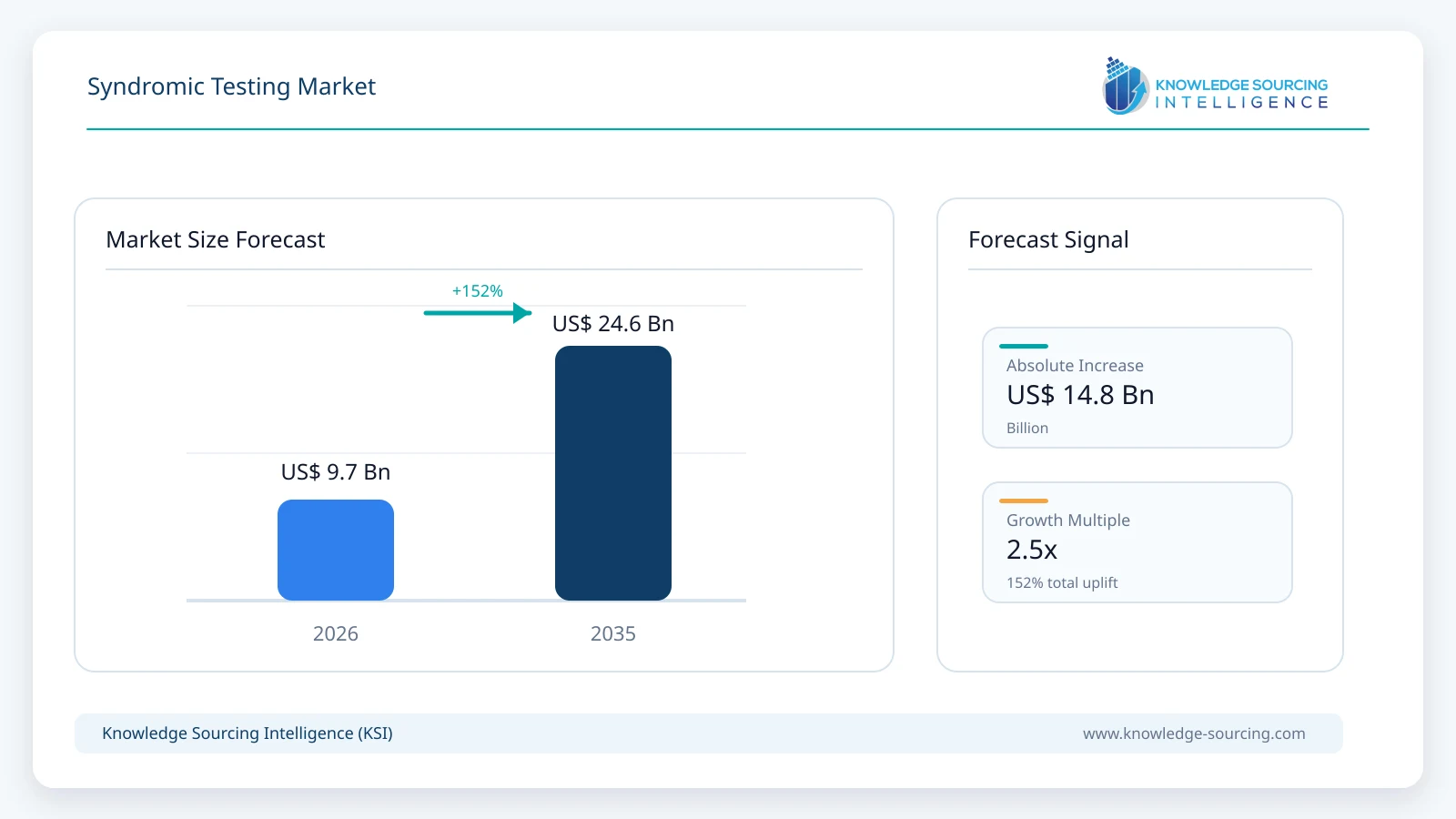
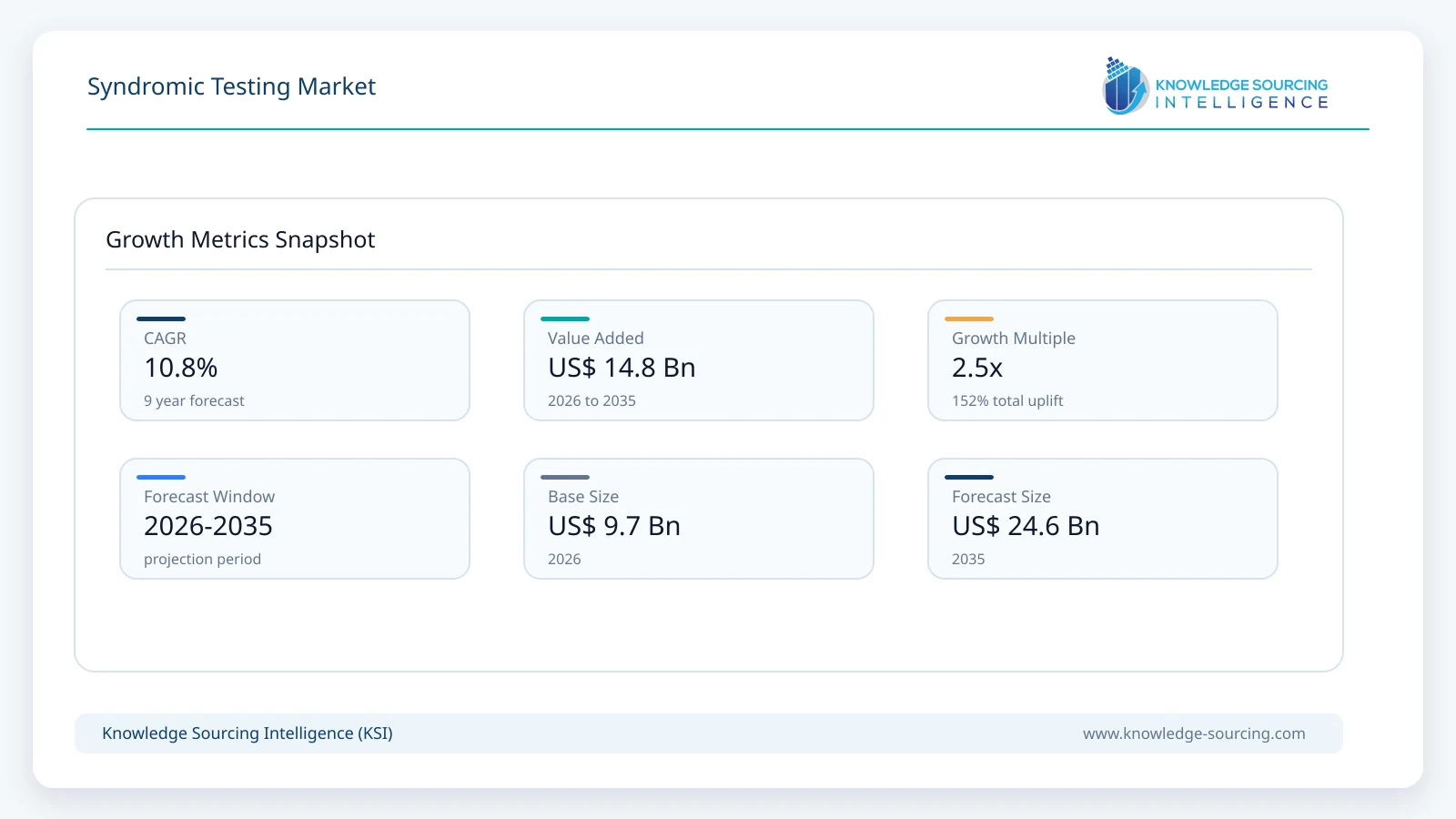
The Syndromic Testing Market is anticipated to grow at a CAGR of 10.8% from USD 9.74 billion in 2026 to USD 24.57 billion in 2035.
Highlights:
- 1Rising infectious disease complexity is increasing demand for multiplex diagnostics because clinicians require broader pathogen coverage from a single test.
- 2Growing antimicrobial stewardship initiatives are accelerating syndromic panel adoption because targeted treatment depends on rapid pathogen identification.
- 3Expansion of emergency and critical care services is increasing testing demand because diagnostic delays negatively affect patient management.
- 4Molecular diagnostic infrastructure is expanding because healthcare providers seek shorter turnaround times than conventional workflows.
Syndromic testing supports infectious disease diagnosis by identifying multiple viral, bacterial, fungal, and parasitic targets within a single workflow. Diagnostic demand is increasing because healthcare providers require actionable information before clinical deterioration occurs. This requirement is becoming more significant as respiratory outbreaks, antimicrobial resistance, and healthcare-associated infections place greater pressure on diagnostic infrastructure.
The market depends on rapid and accurate pathogen identification because empirical treatment strategies create cost, resistance, and outcome challenges when diagnosis remains uncertain. Laboratories are expanding multiplex testing capacity because physicians increasingly require comprehensive results from a single specimen. Diagnostic workflows are becoming more streamlined as healthcare institutions seek reductions in repeat testing and laboratory burden.
Regulatory agencies continue emphasizing analytical performance, quality assurance, and clinical validation requirements. These expectations support adoption of standardized syndromic platforms and encourage investment in advanced molecular diagnostics. The strategic importance of syndromic testing is increasing because healthcare systems seek better resource utilization while improving patient outcomes.
Market Dynamics
Market Drivers
Growing Need for Rapid Clinical Decisions: Patient outcomes depend on timely pathogen identification because infectious diseases frequently present with overlapping symptoms. Healthcare providers are adopting syndromic testing as diagnostic timelines become increasingly compressed. Conventional testing pathways create delays when multiple pathogens require investigation. Laboratories are implementing multiplex solutions to reduce uncertainty. Faster clinical decisions strengthen demand for syndromic testing platforms.
Expansion of Antimicrobial Stewardship Programs: Antimicrobial stewardship requires accurate pathogen identification because inappropriate therapy contributes to resistance development. Hospitals are integrating syndromic diagnostics as treatment optimization becomes a strategic priority. Broad-spectrum therapy creates economic and clinical pressures when definitive diagnosis remains unavailable. Clinicians are relying on multiplex results to support targeted interventions. This trend increases adoption of advanced testing panels.
Increasing Infectious Disease Burden: Healthcare systems manage recurring respiratory, gastrointestinal, and bloodstream infection challenges. Testing demand is expanding as disease surveillance requirements become more rigorous. Sequential diagnostic approaches create operational inefficiencies during periods of elevated testing volume. Laboratories are adopting syndromic platforms to improve throughput and resource utilization. Disease burden therefore supports continued market expansion.
Laboratory Automation and Workflow Optimization: Diagnostic laboratories require efficient testing strategies because workforce constraints continue affecting operations. Automated syndromic platforms are gaining traction as testing complexity increases. Manual workflows limit scalability when sample volumes rise. Healthcare institutions are investing in integrated systems that simplify operations. Workflow optimization reinforces long-term market demand.
Market Restraints
High acquisition costs for multiplex diagnostic systems limit adoption among smaller laboratories.
Reimbursement variability across healthcare systems constrains utilization of premium syndromic panels.
Large panel outputs may increase interpretation complexity in settings with limited infectious disease expertise.
Market Opportunities
Point-of-Care Syndromic Testing: Clinical decision timelines continue shortening across emergency and outpatient settings. Point-of-care platforms are gaining interest because healthcare providers require immediate diagnostic insights. Centralized laboratory dependence creates delays in urgent care environments. Manufacturers are developing decentralized testing solutions. This transition creates substantial growth opportunities.
Expansion into Emerging Markets: Healthcare infrastructure investment is increasing diagnostic capacity across developing regions. Laboratory modernization programs are supporting molecular testing adoption. Conventional testing limitations create demand for more efficient diagnostic approaches. Suppliers are strengthening commercial presence in these markets. Expansion opportunities continue growing.
Artificial Intelligence Integration: Diagnostic data complexity increases as multiplex panels incorporate more targets. AI-enabled software solutions are supporting interpretation and workflow management. Laboratories face operational pressure when large result sets require rapid analysis. Technology providers are introducing decision-support tools. Software integration creates new value-generation opportunities.
Supply Chain Analysis
The syndromic testing supply chain begins with suppliers of enzymes, primers, probes, antibodies, plastics, electronic components, and specialized reagents. Diagnostic manufacturers transform these inputs into instruments, assay cartridges, reagents, software platforms, and integrated testing systems. Distribution partners then deliver products to hospitals, diagnostic laboratories, public health institutions, and research organizations.
Demand increasingly favors cartridge-based and reagent-intensive testing models because multiplex diagnostics require recurring consumable utilization. Manufacturers therefore emphasize platform ecosystems that combine proprietary instruments with recurring reagent purchases. Regulatory requirements and validation standards create barriers to entry, which strengthens the competitive position of established diagnostics companies. This structure supports recurring revenue generation across the value chain.
Government Regulations
Region | Regulatory Authority | Key Requirement |
United States | FDA | Regulation of multiplex in vitro diagnostic devices |
European Union | European Commission / IVDR | Compliance with In Vitro Diagnostic Regulation |
Japan | PMDA | Diagnostic approval and post-market monitoring |
China | NMPA | Registration and quality compliance requirements |
Market Segmentation
By Product Type
Reagents and consumables represent the largest source of recurring demand because every syndromic test requires proprietary assay materials. Testing volumes are increasing as healthcare providers adopt multiplex diagnostics for routine infectious disease management. Instruments remain essential for workflow execution, although purchasing cycles occur less frequently than consumable replenishment. Software and data management solutions are gaining importance because laboratories require result interpretation, connectivity, and reporting capabilities. Demand therefore increasingly concentrates on integrated platform ecosystems that combine hardware, reagents, and software functionality.
By Syndrome Type
Respiratory syndrome testing constitutes a major demand segment because respiratory pathogens frequently present with similar clinical symptoms. Healthcare providers are expanding respiratory panel utilization as differentiation among viral and bacterial pathogens becomes increasingly important. Gastrointestinal and bloodstream infection panels continue gaining adoption because treatment strategies depend on rapid pathogen identification. Central nervous system infection testing remains clinically significant due to the severe consequences of delayed diagnosis. Demand therefore increasingly favors syndrome-focused testing approaches that provide comprehensive diagnostic coverage.
By Technology
PCR-based technologies dominate the market because they provide rapid and sensitive pathogen detection. Real-time PCR adoption continues expanding as laboratories require efficient workflow integration. Isothermal amplification technologies are gaining attention because they support decentralized testing environments. NGS-based approaches are emerging for complex infectious disease investigations where broader characterization is required. Microarray technologies continue serving specialized applications. The technology landscape therefore reflects increasing demand for speed, multiplexing capability, and diagnostic precision.
Regional Analysis
North America
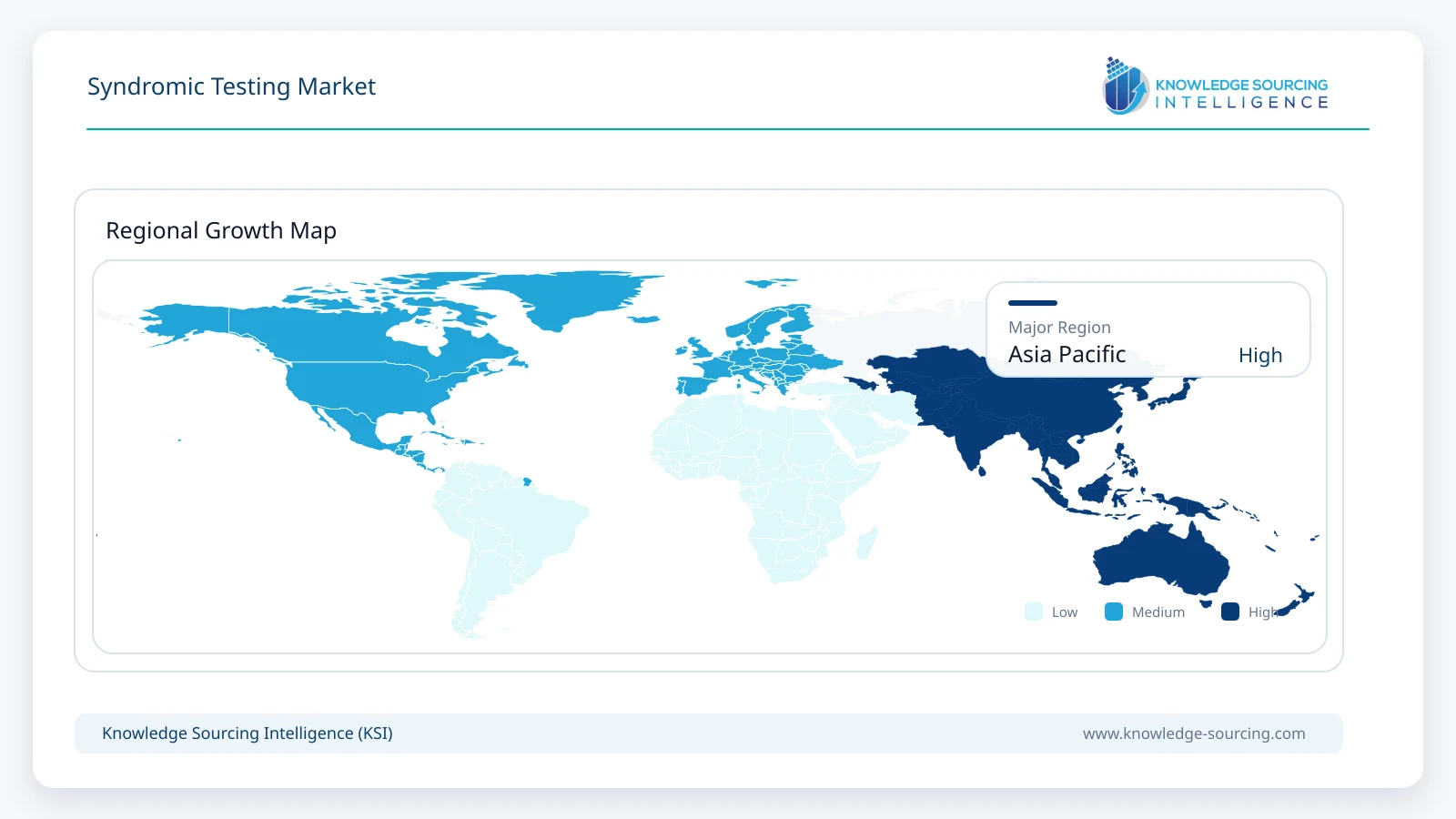
North America represents the largest adoption environment because healthcare systems emphasize rapid infectious disease diagnosis and antimicrobial stewardship. Hospitals are increasing syndromic testing utilization as treatment decisions become more dependent on immediate diagnostic information. Reimbursement support and advanced laboratory infrastructure create favorable conditions for multiplex diagnostics. Emergency departments and critical care units increasingly rely on comprehensive panels because patient management timelines continue shortening. Research investment remains strong, which encourages innovation and supports commercial expansion. These factors sustain high demand for syndromic testing solutions.
Europe
European healthcare systems prioritize infection control and evidence-based treatment practices. Syndromic testing adoption is increasing as antimicrobial resistance concerns become more significant. Regulatory frameworks emphasize diagnostic quality, which encourages utilization of validated multiplex platforms. Laboratories continue investing in molecular testing capabilities because comprehensive pathogen identification improves clinical management. Integrated healthcare networks support broader access to advanced diagnostics. These dynamics strengthen regional demand for syndromic testing technologies.
Asia Pacific
Healthcare infrastructure investment continues expanding across Asia Pacific, which increases access to molecular diagnostics. Hospitals are adopting multiplex testing as infectious disease management capabilities improve. Large patient populations generate substantial diagnostic demand, while laboratory modernization initiatives support technology implementation. Governments continue strengthening disease surveillance programs, which encourages broader syndromic testing utilization. These developments position the region for significant market expansion.
Rest of the World
Healthcare systems across Latin America, the Middle East, and Africa are strengthening infectious disease diagnostic capacity. Syndromic testing awareness is increasing as healthcare providers seek faster and more comprehensive diagnostic solutions. Resource constraints remain present in some markets, yet laboratory investment continues improving access to advanced technologies. Public health initiatives and healthcare modernization programs support gradual adoption. These trends create long-term growth opportunities.
Regulatory Landscape
Regulatory oversight remains essential because syndromic testing results directly influence treatment decisions and infection management strategies. Authorities emphasize analytical validation, clinical performance, and quality management standards. These requirements encourage manufacturers to maintain rigorous development and compliance processes.
The regulatory environment is becoming increasingly focused on multiplex diagnostics as testing complexity expands. Developers are adapting product strategies to satisfy evolving approval requirements. Regulatory expectations increase development costs, yet they also strengthen healthcare provider confidence in commercial products.
Pipeline Analysis
The syndromic testing pipeline remains active because healthcare providers continue demanding broader pathogen coverage and faster turnaround times. Development programs increasingly focus on expanded multiplex panels capable of detecting larger numbers of clinically relevant targets. These efforts seek to improve diagnostic utility while reducing the need for multiple tests.
Manufacturers are also advancing point-of-care platforms that combine multiplex testing capability with simplified workflows. Development activity increasingly incorporates software-enabled interpretation and connectivity features because diagnostic data complexity continues increasing. These initiatives reflect growing demand for comprehensive, rapid, and user-friendly testing solutions.
Competitive Landscape
bioMérieux SA
bioMérieux remains strategically distinct because it combines microbiology expertise with one of the most established syndromic testing portfolios through BioFire Diagnostics. The company benefits from strong adoption across respiratory, gastrointestinal, bloodstream infection, and meningitis panels. Its integrated approach supports broad clinical utilization and strengthens market leadership.
QIAGEN N.V.
QIAGEN differentiates itself through the QIAstat-Dx platform and extensive molecular diagnostics expertise. The company focuses on rapid multiplex testing and workflow integration. Its emphasis on clinically actionable results strengthens adoption across healthcare settings.
F. Hoffmann-La Roche Ltd.
Roche leverages global diagnostics infrastructure and molecular testing expertise. The company continues expanding syndromic testing capabilities through advanced molecular platforms and strategic acquisitions. Its scale supports broad commercial reach.
Becton, Dickinson and Company
BD maintains a strong position through clinical diagnostics and infectious disease testing capabilities. The company benefits from extensive healthcare relationships and integrated laboratory solutions. Operational scale supports continued market relevance.
Abbott Laboratories
Abbott combines molecular diagnostics expertise with global healthcare presence. The company focuses on rapid testing and workflow efficiency. Its diversified diagnostics portfolio supports participation in syndromic testing markets.
Danaher Corporation
Danaher participates through multiple diagnostic businesses, including Cepheid. The company benefits from technological diversity and strong molecular testing capabilities. Continuous innovation strengthens its competitive position.
Bio-Rad Laboratories, Inc.
Bio-Rad supports infectious disease testing through molecular diagnostic technologies and laboratory solutions. The company emphasizes analytical performance and workflow reliability. Its expertise supports participation in multiplex diagnostics.
Seegene Inc.
Seegene differentiates itself through multiplex PCR innovation and extensive assay development capabilities. The company focuses on broad pathogen detection and scalable testing solutions. Continued investment in syndromic diagnostics strengthens market positioning.
Key Market Highlights
In April 2026, QIAGEN N.V. announced its expansion into syndromic testing for bloodstream infections with the launch of the CE-IVDR-certified QIAstat-Dx BCID GPF Plus AMR Panel.
Future Market Outlook
Demand increasingly favors diagnostic platforms capable of simultaneously identifying multiple pathogens because infectious disease management requires rapid clinical decisions. Healthcare providers continue prioritizing testing strategies that reduce uncertainty while improving treatment accuracy. This environment supports ongoing investment in multiplex molecular diagnostics.
Purchasing decisions increasingly reflect workflow efficiency, panel breadth, and software integration rather than instrument functionality alone. Manufacturers are responding through ecosystem-based strategies that combine instruments, consumables, analytics, and connectivity solutions. This transition supports recurring revenue models and deeper customer integration.
The syndromic testing market remains positioned for sustained innovation because healthcare systems continue emphasizing early diagnosis, antimicrobial stewardship, and operational efficiency. As infectious disease complexity increases and treatment timelines compress, demand increasingly concentrates on comprehensive diagnostic platforms capable of delivering rapid, actionable, and clinically relevant results.
Syndromic Testing Market Scope:
| Report Metric | Details |
|---|---|
| Total Market Size in 2026 | USD 9.74 billion |
| Total Market Size in 2035 | USD 24.57 billion |
| Forecast Unit | Billion |
| Growth Rate | 10.8% |
| Study Period | 2021 to 2035 |
| Historical Data | 2021 to 2024 |
| Base Year | 2025 |
| Forecast Period | 2026 – 2035 |
| Segmentation | Product Type, Syndrome Type, Technology, End User, Geography |
| Companies |
|
Market Segmentation
Product Type
Syndrome Type
End User
Geography
- North America
- South America
- Europe
- Middle East and Africa
- Asia Pacific
Table of Contents
1. EXECUTIVE SUMMARY
1.1 Market Snapshot
1.2 Key Findings
1.3 Analyst Insights
1.4 Strategic Recommendations
2. RESEARCH METHODOLOGY
2.1 Research Design
2.2 Data Collection Methodology
2.3 Market Size Estimation
2.4 Forecasting Model
2.5 Assumptions & Limitations
3. SYNDROMIC TESTING MARKET OVERVIEW, SIZE & FORECAST
3.1 Market Definition & Scope
3.2 Overview of Syndromic Testing Technologies
3.3 Industry Evolution
3.4 Key Market Trends
3.5 Disease Burden and Unmet Diagnostic Needs
3.6 Testing Volume Analysis
3.7 User Adoption Analysis
3.8 Diagnostic Workflow Assessment
3.9 Impact of Antimicrobial Resistance on Diagnostic Demand
3.10 Historical Market Size Analysis (2021-2025)
3.11 Market Forecast Analysis (2026-2035)
4. MARKET DYNAMICS
4.1 Market Drivers
4.2 Market Restraints
4.3 Market Opportunities
4.4 Market Challenges
5. INDUSTRY LANDSCAPE
5.1 Industry Value Chain Analysis
5.2 Pricing Analysis
5.3 Reimbursement Landscape
6. INNOVATION LANDSCAPE
6.1 Emerging Multiplex Diagnostic Technologies
6.2 Product Innovation Analysis
6.3 Clinical Trial Analysis
6.4 Pipeline Analysis
6.5 Technology Roadmap
6.6 AI Integration in Syndromic Testing
6.7 Digital Health and Laboratory Informatics Integration
7. REGULATORY LANDSCAPE
7.1 Regulatory Framework
7.2 Approval Pathways
7.3 Compliance Requirements
8. SYNDROMIC TESTING MARKET LANDSCAPE ANALYSIS
8.1 Analysis by Technology Platform
8.2 Analysis by Pathogen Detection Capability
8.3 Analysis by Sample Type
8.4 Analysis by Clinical Application
8.5 Analysis by Testing Methodology
9. SYNDROMIC TESTING MARKET SEGMENT ANALYSIS (2021-2035)
9.1 By Product Type
9.1.1 Instruments
9.1.2 Reagents & Consumables
9.1.3 Software & Data Management Solutions
9.1.4 Services
9.2 By Syndrome Type
9.2.1 Respiratory Syndrome Testing
9.2.2 Gastrointestinal Syndrome Testing
9.2.3 Bloodstream Infection Syndrome Testing
9.2.4 Central Nervous System Infection Testing
9.2.5 Sexually Transmitted Infection Syndrome Testing
9.2.6 Other Syndromic Panels
9.3 By Technology
9.3.1 Polymerase Chain Reaction (PCR)
9.3.2 Real-Time PCR
9.3.3 Isothermal Amplification
9.3.4 Next-Generation Sequencing (NGS)
9.3.5 Microarray-Based Testing
9.4 By End User
9.4.1 Hospitals
9.4.2 Clinical Laboratories
9.4.3 Reference Laboratories
9.4.4 Academic & Research Institutes
9.4.5 Other End Users
10. SYNDROMIC TESTING MARKET GEOGRAPHICAL ANALYSIS (2021-2035)
10.1 North America
10.2 Europe
10.3 Asia-Pacific
10.4 South America
10.5 Middle East & Africa
11. SYNDROMIC TESTING MARKET COUNTRY ANALYSIS (2021-2035)
11.1 United States
11.2 Canada
11.3 Germany
11.4 United Kingdom
11.5 France
11.6 Italy
11.7 Spain
11.8 Netherlands
11.9 Japan
11.10 China
11.11 India
11.12 South Korea
11.13 Australia
11.14 Brazil
11.15 Saudi Arabia
12. COMPETITIVE LANDSCAPE
12.1 Market Share Analysis
12.2 Strategic Developments
12.3 Mergers & Acquisitions, Partnerships & Collaborations
12.4 Product Launches
13. COMPANY PROFILES
13.1 bioMérieux SA
13.2 QIAGEN N.V.
13.3 F. Hoffmann-La Roche Ltd.
13.4 Becton, Dickinson and Company
13.5 Abbott Laboratories
13.6 Danaher Corporation
13.7 Bio-Rad Laboratories, Inc.
13.8 Seegene Inc.
13.9 Hologic, Inc.
13.10 Thermo Fisher Scientific Inc.
13.11 Luminex Corporation (Diasorin Group)
13.12 GenMark Diagnostics, Inc. (Roche)
13.13 BioFire Diagnostics, LLC (bioMérieux)
13.14 Genetic Signatures Limited
13.15 Revvity, Inc.
14. SYNDROMIC TESTING MARKET COMMERCIAL FORECAST ANALYSIS
14.1 Respiratory Syndromic Panels
14.2 Gastrointestinal Syndromic Panels
14.3 Bloodstream Infection Syndromic Panels
14.4 Central Nervous System Infection Syndromic Panels
14.5 Sexually Transmitted Infection Syndromic Panels
14.6 Multiplex Molecular Syndromic Testing Platforms
15. INVESTMENT & FUNDING ANALYSIS
15.1 Venture Capital Trends
15.2 Government Funding
15.3 R&D Investments
16. FUTURE OUTLOOK
16.1 Key Growth Opportunities
16.2 Future Industry Trends
Navigate
Trusted by the world's leading organizations











