Solar PV Backsheet Market Trends & Forecast According to a research study published by Knowledge Sourcing Intelligence (KSI), the solar pv backsheet market will exp...
Solar PV Backsheet Market Trends & Forecast
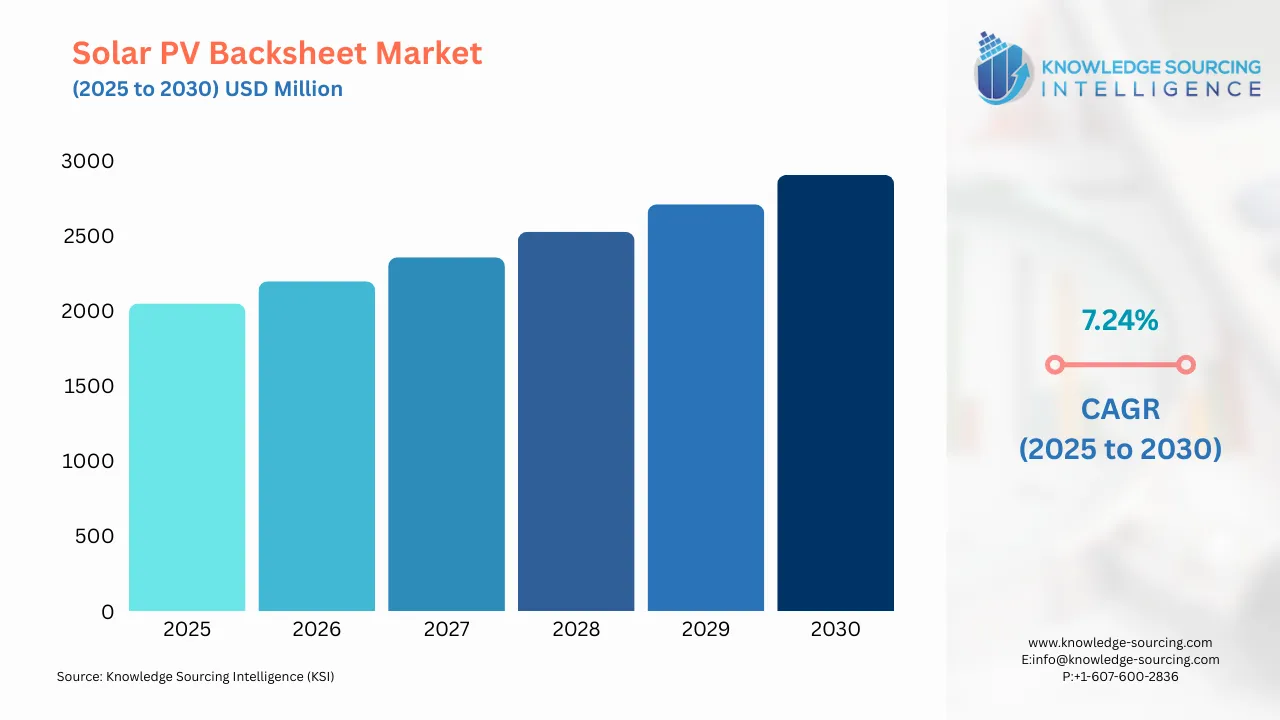
According to a research study published by Knowledge Sourcing Intelligence (KSI), the solar pv backsheet market will expand from USD 2,048.345 million in 2025 to USD 2,904.854 million in 2030 at a CAGR of 7.24% during the forecast period.Rising solar PV installation is the major driver of the solar PV back sheet market. Growing focus on the renewable energy sector due to rising electricity prices and environmental sustainability concerns is driving the installation of solar panels which, in turn, is propelling the growth of the solar PV back sheet market. Furthermore, the declining cost of solar panels is further augmenting the use of solar energy, thus positively impacting the growth of the solar PV back sheet market. While favorable government initiatives and policies to encourage the use of solar energy will continue to support the growth of the solar PV back sheet market in the coming years.
Get In-Depth Analysis of the Solar PV Backsheet Market
This article covers the fundamentals. Our full market report provides the granular data, competitive landscape, and strategic insights you need to navigate the global solar PV backsheet industry.- ? Detailed Market Size & Growth Forecasts
- ? Key Player Analysis & Market Share
- ? Application Breakdowns & Regional Trends
Solar PV Backsheet Market Report Highlights
- The solar PV backsheet market is divided into single-layer PV backsheets, double-layers, and triple-layers. Among them, the triple-layer backsheet segment is the most popular in the market because it is more robust, resistant to weather, and has better electrical insulation than the single- and double-layered ones. Most utility-scale and commercial solar installations use triple-layer backsheets because they can resist extended exposure to UV and other environmental factors, providing the panel with longer life and efficiency. Niche applications or low-cost applications use single- and two-layer backsheets, but are secondary to the adoption of triple-layers.
- By material, the market is separated into backsheets made of fluoropolymer and non-fluoropolymer. Polyvinyl fluoride (PVF) backsheets are the most popular fluoropolymer backsheets in the market because they are long-established products that major module manufacturers have used over decades because they are reliable, UV stable, and withstand weather. PVDF and ETFE based backsheets are also making their inroads due to better performance but they have a smaller share. Polyester (PET) backsheets are becoming an alternative solution on the non-fluoropolymer side due to their inexpensive nature and the growing popularity of fluoropolymer-free solutions as a means of sustainability.
- By the installation type, the market is divided into rooftop solar PV systems, ground-mounted solar PV systems, and floating solar PV systems. The segment with the highest share is the ground-mounted solar PV systems segment, mainly because of the sheer size of utility solar projects globally, which contribute most of the installed solar capacity. The demand driver is the necessity of ground-mounted systems to have durable backsheets, enabling them to tolerate a lot of heat and UV radiation throughout their long lifetimes.
- Based on application, the market is divided into residential, commercial, and industrial. The industrial makers are the market leaders because most big solar farms and corporate renewable energy projects are in this category. Large-scale systems often use high-efficiency, long-life, triple-layered, fluoropolymer-based backsheets on the PV modules, which reduces costs and increases demand. The commercial market is also becoming more and more steady as more businesses decide to use rooftop solar as a way to lower their energy bills and carbon emissions.
- The market is dominated by the Asia Pacific region, with China, India, and Japan leading the market, as they have most of the solar PV installations in the world. High government subsidies, the falling cost of modules and ambitious renewable energy targets have increased the pace of solar installations in the region and have generated a large demand of backsheets. Europe comes in second, as nations such as Germany, Spain and UK are the forefront in the use of rooftop and utility solar.
Report Coverage:
| Report Metric | Details |
| Solar PV Backsheet Market Size in 2025 | US$2,048.345 million |
| Solar PV Backsheet Market Size in 2030 | US$2,904.854 million |
| Growth Rate | CAGR of 7.24% |
| Drivers |
|
| Restraints |
|
| Segmentation |
|
| List of Major Companies in Solar PV Backsheet Market |
|
Solar PV Backsheet Market Growth Drivers
- Rapid growth of solar installations: The strongest driver for the solar PV backsheet market is the accelerating global adoption of solar power. With governments, utilities, and corporations investing heavily in renewable energy, demand for solar modules has surged. Since backsheets are a critical component in solar panels, ensuring insulation, protection, and durability, their demand grows directly in proportion to solar capacity expansion. Utility-scale projects, in particular, are creating massive volumes of backsheet requirements worldwide.
- Supportive Government Policies and Renewable Energy Targets: National and regional commitments to reduce carbon emissions and increase renewable energy penetration are another key driver. Policies such as the EU’s Green Deal, the U.S. Inflation Reduction Act, and China’s renewable energy subsidies are creating long-term certainty for solar developers. This results in strong demand for solar components, including backsheets, as countries race to meet renewable energy targets and climate commitments.
Analyze the Renewable Energy Market
Solar PV backsheets are integral to renewable energy growth. Get our in-depth report on the Renewable Energy Market to explore trends, policies, and forecasts driving the sector.Solar PV Backsheet Market Key Development
- Company Expansion: In August 2025, Vikram Solar, a leading Indian solar PV module manufacturer, has announced a significant order for the supply of 250 MW of high-efficiency solar modules from the Bondada Group.
Solar PV Backsheet Market Segmentation
Knowledge Sourcing Intelligence has segmented the Solar PV Backsheet Market based on product type, material, installation type, application, and region: Solar PV Backsheet Market, by Product Type- Introduction
- Single-layer Backsheets
- Double-layer Backsheets
- Triple-layer Backsheets
- Introduction
- Fluoropolymer-Based Backsheets
- Polyvinyl Fluoride (PVF) Backsheets
- Polyvinylidene Fluoride (PVDF) Backsheets
- Ethylene Tetrafluoroethylene (ETFE) & Other Fluoropolymers
- Non-Fluoropolymer-Based Backsheets
- Polyester (PET) Backsheets
- Co-extruded Backsheets / Polyamide (PA) / PP-based
- Introduction
- Rooftop Solar PV Systems
- Ground-Mounted Solar PV Systems
- Floating Solar PV Systems
- Introduction
- Residential
- Commercial
- Industrial
- North America
- USA
- Canada
- Mexico
- Europe
- UK
- Germany
- France
- Italy
- Spain
- Others
- Asia Pacific
- China
- India
- Japan
- South Korea
- Taiwan
- Thailand
- Indonesia
- Others
- South America
- Brazil
- Argentina
- Others
- Middle East and Africa (MEA)
- Saudi Arabia
- UAE
- Others
Solar PV Backsheet Market Key Players
- DuPont de Nemours, Inc.
- Coveme S.p.A.
- Krempel GmbH
- Toyo Aluminium K.K.
- Toray Industries, Inc.
- Hangzhou First Applied Material Co., Ltd.
- Dunmore Corporation
- Cybrid Technologies Inc.
- Jolywood (Suzhou) Sunwatt Co., Ltd.
- Isovoltaic AG
- Taragray Technology International Inc.
- BioSolar Inc.
- 3M Company
- Koninklijke DSM N.V.
Go from Insight to Action with Our Market Research
You've seen the overview. Now, get the detailed data and strategic analysis you need to stay ahead in the renewable energy market. Explore our related, in-depth reports. Each report includes comprehensive data, forecasts, and competitive analysis to empower your business decisions.Need specialized data cuts or competitive intelligence?
Our analyst team provides bespoke market sizing, supplier audits, and country-level feasibility reports tailored to your enterprise roadmap.
Speak With an Industry Analyst →Ask an Industry Analyst
Have questions regarding this briefing or market projections? Inquire with our sector lead.
Related Press Releases
View All →
ADC Manufacturing & CDMO Market is expected to reach USD 10.49 billion by 2031
Aug 7, 2026
Lifestyle-Associated Cancer Epidemiology Market is expected to reach USD 13.12 billion by 2031
Aug 5, 2026
Psycho-Oncology Digital Health Market is anticipated to surpass USD 290.01 million in 2031 at a CAGR of 8.5%
Jul 30, 2026
Intratumoral Injection Therapy Market is expected to reach USD 630.39 million by 2031
Jul 24, 2026
Palliative Care in Oncology Market is expected to reach USD 244.1 billion by 2031
Jul 22, 2026More Press Releases
Oncology Drug Resistance Testing Market is projected to reach USD 3.41 billion in 2031 at a CAGR of 6.6 %
The oncology drug resistance testing market is expanding due to rising cancer prevalence, increasing drug resistance, and growing adoption of precision oncology. Advances in NGS-based testing, companion diagnostics, and targeted therapies, alongside FDA approvals and investments in personalized medicine, are accelerating demand for effective resistance monitoring across hospitals and clinical diagnostics worldwide.
TROP-2 Targeted Therapy Market is anticipated to surpass USD 3.29 billion in 2031 at a CAGR of 8.6 %
The TROP-2 Targeted Therapy market is expanding rapidly due to increasing precision oncology adoption, rising cancer prevalence, and growing use of antibody-drug conjugates. North America leads the market, while Asia Pacific shows the fastest growth. Continuous clinical trials, regulatory approvals, and strategic collaborations are accelerating innovation and commercial adoption worldwide.
Second Primary Cancer Prevention Market is expected to reach USD 24.7 billion by 2031
The Second primary cancer prevention refers to strategies aimed at reducing the risk of developing a new, unrelated cancer in individuals with a prior cancer diagnosis. Growing cancer survivorship, advances in treatment, and increasing awareness of long-term health outcomes have heightened the importance of prevention and surveillance programs. Key approaches include routine screening, genetic risk assessment, lifestyle modification, and long-term follow-up care. Government agencies and healthcare organisations increasingly emphasise survivorship care plans and evidence-based screening protocols to detect new malignancies at earlier stages. Continued investments in early detection technologies and personalised risk assessment are expected to support advancements in second primary cancer prevention.