
The autonomous vehicle seating market is forecast to grow at a CAGR of 25.2%, reaching approximately USD 7.38 billion by 2031 from USD 2.40 billion in 2026.
Highlights:
- 1Front seats account for approximately 54% of global autonomous vehicle seating market value in 2026 because the first row carries the highest concentration of powered adjustment, sensing, swivel, recline, restraint and comfort content.
- 2Power-adjustable adaptive seating represents approximately 39% of market value in 2026 as multi-axis actuation, memory, posture optimization and software-controlled positioning become standard foundations for higher-automation cabins.
- 3Comfort, wellness and relaxation functions account for approximately 33% of market value in 2026, supported by zero-gravity modes, localized heating and cooling, massage, haptics and occupant-specific support adjustment.
- 4SAE Level 3 applications represent approximately 63% of global market value in 2026 because conditional automation is the first production-scale environment in which seats must support both conventional driving posture and extended non-driving comfort modes.
- 5Personally owned autonomous passenger vehicles account for approximately 66% of market value in 2026, while robotaxi and shared autonomous mobility applications are increasing demand for durable, flexible and easily reconfigurable seating systems.
- 6Asia Pacific represents approximately 43% of global market value in 2026, supported by rapid premium EV and smart-cabin development in China and strong seating, electronics and automotive supply capabilities in Japan and South Korea.
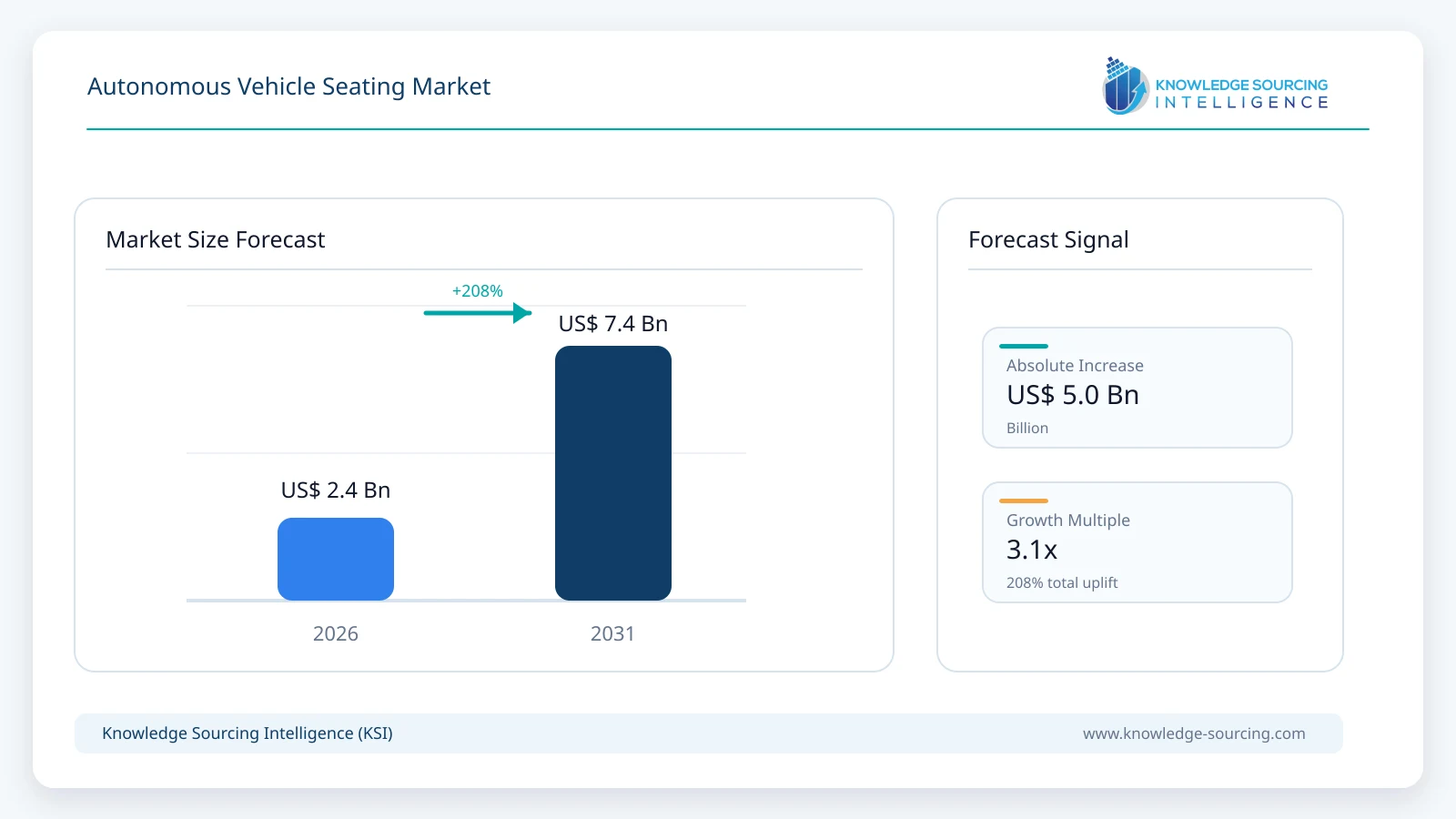
Seating is becoming one of the highest-value physical systems in the autonomous cabin because it directly determines occupant posture, space utilization, comfort and crash protection across both driving and non-driving modes.
Commercial development is moving beyond concept-only seating. Magna has secured production business for a reconfigurable system combining long rails and rotating front seats, while Yanfeng describes XiM27 as a production-ready smart-cabin platform with AI-adaptive seating. Adient and Autoliv have prepared the Z-Guard zero-gravity safety concept for production, and FORVIA is developing Safe & Relax seating with deep recline, integrated restraints and occupant-position monitoring. Toyota Boshoku, Hyundai Transys and Lear are also advancing seats designed around autonomous mobility, adaptive comfort and new ways of using cabin time.
The value pool is broadening from frames, foam and trim toward mechatronics, power actuation, integrated belt systems, sensorized surfaces, thermal management and software. As seats rotate, recline or travel over longer distances, the architecture must remain compatible with airbags, seat belts, occupant monitoring, ingress and egress, electrical distribution and automated-driving state. This system-level integration is increasing engineering content per seat and creating opportunities for seating suppliers with capabilities across structures, mechanisms, electronics, comfort and safety.
Market Overview
Vehicle seating becomes a central engineering platform as driving responsibility shifts toward automated systems. Conventional seats are optimized primarily around forward-facing travel and a predictable driving posture. Higher automation creates a wider range of occupant positions, including deep recline, long-slide, rotated social layouts and relaxation modes, while still requiring the seat to deliver safe restraint geometry and rapid return to driving position when needed.
Seat structures therefore carry more movement and more intelligence. Power rails, high-torque swivel mechanisms, synchronized recliners, cushion tilt, footrests, integrated belts and sensorized surfaces must operate as one controlled system rather than as independent convenience features. The seat controller increasingly exchanges information with cabin monitoring, ADAS, restraint control, climate management and the central vehicle computer.
Magna illustrates the reconfiguration direction through power long rails and swivel systems that can reshape the cabin for different passenger and cargo scenarios. Its awarded Chinese OEM program combines rotating front seats with nearly two metres of power rail travel, showing that high-mobility seat architectures are progressing toward series production. Yanfeng takes a software-centric approach in XiM27, where AI-adaptive seating adjusts position, firmness and temperature as part of coordinated cabin scenarios.
Safety is developing in parallel with flexibility. Adient and Autoliv have co-developed Z-Guard for zero-gravity seating, using predictive repositioning, pretensioning and additional restraint elements to protect occupants in highly reclined positions. FORVIA offers Safe & Relax concepts that extend recline while using reinforced structures, integrated restraint architectures and occupant monitoring. Hyundai Transys similarly emphasizes belt-integrated frames and dynamic safety as seating gains movement in autonomous cabins.
Comfort content is also becoming more personalized. Lear INTU uses sensor inputs and software to identify occupant needs and automatically adjust seat support, while its thermal technologies bring heating and cooling closer to the body. FORVIA Transformer Seat adjusts multiple parameters using occupant morphology and driving conditions, and Toyota Boshoku is developing seating and interior concepts that coordinate the physical environment around how passengers spend time during automated travel.
Market Trends
· Seats Are Becoming Adaptive Mechatronic Platforms Rather Than Static Components
The autonomous seat is increasingly a controlled electromechanical system. Multi-axis motors, electronic control units, smart actuators and position sensing allow the same seat to support driving, relaxation, work and social modes. Software can coordinate slide, swivel, recline, cushion angle and support surfaces while storing occupant preferences and enforcing safe operating limits.
This changes supplier value from individual mechanisms toward integrated seat-system engineering. Companies able to combine frames, kinematics, electronics and software can capture more content because movement quality, noise, speed, packaging and safety must be validated together.
· Zero-Gravity and Deep-Recline Seating Are Driving New Safety Architectures
Deep recline is moving from premium comfort feature to an important autonomous-cabin use case. However, conventional belt geometry and airbag deployment are designed around more upright positions. Suppliers are responding with integrated belts, anti-submarining features, additional airbags, predictive seat repositioning and occupant-position sensing.
Adient and Autoliv's Z-Guard and FORVIA's Safe & Relax concepts show how comfort and restraint engineering are converging. The ability to validate crash protection over a wider range of seat angles will be a major determinant of which relaxation modes reach production at scale.
· Long-Rail and Swivel Architectures Are Moving Toward Production Programs
Flexible seating layouts are becoming technically feasible as flat-floor electric platforms remove some packaging constraints. Long rails increase fore-aft travel, while powered swivel mechanisms support face-to-face, lounge and access-oriented configurations. These functions are especially relevant to premium multipurpose vehicles, robotaxis and autonomous shuttles.
Production readiness matters because high-mobility seating requires robust wiring, integrated restraints, crashworthy tracks and collision avoidance between seats, consoles and interior surfaces. The market is therefore shifting from demonstrator mechanisms toward complete validated systems tied to specific vehicle platforms.
· Localized Thermal Comfort and Wellness Are Increasing Seat Content per Vehicle
Seat-based comfort is becoming more important as electric vehicles seek to reduce the energy used to condition the entire cabin. Heating, ventilation, localized cooling, neck conditioning, massage and pneumatic support can target the occupant directly while supporting personalized comfort.
Autonomous travel also increases the value of restorative functions because occupants can spend longer periods resting or working. Lear, FORVIA and Toyota Boshoku are developing seat-centered thermal and wellness systems that combine comfort with software control, sensing and energy management.
· Seating Is Being Integrated into Centralized Smart-Cabin Control
Autonomous seating no longer operates only through local switches. Seat movement increasingly responds to cabin scenarios, automated-driving state, occupant identity and environmental conditions. Central domain controllers can coordinate seat position with lighting, climate, displays and audio to create repeatable work, lounge, family or rest modes.
Yanfeng XiM27 demonstrates this direction by linking intelligent seat configuration to a centralized cabin architecture. This type of integration increases the importance of open software interfaces, position feedback and functional-safety logic between seating and the rest of the vehicle.
Segment Analysis
· By Seat Position: Front Seats
Front seats represent the largest seat-position segment, accounting for approximately 54% of autonomous vehicle seating market value in 2026. The first row carries the highest level of mechanism, electronics and safety content because it must support conventional driving posture, handover-ready Level 3 operation and increasingly advanced relaxation or swivel functions.
By 2031, front-seat market value is projected to reach approximately USD 3.69 billion. Growth will be supported by integrated seat belts, power swivel, long travel, zero-gravity recline, occupant-position sensing and premium comfort technologies that allow the seat to transition between driving and non-driving modes.
· By Seating Technology: Power-Adjustable Adaptive Seats
Power-adjustable adaptive seats account for approximately 39% of global market value in 2026. These systems provide the mechatronic foundation for autonomous seating by controlling fore-aft movement, height, recline, cushion angle, lumbar support and other parameters through electronically managed actuators.
The segment is projected to generate approximately USD 2.71 billion by 2031. Future systems will increasingly use occupant profiles, sensing and AI-based logic to select posture automatically, while higher-torque actuation and centralized control support faster transitions between drive, comfort and relaxation modes.
· By Primary Function: Comfort, Wellness and Relaxation
Comfort, wellness and relaxation represent the largest primary-function segment, accounting for approximately 33% of market value in 2026. Higher automation gives occupants more opportunity to recline, rest, consume media or work, increasing demand for zero-gravity posture, massage, localized thermal control, pneumatic support and fatigue-management features.
The segment is projected to reach approximately USD 2.51 billion by 2031. Value creation will move toward coordinated systems that adapt support, temperature and seat geometry to occupant morphology, journey context and activity rather than relying only on manual settings.
· By Automation Level: SAE Level 3
SAE Level 3 applications account for approximately 63% of autonomous vehicle seating market value in 2026. Conditional automation creates a dual-role seating requirement: the driver can temporarily disengage from the driving task but must still be able to return to an appropriate control position when requested.
Level 3 therefore favors electronically controlled seats that can move between driving and comfort modes while monitoring position and enforcing safe transition logic. As Level 4 expands, more radical cabin layouts will gain share, but Level 3 will remain the largest near-term production base for adaptive seating through much of the forecast period.
· By Vehicle Application: Personally Owned Autonomous Passenger Vehicles
Personally owned autonomous passenger vehicles represent approximately 66% of market value in 2026. Premium and upper-mid passenger vehicles provide the strongest early commercialization path because buyers already pay for powered seats, memory, massage, ventilation and high-content interior features that can be extended into autonomous use cases.
The segment is projected to generate approximately USD 4.68 billion by 2031. Robotaxi and shuttle applications will grow more rapidly from a smaller base, but privately owned vehicles will continue to support high per-seat content through personalization, luxury comfort and configurable family-use scenarios.
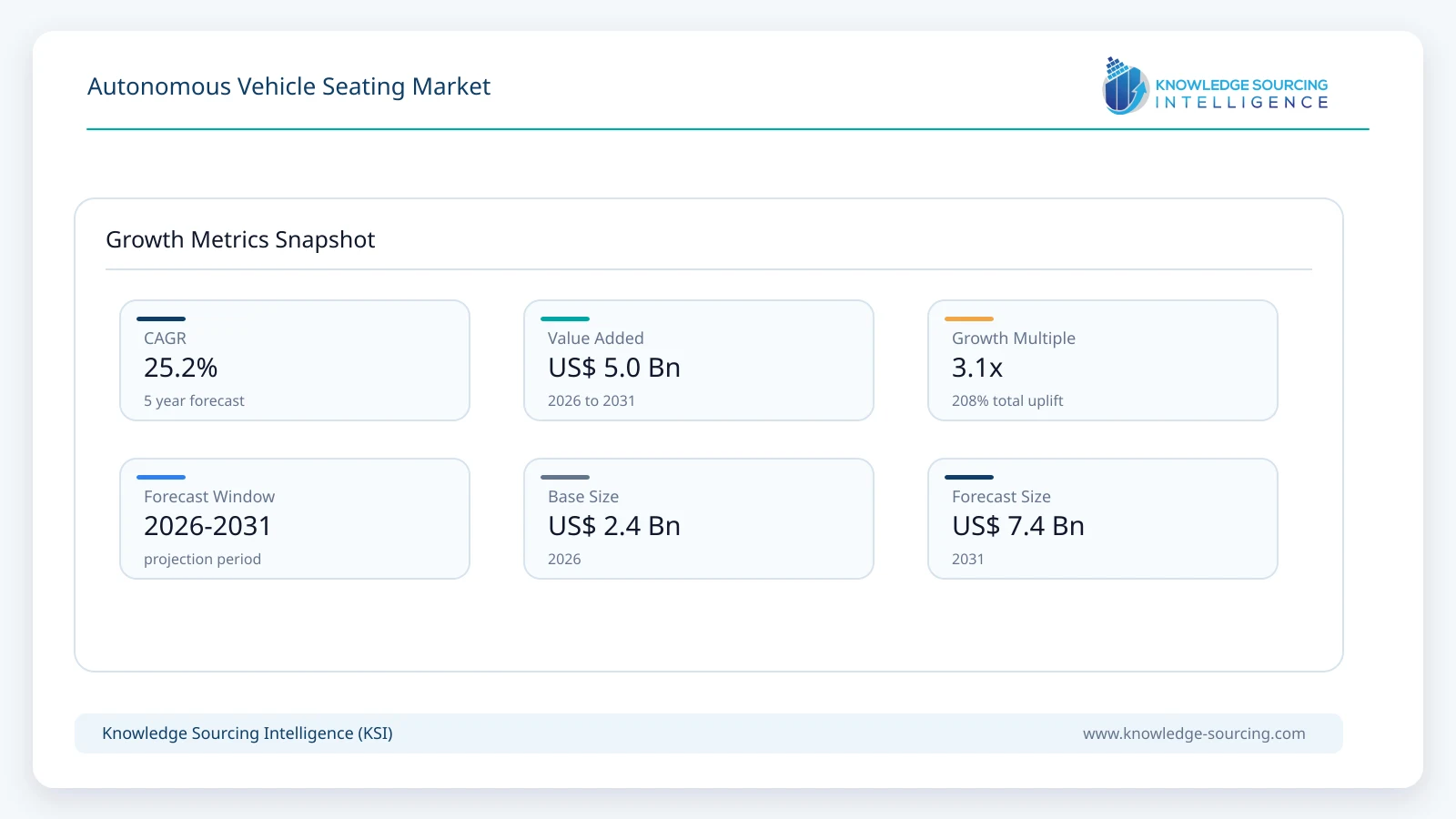
Market Drivers
· Expansion of SAE Level 3 and Level 4 Automated Driving
Higher levels of automation change the time occupants spend actively controlling the vehicle. As hands-off and mind-off periods increase, seating must support a wider range of postures and activities while remaining connected to takeover logic and occupant protection. This directly increases demand for powered movement, sensing and adaptable seat architectures.
The transition is particularly important in premium electric vehicles and autonomous mobility platforms, where interior differentiation is becoming a core purchase and service-quality factor.
· Demand to Reclaim Travel Time through More Flexible Cabin Use
Autonomous mobility creates value when occupants can use travel time for rest, conversation, work or entertainment. Seating is the physical enabler of these use cases because it determines orientation, reach, posture and personal space. Swivel, long-rail and deep-recline functions therefore become more valuable as automated-driving capability expands.
Flexible seating also increases vehicle utility by allowing one cabin to shift between passenger, cargo, family and social configurations without changing the underlying platform.
· Growth of Integrated Restraints and Position-Aware Passive Safety
Seat movement creates new crash-protection requirements. Integrated seat belts, pretensioners, seat-mounted airbags, anti-submarining structures and occupant-position sensing allow restraint geometry to remain effective when seats recline, rotate or move away from conventional anchorage positions.
This safety content increases market value because the seat becomes part of a coordinated protection system rather than a mechanical support structure. Suppliers with crash simulation, restraint integration and structural validation capabilities are positioned to capture higher-value autonomous programs.
· Rising Demand for Personalized Comfort and Wellness
Consumers increasingly expect premium seats to remember preferences and actively improve comfort. Autonomous operation makes these features more useful because occupants can focus on relaxation and wellbeing rather than driving. Adaptive lumbar support, thermal microclimate, massage, haptic feedback and biometric sensing are moving toward integrated seat packages.
Software-based personalization also gives OEMs opportunities to differentiate trim levels and potentially activate features over the vehicle lifecycle.
· Electric and Software-Defined Vehicle Architectures
Battery-electric platforms often provide flatter floors and more centralized electronics, making it easier to package longer seat travel, flexible consoles and high-content power functions. Software-defined architectures also allow seat behavior to be coordinated with cabin modes and updated over time.
These platform changes reduce some of the historical constraints on seating geometry while increasing demand for networked controllers, smart actuators and software validation.
Market Restraints
· Crash Protection in Reclined, Rotated and Non-Standard Seating Positions
The largest engineering challenge is maintaining occupant protection when the seat moves outside conventional forward-facing geometry. Belt routing, airbag interaction, pelvis retention and occupant kinematics can change significantly with recline or rotation, requiring additional structure, sensing and validation.
Until safety performance is validated across a broader range of positions, some high-flexibility seating modes may remain limited to parked operation or specific automated-driving conditions.
· Higher Cost, Weight and Packaging Complexity
Long rails, swivel bearings, power actuators, integrated restraints, footrests, sensors and thermal systems add mass and cost. They also require larger packaging envelopes and stronger floor interfaces. OEMs must balance these benefits against vehicle efficiency, interior space and affordability.
Cost pressure is particularly important outside premium segments, where autonomous seating content must be modular enough to scale without turning the complete seat into a prohibitively expensive subsystem.
· Electrical, Software and Reliability Requirements
High-content seats contain multiple motors, sensors and control units that must operate quietly and reliably over many years. More movement also increases wear on harnesses, tracks and mechanical interfaces. Software must prevent collisions between seat components and maintain safe behavior during faults or power interruptions.
These requirements increase validation time and raise the importance of diagnostics, cybersecurity and functional-safety engineering.
· Uneven Availability of Higher Automation
Autonomous seating value depends partly on how often occupants can safely leave conventional driving posture. SAE Level 3 and Level 4 availability remains limited by vehicle model, geography and operating domain, which can slow adoption of the most advanced seat functions.
Suppliers therefore need architectures that deliver value in normal driving today while remaining capable of more flexible operation as automation expands.
· Cleaning, Durability and Abuse Requirements in Shared Mobility
Robotaxi and autonomous-shuttle seating experiences higher utilization, more frequent occupant turnover and greater exposure to spills, misuse and contamination than privately owned vehicles. Complex adjustment mechanisms and premium materials must therefore be designed for rapid cleaning, high cycle life and low maintenance.
This can conflict with the industry trend toward softer surfaces, more sensors and more moving components, increasing engineering and lifecycle-cost pressure for fleet applications.
Regional Outlook
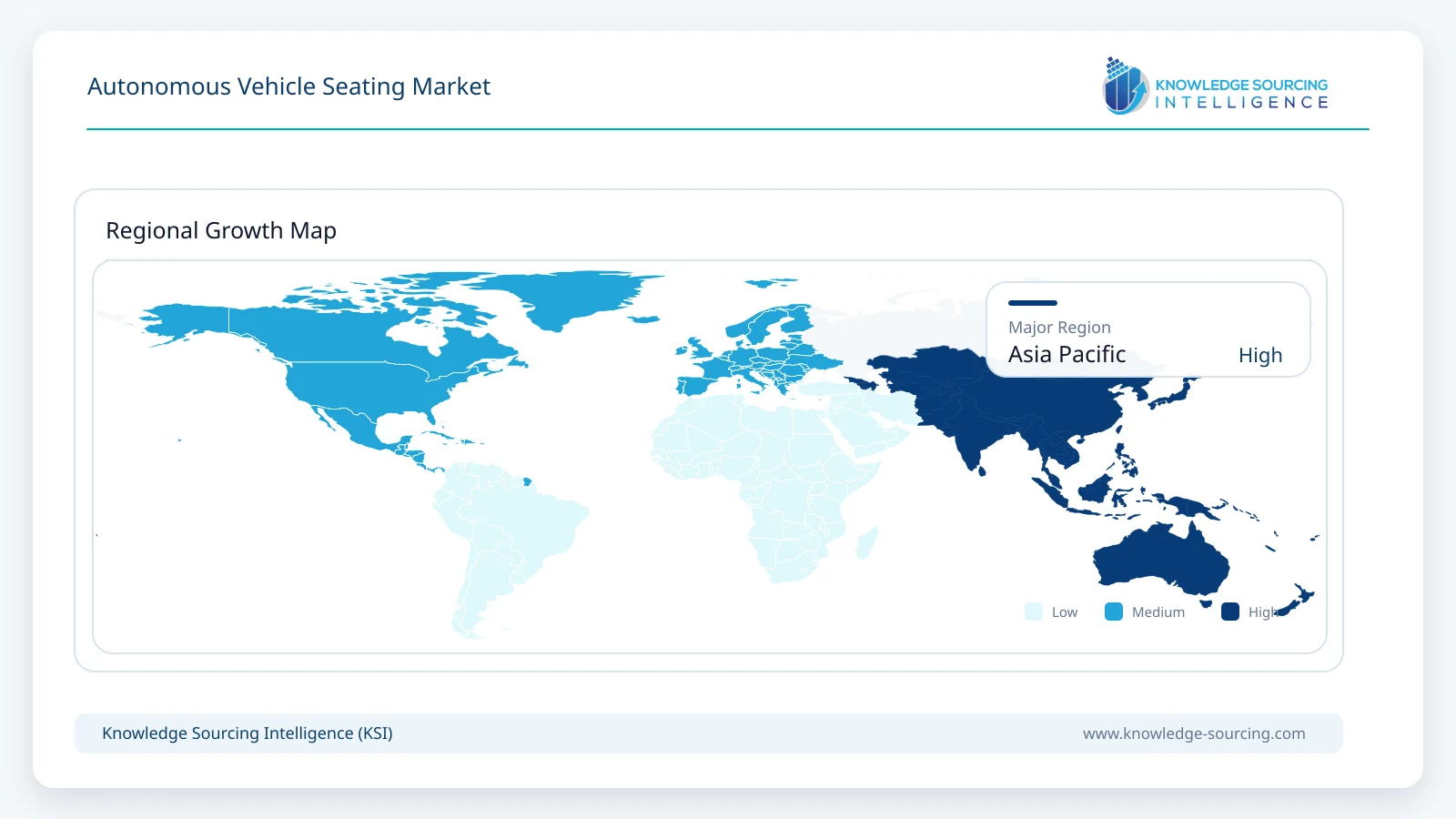
· Asia Pacific
Asia Pacific is the largest autonomous vehicle seating market, accounting for approximately 43% of global value in 2026. China is the principal growth engine because premium EV and smart-cabin competition is driving rapid adoption of zero-gravity seating, advanced power adjustment, long-rail systems and scenario-based interior modes.
The region also has a strong supplier and technology base. Yanfeng is developing production-ready intelligent seating within XiM27, Toyota Boshoku is advancing coordinated seating and interior spaces such as LOUNZE+, and Hyundai Transys is developing autonomous seating concepts with flexible layouts and belt-integrated structures. Japanese and South Korean OEM ecosystems add strength in seating electronics, materials, comfort engineering and high-volume manufacturing.
Through 2031, the region is expected to remain the main volume and innovation center as Chinese OEMs accelerate premium cabin differentiation and autonomous-driving functionality expands across passenger vehicles and mobility services.
· Europe
Europe is a major market for safety-intensive autonomous seating because the region combines premium vehicle production, active Level 3 development and a dense supplier base in seating, restraints and passive safety. European programs place strong emphasis on crash performance, occupant monitoring and controlled seat movement as comfort positions become more aggressive.
Adient is commercializing advanced ergonomic and zero-gravity concepts, while FORVIA combines complete seating capability with Safe & Relax structures, smart actuators and occupant sensing. Collaboration between seating and restraint suppliers is especially important in the region because future reclined positions require integrated engineering across seat frame, belt, airbag and sensing systems.
Growth will be supported by premium OEM adoption, software-defined vehicle platforms and increasingly sophisticated comfort content, although regulation and safety validation are likely to keep deployment more controlled than in rapidly iterating Chinese smart-cabin programs.
Competitive Landscape
The autonomous vehicle seating market is led by global seating suppliers with established complete-seat, structure, mechanism and manufacturing capabilities. Magna, Adient, Lear, FORVIA, Toyota Boshoku, Hyundai Transys and Yanfeng are directly active in technologies that address flexible seating, adaptive comfort, integrated safety or autonomous-cabin use cases.
Magna differentiates through power long rails, swivel systems and production reconfigurable seating. Adient combines ergonomic seat architecture with zero-gravity safety through Z-Guard and Autoliv collaboration. Lear emphasizes intelligent comfort, biometrics and thermal management, while FORVIA combines complete seat systems with Safe & Relax structures, smart sensing and adaptive comfort technologies.
Toyota Boshoku and Hyundai Transys use seating as the foundation of future mobility spaces, with concepts built around relaxation, social interaction and modular cabin layouts. Yanfeng increasingly links seating to centralized smart-cabin control, using AI-adaptive functions and scenario-based configuration in XiM27. Competitive advantage will depend on production readiness, crash validation, mechanism durability, software integration, comfort performance, mass and the ability to scale high-content seating across multiple vehicle platforms.
Recent Developments
• 10 July 2026: Yanfeng announced that its XiM27 smart-cabin concept received the 2026 Red Dot Design Concept Award. The six-seat platform is designed for higher-level autonomous mobility and uses intelligent seat configuration to adapt the cabin for relaxation, rest and social interaction.
• 29 June 2026: Yanfeng unveiled XiM27 as a production-ready smart-cabin platform. Its AI-adaptive seating automatically adjusts seat position, firmness and temperature using learned occupant preferences and supports rapid switching among driving, lounge, rest and workspace scenarios.
• 11 May 2026: Magna detailed its adaptive-seat technology direction, describing the vehicle seat as an intelligent system that can continuously adjust support and comfort around occupant needs as vehicle interiors become more experience-oriented.
• 23 April 2026: Toyota Boshoku presented LOUNZE+ for Auto China 2026. The concept coordinates seats, door trims and console functions to transform the cabin into a living-space-oriented environment for media, relaxation and other future mobility use cases.
• 29 January 2026: FORVIA announced new business with a major European automaker covering front seat structures, foam, trim covers and complete seat assembly, reinforcing its scale in integrated seating systems.
• 22 January 2026: Adient introduced ModuTec, a modular seat design and assembly concept intended to simplify seat construction and enable higher levels of manufacturing automation while reducing assembly time.
• 13 October 2025: Adient and Autoliv announced that the Z-Guard zero-gravity seating safety concept was ready for mass production and scheduled for a high-volume model from a major global OEM. The system combines predictive seat repositioning with advanced pretensioning, cushioning and restraint measures.
• 13 October 2025: FORVIA was selected by Hyundai-Kia to supply seating comfort systems for three models planned for European and U.S. sale from 2027, together with expanded supply of seat frames and mechanisms.
• 25 September 2025: Adient presented its Pure Ergonomics seating concept, derived from the Autonomous Elegance demonstrator, with a redesigned adjustment system intended to improve occupant biomechanics and increase second-row space.
• 23 April 2025: FORVIA presented the Transformer Seat at Auto Shanghai 2025, using sensing and safety technologies to automatically adjust multiple seat parameters according to occupant morphology and driving conditions.
• 5 February 2025: Lear announced engineering integration of its ComfortMax Seat technology with General Motors, bringing thermal comfort functions into seat trim covers to improve occupant comfort and manufacturing efficiency.
Market Outlook
The autonomous vehicle seating market is expected to expand rapidly through 2031 as the seat becomes a primary interface between occupants and the automated cabin. Power-adjustable adaptive seating will remain the largest technology segment, but swivel, long-rail, zero-gravity and integrated-safety systems are expected to gain content as Level 3 and Level 4 functionality expands.
The most important value shift will be from mechanical adjustment toward coordinated mechatronic and software-controlled seating. Future seats will identify occupants, select support settings, manage thermal comfort, communicate their position to restraint and monitoring systems, and transition automatically between driving and non-driving modes. This will increase the value of electronics, sensing and software within the seat while making crash-safe movement a core design requirement.
Asia Pacific is expected to remain the largest market, led by China's rapid premium EV and smart-cabin development, while Europe will remain important for safety engineering, premium comfort and advanced restraint integration. Competitive advantage will depend on production-ready reconfiguration, validated protection across non-standard postures, lightweight structures, low-noise actuation, personalized comfort and the ability to integrate seating with centralized software-defined vehicle architectures.
Autonomous Vehicle Seating Market Scope:
| Report Metric | Details |
|---|---|
| Total Market Size in 2026 | USD 2.40 billion |
| Total Market Size in 2031 | USD 7.38 billion |
| Forecast Unit | USD Billion |
| Growth Rate | 25.2% |
| Study Period | 2021 to 2031 |
| Historical Data | 2021 to 2024 |
| Base Year | 2025 |
| Forecast Period | 2026 – 2031 |
| Segmentation | Seat Position, Seating Technology, Primary Function, Automation Level, Vehicle Application, Geography |
| Companies |
|
Market Segmentation
By Seat Position
Front Seats
Second-Row Seats
Rear and Third-Row Seats
By Seating Technology
Power-Adjustable Adaptive Seats
Swivel and Rotating Seats
Long-Rail and Reconfigurable Seats
Zero-Gravity and Deep-Recline Seats
Fold, Stadium and Convertible Seats
By Primary Function
Comfort, Wellness and Relaxation
Reconfiguration and Space Optimization
Occupant Safety and Restraint Integration
Personalization and Sensing
Accessibility and Convenience
By Automation Level
SAE Level 3
SAE Level 4 and Above
By Vehicle Application
Personally Owned Autonomous Passenger Vehicles
Robotaxi and Shared Autonomous Mobility
Autonomous Shuttle and Commercial Passenger Mobility
By Geography
North America
United States
Canada
Mexico
South America
Brazil
Argentina
Others
Europe
Germany
United Kingdom
France
Italy
Spain
Others
Middle East and Africa
Saudi Arabia
UAE
South Africa
Others
Asia Pacific
China
Japan
South Korea
India
Singapore
Others
Table of Contents
1. INTRODUCTION
1.1. Market Overview
1.2. Market Definition
1.3. Scope of the Study
1.4. Market Segmentation
1.5. Currency
1.6. Assumptions
1.7. Base and Forecast Years
1.8. Key Benefits to Stakeholders
2. RESEARCH METHODOLOGY
2.1. Research Design
2.2. Secondary Research
2.3. Primary Research
2.4. Market Estimation
2.5. Segment Modelling
2.6. Data Triangulation and Validation
3. EXECUTIVE SUMMARY
3.1. Key Findings
3.2. Autonomous Vehicle Seating Market Size, 2026-2031
3.3. Seat Position Outlook
3.4. Seating Technology Outlook
3.5. Primary Function Outlook
3.6. Automation Level Outlook
3.7. Vehicle Application Outlook
3.8. Regional Opportunity Summary
4. MARKET DYNAMICS
4.1. Market Drivers
4.1.1. Expansion of SAE Level 3 and Level 4 Automated Driving
4.1.2. Demand to Reclaim Travel Time through More Flexible Cabin Use
4.1.3. Growth of Integrated Restraints and Position-Aware Passive Safety
4.1.4. Rising Demand for Personalized Comfort and Wellness
4.1.5. Electric and Software-Defined Vehicle Architectures
4.2. Market Restraints
4.2.1. Crash Protection in Reclined, Rotated and Non-Standard Seating Positions
4.2.2. Higher Cost, Weight and Packaging Complexity
4.2.3. Electrical, Software and Reliability Requirements
4.2.4. Uneven Availability of Higher Automation
4.2.5. Cleaning, Durability and Abuse Requirements in Shared Mobility
4.3. Market Opportunities
4.4. Porter's Five Forces Analysis
4.5. Industry Value Chain Analysis
4.6. Autonomous Seating System Economics
4.7. Regulatory, Passive-Safety and Functional-Safety Environment
5. TECHNOLOGY OUTLOOK
5.1. Power Seat Mechatronics and Smart Actuation
5.2. Swivel and Rotating Seat Mechanisms
5.3. Long-Rail and Reconfigurable Track Systems
5.4. Zero-Gravity and Deep-Recline Seating
5.5. Integrated Seat-Belt and Restraint Systems
5.6. Occupant Sensing and Position-Aware Safety
5.7. Thermal Comfort and Microclimate Seating
5.8. Massage, Haptic and Wellness Functions
5.9. Adaptive Seat Software and AI Personalization
5.10. Lightweight and Modular Seat Structures
6. AUTONOMOUS VEHICLE SEATING MARKET BY SEAT POSITION
6.1. Introduction
6.2. Front Seats
6.3. Second-Row Seats
6.4. Rear and Third-Row Seats
7. AUTONOMOUS VEHICLE SEATING MARKET BY SEATING TECHNOLOGY
7.1. Introduction
7.2. Power-Adjustable Adaptive Seats
7.3. Swivel and Rotating Seats
7.4. Long-Rail and Reconfigurable Seats
7.5. Zero-Gravity and Deep-Recline Seats
7.6. Fold, Stadium and Convertible Seats
8. AUTONOMOUS VEHICLE SEATING MARKET BY PRIMARY FUNCTION
8.1. Introduction
8.2. Comfort, Wellness and Relaxation
8.3. Reconfiguration and Space Optimization
8.4. Occupant Safety and Restraint Integration
8.5. Personalization and Sensing
8.6. Accessibility and Convenience
9. AUTONOMOUS VEHICLE SEATING MARKET BY AUTOMATION LEVEL
9.1. Introduction
9.2. SAE Level 3
9.3. SAE Level 4 and Above
10. AUTONOMOUS VEHICLE SEATING MARKET BY VEHICLE APPLICATION
10.1. Introduction
10.2. Personally Owned Autonomous Passenger Vehicles
10.3. Robotaxi and Shared Autonomous Mobility
10.4. Autonomous Shuttle and Commercial Passenger Mobility
11. AUTONOMOUS VEHICLE SEATING MARKET BY GEOGRAPHY
11.1. North America
11.1.1. United States
11.1.2. Canada
11.1.3. Mexico
11.2. South America
11.2.1. Brazil
11.2.2. Argentina
11.2.3. Others
11.3. Europe
11.3.1. Germany
11.3.2. United Kingdom
11.3.3. France
11.3.4. Italy
11.3.5. Spain
11.3.6. Others
11.4. Middle East and Africa
11.4.1. Saudi Arabia
11.4.2. UAE
11.4.3. South Africa
11.4.4. Others
11.5. Asia Pacific
11.5.1. China
11.5.2. Japan
11.5.3. South Korea
11.5.4. India
11.5.5. Singapore
11.5.6. Others
12. COMPETITIVE ENVIRONMENT AND ANALYSIS
12.1. Major Players and Strategy Analysis
12.2. Market Share Analysis
12.3. Autonomous Seating Technology Benchmarking
12.4. OEM Programs and Production Readiness
12.5. Competitive Dashboard
13. COMPANY PROFILES
13.1. Magna International Inc.
13.2. Adient plc
13.3. Lear Corporation
13.4. FORVIA
13.5. Toyota Boshoku Corporation
13.6. Hyundai Transys Inc.
13.7. Yanfeng
14. APPENDIX
14.1. Currency
14.2. Assumptions
14.3. Base and Forecast Years Timeline
14.4. Key Benefits for Stakeholders
14.5. Research Methodology
14.6. Abbreviations
14.7. Data Sources
Navigate
Trusted by the world's leading organizations











