
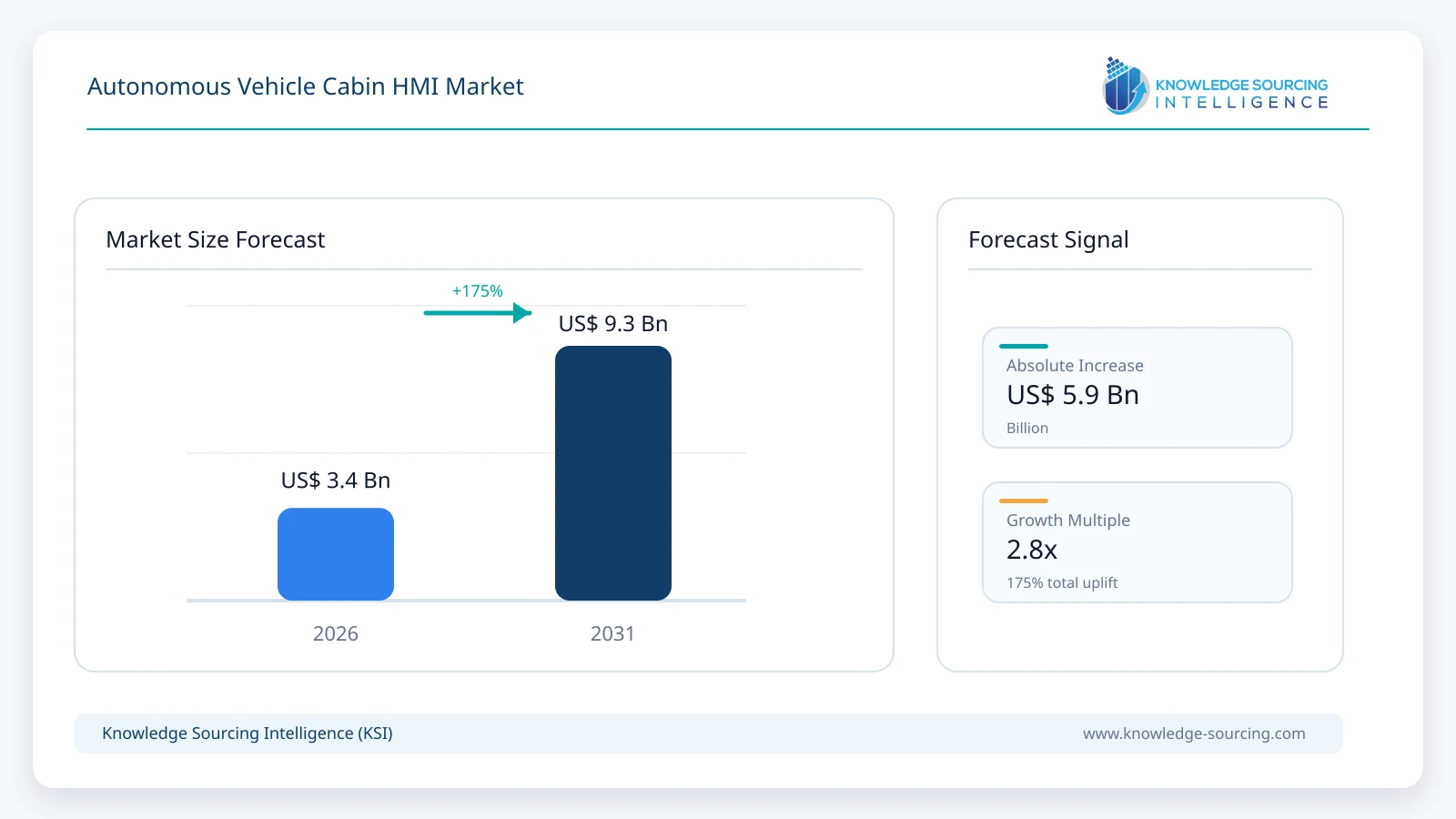
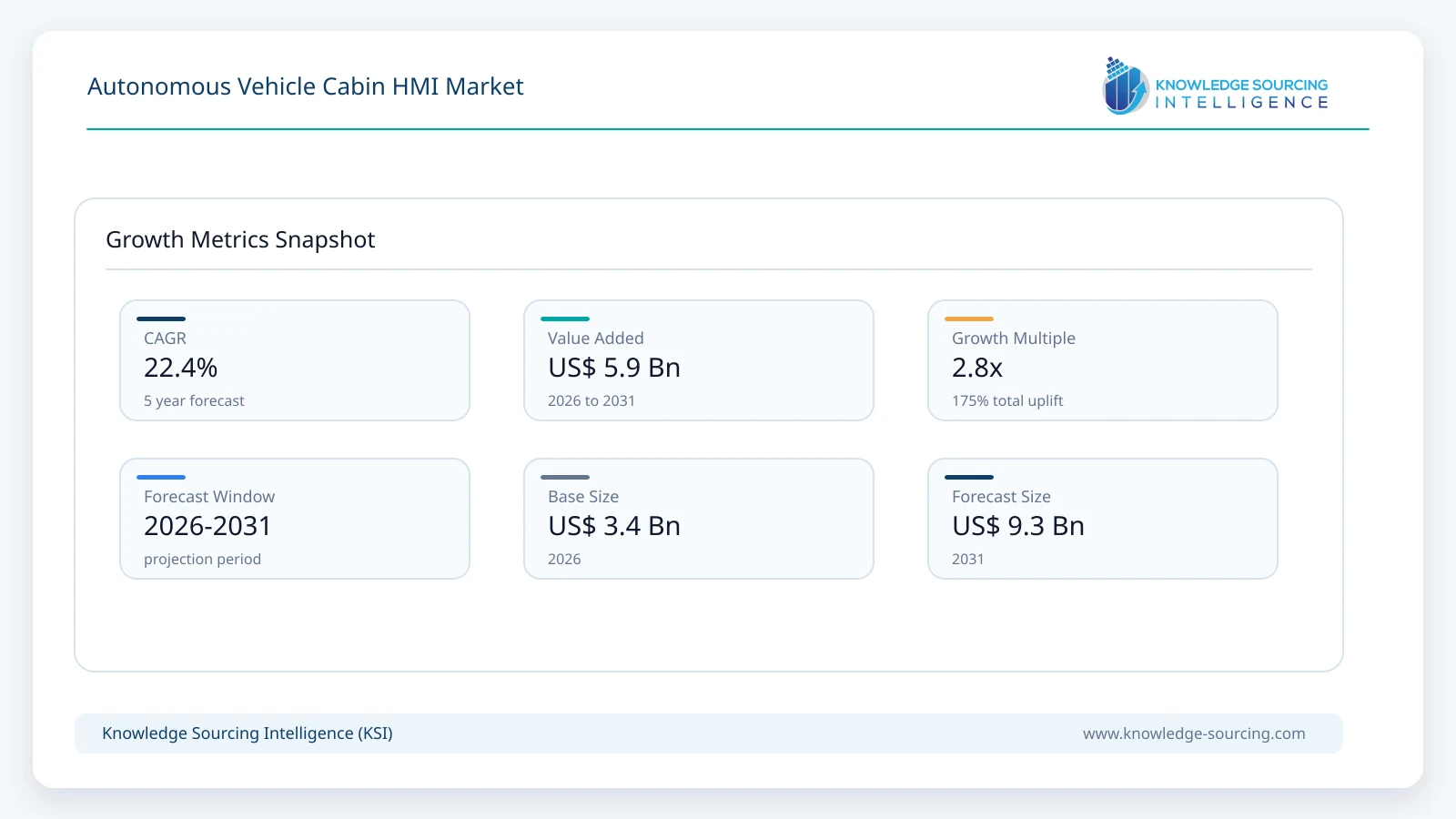
The autonomous vehicle cabin HMI market is forecast to grow at a CAGR of 22.4%, reaching approximately USD 9.35 billion in 2031 from USD 3.40 billion in 2026.
Highlights:
- 1Visual displays and head-up displays account for approximately 46% of global market value in 2026, reflecting their central role in automation-state communication, navigation, passenger information and digital content.
- 2Automation-status, safety and takeover interaction represents approximately 32% of market value in 2026 because Level 3 systems require clear communication of system availability, operating status and control-transition requests.
- 3SAE Level 3 applications account for approximately 61% of global market value in 2026, supported by the first production deployments of conditionally automated driving in premium passenger vehicles.
- 4Personally owned autonomous passenger vehicles represent approximately 63% of market value in 2026, while robotaxi and shared autonomous mobility applications are gaining rapidly.
- 5Battery electric vehicles account for approximately 72% of market value in 2026 because autonomous-driving development is increasingly concentrated on software-defined electric platforms with advanced cockpit electronics.
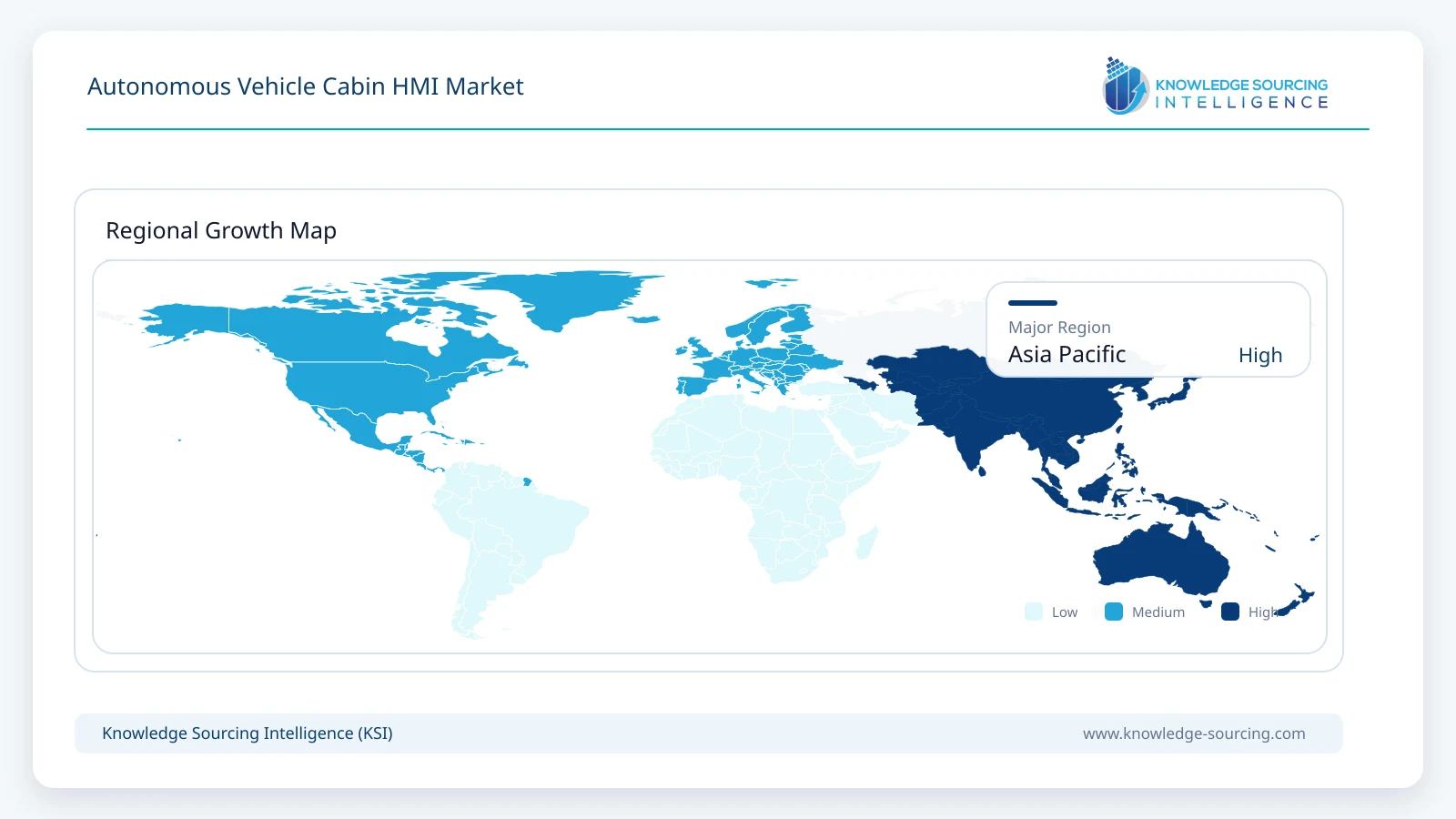
- 6Asia Pacific represents approximately 39% of global market value in 2026, supported by rapid smart-cabin development and strong automated-driving investment in China, Japan and South Korea.
Demand is being driven by the need to communicate automation status, support safe transitions of control, provide intuitive passenger interaction and expand digital services when occupants are no longer continuously responsible for driving.
Autonomous cabin HMI is becoming increasingly multimodal. Visual interfaces are being distributed across instrument clusters, center displays, passenger screens, panoramic head-up displays and windshield displays, while voice, touch, gesture and haptic feedback provide complementary channels according to driving context.
Commercial activity is expanding across both production vehicles and autonomous mobility services. Waymo's Ojai uses a coordinated tri-screen interface and Gemini voice interaction, Yanfeng's XiM27 combines a panoramic head-up display with centralized cabin electronics, and LG, HARMAN, Panasonic Automotive Systems, AUMOVIO and FORVIA are developing scalable cockpit and HMI platforms for increasingly automated vehicles.
Market Overview
Cabin HMI becomes more important as vehicle automation increases because the interface must explain what the vehicle is doing, what the occupant can do and when human intervention is required. At Level 3, this includes automation-state indication, takeover requests and driver-readiness interaction. At Level 4, the emphasis shifts toward passenger information, voice interaction, personalized services and cabin control.
Waymo's Ojai provides a direct Level 4 example. The vehicle uses three large LED displays with seat-position-aware controls and a redesigned user interface that distributes trip information, media and cabin controls according to where riders are seated. Gemini in Waymo adds conversational voice interaction for cabin controls, journey information and general knowledge.
Yanfeng's XiM27 combines a 35.4-inch panoramic head-up display, multiple interior screens and a centralized domain controller linking infotainment, seating, climate, doors and lighting. The system is designed to support transitions between manual and autonomous driving, including automatic steering-wheel stowage and scenario-based cabin adaptation.
LG's Digital Cockpit gamma and AI Cabin Platform demonstrate the move toward multimodal HMI that combines displays, voice, gesture, haptic feedback and in-cabin sensing. HARMAN's Ready Vision QVUE and Ready Engage similarly combine line-of-sight visual information with AI-based interaction, while Panasonic Automotive Systems provides cockpit domain controllers that support redesigned vehicle HMI and connected functions.
Market Trends
Automation-State Communication Is Becoming Safety-Critical
Level 3 driving creates a unique HMI requirement because the driver can disengage from continuous supervision but must be able to resume control when requested. The cabin therefore needs clear visual, acoustic and haptic signals to communicate system availability, activation, operating limits and takeover requests.
As Level 3 operating domains expand to higher speeds and longer periods, the quality and consistency of these transition interfaces becomes increasingly important to user trust and safe system operation.
Panoramic and Windshield-Based Displays Are Expanding
Automotive displays are moving from isolated cluster and center screens toward larger panoramic and windshield-based information layers. Yanfeng uses a 35.4-inch panoramic head-up display in XiM27, while HARMAN's Ready Vision QVUE delivers pillar-to-pillar windshield information and AUMOVIO offers ultrawide and integrated display technologies.
These formats are particularly relevant to automated driving because information volume and screen use can change according to whether the vehicle is in manual, assisted or automated mode.
Conversational AI Is Becoming a Primary Passenger Interface
Voice interaction is moving beyond fixed command structures toward generative and conversational AI. Waymo's Gemini integration allows riders to control cabin functions and ask contextual questions, while Cerence AI provides natural multimodal automotive interaction platforms across a large global installed base.
Conversational HMI becomes increasingly valuable in automated vehicles because occupants may be reclined, facing away from conventional controls or engaged in other activities.
Multimodal HMI Is Reducing Dependence on a Single Interface
Autonomous cabins increasingly combine visual, voice, gesture, touch and haptic channels. LG's intelligent HMI platform integrates voice, gesture and haptic feedback, while FORVIA's Cockpit UX Engine combines gaze-based selection with physical switches and adaptive cabin response.
Multimodal interaction allows the vehicle to select the most appropriate channel according to occupant attention, seating position, task and automation state.
Cabin HMI Is Becoming Seat- and Occupant-Aware
Autonomous-vehicle HMI is increasingly personalized according to who is present and where they are seated. Waymo distributes screen functions according to occupied seats, while in-cabin sensing platforms from LG, AUMOVIO, FORVIA and Valeo use cameras and sensing to understand driver or passenger attention and condition.
This enables information density, alerts and controls to adapt dynamically rather than presenting identical interfaces to every occupant.
Segment Analysis
By Interface Type: Visual Displays and Head-Up Displays
Visual displays and head-up display systems are projected to reach approximately USD 3.55 billion by 2031. Growth is being supported by panoramic screens, windshield displays, passenger-specific interfaces and adaptive information presentation that changes according to automation mode and occupant context.
By HMI Function: Infotainment, Productivity and Passenger Interaction
Infotainment, productivity and passenger-interaction HMI is projected to reach approximately USD 3.10 billion by 2031. As automated-driving periods increase, occupants gain more opportunity to consume media, communicate, work and interact with digital services, increasing demand for richer displays, voice assistants and personalized control.
By Automation Level: SAE Level 4 and Above
SAE Level 4 and above HMI applications are projected to reach approximately USD 5.05 billion by 2031. Level 4 vehicles shift interface design away from continuous driver supervision toward rider information, service interaction, personalized cabin controls and multi-passenger digital experiences.
By Vehicle Application: Personally Owned Autonomous Passenger Vehicles
Personally owned autonomous passenger vehicles are projected to generate approximately USD 4.55 billion of cabin-HMI market value by 2031. Premium and upper-mid passenger vehicles provide a strong commercialization path for advanced displays, multimodal interaction and automated-driving interfaces that are used repeatedly by the same owner.
By Propulsion: Battery Electric Vehicles
Battery electric vehicles are projected to generate approximately USD 7.95 billion of autonomous cabin-HMI market value by 2031. Electric platforms are strongly aligned with centralized computing, software-defined electronics and automated-driving development, making them the principal architecture for advanced cabin interfaces.
By Geography: Asia Pacific
Asia Pacific is projected to reach approximately USD 3.85 billion by 2031. China is the principal growth engine through rapid smart-cabin, EV and automated-driving development, while Japan and South Korea contribute established display, cockpit-electronics and HMI engineering capabilities.
Market Drivers
Expansion of Level 3 and Level 4 Automated Driving
Increasing vehicle automation creates new interface requirements that do not exist in conventional driving. Automation-state communication, takeover interaction and passenger-oriented controls become more important as responsibility shifts between the vehicle and occupants.
Growth of Software-Defined Vehicle Architectures
Centralized computing and software-defined electronics make it easier to coordinate displays, voice assistants, sensing and cabin controls through common platforms. This supports more adaptive and updateable HMI across multiple vehicle programs.
Increasing Demand for Productive and Entertaining Travel
Automated-driving periods create more opportunity for occupants to watch media, work, communicate and use connected services. Richer HMI is therefore becoming a key part of the value proposition for autonomous mobility.
Advances in Generative AI and Natural Language Interaction
Generative AI is improving the ability of in-vehicle assistants to understand natural requests, provide contextual information and control cabin functions. Voice-based interaction is particularly valuable when occupants are not facing conventional dashboards.
Expansion of In-Cabin Sensing
Driver and occupant monitoring allows HMI systems to adapt information according to gaze, attention, posture and seat occupancy. This improves both safety-related alerts and personalization during automated operation.
Market Restraints
Safety-Critical Transition Design
Poorly designed takeover requests or automation-state indicators can create confusion at the point when driver intervention is required. Level 3 HMI therefore demands rigorous human-factors validation and clear multimodal escalation strategies.
Driver and Passenger Distraction
Larger displays and richer digital content can increase distraction if information is presented at the wrong time. HMI systems must adapt content according to automation mode and ensure that manual-driving periods retain appropriate attention management.
High Hardware and Software Cost
Panoramic displays, head-up displays, domain controllers, advanced voice systems and in-cabin sensing add significant hardware and software content. Early deployment is therefore concentrated in premium passenger vehicles and autonomous fleets.
Cybersecurity and Data Privacy
Connected HMI systems can process voice recordings, user profiles, location data and in-cabin sensing information. Secure data handling, consent and software protection become more important as interface systems move into cloud-connected services.
Fragmented Regulations and Automation Definitions
Automated-driving rules differ across markets, and the HMI requirements for driver readiness, takeover requests and passenger interaction evolve with regulation. Suppliers must therefore support different operating domains and compliance frameworks.
Regional Outlook
Asia Pacific
Asia Pacific is the largest regional market and is expected to remain the strongest growth centre through 2031. China is driving rapid smart-cabin development through premium EVs and increasingly automated vehicles, with strong demand for panoramic displays, AI assistants, multimodal controls and centralized cabin electronics.
Yanfeng's XiM27 demonstrates a production-ready HMI architecture with a panoramic head-up display, multiple screens and centralized domain control. LG and Panasonic Automotive Systems add major regional capabilities in displays, cockpit controllers, sensing and multimodal HMI, while Japanese and Korean automakers continue to increase automated-driving and software-defined vehicle investment.
North America
North America is expected to remain a major high-growth market through 2031, supported by commercial Level 4 ride-hailing deployment, a large automotive software ecosystem and strong demand for premium digital cockpits. Waymo's Ojai demonstrates how autonomous HMI can be designed around riders through seat-aware screens, personalized cabin controls and conversational AI.
HARMAN and Cerence AI provide additional regional HMI depth through automotive displays, windshield-based information systems, AI assistants and natural-language interaction. Continued robotaxi scaling and development of software-defined electric vehicles are expected to increase HMI content per autonomous vehicle.
Competitive Landscape
The autonomous vehicle cabin HMI market is led by cockpit-electronics, display, software and AI suppliers with capabilities across visual interfaces, voice interaction, domain control and occupant-aware systems. HARMAN, LG Electronics Vehicle Solution, Panasonic Automotive Systems, AUMOVIO, Yanfeng, FORVIA and Cerence AI are directly involved in automotive HMI technologies relevant to increasingly automated vehicles.
HARMAN combines production-ready displays, windshield-based HMI and AI interaction through Ready Display, Ready Vision QVUE and Ready Engage. LG integrates displays, in-cabin sensing, multimodal HMI and vehicle computing, while Panasonic Automotive Systems supplies cockpit domain controllers that support redesigned vehicle interfaces and connected functionality.
AUMOVIO provides automotive displays, user-experience technologies and software-defined vehicle systems. Yanfeng combines cockpit electronics and complete smart-cabin integration, FORVIA provides cockpit domain controllers and HMI software, and Cerence AI specializes in conversational and generative AI interaction for automotive users.
Recent Developments
29 July 2026: Waymo introduced Gemini in Waymo and a redesigned Ojai tri-screen interface, adding conversational cabin control, journey information, seat-aware screen behavior and passenger personalization.
7 July 2026: Panasonic Automotive Systems announced that its cockpit domain controller had been adopted for the all-new Mazda CX-5, supporting a redesigned HMI, enhanced connectivity and expanded ADAS integration.
29 June 2026: Yanfeng unveiled XiM27, a production-ready smart-cabin platform with a 35.4-inch panoramic head-up display, multiple screens, centralized electronics and interface functions designed to support transitions between manual and autonomous driving.
28 May 2026: LG Electronics announced new Android Automotive OS-based IVI and software-defined vehicle solutions capable of simultaneously controlling multiple in-vehicle displays through a single SoC with personalized passenger features.
28 May 2026: Waymo began introducing public riders to Ojai, a purpose-built autonomous vehicle featuring a flat-floor cabin and three large LED screens with customizable temperature, media and trip information.
13 January 2026: HARMAN introduced expanded production-ready display technologies including Ready Display and Ready Vision QVUE, with context-aware information presentation designed to improve in-cabin clarity and safety.
5 January 2026: Valeo and Seeing Machines announced integrated driver and occupant monitoring applications for CES 2026, combining in-cabin perception with safety-focused software for new regulatory and automated-driving requirements.
17 December 2025: LG Electronics announced AI-powered in-vehicle solutions for CES 2026 combining display technology, in-cabin sensing and on-device AI within an AI-defined vehicle architecture.
Market Outlook
The autonomous vehicle cabin HMI market is expected to expand rapidly through 2031 as Level 3 and Level 4 systems increase the amount of time occupants interact with the vehicle as a digital environment rather than only as a driving machine. Visual displays will remain the largest interface layer, while conversational AI and multimodal interaction are expected to gain share.
The next stage of development will focus on context-aware information presentation, clearer control-transition communication, passenger-specific interfaces and seamless coordination between displays, voice, haptics and in-cabin sensing. HMI architectures will increasingly change automatically according to automation level and occupant role.
Asia Pacific is expected to lead market expansion, while North America remains a major commercialization region for Level 4 mobility and AI-based rider interfaces. Competitive advantage will depend on human-factors design, software integration, display clarity, voice accuracy, functional safety, cybersecurity and the ability to scale common HMI platforms across multiple automation levels.
Autonomous Vehicle Cabin HMI Market Scope
| Report Metric | Details |
|---|---|
| Total Market Size in 2026 | USD 3.40 billion |
| Total Market Size in 2031 | USD 9.35 billion |
| Forecast Unit | Billion |
| Growth Rate | 22.4% |
| Study Period | 2021 to 2031 |
| Historical Data | 2021 to 2024 |
| Base Year | 2025 |
| Forecast Period | 2026 – 2031 |
| Segmentation | Interface Type, HMI Function, Automation Level, Vehicle Application, Propulsion, Geography |
| Companies |
|
Market Segmentation
By Interface Type
Visual Displays and Head-Up Displays
Voice and Conversational AI
Touch and Haptic
Gesture, Gaze and Multimodal Interaction
By HMI Function
Automation Status and Takeover Interaction
Infotainment, Productivity and Passenger Interaction
Cabin Control and Personalization
Occupant Safety and Monitoring Interaction
By Automation Level
SAE Level 3
SAE Level 4 and Above
By Vehicle Application
Personally Owned Autonomous Passenger Vehicles
Robotaxi and Shared Autonomous Mobility
Autonomous Shuttle and Commercial Mobility
By Propulsion
Battery Electric Vehicles
Hybrid Electric Vehicles
Internal Combustion Engine Vehicles
By Geography
North America
United States
Canada
Mexico
South America
Brazil
Argentina
Others
Europe
Germany
United Kingdom
France
Italy
Spain
Others
Middle East and Africa
Saudi Arabia
UAE
South Africa
Others
Asia Pacific
China
Japan
South Korea
India
Singapore
Others
Table of Contents
1. INTRODUCTION
1.1. Market Overview
1.2. Market Definition
1.3. Scope of the Study
1.4. Market Segmentation
1.5. Currency
1.6. Assumptions
1.7. Base and Forecast Years
1.8. Key Benefits to Stakeholders
2. RESEARCH METHODOLOGY
2.1. Research Design
2.2. Secondary Research
2.3. Primary Research
2.4. Market Estimation
2.5. Segment Modelling
2.6. Data Triangulation and Validation
3. EXECUTIVE SUMMARY
3.1. Key Findings
3.2. Autonomous Vehicle Cabin HMI Market Size, 2026-2031
3.3. Interface Type Outlook
3.4. HMI Function Outlook
3.5. Automation Level Outlook
3.6. Vehicle Application Outlook
3.7. Propulsion Outlook
3.8. Regional Opportunity Summary
4. MARKET DYNAMICS
4.1. Market Drivers
4.1.1. Expansion of Level 3 and Level 4 Automated Driving
4.1.2. Growth of Software-Defined Vehicle Architectures
4.1.3. Increasing Demand for Productive and Entertaining Travel
4.1.4. Advances in Generative AI and Natural Language Interaction
4.1.5. Expansion of In-Cabin Sensing
4.2. Market Restraints
4.2.1. Safety-Critical Transition Design
4.2.2. Driver and Passenger Distraction
4.2.3. High Hardware and Software Cost
4.2.4. Cybersecurity and Data Privacy
4.2.5. Fragmented Regulations and Automation Definitions
4.3. Market Opportunities
4.4. Porter's Five Forces Analysis
4.5. Industry Value Chain Analysis
4.6. Cabin HMI System Economics
4.7. Safety and Regulatory Environment
5. TECHNOLOGY OUTLOOK
5.1. Digital Instrument Clusters
5.2. Center and Passenger Displays
5.3. Head-Up and Windshield Displays
5.4. Voice and Conversational AI
5.5. Touch and Capacitive Controls
5.6. Haptic Interaction
5.7. Gesture and Gaze-Based Control
5.8. Driver and Occupant Monitoring Integration
5.9. Automation-State and Takeover HMI
5.10. Centralized Cockpit Domain Controllers
6. AUTONOMOUS VEHICLE CABIN HMI MARKET BY INTERFACE TYPE
6.1. Introduction
6.2. Visual Displays and Head-Up Displays
6.3. Voice and Conversational AI
6.4. Touch and Haptic
6.5. Gesture, Gaze and Multimodal Interaction
7. AUTONOMOUS VEHICLE CABIN HMI MARKET BY HMI FUNCTION
7.1. Introduction
7.2. Automation Status and Takeover Interaction
7.3. Infotainment, Productivity and Passenger Interaction
7.4. Cabin Control and Personalization
7.5. Occupant Safety and Monitoring Interaction
8. AUTONOMOUS VEHICLE CABIN HMI MARKET BY AUTOMATION LEVEL
8.1. Introduction
8.2. SAE Level 3
8.3. SAE Level 4 and Above
9. AUTONOMOUS VEHICLE CABIN HMI MARKET BY VEHICLE APPLICATION
9.1. Introduction
9.2. Personally Owned Autonomous Passenger Vehicles
9.3. Robotaxi and Shared Autonomous Mobility
9.4. Autonomous Shuttle and Commercial Mobility
10. AUTONOMOUS VEHICLE CABIN HMI MARKET BY PROPULSION
10.1. Introduction
10.2. Battery Electric Vehicles
10.3. Hybrid Electric Vehicles
10.4. Internal Combustion Engine Vehicles
11. AUTONOMOUS VEHICLE CABIN HMI MARKET BY GEOGRAPHY
11.1. North America
11.1.1. United States
11.1.2. Canada
11.1.3. Mexico
11.2. South America
11.2.1. Brazil
11.2.2. Argentina
11.2.3. Others
11.3. Europe
11.3.1. Germany
11.3.2. United Kingdom
11.3.3. France
11.3.4. Italy
11.3.5. Spain
11.3.6. Others
11.4. Middle East and Africa
11.4.1. Saudi Arabia
11.4.2. UAE
11.4.3. South Africa
11.4.4. Others
11.5. Asia Pacific
11.5.1. China
11.5.2. Japan
11.5.3. South Korea
11.5.4. India
11.5.5. Singapore
11.5.6. Others
12. COMPETITIVE ENVIRONMENT AND ANALYSIS
12.1. Major Players and Strategy Analysis
12.2. Market Share Analysis
12.3. Product and Technology Benchmarking
12.4. HMI Platform Launches and Development Activity
12.5. Competitive Dashboard
13. COMPANY PROFILES
13.1. HARMAN International
13.2. LG Electronics Vehicle Solution Company
13.3. Panasonic Automotive Systems Co., Ltd.
13.4. AUMOVIO SE
13.5. Yanfeng
13.6. FORVIA
13.7. Cerence AI
14. APPENDIX
14.1. Currency
14.2. Assumptions
14.3. Base and Forecast Years Timeline
14.4. Key Benefits for Stakeholders
14.5. Research Methodology
14.6. Abbreviations
14.7. Data Sources
Navigate
Trusted by the world's leading organizations











