
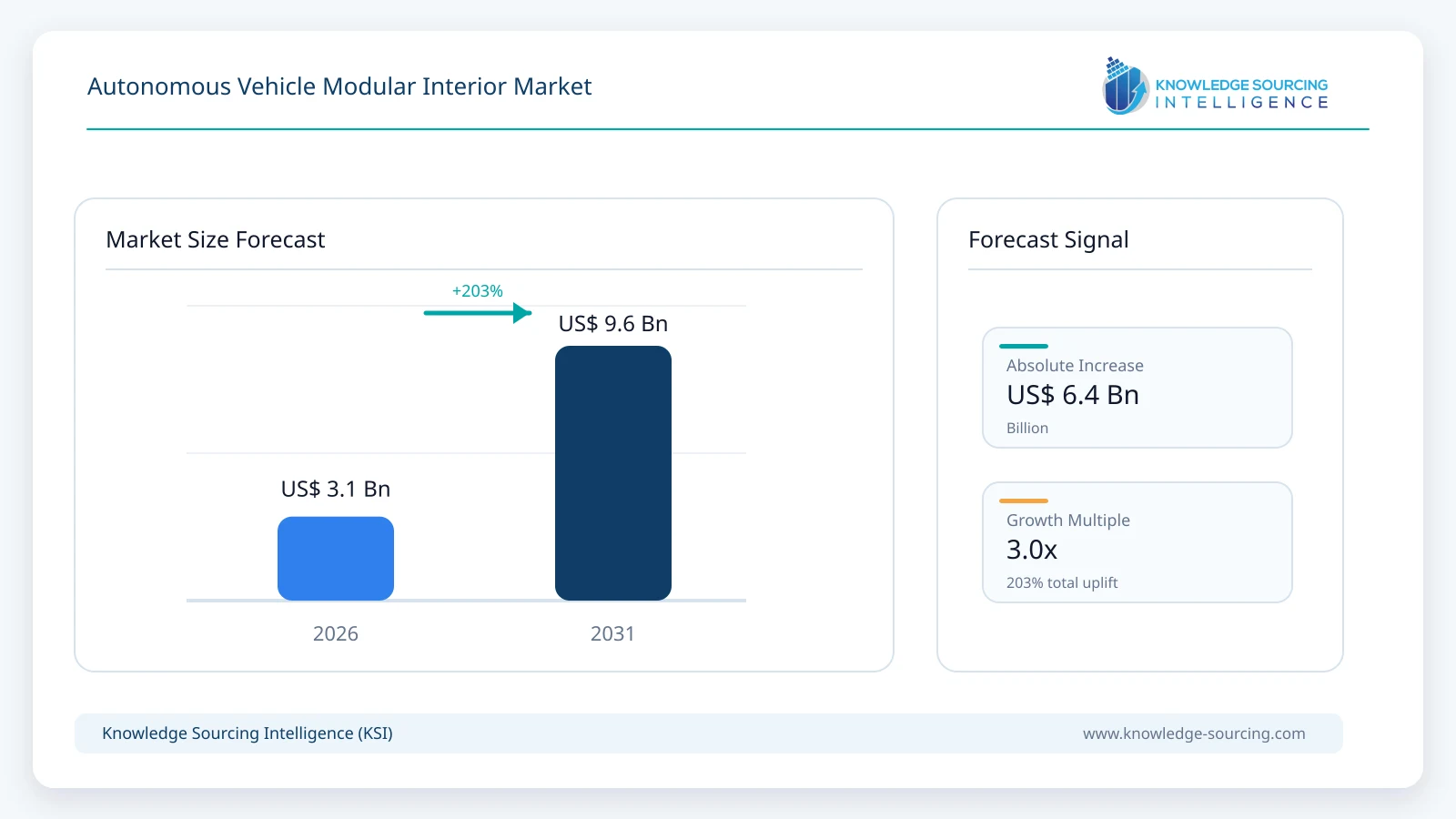
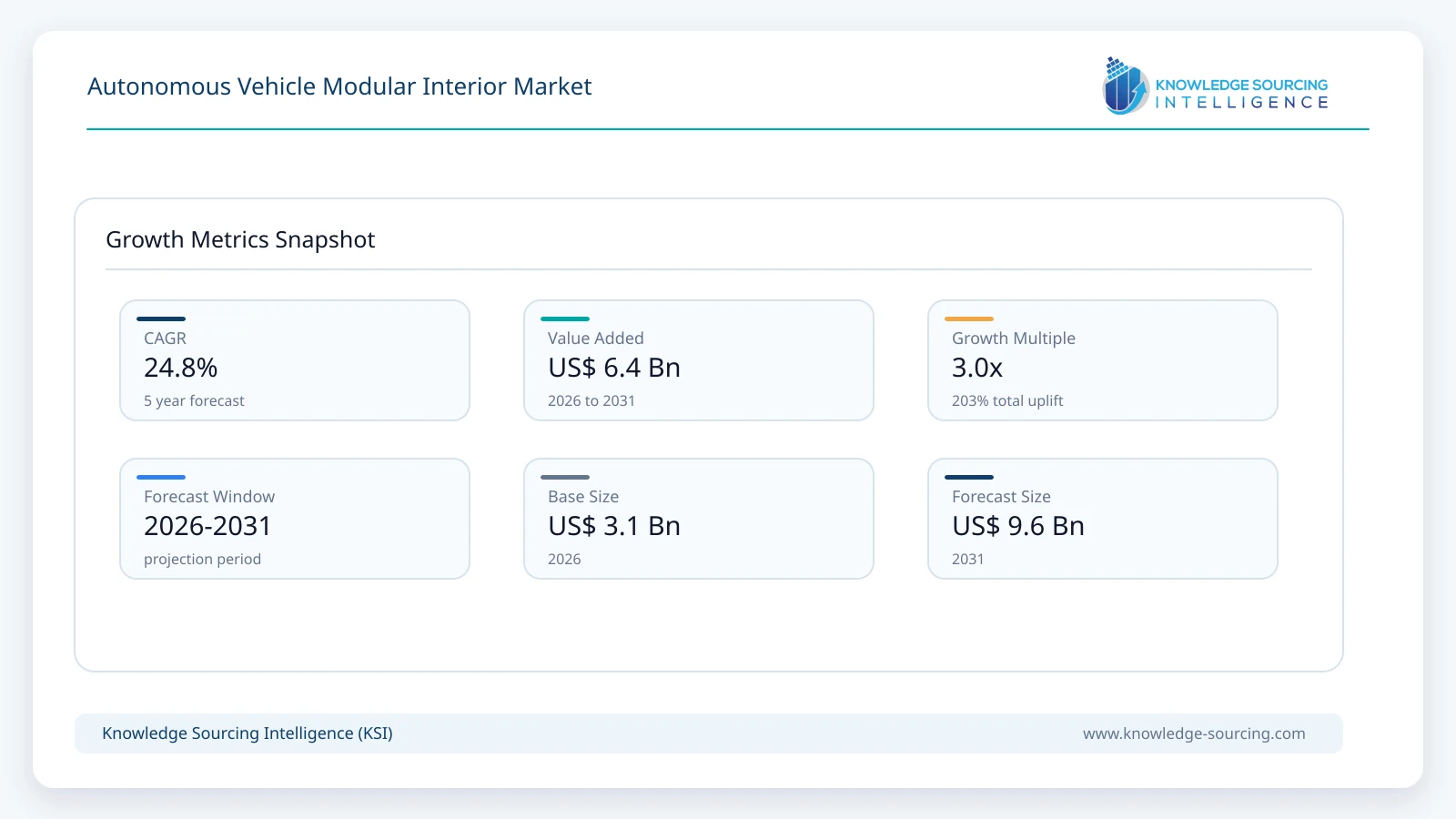
The Autonomous Vehicle Modular Interior Market is forecast to grow at a CAGR of 24.8%, reaching approximately USD 9.55 billion in 2031 from USD 3.15 billion in 2026.
Highlights:
- 1Seating and rail modules account for approximately 39% of global market value in 2026, reflecting the high value of standardized seat structures, long rails, swivels and integrated movement systems.
- 2Front and cockpit-zone modules represent approximately 43% of market value in 2026 because center consoles, cockpit electronics, front seating and HMI surfaces receive modular integration earlier than other cabin zones.
- 3Interchangeable and plug-and-play module architectures account for approximately 46% of global market value in 2026, supported by standardized mechanical, power, data and signal interfaces.
- 4SAE Level 3 applications represent approximately 57% of market value in 2026 as conditional automation creates the first production-scale requirement for cabins that can switch between driver-focused and non-driving modes.
- 5Personally owned autonomous passenger vehicles account for approximately 59% of market value in 2026, while robotaxi and purpose-built autonomous mobility applications are gaining rapidly.
- 6Battery electric vehicles represent approximately 74% of global market value in 2026 because flat floors and centralized electronics provide the strongest platform for modular autonomous interiors.
- 7Asia Pacific represents approximately 41% of global market value in 2026, supported by rapid smart-cabin, EV, and higher-automation development in China, Japan, and South Korea.
Demand is being driven by increasingly automated vehicles that require cabin systems capable of supporting several seating, workspace, lounge, cargo and passenger-service configurations without redesigning the complete interior.
Modular interior development is moving toward common mechanical, electrical and data interfaces that allow seating, consoles, smart surfaces and cockpit functions to be configured across several use cases. FORVIA's On-demand center console uses a standardized tool-free platform for interchangeable modules, while Yanfeng's XiM27 combines highly modular layouts, ultra-long floor rails, movable consoles and centralized cabin electronics within a production-ready Level 3+ smart cabin.
Toyota Boshoku is developing coordinated mobility spaces in which seats, door trims and consoles work together, while its Future Creation Modular Seat uses interchangeable configurations. Magna applies reusable building blocks to flexible seating systems, Adient's ModuGo uses a common modular seat architecture, and Antolin is advancing configurable smart-surface HMI for future vehicle platforms.
Market Overview
Autonomous modular interiors are based on cabin systems that can be reused, exchanged or reconfigured across different vehicle layouts and passenger scenarios. Unlike fixed interior assemblies, modular architectures separate long-life structural foundations from configurable functional modules, allowing automakers to vary seating, storage, HMI, comfort and digital content without recreating the complete cabin.
Yanfeng's XiM27 demonstrates whole-cabin modularity through ultra-long rails that support independent seat and floor-console movement, foldable tables, multiple displays and a centralized domain controller. The platform can move between driving, lounge, rest, work, and cargo scenarios within a common interior architecture.
FORVIA's On-demand center console demonstrates plug-and-play modularity at component level. Its MoodPlug interface integrates mechanical attachment, power, signals and data, allowing storage, tray, refrigerator and display modules to be added or replaced without structural changes.
Toyota Boshoku's LOUNZE+ coordinates seats, door trims and console functions so the cabin can adapt to different passenger scenes. Its Future Creation Modular Seat also uses interchangeable configurations, while Magna and Adient are applying common modular foundations to flexible seating and comfort systems.
Market Trends
Common Interior Building Blocks Are Replacing One-Off Architectures
Interior suppliers are increasingly developing reusable structural and functional foundations that can support several cabin configurations. Magna's flexible seating strategy uses long-travel rails, rotating bases, and common support structures as building blocks that can be scaled across different programs.
This approach reduces the need to engineer separate interior mechanisms for every trim, region, or use case while still allowing meaningful passenger-facing differentiation.
Plug-and-Play Mechanical and Electrical Interfaces Are Expanding
Standardized interfaces are becoming a major enabler of modular interiors because they allow functional modules to be changed without redesigning the base structure. FORVIA's MoodPlug combines tool-free mechanical attachment with electrical, signal, and data connectivity.
Such interfaces can support both factory configuration and later upgrades, increasing the potential for lifecycle customization and component reuse.
Software-Defined Cabins Are Increasing Functional Modularity
Modular interior hardware is increasingly coordinated through centralized software. Yanfeng's XiM27 connects seating, lighting, climate, infotainment and door functions through a domain controller, allowing one hardware platform to support several passenger scenarios.
Software-defined control can therefore increase the number of usable cabin configurations without requiring a proportional increase in unique hardware.
Smart Surfaces Are Becoming Configurable Interior Modules
Interior trim is increasingly being designed as a functional layer that can integrate touch, force sensing, visual feedback, and haptics. Antolin and UltraSense are developing a thin, configurable solid-state Smart Surface HMI intended for a global vehicle platform.
Configurable smart surfaces allow automakers to change control layouts and functionality while retaining common trim structures and industrialization processes.
Circularity Is Strengthening the Value of Replaceable Modules
Modular design can extend interior component life by allowing damaged, outdated, or optional functions to be replaced independently. FORVIA positions its modular console around reuse and lifecycle extension, while suppliers are increasing recyclable materials and easy-disassembly design.
This architecture can reduce full-system replacement and support refurbishment, second-life, and upgrade strategies over the vehicle lifecycle.
Segment Analysis
By Modular System Type: Seating and Rail Modules
Seating and rail modules are projected to reach approximately USD 3.35 billion by 2031. Long rails, standardized structures, swivel bases and configurable seat mechanisms provide the physical foundation for multi-mode autonomous interiors and can be reused across several layouts and vehicle programs.
By Interior Zone: Front and Cockpit Zone
Front and cockpit-zone modular systems are projected to reach approximately USD 3.82 billion by 2031. Center consoles, cockpit electronics, front seats, and smart surfaces combine high functional content with frequent feature differentiation, making them attractive for modular interfaces and scalable hardware.
By Modularity Approach: Interchangeable and Plug-and-Play Modules
Interchangeable and plug-and-play modules are projected to reach approximately USD 4.11 billion by 2031. Standardized interfaces allow functions to be added, replaced, or upgraded without redesigning the complete interior, improving platform reuse and reducing program-specific complexity.
By Automation Level: SAE Level 4 and Above
SAE Level 4 and above modular interiors are projected to reach approximately USD 5.35 billion by 2031. Higher automation increases the number of passenger-focused cabin modes and strengthens the need for interior systems that can be configured around mobility service, accessibility, work, rest, and social use cases.
By Vehicle Application: Personally Owned Autonomous Passenger Vehicles
Personally owned autonomous passenger vehicles are projected to generate approximately USD 4.49 billion of modular-interior market value by 2031. Premium EVs, SUVs and MPVs provide a strong commercialization path for configurable seating, smart consoles and digital interior modules used repeatedly by the same occupants.
By Propulsion: Battery Electric Vehicles
Battery electric vehicles are projected to generate approximately USD 8.02 billion of modular-interior market value by 2031. Flat-floor packaging, centralized electronics and close alignment between EV and automated-driving development make battery-electric platforms the principal architecture for modular cabin systems.
By Geography: Asia Pacific
Asia Pacific is projected to reach approximately USD 4.05 billion by 2031. China is the principal growth engine through rapid smart-cabin and EV commercialization, while Japan and South Korea contribute established seating, interior and electronics capabilities.
Market Drivers
Expansion of SAE Level 3 and Level 4 Automated Driving
Higher automation increases the number of cabin scenarios that vehicles must support. Modular interiors allow common architectures to serve conventional driving, work, lounge, passenger-service, and cargo functions without requiring a separate interior for each use case.
Need to Reuse Interior Architectures Across Vehicle Programs
Automakers are managing more trims, regional variants, and software-defined feature combinations. Modular interior platforms allow common structures and interfaces to be reused while selected functions are varied at module level.
Electric-Vehicle Packaging Freedom
Battery-electric platforms can provide flatter floors and fewer drivetrain intrusions, supporting long rails, movable consoles, and more flexible module placement. Centralized electronics also simplify power and data distribution across modular cabin components.
Demand for Personalized and Upgradeable Cabins
Consumers increasingly expect cabins to adapt to individual preferences and changing activities. Interchangeable modules, configurable controls, and movable seating allow the interior to evolve without replacing complete assemblies.
Sustainability and Lifecycle Extension
Replaceable and reusable modules can reduce material waste and support repair or upgrade strategies. Modular architectures separate functional content from longer-life structures, improving the potential for refurbishment and circularity.
Market Restraints
Lack of Standardized Interfaces
Mechanical, power, data, and safety interfaces differ across OEMs and platforms. Limited standardization can reduce module interchangeability and require supplier-specific engineering for each vehicle architecture.
Higher Upfront Architecture Cost
A reusable modular platform requires significant early engineering to support multiple future configurations, safety conditions and feature combinations. The business case depends on sufficient reuse across vehicle programs and volumes.
Crash and Safety Validation Complexity
Movable seats, consoles and modular interior elements must remain secure under crash loads and must not interfere with airbags, belts, occupant sensing or emergency access. More configurations increase the number of states requiring validation.
Weight and Packaging Trade-Offs
Interfaces, rails, locking systems, and movable hardware can add weight and consume packaging space. Suppliers must balance flexibility and modularity with lightweighting, battery packaging, and cabin ergonomics.
Complex Supplier Coordination
Modular interiors often combine seating, electronics, HMI, trim, storage and climate functions from multiple suppliers. Poorly defined interfaces can shift complexity into integration and validation rather than eliminating it.
Regional Outlook
Asia Pacific
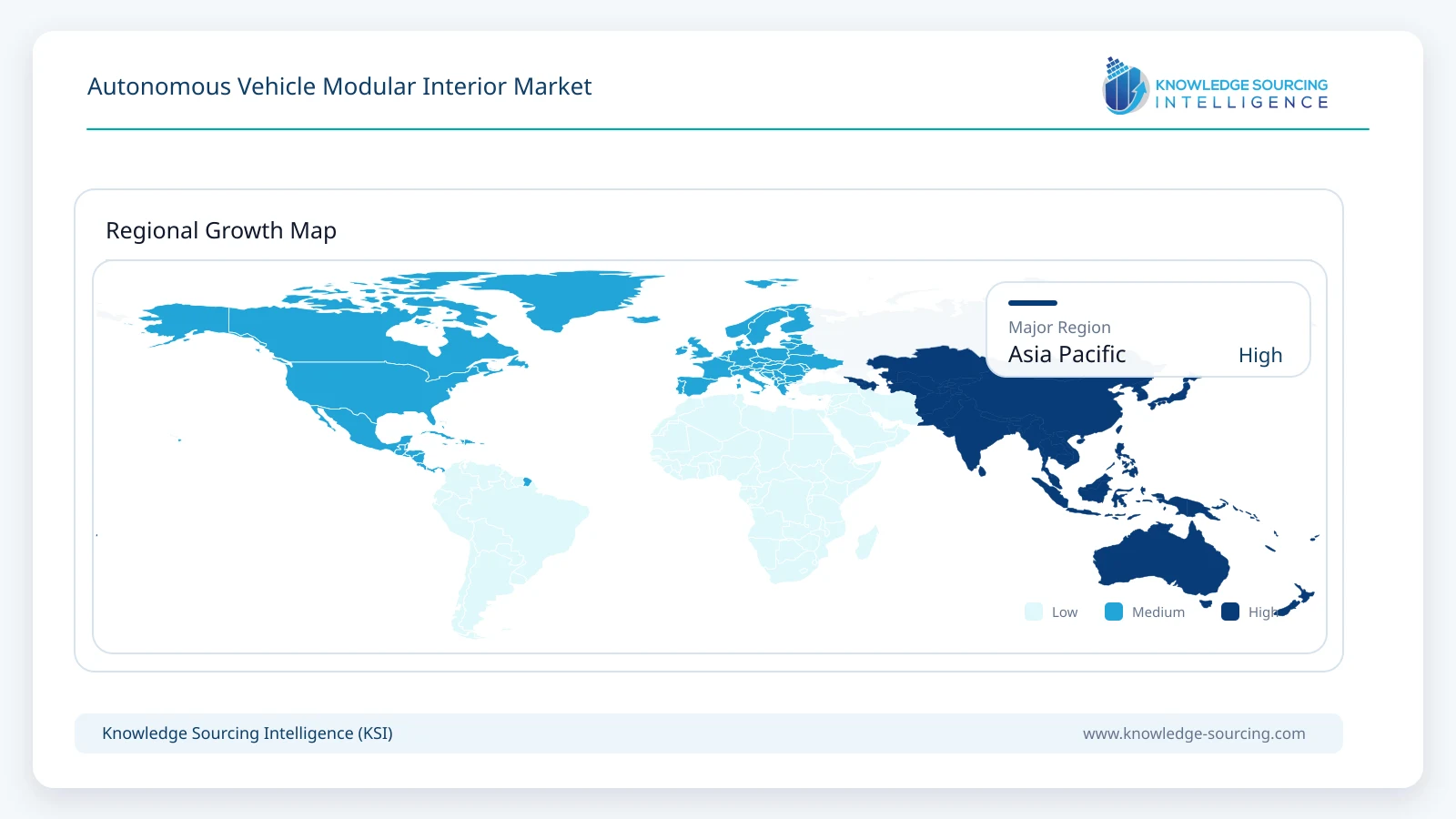
Asia Pacific is the largest regional market and is expected to remain the strongest growth centre through 2031. China is driving commercialization through premium EVs, smart cabins and higher-level automated-driving programs, with suppliers moving modular concepts toward production-ready architectures.
Yanfeng's XiM27 combines highly modular seating layouts, independent floor-console movement and centralized electronics in a Level 3+ platform. Toyota Boshoku's LOUNZE+ and Future Creation Modular Seat demonstrate continued Japanese investment in coordinated and interchangeable mobility-space systems.
Europe
Europe is the second major regional market, supported by premium vehicle production, early Level 3 commercialization and a strong supplier base in modular consoles, seating, smart surfaces and cockpit systems.
FORVIA's On-demand center console provides a direct example of plug-and-play interior modularity, Adient's ModuGo applies a common modular foundation to seating, and Antolin is industrializing configurable Smart Surface HMI for future vehicle platforms. European focus on circularity and software-defined vehicles is expected to strengthen demand for reusable interior architectures.
Competitive Landscape
The autonomous vehicle modular interior market is led by suppliers with direct capabilities in seating, consoles, cockpit systems, trim, smart surfaces and centralized cabin integration. Yanfeng, FORVIA, Toyota Boshoku, Magna, Adient, Antolin and Hyundai Transys are directly active in modular or configurable interior technologies relevant to higher-automation vehicles.
Yanfeng differentiates through complete smart-cabin integration and highly modular floor, seat and console layouts. FORVIA combines plug-and-play console systems with modular cockpit and smart-surface capabilities, while Toyota Boshoku links modular seating with coordinated interior-space concepts.
Magna focuses on scalable seat and rail building blocks, Adient applies common modular foundations to structure and comfort, Antolin develops configurable HMI and smart-surface modules, and Hyundai Transys is advancing flexible seat layouts and integrated controls for autonomous mobility.
Recent Developments
8 September 2026: Antolin and UltraSense Systems announced advancement of a next-generation Smart Surface HMI initiative for a future global vehicle platform, combining configurable touch, force sensing, visual feedback and haptics.
10 July 2026: Yanfeng's XiM27 received the 2026 Red Dot Design Concept Award; the Level 3+ platform features intelligent seat configuration and an adaptable interior architecture.
29 June 2026: Yanfeng unveiled XiM27, a production-ready smart-cabin platform with highly modular seating layouts, ultra-long floor rails, foldable tables, multiple screens and independent floor-console movement.
18 June 2026: Magna detailed its Flexible Seating System, focusing on system-level architecture and reusable building blocks designed around real usage patterns rather than over-indexed novelty configurations.
23 April 2026: Toyota Boshoku presented LOUNZE+ at Auto China 2026, coordinating seats, door trims and the center console so the cabin can adapt to different purposes and passenger scenes.
30 October 2025: FORVIA introduced its On-demand center console, a plug-and-play modular interior system using a standardized tool-free interface for interchangeable storage, tray, refrigerator and display modules.
25 August 2025: Adient announced ModuGo, a modular seat architecture supporting structural customization, materials selection and configurable comfort features from a common platform.
15 April 2025: Toyota Boshoku announced its Future Creation Modular Seat for Auto Shanghai 2025, using an interchangeable structure that can switch among advanced, relaxed and sporty configurations.
Market Outlook
The autonomous vehicle modular interior market is expected to expand rapidly through 2031 as higher automation and software-defined vehicles increase demand for reusable cabin architectures that can support multiple passenger scenarios. Seating and rail modules will remain a major value pool, while plug-and-play consoles, smart surfaces and software-configurable modules are expected to gain share.
Future development will focus on standardized mechanical and electrical interfaces, lighter locking and rail systems, centralized software control and module designs that can be upgraded or replaced independently. Modular interiors will increasingly become a vehicle-platform strategy rather than a collection of isolated components.
Asia Pacific is expected to lead commercialization, while Europe remains a major market for premium modular interiors, circular design and software-linked smart surfaces. Competitive advantage will depend on interface standardization, safety validation, software integration, packaging efficiency, and the ability to reuse common modules across multiple automated-vehicle programs.
Autonomous Vehicle Modular Interior Market Scope:
| Report Metric | Details |
|---|---|
| Total Market Size in 2026 | USD 3.15 billion |
| Total Market Size in 2031 | USD 9.55 billion |
| Forecast Unit | USD Billion |
| Growth Rate | 24.8% |
| Study Period | 2021 to 2031 |
| Historical Data | 2021 to 2024 |
| Base Year | 2025 |
| Forecast Period | 2026 – 2031 |
| Segmentation | Modular System Type, Interior Zone, Modularity Approach, Automation Level |
| Companies |
|
Market Segmentation
By Modular System Type
Seating and Rail Modules
Center Console and Storage Modules
Cockpit and HMI Modules
Smart Surface, Door and Trim Modules
Cabin Electronics and Control Modules
By Interior Zone
Front and Cockpit Zone
Rear and Passenger Cabin
Whole-Cabin Integrated Modules
By Modularity Approach
Interchangeable and Plug-and-Play Modules
Reconfigurable and Movable Modules
Software-Configurable Interior Modules
By Automation Level
SAE Level 3
SAE Level 4 and Above
By Vehicle Application
Personally Owned Autonomous Passenger Vehicles
Robotaxi and Shared Autonomous Mobility
Autonomous Shuttle and Purpose-Built Mobility
By Propulsion
Battery Electric Vehicles
Hybrid Electric Vehicles
Internal Combustion Engine Vehicles
By Geography
North America
United States
Canada
Mexico
South America
Brazil
Argentina
Others
Europe
Germany
France
United Kingdom
Italy
Spain
Others
Middle East and Africa
Saudi Arabia
UAE
South Africa
Others
Asia Pacific
China
Japan
South Korea
India
Singapore
Others
Table of Contents
1. INTRODUCTION
1.1. Market Overview
1.2. Market Definition
1.3. Scope of the Study
1.4. Market Segmentation
1.5. Currency
1.6. Assumptions
1.7. Base and Forecast Years
1.8. Key Benefits to Stakeholders
2. RESEARCH METHODOLOGY
2.1. Research Design
2.2. Secondary Research
2.3. Primary Research
2.4. Market Estimation
2.5. Segment Modelling
2.6. Data Triangulation and Validation
3. EXECUTIVE SUMMARY
3.1. Key Findings
3.2. Autonomous Vehicle Modular Interior Market Size, 2026-2031
3.3. Modular System Type Outlook
3.4. Interior Zone Outlook
3.5. Modularity Approach Outlook
3.6. Automation Level Outlook
3.7. Vehicle Application Outlook
3.8. Propulsion Outlook
3.9. Regional Opportunity Summary
4. MARKET DYNAMICS
4.1. Market Drivers
4.1.1. Expansion of SAE Level 3 and Level 4 Automated Driving
4.1.2. Need to Reuse Interior Architectures Across Vehicle Programs
4.1.3. Electric-Vehicle Packaging Freedom
4.1.4. Demand for Personalized and Upgradeable Cabins
4.1.5. Sustainability and Lifecycle Extension
4.2. Market Restraints
4.2.1. Lack of Standardized Interfaces
4.2.2. Higher Upfront Architecture Cost
4.2.3. Crash and Safety Validation Complexity
4.2.4. Weight and Packaging Trade-Offs
4.2.5. Complex Supplier Coordination
4.3. Market Opportunities
4.4. Porter's Five Forces Analysis
4.5. Industry Value Chain Analysis
4.6. Modular Interior Platform Economics
4.7. Safety and Regulatory Environment
5. TECHNOLOGY OUTLOOK
5.1. Modular Long-Rail and Seat Structures
5.2. Swappable and Tetherless Seating Modules
5.3. Plug-and-Play Center Consoles
5.4. Interchangeable Storage and Work Modules
5.5. Modular Cockpit and Display Systems
5.6. Configurable Smart Surface HMI
5.7. Door and Trim Modules
5.8. Standardized Power and Data Interfaces
5.9. Centralized Cabin Domain Control
5.10. Upgradeable and Circular Interior Architectures
6. AUTONOMOUS VEHICLE MODULAR INTERIOR MARKET BY MODULAR SYSTEM TYPE
6.1. Introduction
6.2. Seating and Rail Modules
6.3. Center Console and Storage Modules
6.4. Cockpit and HMI Modules
6.5. Smart Surface, Door and Trim Modules
6.6. Cabin Electronics and Control Modules
7. AUTONOMOUS VEHICLE MODULAR INTERIOR MARKET BY INTERIOR ZONE
7.1. Introduction
7.2. Front and Cockpit Zone
7.3. Rear and Passenger Cabin
7.4. Whole-Cabin Integrated Modules
8. AUTONOMOUS VEHICLE MODULAR INTERIOR MARKET BY MODULARITY APPROACH
8.1. Introduction
8.2. Interchangeable and Plug-and-Play Modules
8.3. Reconfigurable and Movable Modules
8.4. Software-Configurable Interior Modules
9. AUTONOMOUS VEHICLE MODULAR INTERIOR MARKET BY AUTOMATION LEVEL
9.1. Introduction
9.2. SAE Level 3
9.3. SAE Level 4 and Above
10. AUTONOMOUS VEHICLE MODULAR INTERIOR MARKET BY VEHICLE APPLICATION
10.1. Introduction
10.2. Personally Owned Autonomous Passenger Vehicles
10.3. Robotaxi and Shared Autonomous Mobility
10.4. Autonomous Shuttle and Purpose-Built Mobility
11. AUTONOMOUS VEHICLE MODULAR INTERIOR MARKET BY PROPULSION
11.1. Introduction
11.2. Battery Electric Vehicles
11.3. Hybrid Electric Vehicles
11.4. Internal Combustion Engine Vehicles
12. AUTONOMOUS VEHICLE MODULAR INTERIOR MARKET BY GEOGRAPHY
12.1. North America
12.1.1. United States
12.1.2. Canada
12.1.3. Mexico
12.2. South America
12.2.1. Brazil
12.2.2. Argentina
12.2.3. Others
12.3. Europe
12.3.1. Germany
12.3.2. France
12.3.3. United Kingdom
12.3.4. Italy
12.3.5. Spain
12.3.6. Others
12.4. Middle East and Africa
12.4.1. Saudi Arabia
12.4.2. UAE
12.4.3. South Africa
12.4.4. Others
12.5. Asia Pacific
12.5.1. China
12.5.2. Japan
12.5.3. South Korea
12.5.4. India
12.5.5. Singapore
12.5.6. Others
13. COMPETITIVE ENVIRONMENT AND ANALYSIS
13.1. Major Players and Strategy Analysis
13.2. Market Share Analysis
13.3. Product and Platform Benchmarking
13.4. Modular-Architecture Development Activity
13.5. Competitive Dashboard
14. COMPANY PROFILES
14.1. Yanfeng
14.2. FORVIA
14.3. Toyota Boshoku Corporation
14.4. Magna International Inc.
14.5. Adient plc
14.6. Antolin
14.7. Hyundai Transys Inc.
15. APPENDIX
15.1. Currency
15.2. Assumptions
15.3. Base and Forecast Years Timeline
15.4. Key Benefits for Stakeholders
15.5. Research Methodology
15.6. Abbreviations
15.7. Data Sources
Navigate
Trusted by the world's leading organizations











