
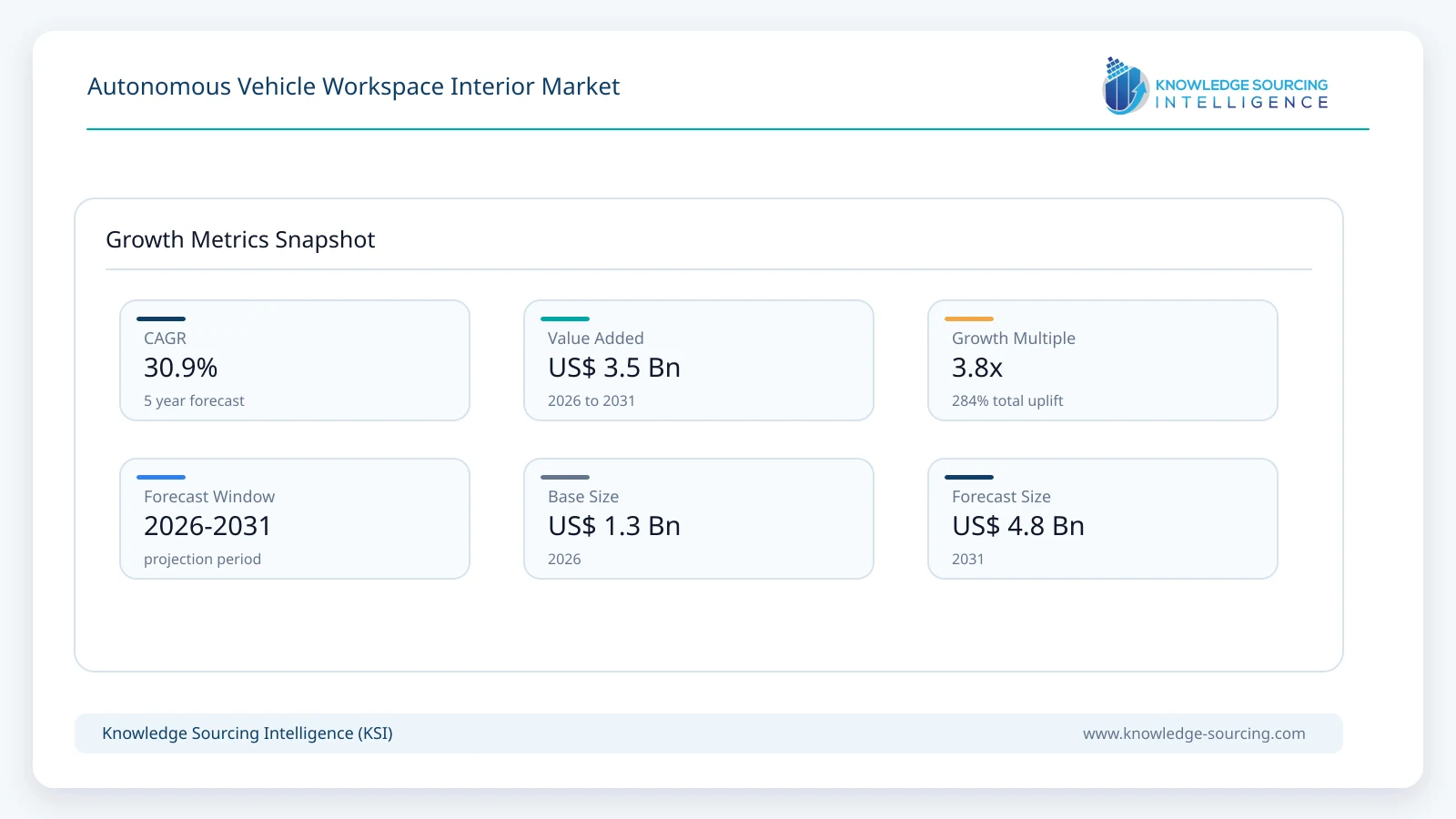
The autonomous vehicle workspace interior market is forecast to grow at a CAGR of 30.9%, reaching approximately USD 4.80 billion in 2031 from USD 1.25 billion in 2026.
Highlights:
- 1Reconfigurable seating and positioning systems account for approximately 34% of global market value in 2026, reflecting the importance of swivel, long-slide and flexible seat architectures in creating usable workspace.
- 2SAE Level 3 applications represent approximately 58% of market value in 2026, supported by early production availability in premium passenger vehicles and the first commercial use cases for hands-off, eyes-off driving under defined conditions.
- 3Personally owned autonomous passenger vehicles account for approximately 62% of global market value in 2026, while robotaxi and shared autonomous mobility applications are gaining rapidly.
- 4Battery electric vehicles represent approximately 70% of market value in 2026 because flat floors, centralized electronics and flexible cabin packaging support workspace-oriented layouts.
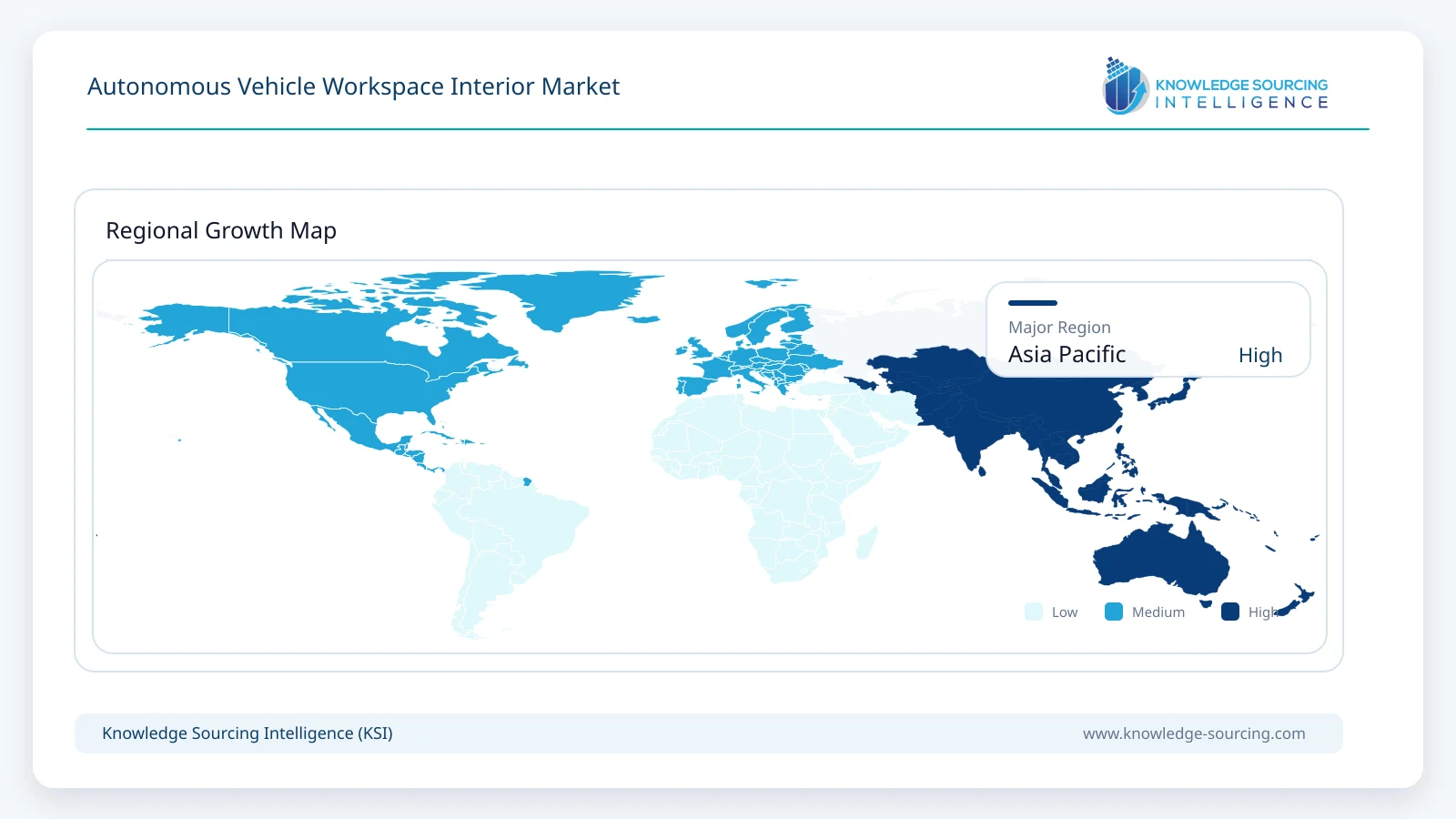
- 5Asia Pacific represents approximately 39% of global market value in 2026, supported by rapid smart-cabin development, premium EV growth and strong supplier activity in China, Japan and South Korea.
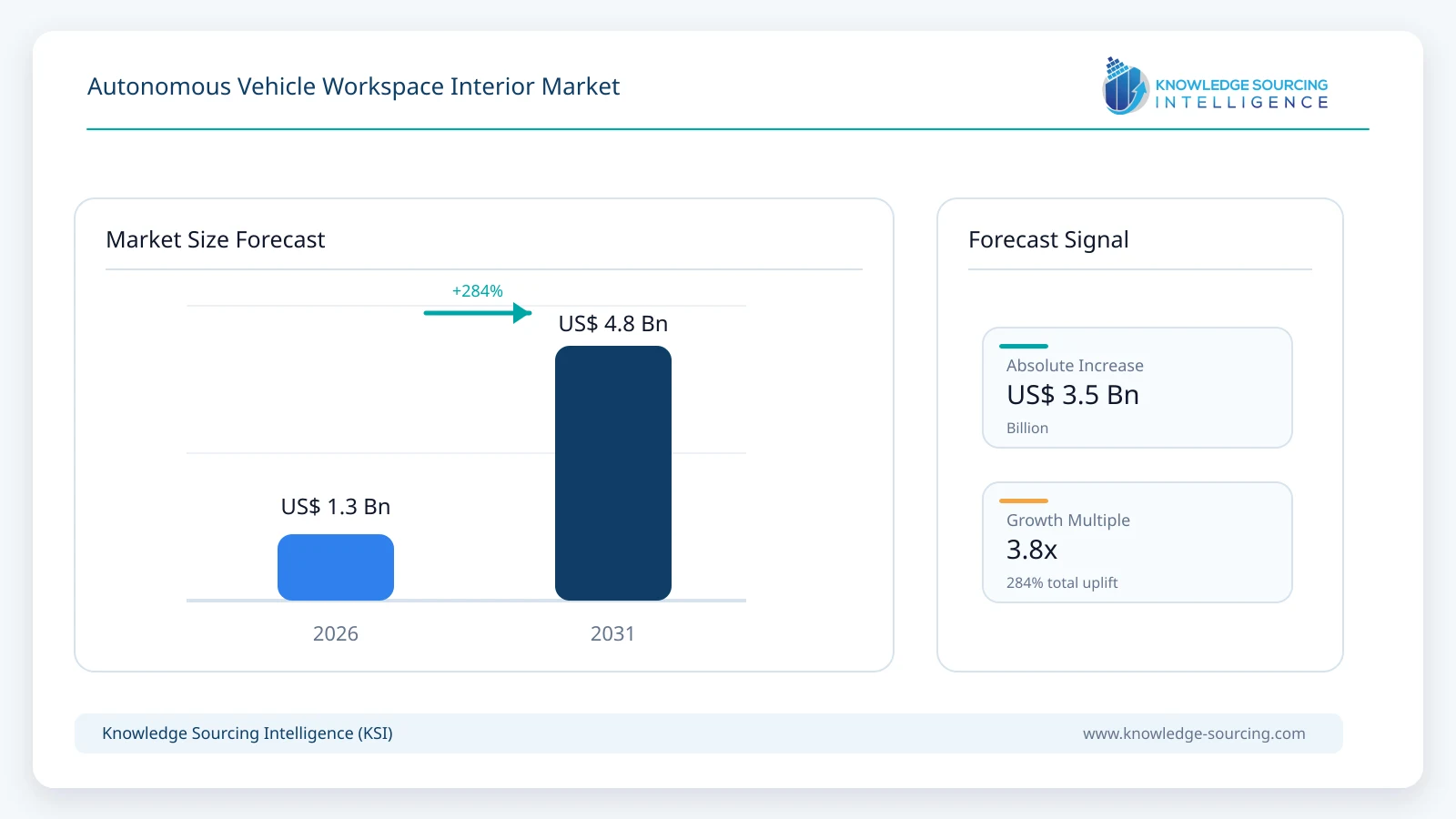
Demand is being driven by increasing deployment of conditionally and highly automated vehicles, greater use of flat-floor electric platforms and rising interest in cabins that support work, communication, entertainment and relaxation during automated-driving periods.
Workspace-oriented interiors increasingly combine powered or swivel seating, long rails, foldable tables, movable consoles, integrated displays, voice interaction, connectivity and personalized environmental controls. Yanfeng's XiM27 demonstrates a production-ready smart cabin that can transition into a mobile workspace, while Toyota Boshoku, FORVIA, Hyundai Transys, TACHI-S and Adient are developing interiors and seating systems that support work, meeting and lounge scenarios.
Commercial deployment is also beginning to validate rider-first autonomous cabin design. Waymo's Ojai provides a flat-floor interior with three large LED screens and personalized cabin controls, while its 2026 Gemini integration adds voice-based information and cabin interaction. These developments are increasing the role of interior systems in autonomous-vehicle differentiation.
Market Overview
Autonomous vehicle workspace interiors combine seating, furniture-like components, displays, connectivity and environmental controls to support productive activities during automated driving. Typical functions include face-to-face seating, work tables, laptop or device support, multi-screen interfaces, power and charging points, voice control, task lighting and individualized climate settings.
At SAE Level 3, the driver can disengage from the driving task under defined conditions but must remain available to resume control when requested. Workspace functions therefore emphasize interruptible tasks, convenient screen interaction and rapid return to a driving-ready posture. At Level 4 and above, interior layouts can be designed around passengers rather than continuous driving responsibility.
Yanfeng's XiM27 illustrates this transition. The platform uses ultra-long floor rails, foldable tables, multiple displays and centralized interior control to support scenarios including working, relaxing and social interaction. The cabin can shift rapidly between driver-focused and lounge or workspace configurations.
Toyota Boshoku is developing mobility spaces that coordinate seats, lighting, displays, thermal comfort and content according to occupant state and travel scenario. Hyundai Transys describes autonomous seats as a foundation for work, meetings, rest and social use, while TACHI-S is developing desk-work and meeting environments around its Moveable My Room concept.
Market Trends
Level 3 Driving Is Creating the First Production Workspace Use Cases
Conditionally automated driving is creating the first commercial environment in which a driver can temporarily redirect attention away from the road. Mercedes-Benz has expanded DRIVE PILOT operation in Germany to speeds of up to 95 km/h under defined motorway conditions, increasing the practical time available for non-driving activities.
Interior suppliers are responding with seats, displays and controls designed to make automated-driving periods more useful while maintaining rapid transition back to driving.
Robotaxi Interiors Are Becoming Rider-First Digital Spaces
Purpose-built autonomous ride-hailing vehicles are accelerating cabin design around passengers rather than drivers. Waymo's Ojai uses a completely flat floor and three large LED screens, with seating-position-aware controls and personalized temperature and media functions.
The addition of Gemini in Waymo in July 2026 extends the cabin into a voice-enabled information and productivity environment, reinforcing the importance of software and HMI within autonomous interiors.
Reconfigurable Seating Is Becoming the Foundation of Mobile Workspaces
Workspace interiors require seats to move beyond conventional fore-aft adjustment. Swivels, long rails, integrated belts and flexible recline allow occupants to face tables, screens or other passengers while maintaining a path back to a safe travel position.
Yanfeng, Hyundai Transys, Lear and Adient are developing seat architectures that support meetings, rest and other multi-purpose cabin scenarios, while Toyota Boshoku and TACHI-S are using seat-centered interior concepts to create room-like work environments.
Furniture-Like Consoles and Work Surfaces Are Expanding
Automotive consoles are becoming more modular and furniture-like as interiors support work and lifestyle functions. FORVIA's On-demand center console uses interchangeable modules that can include tray tables, storage, beverage functions and retractable displays while maintaining electrical and data connections through a common interface.
Foldable tables and movable floor consoles are also being incorporated into smart-cabin concepts, allowing work surfaces to appear only when required and preserving open floor space during other travel modes.
AI and Centralized Cabin Control Are Supporting Productive Use
Workspace interiors increasingly rely on centralized electronics to coordinate seat position, screens, climate, lighting and voice interaction. Yanfeng uses a domain controller to connect major cabin systems, while Waymo's Gemini integration provides voice-based cabin control and general information services.
This architecture can reduce the number of manual interactions needed when occupants transition between driving, work and rest modes.
Segment Analysis
By Workspace System Type: Reconfigurable Seating and Positioning
Reconfigurable seating and positioning systems are projected to reach approximately USD 1.44 billion by 2031. Swivel mechanisms, ultra-long rails, integrated restraints and powered movement create the spatial flexibility required for mobile-office and meeting layouts. The segment benefits directly from flat-floor EV platforms and increasing development of autonomous cabin scenarios.
By Automation Level: SAE Level 4 and Above
SAE Level 4 and above workspace interiors are projected to reach approximately USD 2.78 billion by 2031. Highly automated vehicles allow occupants to spend longer periods away from driving responsibilities, increasing the value of dedicated tables, screens, productivity interfaces and passenger-centric seating configurations.
By Vehicle Application: Personally Owned Autonomous Passenger Vehicles
Personally owned autonomous passenger vehicles are projected to generate approximately USD 2.40 billion of workspace-interior market value by 2031. Premium passenger vehicles will remain an important commercialization channel because owners value personalized work, entertainment and comfort functions that can be used repeatedly across daily commutes and longer journeys.
By Workspace Mode: Individual Work and Productivity
Individual work and productivity applications are projected to reach approximately USD 2.35 billion by 2031. The largest use case includes laptop work, communication, reading, information access and personal digital tasks supported by displays, tables, charging and voice interfaces.
By Propulsion: Battery Electric Vehicles
Battery electric vehicles are projected to generate approximately USD 3.98 billion of workspace-interior market value by 2031. Flat floors, centralized electronics, flexible packaging and strong overlap between EV and automated-driving development make battery-electric platforms the principal architecture for workspace-oriented interiors.
By Geography: Asia Pacific
Asia Pacific is projected to reach approximately USD 2.11 billion by 2031. China is the principal growth engine through rapid smart-cabin and EV development, while Japan and South Korea contribute advanced seat, interior and human-machine-interface engineering.
Market Drivers
Expansion of Level 3 and Level 4 Automated Driving
Increasing automated-driving capability creates periods in which occupants can redirect attention toward non-driving activities. As legal and technical operating domains expand, the value of productive cabin use increases.
Demand to Reclaim Travel Time
Commuters and business travelers increasingly value vehicles as places to work, communicate and manage digital tasks. Workspace interiors can convert previously unproductive travel time into usable personal or professional time.
Growth of Software-Defined and Connected Vehicles
Centralized electronics, high-speed connectivity and software-controlled cabin systems provide the technical foundation for coordinated workspace modes, voice interaction, profile-based settings and screen-rich interiors.
Electric-Vehicle Cabin Flexibility
Battery-electric platforms can provide flatter floors and fewer drivetrain intrusions, supporting longer seat travel, movable consoles, reconfigurable tables and more flexible passenger layouts.
Scaling of Autonomous Mobility Services
Robotaxi and autonomous-shuttle deployment is creating a commercial market for rider-first interiors with digital interfaces, easy ingress and individualized cabin control. Purpose-built vehicles can allocate interior space entirely around passengers.
Market Restraints
Safety Requirements for Non-Driving Postures
Workspace use can place occupants in rotated, reclined or face-to-face positions that differ from conventional crash-design assumptions. Integrated restraints, seat structure and pre-crash repositioning therefore become critical.
Regulatory and Operational Limits
Level 3 systems operate only within defined conditions and still require a driver to resume control when requested. This limits the duration and type of work activities that can be supported in early production vehicles.
Motion Sickness and Visual Task Comfort
Reading, screen use and desk work can increase sensitivity to vehicle motion when visual attention is directed inside the cabin. Workspace interiors therefore require careful coordination of seating posture, display position and motion-management strategies.
High Interior-System Cost
Powered rails, swivels, integrated restraints, large displays, domain controllers, movable consoles and smart surfaces increase interior-system cost. Early adoption is therefore concentrated in premium vehicles and autonomous fleets.
Cybersecurity and Data Privacy
Connected workspace interiors can process user profiles, voice input, device data and cloud services. Secure software architecture and privacy controls are necessary as the cabin becomes more digitally integrated.
Regional Outlook
Asia Pacific
Asia Pacific is the largest regional market and is expected to remain the strongest growth centre through 2031. China is driving rapid smart-cabin development through premium EVs and automated-driving programs, while suppliers are increasingly presenting production-ready workspace, lounge and multi-purpose interior concepts.
Yanfeng's XiM27 provides a direct example through foldable tables, ultra-long rails, multiple screens and centralized control. Toyota Boshoku is developing coordinated mobility spaces including LOUNZE+, MX OASIS and Integrated Cabin concepts, while Hyundai Transys and TACHI-S are developing autonomous-driving seats and room-like interiors for work and meetings.
North America
North America is expected to be one of the fastest-growing major regions through 2031, supported by commercial robotaxi deployment and strong development of purpose-built autonomous vehicles. Waymo is scaling its sixth-generation autonomous platform and introduced the Ojai as a rider-first vehicle with a flat floor, three large screens and personalized cabin controls.
The region also benefits from major automotive seating and interior suppliers including Lear and Adient. Lear's Configure+ technology supports business-meeting and other reconfigurable cabin use cases, while Adient's Autonomous Elegance platform has been developed for driving, working and relaxing in flexible premium interiors.
Competitive Landscape
The autonomous vehicle workspace interior market is led by seating and interior suppliers that combine flexible structures with electronics, HMI, furniture-like components and occupant-centered design. Yanfeng, Toyota Boshoku, FORVIA, Hyundai Transys, TACHI-S, Adient and Lear are directly developing workspace-capable autonomous or future-mobility interiors.
Yanfeng differentiates through production-ready smart-cabin integration, including mobile-workspace layouts, AI-adaptive seating and centralized electronics. Toyota Boshoku combines seating, displays, lighting and environmental control within future mobility spaces, while FORVIA is developing modular consoles and adaptable interiors designed for work, leisure and social interaction.
Hyundai Transys and TACHI-S focus heavily on seat-centered room concepts for meetings, work and relaxation. Adient integrates flexible seating, electronics and safety into its Autonomous Elegance architecture, while Lear's Configure+ provides tetherless powered seating that can reconfigure a cabin for meetings, entertainment, cargo or rest.
Recent Developments
29 July 2026: Waymo introduced Gemini in Waymo and a redesigned tri-screen Ojai user interface, adding voice-based cabin control, trip information and everyday knowledge services to its rider-first autonomous interior.
29 June 2026: Yanfeng unveiled XiM27, a production-ready smart-cabin platform that can transform into a practical mobile workspace using foldable tables, multiple screens, ultra-long rails and centralized interior control.
28 May 2026: Waymo began welcoming first riders to the Ojai, a purpose-built autonomous vehicle with a flat-floor cabin, three large LED screens and personalized temperature and media controls.
20 May 2026: TACHI-S announced its Automotive Engineering Exposition 2026 program featuring Smart Shell, an autonomous-driving-oriented seat experience combining relaxed posture with software-linked sensory functions.
23 April 2026: Toyota Boshoku announced LOUNZE+ for Auto China 2026, a future mobility space in which seats, door trims and console functions coordinate to adapt the cabin to different purposes and scenes.
2 February 2026: Toyota Boshoku detailed MOOX-RIDE, a content-experience support system developed around the expanding importance of how passengers spend time in autonomous vehicles.
30 October 2025: FORVIA introduced its On-demand center console, a modular furniture-inspired system that can incorporate tray tables, storage, a refrigerator, beverage functions and a retractable display using a common mechanical and electrical interface.
Market Outlook
The autonomous vehicle workspace interior market is expected to expand rapidly through 2031 as automated-driving systems move into broader commercial use and vehicle cabins become more passenger-centered. Reconfigurable seating will remain a core value pool, while work surfaces, displays, AI-enabled HMI and connected environmental controls are expected to gain share.
The strongest product development will focus on fast transitions between driving and work modes, safe occupant restraint in non-traditional postures, screen ergonomics, anti-motion-sickness design and compact furniture-like components that can be stowed when not required.
Asia Pacific is expected to lead global expansion, while North America offers strong growth through robotaxi scaling and purpose-built autonomous vehicles. Competitive advantage will depend on interior flexibility, safety integration, digital experience, packaging efficiency and the ability to coordinate seats, tables, displays and environment through a common software architecture.
Autonomous Vehicle Workspace Interior Market Scope
| Report Metric | Details |
|---|---|
| Total Market Size in 2026 | USD 1.25 billion |
| Total Market Size in 2031 | USD 4.80 billion |
| Forecast Unit | Billion |
| Growth Rate | 30.9% |
| Study Period | 2021 to 2031 |
| Historical Data | 2021 to 2024 |
| Base Year | 2025 |
| Forecast Period | 2026 – 2031 |
| Segmentation | Workspace System Type, Automation Level, Vehicle Application, Workspace Mode, Propulsion, Geography |
| Companies |
|
Market Segmentation
By Workspace System Type
Reconfigurable Seating and Positioning
Displays and Human-Machine Interface
Work Surfaces, Consoles and Storage
Connectivity and Power Interfaces
Lighting, Acoustic and Environmental Control
By Automation Level
SAE Level 3
SAE Level 4 and Above
By Vehicle Application
Personally Owned Autonomous Passenger Vehicles
Robotaxi and Shared Autonomous Mobility
Autonomous Shuttle and Multi-Purpose Vehicles
By Workspace Mode
Individual Work and Productivity
Meeting and Collaboration
Mixed Work, Leisure and Communication
By Propulsion
Battery Electric Vehicles
Hybrid and Internal Combustion Vehicles
Fuel Cell Electric Vehicles
By Geography
North America
United States
Canada
Mexico
South America
Brazil
Argentina
Others
Europe
Germany
United Kingdom
France
Italy
Spain
Others
Middle East and Africa
Saudi Arabia
UAE
South Africa
Others
Asia Pacific
China
Japan
South Korea
India
Singapore
Others
Table of Contents
1. INTRODUCTION
1.1. Market Overview
1.2. Market Definition
1.3. Scope of the Study
1.4. Market Segmentation
1.5. Currency
1.6. Assumptions
1.7. Base and Forecast Years
1.8. Key Benefits to Stakeholders
2. RESEARCH METHODOLOGY
2.1. Research Design
2.2. Secondary Research
2.3. Primary Research
2.4. Market Estimation
2.5. Segment Modelling
2.6. Data Triangulation and Validation
3. EXECUTIVE SUMMARY
3.1. Key Findings
3.2. Autonomous Vehicle Workspace Interior Market Size, 2026-2031
3.3. Workspace System Type Outlook
3.4. Automation Level Outlook
3.5. Vehicle Application Outlook
3.6. Workspace Mode Outlook
3.7. Propulsion Outlook
3.8. Regional Opportunity Summary
4. MARKET DYNAMICS
4.1. Market Drivers
4.1.1. Expansion of Level 3 and Level 4 Automated Driving
4.1.2. Demand to Reclaim Travel Time
4.1.3. Growth of Software-Defined and Connected Vehicles
4.1.4. Electric-Vehicle Cabin Flexibility
4.1.5. Scaling of Autonomous Mobility Services
4.2. Market Restraints
4.2.1. Safety Requirements for Non-Driving Postures
4.2.2. Regulatory and Operational Limits
4.2.3. Motion Sickness and Visual Task Comfort
4.2.4. High Interior-System Cost
4.2.5. Cybersecurity and Data Privacy
4.3. Market Opportunities
4.4. Porter's Five Forces Analysis
4.5. Industry Value Chain Analysis
4.6. Workspace Interior System Economics
4.7. Safety and Regulatory Environment
5. TECHNOLOGY OUTLOOK
5.1. Swivel and Long-Rail Seating
5.2. Integrated Belt and Flexible Restraint Systems
5.3. Foldable Tables and Work Surfaces
5.4. Movable and Modular Consoles
5.5. Multi-Screen Displays and Workspace HMI
5.6. Device Charging and Power Interfaces
5.7. Centralized Cabin Domain Controllers
5.8. AI and Voice-Based Interaction
5.9. Occupant Sensing and Personalized Environment
5.10. Anti-Kinetosis and Motion-Aware Interior Design
6. AUTONOMOUS VEHICLE WORKSPACE INTERIOR MARKET BY WORKSPACE SYSTEM TYPE
6.1. Introduction
6.2. Reconfigurable Seating and Positioning
6.3. Displays and Human-Machine Interface
6.4. Work Surfaces, Consoles and Storage
6.5. Connectivity and Power Interfaces
6.6. Lighting, Acoustic and Environmental Control
7. AUTONOMOUS VEHICLE WORKSPACE INTERIOR MARKET BY AUTOMATION LEVEL
7.1. Introduction
7.2. SAE Level 3
7.3. SAE Level 4 and Above
8. AUTONOMOUS VEHICLE WORKSPACE INTERIOR MARKET BY VEHICLE APPLICATION
8.1. Introduction
8.2. Personally Owned Autonomous Passenger Vehicles
8.3. Robotaxi and Shared Autonomous Mobility
8.4. Autonomous Shuttle and Multi-Purpose Vehicles
9. AUTONOMOUS VEHICLE WORKSPACE INTERIOR MARKET BY WORKSPACE MODE
9.1. Introduction
9.2. Individual Work and Productivity
9.3. Meeting and Collaboration
9.4. Mixed Work, Leisure and Communication
10. AUTONOMOUS VEHICLE WORKSPACE INTERIOR MARKET BY PROPULSION
10.1. Introduction
10.2. Battery Electric Vehicles
10.3. Hybrid and Internal Combustion Vehicles
10.4. Fuel Cell Electric Vehicles
11. AUTONOMOUS VEHICLE WORKSPACE INTERIOR MARKET BY GEOGRAPHY
11.1. North America
11.1.1. United States
11.1.2. Canada
11.1.3. Mexico
11.2. South America
11.2.1. Brazil
11.2.2. Argentina
11.2.3. Others
11.3. Europe
11.3.1. Germany
11.3.2. United Kingdom
11.3.3. France
11.3.4. Italy
11.3.5. Spain
11.3.6. Others
11.4. Middle East and Africa
11.4.1. Saudi Arabia
11.4.2. UAE
11.4.3. South Africa
11.4.4. Others
11.5. Asia Pacific
11.5.1. China
11.5.2. Japan
11.5.3. South Korea
11.5.4. India
11.5.5. Singapore
11.5.6. Others
12. COMPETITIVE ENVIRONMENT AND ANALYSIS
12.1. Major Players and Strategy Analysis
12.2. Market Share Analysis
12.3. Workspace Interior Technology Benchmarking
12.4. Concept-to-Production Development Activity
12.5. Competitive Dashboard
13. COMPANY PROFILES
13.1. Yanfeng
13.2. Toyota Boshoku Corporation
13.3. FORVIA
13.4. Hyundai Transys Inc.
13.5. TACHI-S Co., Ltd.
13.6. Adient plc
13.7. Lear Corporation
14. APPENDIX
14.1. Currency
14.2. Assumptions
14.3. Base and Forecast Years Timeline
14.4. Key Benefits for Stakeholders
14.5. Research Methodology
14.6. Abbreviations
14.7. Data Sources
Navigate
Trusted by the world's leading organizations











