
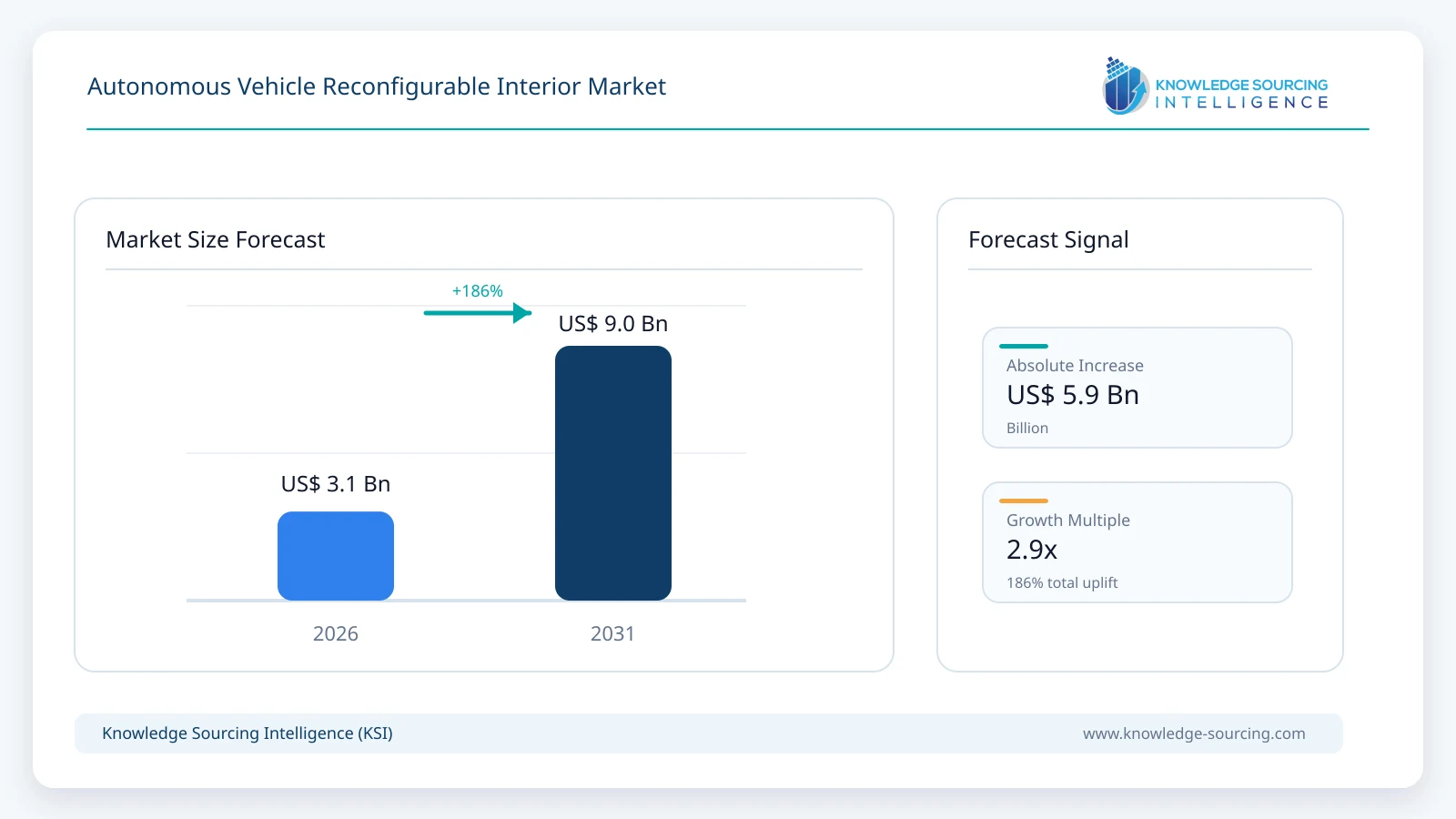
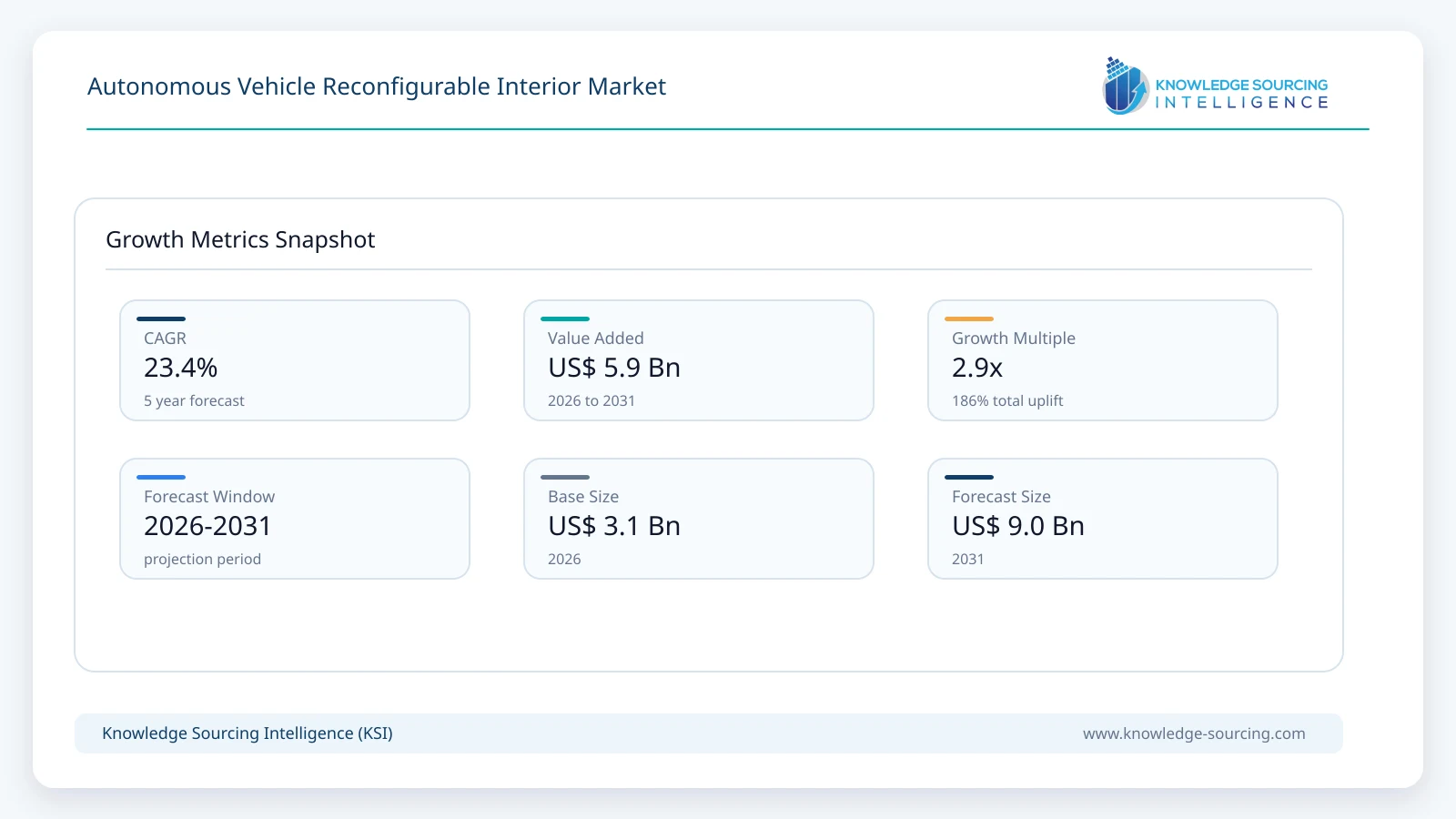
The Autonomous Vehicle Reconfigurable Interior Market is forecast to grow at a CAGR of 23.40%, reaching USD 9.01 billion in 2031 from USD 3.15 billion in 2026.
Highlights:
- 1Reconfigurable seating represents approximately 54% of global market value in 2026 because seats are the primary physical mechanism through which autonomous cabins change orientation, posture, and usable floor space.
- 2Lounge and relaxation configurations account for approximately 30% of functional demand in 2026, supported by zero-gravity seating, deeper recline, leg-rest systems, and automated comfort positioning.
- 3SAE Level 3 applications account for approximately 58% of market value in 2026, as conditional automation creates an initial production pathway for limited cabin transformation while retaining conventional driving capability.
- 4Personally owned autonomous passenger vehicles represent approximately 61% of 2026 market value, while robotaxi, shuttle and purpose-built mobility applications provide the strongest long-term design freedom.
- 5Battery electric vehicles represent approximately 74% of market value in 2026 because skateboard-style architectures, flatter floors and centralized electronics enable greater interior packaging flexibility.
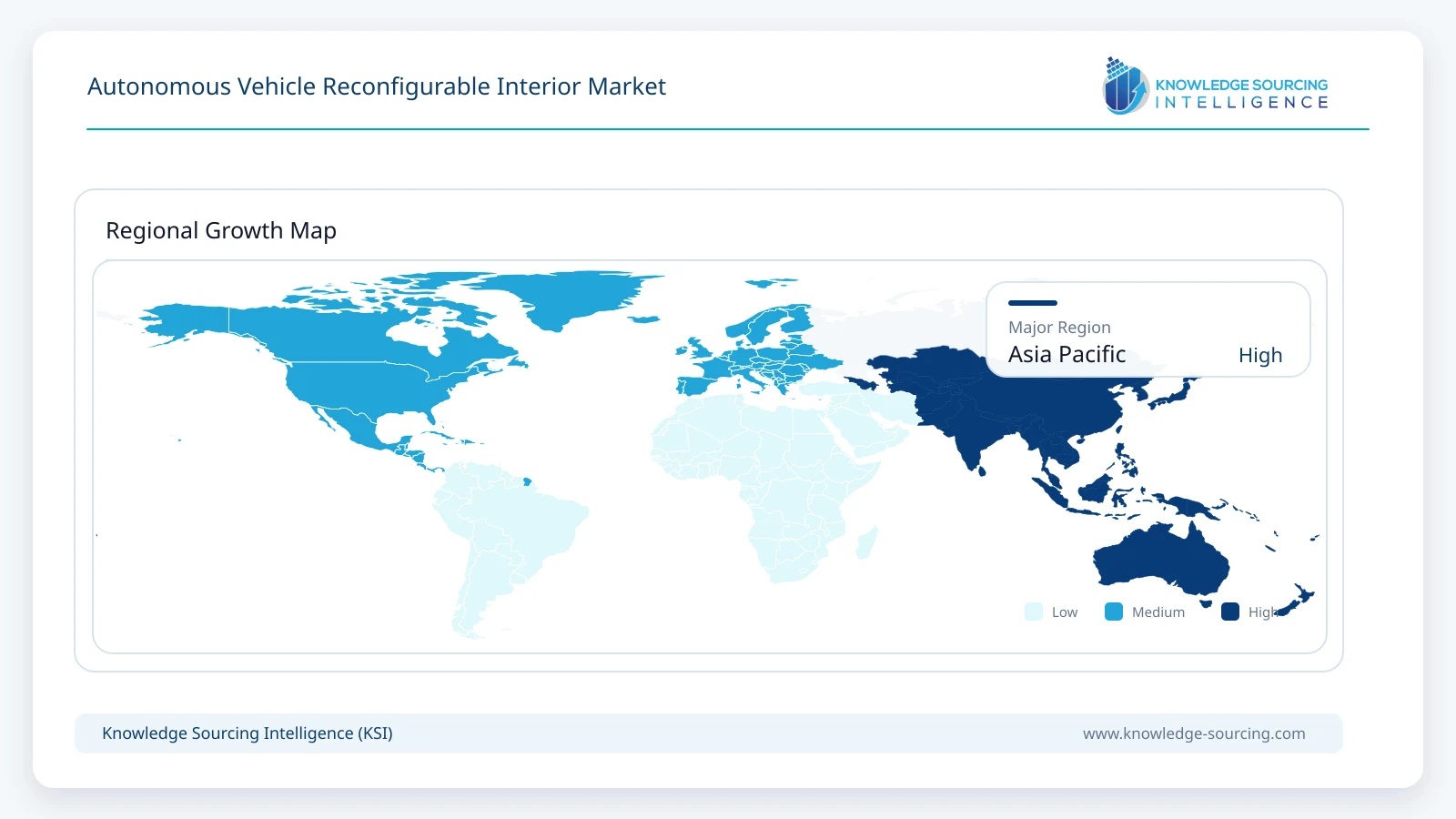
- 6Asia Pacific accounts for approximately 40% of global market value in 2026, led by rapid smart-cabin development and strong seating and interior-systems capabilities in China, Japan and South Korea.
The addressable market is concentrated in systems that physically reshape the cabin rather than conventional fixed seating or generic smart-cabin electronics.
Reconfigurability is moving from concept-car experimentation toward production-oriented architectures. Yanfeng's XiM27 uses full-length rails, rotating seats, a movable center console and a fold-away steering wheel to switch rapidly among work, rest, entertainment and social configurations. Magna offers swivel, long-rail and stadium-seat systems, while Toyota Boshoku continues to develop rotating and long-slide seating for living-room-style and MaaS interiors.
Safety engineering is becoming inseparable from cabin flexibility. Reclined, rear-facing and rotated seating positions change occupant kinematics during a crash, increasing the importance of belt-in-seat architectures, adaptive airbags, occupant monitoring and position-aware restraint control. This safety layer will determine how quickly highly flexible interiors can move from premium demonstrators into broader series production.
Market Overview
Vehicle interiors are becoming more structurally flexible as automated driving reduces the need for every seat, control, and storage element to remain fixed around a conventional driver-centric layout. The highest-value opportunity lies in coordinated transformation: seats move or rotate, controls retract, tables and consoles deploy, and the cabin changes according to the activity being performed.
Yanfeng's XiM27 demonstrates this direction through full-length seat rails, quiet rotating mechanisms, foldable tables, a movable center console, and a steering wheel that folds into the instrument panel. The platform is designed to transition among driving, face-to-face social interaction, work, rest, and entertainment modes within a centrally controlled cabin architecture.
Magna approaches reconfiguration from a seating-system architecture perspective. Its reconfigurable portfolio combines long rails, swivel mechanisms and stadium-style seat movement, while its Cell-to-Seat architecture integrates long-rail seating directly with the battery enclosure to reduce structural redundancy and increase packaging freedom.
Toyota Boshoku is developing similar flexibility through LOUNZE, LOUNZE+ and future modular seating concepts. Its systems use rotating seats, long slides, and coordinated interior elements to create multiple cabin arrangements. FORVIA extends the concept beyond seats through sliding and interchangeable center-console modules, while Lear's Configure+ demonstrates powered, tetherless seating and cargo reconfiguration.
Market Trends
Long-Rail and Swivel Seating Is Becoming the Core Reconfiguration Architecture
The strongest physical trend is the shift from short fixed seat tracks toward powered long rails and compact swivel mechanisms. Long rails allow front and rear occupants to create social, lounge, and cargo configurations, while swivels enable face-to-face arrangements without requiring a larger vehicle footprint.
Suppliers are reducing mechanism height, noise, and packaging complexity so these systems can be integrated into production platforms rather than remaining concept-only features.
Cabin Transformation Is Moving Toward Scenario-Based Automation
Reconfiguration is increasingly controlled as a coordinated cabin mode rather than through separate seat switches. A work mode can reposition seats, deploy a table, move the console, and adjust displays, while a relaxation mode can recline seats and clear driver controls. Centralized cabin electronics and software-defined architectures make this multi-component coordination practical.
Driving Controls Are Becoming Stowable
Retractable or fold-away steering systems create additional space when automated driving is active. ZF LIFETEC and Yanfeng have demonstrated systems that move the steering wheel away from the occupant, while by-wire architectures reduce the mechanical constraints associated with a fixed steering column.
These systems are particularly relevant to dual-mode vehicles that must support both conventional manual operation and highly automated travel.
Modular Consoles and Work Surfaces Are Expanding the Reconfigurable Interior Beyond Seating
Interior flexibility is broadening into center consoles, tables, storage, and entertainment modules. FORVIA's On-demand center console uses interchangeable modules for work, storage, refrigeration, and display functions, while Yanfeng uses a mobile console with charging, refrigeration, and an extendable worktable.
This creates a secondary value pool in which cabin functions can be upgraded or rearranged without redesigning the entire interior.
Occupant Protection Is Becoming Position-Aware
Reclined and unconventional seating positions require restraint systems that respond to occupant position, size, and posture. Seat-integrated belts, adaptive airbags, cameras and seat sensors are increasingly being developed as a coordinated safety architecture so interior freedom does not reduce crash protection.
Segment Analysis
By Interior System: Reconfigurable Seating Systems
Reconfigurable seating systems are projected to generate approximately USD 4.78 billion in market value by 2031. Growth is supported by powered long rails, swivel mechanisms, fold-flat and zero-gravity kinematics, integrated leg rests, and seat-mounted restraint systems that allow the seat to remain functional and safe across a wider range of positions.
By Reconfiguration Function: Lounge, Rest and Relaxation
Lounge, rest and relaxation applications are projected to reach approximately USD 2.79 billion by 2031. Autonomous operation increases the value of recline, zero-gravity posture, leg support and flat-bed configurations, particularly in premium EVs, MPVs and long-duration mobility services.
By Automation Level: SAE Level 4 and Above
SAE Level 4 and above applications are projected to reach approximately USD 5.50 billion by 2031. Higher automation permits more extensive cabin transformation because occupants are no longer required to maintain immediate driving readiness within the automated operating domain.
By Vehicle Application: Personally Owned Autonomous Passenger Vehicles
Personally owned autonomous passenger vehicles are projected to account for approximately USD 4.96 billion of market value by 2031. Premium EVs, executive MPVs and software-defined passenger vehicles provide the most immediate route for monetizing transformable interiors through comfort, productivity and lifestyle-oriented features.
By Propulsion: Battery Electric Vehicles
Battery electric vehicles are projected to generate approximately USD 6.85 billion of reconfigurable-interior market value by 2031. Flat floors, compact powertrain packaging and centralized electrical architectures create more usable cabin volume and simplify integration of powered rails, movable consoles and stowable controls.
By Geography: Asia Pacific
Asia Pacific is projected to reach approximately USD 3.70 billion by 2031. China is the principal commercialization engine through fast-moving smart-cabin and premium EV programs, while Japan and South Korea contribute advanced seating, interior mechanisms, electronics and mobility-space engineering.
Market Drivers
Expansion of Level 3 and Level 4 Automated Driving
Higher automation reduces the amount of time occupants must remain in a conventional driving posture. This increases demand for seating and interior architectures that can support relaxation, work, social interaction and alternative seating orientations.
EV-Native Flat-Floor Architectures
Battery-electric skateboard platforms reduce intrusion from transmission tunnels and other mechanical components. The resulting floor freedom supports longer seat rails, movable consoles, face-to-face seating and broader passenger-cargo conversion.
Growth of Software-Defined Cabin Control
Centralized electronics allow seats, steering systems, consoles, displays, lighting and climate functions to move together as a predefined cabin mode. This reduces user complexity and improves the practicality of multi-stage interior transformation.
Demand for Multi-Use Vehicle Space
Consumers and mobility operators increasingly seek cabins that can serve more than one function. A single vehicle may need to operate as a conventional car, mobile office, lounge, family space or cargo carrier, creating demand for components that change position without compromising packaging efficiency.
Expansion of Robotaxi, Shuttle and Purpose-Built Mobility Platforms
Purpose-built autonomous mobility removes many assumptions of the traditional driver-centric cabin. This gives designers greater freedom to use symmetric layouts, social seating, accessibility-focused entry systems and modular passenger areas.
Market Restraints
Crash Safety in Reclined and Non-Conventional Seating Positions
Rotated, rear-facing and deeply reclined seating changes how occupants interact with belts, airbags and surrounding structures in a collision. Validation requirements therefore increase substantially as interior flexibility expands.
Mechanism Cost, Weight and Packaging
Long rails, powered swivels, locking systems and seat-integrated safety hardware add mass, cost and floor-space requirements. Suppliers must reduce mechanism complexity before highly reconfigurable interiors can move into volume vehicle segments.
Regulatory Translation for Unconventional Cabin Layouts
Existing occupant-protection standards were developed primarily around conventional forward-facing seating and fixed driving controls. Regulators are evaluating how crashworthiness procedures should address rear-facing, reclined and other unconventional configurations, creating a longer validation path for new layouts.
Limited Operating Availability of Higher Automation
The strongest use case for major interior transformation appears when occupants can disengage from the driving task. Until Level 3 and Level 4 operation expands across more roads and jurisdictions, some reconfiguration features will remain restricted to parked or limited-domain use.
Durability and Misuse Requirements
Movable seats, rails, consoles and tables must withstand repeated repositioning, contamination and occupant misuse across a long vehicle life. They also require reliable position sensing and locking so the vehicle can prevent unsafe travel configurations.
Regional Outlook
Asia Pacific
Asia Pacific is the largest regional market and is expected to remain the leading development center through 2031. China combines rapid premium EV development, strong demand for "third-space" interiors and short product-development cycles, making it an important commercialization market for powered rails, rotating seats, movable consoles and integrated cabin transformation.
Yanfeng's XiM27 is a direct example of this direction, combining full-length rails, rotating seating, a mobile console and fold-away steering functionality in a production-oriented smart-cabin platform. Toyota Boshoku is also advancing rotating and long-slide seating concepts for China and broader Asian mobility applications.
North America
North America is a major high-growth market supported by strong seating-system suppliers, premium EV platforms and commercial autonomous-mobility development. Magna, Lear and Adient provide relevant long-rail, swivel, powered reconfiguration and adaptive seating technologies, while U.S. regulatory research is increasingly addressing unconventional seating arrangements in automated vehicles.
Commercial Level 4 deployments and purpose-built autonomous vehicles can create demand for more radical cabin layouts over time, while premium passenger vehicles are expected to provide the nearer-term route for reconfigurable seating and lounge-oriented features.
Competitive Landscape
The autonomous vehicle reconfigurable interior market is led by seating and interior-system suppliers capable of combining mechanics, electronics, cabin integration and occupant safety. Yanfeng, Magna, Toyota Boshoku, Lear, FORVIA, Adient and ZF LIFETEC are directly relevant because each supplies or develops technologies that alter cabin geometry, seating orientation, control placement or the safety architecture required for flexible occupant positions.
Yanfeng differentiates through complete smart-cabin integration and rapid scenario switching. Magna emphasizes long rails, swivel systems and battery-integrated seat architecture. Toyota Boshoku combines rotating seating, long-slide systems and coordinated interior-space concepts. Lear provides powered tetherless reconfiguration through Configure+, while FORVIA extends cabin modularity into consoles, cockpit structures and retractable controls. Adient focuses on adaptive seating, integrated restraints and ergonomics across drive, work and relax positions. ZF LIFETEC supports reconfiguration with retractable steering and adaptive occupant-protection technologies.
Recent Developments
17 September 2026: ZF LIFETEC presented a production-ready occupant-safety architecture combining camera, seat and belt sensing with adaptive airbags and restraint control, directly supporting more varied occupant positions in future automated cabins.
29 June 2026: Yanfeng unveiled XiM27, a production-ready smart-cabin platform using full-length rails, rotating seats, a movable center console, foldable work surfaces and a steering wheel that retracts into the instrument panel.
25 June 2026: ZF LIFETEC highlighted a coordinated four-airbag approach for comfort seating positions, addressing occupant stabilization and submarining risk in reclined configurations.
18 June 2026: Magna detailed its design approach for flexible seating systems, emphasizing scalable reconfiguration without multiplying mechanical complexity across vehicle programs.
23 April 2026: Toyota Boshoku presented LOUNZE+ at Auto China 2026, with seats, door trims and the console operating together to adapt the cabin to different living-space scenarios.
10 April 2026: Adient launched StepJoy, a space-efficient foot-massage and footrest system that stows into the seatback, reinforcing the movement toward multi-function relaxation-oriented seat architectures.
30 October 2025: FORVIA introduced its On-demand center console, a modular plug-and-play interior system with interchangeable work, storage, refrigeration and retractable-display modules.
8 September 2025: ZF LIFETEC presented a retractable steering-wheel concept that folds forward and moves into the dashboard to create more room during automated driving or parking.
Market Outlook
The autonomous vehicle reconfigurable interior market is expected to scale rapidly through 2031 as interior architecture becomes a larger source of differentiation in automated and electric vehicles. Reconfigurable seating will remain the largest value pool, but growth will increasingly extend into movable consoles, deployable work surfaces, stowable driving controls and position-aware safety systems.
The most important technical transition will be from individually adjustable components to coordinated cabin transformation. Seats, consoles, steering systems and displays will increasingly move as a synchronized system based on a selected activity or driving mode. This favors suppliers with capabilities across mechanics, electronics, sensing and software rather than single-component providers.
Asia Pacific is expected to remain the largest market, while North America provides a strong development path through premium EVs, advanced seating suppliers and commercial autonomous mobility. Market growth will depend on the pace of Level 3 and Level 4 deployment, regulatory treatment of unconventional seating, and suppliers' ability to deliver flexible interiors without high cost, weight or safety compromise.
Autonomous Vehicle Reconfigurable Interior Market Scope:
| Report Metric | Details |
|---|---|
| Total Market Size in 2026 | USD 3.15 billion |
| Total Market Size in 2031 | USD 9.01 billion |
| Forecast Unit | USD Billion |
| Growth Rate | 23.4% |
| Study Period | 2021 to 2031 |
| Historical Data | 2021 to 2024 |
| Base Year | 2025 |
| Forecast Period | 2026 – 2031 |
| Segmentation | Interior Systems, Reconfiguration Function, Automation Level, Vehicle Application |
| Companies |
|
Market Segmentation
By Interior System
Reconfigurable Seating Systems
Modular Consoles and Work Surfaces
Retractable and Stowable Driving Controls
Adaptive Storage and Partition Systems
Other Transformable Interior Components
By Reconfiguration Function
Lounge, Rest and Relaxation
Work and Productivity
Social and Face-to-Face Interaction
Passenger-Cargo Conversion
Accessibility and Entry/Egress
By Automation Level
SAE Level 3
SAE Level 4 and Above
By Vehicle Application
Personally Owned Autonomous Passenger Vehicles
Robotaxi and Shared Autonomous Mobility
Autonomous Shuttle, MPV and Purpose-Built Mobility
By Propulsion
Battery Electric Vehicles
Hybrid and Plug-In Hybrid Electric Vehicles
Internal Combustion Engine Vehicles
Fuel Cell Electric Vehicles
By Geography
North America
United States
Canada
Mexico
South America
Brazil
Argentina
Others
Europe
Germany
United Kingdom
France
Italy
Spain
Others
Middle East and Africa
Saudi Arabia
UAE
South Africa
Others
Asia Pacific
China
Japan
South Korea
India
Singapore
Others
Table of Contents
1. INTRODUCTION
1.1. Market Overview
1.2. Market Definition
1.3. Scope of the Study
1.4. Market Segmentation
1.5. Currency
1.6. Assumptions
1.7. Base and Forecast Years
1.8. Key Benefits to Stakeholders
2. RESEARCH METHODOLOGY
2.1. Research Design
2.2. Secondary Research
2.3. Primary Research
2.4. Market Estimation
2.5. Segment Modelling
2.6. Data Triangulation and Validation
3. EXECUTIVE SUMMARY
3.1. Key Findings
3.2. Autonomous Vehicle Reconfigurable Interior Market Size, 2026-2031
3.3. Interior System Outlook
3.4. Reconfiguration Function Outlook
3.5. Automation Level Outlook
3.6. Vehicle Application Outlook
3.7. Propulsion Outlook
3.8. Regional Opportunity Summary
4. MARKET DYNAMICS
4.1. Market Drivers
4.1.1. Expansion of Level 3 and Level 4 Automated Driving
4.1.2. EV-Native Flat-Floor Architectures
4.1.3. Growth of Software-Defined Cabin Control
4.1.4. Demand for Multi-Use Vehicle Space
4.1.5. Expansion of Robotaxi, Shuttle and Purpose-Built Mobility Platforms
4.2. Market Restraints
4.2.1. Crash Safety in Reclined and Non-Conventional Seating Positions
4.2.2. Mechanism Cost, Weight and Packaging
4.2.3. Regulatory Translation for Unconventional Cabin Layouts
4.2.4. Limited Operating Availability of Higher Automation
4.2.5. Durability and Misuse Requirements
4.3. Market Opportunities
4.4. Porter's Five Forces Analysis
4.5. Industry Value Chain Analysis
4.6. Reconfigurable Interior System Economics
4.7. Safety, Homologation and Human-Factors Environment
5. TECHNOLOGY OUTLOOK
5.1. Powered Long-Rail Seat Systems
5.2. Swivel and Rotating Seat Mechanisms
5.3. Zero-Gravity and Deep-Recline Seating
5.4. Fold-Flat, Stadium and Nesting Seat Architectures
5.5. Movable and Modular Center Consoles
5.6. Deployable Tables and Work Surfaces
5.7. Retractable and Stowable Steering Systems
5.8. Belt-in-Seat and Seat-Integrated Safety
5.9. Occupant Position Sensing and Adaptive Restraints
5.10. Centralized Cabin Motion Control
6. AUTONOMOUS VEHICLE RECONFIGURABLE INTERIOR MARKET BY INTERIOR SYSTEM
6.1. Introduction
6.2. Reconfigurable Seating Systems
6.3. Modular Consoles and Work Surfaces
6.4. Retractable and Stowable Driving Controls
6.5. Adaptive Storage and Partition Systems
6.6. Other Transformable Interior Components
7. AUTONOMOUS VEHICLE RECONFIGURABLE INTERIOR MARKET BY RECONFIGURATION FUNCTION
7.1. Introduction
7.2. Lounge, Rest and Relaxation
7.3. Work and Productivity
7.4. Social and Face-to-Face Interaction
7.5. Passenger-Cargo Conversion
7.6. Accessibility and Entry/Egress
8. AUTONOMOUS VEHICLE RECONFIGURABLE INTERIOR MARKET BY AUTOMATION LEVEL
8.1. Introduction
8.2. SAE Level 3
8.3. SAE Level 4 and Above
9. AUTONOMOUS VEHICLE RECONFIGURABLE INTERIOR MARKET BY VEHICLE APPLICATION
9.1. Introduction
9.2. Personally Owned Autonomous Passenger Vehicles
9.3. Robotaxi and Shared Autonomous Mobility
9.4. Autonomous Shuttle, MPV and Purpose-Built Mobility
10. AUTONOMOUS VEHICLE RECONFIGURABLE INTERIOR MARKET BY PROPULSION
10.1. Introduction
10.2. Battery Electric Vehicles
10.3. Hybrid and Plug-In Hybrid Electric Vehicles
10.4. Internal Combustion Engine Vehicles
10.5. Fuel Cell Electric Vehicles
11. AUTONOMOUS VEHICLE RECONFIGURABLE INTERIOR MARKET BY GEOGRAPHY
11.1. North America
11.1.1. United States
11.1.2. Canada
11.1.3. Mexico
11.2. South America
11.2.1. Brazil
11.2.2. Argentina
11.2.3. Others
11.3. Europe
11.3.1. Germany
11.3.2. United Kingdom
11.3.3. France
11.3.4. Italy
11.3.5. Spain
11.3.6. Others
11.4. Middle East and Africa
11.4.1. Saudi Arabia
11.4.2. UAE
11.4.3. South Africa
11.4.4. Others
11.5. Asia Pacific
11.5.1. China
11.5.2. Japan
11.5.3. South Korea
11.5.4. India
11.5.5. Singapore
11.5.6. Others
12. COMPETITIVE ENVIRONMENT AND ANALYSIS
12.1. Major Players and Strategy Analysis
12.2. Market Share Analysis
12.3. Reconfigurable Interior Technology Benchmarking
12.4. Production Readiness and Platform Adoption
12.5. Competitive Dashboard
13. COMPANY PROFILES
13.1. Yanfeng
13.2. Magna International Inc.
13.3. Toyota Boshoku Corporation
13.4. Lear Corporation
13.5. FORVIA
13.6. Adient plc
13.7. ZF LIFETEC
14. APPENDIX
14.1. Currency
14.2. Assumptions
14.3. Base and Forecast Years Timeline
14.4. Key Benefits for Stakeholders
14.5. Research Methodology
14.6. Abbreviations
14.7. Data Sources
Navigate
Trusted by the world's leading organizations











