
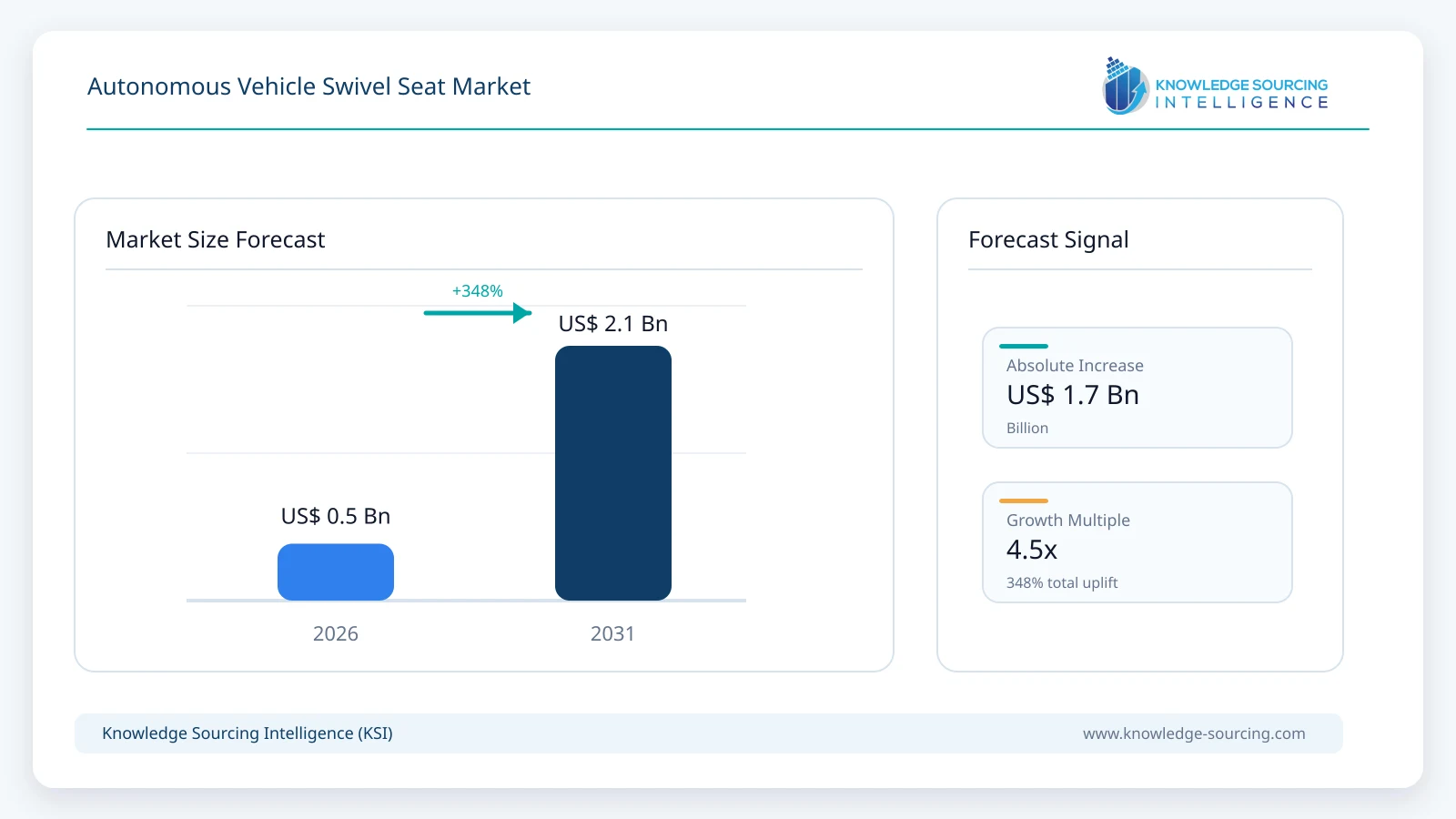
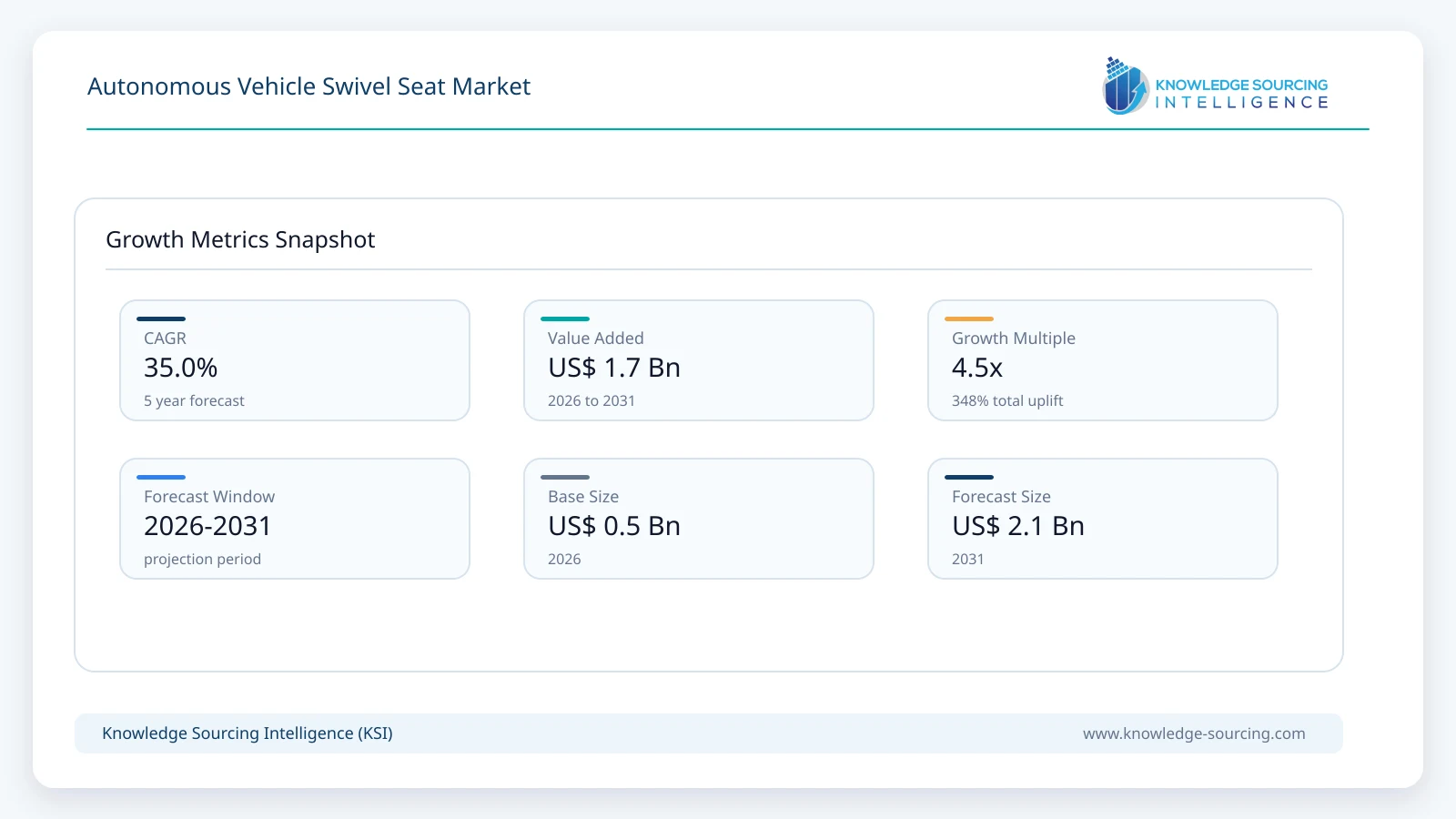
The autonomous vehicle swivel seat market is estimated at approximately USD 0.48 billion in 2026 and is projected to reach about USD 2.15 billion by 2031, representing a CAGR of 35.0% during the forecast period.
Highlights:
- 1Swivel-and-long-rail integrated systems account for approximately 59% of global market value in 2026 because autonomous-cabin use cases require both seat rotation and substantial longitudinal travel to create clearance and face-to-face layouts.
- 2Front-row swivel seats represent approximately 54% of market value in 2026, reflecting the high technical content required to rotate driver and front-passenger seats while retaining restraint, electrical and control integration.
- 3SAE Level 3 applications account for approximately 57% of market value in 2026, providing the first commercial pathway for automated mode-dependent seat movement, while Level 4 applications are expected to expand faster through 2031.
- 4Personally owned autonomous passenger vehicles represent approximately 63% of 2026 market value, supported by premium EVs, executive MPVs and smart-cabin platforms where swivel seating is positioned as a high-value interior feature.
- 5Battery electric vehicles represent approximately 79% of 2026 market value because flat floors, long wheelbases and centralized electronics provide the strongest architecture for powered seat rotation and long-rail integration.
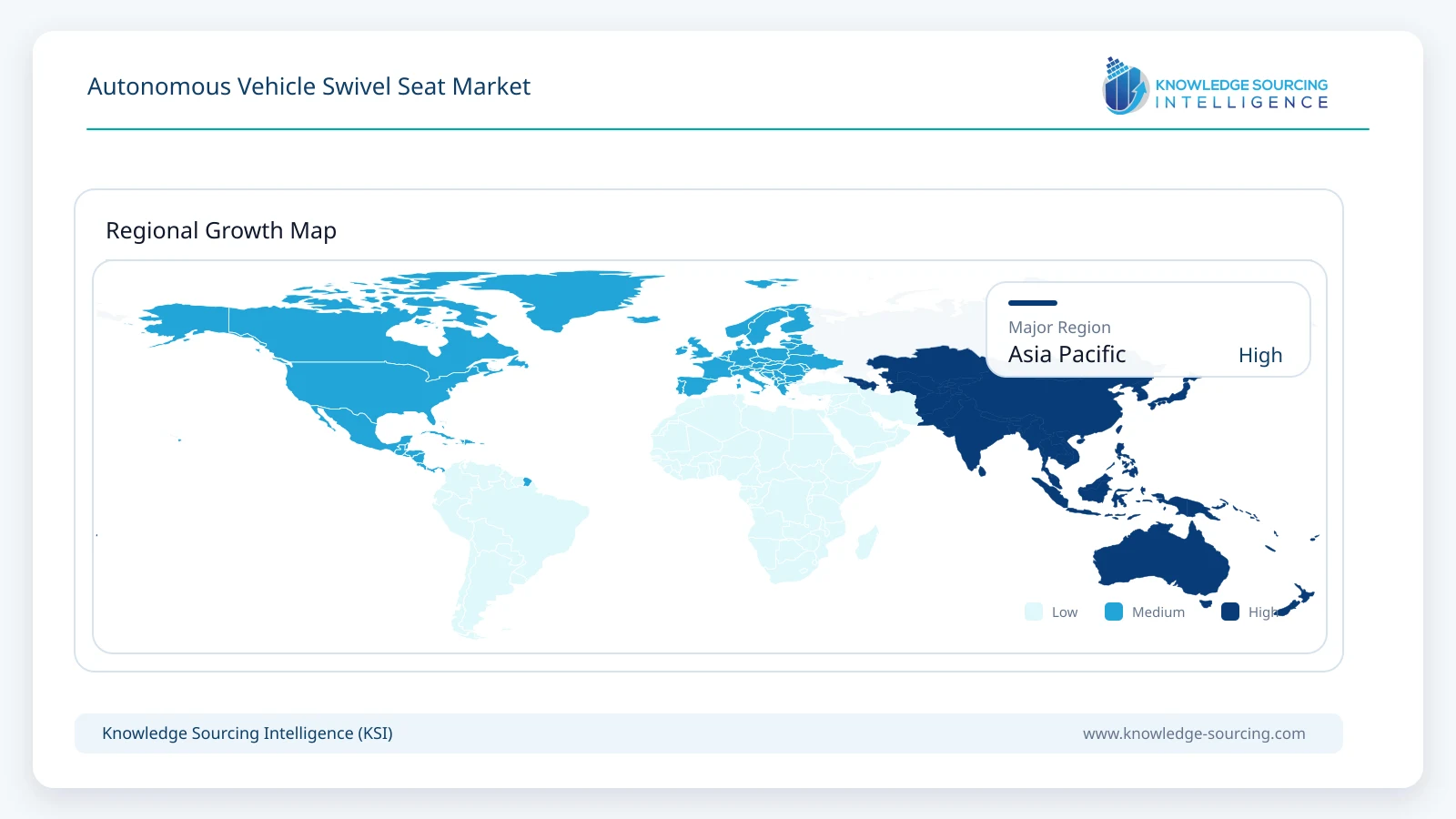
- 6Asia Pacific accounts for approximately 46% of global market value in 2026, led by rapid smart-cabin development in China and established seating-system capabilities in Japan and South Korea.
The market is moving from concept-stage rotating seats toward production-oriented seat architectures that combine powered rotation, long travel, electronic locking, occupant sensing and seat-integrated restraint systems.
Supplier development shows a clear move toward integrated seat motion. Magna has disclosed a significant program with a Chinese OEM using power swivel seats on nearly two meters of power long rails and enabling up to 270-degree rotation of the driver and front passenger seats. Adient has presented a 0-180-degree power long-track and swivel solution, Toyota Boshoku has demonstrated electrically powered lightweight rotating rear seats, and Hyundai Transys is developing autonomous-driving seats combining swivel mechanisms, power long slides and belt-in-seat structures.
Safety is the principal technical gate to broader in-motion use. Rotated and rear-facing positions change occupant kinematics and move the passenger away from conventional restraint geometry. Seat-integrated belts, occupant-position sensing, adaptive airbags, electronic locking and automatic return-to-safe-position logic are therefore becoming central to the swivel-seat value proposition. Current deployment also depends on national homologation rules and on whether the vehicle is parked, operating under conditional automation or functioning in a Level 4 domain.
Market Overview
Swivel seating changes the relationship between the occupant and the vehicle interior. In a conventional cabin, the seat remains aligned with the direction of travel because the occupant must face the road, steering controls and frontal restraint system. Higher automation creates periods in which this fixed orientation becomes less important, opening demand for seats that can turn toward other passengers, cabin displays, work surfaces or the door opening.
Yanfeng's XiM27 demonstrates the emerging cabin logic. Its modular interior uses ultra-long rails and quiet, thin rotating mechanisms to create vis-a-vis and social layouts, while the wider cabin architecture coordinates seating, displays, climate, lighting and a fold-away steering system. Magna's reconfigurable seating portfolio combines power long rails with its Stadium Swivel mechanism, and its disclosed Chinese OEM program extends front-seat rotation to 270 degrees.
Toyota Boshoku has developed electrically powered high-strength lightweight rotating seats that support face-to-face rear-seat arrangements and vary slide speed according to whether a passenger is present. Adient has presented power long-track and swivel systems with 0-180-degree rotation, while Hyundai Transys combines swivel movement, power long slides and seat-belt-integrated frames for autonomous-driving seat applications.
The market is therefore developing around complete motion and safety architectures rather than a simple turntable under the seat. The value of the system increasingly includes compact bearings and drives, floor rails, position sensors, electronic control, locking, cable management, integrated restraints and algorithms that determine when rotation is permitted and how the seat returns to a protected position.
Market Trends
Swivel and Long-Rail Functions Are Converging into One Seat Architecture
Seat rotation alone provides limited cabin flexibility because surrounding consoles, doors and adjacent seats constrain the swivel arc. Suppliers are therefore pairing rotating mechanisms with powered long rails so the seat can first create clearance, then rotate into a lounge or face-to-face position. This architecture is becoming the principal technical direction for autonomous-cabin swivel seating.
Long-rail integration also allows the same seat to serve multiple cabin modes without multiplying the number of seat structures, helping OEMs preserve platform commonality across different trim levels and vehicle-use scenarios.
Powered Rotation Is Replacing Manual Swivel in Higher-Value Autonomous Applications
Autonomous-cabin concepts increasingly use electric actuation rather than manually released turntables. Powered movement enables the seat controller to synchronize rotation with fore-aft travel, recline, steering-wheel position, console movement and door clearance. It also allows software to limit motion when the required safety conditions are not met.
Seat-Integrated Restraints Are Becoming Essential to Rotation Freedom
A conventional B-pillar-mounted belt constrains seat orientation because the restraint geometry changes as the seat turns. Belt-in-seat architectures keep the shoulder and lap belt relationship aligned with the occupant across a wider range of positions. ZF LIFETEC, Hyundai Transys, FORVIA and other suppliers are developing seat-integrated restraint technologies that increase design freedom for movable and rotatable seats.
Occupant Sensing Is Moving from Monitoring to Motion Permission and Restraint Adaptation
Seat rotation requires reliable knowledge of occupant presence, size, posture and belt status. Toyota Boshoku already uses passenger detection to vary slide speed in its rotating-seat concept, while newer safety systems combine cameras, seat sensors and belt sensors to adapt restraint deployment. The same sensing layer can support anti-collision logic, rotation authorization and automatic repositioning.
Automatic Safe-Position Return Is Emerging as a Core Control Function
For vehicles that alternate between manual and automated driving, the seat must return quickly and predictably to a driving-compatible position before a takeover request or other safety-critical event. Fast electric adjustment, seat-position memory and coordinated steering/console movement are therefore becoming as important as the rotation mechanism itself.
Segment Analysis
By Motion Architecture: Swivel + Long-Rail Integrated Systems
Swivel-and-long-rail integrated systems are projected to generate approximately USD 1.40 billion in market value by 2031. Their advantage is the ability to create clearance before rotation and to support multiple seating layouts using one seat structure. The architecture is particularly relevant to premium MPVs, large EVs, robotaxis and purpose-built autonomous vehicles where face-to-face or lounge modes require both longitudinal travel and rotation.
By Seat Position: Front-Row Swivel Seats
Front-row swivel seats are projected to account for approximately USD 1.08 billion of market value by 2031. The front row carries the highest system value because rotation must be integrated with driving controls, seat-belt geometry, occupant detection, airbags, wiring and automated-mode logic. As Level 4 applications expand, front seats can increasingly transition from driving positions into passenger-oriented positions when the operating domain permits.
By Automation Level: SAE Level 4 and Above
SAE Level 4 and above applications are projected to reach approximately USD 1.27 billion by 2031. Higher automation provides the strongest functional justification for swivel seats because occupants can spend longer periods without an expectation of immediate driving-task engagement. Purpose-built Level 4 platforms also provide greater freedom to design symmetrical, social or lounge-oriented interiors from the outset.
By Vehicle Application: Personally Owned Autonomous Passenger Vehicles
Personally owned autonomous passenger vehicles are projected to generate approximately USD 1.21 billion of market value by 2031. Premium EVs and executive MPVs provide an early commercialization path because customers already pay for multi-function seating, power adjustment and advanced cabin experiences, allowing swivel functionality to be added as part of a broader comfort and reconfiguration package.
By Propulsion: Battery Electric Vehicles
Battery electric vehicles are projected to generate approximately USD 1.81 billion of swivel-seat market value by 2031. Flat underfloors and long wheelbases create more usable rail length and cabin clearance, while centralized electrical architectures simplify powered actuation, sensing and coordinated seat-control software.
By Geography: Asia Pacific
Asia Pacific is projected to reach approximately USD 1.03 billion by 2031. China is the principal commercialization engine through premium EV, MPV and smart-cabin development, while Japan and South Korea contribute strong seat-system engineering through suppliers such as Toyota Boshoku and Hyundai Transys. The region also benefits from faster product cycles for interior differentiation and growing supplier investment in integrated seating systems.
Market Drivers
Expansion of SAE Level 3 and Level 4 Automated Driving
Higher automation reduces the requirement for occupants to remain continuously oriented toward conventional driving controls. This creates demand for seats that can support conversation, relaxation, work and alternative viewing positions during authorized automated operation or while parked.
Demand for Face-to-Face and Social Cabin Layouts
Swivel seats enable one of the most visible transformations of the autonomous cabin: turning front or middle-row occupants toward each other. Face-to-face seating is relevant to family interaction, business use, shared mobility and lounge-style travel, giving OEMs a clear experiential reason to invest in rotating-seat architectures.
EV-Native Flat Floors and Longer Usable Seat Travel
Electric platforms reduce packaging intrusion from transmission tunnels and mechanical driveline components. This creates room for longer seat rails, low-profile swivel mechanisms and wider movement envelopes, particularly in MPVs, large SUVs and purpose-built mobility vehicles.
Growth of Software-Defined Cabin Motion Control
Centralized vehicle electronics allow seat rotation to become part of an orchestrated cabin mode. The vehicle can move the seat longitudinally, check clearance, rotate it, change recline, reposition the steering wheel and adjust the console through a coordinated software sequence rather than relying on separate manual controls.
Advances in Seat-Integrated Occupant Protection
Belt-in-seat systems, adaptive airbags, seat and belt sensing, pre-crash repositioning and electronic locking are reducing one of the main barriers to unconventional seating. Continued progress in these technologies increases the range of seat positions that can be engineered and validated safely.
Market Restraints
Crash Safety in Rotated and Rear-Facing Positions
Rotated seating changes the direction and magnitude of occupant loading in a crash and introduces new contact points inside the cabin. Restraint systems designed for a conventional forward-facing position cannot simply be carried over, increasing simulation, sled testing, sensor integration and vehicle-level validation requirements.
Regulatory Limits on In-Motion Seat Rotation
The legal treatment of unconventional seat positions differs across jurisdictions, and many current safety rules were written around conventional forward-facing seating. Manufacturers must therefore control when seats are allowed to rotate and demonstrate equivalent occupant protection before broader in-motion use can scale.
Cost, Weight and Packaging of Powered Swivel Systems
Powered turntables, long rails, electric drives, locking mechanisms, reinforced seat structures and integrated restraints add cost and mass. The rotating envelope also competes with doors, consoles and adjacent seats for space, requiring careful packaging that can be difficult in smaller vehicles.
Rotation Clearance, Anti-Pinch and Interior Collision Risk
A seat that turns inside a constrained cabin can contact another occupant, door trim, console or deployed work surface. Reliable sensing and motion planning are required to prevent pinching and collision, adding software and sensor content to what was historically a mechanical seat function.
Durability and Electrical Integration
Repeated rotation places additional demands on bearings, electrical connections, wiring paths and locking systems. Seat-mounted airbags, heating, ventilation, controls and sensors must remain reliable across repeated swivel cycles without cable fatigue, noise growth or loss of position accuracy.
Regional Outlook
Asia Pacific
Asia Pacific is the largest regional market and is expected to remain the leading development and commercialization center through 2031. China combines rapid premium EV and MPV development with aggressive smart-cabin differentiation, while Japan and South Korea provide established seating and interior-system engineering capabilities.
Yanfeng's XiM27 uses thin rotating mechanisms and ultra-long rails to create vis-a-vis layouts, Magna has disclosed a Chinese OEM award for power swivel seats with nearly two meters of power long rails, Adient has presented 0-180-degree power swivel and long-track systems in China, and Toyota Boshoku has demonstrated electrically powered rotating rear seats at Auto Shanghai. Hyundai Transys further strengthens the regional supplier base with swivel, power-long-slide and belt-in-seat technologies for autonomous-driving seats.
Europe
Europe is a major technology and validation market because it combines premium automated-driving development with strong seat-mechanism and occupant-safety suppliers. FORVIA has developed an Advanced Versatile Structure that supports seat swivel and integrated restraint functions, Brose has long demonstrated 180-degree rotating seats and continuous rail architectures, and ZF LIFETEC is advancing seat-integrated belts and adaptive restraint technologies that support greater seat movement freedom.
European growth will depend heavily on homologation and the controlled expansion of Level 3 and Level 4 operating domains. The region is therefore expected to remain important for high-value engineering, safety validation and premium vehicle applications even when volume growth is led by Asia Pacific.
Competitive Landscape
The autonomous vehicle swivel seat market is concentrated among global seating, seat-mechanism and interior-system suppliers with the ability to combine structural engineering, electric actuation, electronics, safety and vehicle integration. Competition is shifting from stand-alone rotating bases toward low-profile, powered, sensor-aware systems that integrate with long rails and broader cabin-control software.
Magna differentiates through Stadium Swivel, power long rails and a disclosed 270-degree front-seat program for a Chinese OEM. Yanfeng combines thin swivel mechanisms with ultra-long rails and complete smart-cabin control. Toyota Boshoku focuses on lightweight powered rotation and passenger-aware motion, Adient combines power swivel with long-track and safety technologies, Hyundai Transys integrates swivel with belt-in-seat structures, FORVIA links seat rotation to integrated safety and comfort architecture, and Brose contributes high-volume seat-adjustment mechatronics and flexible interior-control systems.
Recent Developments
17 September 2026: ZF LIFETEC presented a production-ready safety architecture that combines cameras, seat sensors and belt sensors with adaptive airbag and seat-belt deployment, strengthening the safety foundation for occupants in variable seating positions.
10 July 2026: Yanfeng announced that XiM27 received the 2026 Red Dot Design Concept Award. The concept uses an intelligent seat-configuration system to create multiple cabin modes for higher-level autonomous mobility.
29 June 2026: Yanfeng unveiled XiM27 as a production-ready smart-cabin platform using ultra-long floor rails and swivel seating to move between driver-focused, face-to-face, relaxation and work configurations.
28 August 2025: Brose detailed its vehicle-seat development direction for autonomous and electrified interiors, emphasizing greater flexibility, comfort and electronically controlled seat adjustment as cabins evolve into multi-use living spaces.
23 May 2025: Adient presented its latest China seating innovations, including a power long-track and swivel system with smooth 0-180-degree rotation and an integrated cockpit concept combining driver-seat swivel, long travel and zero-gravity functionality.
23 April 2025: Toyota Boshoku displayed electrically powered high-strength lightweight rotating seats at Auto Shanghai 2025, enabling rear-seat rotation and face-to-face layouts with occupant-dependent slide-speed control.
Market Outlook
The autonomous vehicle swivel seat market is expected to expand rapidly through 2031 as automated-driving capability and reconfigurable cabin design converge. Early commercialization will remain concentrated in premium EVs, executive MPVs and advanced mobility platforms where the additional mechanism and safety cost can be absorbed within a high-value interior package.
The technical direction will move toward integrated swivel-and-long-rail systems controlled by centralized cabin software. Rotation will increasingly be conditioned by occupant detection, belt status, collision clearance and automated-driving state, while seat-integrated restraints and adaptive airbags will support a wider range of safe positions.
Asia Pacific is expected to remain the largest market, while Europe remains a major technology and homologation region. Competitive advantage will depend on compact mechanism packaging, low noise, motion speed, structural rigidity, seat-integrated safety, sensing accuracy, software coordination and the ability to industrialize swivel functions at automotive scale.
Autonomous Vehicle Swivel Seat Market Scope
| Report Metric | Details |
|---|---|
| Total Market Size in 2026 | USD 0.48 billion |
| Total Market Size in 2031 | USD 2.15 billion |
| Forecast Unit | Billion |
| Growth Rate | 35.0% |
| Study Period | 2021 to 2031 |
| Historical Data | 2021 to 2024 |
| Base Year | 2025 |
| Forecast Period | 2026 – 2031 |
| Segmentation | Motion Architecture, Seat Position, Automation Level, Vehicle Application, Propulsion, Geography |
| Companies |
|
Market Segmentation
By Motion Architecture
Swivel + Long-Rail Integrated Systems
Standalone Swivel Seat Systems
Multi-Axis Reconfigurable Swivel Seats
By Seat Position
Front-Row Swivel Seats
Second-Row Swivel Seats
Other Passenger Seat Positions
By Automation Level
SAE Level 3
SAE Level 4 and Above
By Vehicle Application
Personally Owned Autonomous Passenger Vehicles
Robotaxi and Shared Autonomous Mobility
Autonomous Shuttle, MPV and Purpose-Built Mobility
By Propulsion
Battery Electric Vehicles
Hybrid and Plug-In Hybrid Electric Vehicles
Internal Combustion Engine Vehicles
Fuel Cell Electric Vehicles
By Geography
North America
United States
Canada
Mexico
South America
Brazil
Argentina
Others
Europe
Germany
United Kingdom
France
Italy
Spain
Others
Middle East and Africa
Saudi Arabia
UAE
South Africa
Others
Asia Pacific
China
Japan
South Korea
India
Singapore
Others
Table of Contents
1. INTRODUCTION
1.1. Market Overview
1.2. Market Definition
1.3. Scope of the Study
1.4. Market Segmentation
1.5. Currency
1.6. Assumptions
1.7. Base and Forecast Years
1.8. Key Benefits to Stakeholders
2. RESEARCH METHODOLOGY
2.1. Research Design
2.2. Secondary Research
2.3. Primary Research
2.4. Market Estimation
2.5. Segment Modelling
2.6. Data Triangulation and Validation
3. EXECUTIVE SUMMARY
3.1. Key Findings
3.2. Autonomous Vehicle Swivel Seat Market Size, 2026-2031
3.3. Motion Architecture Outlook
3.4. Seat Position Outlook
3.5. Automation Level Outlook
3.6. Vehicle Application Outlook
3.7. Propulsion Outlook
3.8. Regional Opportunity Summary
4. MARKET DYNAMICS
4.1. Market Drivers
4.1.1. Expansion of SAE Level 3 and Level 4 Automated Driving
4.1.2. Demand for Face-to-Face and Social Cabin Layouts
4.1.3. EV-Native Flat Floors and Longer Usable Seat Travel
4.1.4. Growth of Software-Defined Cabin Motion Control
4.1.5. Advances in Seat-Integrated Occupant Protection
4.2. Market Restraints
4.2.1. Crash Safety in Rotated and Rear-Facing Positions
4.2.2. Regulatory Limits on In-Motion Seat Rotation
4.2.3. Cost, Weight and Packaging of Powered Swivel Systems
4.2.4. Rotation Clearance, Anti-Pinch and Interior Collision Risk
4.2.5. Durability and Electrical Integration
4.3. Market Opportunities
4.4. Porter's Five Forces Analysis
4.5. Industry Value Chain Analysis
4.6. Swivel Seat System Economics
4.7. Safety, Homologation and Human-Factors Environment
5. TECHNOLOGY OUTLOOK
5.1. Low-Profile Swivel Mechanisms
5.2. Powered Electric Rotation Systems
5.3. Swivel and Long-Rail Integration
5.4. Belt-in-Seat and Seat-Integrated Restraints
5.5. Occupant Position and Rotation Sensing
5.6. Anti-Pinch, Collision Avoidance and Clearance Detection
5.7. Automatic Safe-Position Return
5.8. Multi-Axis Seat Motion Control
5.9. Centralized Cabin Motion Coordination
5.10. Lightweight Structures and Compact Drives
6. AUTONOMOUS VEHICLE SWIVEL SEAT MARKET BY MOTION ARCHITECTURE
6.1. Introduction
6.2. Swivel + Long-Rail Integrated Systems
6.3. Standalone Swivel Seat Systems
6.4. Multi-Axis Reconfigurable Swivel Seats
7. AUTONOMOUS VEHICLE SWIVEL SEAT MARKET BY SEAT POSITION
7.1. Introduction
7.2. Front-Row Swivel Seats
7.3. Second-Row Swivel Seats
7.4. Other Passenger Seat Positions
8. AUTONOMOUS VEHICLE SWIVEL SEAT MARKET BY AUTOMATION LEVEL
8.1. Introduction
8.2. SAE Level 3
8.3. SAE Level 4 and Above
9. AUTONOMOUS VEHICLE SWIVEL SEAT MARKET BY VEHICLE APPLICATION
9.1. Introduction
9.2. Personally Owned Autonomous Passenger Vehicles
9.3. Robotaxi and Shared Autonomous Mobility
9.4. Autonomous Shuttle, MPV and Purpose-Built Mobility
10. AUTONOMOUS VEHICLE SWIVEL SEAT MARKET BY PROPULSION
10.1. Introduction
10.2. Battery Electric Vehicles
10.3. Hybrid and Plug-In Hybrid Electric Vehicles
10.4. Internal Combustion Engine Vehicles
10.5. Fuel Cell Electric Vehicles
11. AUTONOMOUS VEHICLE SWIVEL SEAT MARKET BY GEOGRAPHY
11.1. North America
11.1.1. United States
11.1.2. Canada
11.1.3. Mexico
11.2. South America
11.2.1. Brazil
11.2.2. Argentina
11.2.3. Others
11.3. Europe
11.3.1. Germany
11.3.2. United Kingdom
11.3.3. France
11.3.4. Italy
11.3.5. Spain
11.3.6. Others
11.4. Middle East and Africa
11.4.1. Saudi Arabia
11.4.2. UAE
11.4.3. South Africa
11.4.4. Others
11.5. Asia Pacific
11.5.1. China
11.5.2. Japan
11.5.3. South Korea
11.5.4. India
11.5.5. Singapore
11.5.6. Others
12. COMPETITIVE ENVIRONMENT AND ANALYSIS
12.1. Major Players and Strategy Analysis
12.2. Market Share Analysis
12.3. Swivel Seat Technology Benchmarking
12.4. Production Readiness and OEM Adoption
12.5. Competitive Dashboard
13. COMPANY PROFILES
13.1. Magna International Inc.
13.2. Yanfeng
13.3. Toyota Boshoku Corporation
13.4. Adient plc
13.5. Hyundai Transys
13.6. FORVIA
13.7. Brose / Brose Sitech
14. APPENDIX
14.1. Currency
14.2. Assumptions
14.3. Base and Forecast Years Timeline
14.4. Key Benefits for Stakeholders
14.5. Research Methodology
14.6. Abbreviations
14.7. Data Sources
Navigate
Trusted by the world's leading organizations











