
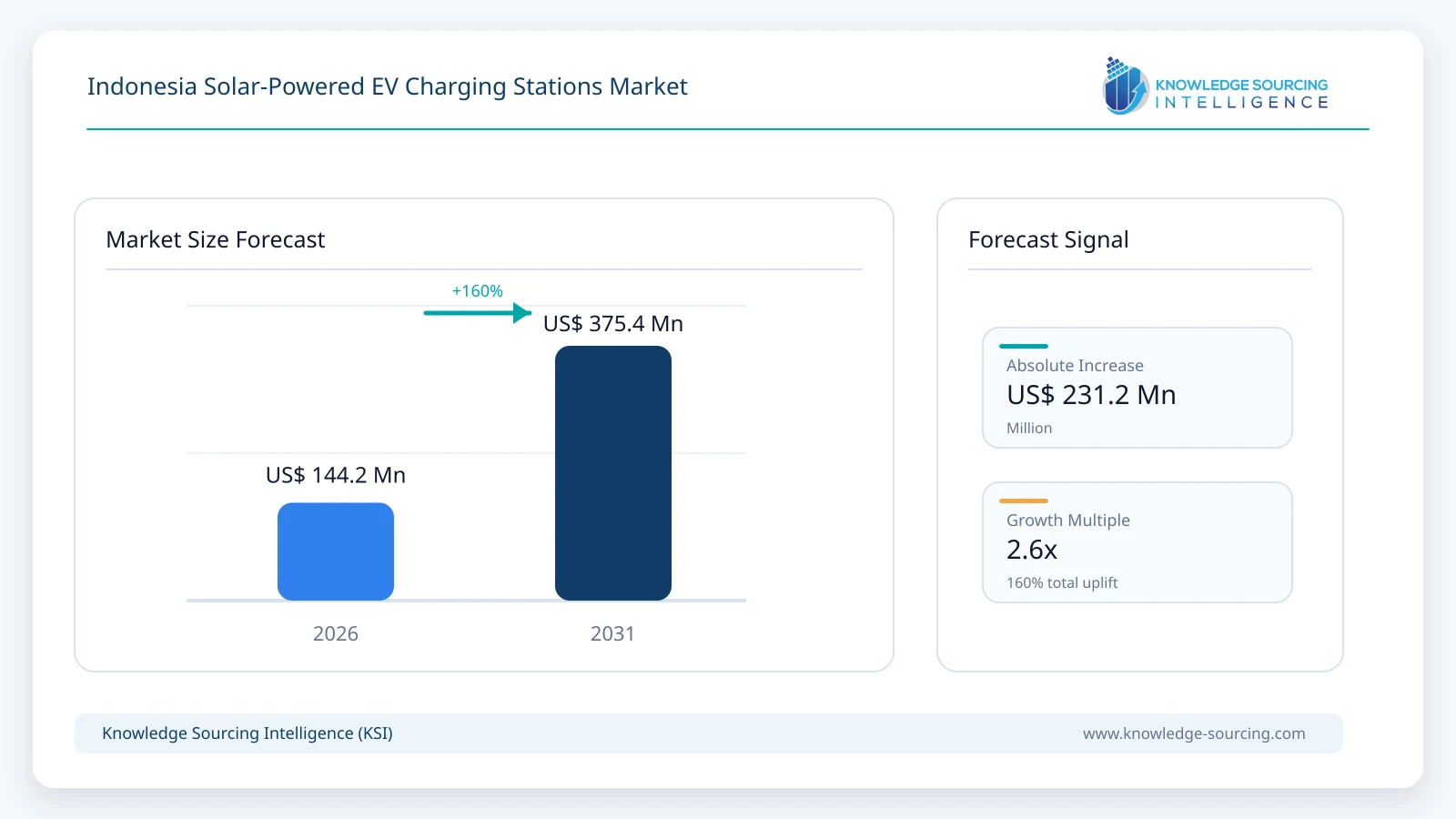
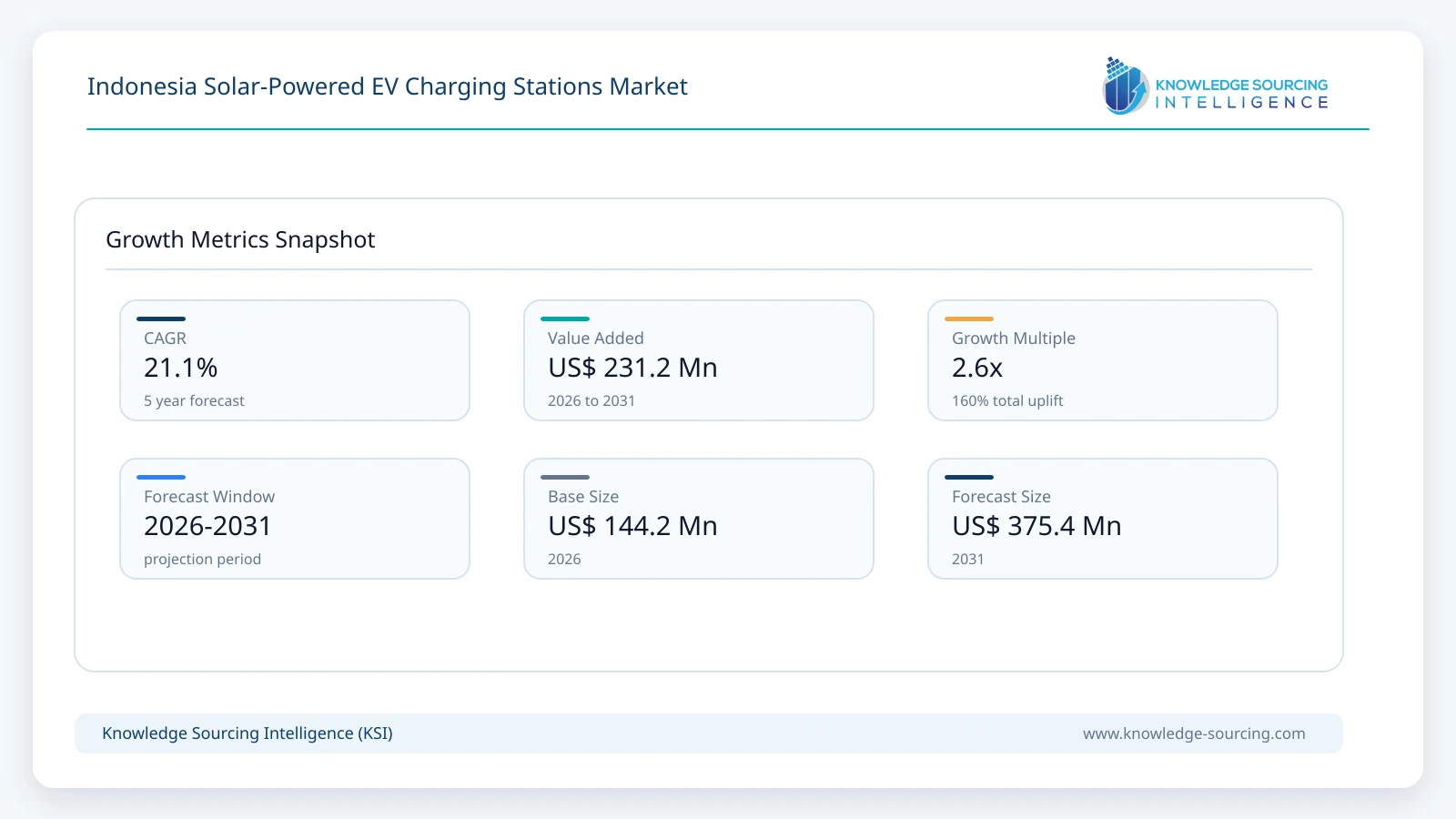
Indonesia Solar-Powered EV Charging Stations Market is forecast to grow at a CAGR of 21.1%, reaching USD 375.4 million in 2031 from USD 144.2 million in 2026.
Highlights:
- 1The archipelagic area of Indonesia allows solar charging systems to be decentralized, off-grid, and hybrid.
- 2There are fast and ultra-fast chargers at PLN's 2025 SPKLU Center in Jakarta, showing the charging infrastructure evolving toward these higher powers.
- 3Indonesia aims for around 600,000 EVs each year by 2030, significantly increasing its long-term charging infrastructure needs.
- 4Indonesian projects on solar EV charging are integrating PV generation, batteries, and EV fast charging rather than direct flow of electricity from solar to vehicle.
The market is changing from EV charging infrastructure as a standalone to integrated renewable-energy systems, which include solar photovoltaic panels, EV chargers, maximum power point tracking charge controllers, batteries with battery energy storage system (BESS), inverters rated, and intelligent charging-management platforms.
The growth of Indonesia's conventional charging infrastructure is building the base for solar integration. Additionally, PLN and its partners expanded the open charging EV stations, i.e., the SPKLU network in Indonesia, with a total of 4,655 units at 3,007 locations in 2025.
This factor is especially boosted in highly developed urban areas, where the potential for solar-powered EV charging is growing. Solar-powered storage systems can enable remote communities, tourist areas, logistics centers, highways, and islands to shift from reliance on traditional grid electricity. Further, PT Surya Energi Indotama installed an EV charging station using solar-powered PV electricity to charge an energy-storage battery that can connect and supply fast charging for EVs.
Market Dynamics
Market Drivers
Expansion of EV charging infrastructure: Indonesia's SPKLU network is growing quickly and forming the basic infrastructure basis of solar-powered charging. During 2025, PLN and its partners have installed a total of 4,655 SPKLU at 3,007 locations throughout Indonesia compared to the previous year's numbers of 3,223 units at 2,192 locations in 2024. Operators are exploring renewable-energy sources to lower their operation costs and boost energy resilience while charging locations grow. Solar PV can be incorporated into new EV charging stations or used to retrofit existing commercial and public charging locations.
Indonesia's EV Manufacturing Ambitions: Indonesia has been building a complete domestic EV ecosystem, from nickel processing to battery manufacturing, vehicle production and charging infrastructure. The target, according to the government, is around 600000 EVs by FY 2030. Increased EV production and sales in the country would boost charging needs across passenger vehicles, commercial fleets, buses, and logistics applications.
Increasing Demand for High-Power Charging: High-output charging is gradually being incorporated into the country's ever-expanding charging infrastructure. However, PLN's first SPKLU Centers in Jakarta consist of chargers with a rating of 22 kW, 60 kW, 120 kW, and even up to 200 kW. The combination of higher charging power and electricity demand makes a better case for BESS. This stored solar energy can reduce the need for oversized grid connections, as it can supplement grid electricity during high-demand charging sessions.
Energy Resilience Requirements: Electricity demand in Indonesia is distributed spatially, and different parts of the grid have different conditions. The compelling case for solar-powered-storage charging stations is that they can act as an alternate energy source and maintain charging in the event of small-scale regional power loss. The studies show EV charging infrastructure in Indonesia listed electricity uncertainty and service reliability as critical issue on develop charging network.
Market Restraints & Opportunities
The major constraint is high upfront capital expenditure. Compared to conventional grid-connected charging, additional costs of solar PV, BESS, inverters, DC fast chargers, electrical equipment, land preparation, and other forms of grid interconnection can raise project costs significantly.
The fragmented geography of Indonesia can also complicate the logistics and maintenance of charging infrastructure installed outside major metropolitan regions.
However, these challenges also offer opportunity, as the market can deliver hybrid solar EV charging stations. Solar generation can be efficiently used for hybrid systems during the daytime; extra electricity, when generated, goes into BESS and the grid when renewable generation is inadequate.
Off-grid integrated solar-storage stations also open new prospects in remote islands, tourist areas, mining districts, rural areas, and highway corridors where grid extension may not be practical.
Key Developments
February 2026: MEBI and Huawei launched ZORA Signature at Gading Serpong, Tangerang, utilizing Huawei FusionCharge liquid-cooled technology and split charging. The station can charge nearly all EV brands with charging architecture between 200–1,000 V, as ultra-fast charging solutions aim to optimize power distribution and charging efficiency. The station also comes with solar power and energy-storage systems.
Market Segmentation
The market is segmented by component, charging type, vehicle type, charging station type, application, and city.
By Vehicle Type: Electric Passenger Vehicles
The passenger electric vehicle segment is the largest type of vehicle segment, as demand for residential, commercial, and public charging will be driven by the growing EV fleet in the country.
Indonesia has recently stated that they're forecasting to ramp up EV production, broadening its passenger-EV customer base, as an increasing volume of affordable electric cars pack out their producing ambitions. While the country has set a long-term market target for its EV charging infrastructure, around 600,000 EVs of annual production within the country by 2030.
The residential solar systems of apartments, shopping centers, offices/hotels, and public charging locations can be integrated with passenger EV charging. Further, across nearly all power delivery scenarios, passenger EVs will comprise the largest vehicle category given their ability to generate widespread charging demand in urban and intercity environments.
By Charging Station Type: Hybrid Solar EV Charging Station
Hybrid solar EV charging stations are predicted to be the major station type because they integrate solar PV, BESS, and grid electricity to increase resiliency.
Hybrid systems can utilize solar electricity for daytime loads, store excess generation in batteries, and draw from the grid when neither the solar input nor the battery output are sufficient to drive their respective electrical devices. Such an architecture is well suited to Indonesia, where the demand for charging on location and time of day can vary greatly.
PT Surya Energi Indotama has a solar-powered charging solution, which showcases that they combine solar generation and energy storage with fast EV charging. Similarly, BESCORE also supports ESS architectures with solar generation and grid electricity for on-grid/off-grid configurations, while dynamic load distribution is supported in EV charging systems.
By Application: Commercial
Commercial dominates the application segment as shopping centers, offices, hotels, retail facilities, parking complexes, and even entire commercial developments provide a clustering of EV demand along with areas with appropriate surfaces for solar deployment.
Solar carports offer a particularly appealing architecture, as they leverage existing parking areas for energy production while shading parked vehicles. Indonesia's growing commercial EV infrastructure is also spurring integrated energy systems that bring together PV, BESS, chargers, and software-enabled management.
Among these, BESCORE commercial & industrial ESS solutions are aimed at application scenarios such as offices, shopping malls, factories, and industrial zones from a single site for all energy storage and EV charging stations.
By City: Jakarta Market Analysis
Jakarta is the largest market at the city level, as it has a large population, significant commercial activities, and growing EV adoption among consumers, while existing charging infrastructure is predominantly concentrated in this region.
In November 2025, PLN opened its first two SPKLU Centers in Jakarta, while in the Jagorawi area, seven chargers from 22 kW to 200 kW with 13 charging connectors are located.
The high-density urban environment of the city is well suited to rooftop solar, commercial solar carports, BESS-supported DC fast charging systems and compact hybrid charging systems. Additionally, the city will also continue to be an important market for smart charging, energy management, and solar-storage-charging systems.
List of Companies
Bescore
Continental Power
ABB
Delta Electronics
Siemens
Schneider Electric
Huawei
VinFast
V-Green
Sungrow
BESCORE
BESCORE is engaged in energy storage and EV charging technologies. The EV charging portfolio consists of dual-output charging solutions with dynamic load distribution and OCPP compatibility, allowing connectivity to backend identification together with proprietary remote monitoring and charging control capabilities. The company's energy-storage portfolio is complementary to solar and grid power.
ABB
ABB's extensive product range encompasses EV charging, power conversion, electrification, automation, and renewable-energy infrastructure. Its Proteus PV Stations provide a comprehensive, commercial-scale solar power-conversion solution that can house up to two inverters in a typical 40-foot skid with support for as much as 9.4 MVA.
Analyst View
Indonesia's solar-powered EV charging stations market is moving from early-stage deployments toward integrated solar-powered-storage charging infrastructure with rising expansion of PLN. High-power DC chargers create peak electricity requirements, while grid capacity is still constrained, and hybrid solar EV charging stations will gain the strongest commercial traction. Jakarta will continue as the main market while Surabaya, Bandung, Bali, Batam, Medan and other regional markets will provide commercial, fleet, tourism and decentralized charging opportunities. Indonesia is one of Asia's largest downstream markets for EV manufacturing; along with its extensive land area gives it a particular opportunity to deploy solar PV and BESS systems as a pathway to exporting reliable charging infrastructure access beyond the major cities.
Indonesia Solar-Powered EV Charging Stations Market Scope:
| Report Metric | Details |
|---|---|
| Total Market Size in 2026 | USD 144.2 million |
| Total Market Size in 2031 | USD 375.4 million |
| Forecast Unit | USD Million |
| Growth Rate | 21.1% |
| Study Period | 2021 to 2031 |
| Historical Data | 2021 to 2024 |
| Base Year | 2025 |
| Forecast Period | 2026 – 2031 |
| Segmentation | Component, Charging Type, Vehicle Type, Charging Station Type, Application, City |
| Companies |
|
Table of Contents
1. EXECUTIVE SUMMARY
2. MARKET SNAPSHOT
2.1. Market Overview
2.2. Market Definition
2.3. Scope of the Study
2.4. Market Segmentation
3. MARKET DYNAMIC
3.1. Market Drivers
3.2. Market Restraints
3.3. Market Opportunities
3.4. Porter’s Five Forces Analysis
3.5. Industry Value Chain Analysis
4. BUSINESS LANDSCAPE
4.1. Policy & Regulatory Landscape
4.2. EV Charging Infrastructure Deployment Landscape
4.3. Business & Revenue Model Landscape
4.4. Import & Domestic Manufacturing Landscape
4.5. Strategic Recommendations
5. TECHNOLOGICAL OUTLOOK
5.1. Solar PV and EV Charging Technology
5.2. Solar-Charger Integration Technology
5.3. Grid-Interactive Charging Technologies
5.4. Smart Charging & Digital Technologies
6. INDONESIA SOLAR POWERED EV CHARGING STATIONS MARKET BY COMPONENT
6.1. Introduction
6.2. Solar Photovoltaic (PV) Panels
6.3. EV Chargers & MPPT Charge Controller
6.3. Battery Energy Storage System (BESS)
6.4. Power Inverter
6.5. Others
7. INDONESIA SOLAR POWERED EV CHARGING STATIONS MARKET BY CHARGING TYPE
7.1. Introduction
7.2. AC Charging Stations
7.3. DC Charging Stations
8. INDONESIA SOLAR POWERED EV CHARGING STATIONS MARKET BY VEHICLE TYPE
8.1. Introduction
8.2. Passenger Electric Vehicles
8.3. Commercial Vehicles
8.4. Electric Buses
8.5. Others
9. INDONESIA SOLAR POWERED EV CHARGING STATIONS MARKET BY CHARGING STATION TYPE
9.1. Introduction
9.2. Off-Grid Solar EV Charging Station
9.3. Grid-Tied Solar EV Charging Station
9.4. Hybrid Solar EV Charging Station
10. INDONESIA SOLAR POWERED EV CHARGING STATIONS MARKET BY APPLICATION
10.1. Introduction
10.2. Residential
10.3. Commercial
10.4. Fleet Charging
10.5. Highway & Transit Corridor Charging
10.6. Others
11. INDONESIA SOLAR POWERED EV CHARGING STATIONS MARKET BY CITY
11.1. Introduction
11.2. Jakarta
11.3. Surabaya
11.3. Bandung
11.4. Others
12. COMPETITIVE ENVIRONMENT AND ANALYSIS
12.1. Major Players and Strategy Analysis
12.2. Market Share Analysis
12.3. Mergers, Acquisitions, Agreements, and Collaborations
12.4. Competitive Dashboard
13. COMPANY PROFILES
13.1. Bescore
13.2. Continental Power
13.3. ABB
13.4. Delta Electronics
13.5. Siemens
13.6. Schneider Electric
13.7. Huawei
13.8. VinFast
13.9. V-Green
13.10. Sungrow
14. APPENDIX
14.1. Currency
14.2. Assumptions
14.3. Base and Forecast Years Timeline
14.4. Key benefits for the stakeholders
14.5. Research Methodology
14.6. Abbreviations
Navigate
Trusted by the world's leading organizations











