
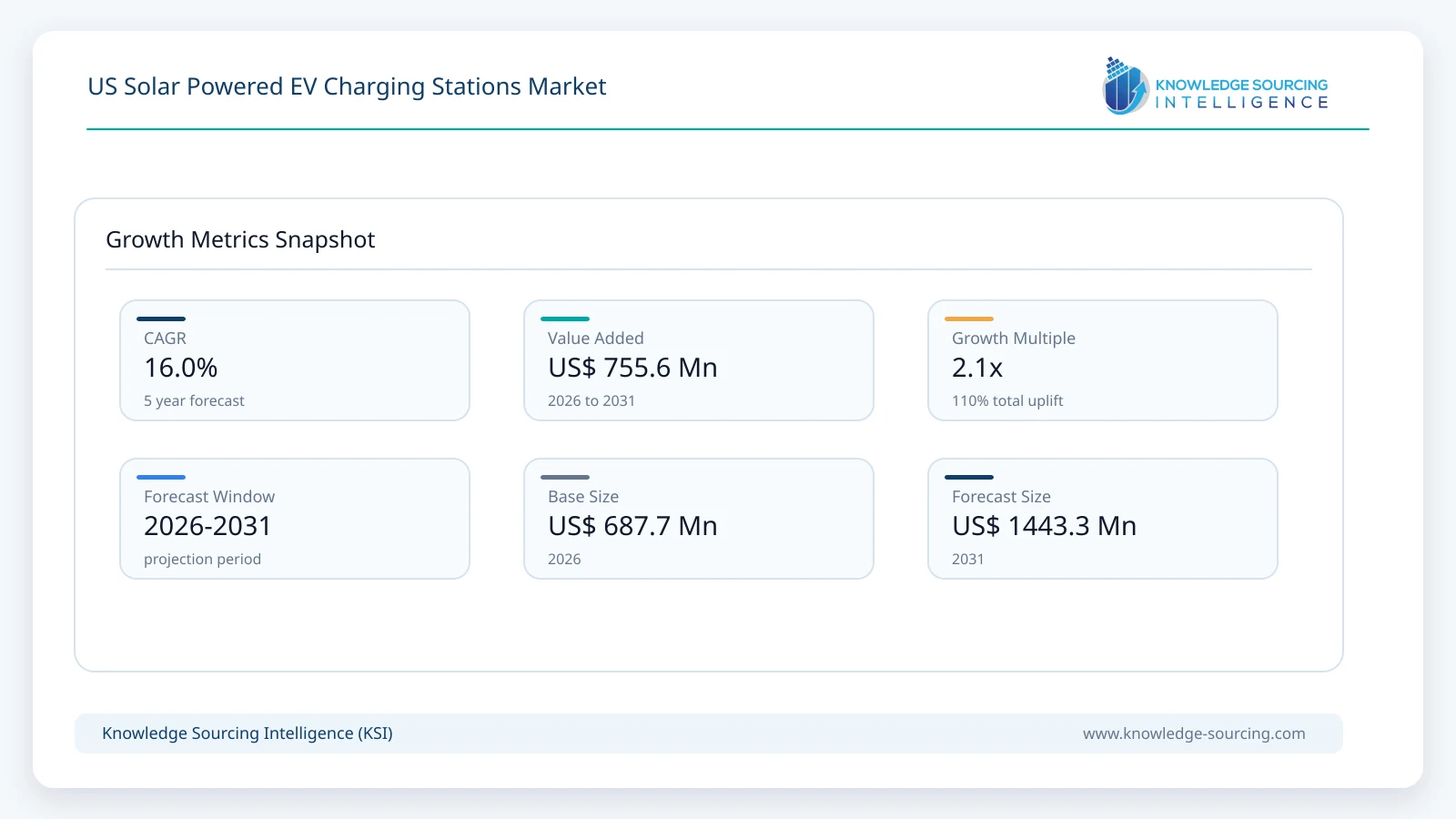
The US Solar Powered EV Charging Stations Market is forecast to grow at a CAGR of 16.0%, reaching USD 1,443.3 million in 2031 from USD 687.7 million in 2026.
Highlights:
- 1Integration of solar PV (PV) systems with EV charging infrastructure is helping to shift reliance away from grid electricity and to help meet federal and state decarbonization targets in commercial, public, and fleet charging applications.
- 2Federal funding via the National Electric Vehicle Infrastructure (NEVI) Formula Program and clean energy incentives are helping to drive the growth of EV charging corridors, which opens the door to renewable-powered charging solutions across the country.
- 3The connection of Battery Energy Storage Systems (BESS) with solar-powered charging stations is gaining popularity to achieve greater charging reliability, lower peak electricity usage, and greater use of onsite renewable energy.
- 4Commercial facilities, fleet operators, workplaces, retail centers, and municipalities are increasing the number of investments in solar-powered charging facilities and systems to reduce operational costs, enhance energy resilience, and meet corporate sustainability and net-zero targets.
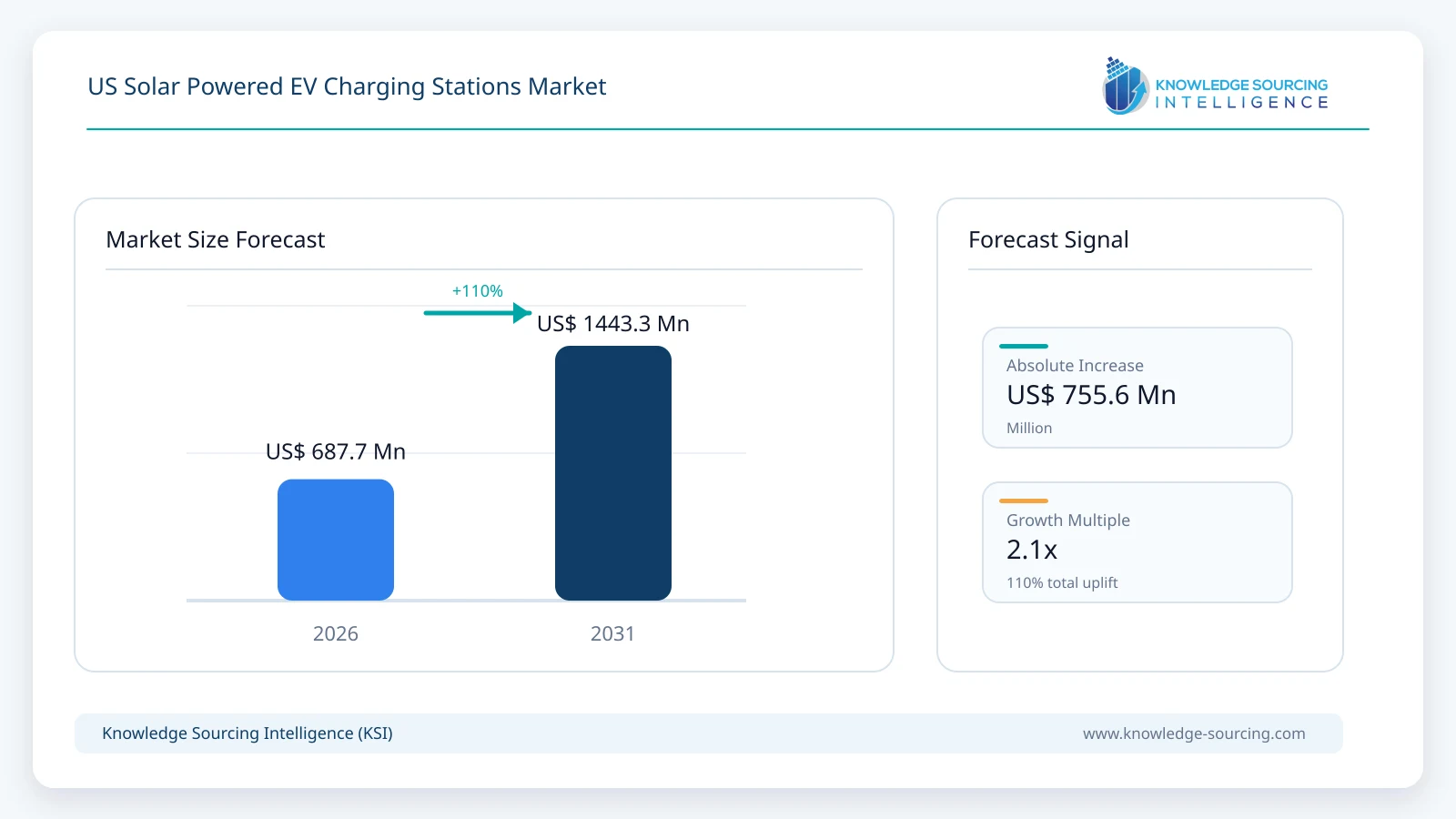
The U.S. Solar Powered EV Charging Stations Market is expected to grow significantly through the forecast period, as a result of the rising adoption of EVs, supportive renewable energy policies, and ongoing deployment of charging stations. Solar powered EV charging stations combine PV panels, EV charging stations, battery storage, power electronics, and intelligent energy management systems to produce renewable energy needed to power vehicles, while simultaneously cutting down on the use of traditional grid electricity.
In the Netherlands, the rapid rollout of public charging stations is opening up opportunities to integrate decentralized solar generation sources into charging networks. The fast deployment of public charging stations creates opportunities for integrating decentralized solar generation sources into charging networks in the Netherlands. The National Electric Vehicle Infrastructure (NEVI) Formula Program will provide USD 5 billion to accelerate EV charging corridor deployment in the United States, including the adoption of resilient and renewable-charging stations. Additionally, the Inflation Reduction Act continues to provide federal tax incentives for clean energy technologies, such as commercial solar and energy storage systems.
Renewable electricity generation, which complements transportation electrification efforts, continued to rise during 2025, with the U.S. Energy Information Administration (EIA) reporting continued growth of utility-scale solar generation. At the same time, corporations, universities, airports, logistics providers, and commercial real estate developers are investing in solar-powered charging stations to lower operating costs and meet environmental, social, and governance (ESG) targets.
Technological innovations like AI-powered energy optimization, cloud-based charging infrastructure management platforms, dynamic load balancing, and battery storage integration are also driving the market. These technologies enable the use of solar energy, reduce peak electricity consumption, and offer more reliability in charging. With the growth of fleet electrification in public transportation and logistics as well as commercial delivery services, solar-powered charging stations are likely to become an increasing part of the solution for sustainable mobility in the United States.
Market Dynamics
Market Drivers
Growing EV adoption is one of the most important factors for EV charging infrastructure, and that's the case in the United States as well. This demand for EVs is growing as more models are available and federal and state incentives are being offered to consumers. The U.S. Department of Energy's Alternative Fuels Data Center shows that the number of public EV charging stations has continued to grow nationwide, providing the potential to use renewable energy in charging stations.
Businesses are also expediting electrification efforts to lower fuel costs and meet their sustainability targets. Coupling solar generation with charging stations helps organizations lower their electric bills and increase energy security.
Federal Funding of Renewable-Powered Charging Infrastructure: Government programs continue to drive investment in EV charging infrastructure in the United States. NEVI Formula Program and similar programs covered by the Bipartisan Infrastructure Law are assisting with the implementation of fast charging stations along highways. Furthermore, tax credits from the Inflation Reduction Act (IRA) provide an added boost for companies to adopt solar PV, battery storage, and clean energy technologies that can be paired with EV charging stations.
State governments such as California, New York, Texas, and Florida are also launching schemes to promote renewable energy for transportation facilities via grants, tax incentives, and clean energy policies.
Increasing Solar PV system deployment and falling battery storage costs are helping spread solar-powered charging stations. BESS (battery energy storage systems) enables the utilization of surplus solar power generated during the day for battery charging in the night time, when generation is lower. This will increase charging reliability and lower electric bill costs during high-cost periods.
Market Restraints & Opportunities
One of the key issues that hinder the growth of the market is the high upfront investment needed for PV panels, battery storage systems, power conversion equipment, and high-speed EV charging stations. Also, constraints on available land area, local permitting requirements, interconnection approvals, and weather-dependent solar generation could make a project complex and take longer to deploy. However, for high-power DC fast charging applications, solar generation may not be enough without using supplemental battery storage or grid connectivity.
Continued improvements in solar panel efficiency, battery storage technologies, and intelligent charging software are expected to create significant growth opportunities. AI-enabled energy management platforms capable of forecasting solar production, optimizing charging schedules, and balancing electricity demand are becoming increasingly important for commercial charging operators.
Key Developments
January 2026: Beam Global expanded deployments of its off-grid solar-powered EV charging systems for municipal and federal customers across the United States. The company's EV ARC™ systems continue to support rapid deployment of charging infrastructure without requiring grid connections or extensive civil construction.
Market Segmentation
The market is segmented by component, charging type, vehicle type, charging station type, application, and geography.
By Component: Solar Photovoltaic (PV) Panels
Solar photovoltaic (PV) panels account for the largest share of the U.S. solar-powered EV charging stations market because they serve as the primary renewable electricity source for charging infrastructure. Improvements in panel efficiency, declining installation costs, and wider availability of high-efficiency bifacial modules have improved the economic feasibility of solar-powered charging installations across commercial facilities, workplaces, educational campuses, airports, and public parking areas.
Commercial operators are increasingly installing rooftop and canopy-mounted solar systems above parking lots to maximize available space while generating electricity for EV charging. Solar canopies also provide vehicle protection and improve utilization of otherwise underused parking infrastructure.
PowerFlex provides integrated solar canopies, battery storage, and EV charging solutions that enable commercial customers to reduce electricity costs while improving renewable energy utilization. Similarly, Beam Global's EV ARC™ platform combines solar generation, battery storage, and EV charging within an off-grid system designed for rapid deployment without utility interconnection.
By Charging Type: DC Fast Charging
DC fast charging represents the leading charging type segment due to increasing demand for rapid charging along highways, commercial corridors, logistics hubs, and fleet depots. High-power charging significantly reduces charging time and supports long-distance travel, making it particularly suitable for public charging networks and commercial fleet applications.
Solar-powered DC charging stations increasingly incorporate battery energy storage systems to supplement onsite renewable generation during periods of high electricity demand or limited sunlight. Hybrid configurations combining solar generation, battery storage, and grid connectivity ensure reliable charging while lowering operating costs and reducing peak electricity consumption.
ABB offers high-power DC charging systems that can be integrated with renewable energy and energy storage solutions, while Schneider Electric provides smart energy management platforms that optimize solar generation, battery storage, and EV charging across commercial installations.
By Vehicle Type: Passenger Electric Vehicles
Passenger electric vehicles constitute the largest vehicle segment owing to growing consumer EV adoption supported by expanding model availability, federal incentives, and continuous improvements in charging infrastructure. Increasing installation of residential, workplace, retail, and public charging facilities is creating sustained demand for solar-powered charging systems.
Many commercial property owners are deploying solar-powered chargers to attract EV-driving customers while reducing long-term electricity expenses. Workplace charging programs are also expanding as employers seek to provide sustainable transportation benefits to employees.
Companies including ChargePoint, Tesla, and Blink Charging continue expanding charging solutions suitable for passenger EVs, while solar integration is increasingly incorporated into commercial charging projects through partnerships with renewable energy developers and energy management providers.
Regional Analysis
California
California represents the largest market for solar-powered EV charging stations in the United States owing to its leadership in electric vehicle adoption, renewable energy deployment, and clean transportation policies. The state continues to expand charging infrastructure through investments by utilities, municipalities, commercial property owners, and private charging network operators. California's extensive solar generation capacity and favorable incentive programs encourage the integration of photovoltaic systems with public and commercial EV charging stations. Fleet electrification initiatives across transit agencies, ports, and logistics operators further strengthen demand for solar-powered charging solutions.
Texas
Texas is emerging as one of the fastest-growing markets due to rapid expansion of both utility-scale solar generation and EV charging infrastructure. Increasing corporate investments in renewable energy, combined with the state's abundant solar resources and growing electric vehicle ownership, are encouraging deployment of solar-integrated charging stations. Commercial facilities, industrial parks, and logistics operators are increasingly adopting hybrid charging systems incorporating solar PV and battery storage to reduce operating costs and improve energy resilience.
Florida
Florida benefits from high solar irradiance, increasing EV registrations, and continuous expansion of charging infrastructure throughout urban areas and interstate corridors. Hotels, shopping centers, office campuses, healthcare facilities, and municipalities are increasingly investing in solar-powered charging stations to support sustainable transportation while lowering electricity costs. Continued investments in renewable energy projects are expected to accelerate market growth during the forecast period.
New York
New York's ambitious clean energy and transportation electrification policies continue to drive deployment of renewable-powered charging infrastructure. Commercial buildings, transit facilities, universities, airports, and municipal parking facilities are increasingly integrating solar photovoltaic systems with EV charging stations to reduce carbon emissions and support statewide climate objectives. Incentive programs promoting renewable energy and zero-emission transportation continue to strengthen investment across both public and private sectors.
Georgia
Georgia is witnessing growing adoption of solar-powered EV charging infrastructure supported by increasing EV manufacturing investments, expanding commercial charging networks, and continued development of renewable energy resources. The presence of major automotive and battery manufacturing facilities is further accelerating charging infrastructure deployment throughout the state, creating opportunities for integrated solar charging solutions across industrial and commercial applications.
List of Companies
Beam Global
ChargePoint Holdings, Inc.
Tesla, Inc.
Electrify America LLC
Blink Charging Co.
EVgo Inc.
Paired Power
PowerFlex Systems
ABB Ltd.
Schneider Electric SE
Beam Global
Beam Global is a leading U.S. provider of sustainable charging infrastructure specializing in off-grid solar-powered EV charging systems. Its EV ARC™ platform combines solar photovoltaic generation, battery storage, and EV charging into a self-contained solution that requires minimal site preparation and does not depend on utility grid connections. The company's products are widely deployed by federal agencies, municipalities, military installations, airports, and commercial customers seeking resilient charging infrastructure.
ChargePoint Holdings, Inc.
ChargePoint operates one of North America's largest EV charging networks, providing AC and DC charging solutions for commercial, workplace, fleet, residential, and public applications. The company integrates intelligent energy management software that enables customers to optimize charging operations alongside onsite renewable energy generation and battery storage.
Tesla, Inc.
Tesla continues to expand its Supercharger network throughout the United States while increasing compatibility with additional vehicle manufacturers. The company combines expertise in electric vehicles, battery storage, and solar energy through its integrated energy ecosystem, supporting renewable-powered charging solutions for residential and commercial applications.
Analyst View
The U.S. solar-powered EV charging stations market is expected to experience sustained growth as transportation electrification converges with renewable energy deployment. Increasing federal support, declining solar and battery system costs, and continued expansion of public charging infrastructure are creating favorable conditions for market development. Commercial facilities, fleet operators, municipalities, and utilities are expected to remain the primary adopters of integrated solar charging systems. Future market competitiveness will increasingly depend on intelligent energy management, battery storage integration, and scalable charging solutions capable of maximizing renewable energy utilization while ensuring reliable charging performance.
US Solar-Powered EV Charging Stations Market Scope:
| Report Metric | Details |
|---|---|
| Total Market Size in 2026 | USD 687.7 million |
| Total Market Size in 2031 | USD 1,443.3 million |
| Forecast Unit | USD Million |
| Growth Rate | 16.0% |
| Study Period | 2021 to 2031 |
| Historical Data | 2021 to 2024 |
| Base Year | 2025 |
| Forecast Period | 2026 – 2031 |
| Segmentation | Component, Charging Type, Vehicle Type, Charging Station Type, Application, City |
| Companies |
|
Table of Contents
1. EXECUTIVE SUMMARY
2. MARKET SNAPSHOT
2.1. Market Overview
2.2. Market Definition
2.3. Scope of the Study
2.4. Market Segmentation
3. MARKET DYNAMICS
3.1. Market Drivers
3.2. Market Restraints
3.3. Market Opportunities
3.4. Porter’s Five Forces Analysis
3.5. Industry Value Chain Analysis
4. BUSINESS LANDSCAPE
4.1. Policy & Regulatory Landscape
4.2. EV Charging Infrastructure Deployment Landscape
4.3. Business & Revenue Model Landscape
4.4. Import & Domestic Manufacturing Landscape
4.5. Strategic Recommendations
5. TECHNOLOGICAL OUTLOOK
5.1. Solar PV and EV Charging Technology
5.2. Solar-Charger Integration Technology
5.3. Grid-Interactive Charging Technologies
5.4. Smart Charging & Digital Technologies
6. US SOLAR POWERED EV CHARGING STATIONS MARKET BY COMPONENT
6.1. Introduction
6.2. Solar Photovoltaic (PV) Panels
6.3. EV Chargers & MPPT Charge Controller
6.3. Battery Energy Storage System (BESS)
6.4. Power Inverter
6.5. Others
7. US SOLAR POWERED EV CHARGING STATIONS MARKET BY CHARGING TYPE
7.1. Introduction
7.2. AC Charging Stations
7.3. DC Charging Stations
8. US SOLAR POWERED EV CHARGING STATIONS MARKET BY VEHICLE TYPE
8.1. Introduction
8.2. Passenger Electric Vehicles
8.3. Commercial Vehicles
8.4. Electric Buses
8.5. Others
9. US SOLAR POWERED EV CHARGING STATIONS MARKET BY CHARGING STATION TYPE
9.1. Introduction
9.2. Off-Grid Solar EV Charging Station
9.3. Grid-Tied Solar EV Charging Station
9.4. Hybrid Solar EV Charging Station
10. US SOLAR POWERED EV CHARGING STATIONS MARKET BY APPLICATION
10.1. Introduction
10.2. Residential
10.3. Commercial
10.4. Fleet Charging
10.5. Highway & Transit Corridor Charging
10.6. Others
11. US SOLAR POWERED EV CHARGING STATIONS MARKET BY CITY
11.1. Introduction
11.2. California
11.3. Texas
11.4. Florida
11.5 New York
11.6 Arizona
11.7 Rest of United States
12. COMPETITIVE ENVIRONMENT AND ANALYSIS
12.1. Major Players and Strategy Analysis
12.2. Market Share Analysis
12.3. Mergers, Acquisitions, Agreements, and Collaborations
12.4. Competitive Dashboard
13. COMPANY PROFILES
13.1. Beam Global
13.2. ChargePoint Holdings, Inc.
13.3. Tesla, Inc.
13.4. Electrify America LLC
13.5. Blink Charging Co.
13.6. EVgo Inc.
13.7. Paired Power
13.8. PowerFlex Systems
13.9. ABB Ltd.
13.10. Schneider Electric SE
14. APPENDIX
14.1. Currency
14.2. Assumptions
14.3. Base and Forecast Years Timeline
14.4. Key benefits for the stakeholders
14.5. Research Methodology
14.6. Abbreviations
Navigate
Trusted by the world's leading organizations











