
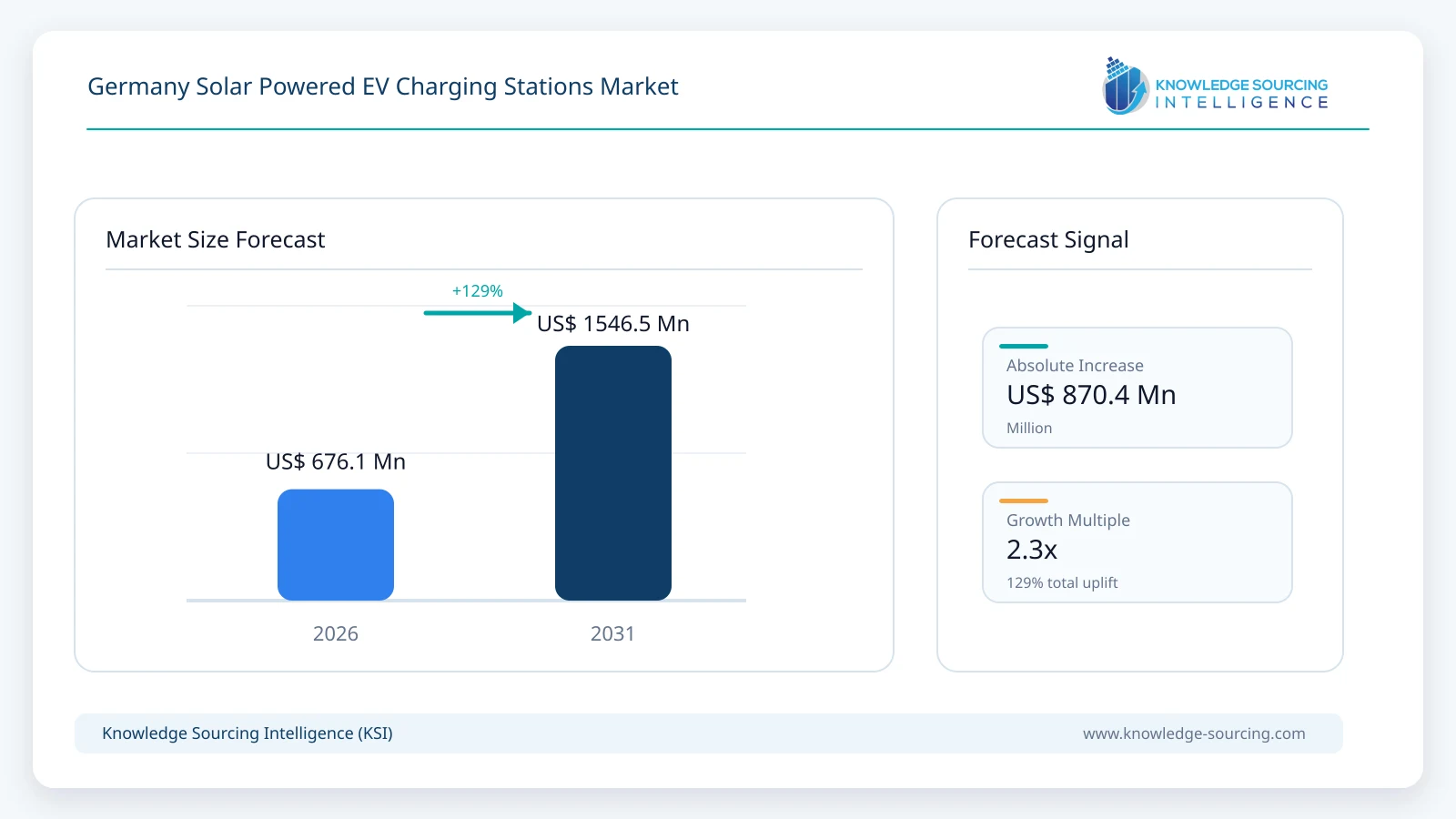
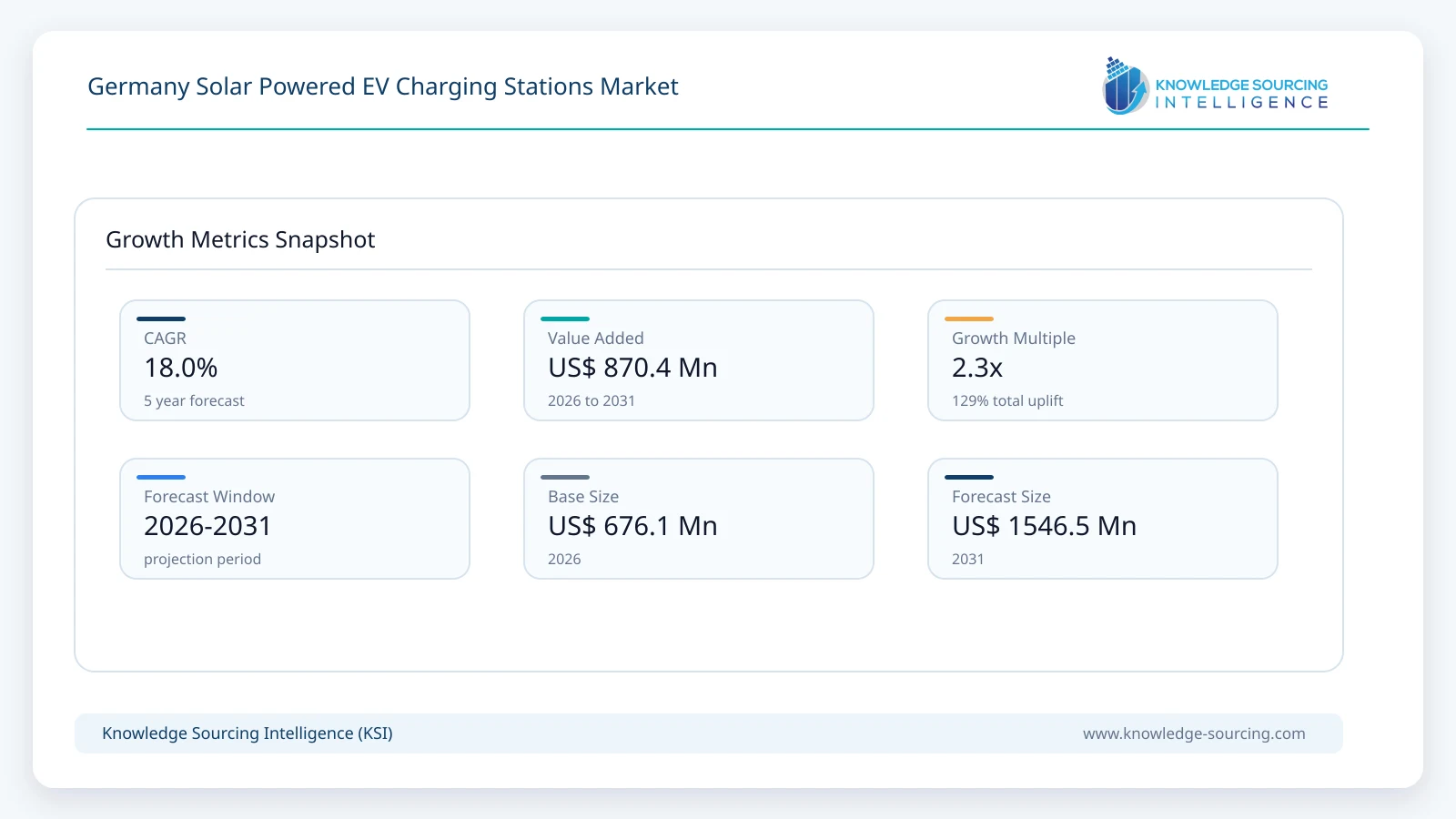
The Germany Solar Powered EV Charging Stations Market is forecast to grow at a CAGR of 18.0%, reaching USD 1,546.5 million in 2031 from USD 676.1 million in 2026.
Highlights:
- 1Germany is developing one of Europe's biggest EV charging networks, providing significant prospects for PV system integration into the public and commercial charging infrastructure.
- 2The growing roll-out of rooftop solar PV and BESS technologies will have a positive impact on the commercial uptake of renewable-powered EV charging and cut down on electricity bills and energy dependence.
- 3Solar-powered charging stations for commercial buildings, industrial sites, logistics companies, retail stores, and cities are being installed to enable fleet electrification and corporate sustainability goals.
- 4The intelligent charging of renewable energies and the bidirectional charging of electricity services are increasingly driving investments in smart charging infrastructure in Germany with the support of the government.
The growth of the Germany Solar Powered EV Charging Stations Market is expected to be robust, driven by rising EV adoption, continued expansion of charging infrastructure, and positive government initiatives related to the integration of renewable energy. The solar-powered EV charging stations come with photovoltaic panels, battery energy storage systems (BESS), EV charging equipment, inverters, and intelligent energy management software, which help to create renewable electricity and provide reliable charging for EVs.
Investments in distributed renewable energy systems continue to be motivated by Germany's energy transition (Energiewende) and ambitious climate targets. Solar charging solutions help businesses and municipalities lower their electric bills and make strides toward carbon neutrality. Hybrids that integrate solar generation, battery storage, and grid connection are becoming more prevalent in commercial buildings, industrial sites, public parking, and logistics centers.
Germany is still investing in the development of charging infrastructure and the use of smart charging technologies and bidirectional charging systems to make the grid more flexible, according to the German Federal Ministry for Economic Affairs and Energy.
Meanwhile, the market is seeing rapid technology advancements, such as artificial intelligence (AI) for energy optimization, cloud-based charging management, remote monitoring platforms, and vehicle-to-grid (V2G) technologies. These innovations enable the most efficient use of renewables, minimize peak demand, and enhance charging network performance. The solar-powered charging stations will likely play a larger role in the future of sustainable mobility in Germany as more companies switch to electric vehicles and more charging infrastructure is installed.
Market Dynamics
Market Drivers
To encourage the uptake of electric vehicles: Germany remains one of the biggest EV markets in Europe, driving a long-term demand for charging stations. This is driving EV adoption, particularly battery electric vehicles (BEVs), and both public and private charging station deployment is increasing as a result of greater vehicle availability, investment from domestic automakers, and consumer uptake. With the rising demand for charging, operators can achieve better sustainability and lower operating costs through the integration of solar generation and charging infrastructure.
Expansion of renewable energy and charging infrastructure: Renewable electricity generation is progressing in Germany, and this is a positive development for solar-fuelled charging of EVs. Solar PV is being installed on commercial buildings, industrial buildings and parking garages, and is more frequently being integrated with EV charging. The public charging infrastructure is being expanded along highways, in urban areas and at commercial sites and provides excellent opportunities for renewable-powered charging solutions. During 2024, Germany's public charging network kept growing at a fast pace, continuing to be one of the leading EV charging infrastructure markets in Europe, according to the IEA.
Support for Sustainable Mobility in the Government: The government invests in the development of EVs, charging infrastructure, renewable energy production, and bidirectional charging. The future targets of Germany in this field, namely to install charging stations everywhere and to use renewable energies, are contributing to investments in hybrid charging systems that combine solar energy, battery storage, and intelligent energy management. The deployment of the renewable-powered charging infrastructure is likely to be further boosted by government incentives for smart charging.
Market Restraints & Opportunities
The capital cost of battery storage, high-power DC charging infrastructure, and electrical infrastructure are some of the major bottlenecks in the adoption of large-scale PV systems. Other factors that pose barriers for commercial charging projects include grid interconnection standards, permitting processes, space for installation, and variable solar generation from seasonal weather changes. With its intermittent nature, solar power is often insufficient for high-capacity fast charging systems without storage or interaction with the grid.
Germany is all set for more noteworthy opportunities in the solar-powered EV charging stations market, as the DESST penetration is rising, PV efficiency is increasing, and charging management is getting increasingly better with AI. Commercial fleet electrification, logistics decarbonization, workplace charging and public charging corridors are key factors expected to drive the demand for integrated renewable-powered charging systems. The expansion of bidirectional charging, the vehicle-to-grid (V2G) concept, and smart energy management platforms will further strengthen the role of solar-powered charging stations in the future in Germany. This trend is also captured by the industry analysis carried out recently, which shows the increasing interest in PV-integrated charging stations with the use of intelligent energy management and microgrid technologies.
Key Developments
July 2026: Volkswagen Group subsidiary Elli is taking the next major step for the energy ecosystem of electric vehicles and is bringing Vehicle-to-Grid charging to market maturity. Together with the brands Volkswagen, Volkswagen Commercial Vehicles and CUPRA, Elli is presenting at Power2Drive, the international leading trade fair for electric mobility in Munich, how bidirectional charging can soon be translated into a scalable, customer-focused offer that is integrated into the energy industry.
May 2026: BMW and SOLARWATT are further expanding their collaboration in the field of smart energy and home charging solutions. With the launch of the first models in the Neue Klasse, the BMW iX3 and the BMW i3, BMW is beginning the rollout of its bidirectional charging technology.
Market Segmentation
The market is segmented by component, charging type, vehicle type, charging station type, application, and geography.
By Component: Solar Photovoltaic (PV) Panels
The solar photovoltaic (PV) panels are the major portion of Germany's solar-powered EV charging stations market as they are the main renewable electricity source for charging stations. The economic viability of solar-powered charging stations has been boosted at commercial sites, workplaces, schools, airports, and public parking locations due to advancements in panel efficiency, decreasing installation costs, and the availability of high-efficiency bifacial panels.
To maximize space to produce energy to charge EVs, commercial operators are turning to rooftop and canopy installation of solar systems above parking lots. Solar canopies also protect vehicles and enhance the use of underutilized parking facilities.
SMA Solar Technology AG is a company that sells photovoltaic inverters, energy management systems, and battery storage, all of which are widely used in the commercial photovoltaic energy market in Germany. Similarly, KOSTAL Solar Electric GmbH has developed new inverter and smart energy management solutions to facilitate the efficient use of solar-powered charging stations.
By Charging Type: DC Fast Charging
DC fast charging is the fastest-growing charging type segment, as demand for fast charging infrastructure along highways, commercial corridors, logistics areas, and fleet depots grows. High-power charging drastically cuts charging time and ensures long-distance travel, which is especially well suited for public charging networks and for commercial fleet use.
Many solar-powered DC charging stations now feature battery energy storage systems to help meet onsite electricity demand when the sun is not producing enough energy. A hybrid setup of solar power, battery storage and grid connection provides a reliable power source, reduces operation costs and reduces peak electricity consumption.
ABB offers high-power Terra DC fast charging infrastructure (DCFC) that is suitable for integration with renewable energy, and Alpitronic are one of the biggest suppliers of ultra-fast DC charging systems in Germany, with a wide rollout across the country.
By Vehicle Type: Passenger Electric Vehicles
Germany's robust passenger car market and the ongoing increase in battery electric vehicles (BEVs) will make the passenger electric vehicle the biggest vehicle segment. Domestic automotive manufacturers, such as Volkswagen, BMW, Mercedes-Benz, Audi and Porsche, are still adding EV models to their line-ups, driving greater demand for public and workplace charging stations.
As EV use becomes more commonplace, solar-powered charging stations are popping up in commercial offices, shopping centers, residential communities, airports, hotels, and public parking lots, helping to meet the rising demand while cutting down on operating costs with local renewable energy generation.
The following companies: EnBW, E.Power infrastructure for passenger EVs keeps growing, with more and more integration of renewable energy and intelligent charging management for ON Drive and Siemens.
Regional Analysis
Bavaria
Bavaria represents the largest regional market for solar-powered EV charging stations in Germany, driven by its strong automotive industry, high electric vehicle adoption, and significant investments in renewable energy. Home to major automotive manufacturers including BMW and Audi, the region continues to expand charging infrastructure across urban centers, highways, commercial buildings, and industrial facilities. Commercial property owners and logistics operators are increasingly integrating rooftop solar systems with EV charging stations to reduce electricity costs while supporting corporate sustainability initiatives. The region's continued investment in distributed solar generation and battery storage is expected to further accelerate deployment of solar-powered charging infrastructure.
Baden-Württemberg
Baden-Württemberg is one of Germany's leading regions for electric mobility owing to the presence of major automotive manufacturers such as Mercedes-Benz and Porsche. The region continues to expand public charging infrastructure while encouraging renewable energy integration through commercial rooftop solar installations and smart energy management systems. Industrial parks, technology campuses, office buildings, and manufacturing facilities are increasingly adopting solar-powered charging stations to support fleet electrification and employee charging. Continued investments in innovation and clean transportation are expected to sustain market growth during the forecast period.
North Rhine-Westphalia
North Rhine-Westphalia is witnessing strong growth in solar-powered EV charging infrastructure due to its large population, extensive industrial base, and expanding commercial EV fleet. The region is investing in charging stations across retail centers, logistics hubs, public parking facilities, and transportation corridors to support increasing EV ownership. Growing adoption of rooftop solar systems across commercial and industrial facilities is creating favorable opportunities for integrating renewable energy with EV charging infrastructure. Utilities and private charging operators continue to expand charging networks supported by intelligent energy management solutions.
Lower Saxony
Lower Saxony continues to strengthen its position in Germany's electric mobility market through investments in automotive manufacturing, renewable energy, and charging infrastructure. The presence of Volkswagen's manufacturing operations, together with expanding renewable electricity generation, is encouraging greater deployment of solar-powered EV charging stations across commercial buildings, fleet depots, logistics facilities, and public charging locations. Hybrid charging systems integrating photovoltaic generation, battery storage, and smart charging software are becoming increasingly common across the region.
Rest of Germany
Other federal states, including Hesse, Saxony, Rhineland-Palatinate, Schleswig-Holstein, Hamburg, and Berlin, are steadily expanding renewable-powered EV charging infrastructure through public and private investments. Commercial buildings, municipal parking facilities, airports, universities, hotels, and retail centers are increasingly deploying solar-integrated charging stations to support sustainable transportation. Continued expansion of Germany's charging network and renewable electricity generation is expected to drive adoption across the remainder of the country throughout the forecast period.
List of Companies
Siemens AG
ABB Ltd.
E.ON Drive GmbH
EnBW Energie Baden-Württemberg AG
Schneider Electric SE
ADS-TEC Energy plc
Alpitronic GmbH
Compleo Charging Solutions AG
SMA Solar Technology AG
KOSTAL Solar Electric GmbH
Siemens AG
Siemens AG is one of Germany's leading providers of smart EV charging infrastructure, offering AC and DC charging solutions integrated with intelligent energy management platforms. The company supports commercial, industrial, and public charging applications while enabling seamless integration of solar photovoltaic systems, battery energy storage, and smart grid technologies. Siemens continues to strengthen Germany's transition toward sustainable mobility through digital charging management and renewable energy integration.
E.ON Drive GmbH
E.ON Drive is among Germany's largest EV charging infrastructure operators, providing charging solutions for public, residential, workplace, and fleet applications. The company continues expanding its nationwide charging network while integrating renewable electricity, smart charging technologies, and cloud-based energy management systems. E.ON Drive's partnerships with municipalities, commercial property owners, and fleet operators position the company as a major participant in Germany's solar-powered charging ecosystem.
SMA Solar Technology AG
SMA Solar Technology AG is a global leader in photovoltaic inverters and energy management solutions. The company provides integrated technologies combining rooftop solar, battery storage, and EV charging systems that enable commercial customers to maximize renewable energy utilization while reducing electricity costs. SMA's smart energy management platforms support efficient operation of solar-powered charging stations across Germany's commercial and industrial sectors.
Analyst View
Germany's solar-powered EV charging stations market is expected to witness robust growth during the forecast period, supported by strong electric vehicle adoption, expanding renewable energy deployment, and continuous investments in charging infrastructure. The increasing integration of rooftop solar systems, battery energy storage, and intelligent charging technologies will improve charging efficiency while reducing dependence on conventional grid electricity. As commercial fleet electrification, public charging deployment, and corporate sustainability initiatives continue to accelerate, solar-powered EV charging stations are expected to play an increasingly important role in Germany's transition toward a low-carbon transportation system.
Germany Solar-Powered EV Charging Stations Market Scope:
| Report Metric | Details |
|---|---|
| Total Market Size in 2026 | USD 676.1 million |
| Total Market Size in 2031 | USD 1,546.5 million |
| Forecast Unit | USD Million |
| Growth Rate | 18.0% |
| Study Period | 2021 to 2031 |
| Historical Data | 2021 to 2024 |
| Base Year | 2025 |
| Forecast Period | 2026 – 2031 |
| Segmentation | Component, Charging Type, Vehicle Type, Charging Station Type, Application, City |
| Companies |
|
Table of Contents
1. EXECUTIVE SUMMARY
2. MARKET SNAPSHOT
2.1. Market Overview
2.2. Market Definition
2.3. Scope of the Study
2.4. Market Segmentation
3. MARKET DYNAMICS
3.1. Market Drivers
3.2. Market Restraints
3.3. Market Opportunities
3.4. Porter’s Five Forces Analysis
3.5. Industry Value Chain Analysis
4. BUSINESS LANDSCAPE
4.1. Policy & Regulatory Landscape
4.2. EV Charging Infrastructure Deployment Landscape
4.3. Business & Revenue Model Landscape
4.4. Import & Domestic Manufacturing Landscape
4.5. Strategic Recommendations
5. TECHNOLOGICAL OUTLOOK
5.1. Solar PV and EV Charging Technology
5.2. Solar-Charger Integration Technology
5.3. Grid-Interactive Charging Technologies
5.4. Smart Charging & Digital Technologies
6. GERMANY SOLAR POWERED EV CHARGING STATIONS MARKET BY COMPONENT
6.1. Introduction
6.2. Solar Photovoltaic (PV) Panels
6.3. EV Chargers & MPPT Charge Controller
6.3. Battery Energy Storage System (BESS)
6.4. Power Inverter
6.5. Others
7. GERMANY SOLAR POWERED EV CHARGING STATIONS MARKET BY CHARGING TYPE
7.1. Introduction
7.2. AC Charging Stations
7.3. DC Charging Stations
8. GERMANY SOLAR POWERED EV CHARGING STATIONS MARKET BY VEHICLE TYPE
8.1. Introduction
8.2. Passenger Electric Vehicles
8.3. Commercial Vehicles
8.4. Electric Buses
8.5. Others
9. GERMANY SOLAR POWERED EV CHARGING STATIONS MARKET BY CHARGING STATION TYPE
9.1. Introduction
9.2. Off-Grid Solar EV Charging Station
9.3. Grid-Tied Solar EV Charging Station
9.4. Hybrid Solar EV Charging Station
10. GERMANY SOLAR POWERED EV CHARGING STATIONS MARKET BY APPLICATION
10.1. Introduction
10.2. Residential
10.3. Commercial
10.4. Fleet Charging
10.5. Highway & Transit Corridor Charging
10.6. Others
11. GERMANY SOLAR POWERED EV CHARGING STATIONS MARKET BY CITY
11.1. Introduction
11.2. Bavaria
11.3 Baden-Württemberg
11.4 North Rhine-Westphalia
11.5 Lower Saxony
11.6 Rest of Germany
12. COMPETITIVE ENVIRONMENT AND ANALYSIS
12.1. Major Players and Strategy Analysis
12.2. Market Share Analysis
12.3. Mergers, Acquisitions, Agreements, and Collaborations
12.4. Competitive Dashboard
13. COMPANY PROFILES
13.1. Siemens AG
13.2 ABB Ltd.
13.3 Schneider Electric SE
13.4 E.ON Drive GmbH
13.5 EnBW Energie Baden-Württemberg AG
13.6 Compleo Charging Solutions AG
13.7 ADS-TEC Energy plc
13.8 Alpitronic GmbH
13.9 SMA Solar Technology AG
13.10 Kostal Solar Electric GmbH
14. APPENDIX
14.1. Currency
14.2. Assumptions
14.3. Base and Forecast Years Timeline
14.4. Key benefits for the stakeholders
14.5. Research Methodology
14.6. Abbreviations
Navigate
Trusted by the world's leading organizations











