
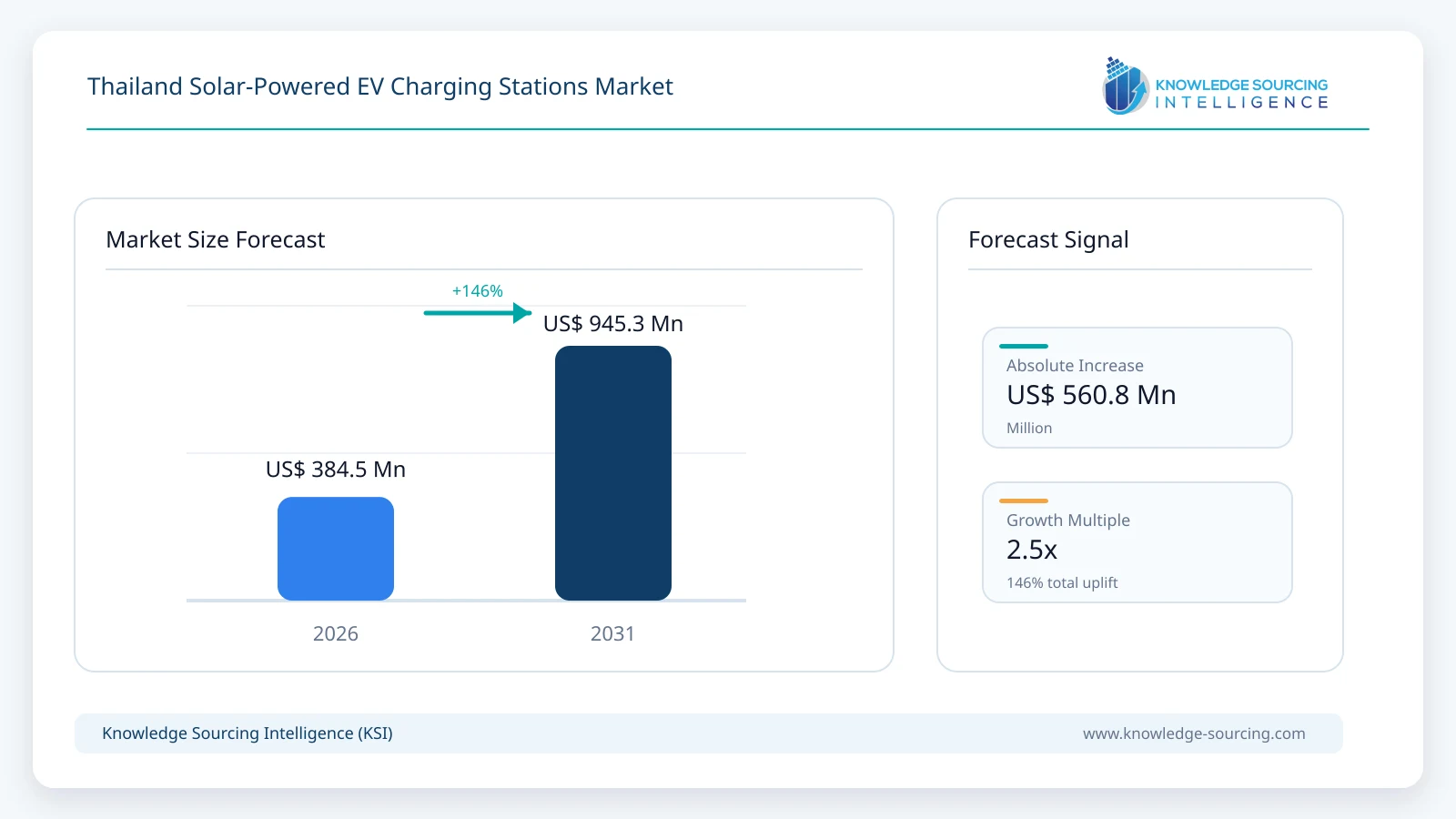
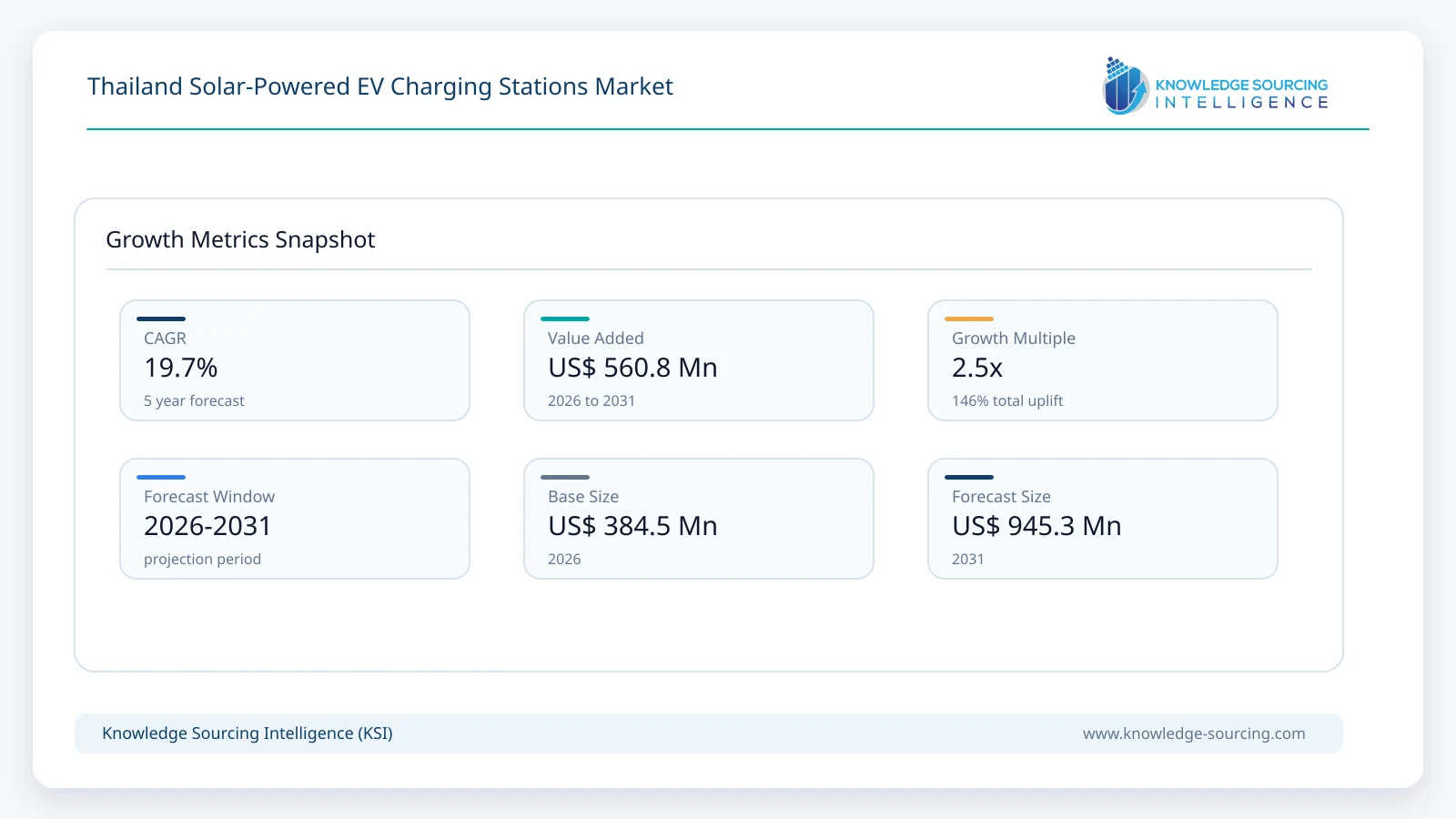
Thailand Solar Powered EV Charging Stations Market is expected to increase at a CAGR of 19.7%, reaching USD 945.34 million in 2031 from USD 384.50 million in 2026.
Highlights:
- 1Thailand's rapid EV adoption is growing, with 57,289 new BEV passenger cars registered in H1 of 2025.
- 2The strong solar resource in Thailand that enables direct PV-to-EV charging, and BESS can help mitigate intermittency and address peak-demand needs.
- 3The market has matured to start spanning public, home, fleet, engineering, and digital charging innovations with companies like SHARGE.
- 4PEA VOLTA can handle both AC and DC charging, from 25 kW to 360 kW, cementing the potential for solar-storage at high-utilization sites.
The market is transitioning from traditional grid-oriented EV chargers to sustainable renewable-energy charging systems, which will combine solar photovoltaic panels, EV chargers, maximum power point tracking charge controllers, battery energy storage systems (BESSs), power inverters, and digital energy-management frameworks.
The abundant solar resource in Thailand gives solar-based charging infrastructure a distinct advantage. When the EV is not actively consuming power from the grid, solar generation can offset this consumption directly, whereas with BESS, renewable electricity can be stored and consumed later in the evening or peak period.
Expansion in public charging infrastructure is a huge addressable market. Thailand emerging as a key EV manufacturing hub in the region is also providing more support to the market with government incentives under EV3 & EV3. The plan promotes vehicle manufacturing and supply-chain funding, with cumulative approved EV supply-chain funding at THB 140 billion by October 2025.
Additionally, the major factor for commercial properties in particular is that solar charging infrastructure allows for a dedicated solar carport to offer all three at once: parking shade, electricity generation and EV charging. These systems could drive a reduction in expanding the grid out to remote and high-resilience applications. The market will be supported by a rising shift away from reliance on chargers toward a fully integrated energy infrastructure with renewable generation, storage, charging, software and grid interaction all operating as one system.
Market Dynamics
Market Drivers
Rising Expansion of Thailand's EV Market: The most significant demand driver for charging infrastructure is the accelerated growth of registrations of battery electric vehicles (BEVs). Thailand's new BEV passenger-car registrations in the first half of 2025 totaled 57,289 units, i.e., a 15% share of total new passenger-car registrations. With the rollout of charging stations increasing with the growth in the installed EV fleet, demand is being felt across residential, commercial, fleet, and highway locations for operators to provide charge points. Solar integration is a way to offset the increasing electricity load from charging.
Increased Public and Fast-Charge Infrastructure: Fastest-deploying charging infrastructure in Thailand. By March 2025, the country possessed 3,720 charging stations and a total of 11,622 installed chargers, with the DC fast charger base comprising more than half of it. This presents big opportunities for DC charging infrastructure powered by solar generation. In order to avoid unwanted peak demand, BESS will prove to be extremely valuable for high-power chargers.
Strong Solar Energy Potential: Thailand is in a geographical location that allows for good solar energy generation. In particular, solar PV can be installed on rooftops, parking canopies, commercial facilities, industrial plants, and dedicated solar charger sites. A solar electric charging architecture allows for on-site renewable electricity consumption by charge operators instead of purchasing all their charging electricity from the grid.
Increasing Demand for Smart Charging: Charging operators are rapidly transitioning to digital platforms that can oversee key areas such as monitoring charging sessions, managing payments, maximizing station utilization, and regulating energy flows. In addition, the digital layer serves as the integrating point for operators looking to combine renewable-energy forecasting, battery management, and intelligent charging schedules.
Market Restraints & Opportunities
The major restraint is that small commercial operators and residential users find the high upfront capital expenditure particularly difficult. Another challenge is solar intermittency, as time of charging demand does not always align with solar-generation periods. That is where BESS can help tackle these issues, but it does come at a cost and increased system complexity with the project. Established urban land is available as another potential obstacle for large solar installations in cities like Bangkok and other higher population areas.
However, the combination of solar generation, battery storage, and grid electricity in a hybrid solar EV charging station that opens up the biggest opportunity. The new architecture is designed to help charging operators achieve maximum consumption of renewable energy while delivering reliable service. Solar carports also present an opportunity as they deploy PV on existing parking lots, which reduces the need for land acquisition altogether. This model can be especially beneficial for fleet depots, logistics facilities, hotels, shopping centers, airports, and highway rest areas across the country.
Key Developments
August 2026: The signing of an MOU between Thailand’s Energy Policy and Planning Office, Electricity Generating Authority of Thailand, Metropolitan Electricity Authority and Provincial Electricity Authority, as well as PTT Oil and Retail Business, led to the establishment of an EV Roaming Hub nationwide. The program aims to link charging-station data across networks to help drivers find stations, compare availability over time, and ultimately tap services in a more seamless way.
Market Segmentation
The market is segmented by component, charging type, vehicle type, charging station type, application, and city.
By Charging Type: DC Charging Stations
DC charging stations are the leading segment by type of charging due to fast-growing high-power charging infrastructure in Thailand. By March 2025, the nation had seen a total of 6,524 DC fast chargers, and this number rose to 7,096 by September 2025.
The PEA VOLTA's network accommodates DC charging powers of 50 kW, 120 kW, and even 300 kW, indicative of the greater push for ultra-high-power publicly available charging infrastructure in the country. SHARGE also offers 50 kW to 360 kW DC fast charging at highway stops, gas stations, and automotive locations.
The presence of high-power DC chargers generates a compelling business case for solar PV and BESS integration, since stored solar energy can provide supplemental grid electricity when charging demand peaks.
By Vehicle Type: Passenger Electric Cars
Passenger electric vehicles are the leading vehicle type since they make up most of Thailand's newly growing BEV fleet. Thailand Board of Investment data showed that there were about 203,000 BEV passenger vehicles on Thailand's roads by mid-2025.
Increasing adoption of passenger EVs is leading to strong demand for home charging, workplace charging, shopping centers and hotels, public parking facilities, and highway corridors. For instance, SHARGE combines home and public charging, illustrating that residential and public infrastructure within passenger EVs are converging.
By Charging Station Type: Hybrid Solar EV Charging Station
The hybrid solar EV charging stations that combine PV generation with grid electricity and possibly the battery energy storage system (BESS) is likely to be the major station-type segment. Such architecture offers enhanced reliability over decoupled off-grid systems and enables operators to maximize the use of renewable energy.
Hybrid systems can directly charge EVs from solar during periods of high generation while also storing excess power in batteries, and import electricity from the grid when there is low solar availability.
The solar EV charging project by NECTEC showcases an on-grid solar architecture in Thailand, along with its charging-management platform that enables real-time monitoring of power generation from the solar source and consumption from EVs.
By City: Bangkok Market Analysis
Bangkok is expected to be the largest solar-powered EV charging station market due to its population density, large vehicle fleet, and proliferation of commercial infrastructure and EV charge point operators. There are vast opportunities with solar carports and rooftop PV charging systems at shopping malls, office buildings, condominiums, hotels, and commercial parking facilities.
SHARGE destination charging stations are established at Central Embassy and Central Chidlom to demonstrate that Bangkok is a major market. The compact solar carports, along with hybrid charging configurations and BESS-supported DC charging, will fit well in a dense city setting like Bangkok.
List of Companies
ApexSun Solar Co., Ltd.
SHARGE Management
Evolt Technology
RaviVolt
PTT EV Station PluZ
Energy Absolute
Bangchak EV Station
Delta Electronics Thailand
Banpu Next
SCG Cleanergy
ApexSun Solar Co., Ltd.
ApexSun Solar Co, Ltd. facilitates new opportunities for integration between photovoltaic generation and EV charging infrastructure in Thailand's solar-energy ecosystem. The solar landscape is important regarding the establishment of solar-based recharging systems such as rooftop and commercial.
SHARGE Management
SHARGE Management is one of Thailand's pioneering EV charging ecosystem operators. The company states more than 160,000 customers and more than 1,300 charge points, and solutions for public charging, home charging, and fleet charging alongside engineering services and mobile applications.
Evolt Technology
Evolt Technology handles the offering of EV charging needs, from developing infrastructure to supplying chargers and smart charging platforms. The platform features a backend management system for charging operators, as well as a driver application to find stations, start charging sessions, and make payments.
Analyst View
The EV charging stations market within Thailand is powered by solar energy and is going through a high-growth stage with BEV uptake, in addition to fast-charging infrastructure and renewable-energy deployment. Hybrid solar-powered BESS configurations are anticipated to become the lead commercial architecture, especially for high-power charging where solar generation can reduce grid consumption, and batteries handle demand peaks. Bangkok and Chonburi will continue to be major markets while Chiang Mai, Phuket, and highway corridors offer further opportunities for tourism, destination charging, and intercity EV mobility.
Thailand Solar-Powered EV Charging Stations Market Scope:
| Report Metric | Details |
|---|---|
| Total Market Size in 2026 | USD 384.50 million |
| Total Market Size in 2031 | USD 945.34 million |
| Forecast Unit | USD Million |
| Growth Rate | 19.7% |
| Study Period | 2021 to 2031 |
| Historical Data | 2021 to 2024 |
| Base Year | 2025 |
| Forecast Period | 2026 – 2031 |
| Segmentation | Component, Charging Type, Vehicle Type, Charging Station Type, Application, City |
| Companies |
|
Market Segmentation
By Component
By Charging Type
By Vehicle Type
By Charging Station Type
By Application
By City
Table of Contents
1. EXECUTIVE SUMMARY
2. MARKET SNAPSHOT
2.1. Market Overview
2.2. Market Definition
2.3. Scope of the Study
2.4. Market Segmentation
3. MARKET DYNAMIC
3.1. Market Drivers
3.2. Market Restraints
3.3. Market Opportunities
3.4. Porter’s Five Forces Analysis
3.5. Industry Value Chain Analysis
4. BUSINESS LANDSCAPE
4.1. Policy & Regulatory Landscape
4.2. EV Charging Infrastructure Deployment Landscape
4.3. Business & Revenue Model Landscape
4.4. Import & Domestic Manufacturing Landscape
4.5. Strategic Recommendations
5. TECHNOLOGICAL OUTLOOK
5.1. Solar PV and EV Charging Technology
5.2. Solar-Charger Integration Technology
5.3. Grid-Interactive Charging Technologies
5.4. Smart Charging & Digital Technologies
6. THAILAND SOLAR POWERED EV CHARGING STATIONS MARKET BY COMPONENT
6.1. Introduction
6.2. Solar Photovoltaic (PV) Panels
6.3. EV Chargers & MPPT Charge Controller
6.3. Battery Energy Storage System (BESS)
6.4. Power Inverter
6.5. Others
7. THAILAND SOLAR POWERED EV CHARGING STATIONS MARKET BY CHARGING TYPE
7.1. Introduction
7.2. AC Charging Stations
7.3. DC Charging Stations
8. THAILAND SOLAR POWERED EV CHARGING STATIONS MARKET BY VEHICLE TYPE
8.1. Introduction
8.2. Passenger Electric Vehicles
8.3. Commercial Vehicles
8.4. Electric Buses
8.5. Others
9. THAILAND SOLAR POWERED EV CHARGING STATIONS MARKET BY CHARGING STATION TYPE
9.1. Introduction
9.2. Off-Grid Solar EV Charging Station
9.3. Grid-Tied Solar EV Charging Station
9.4. Hybrid Solar EV Charging Station
10. THAILAND SOLAR POWERED EV CHARGING STATIONS MARKET BY APPLICATION
10.1. Introduction
10.2. Residential
10.3. Commercial
10.4. Fleet Charging
10.5. Highway & Transit Corridor Charging
10.6. Others
11. THAILAND SOLAR POWERED EV CHARGING STATIONS MARKET BY CITY
11.1. Introduction
11.2. Bangkok
11.3. Chonburi
11.3. Chiang Mai
11.4. Phuket
11.5. Others
12. COMPETITIVE ENVIRONMENT AND ANALYSIS
12.1. Major Players and Strategy Analysis
12.2. Market Share Analysis
12.3. Mergers, Acquisitions, Agreements, and Collaborations
12.4. Competitive Dashboard
13. COMPANY PROFILES
13.1. ApexSun Solar Co., Ltd.
13.2. SHARGE Management
13.3. Evolt Technology
13.4. RaviVolt
13.5. PTT EV Station PluZ
13.6. Energy Absolute
13.7. Bangchak EV Station
13.8. Delta Electronics Thailand
13.9. Banpu Next
13.10. SCG Cleanergy
14. APPENDIX
14.1. Currency
14.2. Assumptions
14.3. Base and Forecast Years Timeline
14.4. Key benefits for the stakeholders
14.5. Research Methodology
14.6. Abbreviations
Navigate
Trusted by the world's leading organizations











