
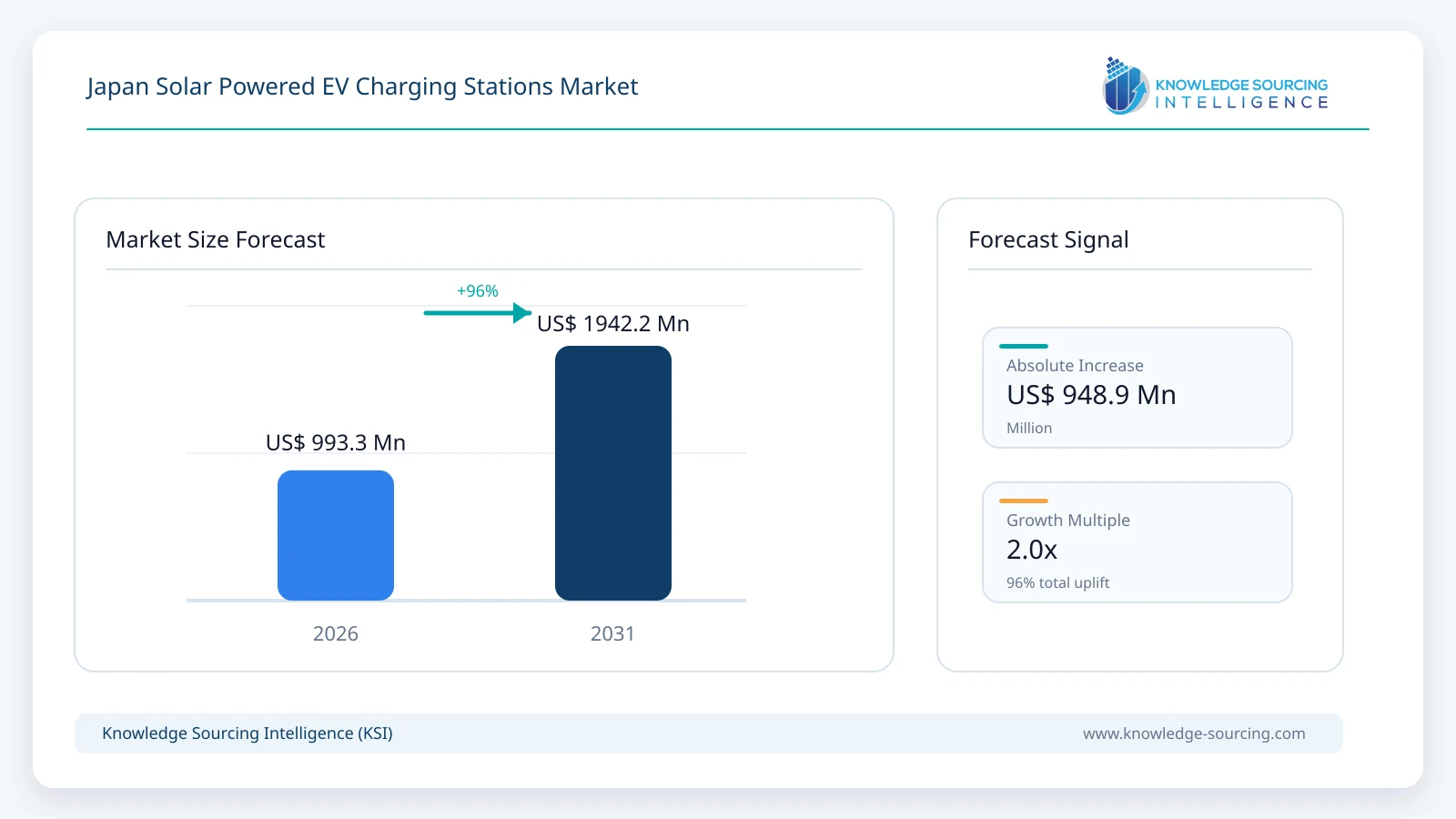
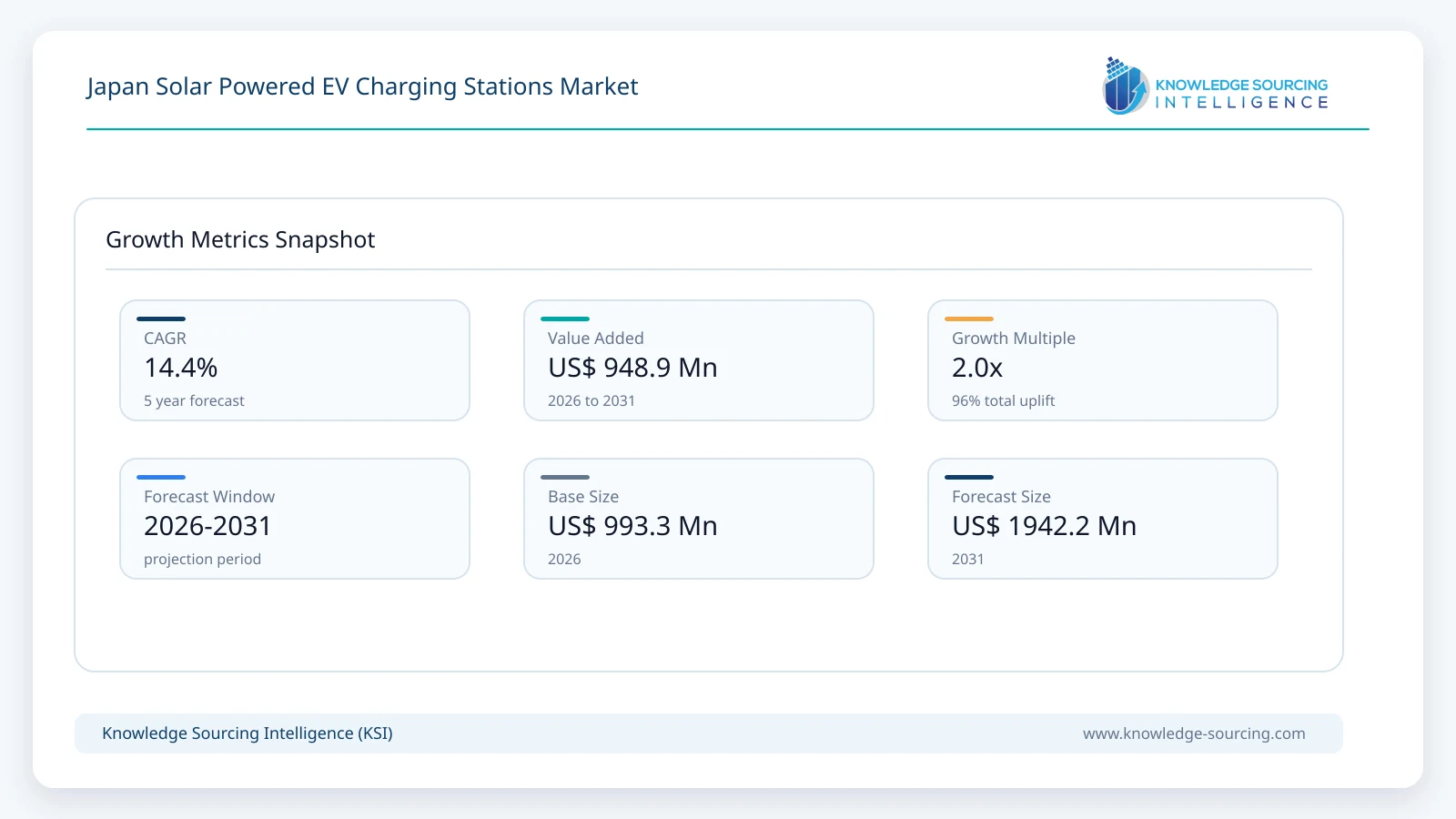
Japan Solar Powered EV Charging Stations Market is forecast to grow at a CAGR of 14.4%, reaching USD 1,942.23 million in 2031 from USD 993.30 million in 2026.
Highlights:
- 1Solar PV combined with BESS is becoming a critical component, as it offsets grid electricity consumption while minimizing charging peaks and providing resilience to the charging process.
- 2Grid-connected hybrid solar charging stations are the most practical, as they provide renewable generation while maintaining a grid backup.
- 3High vehicle density, high commercial activity, and high charging demand are likely to keep Tokyo, Osaka, Nagoya, and Yokohama as the top four deployment centers.
- 4Japan is a country that often faces many emergencies, and with solar-powered charging systems that can store electricity for times most needed, such as during blackouts caused by severe disasters, they are more significant.
The market is growing at a confluence of three major shifts: adoption and spread of EVs, building out charging infrastructure, and Japan's energy transition toward decentralized renewables. These solar-power charging stations create electricity near the point of consumption, decreasing reliance on the grid while also giving resiliency to EV charging networks.
Japan is rapidly changing infrastructure policy, focusing on the number of chargers along with more recent power and utilization. In its statement, METI stated high-output chargers were being introduced along highways to reduce charging times, as well as expanding other charging infrastructure at commercial facilities, accommodation facilities, and residential buildings.
This trend supports the advantages of solar-based charging systems largely because it presents a significant instantaneous electrical load associated with high-power charging. Due to charging load reductions from locally generated and stored electricity, Solar PV with BESS can produce sufficient power during daylight hours to meet some of the grid requirements needed at peak or high demand times.
Japan's disaster-resilience requirements are also boosting the market. Hydro storage systems can power homes after their grid infrastructure has experienced outages and failures.
Market Dynamics
Market Drivers
Japan EV Supply Chain and Sales Expansion: Charging infrastructure expansion is the key growth catalyst for solar charging stations. By the end of FY2024, Japan had around 68,000 charging ports in total and is aiming for a goal of 300,000 ports by 2030. METI is also specifying quicker charge production and more charging points in business scenarios, highways, and residential areas. Operators are now weighing up power needed, as the national charging network expands. An alternative architecture that can partially supply the charging demand is offered by solar PV and BESS.
Greater Integration of Solar Energy and EV Charging: Japan has a solid history of a residential and commercial solar sector that makes the customer base for solar-powered EV charging robust. The integration of solar PV systems, EV chargers, and energy storage into standalone, distributed energy systems is a major driver. For instance, Toyota's bZ4X comes with a solar charging system option that can create enough electricity to translate to up to about 11.6 km of range per day under the automaker's claims. While vehicle-integrated solar charging technology is different from solar charging stations, it highlights Japan's overall amalgamation of photovoltaic generation and electric mobility.
Growing Demand for Energy Resilience: Japan is prone to earthquakes, typhoons, floods, and other natural disasters, which creates a dire need for resilient energy infrastructure. Solar-powered charging stations, with BESS, can be used to supply emergency electricity during disruption of standard grid services. Toyota has shown this with energy systems that connect batteries of electrified vehicles and photovoltaic (PV) systems to use stored electricity to power homes or other loads in the event of an outage.
Rising Adoption of High-Power Charging: To minimize charging times, METI is advocating for higher-output chargers, including 90 kW and even 150 kW systems on highways. Batteries can provide extra solar generation when demand spikes, which creates a useful opportunity, and high-power charging place for such solar-storage configurations.
Market Restraints & Opportunities
The high capital cost of PV panels and BESS, power electronics, land preparation & DC fast chargers is a major restraint for the country. The compact layout of many Japanese cities also makes it difficult to create space for large solar panels.
Unlike peak solar-generation times, EV-charging demand is not weather-dependent. That creates a gap for battery storage and grid integration, adding to both system complexity and capital expenditure.
Yet these constraints are also creating opportunities in the form of hybrid solar charging stations. The mixing of sources by solar PV- BESS and grid electricity allows the operator to select generation availability and spot price for electricity so that energy sources are optimized along with charging demand.
Key Developments
March 2026: SolaX Power agreed to collaborate with Hanwha Japan on introducing residential energy storage options in Japan. SolaX is focused on solar energy storage technology and system integration, while Hanwha Japan supports local sales, installers, customer service, and after-sales operations.
February 2026: JR Kyushu and the Sumitomo Corporation Group completed Battery Station Tomiai, a grid-scale battery-storage project with output of about 1.5 MW and effective capacity of about 6.3 MWh. The facility is built to take part in Japan's ancillary and capacity markets alongside offering emergency power and EV-charging availability in times of disaster.
Market Segmentation
The market is segmented by component, charging type, vehicle type, charging station type, application, and city.
By Component: Solar Photovoltaic (PV) Panels
The solar photovoltaic panels segment accounts for the largest component segment as they provide the renewable electricity generation capacity needed by solar-powered EV charging stations. Japan has space in which it can integrate PV systems with EV charging because it already has an established base for solar deployment and good levels of distributed energy generation.
The segment is typically integrated along with battery storage and smart energy-management technology. Instead of continuously supplying the vehicle, electric energy from PV can also be stored in BESS units and later supplied to EVs when charging demand rises.
Toyota has already shown solar generation integrated with electrified mobility in the form of its solar charging systems. Toyota's bZ4X solar system allows the car to generate electricity while parked.
By Charging Type: DC Charging Stations
Due to efforts in Japan to improve the availability of high-output chargers aimed at cutting charging times, DC charging stations are predicted to comprise the largest charging type segment. METI directly mentioned 90 kW and 150 kW charging deployment along highways as part of its charging-infrastructure strategy.
Specifically, the standalone solar-powered DC charging stations tend to be especially economically attractive for commercial sites, highway corridors, fleet depots, and other places with high traffic volume. Nissan has its nationwide charging ecosystem in place, including the fast-charging infrastructure of e-Mobility Power, while Toyota has the G-Stations II network to provide EV/PHV charging at a number of sites such as Toyota dealers and shopping malls.
By Application: Commercial
The commercial segment application is expected to occupy the largest share in solar carports and rooftop PV modules because shopping centres, office buildings, hotels, retail facilities, parking operators and other destination locations all create potential opportunities for solar PV installations.
Commercial facilities and accommodation facilities also fit as an appropriate location for setting up charging power, according to Japan's unique charging strategy. They could charge customers on-site and also harness solar power for on-site renewable generation.
Solar carports are especially enticing as they can simultaneously deliver shade for vehicles, electricity generation, and EV charging with no need for extra land.
By City: Tokyo Market Analysis
Tokyo represents the biggest opportunity at a city level for market growth due to a large population density, several businesses, along with EV proliferation. Solar charging is especially well-suited to parking structures, commercial rooftops, office buildings, residential developments, and solar carports across the city.
The compactness of the high-power density and intelligent energy management system will be preferred by the city. Commercial operators can use battery storage to control peak charging demand and minimize grid constraints. Additionally, the expanding green public transportation ecosystem in Tokyo and a greater focus on zero-emission mobility make this an even more opportune time for investment in charging infrastructure.
List of Companies
Nissan Motor Corporation
Toyota Motor Corporation
Terra Motors Corporation
Panasonic Corporation
Delta Electronics
PowerX, Inc.
Hitachi, Ltd.
Sumitomo Electric
ENECHANGE
Nichicon
Nissan Motor Corporation
Nissan Motor Corporation is an iconic Japanese auto giant boasting an EV ecosystem built around the Nissan LEAF, Sakura, and Ariya. Nissan offers home and public charging support, allowing customers to use the e-Mobility Power network locations across Japan. Nissan is also working on charging-related technologies, such as wireless charging and advanced parking integration able to form the backbone of a potential automated future charging ecosystem.
Toyota Motor Corporation
Toyota Motor Corporation has built a comprehensive EV and energy ecosystem that covers vehicles, charging infrastructure, solar generation, and energy storage. Toyota's G-Station II charging system has been rolled out to around 4,300 spots in Japan so far, with sites consisting of dealerships and shopping centers. It also has solar-charging systems for cars and a vehicle-energy-storage system that can connect photovoltaic generation to batteries of electrified vehicles.
Terra Motors Corporation
Terra Charge operates an expanding EV charging infrastructure business in Japan. Its development strategy focuses more and more on high-power charging with mass deployment.
Analyst View
The solar-powered EV charging stations market in Japan is shifting from self-contained charging infrastructure to interconnected renewable-energy systems. Further, the government electrification goals and a growing need for higher-output charging are creating a significant opportunity within the infrastructure market. The commercial readiness of hybrid solar-plus-BESS systems is likely to be the most profound, with emphasis on locations including commercial facilities, highway corridors, fleet depots, as well as disaster-resilient infrastructure sites. Centralised, large-scale solar deployments will continue to be common in major megacities, such as Tokyo, Osaka, Nagoya and Yokohama, which are key deployment centers across the country, whilst off-grid and decentralized solar charging will continue in regional cities and remote areas.
Japan Solar Powered EV Charging Stations Market Scope:
| Report Metric | Details |
|---|---|
| Total Market Size in 2026 | USD 993.30 million |
| Total Market Size in 2031 | USD 1,942.23 million |
| Forecast Unit | USD Million |
| Growth Rate | 14.4% |
| Study Period | 2021 to 2031 |
| Historical Data | 2021 to 2024 |
| Base Year | 2025 |
| Forecast Period | 2026 – 2031 |
| Segmentation | Component, Charging Type, Vehicle Type, Charging Station Type, Application, City |
| Companies |
|
Market Segmentation
By Component
By Charging Type
By Vehicle Type
By Charging Station Type
By Application
By City
Table of Contents
1. EXECUTIVE SUMMARY
2. MARKET SNAPSHOT
2.1. Market Overview
2.2. Market Definition
2.3. Scope of the Study
2.4. Market Segmentation
3. MARKET DYNAMIC
3.1. Market Drivers
3.2. Market Restraints
3.3. Market Opportunities
3.4. Porter’s Five Forces Analysis
3.5. Industry Value Chain Analysis
4. BUSINESS LANDSCAPE
4.1. Policy & Regulatory Landscape
4.2. EV Charging Infrastructure Deployment Landscape
4.3. Business & Revenue Model Landscape
4.4. Import & Domestic Manufacturing Landscape
4.5. Strategic Recommendations
5. TECHNOLOGICAL OUTLOOK
5.1. Solar PV and EV Charging Technology
5.2. Solar-Charger Integration Technology
5.3. Grid-Interactive Charging Technologies
5.4. Smart Charging & Digital Technologies
6. JAPAN SOLAR POWERED EV CHARGING STATIONS MARKET BY COMPONENT
6.1. Introduction
6.2. Solar Photovoltaic (PV) Panels
6.3. EV Chargers & MPPT Charge Controller
6.3. Battery Energy Storage System (BESS)
6.4. Power Inverter
6.5. Others
7. JAPAN SOLAR POWERED EV CHARGING STATIONS MARKET BY CHARGING TYPE
7.1. Introduction
7.2. AC Charging Stations
7.3. DC Charging Stations
8. JAPAN SOLAR POWERED EV CHARGING STATIONS MARKET BY VEHICLE TYPE
8.1. Introduction
8.2. Passenger Electric Vehicles
8.3. Commercial Vehicles
8.4. Electric Buses
8.5. Others
9. JAPAN SOLAR POWERED EV CHARGING STATIONS MARKET BY CHARGING STATION TYPE
9.1. Introduction
9.2. Off-Grid Solar EV Charging Station
9.3. Grid-Tied Solar EV Charging Station
9.4. Hybrid Solar EV Charging Station
10. JAPAN SOLAR POWERED EV CHARGING STATIONS MARKET BY APPLICATION
10.1. Introduction
10.2. Residential
10.3. Commercial
10.4. Fleet Charging
10.5. Highway & Transit Corridor Charging
10.6. Others
11. JAPAN SOLAR POWERED EV CHARGING STATIONS MARKET BY CITY
11.1. Introduction
11.2. Tokyo
11.3. Osaka
11.3. Nagoya
11.4. Yokohama
11.5. Others
12. COMPETITIVE ENVIRONMENT AND ANALYSIS
12.1. Major Players and Strategy Analysis
12.2. Market Share Analysis
12.3. Mergers, Acquisitions, Agreements, and Collaborations
12.4. Competitive Dashboard
13. COMPANY PROFILES
13.1. Nissan Motor Corporation
13.2. Toyota Motor Corporation
13.3. Terra Motors Corporation
13.4.Panasonic Corporation
13.5. Delta Electronics
13.6. PowerX, Inc.
13.7. Hitachi, Ltd.
13.8. Sumitomo Electric
13.9. ENECHANGE
13.10. Nichicon
14. APPENDIX
14.1. Currency
14.2. Assumptions
14.3. Base and Forecast Years Timeline
14.4. Key benefits for the stakeholders
14.5. Research Methodology
14.6. Abbreviations
Navigate
Trusted by the world's leading organizations











