
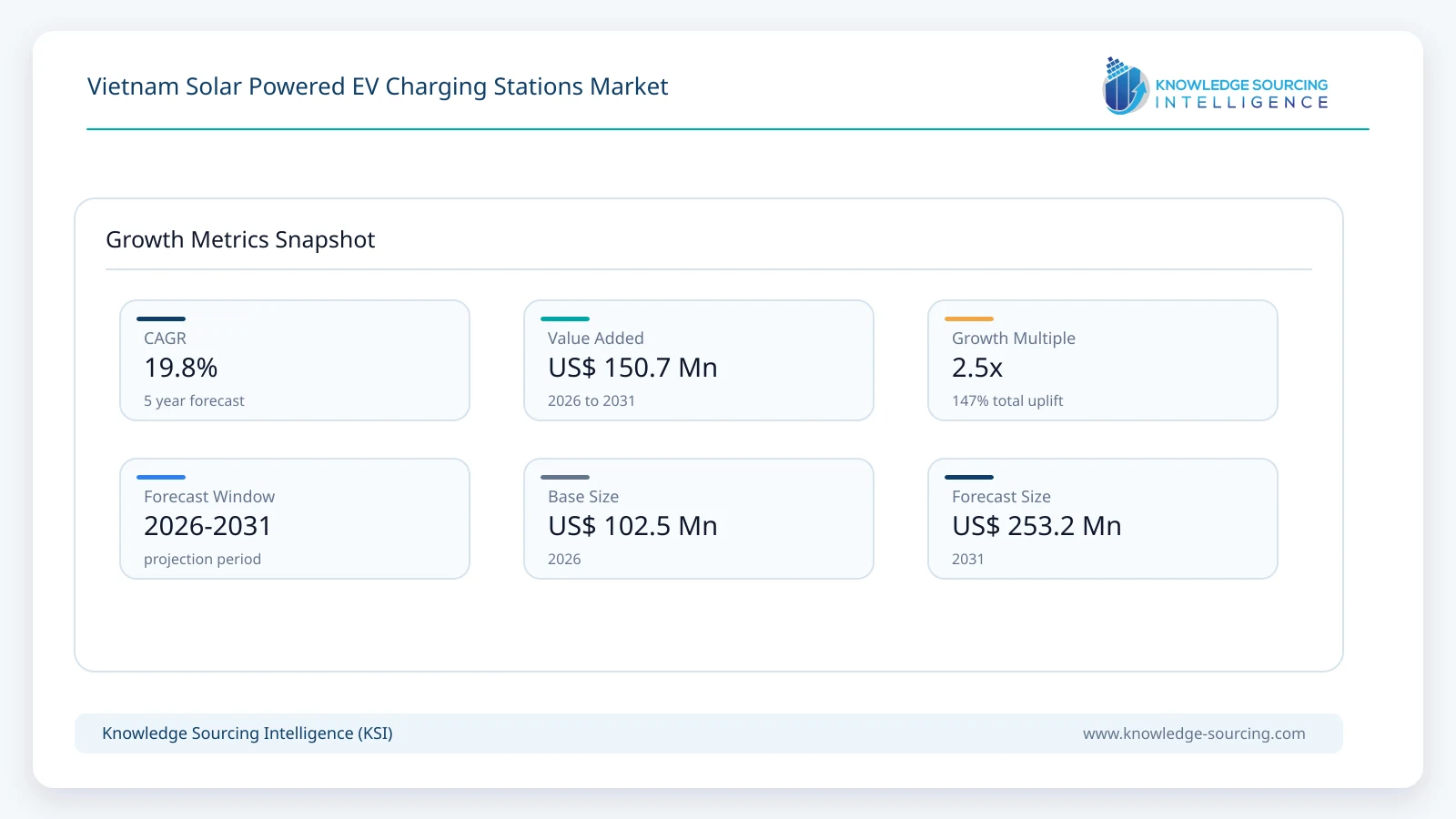
The Vietnam Solar-Powered EV Charging Stations Market is forecast to grow at a CAGR of 19.8%, reaching USD 253.2 million in 2031 from USD 102.5 million in 2026.
Highlights:
- 1The electric mobility ecosystem in Vietnam is growing quickly, and this trend has led to a rise in demand for sustainable charging stations equipped with renewable energy.
- 2Self-produced and self-consumed rooftop solar systems are creating a favorable environment to harness solar PV systems with EV charging in residential and commercial applications, with the support of government policies.
- 3Battery Energy Storage Systems (BESS) are becoming more common in combination with solar-powered charging stations to make charging more reliable, maximise the use of renewable energy, and minimise reliance on the electricity grid when there is a demand.
- 4Commercial buildings, industrial parks, shopping malls, hotels, logistics companies, and fleet operators are investing in solar-powered EV charging stations as a way to lower operating costs and fuel corporate sustainability initiatives.
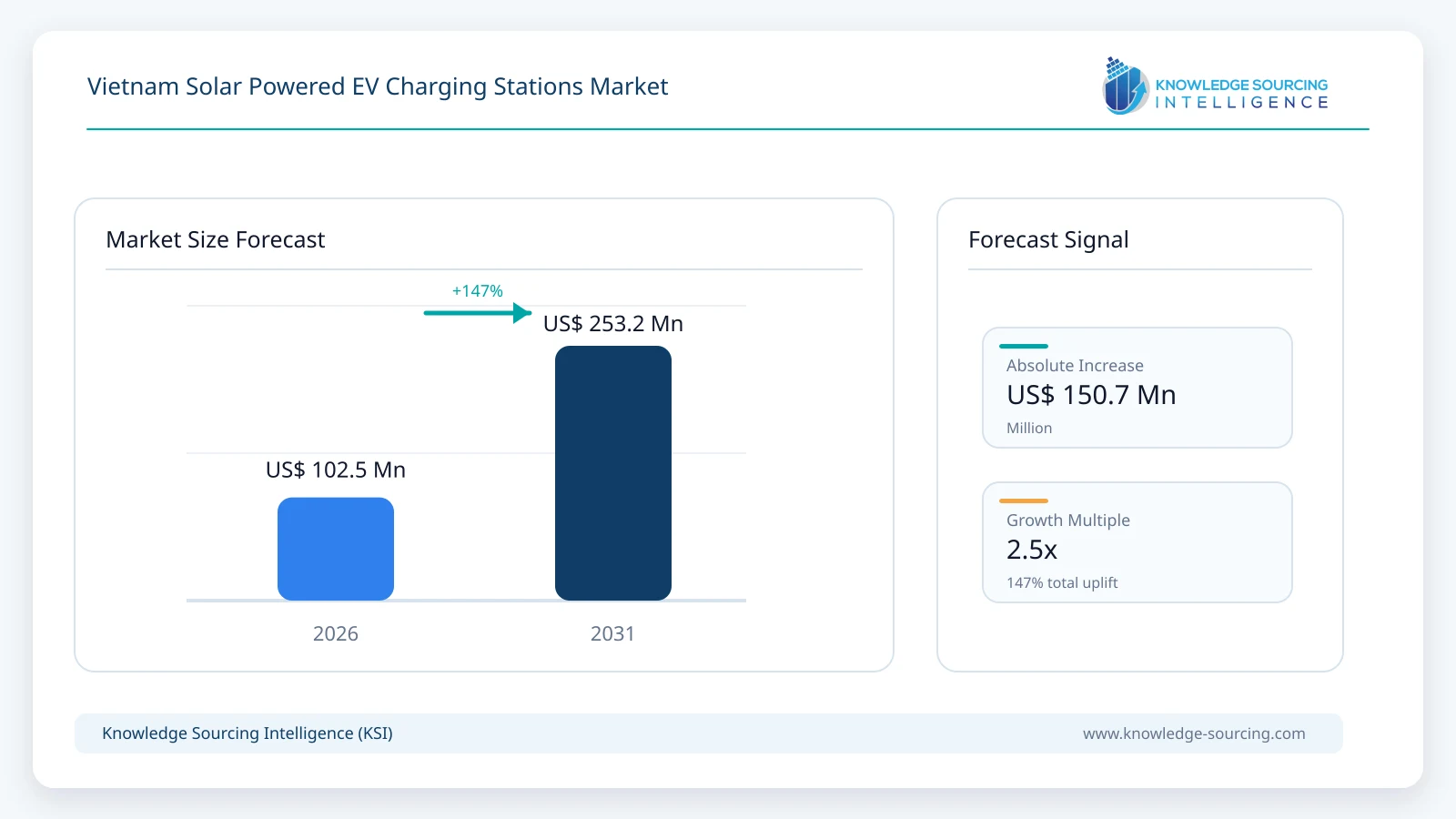
Growing EV penetration and continuous investment in charging stations, with greater support from government initiatives in renewable energy, are expected to drive the Vietnam Solar Powered EV Charging Stations market to steady growth during 2026 to 2031. Solar-powered EV charging stations combine the working elements of a PV system, battery storage, charging equipment, inverters and intelligent energy management software to deliver reliable and low-carbon electricity to EVs.
The transportation electrification plan and the rapid increase of rooftop PV installations create conditions for the deployment of electricity-powered charging infrastructure in Vietnam. Opportunities for commercial and residential charging applications are likely to grow with self-produced and self-consumed rooftop solar systems and battery storage integration, due to government policies.
The market is also benefiting from increasing private-sector investments. The nation is seeing an increasing number of EV charging stations from automotive companies, charging network operators, commercial real estate developers, and logistics providers to support the country's thriving electric mobility industry. The integration of solar PV with charging stations offers a way for businesses to save on electricity costs, increase their energy independence, and help achieve their environmental objectives.
Cloud-based charging management, AI-driven load balancing, battery storage optimisation, and remote monitoring systems are other technological innovations that enhance operational efficiency. Such solutions can help charging operators make the best use of solar energy and keep charging services going smoothly when electricity demand fluctuates.
Market Dynamics
Market Drivers
Increase the use of EVs.Promote growth of EV adoption: The EV market in Vietnam is growing with growing awareness among consumers, government incentives, and growing production by local manufacturers. Sustained demand for charging infrastructure will develop throughout the country as electric passenger vehicles, buses, and electric two-wheelers are rapidly growing. Increased availability of public charging stations in urban, highway, commercial, and residential areas is likely to drive more solar-powered charging solutions.
Government support for Renewable Energy: Government initiatives are promoting self-consumption and rooftop solar projects, which leads to a greater share of rooftop renewable energy systems. The introduction of new policy measures and regulations is also stimulating the rise of rooftop solar installations with battery storage systems, contributing to the transition of solar power into EV charging infrastructure. Increased incentives through new policy proposals and regulatory changes are increasingly encouraging households and businesses to roll out rooftop solar energy with battery storage, thereby expanding the potential to introduce solar energy into the EV charging market. These programs will help make communities more resilient when it comes to power, with a decrease in strain on the national electric grid.
Encourage solar power charging stations: Solar charging stations for vehicles are gaining traction as a means to reduce electricity costs and enhance environmental sustainability in companies. Commercial buildings like commercial offices, shopping malls, industrial parks, hotels, logistics operators, and manufacturing plants now need to take advantage of rooftop PV to plug into their EV charging infrastructure, to help with the electrification of their fleets and optimize the charging of their employees, and to improve the long-term operational efficiency.
Market Restraints & Opportunities
High initial capital expenditure (IACE) for PV panels, battery storage systems, power conversion equipment, and high-speed EV charging stations is one of the factors that jeopardizes the growth of the market. Also, constraints on available land area, local permitting requirements, interconnection approvals, and weather-dependent solar generation could make a project complex and take longer to deploy. Solar generation, however, is not sufficient for high-power DC fast charging applications unless backed by Vietnamese battery storage or grid connection.
Continued advancements in solar panel efficiency, battery storage solutions, and smart charging software are likely to provide substantial growth opportunities. Commercial charging operators are increasingly relying on AI-driven energy management solutions that can predict solar generation capacity, schedule charging, and match demand/forecast load patterns.
Key Developments
August 2026: Foxconn EV Energy and Components (Vietnam) Co. Ltd. (FEVC) has increased its charter capital to over $370 million and expanded its business scope to include the manufacturing and assembly of electric vehicle charging stations in northern Vietnam, according to newly updated business registration records.
Market Segmentation
The market is segmented by component, charging type, vehicle type, charging station type, application, and geography.
By Product: Solar Photovoltaic (PV) Panels
As the most important renewable energy source for EV charging, solar PV panels take up the largest market share in Vietnam's solar-powered EV charging stations market. As for solar resources, Vietnam has rich resources, particularly in the southern and central provinces, so that the current solar energy generation is economically feasible for the charging stations in commercial and industrial sectors. PV systems continue to become cheaper, and the number of rooftop PV systems is increasing, as companies start to power EV charging stations with PV energy.
The deployment of solar canopies over parking lots in commercial and industrial complexes, shopping malls, logistics centres and office sites is becoming increasingly popular, and is gaining momentum as a way to generate renewable electricity and provide EV parking. These systems cut down on reliance on grid power, cut down on running costs, and assist companies in accomplishing their environmental sustainability objectives.
Sungrow offers PV power inverters and battery storage systems that are extensively used in the commercial PV industry in Vietnam, and Huawei Digital Power offers PV integrated smart technology, battery storage, and EV charging solutions to help efficiently manage the energy supply for commercial facilities.
By Charging Type: DC Fast Charging
The fast charging market is dominated by DC fast charging due to the rising demand for fast charging services along the highway, urban transportation corridors, commercial centers, and public charging networks. With the growing number of EVs on the road in Vietnam, fast charging stations are becoming more crucial for reducing charging time and facilitating long-distance journeys.
Battery energy storage systems are increasing in use with solar-powered DC charging stations to ensure power is available when the sun isn't generating electricity, to keep charging stations operational, and to reduce peak electricity demand.
There are companies such as ABB, Siemens, and Delta Electronics that offer high-power DC charging equipment that can be connected to renewable energy systems and intelligent energy management platforms for commercial charging applications.
By Vehicle Type: Passenger Electric Vehicles
The rapid development of Vietnam's local EV market makes the passenger electric vehicle segment the largest segment. Market growth is driven by rising consumer acceptance, expanding product lines by VinFast, and ongoing investments in charging infrastructure. Market growth is fueled by consumers' acceptance, an increased product lineup by VinFast, and investments in charging infrastructure.
As more and more passenger EVs are entering the streets, charging stations are increasingly being installed in residential communities, commercial office buildings, hotels, shopping centers, and mixed-use developments – powered by solar energy. Employer charging is also gaining popularity as employers implement sustainability practices and charging programs for employees.
With the increasing number of vehicles on the road, VinFast remains the leader of Vietnam's passenger EV market, and V-GREEN is also actively increasing charging stations across the country.
Regional Analysis
Northern Vietnam
The rapid urbanization in Northern Vietnam, along with the growth of EV adoption and investments in renewable energy infrastructure, makes it one of the country's most attractive markets for solar-powered EV charging stations. Government, commercial development, industrial parks, and corporate offices are paving the way for electric mobility in Hanoi, which will also continue to be the main growth hub. More charging stations are also being installed throughout the area on expressways and city transit routes. As rooftop solar power becomes increasingly common in commercial buildings and manufacturing facilities, it supports the integration of renewable-powered EV charging.
Central Vietnam
Central Vietnam is becoming an attractive market due to its strong solar radiation, the development of tourism and the commercialization of the area. The number of EV charging stations at hotels, shopping malls, airports and public parking lots is on the rise in provinces including Da Nang, Khanh Hoa and Thua Thien Hue. Commercial establishments are increasingly integrating rooftop solar systems with EV charging stations to reduce electricity costs while supporting sustainable tourism initiatives. Continued development of transportation corridors is expected to create additional opportunities for solar-powered charging deployment.
Southern Vietnam
Southern Vietnam dominates the market owing to its high concentration of electric vehicles, industrial activities, commercial establishments, and renewable energy projects. Ho Chi Minh City remains the country's largest EV market, supported by rapid expansion of charging infrastructure across residential communities, office buildings, shopping malls, logistics centers, and mixed-use developments. The region also accounts for a significant share of Vietnam's rooftop solar capacity, making solar-powered EV charging economically attractive for commercial users. Increasing fleet electrification and corporate sustainability initiatives are expected to sustain strong market growth throughout the forecast period.
Mekong Delta
The Mekong Delta is gradually emerging as a growing market for solar-powered EV charging stations due to increasing renewable energy investments and improving EV accessibility. The region benefits from abundant solar resources and expanding commercial activities, encouraging businesses to adopt distributed solar generation integrated with EV charging facilities. Hotels, tourism operators, retail centers, and municipal authorities are increasingly exploring renewable-powered charging infrastructure to support sustainable regional development.
List of Companies
VinFast Auto Ltd.
V-GREEN Global Charging Station Development Company
ABB Ltd.
Schneider Electric SE
Siemens AG
Delta Electronics, Inc.
Huawei Digital Power Technologies Co., Ltd.
Sungrow Power Supply Co., Ltd.
Charge+ Pte. Ltd.
EV One Vietnam
VinFast Auto Ltd.
VinFast is Vietnam's leading electric vehicle manufacturer and plays a central role in the country's electric mobility ecosystem. The company has accelerated EV adoption through an expanding portfolio of passenger electric vehicles while working closely with V-GREEN to develop a nationwide charging network. VinFast's continued investments in charging infrastructure, together with integrated energy solutions, are expected to strengthen the adoption of solar-powered charging stations across Vietnam.
V-GREEN Global Charging Station Development Company
V-GREEN is one of Vietnam's largest EV charging infrastructure developers and is responsible for the rapid expansion of VinFast's nationwide charging network. The company continues to deploy charging stations across urban areas, highways, commercial centers, and residential developments while exploring renewable energy integration to improve sustainability and operational efficiency. Its expansion strategy positions the company as a major participant in Vietnam's future solar-powered charging ecosystem.
ABB Ltd.
ABB supplies AC and DC fast charging solutions that support commercial, public, and fleet charging applications throughout Vietnam. The company's charging systems can be integrated with photovoltaic generation, battery energy storage, and intelligent energy management platforms, enabling customers to optimize renewable energy utilization while maintaining reliable charging performance.
Analyst View
Vietnam's solar-powered EV charging stations market is expected to experience strong growth between 2026 and 2031, driven by increasing EV adoption, favorable renewable energy policies, and expanding charging infrastructure. Continued investments in rooftop solar, battery energy storage systems, and intelligent charging technologies will strengthen the integration of renewable energy with electric mobility. As commercial facilities, fleet operators, and municipalities increasingly prioritize sustainable transportation, solar-powered EV charging stations are expected to become an integral component of Vietnam's clean energy transition.
Vietnam Solar-Powered EV Charging Stations Market Scope:
| Report Metric | Details |
|---|---|
| Total Market Size in 2026 | USD 102.5 million |
| Total Market Size in 2031 | USD 253.2 million |
| Forecast Unit | USD Million |
| Growth Rate | 19.8% |
| Study Period | 2021 to 2031 |
| Historical Data | 2021 to 2024 |
| Base Year | 2025 |
| Forecast Period | 2026 – 2031 |
| Segmentation | Component, Charging Type, Vehicle Type, Charging Station Type, Application, Region |
| Companies |
|
Market Segmentation
By Component
Solar Photovoltaic (PV) Panels
EV Chargers & MPPT Charge Controller
Battery Energy Storage System (BESS)
Power Inverter
Others
By Charging Type
AC Charging Stations
DC Charging Stations
By Vehicle Type
Passenger Electric Vehicles
Commercial Vehicles
Electric Buses
Others
By Charging Station Type
Off-Grid Solar EV Charging Station
Grid-Tied Solar EV Charging Station
Hybrid Solar EV Charging Station
By Application
Residential
Commercial
Fleet Charging
Highway & Transit Corridor Charging
Others
By Region
Northern Vietnam
Central Vietnam
Southern Vietnam
Mekong Delta
Rest of Vietnam
Table of Contents
1. EXECUTIVE SUMMARY
2. MARKET SNAPSHOT
2.1. Market Overview
2.2. Market Definition
2.3. Scope of the Study
2.4. Market Segmentation
3. MARKET DYNAMICS
3.1. Market Drivers
3.2. Market Restraints
3.3. Market Opportunities
3.4. Porter’s Five Forces Analysis
3.5. IndVietnamtry Value Chain Analysis
4. BVIETNAMINESS LANDSCAPE
4.1. Policy & Regulatory Landscape
4.2. EV Charging Infrastructure Deployment Landscape
4.3. BVietnaminess & Revenue Model Landscape
4.4. Import & Domestic Manufacturing Landscape
4.5. Strategic Recommendations
5. TECHNOLOGICAL OUTLOOK
5.1. Solar PV and EV Charging Technology
5.2. Solar-Charger Integration Technology
5.3. Grid-Interactive Charging Technologies
5.4. Smart Charging & Digital Technologies
6. VIETNAM SOLAR POWERED EV CHARGING STATIONS MARKET BY COMPONENT
6.1. Introduction
6.2. Solar Photovoltaic (PV) Panels
6.3. EV Chargers & MPPT Charge Controller
6.3. Battery Energy Storage System (BESS)
6.4. Power Inverter
6.5. Others
7. VIETNAM SOLAR POWERED EV CHARGING STATIONS MARKET BY CHARGING TYPE
7.1. Introduction
7.2. AC Charging Stations
7.3. DC Charging Stations
8. VIETNAM SOLAR POWERED EV CHARGING STATIONS MARKET BY VEHICLE TYPE
8.1. Introduction
8.2. Passenger Electric Vehicles
8.3. Commercial Vehicles
8.4. Electric BVietnames
8.5. Others
9. VIETNAM SOLAR POWERED EV CHARGING STATIONS MARKET BY CHARGING STATION TYPE
9.1. Introduction
9.2. Off-Grid Solar EV Charging Station
9.3. Grid-Tied Solar EV Charging Station
9.4. Hybrid Solar EV Charging Station
10. VIETNAM SOLAR POWERED EV CHARGING STATIONS MARKET BY APPLICATION
10.1. Introduction
10.2. Residential
10.3. Commercial
10.4. Fleet Charging
10.5. Highway & Transit Corridor Charging
10.6. Others
11. VIETNAM SOLAR POWERED EV CHARGING STATIONS MARKET BY REGION
11.1. Introduction
11.2. Northern Vietnam
11.2 Central Vietnam
11.3 Southern Vietnam
11.4 Mekong Delta
11.5 Rest of Vietnam
12. COMPETITIVE ENVIRONMENT AND ANALYSIS
12.1. Major Players and Strategy Analysis
12.2. Market Share Analysis
12.3. Mergers, Acquisitions, Agreements, and Collaborations
12.4. Competitive Dashboard
13. COMPANY PROFILES
13.1. VinFast Auto Ltd.
13.2 V-GREEN Global Charging Station Development Company
13.3 ABB Ltd.
13.4 Schneider Electric SE
13.5 Siemens AG
13.6 Delta Electronics, Inc.
13.7 Huawei Digital Power Technologies Co., Ltd.
13.8 Sungrow Power Supply Co., Ltd.
13.9 Charge+ Pte. Ltd.
13.10 EV One Vietnam
14. APPENDIX
14.1. Currency
14.2. Assumptions
14.3. Base and Forecast Years Timeline
14.4. Key benefits for the stakeholders
14.5. Research Methodology
14.6. Abbreviations
Navigate
Trusted by the world's leading organizations











