
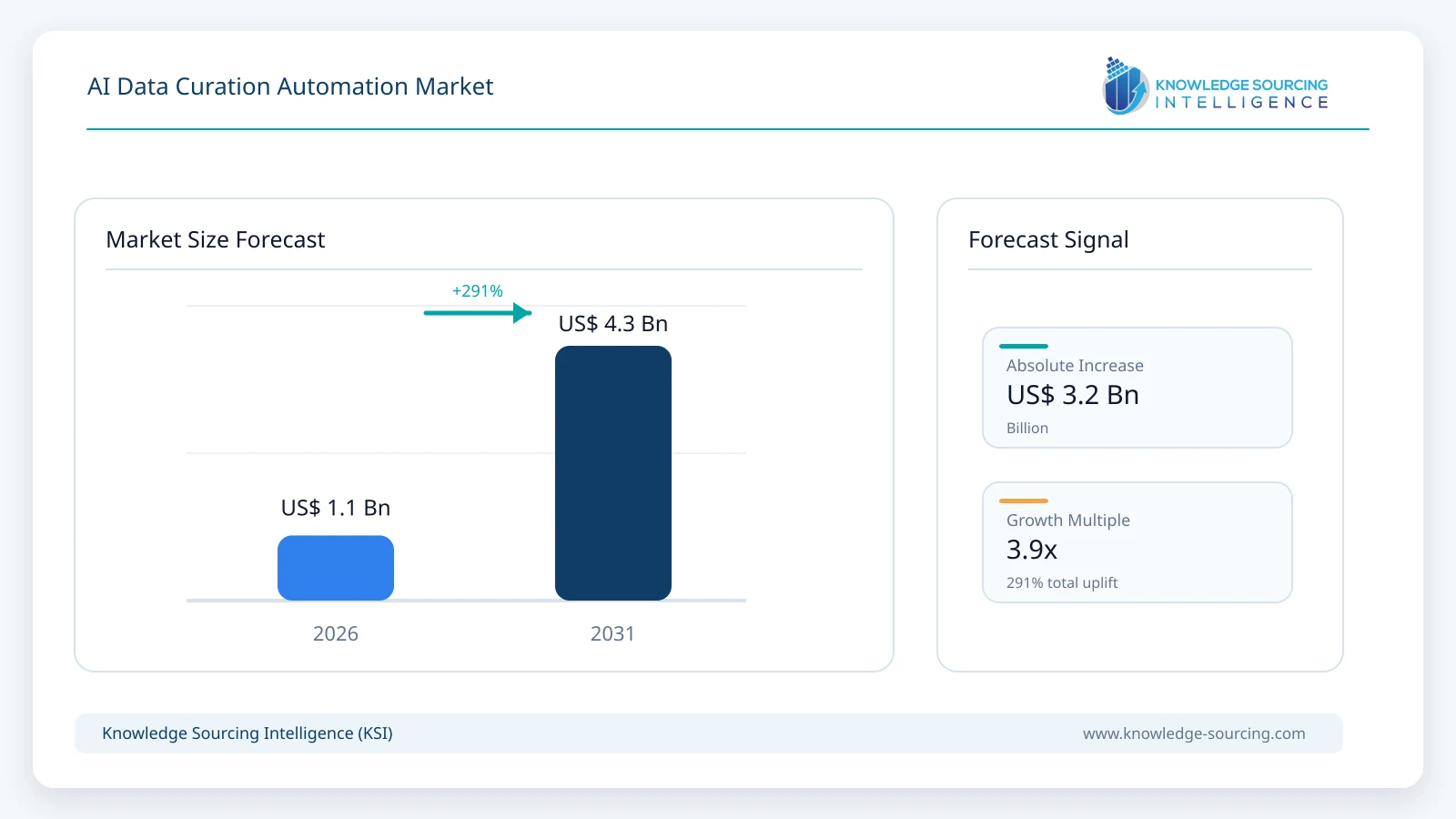
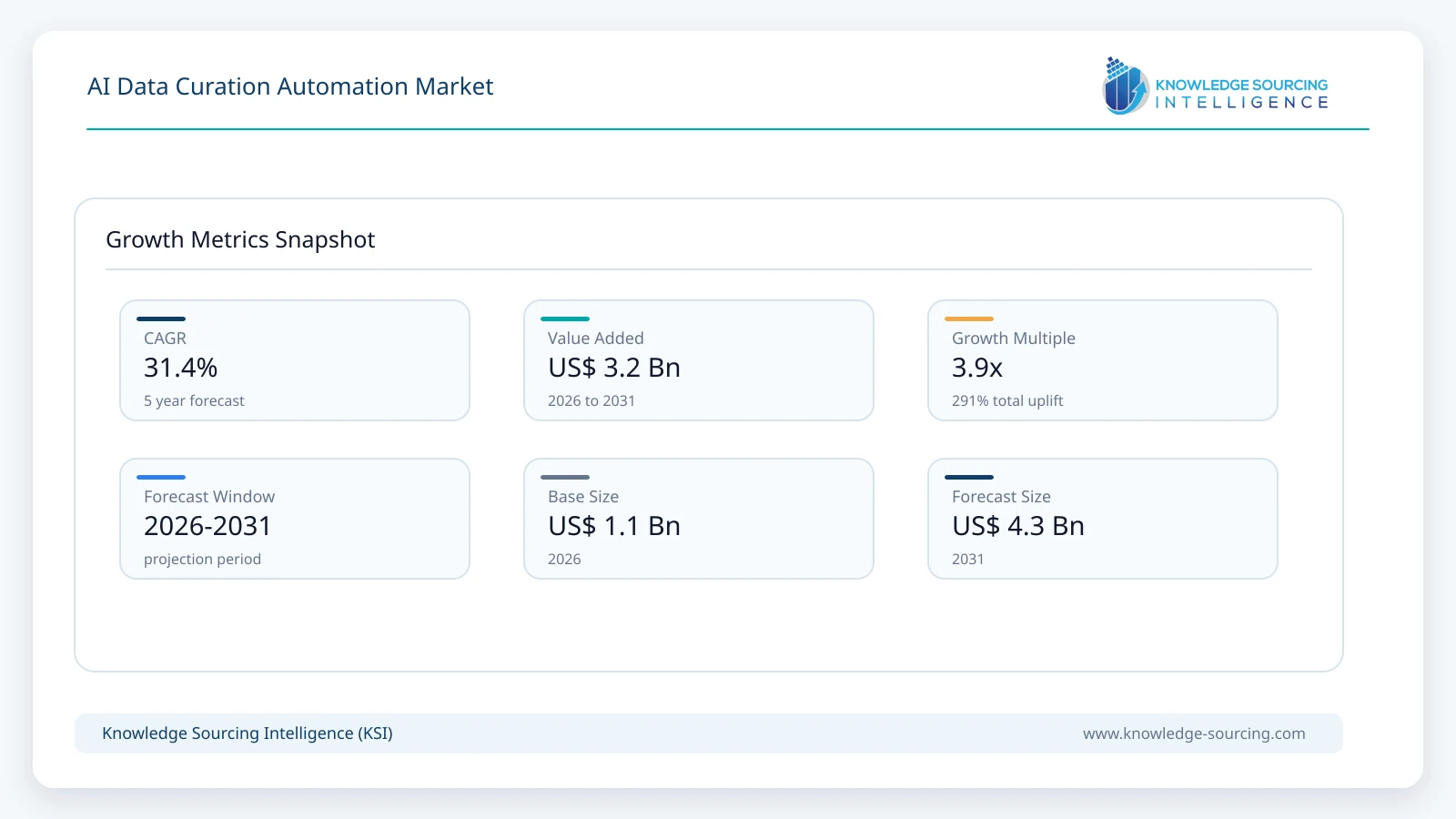
The AI Data Curation Automation Market is forecast to grow at a CAGR of 31.4%, reaching USD 4.30 billion in 2031 from approximately USD 1.10 billion in 2026.
Highlights:
- 1Dedicated AI data curation platforms account for approximately 47% of global revenue in 2026, supported by specialist filtering, dataset selection and repeatable quality workflows.
- 2Automated cleaning and quality filtering represent approximately 24% of revenue in 2026, while automated labeling QA and error detection account for a further 21%.
- 3Text and document data represent approximately 38% of 2026 demand as language-model development and domain adaptation require large quantities of curated material.
- 4North America accounts for approximately 39% of the global market in 2026, supported by AI laboratories, software platforms and mature enterprise ML procurement.
- 5Asia Pacific is expected to expand more rapidly through 2031 as local AI development, multilingual data programs, and manufacturing computer vision applications scale.
The market includes software and directly attributable implementation services that automate the selection, cleaning, filtering, deduplication, enrichment, and quality assurance of datasets prepared for AI training, fine-tuning, and evaluation. It covers dedicated data curation products and relevant functionality within larger ML development platforms, without counting the same underlying platform contract more than once.
Automated curation differs from purchasing datasets or outsourcing annotation projects because customers pay for repeatable preparation capabilities that can be applied across successive model training cycles. NVIDIA NeMo Curator supports distributed quality filtering and similarity removal across text, images, audio, and video, while Snorkel offers programmatic labeling and targeted dataset development. Cloud platforms such as Amazon SageMaker Data Wrangler help integrate data cleaning and transformation into model development workflows, and specialists such as Lightly focus on efficient sample selection for computer vision.
Market Overview
High-volume AI training pipelines routinely receive duplicate records, weak labels, inconsistent formats, low-value samples and mixed-quality sources that impair model performance or consume unnecessary processing capacity. Automated curation helps identify which examples should be retained, corrected, rebalanced, or excluded before training. For multimodal systems, the process also involves image similarity, audio quality, frame selection, and cross-modal metadata, extending far beyond traditional tabular ETL.
NVIDIA NeMo Curator provides a particularly clear technical example of industrialized dataset preparation. Its GPU-accelerated framework supports exact and semantic deduplication, heuristic and model-based filtering, language detection and multi-node processing. The company’s 2026 releases expanded Ray-based workflows across text, image, audio and video data, supporting integrated processing of datasets that may be too large for conventional single-machine pipelines.
Commercial adoption is not restricted to developers of foundation models. Enterprises use curated datasets to adapt models for contracts, clinical narratives, customer-service classifications and product images, while automotive and industrial teams select rare camera or sensor events to improve computer vision. Snorkel, Scale AI, Lightly and other specialists serve these needs through different combinations of software, assisted preparation and domain expertise. The existence of free and open-source alternatives is also shaping pricing, making repeatability, integration and governance important sources of paid differentiation.
Market Trends
GPU-Accelerated Curation Is Expanding Beyond Text
Large language-model training sets are increasingly processed using distributed filtering and deduplication rather than one-time scripts executed on small data samples. NVIDIA NeMo Curator combines Ray execution with GPU-accelerated data operations, enabling the same pipeline architecture to handle text, image, audio, and video workloads. These capabilities matter when quality checks must run over millions of images or exceptionally large token collections.
Multimodal curation also raises the value of metadata and sample selection. A video dataset may need representative frames and scene boundaries, while speech datasets require transcription quality, speaker characteristics, and recording filters before they can support reliable model adaptation.
Dataset Selection Is Becoming More Important Than Volume
Computer vision teams increasingly select representative, uncertain, or unusual examples instead of labeling every collected frame. LightlyStudio combines embeddings, similarity search, and sampling strategies to identify high-value data subsets, while Scale Data Engine emphasizes targeting model failures and improving labeling efficiency with curated examples.
This shift can improve economics in vehicle perception, robotics, and industrial inspection because repetitive observations contribute less learning value than rare edge cases. It also creates recurring software demand as deployed models encounter new operating conditions.
Programmatic Quality Assurance Is Reducing Routine Review
Data development platforms are integrating automated checks into labeling and annotation workflows, helping teams detect inconsistent labels, class imbalance, and weak examples before a dataset reaches model training. Snorkel combines programmatic labeling with slice-based evaluation, while Toloka describes confidence-based review that routes uncertain cases to human experts.
Automation does not remove the need for specialist judgment. Healthcare, financial, or safety-critical datasets still require human validation of complex labels and ambiguous cases, but software can reduce the volume of records that need individual inspection.
Data Preparation Is Moving Into Governed Cloud Pipelines
Amazon SageMaker Data Wrangler combines transformations, data-quality reporting and reusable processing flows that can feed machine learning pipelines. Databricks provides expectations, anomaly reporting and quarantine-oriented controls that address recurring data quality defects, although those broad platform capabilities must be attributed only when purchased for AI curation use cases.
Enterprises increasingly seek one monitored preparation workflow with repeatable quality thresholds, access controls and documented outputs rather than disconnected notebooks. This favors products that connect curation with model registries, data governance and evaluation systems.
Segment Analysis
By Offering: Dedicated AI Data Curation Platforms
Specialist AI curation platforms represent the largest offering category because they provide purpose-built tooling for sample scoring, deduplication, annotation review, and dataset versioning across repeated AI development cycles. Buyers can apply these functions across several models and business units, which supports subscription-based spending and usage-linked revenue beyond a single preparation project.
Revenue from dedicated platforms is projected to reach approximately USD 2.15 billion in 2031. NVIDIA’s open-source NeMo Curator demonstrates the technical direction, while commercial specialists such as Snorkel and Lightly compete by combining automation with integration, collaboration, and supported workflows.
By Curation Function: Automated Cleaning and Quality Filtering
Quality filtering is central to AI dataset preparation because noisy, irrelevant, unsafe, or malformed examples can waste training compute and introduce unwanted model behavior. Automated rules, model-based quality classifiers and data profiling identify records that should be removed or sent to specialist reviewers.
The automated cleaning and quality filtering segment is projected to reach approximately USD 989 million in 2031. Demand is supported by foundation-model corpus refinement, enterprise document preparation, and continuous quality assurance for changing source data.
By Application: Fine-Tuning and Alignment
Enterprise model adaptation requires smaller but more tightly controlled training and evaluation sets than broad unsupervised pretraining. High-quality instruction examples, preference comparisons and domain-specific documents need repeated filtering, error analysis and selection to prevent weak labels or irrelevant content from degrading model behavior.
Fine-tuning and alignment are expected to account for approximately USD 1.376 billion in 2031 revenue. Growth reflects the increasing number of enterprise-specific models and the repeated updating of supervised fine-tuning datasets, safety tests, and evaluation records.
Market Drivers
Expansion of Enterprise Model Customization
Companies adapting language and predictive models to proprietary business data need repeatable curation for domain documents, transaction records and task-specific training examples. As multiple teams refine related models, reusable filtering and quality policies reduce duplicated engineering effort and support wider adoption of specialized curation software.
Growth in Multimodal AI Training
Image, audio, and video model development produces larger and more diverse raw datasets than many traditional tabular ML workflows. Automatic deduplication, audio filtering, scene selection, and multimodal metadata validation help teams concentrate training on representative and informative samples.
Pressure to Improve GPU Training Efficiency
GPU-intensive model training makes irrelevant and duplicated data costly to process. Removing redundant examples and targeting higher-quality training samples can reduce unproductive training iterations and improve dataset coverage, giving AI developers a direct economic reason to invest in efficient curation pipelines.
Need for Repeatable Data Quality Controls
Production AI programs frequently refresh source information, labels, and evaluation sets after deployment. Teams increasingly need versioned quality rules, monitoring, exception handling and repeatable preparation processes rather than a one-off cleanup before the first model release.
Rising Expectations for Data Governance
AI deployments in regulated sectors require greater attention to data origin, quality, representativeness and preparation methods. EU AI Act Article 10 addresses training, validation and test-data governance for high-risk systems, supporting demand for documented data-preparation operations, although compliance alone does not create a separately priced curation contract.
Market Restraints
Open-Source and Bundled Alternatives
NVIDIA NeMo Curator and LightlyStudio make substantial curation capabilities available through open-source software, while cloud data platforms embed related operations within broader subscriptions. Standalone vendors must demonstrate measurable workflow benefits to sustain pricing, especially for customers with skilled internal engineering teams.
Dependence on Human Review for Complex Errors
Automated filters can flag suspicious records but cannot reliably resolve every domain-specific ambiguity, medical annotation dispute or safety-critical edge case. Customers must preserve expert review for exceptions, limiting end-to-end automation and complicating claims of uniform labor savings.
Heterogeneous Source Data and Integration Cost
Large organizations combine data lakes, annotation platforms, on-premises repositories, and specialized model-training stacks. Integrating repeatable curation into each system may require custom connectors, security reviews, and ongoing maintenance that slow deployment.
Uncertain Attribution of Platform Revenue
Many software suites combine transformation, profiling, labeling, evaluation, and governance in one price. Buyers and suppliers rarely report the share attributable only to AI data curation, which complicates product ROI comparisons and constrains the visibility of commercial market revenue.
Risk of Excessive Filtering and Reduced Data Diversity
Aggressive deduplication or quality scoring can unintentionally exclude rare but valuable events, minority languages or unusual operating conditions. Effective programs must monitor representativeness and benchmark performance instead of assuming that smaller or cleaner datasets are automatically more useful.
Regional Outlook
North America
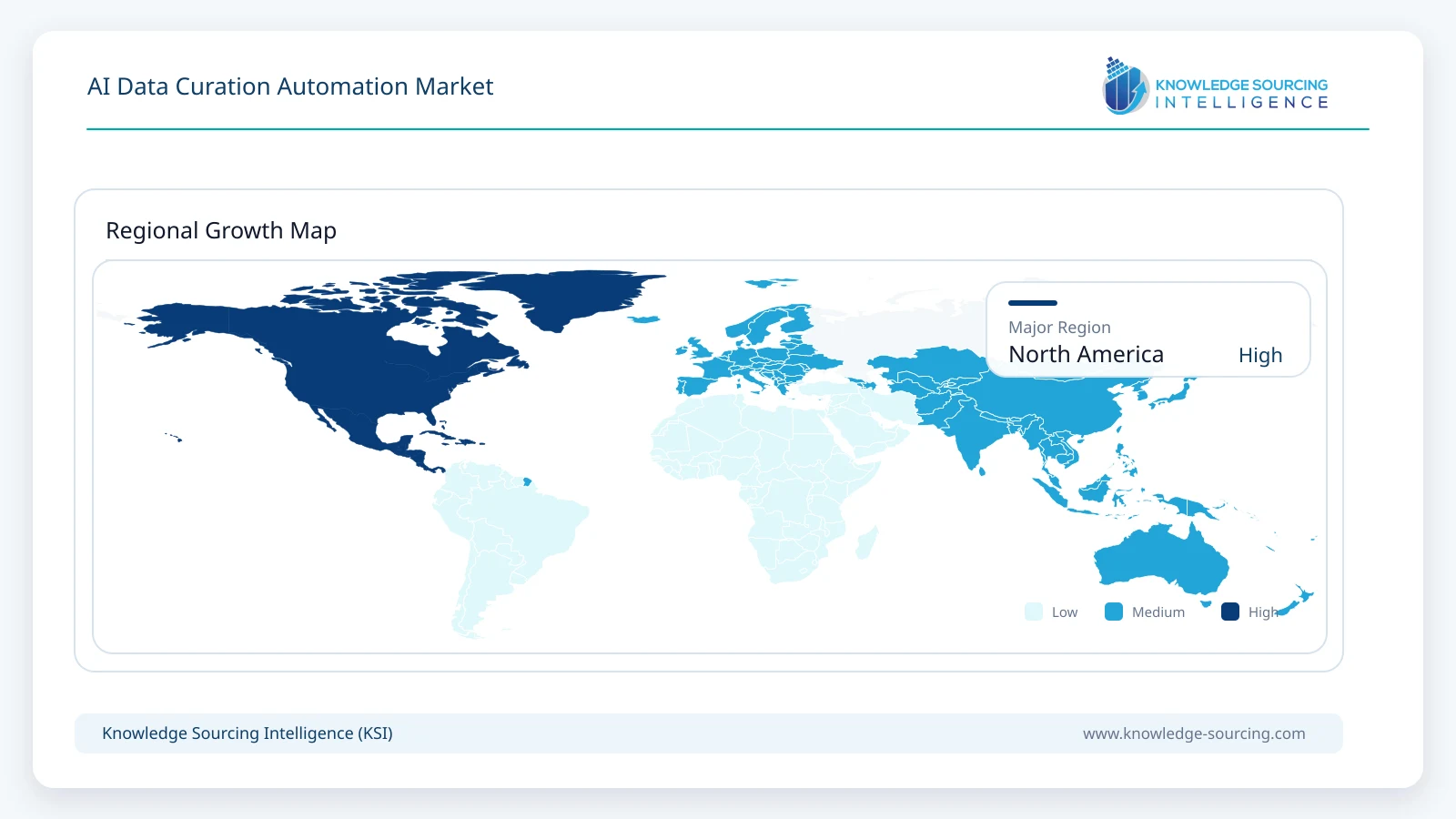
North America has the largest AI data curation automation market because the United States concentrates many model developers, enterprise AI software providers, and cloud infrastructure companies with substantial training-data operations. Financial services, technology, healthcare and digital-platform customers require repeatable curation for specialized model development, while the region also contains major suppliers such as NVIDIA, AWS, Snorkel, Scale and Labelbox.
Regional revenue is forecast to reach approximately USD 1.505 billion in 2031, compared with USD 429 million in 2026. Enterprise spending is supported by recurring investments in domain adaptation, software engineering and multimodal dataset preparation, although open-source adoption and bundled platform features affect the share captured through standalone licenses.
Asia Pacific
Asia Pacific is expected to record the fastest growth as China, India, Japan, South Korea, Australia and Singapore increase AI software development and deploy computer vision in manufacturing, logistics and consumer applications. Multilingual training sets and region-specific content introduce additional requirements for language filtering, local relevance assessment and dataset refresh.
Asia Pacific revenue is projected to reach approximately USD 1.290 billion in 2031 from USD 275 million in 2026. India is positioned to increase its regional share through software engineering, enterprise AI customization and data operations, while China, Japan and South Korea contribute significant demand from cloud ecosystems, industrial automation and multimodal model programs.
Competitive Landscape
Competition spans dedicated data curation vendors, AI training data suppliers and cloud model-development platforms. NVIDIA provides scalable open-source curation software, while Snorkel specializes in programmatic dataset development and evaluation workflows. Scale AI and Labelbox combine data workflow software with broader training-data services, and Lightly focuses on sample selection, embeddings and annotation quality for computer vision.
Amazon Web Services, Databricks, Microsoft and Google participate through wider data preparation and machine learning platform offerings, while Toloka and specialist quality tools address automated annotation and review. Cleanlab’s acquisition by Handshake in January 2026 also illustrates changing corporate ownership within the category. Commercial positions should be assessed against the directly attributable curation component of each offering rather than assuming that all labeling, cloud, training or data-services revenue belongs to this market.
Recent Developments
September 2026: Snorkel announced a USD 350 million Series E financing and expanded its emphasis on frontier AI data research and development, highlighting growing demand for specialized dataset engineering.
July 2026: NVIDIA published a financial AI data curation example using NeMo Curator for semantic deduplication in an iterative synthetic headline development workflow.
April 2026: NVIDIA released NeMo Curator 26.04 with changes to resource management and its Ray-based distributed processing environment.
March 2026: Lightly highlighted LightlyStudio as its latest open-source project, providing a unified multimodal curation and labeling environment that integrates sample selection, embeddings, and annotation management.
February 2026: NVIDIA released NeMo Curator 26.02 with a unified Ray-based architecture spanning text, images, video, and audio datasets.
January 2026: Handshake announced the acquisition of Cleanlab, bringing automated data quality and curation expertise into a larger organization focused on AI-related workflows.
Market Outlook
AI data curation automation revenue is expected to grow as model providers and enterprise developers shift from periodic dataset preparation toward continuous, quality-controlled data development. Dedicated platforms are likely to benefit from repeatable pipeline deployment, multimodal filtering and model-informed sample selection, while usage-based modules expand their position inside established cloud ML environments.
Open-source availability will continue to pressure license pricing for basic filtering and deduplication, increasing the importance of managed deployment, collaborative quality review, auditability and connection to enterprise training pipelines. Vendors that help customers quantify reduced preparation effort or more efficient training runs will have a stronger basis for recurring commercial contracts.
North America is expected to remain the largest market in absolute spending, while Asia Pacific gains share through faster expansion in multilingual AI development, enterprise model adaptation, and physical AI training. The ability to maintain data coverage while removing low-value records will increasingly separate high-performing curation systems from basic data-cleaning utilities.
AI Data Curation Automation Market Scope:
| Report Metric | Details |
|---|---|
| Total Market Size in 2026 | USD 1.10 billion |
| Total Market Size in 2031 | USD 4.30 billion |
| Forecast Unit | USD Billion |
| Growth Rate | 31.4% |
| Study Period | 2021 to 2031 |
| Historical Data | 2021 to 2024 |
| Base Year | 2025 |
| Forecast Period | 2026 – 2031 |
| Segmentation | Offering, Curation Function , Data Modality, Deployment Model |
| Companies |
|
| Customization Scope | 15% Free Customization included with purchase — Request Custom Breakdown → |
| Sample & Data Access | PDF Sample, Excel Databook & Analyst Briefing — Download Free Sample → |
Market Segmentation
By Offering
Dedicated AI data curation platforms
Integrated data-preparation automation modules
Curation implementation and managed services
By Curation Function
Automated cleaning and quality filtering
Deduplication and similarity removal
Schema and metadata harmonization
Automated labeling QA and error detection
Dataset selection, balancing and sampling
By Data Modality
Text and document datasets
Image and video datasets
Audio and speech datasets
Structured and tabular datasets
By Deployment Model
Managed cloud
Self-hosted and on-premises
Hybrid deployment
By Application
Foundation-model pretraining
Fine-tuning and alignment
Enterprise predictive AI
Multimodal and physical AI
By Organization Size
Large enterprises
Medium-sized organizations
Small organizations
By End User
Technology and cloud services
Banking, financial services and insurance
Healthcare and life sciences
Retail and e-commerce
Manufacturing and automotive
Government and public sector
Other industries
By Geography
North America
United States
Canada
Mexico
South America
Brazil
Argentina
Rest of South America
Europe
Germany
United Kingdom
France
Italy
Spain
Netherlands
Rest of Europe
Middle East and Africa
Saudi Arabia
United Arab Emirates
South Africa
Israel
Rest of Middle East and Africa
Asia Pacific
China
Japan
India
South Korea
Australia
Singapore
Rest of Asia Pacific
Table of Contents
1. EXECUTIVE SUMMARY
1.1. Market Opportunity and Key Findings
1.2. AI Data Curation Automation Market Size, 2026-2031
1.3. Key Segment Outlook
1.4. Regional Opportunity Summary
2. MARKET SNAPSHOT
2.1. Market Overview
2.2. Market Definition
2.3. Scope of the Study
2.4. Market Segmentation
2.5. Currency
2.6. Base and Forecast Years
3. BUSINESS LANDSCAPE
3.1. Market Drivers
3.1.1. Expansion of Enterprise Model Customization
3.1.2. Growth in Multimodal AI Training
3.1.3. Pressure to Improve GPU Training Efficiency
3.1.4. Need for Repeatable Data Quality Controls
3.1.5. Rising Expectations for Data Governance
3.2. Market Restraints
3.2.1. Open-Source and Bundled Alternatives
3.2.2. Dependence on Human Review for Complex Errors
3.2.3. Heterogeneous Source Data and Integration Cost
3.2.4. Uncertain Attribution of Platform Revenue
3.2.5. Risk of Excessive Filtering and Reduced Data Diversity
3.3. Market Opportunities
3.4. Porter’s Five Forces Analysis
3.5. Industry Value Chain Analysis
3.6. Policies and Regulations
3.7. Strategic Recommendations
4. TECHNOLOGICAL OUTLOOK
4.1. Automated Data Quality Classification
4.2. Exact and Semantic Deduplication
4.3. Embedding-Based Dataset Selection
4.4. Programmatic Labeling and Quality Assurance
4.5. Multimodal Filtering and Metadata Processing
4.6. Distributed GPU and Cloud Pipeline Orchestration
5. AI DATA CURATION AUTOMATION MARKET BY OFFERING
5.1. Introduction
5.2. Dedicated AI data curation platforms
5.3. Integrated data-preparation automation modules
5.4. Curation implementation and managed services
6. AI DATA CURATION AUTOMATION MARKET BY CURATION FUNCTION
6.1. Introduction
6.2. Automated cleaning and quality filtering
6.3. Deduplication and similarity removal
6.4. Schema and metadata harmonization
6.5. Automated labeling QA and error detection
6.6. Dataset selection, balancing and sampling
7. AI DATA CURATION AUTOMATION MARKET BY DATA MODALITY
7.1. Introduction
7.2. Text and document datasets
7.3. Image and video datasets
7.4. Audio and speech datasets
7.5. Structured and tabular datasets
8. AI DATA CURATION AUTOMATION MARKET BY DEPLOYMENT MODEL
8.1. Introduction
8.2. Managed cloud
8.3. Self-hosted and on-premises
8.4. Hybrid deployment
9. AI DATA CURATION AUTOMATION MARKET BY APPLICATION
9.1. Introduction
9.2. Foundation-model pretraining
9.3. Fine-tuning and alignment
9.4. Enterprise predictive AI
9.5. Multimodal and physical AI
10. AI DATA CURATION AUTOMATION MARKET BY ORGANIZATION SIZE
10.1. Introduction
10.2. Large enterprises
10.3. Medium-sized organizations
10.4. Small organizations
11. AI DATA CURATION AUTOMATION MARKET BY END USER
11.1. Introduction
11.2. Technology and cloud services
11.3. Banking, financial services and insurance
11.4. Healthcare and life sciences
11.5. Retail and e-commerce
11.6. Manufacturing and automotive
11.7. Government and public sector
11.8. Other industries
12. AI DATA CURATION AUTOMATION MARKET BY GEOGRAPHY
12.1. North America
12.1.1. United States
12.1.2. Canada
12.1.3. Mexico
12.2. South America
12.2.1. Brazil
12.2.2. Argentina
12.2.3. Rest of South America
12.3. Europe
12.3.1. Germany
12.3.2. United Kingdom
12.3.3. France
12.3.4. Italy
12.3.5. Spain
12.3.6. Netherlands
12.3.7. Rest of Europe
12.4. Middle East and Africa
12.4.1. Saudi Arabia
12.4.2. United Arab Emirates
12.4.3. South Africa
12.4.4. Israel
12.4.5. Rest of Middle East and Africa
12.5. Asia Pacific
12.5.1. China
12.5.2. Japan
12.5.3. India
12.5.4. South Korea
12.5.5. Australia
12.5.6. Singapore
12.5.7. Rest of Asia Pacific
13. COMPETITIVE ENVIRONMENT AND ANALYSIS
13.1. Major Players and Strategy Analysis
13.2. Market Share Analysis
13.3. Mergers, Acquisitions, Agreements, and Collaborations
13.4. Competitive Dashboard
14. COMPANY PROFILES
14.1. NVIDIA Corporation
14.2. Amazon Web Services, Inc.
14.3. Snorkel AI, Inc.
14.4. Scale AI, Inc.
14.5. Labelbox, Inc.
14.6. Toloka
14.7. Databricks, Inc.
14.8. Google LLC
14.9. Lightly AG
14.10. Microsoft Corporation
14.11. Handshake (Cleanlab)
14.12. Roboflow, Inc.
15. APPENDIX
15.1. Research Methodology
15.2. Data Sources
15.3. Definitions and Abbreviations





Frequently asked questions
What is the projected AI Data Curation Automation market size by 2031?
The AI Data Curation Automation Market is forecast to reach USD 4.30 billion by 2031.
What is the Compound Annual Growth Rate (CAGR) for this market?
The AI Data Curation Automation Market is forecast to grow at a 31.4% CAGR.
Which segment generates the most revenue in AI data curation automation?
Dedicated AI data curation platforms account for 47% of revenue.
Which region is expected to grow fastest through 2031?
Asia Pacific is expected to expand more rapidly through 2031.
Which data type drives the most demand in 2026?
Text and document data represent 38% of 2026 demand.
What core processes does AI Data Curation Automation cover?
The AI Data Curation Automation Market automates dataset selection, cleaning, filtering, and quality assurance.
Cite this report
Knowledge Sourcing Intelligence. (Oct 2026). AI Data Curation Automation Market Size, Share & Growth Forecast (2026-2031). https://www.knowledge-sourcing.com/report/ai-data-curation-automation-market