
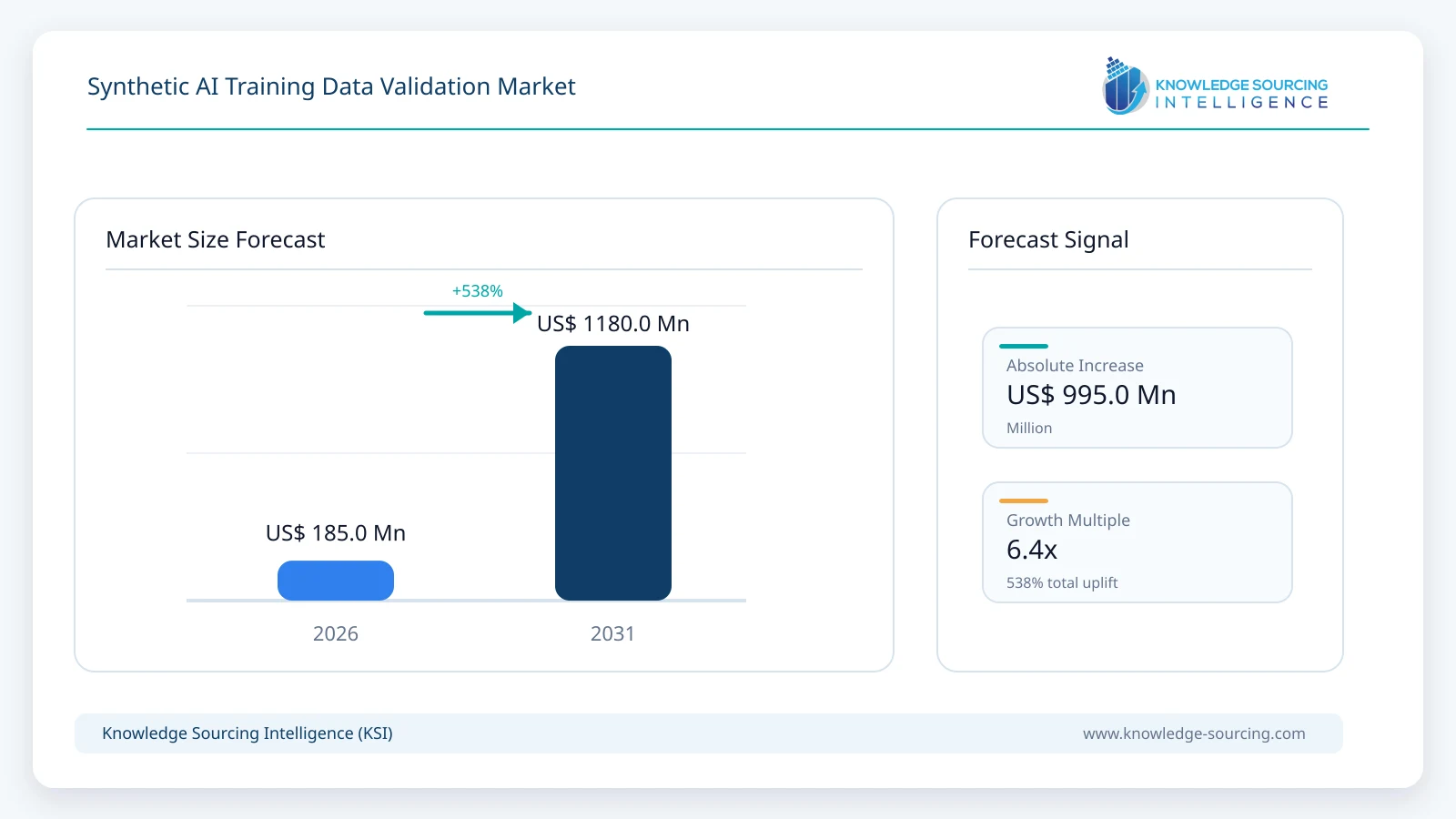
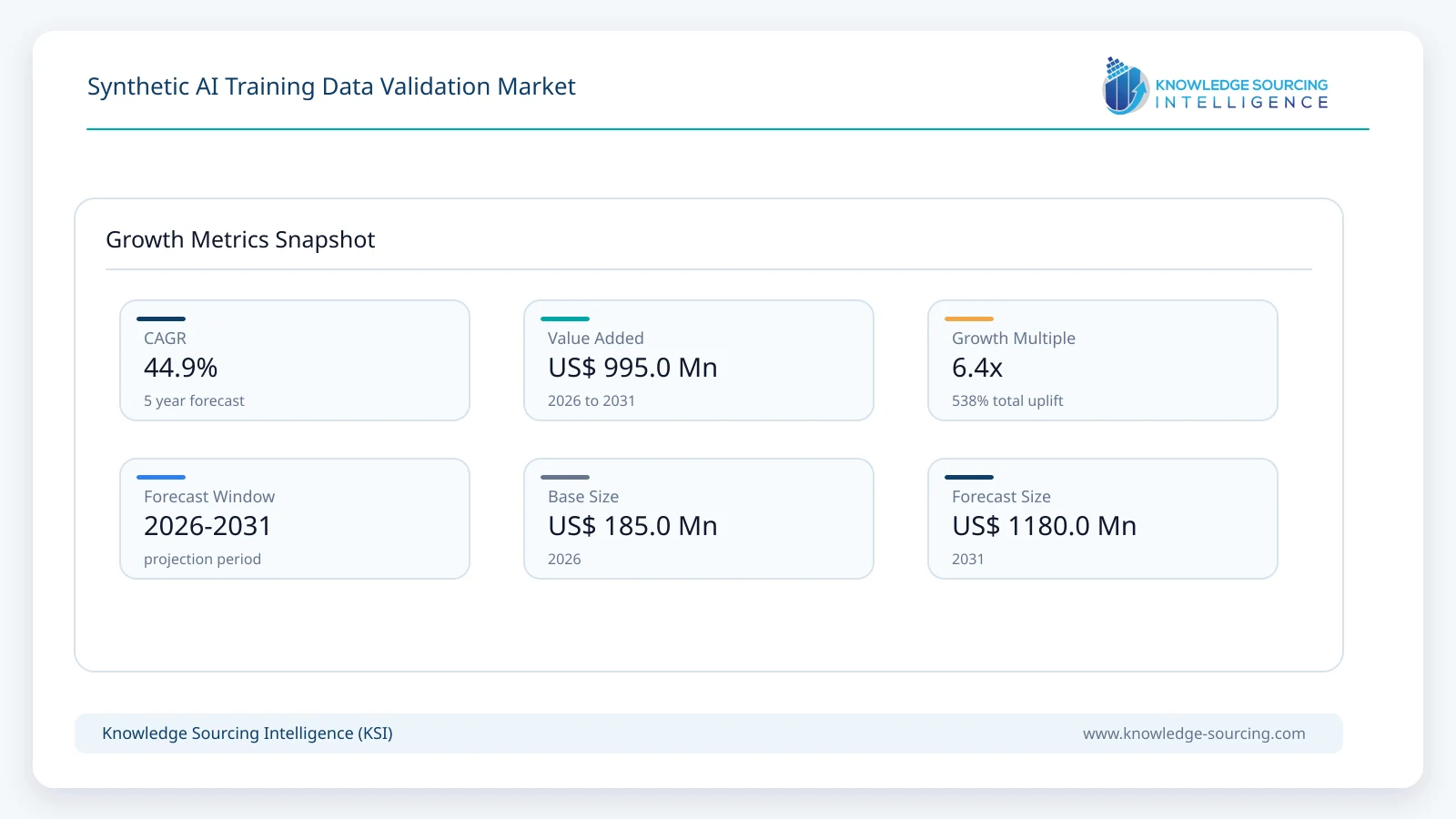
The Synthetic AI Training Data Validation Market is forecast to grow at a CAGR of 44.9%, reaching USD 1,180 million in 2031 from approximately USD 185 million in 2026.
Highlights:
- 1Integrated enterprise validation modules account for approximately 42.2% of global revenue in 2026, supported by quality controls bundled within established synthetic-data products.
- 2Semantic accuracy and grounded correctness represent approximately 23.8% of 2026 revenue; statistical fidelity contributes a further 20.5%.
- 3Text and instruction datasets account for an estimated 40.0% of the market in 2026 as enterprises fine-tune language and task-specific models.
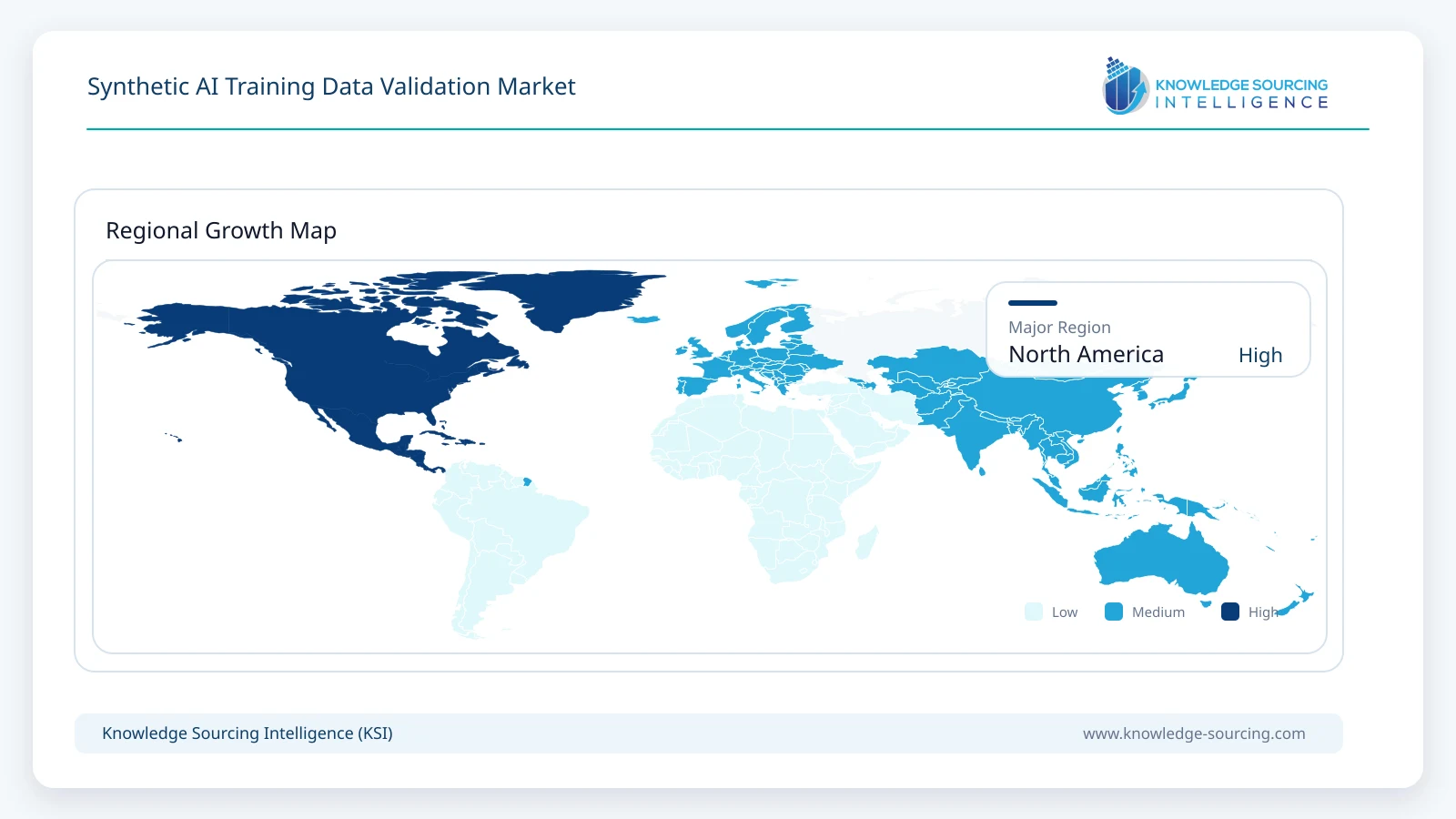
- 4North America represents approximately 42.7% of 2026 market revenue, reflecting AI laboratory activity and established enterprise platform purchasing.
- 5Asia Pacific is positioned for substantial absolute growth through 2031, particularly in multilingual AI, industrial simulation and domestic model-development programs.
It covers paid software and attributable services that verify the statistical realism, structural validity, semantic accuracy, privacy protection, scenario coverage and downstream training utility of synthetic text, code, tabular, image, video and multimodal datasets before those datasets are accepted for model development.
Commercial validation is a narrower activity than synthetic-data generation or broad AI evaluation. NVIDIA NeMo Data Designer includes data-quality gates, custom validators and LLM-based judges; DataCebo SDMetrics provides reports on distribution quality and diagnostic validity; and Tonic Fabricate uses a Validation Agent to assess generated output. Enterprise customers increasingly combine automated checks with held-out model testing and expert review, creating a recurring software opportunity that remains partly embedded within wider platform contracts.
Market Overview
Generated text and structured data can satisfy basic format requirements while containing incorrect labels, contradictory reasoning, repeated examples or relationships that would not hold in real applications. Validation therefore operates at several levels: record syntax, dataset-level statistical patterns, task-specific answer correctness and the ability of a model trained on the records to generalize to independent examples. DataCebo expressly distinguishes statistical quality from the downstream return achieved by a trained model, which is important when a dataset appears realistic but adds little learning value.
Synthetic-data use also creates two distinct trust problems for regulated customers. A dataset may faithfully reproduce source distributions while still exposing individuals through memorized values or rare combinations; alternatively, it may protect privacy but distort minority cases that are essential to model performance. SAS Data Maker and the MOSTLY AI quality framework publish controls for accuracy, privacy and distributional similarity, and the UK Financial Conduct Authority identifies fidelity, utility and privacy as separate dimensions of validation. These requirements are especially relevant to banking, insurance, healthcare and public-sector model development.
For generative and agent-based workflows, statistical comparisons alone cannot confirm that synthetic examples are suitable for training. Code must execute, tool-call arguments must conform to available APIs, and generated conversations must represent missing permissions, contradictory evidence and failure recovery. NVIDIA supports programmatic code and SQL checks as well as judge-based scoring; Snorkel has documented task-specific quality evaluators for synthetic agent-training examples. These workflows are increasing the value of domain-specific validation over generic data-profiling dashboards.
Market Trends
Validation Is Being Built Into Synthetic Data Generation
Synthetic-data platforms increasingly reject weak records while they are being generated, rather than validating only after a large dataset has been exported. Tonic Fabricate introduced a Validation Agent in June 2026, allowing users to inspect generated data and the scripts used to produce it, while NVIDIA NeMo Data Designer exposes explicit validation columns, custom rules and model-based scoring. Integrating these checks into the pipeline reduces the number of defective examples passed into expensive training jobs and encourages reusable validation policies.
Statistical Fidelity Is Being Paired With Model Utility
DataCebo SDMetrics assesses distributions, correlations, category coverage and structural constraints, but its documentation also emphasizes the value of measuring downstream training performance. For a fraud model, a synthetic record set can reproduce normal transaction statistics yet omit the rare patterns required to identify suspicious behavior; for a clinical classifier, a realistic dataset may still produce weaker results on held-out patients. Enterprises are therefore combining fidelity dashboards with real-data holdouts, augmentation tests and task-level acceptance thresholds.
Language, Code and Agentic Training Require Semantic Judges
Large language model post-training relies on synthetic instructions, responses and multi-step trajectories whose validity cannot be assessed by distributional similarity alone. Validation pipelines check whether a response is grounded in its prompt, whether reasoning examples satisfy task constraints and whether simulated tool calls handle errors correctly. NVIDIA supports code checks and judge rubrics, while Snorkel reports customer work using domain-specific evaluators for tool-use correctness, planning quality and sequence consistency.
Judges can themselves make errors or reward superficial fluency, so higher-risk uses continue to require independent labels and specialist review. This limitation favors validation platforms that can blend deterministic rules, model-based scoring and human adjudication instead of treating a single aggregate quality score as proof of reliability.
Privacy and Bias Testing Are Expanding the Validation Scope
Synthetic data is often commissioned because regulated source records cannot be transferred freely between teams or organizations. Validation must therefore check for near-duplicate source rows, attribute inference risk, unusual value combinations and minority-class coverage alongside conventional accuracy. The UK Financial Conduct Authority has described the challenge of jointly testing privacy, fidelity and utility, while SAS and MOSTLY AI provide product-level examples of privacy-oriented reporting.
Segment Analysis
By Offering: Integrated Enterprise Validation Modules
Integrated validation modules represent the largest offering category because many organizations already purchase synthetic data through an enterprise platform and expect data acceptance tests within that workflow. The segment is projected to reach approximately USD 500 million by 2031, from USD 78 million in 2026. NVIDIA, SAS and Syntho illustrate different approaches to embedding automated validity, privacy and dataset-quality checks alongside generation, with the associated spend attributed only to the validation portion of a broader platform contract.
Dedicated validation software and metered scoring APIs create alternatives for buyers that use multiple generators or need independent evidence. These categories are projected to reach USD 330 million and USD 270 million, respectively, by 2031. The ability to reproduce the same checks across model revisions and dataset suppliers supports repeatable usage rather than one-off manual assessments.
By Validation Capability: Semantic Accuracy and Grounded Correctness
Semantic accuracy testing is projected to reach approximately USD 300 million in 2031, compared with USD 44 million in 2026, reflecting increasing use of synthetically generated training instructions, domain question-answer examples, code tasks and agent trajectories. Deterministic validation, reference-grounded scoring and LLM judges can identify different defects, but the strongest workflows define task-specific criteria and route uncertain examples to experts.
Statistical fidelity and distribution similarity remain important for tabular and multimodal data, with projected 2031 revenue of USD 230 million. Privacy leakage checks reach an estimated USD 180 million, while diversity and scenario-coverage testing reaches USD 205 million. These amounts represent independent categories within one validation-capability segmentation, not additional revenue on top of the global market.
By Data Modality: Text and Instruction Datasets
Text and instruction validation is forecast to reach approximately USD 450 million by 2031, supported by repeated training-data refreshes for enterprise copilots, retrieval systems and domain-specific language models. Buyers must check instruction consistency, factual grounding, duplicate content, answer usefulness and sensitive information exposure, which creates demand for automated scoring at large record volumes.
Structured and tabular validation reaches an estimated USD 260 million by 2031, while image and video validation reaches USD 240 million as physical AI developers compare simulated scenes, automatic labels and real-world target conditions. Code and agent-trajectory checks are smaller today but increase in commercial importance as tool-using agents become more widely trained on generated examples.
Market Drivers
Expansion of Synthetic Data in Model Training
Model developers are creating larger volumes of generated examples to cover domain gaps, rare situations and instruction variants that cannot be obtained economically from public data alone. Acceptance testing becomes more valuable as synthetic training volumes grow, because errors repeated at scale can consume accelerator capacity and introduce systematic weaknesses into the finished model.
Cost of Repeated Training on Weak Datasets
Large fine-tuning and pretraining programs incur material compute and engineering expenses before dataset defects become visible in model behavior. Automated validation allows teams to preview samples, remove invalid records and confirm coverage before running an expensive training cycle, supporting measurable savings in avoidable retraining.
Growth of Regulated Enterprise AI
Banks, insurers, healthcare organizations and government bodies face tighter requirements for controlling sensitive input data and demonstrating that generated replacements do not create unacceptable leakage or bias. Privacy, fidelity and utility reporting offers a practical route to documenting data suitability for specific model-development projects.
Expansion of Agentic and Multimodal Systems
Tool-calling agents, robotic perception and multimodal models need training examples with coherent relationships between text, sensor inputs, actions and outcomes. Cross-field constraints, simulated-event realism and tool-call correctness increase the complexity of acceptance tests and support demand for specialist validation capabilities.
Continuous Dataset Refresh and Governance
Production AI applications require recurrent model updating as products, customer language, risk patterns and operating conditions change. Repeatable checks integrated into dataset versioning and training pipelines create recurring demand for validation policies, score reports and independent review services.
Market Restraints
Open-Source and Bundled Competition
SDMetrics, validation components in NeMo Data Designer and enterprise platform features reduce the amount buyers will pay for a separate validator. Standalone suppliers must demonstrate better domain coverage, independent assurance or operational convenience rather than assuming all quality checks create a distinct software contract.
Inconsistent Definitions of Synthetic Data Quality
Statistical fidelity, privacy, task accuracy and downstream usefulness can produce conflicting results for the same dataset. A single headline score cannot reliably prove acceptability across healthcare, financial fraud, code and robotics tasks, increasing the cost of solution configuration and buyer education.
Shortage of Reliable Reference Data
Organizations often generate synthetic data precisely because representative original data is unavailable, restricted or extremely rare. The absence of independent ground-truth samples makes some validation claims difficult to substantiate, especially for tail events and complex multimodal scenarios.
Reliance on Expert Review and Judge Reliability
LLM judges can overlook subtle factual defects or favor fluent but incorrect examples. Experts remain necessary for clinical reasoning, legal decisions and safety-critical perception tasks, limiting the automation savings achievable through software alone.
Attribution and Procurement Complexity
Validation is frequently priced as part of generation, curation or wider AI development services. Buyers may not see a separate validation line item, while suppliers can recognize revenue across several platform functions, complicating market measurement and constraining specialist market pricing.
Regional Outlook
North America
North America accounts for an estimated USD 79 million of market revenue in 2026 and is projected to reach approximately USD 466 million by 2031. United States-based frontier-model developers, AI software firms and regulated enterprises provide an early customer base for validation of generated language, code, customer and clinical data. The region also hosts major platform suppliers, including NVIDIA, Tonic, DataCebo and SAS, whose evaluation features help shape enterprise procurement specifications.
Demand is moving toward reusable acceptance policies that can be applied to datasets supplied by different development teams and synthetic-data vendors. US financial services, life-sciences and model-platform buyers are likely to remain important purchasers as they evaluate privacy leakage, task utility and audit requirements. Canadian AI research and enterprise projects provide additional activity, although procurement is more concentrated in the United States.
Asia Pacific
Asia Pacific is forecast to rise from approximately USD 45 million in 2026 to USD 307 million in 2031, supported by local language-model development, enterprise AI adaptation and industrial computer-vision training. China, Japan and South Korea have substantial AI and electronics ecosystems, while India and Singapore are supporting domain-specific models and data governance initiatives that increase the need for repeatable validation of synthetic instructions and regulated datasets.
Multilingual accuracy and variation across physical environments make regional validation particularly demanding. Enterprises need coverage checks against local language patterns and customer behaviors, while manufacturing and robotics programs require evidence that simulated scenes generalize to operational conditions. Local deployment controls and data-residency expectations are likely to support private cloud and dedicated validation options alongside managed international platforms.
Competitive Landscape
Competition includes specialist assessment software, synthetic-data platforms with built-in checks, broader model-data engineering suppliers and physical-AI simulation specialists. DataCebo provides a dedicated metrics framework, while NVIDIA integrates quality gates into NeMo Data Designer. SAS Data Maker, Tonic Fabricate, Syntho and Synthesized are important for combined generation and quality-validation workflows. Snorkel and Scale AI address domain-specific data quality through broader curated-data services, and Rendered.ai and Parallel Domain contribute validation-oriented approaches for synthetic visual training data.
Corporate structure matters when assessing suppliers. Syntho announced the acquisition of the MOSTLY AI brand in June 2026; MOSTLY AI should therefore not be listed as an independent competing company. NVIDIA acquired Gretel according to 2025 transaction reports, so historic Gretel functionality should not be counted again as an independent supplier franchise. Competitive differentiation increasingly rests on independently interpretable metrics, real-world utility evidence, privacy testing and deployment flexibility, rather than synthetic generation volume alone.
Recent Developments
September 2026: NVIDIA NeMo Curator 26.09 documented integration with NeMo Data Designer, providing a common processing route for synthetic data generation and curation workflows.
September 15, 2026: DataCebo announced SDV 2.0 and Generative Relational Models, strengthening its enterprise synthetic-data platform ecosystem and associated quality assessment needs.
July 9, 2026: NVIDIA published a financial-news synthetic-data study that generated more than 500,000 unique headlines using iterative generation and global semantic deduplication.
June 17, 2026: Tonic.ai published details of its Fabricate Validation Agent, describing automated inspection of generated records and generation logic.
June 9, 2026: Syntho announced the acquisition of the MOSTLY AI brand and related assets, consolidating two previously distinct synthetic-data brands.
June 3, 2026: Tonic.ai released Fabricate Validation Agent support for Plus and Enterprise users, adding configurable analysis of synthetic data quality and associated scripts.
Market Outlook
Synthetic training-data validation will become more closely tied to the economics of foundation-model fine-tuning, enterprise agents and domain-specific AI development. As generated training volumes rise, buyers will place greater weight on proving semantic correctness, realistic coverage and downstream performance before committing compute resources. Validation tools that combine deterministic checks, statistical assessment and targeted specialist review are positioned to gain share of this emerging software category.
Commercial adoption will not follow synthetic generation spending one-for-one because many capabilities are open source or bundled inside existing enterprise platforms. Independent products will be most valuable where customers compare multiple generators, require auditable risk assessments or must validate regulated data in private environments. Usage-metered validation is expected to grow with repeatable testing against successive dataset and model releases.
North America is expected to retain the largest absolute market through 2031, while Asia Pacific offers substantial growth in multilingual and physical AI. Competition will increasingly reward independent utility evidence, privacy safeguards and traceable validation outcomes rather than broad synthetic-data realism claims.
Synthetic AI Training Data Validation Market Scope
| Report Metric | Details |
|---|---|
| Total Market Size in 2026 | USD 185 million |
| Total Market Size in 2031 | USD 1,180 million |
| Forecast Unit | Million |
| Growth Rate | 44.9% |
| Study Period | 2021 to 2031 |
| Historical Data | 2021 to 2024 |
| Base Year | 2025 |
| Forecast Period | 2026 – 2031 |
| Segmentation | Offering, Validation Capability, Data Modality, Deployment Model, Application, End User, Commercial Model, Geography |
| Companies |
|
| Customization Scope | 15% Free Customization included with purchase — Request Custom Breakdown → |
| Sample & Data Access | PDF Sample, Excel Databook & Analyst Briefing — Download Free Sample → |
Market Segmentation
By Offering
Integrated Enterprise Validation Modules
Standalone Synthetic-Data Validation Software
Metered Validation APIs and Scoring Services
Specialist Validation Services
By Validation Capability
Semantic Accuracy and Grounded Correctness
Statistical Fidelity and Distribution Similarity
Privacy Leakage and Memorization Risk
Diversity, Bias and Scenario Coverage
Structural and Logical Validity
Downstream Training-Utility Assessment
By Data Modality
Text and Instruction Datasets
Structured and Tabular Datasets
Image and Video Datasets
Code and Agent-Trajectory Datasets
Audio and Combined Multimodal Datasets
By Deployment Model
Managed Cloud and SaaS
Private Cloud and Dedicated VPC
On-Premises and Isolated Environments
By Application
Foundation-Model Training and Fine-Tuning
Enterprise-Domain Model Adaptation
Regulated and Privacy-Sensitive AI Training
Physical AI and Simulation-Based Training
Agent and Evaluation-Corpus Development
By End User
AI Laboratories and Technology Providers
BFSI
Healthcare and Life Sciences
Automotive, Robotics and Industrial
Government and Public Sector
Retail and Other Enterprises
By Commercial Model
Annual and Platform Subscriptions
Consumption-Based Validation Services
Project-Based and Managed Delivery
By Geography
North America
United States
Canada
Mexico
South America
Brazil
Argentina
Rest of South America
Europe
Germany
United Kingdom
France
Italy
Spain
Rest of Europe
Middle East and Africa
United Arab Emirates
Saudi Arabia
South Africa
Rest of Middle East and Africa
Asia Pacific
China
Japan
India
South Korea
Singapore
Australia
Rest of Asia Pacific
Table of Contents
1. EXECUTIVE SUMMARY
1.1. Market Opportunity and Key Findings
1.2. Synthetic AI Training Data Validation Market Size, 2026-2031
1.3. Key Segment Outlook
1.4. Regional Opportunity Summary
2. MARKET SNAPSHOT
2.1. Market Overview
2.2. Market Definition
2.3. Scope of the Study
2.4. Market Segmentation
2.5. Currency
2.6. Base and Forecast Years
3. BUSINESS LANDSCAPE
3.1. Market Drivers
3.1.1. Expansion of Synthetic Data in Model Training
3.1.2. Cost of Repeated Training on Weak Datasets
3.1.3. Growth of Regulated Enterprise AI
3.1.4. Expansion of Agentic and Multimodal Systems
3.1.5. Continuous Dataset Refresh and Governance
3.2. Market Restraints
3.2.1. Open-Source and Bundled Competition
3.2.2. Inconsistent Definitions of Synthetic Data Quality
3.2.3. Shortage of Reliable Reference Data
3.2.4. Reliance on Expert Review and Judge Reliability
3.2.5. Attribution and Procurement Complexity
3.3. Market Opportunities
3.4. Porter’s Five Forces Analysis
3.5. Industry Value Chain Analysis
3.6. Policies and Regulations
3.7. Strategic Recommendations
4. TECHNOLOGICAL OUTLOOK
4.1. Semantic and Reference-Grounded Scoring
4.2. Statistical Fidelity and Utility Metrics
4.3. Privacy and Membership-Inference Testing
4.4. Diversity and Coverage Assessment
4.5. Code and Agent-Trace Validation
4.6. Multimodal and Sim-to-Real Evaluation
5. SYNTHETIC AI TRAINING DATA VALIDATION MARKET BY OFFERING
5.1. Introduction
5.2. Integrated enterprise validation modules
5.3. Standalone synthetic-data validation software
5.4. Metered validation APIs and scoring services
5.5. Specialist validation services
6. SYNTHETIC AI TRAINING DATA VALIDATION MARKET BY VALIDATION CAPABILITY
6.1. Introduction
6.2. Semantic accuracy and grounded correctness
6.3. Statistical fidelity and distribution similarity
6.4. Privacy leakage and memorization risk
6.5. Diversity, bias and scenario coverage
6.6. Structural and logical validity
6.7. Downstream training-utility assessment
7. SYNTHETIC AI TRAINING DATA VALIDATION MARKET BY DATA MODALITY
7.1. Introduction
7.2. Text and instruction datasets
7.3. Structured and tabular datasets
7.4. Image and video datasets
7.5. Code and agent-trajectory datasets
7.6. Audio and combined multimodal datasets
8. SYNTHETIC AI TRAINING DATA VALIDATION MARKET BY DEPLOYMENT MODEL
8.1. Introduction
8.2. Managed cloud and SaaS
8.3. Private cloud and dedicated VPC
8.4. On-premises and isolated environments
9. SYNTHETIC AI TRAINING DATA VALIDATION MARKET BY APPLICATION
9.1. Introduction
9.2. Foundation-model training and fine-tuning
9.3. Enterprise-domain model adaptation
9.4. Regulated and privacy-sensitive AI training
9.5. Physical AI and simulation-based training
9.6. Agent and evaluation-corpus development
10. SYNTHETIC AI TRAINING DATA VALIDATION MARKET BY END USER
10.1. Introduction
10.2. AI laboratories and technology providers
10.3. BFSI
10.4. Healthcare and life sciences
10.5. Automotive, robotics and industrial
10.6. Government and public sector
10.7. Retail and other enterprises
11. SYNTHETIC AI TRAINING DATA VALIDATION MARKET BY COMMERCIAL MODEL
11.1. Introduction
11.2. Annual and platform subscriptions
11.3. Consumption-based validation services
11.4. Project-based and managed delivery
12. SYNTHETIC AI TRAINING DATA VALIDATION MARKET BY GEOGRAPHY
12.1. North America
12.1.1. United States
12.1.2. Canada
12.1.3. Mexico
12.2. South America
12.2.1. Brazil
12.2.2. Argentina
12.2.3. Rest of South America
12.3. Europe
12.3.1. Germany
12.3.2. United Kingdom
12.3.3. France
12.3.4. Italy
12.3.5. Spain
12.3.6. Rest of Europe
12.4. Middle East and Africa
12.4.1. United Arab Emirates
12.4.2. Saudi Arabia
12.4.3. South Africa
12.4.4. Rest of Middle East and Africa
12.5. Asia Pacific
12.5.1. China
12.5.2. Japan
12.5.3. India
12.5.4. South Korea
12.5.5. Singapore
12.5.6. Australia
12.5.7. Rest of Asia Pacific
13. COMPETITIVE ENVIRONMENT AND ANALYSIS
13.1. Major Players and Strategy Analysis
13.2. Market Share Analysis
13.3. Mergers, Acquisitions, Agreements and Collaborations
13.4. Competitive Dashboard
14. COMPANY PROFILES
14.1. NVIDIA Corporation
14.2. DataCebo, Inc.
14.3. Tonic.ai, Inc.
14.4. SAS Institute Inc.
14.5. Syntho B.V. (MOSTLY AI brand)
14.6. Synthesized Ltd.
14.7. Clearbox AI
14.8. Snorkel AI, Inc.
14.9. Rendered.ai
14.10. Parallel Domain
14.11. Scale AI, Inc.
14.12. Synthesis AI
15. APPENDIX
15.1. Research Methodology
15.2. Source Register
15.3. Abbreviations





Frequently asked questions
What is the projected market size for Synthetic AI Training Data Validation by 2031?
The Synthetic AI Training Data Validation Market is projected to reach USD 1,180 million by 2031.
What is the Compound Annual Growth Rate (CAGR) for this market?
The Synthetic AI Training Data Validation Market is forecast to grow at a CAGR of 44.9% through 2031.
Which validation module segment accounts for the largest revenue share?
Integrated enterprise validation modules account for approximately 42.2% of revenue.
Which synthetic dataset type dominates the market in 2026?
Text and instruction datasets account for an estimated 40.0% of the market.
Which region holds the largest market share in 2026?
North America represents approximately 42.7% of 2026 market revenue.
Which region is positioned for substantial future growth?
Asia Pacific is positioned for substantial absolute growth through 2031.
Cite this report
Knowledge Sourcing Intelligence. (Oct 2026). Synthetic AI Training Data Validation Market Size, Share & Growth Forecast (2026-2031). https://www.knowledge-sourcing.com/report/synthetic-ai-training-data-validation-market