
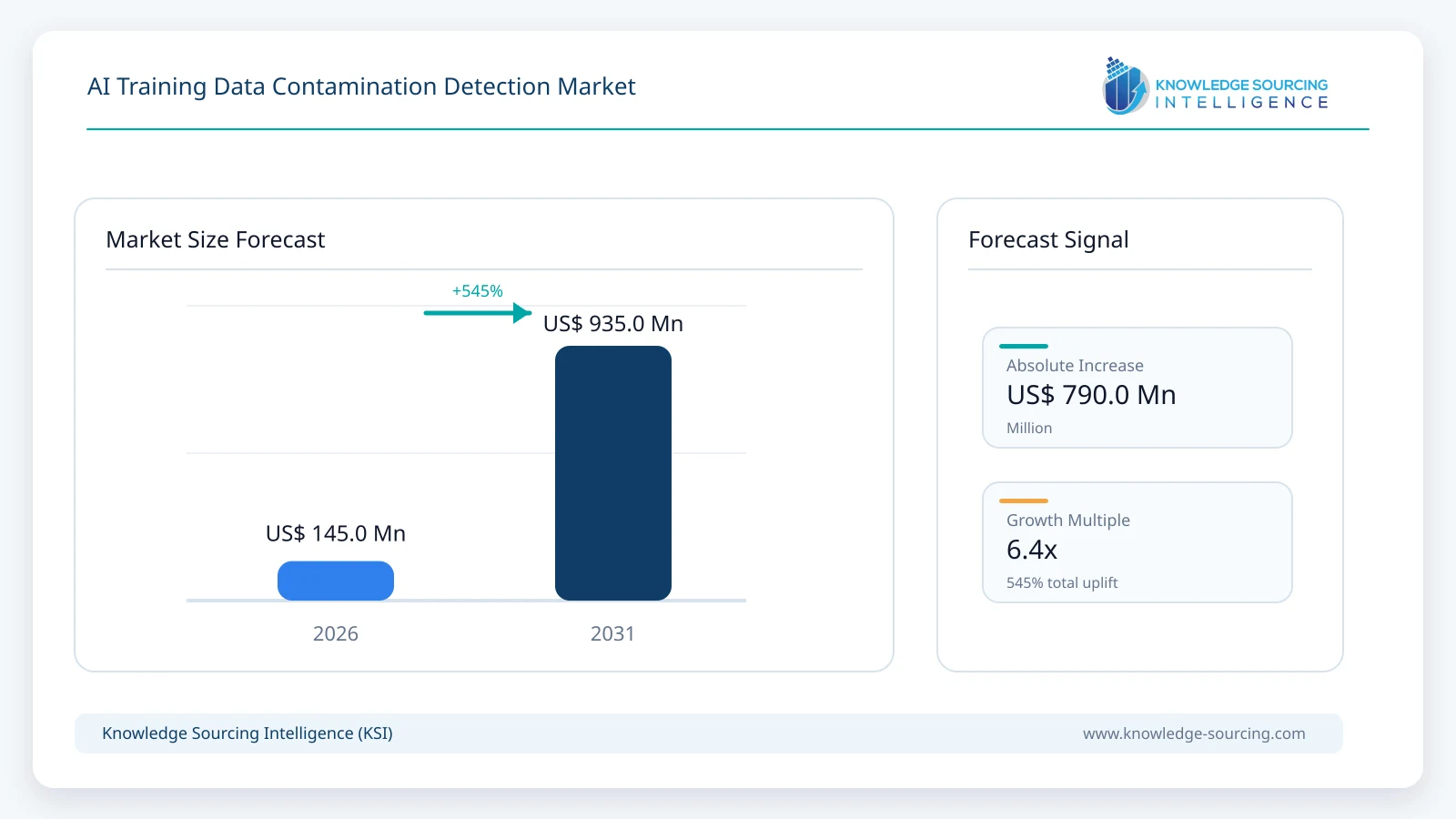
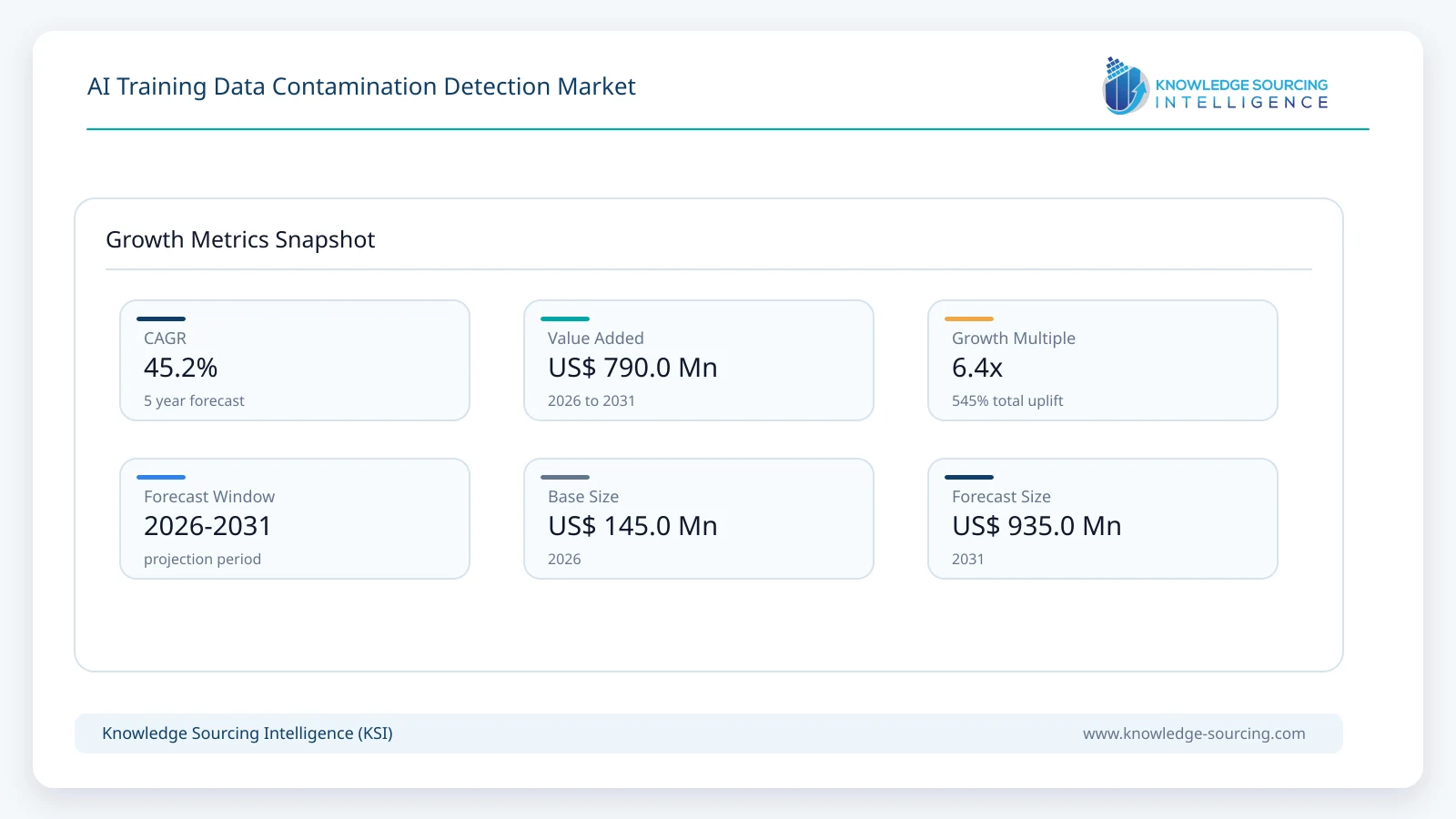
The AI Training Data Contamination Detection Market is forecast to grow at a CAGR of 45.2%, reaching approximately USD 935 million in 2031 from USD 145 million in 2026.
Highlights:
- 1Integrated enterprise detection modules account for approximately 49.7% of estimated 2026 spending, reflecting adoption inside existing AI data platforms.
- 2Benchmark leakage and evaluation-set exposure represent approximately 30.3% of 2026 revenue as model teams protect the independence of test results.
- 3Text and code datasets contribute approximately 57.2% of the 2026 market, reflecting the size and reuse of language-model corpora.
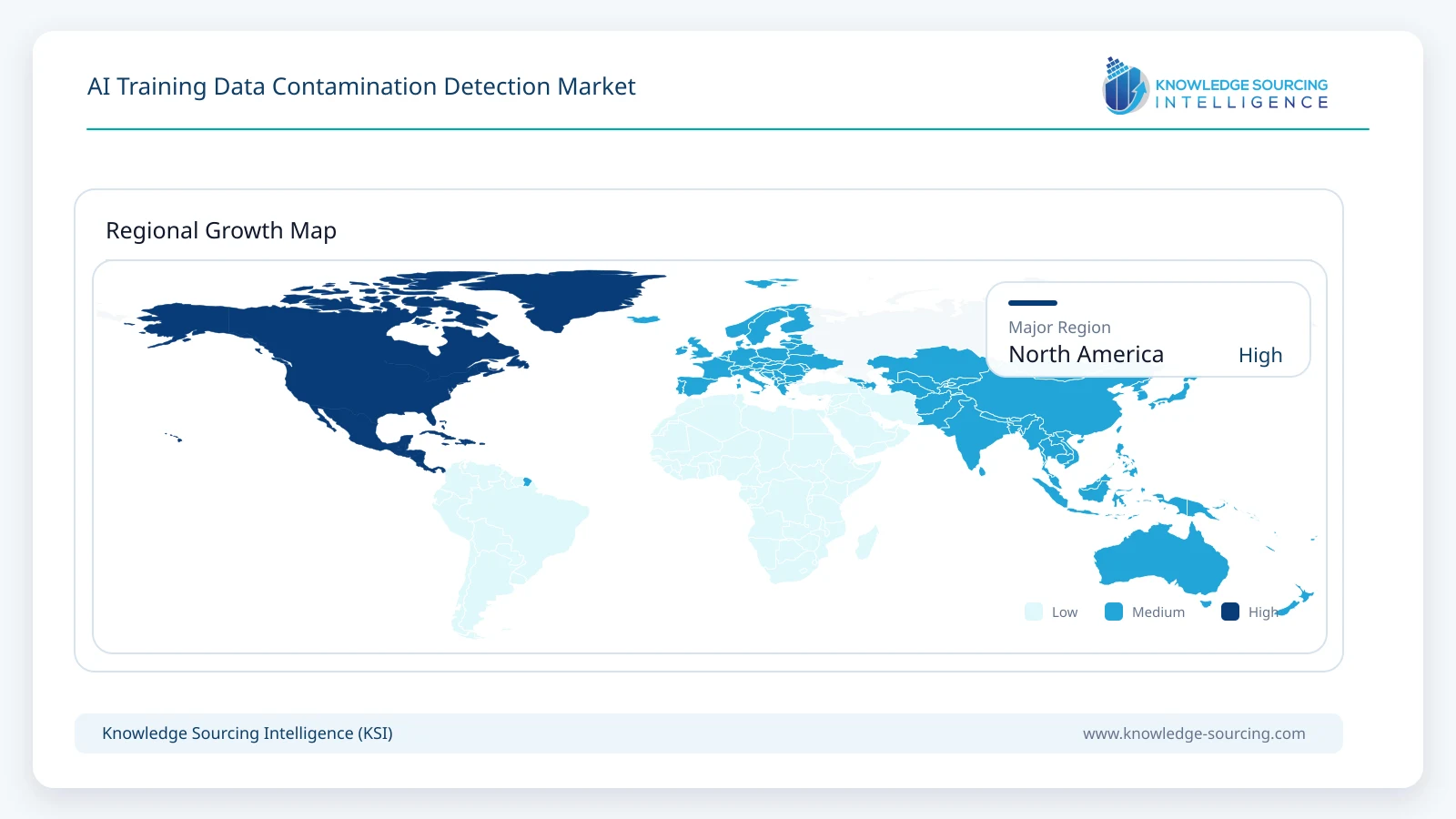
- 4North America contributes an estimated 42.1% of global revenue in 2026, supported by foundation-model developers and enterprise AI buyers.
- 5Asia Pacific shows a strong 2031 opportunity as multilingual model-training programs increase demand for reusable screening and evaluation-integrity controls.
The market covers software and attributable specialist services that identify harmful or inappropriate records before or during AI model training, including data leakage between training and evaluation sets, suspicious poisoning patterns, duplicates, incorrect labels and sensitive-content exposure. Spending arises through standalone scanning subscriptions, usage-based audits, platform-integrated checks and specialist validation engagements.
Detection infrastructure is evolving from individual scripts into documented checks that can be rerun as datasets, benchmarks and training mixtures change. NVIDIA NeMo Curator provides exact, fuzzy and semantic deduplication, while Cleanlab Datalab detects mislabeled records, outliers and near-duplicates. Snorkel AI has extended benchmark-quality work to contamination and leakage testing, indicating a commercial shift toward the integrity of both training inputs and the evaluation data used to judge subsequent model performance.
Market Overview
Contamination affects model training through several different mechanisms. Evaluation leakage occurs when protected tests or close paraphrases enter training material; ordinary duplication can overweight selected topics and create cross-split overlap; incorrect labels and malformed records can weaken supervised updates; and adversarial inserts may attempt to steer model behavior. Effective screening therefore combines deterministic fingerprints, similarity retrieval, statistical and model-based anomaly checks, and review of data lineage or sample provenance where available.
Training-data checks have different performance requirements according to data modality and training stage. Web-scale text preparation calls for high-throughput hashing and similarity search, while enterprise domain fine-tuning benefits from inspection of label consistency and unusual record patterns. Cleanlab reports label, outlier and duplicate issues at sample level; NVIDIA maintains GPU-accelerated text and multimodal curation components. These capabilities allow suspicious records to be identified before they become expensive to investigate after a model run.
Benchmark contamination is also moving into procurement decisions because public test sets can be copied, regenerated or indirectly learned during post-training. Snorkel AI announced an Open Benchmarks Red Team in October 2026 to examine leakage, contamination and verifier weaknesses. For commercial customers, the value is not simply the number of records removed but the reliability of model comparisons and the traceable evidence supporting data acceptance, especially when systems face regulatory or enterprise assurance reviews.
Market Trends
Benchmark Leakage Checks Are Becoming a Release Control
Training datasets are increasingly cross-checked against public and restricted evaluation corpora before model training or model-card publication. Model developers need to know whether a high benchmark score reflects genuine generalization or exposure to similar questions and answers in earlier training runs. Hash matching remains inexpensive, but translated, paraphrased and generated variants require similarity analysis and carefully calibrated thresholds.
Snorkel AI’s October 2026 Open Benchmarks Red Team illustrates the expansion of quality assurance beyond static test-set creation. Expert review, contamination screening and verifier testing are becoming connected activities, providing a route for paid validation workflows where customers require more than a one-time benchmark score.
Exact, Fuzzy and Semantic Detection Are Being Combined
Large text and code corpora contain repeated information that can escape simple string-based filters. NVIDIA NeMo Curator documents exact hashing, fuzzy MinHash-based matching and semantic embedding comparisons as separate detection methods. Using these methods together improves coverage across formatting changes and near-equivalent passages, although more expansive matching can incorrectly flag legitimate independent examples.
The September 2026 NeMo Curator release added text normalization to exact and fuzzy duplicate checks and reduced memory pressure in semantic deduplication. Those changes make large-scale screening easier to integrate into recurring pipelines, increasing demand for managed processing, validation reporting and operational support around otherwise open-source tools.
Poisoning and Anomalous-Record Review Is Moving Earlier
Maliciously altered or unusual training examples can be difficult to identify after model behavior has changed. Dataset-level checks that flag outliers, inconsistent labels and anomalous clusters help teams prioritize manual inspection before training begins. Cleanlab Datalab supplies model-assisted rankings of suspected label errors, unusual examples and near-duplicates, providing a practical screening layer even when no single test can prove an intentional attack.
Buyers increasingly combine automated risk ranking with expert adjudication for high-consequence datasets. This creates demand for auditable workflows that record which samples were challenged, which were retained and why, rather than treating a general data-quality score as proof of contamination.
Private and Multimodal Data Increase Screening Complexity
Enterprises fine-tuning language and multimodal models face additional contamination risks from confidential documents, customer identifiers and proprietary operational records. Screening these sources can require entity recognition, policy-based exclusions, image or audio duplicate detection and restricted-access review. The same rules cannot be applied uniformly to all industries because permissible data usage and material sensitivity vary by source.
NVIDIA’s 2026 NeMo Curator development includes text, image, video and audio processing stages, indicating that detection and quality checks must operate across more than one data type. Vendors able to combine private deployment, reproducible audit trails and multimodal inspection may obtain higher-value contracts than suppliers offering only generic text cleaning.
Segment Analysis
By Offering: Integrated Enterprise Detection Modules
Integrated detection modules are the leading offering because organizations prefer to test datasets within the same environments used for collection, preparation and training. Attachable checks can flag contaminated records at ingestion, before dataset approval and again when new corpora are merged. This design lowers operational handoffs and helps teams document why selected data sources were rejected without managing a separate scanning stack.
The integrated module segment is projected to reach approximately USD 420 million by 2031, up from USD 72 million in 2026. Growth reflects broader deployment of repeatable checks inside enterprise AI platforms, although license attribution remains sensitive to how suppliers bundle inspection capabilities with general data preparation and orchestration.
By Detection Capability: Benchmark Leakage and Evaluation-Set Exposure
Benchmark leakage detection is a leading commercial use because contaminated holdout data can undermine comparisons between successive model versions or suppliers. Screening compares training records with known evaluation assets using fingerprints, similarity indexes and more contextual tests where wording differs. Customers also need processes to manage test-set revisions and newly published benchmarks that may already be circulating in public datasets.
The segment is projected to reach approximately USD 300 million by 2031. Snorkel AI’s benchmark red-teaming activity demonstrates the commercial relevance of detecting leaked material before test results inform production deployment, public claims or model procurement decisions.
By Data Modality: Text and Code
Text and code account for the largest detection volume because language-model training uses extensive web, enterprise and repository corpora with frequent repetition and derivative content. Exact overlap with published evaluations is relatively straightforward to test, but paraphrased instructions, translated documents and transformed source code require more selective methods to avoid removing valuable independent examples.
Text and code contamination-detection revenue is projected to approach USD 535 million by 2031, supported by repeated corpus refreshes and expansion of post-training datasets. NVIDIA’s semantic and fuzzy deduplication workflows and Cleanlab’s sample-level diagnostics illustrate the range of techniques purchased or operationalized by model-development teams.
Market Drivers
Frequent Foundation-Model Retraining and Post-Training
Foundation-model builders now combine web collections, licensed material, synthetic instructions and specialist evaluation datasets in fast-moving training programs. Each new data mixture can reintroduce examples excluded from an earlier run, making a single pretraining scan insufficient.
Repeated validation before fine-tuning and release creates demand for automated, version-aware controls. The economic benefit arises from avoiding costly training reruns and ensuring a measured model improvement is not merely the result of leaked test material.
Stronger Benchmark Integrity Requirements
Public benchmarks can lose discriminatory power once similar tasks appear in training corpora or generated instruction collections. Private and refreshed evaluations therefore require contamination analysis alongside grading and task-design controls.
Snorkel AI’s 2026 expansion into benchmark red teaming supports a broader assurance market involving held-out data inspection, evidence logs and targeted audits that accompany model release cycles.
More Complex Third-Party Data Supply Chains
Enterprises increasingly receive training assets from data partners, internal business units and external repositories with differing metadata, quality and privacy standards. Contractual permission alone does not establish that records are unique, correctly labeled or absent from evaluation sets.
Screening at the point of ingestion helps customers quarantine questionable batches before they propagate through training workflows. Integrations with existing data catalogs and pipeline tools make repeatable inspection easier to operationalize.
Scaling of AI-Ready Data Automation
Large training corpora are too extensive for comprehensive manual record-by-record review, while narrow spot checks can miss rare but consequential contamination patterns. GPU acceleration, similarity indexing and model-assisted triage improve screening coverage.
NVIDIA’s successive 2026 NeMo Curator releases improve deduplication and workflow efficiency. That technical progress supports commercial services that schedule scans, manage findings and provide assurance documentation across repeated training cycles.
Regulated and High-Consequence AI Deployment
Financial services, healthcare, government and industrial AI buyers often require stronger evidence about the data used to train models. Mislabeled samples, private information and suspicious source records can create trust problems even when reported model accuracy remains high.
More rigorous acceptance tests encourage procurement of configurable scanners and specialist review services. Deployments frequently favor private or hybrid architectures to avoid sending sensitive training material to an external shared analysis environment.
Market Restraints
False Positives in Semantic and Anomaly Screening
Near-duplicate and embedding-based detection can flag legitimate examples with shared vocabulary or common factual content. Aggressive exclusions may reduce coverage of minority languages, uncommon topics and valuable edge cases.
Model developers must calibrate thresholds by domain, review suspicious clusters and compare downstream performance after filtering. These activities reduce the speed advantage of automation and create a continuing requirement for expert adjudication.
Incomplete Visibility Into Existing Model Training Corpora
When customers evaluate external or closed-weight models, they may not know the precise training examples or post-training mixtures used by the supplier. Direct record-matching methods cannot reliably establish whether an undisclosed corpus contains an evaluation set.
Behavioral contamination tests provide indirect clues but cannot replace full dataset access. Procurement decisions must therefore distinguish verified training-data inspections from probabilistic evidence obtained through model outputs.
Inconsistent Definitions of Contamination
A duplicate record is not necessarily harmful, and unusual observations may represent valid rare situations rather than attacks. Benchmark leakage, label error, source-policy breaches and deliberate poisoning have different consequences and require separate escalation rules.
Without agreed acceptance thresholds, different teams can reach conflicting conclusions about the same dataset. Vendors must support configurable policies and transparent exception handling, which raises implementation effort for multi-model organizations.
Privacy and Data-Movement Constraints
Sensitive corpora cannot always be transferred to shared cloud scanners for centralized comparison. Locality and contractual restrictions complicate screening against third-party reference sets, especially when both datasets must remain confidential.
Private deployment, secure similarity techniques and controlled reference-sharing can reduce exposure but increase system cost. Customers may defer comprehensive cross-organization checking when acceptable verification arrangements are unavailable.
Open-Source Alternatives and Bundled Capabilities
NVIDIA NeMo Curator and Cleanlab open-source components provide substantial scanning and quality-diagnostic capabilities without a standalone proprietary license. Enterprises with mature data engineering teams can assemble effective controls internally.
Commercial suppliers must differentiate through deployment reliability, protected data handling, specialist benchmark coverage and audit support rather than basic duplicate removal alone. This constrains average revenue per customer as adoption broadens.
Regional Outlook
North America
North America represents the largest estimated market for AI training data contamination detection, supported by the concentration of foundation-model laboratories, hyperscale cloud services and enterprise AI software programs in the United States. Buyers increasingly require repeatable controls for external data ingestion and pre-release benchmarking as post-training datasets are refreshed more frequently.
The regional market is projected to reach approximately USD 340 million by 2031, compared with USD 61 million in 2026. Specialist benchmark assurance, platform-integrated screening and private enterprise deployment contribute to growth, while the region also benefits from suppliers developing open-source screening techniques and commercial audit workflows.
Asia Pacific
Asia Pacific demand is developing through domestic language-model programs, enterprise AI adoption and expansion of computing capacity in China, India, Japan, South Korea and Singapore. Multilingual datasets make contamination screening more complex because translations, regional terminology and mixed scripts can defeat straightforward text-overlap checks, increasing the value of semantic methods and human language expertise.
The region is projected to reach approximately USD 250 million by 2031, from USD 33 million in 2026. Growth depends on scaled screening infrastructure, access to appropriate evaluation reference sets and local data-processing controls, particularly for sovereign or regulated AI development initiatives.
Competitive Landscape
The competitive environment combines providers of AI data-development platforms, dataset diagnostics, evaluation software and cloud machine-learning infrastructure. NVIDIA contributes scalable open-source curation components, while Cleanlab specializes in sample-level data quality diagnosis. Snorkel AI connects enterprise data development with benchmark integrity work, and Galileo applies model-assisted scoring to data error identification.
Large cloud and data platforms participate through bundled preparation, lineage, monitoring and quality services rather than always selling contamination detection as a standalone product. Google Cloud, Microsoft and Databricks provide parts of the governance and ML operations environment in which customers implement screening. Confident AI supports evaluation workflows, while Hugging Face provides open tooling and dataset distribution that influences contamination-control practices.
Differentiation is expected to depend on detection coverage, scalability, private deployment, traceable findings and the quality of enterprise support. Product availability should not be interpreted as evidence of individual market share: many providers monetize contamination screening only within broader platform contracts, and a significant portion of the underlying technology is freely distributed.
Recent Developments
October 2026: Snorkel AI expanded its Open Benchmarks Grants commitment to USD 30 million and introduced a red-team program that explicitly examines benchmark contamination, leakage and verifier weaknesses.
September 2026: NVIDIA released NeMo Curator 26.09 with text normalization in duplicate detection, bounded semantic-similarity processing and memory-efficiency enhancements for large-scale curation.
September 2026: Snorkel AI announced USD 350 million in Series E financing and reported expansion of its AI data-development offering, strengthening its ability to invest in benchmark and data-quality workflows.
July 2026: NVIDIA released NeMo Curator 26.07 with broader multimodal curation functionality, dataset-mixture optimization and more memory-efficient semantic-deduplication processing.
May 2025: NVIDIA described the Nemotron-CC pretraining-data pipeline, including classifier-based filtering and dataset curation stages, illustrating operational use of multi-step record screening.
January 2025: NVIDIA published technical evidence on NeMo Curator pipelines spanning text, image and video preparation, including GPU-accelerated exact, fuzzy and semantic duplicate detection.
Market Outlook
AI training data contamination detection is expected to become a routine assurance layer in model-development workflows as buyers demand credible test results and better control over training inputs. Benchmark exposure tests and anomaly screening will increasingly run before data approval and again before model release, while versioned datasets and evaluation sets will require recurring revalidation. Standalone scanners remain relevant where organizations need independent review of training material supplied by third parties.
Commercial growth will depend on the ability to translate open techniques into dependable products that minimize false positives, handle sensitive datasets and provide useful remediation evidence. Suppliers combining scalable matching, contextual detection and auditable review are positioned to secure larger enterprise contracts, although basic deduplication will remain subject to competitive pressure from open-source alternatives.
North America should remain the largest regional market, while Asia Pacific expands through multilingual and sovereign model development. As evaluation methods evolve, the highest-value offerings are likely to connect contamination screening with benchmark refreshes, model-release controls and independent assurance rather than treating dataset scanning as an isolated preprocessing step.
AI Training Data Contamination Detection Market Scope
| Report Metric | Details |
|---|---|
| Total Market Size in 2026 | USD 145 million |
| Total Market Size in 2031 | USD 935 million |
| Forecast Unit | Million |
| Growth Rate | 45.2% |
| Study Period | 2021 to 2031 |
| Historical Data | 2021 to 2024 |
| Base Year | 2025 |
| Forecast Period | 2026 – 2031 |
| Segmentation | Offering, Detection Capability, Data Modality, Deployment Model, Training Workflow, End User, Commercial Model, Geography |
| Companies |
|
| Customization Scope | 15% Free Customization included with purchase — Request Custom Breakdown → |
| Sample & Data Access | PDF Sample, Excel Databook & Analyst Briefing — Download Free Sample → |
Market Segmentation
By Offering
Integrated enterprise detection modules
Standalone contamination scanning tools
Specialist audit and validation services
By Detection Capability
Benchmark leakage and evaluation-set exposure
Poisoning and anomalous-record detection
Duplicate and split-overlap detection
Label and semantic error detection
Sensitive and restricted-content detection
By Data Modality
Text and code
Structured and tabular data
Image and video
Audio and multimodal datasets
By Deployment Model
Cloud-managed services
Self-hosted and private deployment
Hybrid deployment
By Training Workflow
Foundation-model pretraining
Post-training and fine-tuning
Benchmark and evaluation integrity
Enterprise domain-model training
By End User
Foundation-model developers and hyperscalers
Enterprise and regulated AI teams
AI data and platform vendors
Research laboratories and evaluation bodies
By Commercial Model
Enterprise subscription and bundled allocation
Usage-based scanning charges
Specialist audit and project fees
By Geography
North America
United States
Canada
Mexico
South America
Brazil
Argentina
Rest of South America
Europe
Germany
United Kingdom
France
Italy
Spain
Netherlands
Rest of Europe
Middle East and Africa
United Arab Emirates
Saudi Arabia
Israel
South Africa
Rest of Middle East and Africa
Asia Pacific
China
India
Japan
South Korea
Australia
Singapore
Taiwan
Rest of Asia Pacific
Table of Contents
1. EXECUTIVE SUMMARY
1.1. Market Opportunity and Key Findings
1.2. Market Size and Forecast, 2026–2031
1.3. Segment and Regional Highlights
2. MARKET SNAPSHOT
2.1. Market Overview
2.2. Market Definition and Scope
2.3. Market Segmentation
2.4. Currency and Forecast Assumptions
3. BUSINESS LANDSCAPE
3.1. Market Drivers
3.1.1. Frequent Foundation-Model Retraining and Post-Training
3.1.2. Stronger Benchmark Integrity Requirements
3.1.3. More Complex Third-Party Data Supply Chains
3.1.4. Scaling of AI-Ready Data Automation
3.1.5. Regulated and High-Consequence AI Deployment
3.2. Market Restraints
3.2.1. False Positives in Semantic and Anomaly Screening
3.2.2. Incomplete Visibility Into Existing Model Training Corpora
3.2.3. Inconsistent Definitions of Contamination
3.2.4. Privacy and Data-Movement Constraints
3.2.5. Open-Source Alternatives and Bundled Capabilities
3.3. Market Opportunities
3.4. Porter’s Five Forces Analysis
3.5. Industry Value Chain Analysis
3.6. Policies and Regulations
3.7. Strategic Recommendations
4. TECHNOLOGICAL OUTLOOK
4.1. Exact and Fuzzy Matching
4.2. Semantic Contamination Detection
4.3. Model-Assisted Anomaly Detection
4.4. Benchmark Leakage Testing
4.5. Protected and Multimodal Dataset Auditing
5. AI TRAINING DATA CONTAMINATION DETECTION MARKET BY OFFERING
5.1. Introduction
5.2. Integrated enterprise detection modules
5.3. Standalone contamination scanning tools
5.4. Specialist audit and validation services
6. AI TRAINING DATA CONTAMINATION DETECTION MARKET BY DETECTION CAPABILITY
6.1. Introduction
6.2. Benchmark leakage and evaluation-set exposure
6.3. Poisoning and anomalous-record detection
6.4. Duplicate and split-overlap detection
6.5. Label and semantic error detection
6.6. Sensitive and restricted-content detection
7. AI TRAINING DATA CONTAMINATION DETECTION MARKET BY DATA MODALITY
7.1. Introduction
7.2. Text and code
7.3. Structured and tabular data
7.4. Image and video
7.5. Audio and multimodal datasets
8. AI TRAINING DATA CONTAMINATION DETECTION MARKET BY DEPLOYMENT MODEL
8.1. Introduction
8.2. Cloud-managed services
8.3. Self-hosted and private deployment
8.4. Hybrid deployment
9. AI TRAINING DATA CONTAMINATION DETECTION MARKET BY TRAINING WORKFLOW
9.1. Introduction
9.2. Foundation-model pretraining
9.3. Post-training and fine-tuning
9.4. Benchmark and evaluation integrity
9.5. Enterprise domain-model training
10. AI TRAINING DATA CONTAMINATION DETECTION MARKET BY END USER
10.1. Introduction
10.2. Foundation-model developers and hyperscalers
10.3. Enterprise and regulated AI teams
10.4. AI data and platform vendors
10.5. Research laboratories and evaluation bodies
11. AI TRAINING DATA CONTAMINATION DETECTION MARKET BY COMMERCIAL MODEL
11.1. Introduction
11.2. Enterprise subscription and bundled allocation
11.3. Usage-based scanning charges
11.4. Specialist audit and project fees
12. AI TRAINING DATA CONTAMINATION DETECTION MARKET BY GEOGRAPHY
12.1. North America
12.1.1. United States
12.1.2. Canada
12.1.3. Mexico
12.2. South America
12.2.1. Brazil
12.2.2. Argentina
12.2.3. Rest of South America
12.3. Europe
12.3.1. Germany
12.3.2. United Kingdom
12.3.3. France
12.3.4. Italy
12.3.5. Spain
12.3.6. Netherlands
12.3.7. Rest of Europe
12.4. Middle East and Africa
12.4.1. United Arab Emirates
12.4.2. Saudi Arabia
12.4.3. Israel
12.4.4. South Africa
12.4.5. Rest of Middle East and Africa
12.5. Asia Pacific
12.5.1. China
12.5.2. India
12.5.3. Japan
12.5.4. South Korea
12.5.5. Australia
12.5.6. Singapore
12.5.7. Taiwan
12.5.8. Rest of Asia Pacific
13. COMPETITIVE ENVIRONMENT AND ANALYSIS
13.1. Major Players and Strategy Analysis
13.2. Market Share Analysis
13.3. Mergers, Acquisitions, Agreements and Collaborations
13.4. Competitive Dashboard
14. COMPANY PROFILES
14.1. NVIDIA Corporation
14.2. Snorkel AI, Inc.
14.3. Cleanlab, Inc.
14.4. Galileo AI
14.5. Google LLC
14.6. Microsoft Corporation
14.7. Databricks, Inc.
14.8. Scale AI, Inc.
14.9. Confident AI
14.10. Cisco Systems, Inc.
14.11. Hugging Face, Inc.
15. APPENDIX
15.1. Research Methodology
15.2. Data Sources and Definitions





Frequently asked questions
What is the projected market size and growth rate for AI Training Data Contamination Detection?
Reaches $935 million in 2031 from $145 million in 2026, CAGR 45.2%.
Which detection module type accounts for the largest 2026 spending?
Integrated enterprise detection modules comprise 49.7% of 2026 spending.
Which data modalities dominate the contamination detection market in 2026?
Text and code datasets represent 57.2% of the 2026 market.
Which region holds the largest share of global revenue in 2026?
North America contributes 42.1% of global revenue in 2026.
What specific contamination issue generates significant 2026 revenue?
Benchmark leakage and evaluation-set exposure account for 30.3% revenue.
Which region shows a strong growth opportunity by 2031?
Asia Pacific shows strong 2031 opportunity due to multilingual model training.
Cite this report
Knowledge Sourcing Intelligence. (Oct 2026). AI Training Data Contamination Detection Market Size, Share & Growth Forecast (2026-2031). https://www.knowledge-sourcing.com/report/ai-training-data-contamination-detection-market