
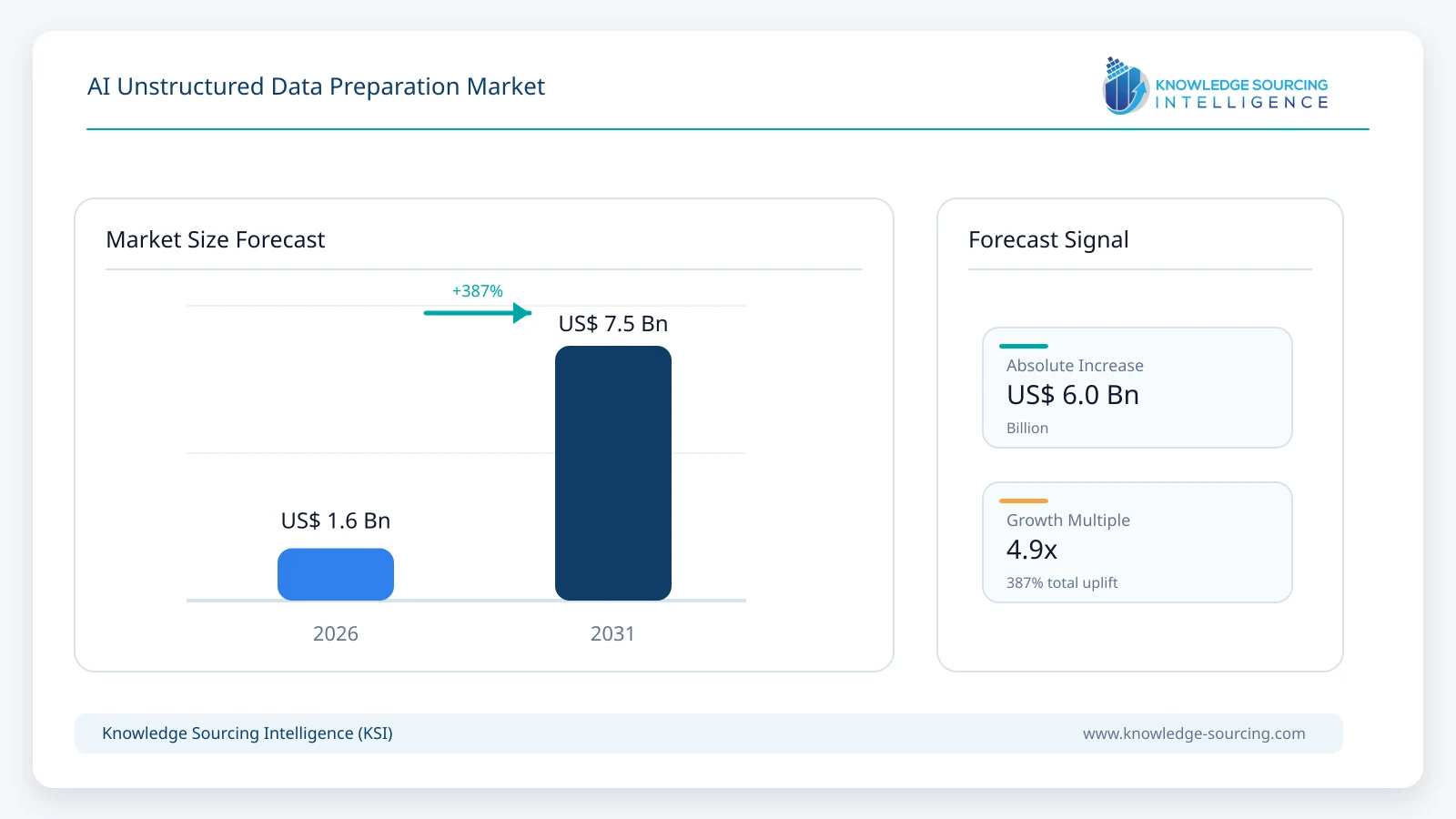
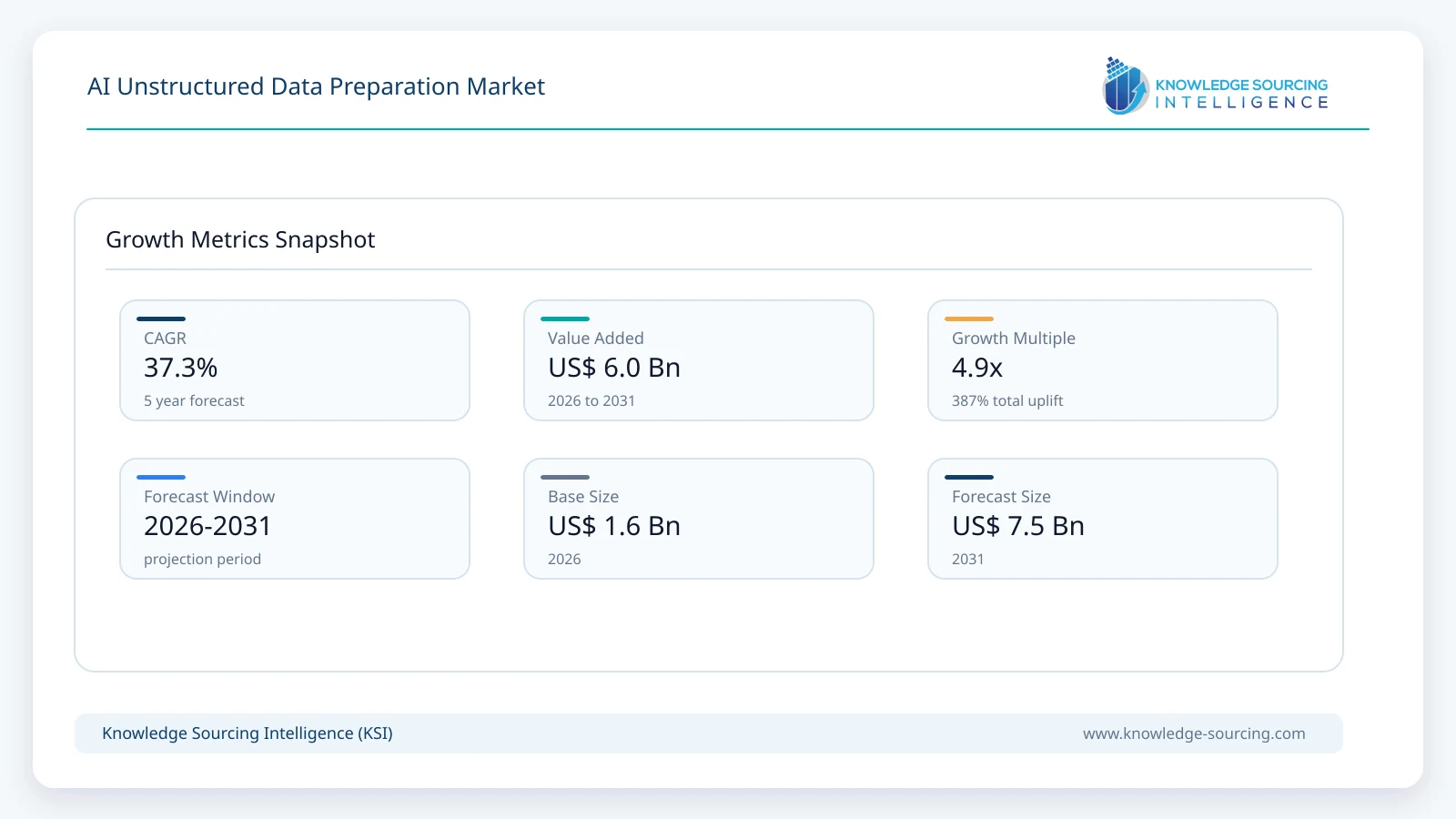
The AI unstructured data preparation market is estimated at USD 1.55 billion in 2026 and is projected to reach USD 7.55 billion in 2031, growing at a CAGR of 37.3% during the forecast period.
Highlights:
- 1Document and image parsing is the largest modeled function at USD 560 million in 2026 and is projected to reach USD 2.60 billion in 2031.
- 2Cloud-hosted preparation services account for approximately 53.87% of 2026 market revenue and expand to USD 4.67 billion in 2031.
- 3Enterprise RAG and knowledge search contribute an estimated USD 680 million in 2026, the largest application-specific spending pool.
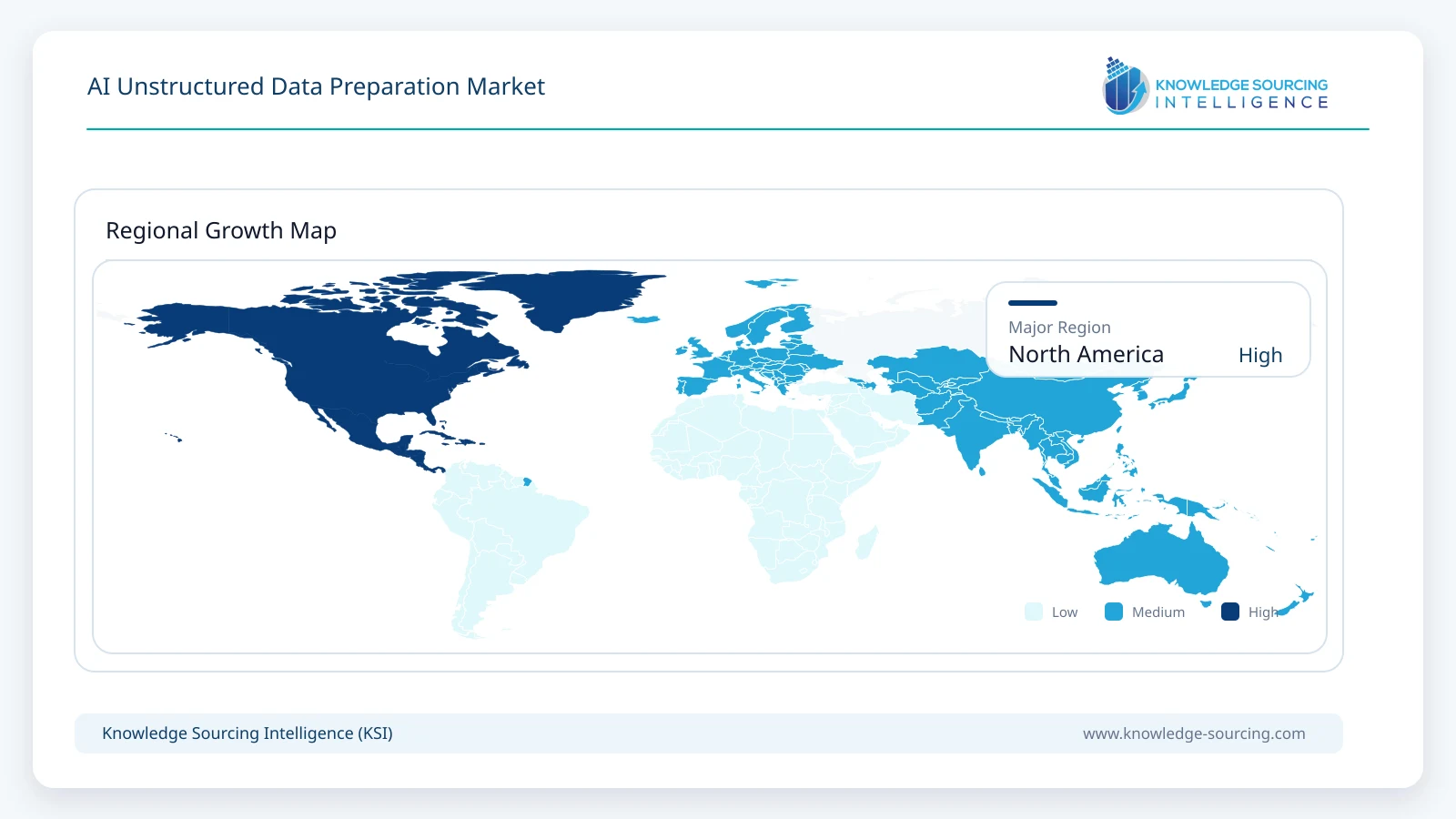
- 4North America generates an estimated USD 655 million in 2026, while Asia Pacific is forecast to reach USD 2.34 billion by 2031.
- 5Vision-language and agentic parsing is expected to grow from USD 390 million in 2026 to USD 2.40 billion in 2031 as complex-layout extraction improves.
The market measures paid parsing, AI-specific document transformation, layout-preserving extraction, multimedia preparation, content chunking, metadata enrichment and managed ingestion needed to make unstructured information usable for AI.
Enterprise AI development is shifting toward recurring preparation pipelines because source content changes after an initial retrieval or model-training deployment. Unstructured provides extraction-to-embedding preparation with connectors and incremental updates; Databricks offers document parsing and search-oriented content preparation; and AWS Bedrock Data Automation transforms documents and audiovisual inputs into structured outputs.
Commercial adoption is governed by document complexity and the cost of achieving reliable downstream results. An inexpensive optical character recognition pass can still lose chart context, table relationships or section hierarchy, resulting in poor search answers or unusable training records. Buyers increasingly compare the complete cost of a successfully prepared, traceable document rather than the quoted price of a raw text extraction.
Market Overview
Unstructured content includes contracts, spreadsheets, presentations, scanned records, emails, webpages, images, recordings and other files that do not arrive as uniform database tables. AI preparation pipelines identify document boundaries, recover text and layout, assign headings and relationships, extract tables or fields, and preserve metadata linking each output to its original source.
Preparation technology increasingly uses specialized vision-language models alongside OCR, deterministic parsers and policy-based transformation rules. LandingAI and Reducto focus on complex pages and structured outputs, while LlamaParse provides selectable parsing and extraction tiers for developers. Google Cloud Document AI offers separate layout and custom-extraction services, and IBM brought Docling into a managed watsonx service in June 2026.
Enterprise procurement also requires preparation work to connect with governed content estates rather than operate as a one-time upload utility. Unstructured supports multiple source and destination connectors, and Databricks links parsed document structures to its preparation and search workflow. Secure deployments may use a dedicated instance, a customer virtual private cloud or an on-premises installation when sensitive content cannot enter a multitenant service.
Market Trends
Layout-Aware Parsing Is Replacing Plain-Text Conversion
Enterprise AI teams are placing greater value on reading order, table-cell relationships, document hierarchy and citations because these features directly affect retrieval quality. Unstructured launched Transform in October 2026 with a focus on complex tables, forms and scans, while Reducto introduced its r-1 parser in September to handle difficult financial and legal layouts.
Improved parsing is not simply an accuracy upgrade for existing OCR contracts. A structured representation can reduce manual correction, support trustworthy page references and let downstream agents distinguish source content from model-generated interpretation. Specialized providers can command higher realized revenue where mixed layouts or regulated records justify additional processing, while basic text-only pages remain exposed to lower-cost competition.
Agentic and Vision-Language Extraction Is Expanding
Vision-language extraction models increasingly interpret the content and spatial structure of a document together, rather than depending on a succession of independent OCR and text-cleaning steps. LandingAI introduced its second-generation Agentic Document Extraction in September 2026, and LlamaIndex expanded its extraction choices with a Turbo tier for lower-latency structured outputs. Google and AWS likewise provide schema-guided extraction for enterprise use cases.
The opportunity is strongest where firms process forms with variable layouts, contracts with amendments, engineering drawings and image-heavy reports. Providers still need measurable validation because plausible but incorrect field values can enter enterprise systems unnoticed. Costs depend on page complexity, chosen model tier and the frequency with which documents must be reprocessed after source updates.
Continuous AI-Ready Ingestion Is Becoming a Platform Requirement
Production retrieval systems must keep prepared content synchronized with SharePoint, cloud storage, collaboration tools and internal knowledge bases as documents are created or revised. Unstructured offers connector-based change detection and incremental processing; Databricks supports governed parsing and search-ready chunk preparation through SQL and related services. This changes procurement from a fixed conversion project to an operating subscription or recurring processing workload.
Continuous synchronization makes document provenance and version handling important even when the buyer does not purchase a separate data-provenance platform. The commercial value is maintaining accurate prepared representations while avoiding full reprocessing of unchanged content. Enterprise customers increasingly prefer pipelines that support scheduling, error recovery, access control and consistent metadata across many repositories.
Multimodal Preparation Is Moving Beyond Documents
Audio recordings, video, diagrams and screenshots increasingly form part of the knowledge supplied to AI assistants and workflow agents. Amazon Bedrock Data Automation processes documents, image, audio and video inputs, while NVIDIA NeMo Retriever supports extraction of text, tables, charts and other document elements. These capabilities can preserve more useful evidence than plain transcription or a text-only PDF conversion.
Multimodal projects introduce a different processing unit economics from ordinary pages because customers may pay by media duration, image count, model calls or structured output volume. Preparation architecture must also preserve timestamps, speaker identity and frame-level references when relevant.
Segment Analysis
By Preparation Function: Document and Image Parsing
Document and image parsing remains the largest preparation function because most current enterprise knowledge collections comprise PDFs, Office files, scanned forms and images that require structure-aware conversion. Table extraction, layout preservation and reliable metadata are important for technical manuals, regulated financial records and legal documents.
Unstructured, LlamaIndex, Reducto, LandingAI and IBM offer differentiated parsing workflows, while Google Document AI and Microsoft Document Intelligence supply API-based alternatives. Buyers compare extraction quality against realized cost per accepted page, including correction and integration expenses. Basic OCR increasingly faces commodity pricing pressure, whereas complex-layout and validation-heavy processing supports higher-value offerings.
By Commercial Offering: Enterprise Preparation Platforms
Enterprise preparation platforms are expected to reach USD 3.25 billion in 2031 from USD 670 million in 2026 as organizations standardize processing across repositories, security domains and applications. Platform contracts typically combine connectors, orchestration, document processing, monitoring and operational controls. Their expansion reflects the need to prepare source material continuously, not simply convert historical archives at the start of a project.
Dedicated deployments can support customer-specific transformation rules, retention policies and integration with internal model or search systems. Unstructured offers dedicated and private deployments, and Databricks embeds document intelligence within a governed data environment. Enterprise subscription figures in this segmentation exclude usage-based charges already recognized within the same bundled agreement.
By Primary AI Workflow: Enterprise RAG and Knowledge Search
Enterprise RAG and knowledge search constitute the leading AI workflow segment, growing from an estimated USD 680 million in 2026 to USD 3.10 billion in 2031. Organizations require consistent parsing, chunking and source metadata to return grounded answers from changing collections of internal files.
Databricks offers an ai_prep_search function for creating context-aware retrieval chunks from parsed documents, while NVIDIA NeMo Retriever and Unstructured support extraction pipelines for downstream retrieval. The modeled spending covers the preparation step and not vector-search subscriptions or inference charges. As enterprise AI agents consume broader knowledge collections, retrieval-ready preparation should attract recurring operational investment.
Market Drivers
Rising Enterprise AI Knowledge Deployment
Organizations are deploying retrieval systems, internal assistants and model-training pipelines against proprietary document collections that lack consistent machine-readable structure. These projects require layout extraction, normalization and content segmentation before production use. Spending rises as pilots become business-critical systems that ingest new information daily rather than relying on manually prepared test collections.
Demand for Reliable Complex-Document Interpretation
Financial statements, invoices, legal contracts and engineering documents often contain information where the meaning depends on page structure or surrounding annotations. Generic text extraction can separate numbers from their row labels and fail on scanned material. Layout-aware parsers and verification features therefore offer customers a way to lower downstream correction costs and improve grounded AI responses.
Continuous Content Change Across Enterprise Repositories
Companies increasingly operate knowledge sources across productivity suites, cloud object stores and department-specific platforms. Continuous ingestion, change detection and stable source metadata reduce the operational burden of manually refreshing AI indices. Commercial preparation platforms benefit when customers need persistent pipelines that preserve access controls and reflect updated content without repeatedly reprocessing every file.
Improving Multimodal Preparation Technology
Vision-language models and specialized document intelligence systems are improving extraction of tables, figures and image-rich content that text-only tools handle poorly. Suppliers now package several processing modes behind APIs with different quality and latency profiles. Wider format coverage expands addressable preparation spending in healthcare, manufacturing, insurance and multimedia-rich business operations.
Need for Governed and Auditable AI Inputs
Enterprise customers want prepared data to retain page references, document versions, access permissions and traceable transformations. Strong source lineage allows teams to investigate inaccurate responses or remove a withdrawn record from downstream workflows. Although full AI provenance is a distinct market, attribution and output-verification functions embedded in preparation products support purchasing decisions in regulated deployments.
Market Restraints
Rapid Price Compression in Basic Parsing
Open-source OCR tools, general-purpose vision models and low-cost managed APIs reduce the price customers are willing to pay for straightforward text pages. Public pricing from Google Document AI and LlamaIndex demonstrates substantial variation between basic and higher-complexity operations. Providers must avoid treating every processed page as a premium extraction job when much of the content requires only low-cost conversion.
Extraction Errors in Complex or Low-Quality Content
Scanned tables, handwriting, overlapping layouts and diagrams can produce incorrect field associations even when output appears fluent. These errors may enter model-training records or enterprise retrieval indices and become difficult to diagnose later. High-stakes workflows require confidence measurement, sampling and remediation that increase the true cost of each production-ready document.
Security and Data-Residency Requirements
Medical records, confidential financial statements and government documents cannot always move into general cloud processing environments. Dedicated VPC and on-premises deployments add infrastructure, configuration and security assessment costs. Procurement cycles may extend while buyers verify retention policies, cross-border transfers, model training on customer data and the enforcement of document-level permissions.
Bundled Competition From Larger Platforms
Cloud and lakehouse suppliers can embed document preparation within wider storage, analytics and AI products, limiting the ability of specialist vendors to price every capability independently. Enterprise buyers may favor platform integration over a separate best-of-breed tool, particularly for routine processing. Category revenue must therefore capture only the purchased preparation share instead of the total value of a cloud or data-platform contract.
Uncertain Reprocessing and Consumption Patterns
Annual preparation demand cannot be derived directly from the total number of documents stored by enterprises. Customers may convert a document once, refresh it only when updated, or use cheaper incremental methods for routine changes. Pipeline economics depend on new-content creation, model refresh cycles, file complexity and how much processing is cached or avoided, creating uncertainty in forecast unit volumes.
Regional Outlook
North America
North America is the largest modeled regional AI unstructured data preparation market at USD 655 million in 2026, supported by substantial enterprise AI development, cloud-service spending and demand for regulated document processing. US banks, healthcare organizations, software companies and public-sector agencies manage extensive collections of PDF, Office and media content that must be converted before use in assistants and workflow agents.
North American market revenue is projected to reach USD 3.05 billion by 2031 as preparation capabilities become embedded in operational enterprise AI systems. Cloud-hosted processing should remain important, while private deployments gain traction for protected content and strict retention requirements. Customers are expected to favor suppliers that can demonstrate both complex-document accuracy and managed synchronization across multiple repositories.
Asia Pacific
Asia Pacific is estimated at USD 435 million in 2026 and benefits from expanding adoption of AI search, enterprise automation and document intelligence across China, India, Japan, South Korea and regional cloud centers. Multilingual documents, varied scripts and mixed scanned and digital records raise preparation complexity.
Asia Pacific market revenue is projected at USD 2.34 billion in 2031, representing faster modeled growth than North America from a smaller base. India and China offer large collections and expanding AI deployment, while Japan, South Korea, Singapore and Australia contribute high-value enterprise requirements. Deployment preferences will reflect local cloud availability, sovereignty rules and language performance.
Competitive Landscape
The competitive environment includes specialized content-preparation suppliers, cloud AI services and data-platform providers. Unstructured, LlamaIndex, Reducto and LandingAI emphasize document conversion, extraction quality and developer-facing APIs. AWS, Google Cloud and Microsoft distribute document intelligence through broader cloud platforms, while Databricks and IBM connect preparation to enterprise data or AI workflows. NVIDIA supplies extraction components within its NeMo Retriever stack, creating further competition around multimodal processing.
Competitive differences extend beyond model accuracy to measured cost per accepted document, format coverage, source connectors, governance and deployment flexibility. Unstructured offers metered and private implementations; LlamaParse differentiates processing tiers; Reducto and LandingAI emphasize complex page interpretation. Larger platforms benefit from existing customer relationships and the ability to bundle preparation, but their overall cloud or database revenue is not equivalent to this market. Suppliers also compete on whether outputs retain structured page evidence that downstream AI systems can use.
Recent Developments
October 2026: Unstructured introduced Transform, updating its core document parsing capabilities with a focus on difficult tables, forms and scanned pages.
October 2026: Databricks made real-time Document Intelligence REST APIs generally available for parsing, extraction and classification in application workflows.
September 2026: LandingAI launched the second generation of Agentic Document Extraction based on its DPT-3 model family and enhanced source-grounded output.
September 2026: Reducto introduced its r-1 document parsing model family for complex layouts, tables and citation-aware extraction.
September 2026: LlamaIndex launched the Turbo extraction tier for lower-latency schema-guided document processing.
June 2026: IBM made Docling for watsonx generally available as a managed enterprise document conversion service.
Market Outlook
AI unstructured data preparation demand is expected to expand as companies move from pilot knowledge assistants to applications that continually process growing collections of documents and media. The main commercial opportunity lies in converting difficult content into consistent, permission-aware and traceable inputs that can support retrieval, training and automated decisions. Document parsing will remain the largest immediate revenue function, while agentic extraction and multimodal preparation should gain share as applications extend beyond plain text.
The market will also face substantial pricing pressure as general-purpose foundation models and integrated cloud offerings improve. Vendors are likely to differentiate through reliable complex-table handling, incremental ingestion, secure deployments and clear measurement of downstream input quality. Enterprise contracts should favor providers that manage ongoing transformation at predictable costs, while the broader AI data-curation, governance and vector-search layers remain distinct economic categories rather than additive components of this estimate.
AI Unstructured Data Preparation Market Scope
| Report Metric | Details |
|---|---|
| Total Market Size in 2026 | USD 1.55 billion |
| Total Market Size in 2031 | USD 7.55 billion |
| Forecast Unit | Billion |
| Growth Rate | 37.3% |
| Study Period | 2021 to 2031 |
| Historical Data | 2021 to 2024 |
| Base Year | 2025 |
| Forecast Period | 2026 – 2031 |
| Segmentation | Preparation Function, Commercial Offering, Data Modality, Processing Architecture, Primary AI Workflow, Deployment Model, End-User Industry, Geography |
| Companies |
|
| Customization Scope | 15% Free Customization included with purchase — Request Custom Breakdown → |
| Sample & Data Access | PDF Sample, Excel Databook & Analyst Briefing — Download Free Sample → |
Market Segmentation
By Preparation Function
Document and Image Parsing
Chunking and Semantic Enrichment
Audio and Video Preparation
Source Ingestion and Synchronization
Structuring and Metadata Normalization
By Commercial Offering
Metered Processing APIs
Enterprise Preparation Platforms
Attributable Specialist Services
By Data Modality
Text and Office Documents
Scanned and Image-Rich Documents
Audio and Video
Web and Other Content
By Processing Architecture
OCR and Layout-Aware Parsing
Vision-Language and Agentic Parsing
Rules-Assisted and Hybrid Pipelines
Retrieval-Ready Preparation Pipelines
By Primary AI Workflow
Enterprise RAG and Knowledge Search
Model Training and Fine-Tuning
Agentic Knowledge and Workflow Systems
Structured Extraction for AI Decisions
By Deployment Model
Cloud-Hosted Services
Dedicated Cloud or Customer VPC
On-Premises and Edge Environments
By End-User Industry
Banking and Financial Services
Technology and SaaS
Healthcare and Life Sciences
Government and Public Sector
Manufacturing and Engineering
Retail, Media and Communications
Other Industries
By Geography
North America
United States
Canada
Mexico
South America
Brazil
Argentina
Chile
Colombia
Rest of South America
Europe
Germany
United Kingdom
France
Netherlands
Sweden
Italy
Rest of Europe
Middle East and Africa
United Arab Emirates
Saudi Arabia
Israel
South Africa
Rest of Middle East and Africa
Asia Pacific
China
India
Japan
South Korea
Singapore
Australia
Taiwan
Rest of Asia Pacific
Table of Contents
1. EXECUTIVE SUMMARY
1.1. Research Highlights
1.2. Market Size and Forecast, 2026-2031
1.3. Strategic Market Outlook
2. MARKET SNAPSHOT
2.1. Definition and Scope
2.2. Market Dynamics
2.3. Commercialization and Adoption
3. BUSINESS LANDSCAPE
3.1. Market Drivers
3.1.1. Rising Enterprise AI Knowledge Deployment
3.1.2. Demand for Reliable Complex-Document Interpretation
3.1.3. Continuous Content Change Across Enterprise Repositories
3.1.4. Improving Multimodal Preparation Technology
3.1.5. Need for Governed and Auditable AI Inputs
3.2. Market Restraints
3.2.1. Rapid Price Compression in Basic Parsing
3.2.2. Extraction Errors in Complex or Low-Quality Content
3.2.3. Security and Data-Residency Requirements
3.2.4. Bundled Competition From Larger Platforms
3.2.5. Uncertain Reprocessing and Consumption Patterns
3.3. Market Opportunities
3.4. Porter’s Five Forces Analysis
3.5. Industry Value Chain Analysis
3.6. Policies and Regulations
3.7. Strategic Recommendations
4. TECHNOLOGICAL OUTLOOK
4.1. Layout- and Structure-Aware Extraction
4.2. Vision-Language and Agentic Parsing
4.3. Chunking and Semantic Metadata
4.4. Multimodal Audio and Video Preparation
4.5. Source Connectors and Incremental Processing
4.6. Governance and Output Validation
5. AI UNSTRUCTURED DATA PREPARATION MARKET BY PREPARATION FUNCTION
5.1. Document and Image Parsing
5.2. Chunking and Semantic Enrichment
5.3. Audio and Video Preparation
5.4. Source Ingestion and Synchronization
5.5. Structuring and Metadata Normalization
6. AI UNSTRUCTURED DATA PREPARATION MARKET BY COMMERCIAL OFFERING
6.1. Metered Processing APIs
6.2. Enterprise Preparation Platforms
6.3. Attributable Specialist Services
7. AI UNSTRUCTURED DATA PREPARATION MARKET BY DATA MODALITY
7.1. Text and Office Documents
7.2. Scanned and Image-Rich Documents
7.3. Audio and Video
7.4. Web and Other Content
8. AI UNSTRUCTURED DATA PREPARATION MARKET BY PROCESSING ARCHITECTURE
8.1. OCR and Layout-Aware Parsing
8.2. Vision-Language and Agentic Parsing
8.3. Rules-Assisted and Hybrid Pipelines
8.4. Retrieval-Ready Preparation Pipelines
9. AI UNSTRUCTURED DATA PREPARATION MARKET BY PRIMARY AI WORKFLOW
9.1. Enterprise RAG and Knowledge Search
9.2. Model Training and Fine-Tuning
9.3. Agentic Knowledge and Workflow Systems
9.4. Structured Extraction for AI Decisions
10. AI UNSTRUCTURED DATA PREPARATION MARKET BY DEPLOYMENT MODEL
10.1. Cloud-Hosted Services
10.2. Dedicated Cloud or Customer VPC
10.3. On-Premises and Edge Environments
11. AI UNSTRUCTURED DATA PREPARATION MARKET BY END-USER INDUSTRY
11.1. Banking and Financial Services
11.2. Technology and SaaS
11.3. Healthcare and Life Sciences
11.4. Government and Public Sector
11.5. Manufacturing and Engineering
11.6. Retail, Media and Communications
11.7. Other Industries
12. AI UNSTRUCTURED DATA PREPARATION MARKET BY GEOGRAPHY
12.1. North America
12.1.1. United States
12.1.2. Canada
12.1.3. Mexico
12.2. South America
12.2.1. Brazil
12.2.2. Argentina
12.2.3. Chile
12.2.4. Colombia
12.2.5. Rest of South America
12.3. Europe
12.3.1. Germany
12.3.2. United Kingdom
12.3.3. France
12.3.4. Netherlands
12.3.5. Sweden
12.3.6. Italy
12.3.7. Rest of Europe
12.4. Middle East and Africa
12.4.1. United Arab Emirates
12.4.2. Saudi Arabia
12.4.3. Israel
12.4.4. South Africa
12.4.5. Rest of Middle East and Africa
12.5. Asia Pacific
12.5.1. China
12.5.2. India
12.5.3. Japan
12.5.4. South Korea
12.5.5. Singapore
12.5.6. Australia
12.5.7. Taiwan
12.5.8. Rest of Asia Pacific
13. COMPETITIVE ENVIRONMENT AND ANALYSIS
13.1. Major Players and Strategy Analysis
13.2. Market Share Analysis
13.3. Mergers, Acquisitions, Agreements and Collaborations
13.4. Competitive Dashboard
14. COMPANY PROFILES
14.1. Unstructured, Inc.
14.2. LlamaIndex
14.3. Reducto
14.4. LandingAI
14.5. Databricks, Inc.
14.6. Amazon Web Services (Amazon)
14.7. Google Cloud (Alphabet)
14.8. Microsoft Corporation
14.9. IBM Corporation
14.10. NVIDIA Corporation
14.11. Snowflake Inc.
14.12. Box, Inc.
15. APPENDIX
15.1. Currency
15.2. Assumptions
15.3. Market Estimation Methodology
15.4. Research Sources
15.5. Abbreviations





Frequently asked questions
What is the projected market size for AI unstructured data preparation by 2031?
The AI Unstructured Data Preparation Market is projected to reach USD 7.55 billion by 2031.
What is the compound annual growth rate (CAGR) for this market (2026-2031)?
The AI Unstructured Data Preparation Market is growing at a CAGR of 37.3% from 2026 to 2031.
Which function is the largest in the AI unstructured data preparation market?
Document and image parsing is the largest modeled function.
What is the largest application-specific spending pool in 2026?
Enterprise RAG and knowledge search is the largest application.
Which deployment model accounts for the most revenue share?
Cloud-hosted preparation services account for over 53% of revenue.
Which region is forecast for significant growth by 2031?
Asia Pacific is forecast to reach USD 2.34 billion by 2031.
Cite this report
Knowledge Sourcing Intelligence. (Oct 2026). AI Unstructured Data Preparation Market Size, Share & Growth Forecast (2026-2031). https://www.knowledge-sourcing.com/report/ai-unstructured-data-preparation-market