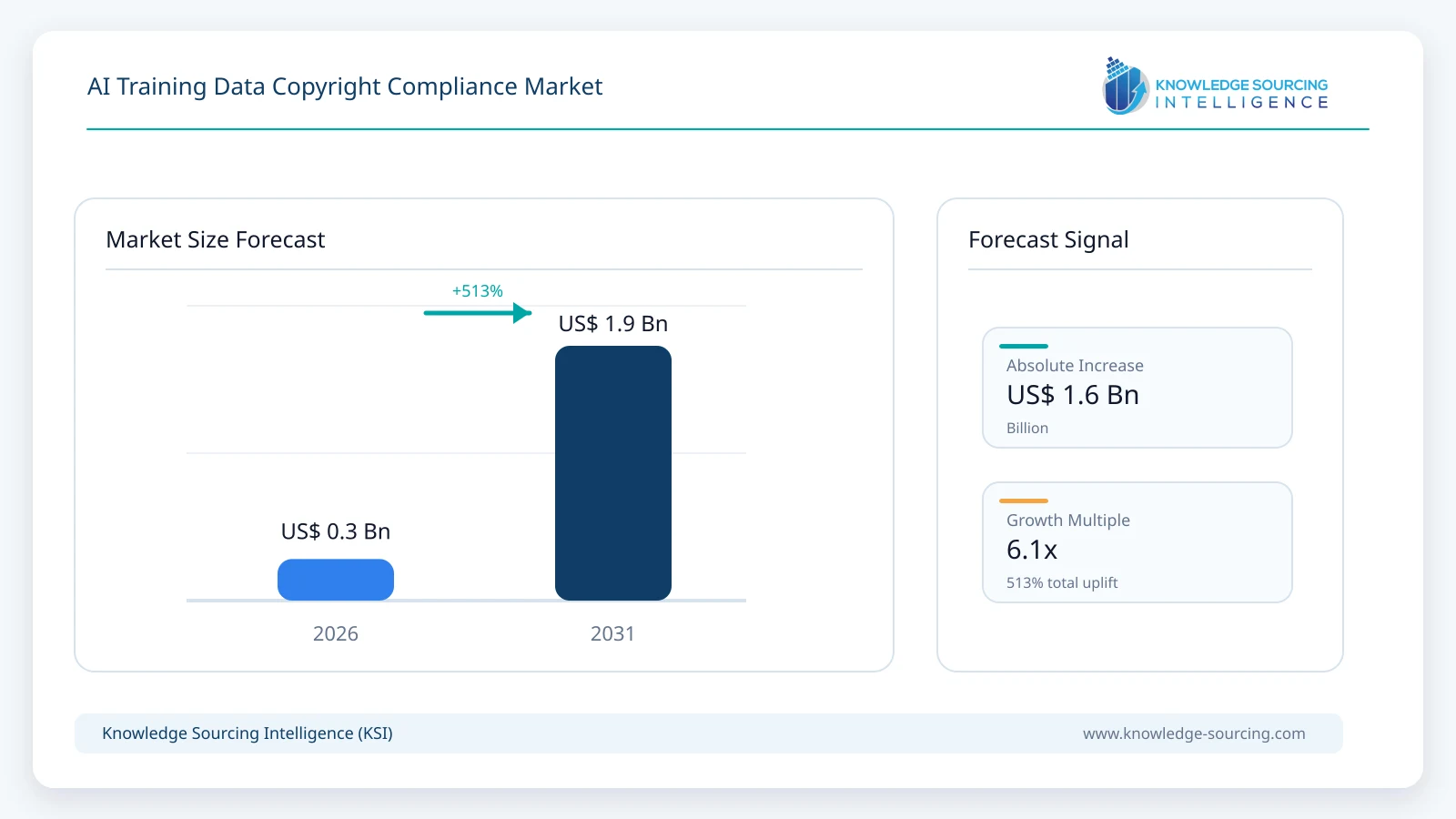
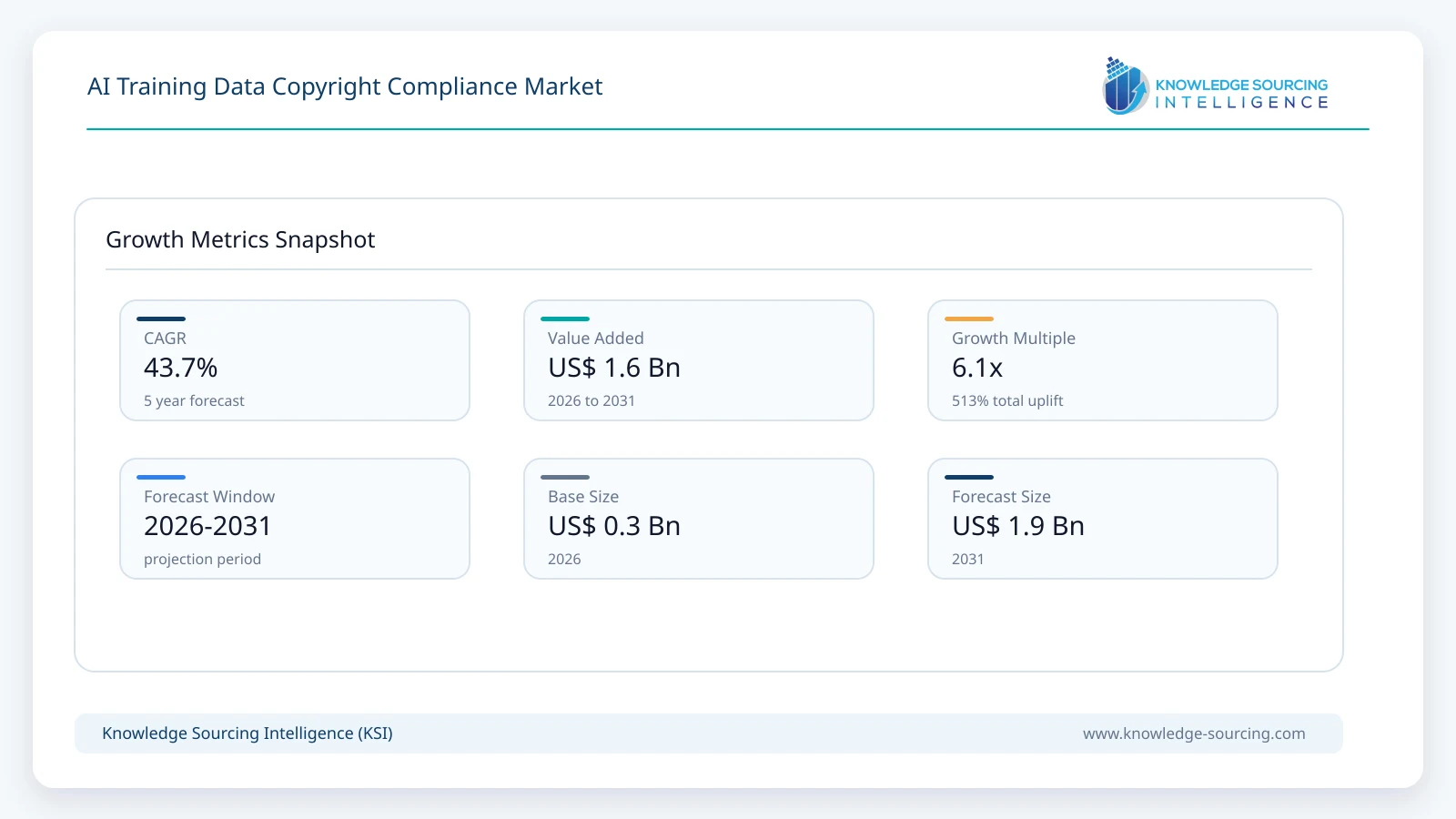
The AI Training Data Copyright Compliance Market is projected to grow at a CAGR of 43.71%, increasing from approximately USD 0.31 billion in 2026 to USD 1.90 billion by 2031 during the forecast period.
Highlights:
- 1Training dataset provenance and lineage software represents approximately 29% of global market value in 2026 as developers strengthen records linking model versions to their training sources.
- 2Foundation-model pre-training represents approximately 42% of market value in 2026 because the scale and diversity of upstream content creates extensive rights-verification work.
- 3Managed cloud deployments represent approximately 56% of 2026 revenue, supported by centralized metadata, policy enforcement and reporting across distributed development teams.
- 4North America accounts for approximately 44% of global market value in 2026, reflecting concentration of foundation-model developers and enterprise AI governance spending.
- 5Asia Pacific is expected to post the fastest growth among the major regions through 2031 as commercial AI model development, digital publishing and cross-border compliance activity expand.
The market includes software and directly associated services used to identify copyrighted training content, verify source provenance, check rights reservations, manage permissions and document compliance for model pre-training and fine-tuning. It does not include the value of training-content licenses, payments to rights holders, general-purpose model training or the cost of legal settlements.
The European Union’s AI Act requires providers of general-purpose AI models to implement a copyright compliance policy and publish a sufficiently detailed training-content summary. These requirements make source inventories, documented rights checks and reproducible audit records operational concerns for teams preparing or updating AI training datasets. California’s training-data disclosure requirements and continuing copyright disputes in the United States reinforce the importance of understanding data acquisition, authorized uses and model lineage.
Training-data copyright controls operate across ingestion, curation, preparation and model-development workflows. A company collecting documents, source code or multimedia files must establish where each asset came from, record the legal or contractual basis for use, check any rights reservations and retain evidence of the resulting decision. This work becomes more difficult when raw content is deduplicated, transformed, translated or combined with other datasets before model training.
Commercial vendors approach these requirements from several directions. Copyright Clearance Center provides collective AI-use licensing mechanisms, while Spawning supports machine-readable training opt-outs through its rights registry and open-source checks. Adobe’s Content Credentials allow creators to communicate provenance and training-related preferences, and Bria documents attribution mechanisms built around licensed visual training data. None of these products alone establishes universal legal clearance across jurisdictions.
Broader enterprise suppliers provide complementary infrastructure. Microsoft Purview, Google Cloud metadata services, Collibra and OneTrust offer cataloging, lineage, policy and governance capabilities that can be configured for training-data review. Only the revenue attributable to copyright-specific use cases belongs in this market, rather than the complete value of broader data-governance contracts.
Market Trends
Training-Content Registers Are Becoming Part of Model Documentation
Training-content inventory requirements are moving from ad hoc spreadsheets into controlled data pipelines because organizations must identify major data sources across successive model versions. The European Commission’s published summary template calls for meaningful descriptions of datasets, web collections, private sources and relevant processing practices, increasing demand for consistent metadata at ingestion and before training runs.
Model builders increasingly need a link from model versions to dataset versions, source contracts and any content exclusions. Google Cloud’s lineage tools demonstrate how datasets and model-training artifacts can be connected, although a standard lineage record does not independently verify that the underlying content was lawfully licensed.
Rights Reservations Are Moving Toward Machine-Readable Checks
Rights holders are using structured signals to communicate restrictions on text and data mining, including machine-readable records, site-level controls and asset metadata. The European Commission has examined different opt-out mechanisms, including Spawning’s Do Not Train Registry and metadata-based approaches, as it considers practical ways for model providers to recognize rights reservations.
Technical controls are useful only when crawlers and dataset processors actually apply them. A scalable compliance workflow needs rights-signal detection, timestamped policy decisions, a record of rejected assets and a process for handling contested ownership or contradictory permissions.
Licensing and Compliance Workflows Are Becoming More Closely Connected
Commercial use of copyrighted text, images and music is creating a stronger connection between content procurement, rights verification and training approval. Copyright Clearance Center’s AI Systems Training License illustrates a collective rights mechanism for eligible third-party works, while companies developing licensed-data models can use contract and attribution records to support their commercial controls.
The revenue opportunity for compliance suppliers comes from registering permissions, tracking approved purposes, maintaining reporting evidence and integrating these checks into training pipelines. Royalties and the price of the underlying content remain separate economic categories.
Enterprise AI Governance Platforms Are Adding Dataset-Level Controls
Enterprise governance platforms increasingly connect model records with source datasets, policy classifications and lineage information. OneTrust’s Data Use Governance offering and Collibra’s AI Governance capabilities illustrate how policy management can be linked to data assets used in AI workflows, giving compliance teams a basis for reviewing permitted training uses.
The strongest commercial opportunities are likely to arise where general metadata products are adapted into repeatable copyright checks, rather than when vendors simply rebrand existing catalog features as new software.
AI Training Data Copyright Compliance Market Segment Analysis
By Offering
Training Dataset Provenance and Lineage Software
Training dataset provenance and lineage software is the largest offering category as model builders require consistent records covering dataset origin, transformations, ownership metadata and links to specific training runs. The segment accounts for approximately 29% of global market value in 2026, supported by enterprise governance programs and the increased documentation burden associated with third-party training content.
The segment is projected to reach approximately USD 608 million in 2031. Growth will depend on integrating source verification with large-scale data pipelines and automating evidence collection across model revisions. Microsoft, Google and specialist data-lineage suppliers already provide technical foundations, while copyright-specific validation remains an additional application layer.
By Application
Foundation-Model Pre-Training
Foundation-model pre-training represents the largest application because extensive text and multimodal collections introduce complex questions of authorship, reuse restrictions, licenses and provenance before training starts. Approval processes must work at dataset scale while preserving sufficient source information for legal review, regulatory summaries and future retraining decisions.
The pre-training application segment is projected to reach approximately USD 703 million in 2031. More frequent model refreshes and expanding multimodal datasets support demand, although the segment’s share is expected to moderate as fine-tuning, procurement and periodic audit activities develop into separately budgeted workflows.
By Deploymen
Managed Cloud
Managed cloud services lead deployment because data engineering, legal and model-development teams often operate across multiple cloud environments and require a common view of dataset records and policy decisions. Centralized access controls, scalable metadata processing and audit-report generation make hosted offerings attractive where organizations can retain appropriate control of sensitive content.
The managed cloud segment is projected to reach approximately USD 1.197 billion in 2031. Private and hybrid deployments will remain important for rights-sensitive publishers, regulated enterprises and model developers whose contracts restrict external processing or storage.
Market Drivers
Mandatory Training-Content Disclosure
The European AI Act’s documentation and public-summary provisions increase the need to identify content sources, maintain versioned records and demonstrate how training data was assembled. Organizations releasing models in multiple jurisdictions must manage these requirements alongside internal evidence used to approve content acquisition.
Growing Investment in Enterprise and Foundation Models
Commercial AI developers are building or adapting models with licensed, proprietary and publicly collected material, requiring consistent decisions about authorized use. The greater the number of model variants and data updates, the more valuable repeatable review and rights-checking software becomes.
Expansion of Licensed Multimedia Data
Image, audio and video training programs increasingly require contractual controls that distinguish the rights to view, store, adapt, train and redistribute. Licensed-data initiatives from firms such as Bria demonstrate the commercial importance of tracking source agreements and associated content records.
More Effective Rights-Reservation Technologies
Machine-readable controls and standardized provenance metadata are improving the practicality of screening training inputs before they enter processing pipelines. Adoption remains uneven, but systems capable of checking different signals through one documented workflow offer a clear operational advantage.
Pressure for Defensible AI Procurement
Enterprises purchasing third-party models or developing their own increasingly require evidence about how data was obtained and what permissions apply. Documented training sources, policy review trails and exception management support supplier due diligence and internal governance decisions.
Market Restraints
Unsettled Legal Interpretations Across Markets
Copyright exceptions, contract rights and text-and-data-mining rules vary between jurisdictions, making it difficult for vendors to offer a single automated rule that resolves every training scenario. Expert legal review remains necessary when lawful-use grounds or source ownership are disputed.
Limited Availability of Reliable Source Metadata
Large historical training datasets often lack verified source URLs, author identities, licenses or crawler records. Retrofitting provenance after collection can require substantial manual investigation and may not produce conclusive rights evidence.
Bundled Governance Features and Open Standards
Cloud platforms and enterprise data catalogs already include many generic lineage, classification and reporting functions. This can limit incremental spending on separate copyright tools unless suppliers demonstrate distinctive rights-verification and exception-handling capabilities.
Inconsistent Adoption of Opt-Out Signals
Rights reservations expressed through websites, registries or asset metadata depend on their technical implementation and recognition by data collectors. Inconsistent adoption and conflicting assertions can restrict automation and increase compliance review costs.
Cost and Complexity of Model-Level Attribution
Deduplicated and transformed datasets can be difficult to match back to specific original works, particularly for multimodal models. Organizations may need to preserve additional provenance data and audit records without exposing trade secrets or confidential training datasets.
Regional Outlook
North America
North America is the largest AI training data copyright compliance market, supported by the concentration of foundation-model developers, enterprise AI technology spending and a developed ecosystem of data governance, copyright licensing and legal advisory providers. United States model developers are increasingly integrating rights review into content procurement and model-development practices as copyright litigation and disclosure requirements increase scrutiny of dataset sourcing.
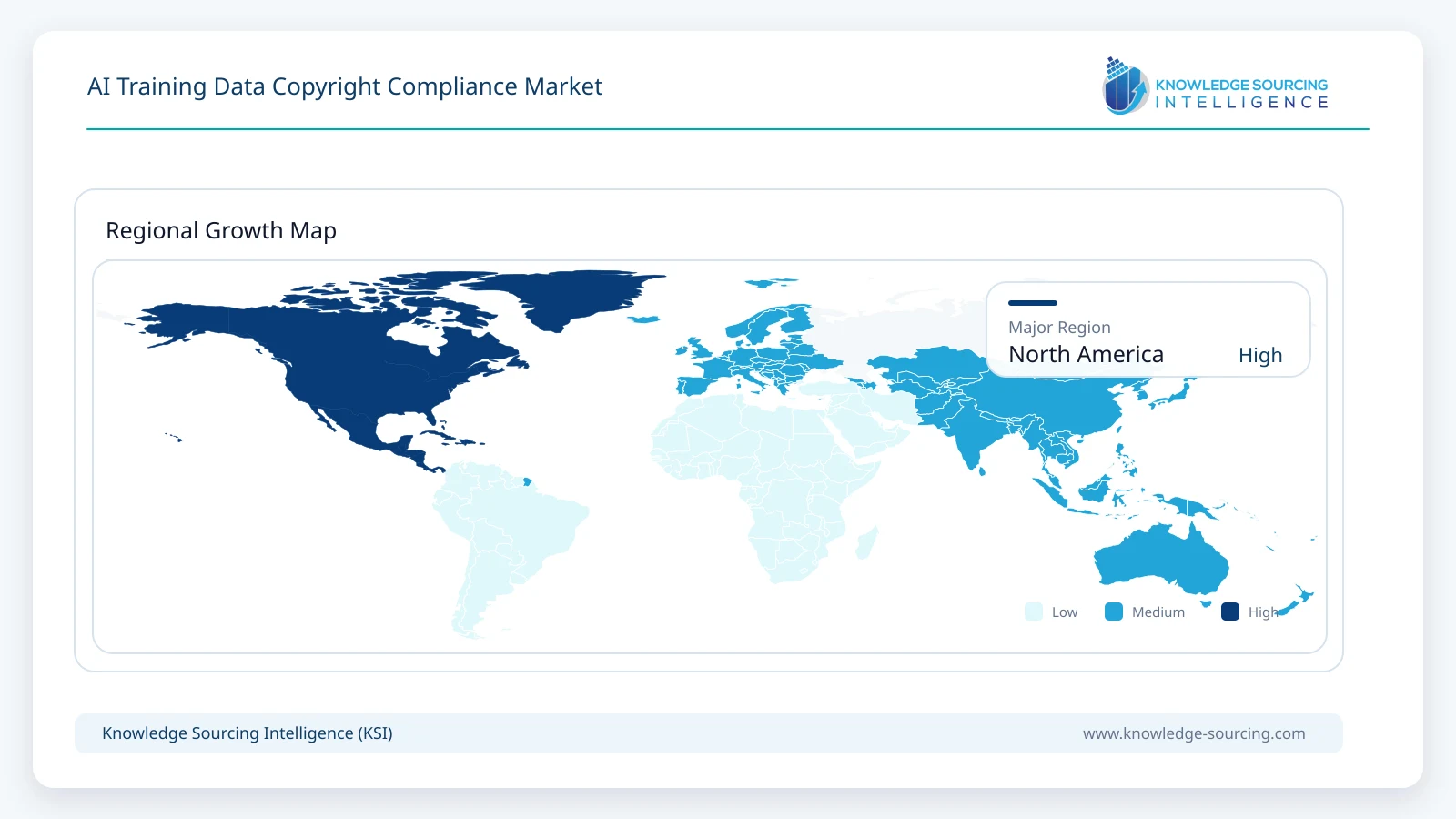
The regional market is projected to reach approximately USD 722 million in 2031. Copyright Clearance Center, Adobe, OneTrust and major cloud governance vendors provide relevant commercial capabilities, while customer demand is expected to reflect both new AI model development and reviews of existing training collections.
Asia Pacific
Asia Pacific is expected to record the fastest regional growth as China, Japan, India, South Korea, Australia and Singapore expand AI model development, local-language datasets and digital-content production. International model distribution also requires organizations to respond to the copyright and transparency expectations of overseas customers and regulators, even when local legal frameworks differ.
The region is projected to reach approximately USD 475 million in 2031, compared with USD 55.8 million in 2026. Multilingual source records, cross-border licensing review and expanding enterprise fine-tuning activity should support adoption of provenance and rights-management workflows.
Competitive Landscape
Competition in AI training-data copyright compliance combines dedicated rights-management organizations with enterprise data and AI governance providers. Copyright Clearance Center supplies collective licensing structures; Spawning focuses on training opt-outs; Adobe supports content provenance and creator preferences; and Bria demonstrates an attribution-oriented, licensed-data operating model. These offerings address different points in the compliance process rather than delivering identical products.
Enterprise-platform suppliers including OneTrust, Collibra, Microsoft, Google, IBM, BigID and Acryl Data compete indirectly through data inventories, policy controls, lineage and review workflows that can support copyright-sensitive model development. TollBit participates in adjacent content-access and licensing infrastructure; its general retrieval and bot-monetization activity should not be mistaken for training-specific compliance revenue. Competition is therefore likely to focus on verified rights evidence, practical integration and transparent auditability.
Recent Developments
September 2026: Collibra documented AI Governance notifications for metadata changes affecting related AI use cases and models, strengthening visibility into policy and data-category updates.
August 2026: Adobe updated its Content Credentials guidance, describing creator attribution and the ability to express preferences concerning generative AI training use.
June 2026: IBM outlined its next-generation watsonx.governance direction, emphasizing continuous visibility, controls and accountability for enterprise AI assets.
May 2026: Copyright Clearance Center announced that its higher-education Annual Copyright License would add internal-use AI reuse rights effective July 1, 2026.
March 2026: Copyright Clearance Center announced additional AI transactional licensing capabilities and higher-education reuse rights across its licensing portfolio.
March 2026: The United Kingdom published its report on copyright and artificial intelligence, examining options for AI training and rights-holder protection.
Market Outlook
Training-data compliance spending is expected to rise as AI developers place stronger controls around content acquisition, permissions, dataset transformation and the release of model revisions. The most effective solutions will link rights decisions to identifiable training records and support the documentation requirements faced by developers distributing general-purpose AI models.
Software-led provenance and license-verification workflows should gain importance as organizations seek to reduce manual reviews and connect contractual permissions to automated data pipelines. Demand will extend beyond initial pre-training toward fine-tuning, dataset procurement and recurring audit work, while broad data-governance providers will continue to constrain pricing for standard catalog and lineage capabilities.
North America is expected to remain the largest regional market, with Asia Pacific recording faster expansion as model development and local-language data use broaden. Suppliers that can translate different rights signals into reliable controls, distinguish copyright checks from general governance and produce defensible evidence will be best positioned for long-term customer relationships.
AI Training Data Copyright Compliance Market Scope:
| Report Metric | Details |
|---|---|
| Total Market Size in 2026 | USD 0.31 billion |
| Total Market Size in 2031 | USD 1.90 billion |
| Forecast Unit | USD Billion |
| Growth Rate | 43.71% |
| Study Period | 2021 to 2031 |
| Historical Data | 2021 to 2024 |
| Base Year | 2025 |
| Forecast Period | 2026 – 2031 |
| Segmentation | Offering, Compliance Function, Deployment, Data Modality, Application, End User, Organization Size, Geography |
| Companies |
|
| Customization Scope | 15% Free Customization included with purchase — Request Custom Breakdown → |
| Sample & Data Access | PDF Sample, Excel Databook & Analyst Briefing — Download Free Sample → |
Market Segmentation
By Offering
Rights-Reservation and Opt-Out Management Software
Training Dataset Provenance and Lineage Software
License and Permission Management Software
Training-Content Audit and Disclosure Software
Copyright Compliance Integration and Support Services
By Compliance Function
Dataset Sourcing and Provenance Validation
Rights-Reservation Detection and Exclusion
License and Use-Rights Verification
Training-Content Disclosure and Audit Reporting
Exception Remediation and Rights-Holder Review
By Deployment
Managed Cloud
Hybrid
On-Premises and Private Cloud
By Data Modality
Text and Source Code
Images and Design Assets
Audio and Music
Video and Other Multimodal Content
By Application
Foundation-Model Pre-Training
Fine-Tuning and Model Customization
Training Data Procurement and Onboarding
Model Audit and Periodic Compliance Review
By End User
Foundation-Model Developers and Cloud Providers
Software and Enterprise AI Developers
Media, Publishing and Rights-Holder Organizations
Research Institutions and Academia
Creative and Digital Content Platforms
By Organization Size
Large Enterprises
Mid-Sized Enterprises
Small Developers and Organizations
By Geography
North America
United States
Canada
Mexico
South America
Brazil
Argentina
Chile
Colombia
Rest of South America
Europe
Germany
United Kingdom
France
Netherlands
Italy
Spain
Switzerland
Rest of Europe
Middle East and Africa
United Arab Emirates
Saudi Arabia
Israel
South Africa
Rest of Middle East and Africa
Asia Pacific
China
Japan
India
South Korea
Australia
Singapore
Rest of Asia Pacific
Table of Contents
1. EXECUTIVE SUMMARY
1.1. Market Opportunity and Key Findings
1.2. AI Training Data Copyright Compliance Market Size, 2026–2031
1.3. Segment and Regional Outlook
2. MARKET SNAPSHOT
2.1. Market Overview
2.2. Market Definition
2.3. Scope of the Study
2.4. Market Segmentation
3. BUSINESS LANDSCAPE
3.1. Market Drivers
3.1.1. Mandatory Training-Content Disclosure
3.1.2. Growing Investment in Enterprise and Foundation Models
3.1.3. Expansion of Licensed Multimedia Data
3.1.4. More Effective Rights-Reservation Technologies
3.1.5. Pressure for Defensible AI Procurement
3.2. Market Restraints
3.2.1. Unsettled Legal Interpretations Across Markets
3.2.2. Limited Availability of Reliable Source Metadata
3.2.3. Bundled Governance Features and Open Standards
3.2.4. Inconsistent Adoption of Opt-Out Signals
3.2.5. Cost and Complexity of Model-Level Attribution
3.3. Market Opportunities
3.4. Porter’s Five Forces Analysis
3.5. Industry Value Chain Analysis
3.6. Policies and Regulations
3.7. Strategic Recommendations
4. TECHNOLOGICAL OUTLOOK
4.1. Training-Data Inventory and Source Metadata
4.2. Content Provenance and Rights Records
4.3. Machine-Readable Rights Reservations
4.4. License and Permission Verification
4.5. Model-to-Dataset Lineage and Audit Trails
4.6. Training-Content Disclosure Automation
5. AI TRAINING DATA COPYRIGHT COMPLIANCE MARKET BY OFFERING
5.1. Introduction
5.2. Rights-reservation and opt-out management software
5.3. Training dataset provenance and lineage software
5.4. License and permission management software
5.5. Training-content audit and disclosure software
5.6. Copyright compliance integration and support services
6. AI TRAINING DATA COPYRIGHT COMPLIANCE MARKET BY COMPLIANCE FUNCTION
6.1. Introduction
6.2. Dataset sourcing and provenance validation
6.3. Rights-reservation detection and exclusion
6.4. License and use-rights verification
6.5. Training-content disclosure and audit reporting
6.6. Exception remediation and rights-holder review
7. AI TRAINING DATA COPYRIGHT COMPLIANCE MARKET BY DEPLOYMENT
7.1. Introduction
7.2. Managed cloud
7.3. Hybrid
7.4. On-premises and private cloud
8. AI TRAINING DATA COPYRIGHT COMPLIANCE MARKET BY DATA MODALITY
8.1. Introduction
8.2. Text and source code
8.3. Images and design assets
8.4. Audio and music
8.5. Video and other multimodal content
9. AI TRAINING DATA COPYRIGHT COMPLIANCE MARKET BY APPLICATION
9.1. Introduction
9.2. Foundation-model pre-training
9.3. Fine-tuning and model customization
9.4. Training data procurement and onboarding
9.5. Model audit and periodic compliance review
10. AI TRAINING DATA COPYRIGHT COMPLIANCE MARKET BY END USER
10.1. Introduction
10.2. Foundation-model developers and cloud providers
10.3. Software and enterprise AI developers
10.4. Media, publishing and rights-holder organizations
10.5. Research institutions and academia
10.6. Creative and digital content platforms
11. AI TRAINING DATA COPYRIGHT COMPLIANCE MARKET BY ORGANIZATION SIZE
11.1. Introduction
11.2. Large enterprises
11.3. Mid-sized enterprises
11.4. Small developers and organizations
12. AI TRAINING DATA COPYRIGHT COMPLIANCE MARKET BY GEOGRAPHY
12.1. North America
12.1.1. United States
12.1.2. Canada
12.1.3. Mexico
12.2. South America
12.2.1. Brazil
12.2.2. Argentina
12.2.3. Chile
12.2.4. Colombia
12.2.5. Rest of South America
12.3. Europe
12.3.1. Germany
12.3.2. United Kingdom
12.3.3. France
12.3.4. Netherlands
12.3.5. Italy
12.3.6. Spain
12.3.7. Switzerland
12.3.8. Rest of Europe
12.4. Middle East and Africa
12.4.1. United Arab Emirates
12.4.2. Saudi Arabia
12.4.3. Israel
12.4.4. South Africa
12.4.5. Rest of Middle East and Africa
12.5. Asia Pacific
12.5.1. China
12.5.2. Japan
12.5.3. India
12.5.4. South Korea
12.5.5. Australia
12.5.6. Singapore
12.5.7. Rest of Asia Pacific
13. COMPETITIVE ENVIRONMENT AND ANALYSIS
13.1. Major Players and Strategy Analysis
13.2. Market Share Analysis
13.3. Mergers, Acquisitions, Agreements and Collaborations
13.4. Competitive Dashboard
14. COMPANY PROFILES
14.1. Copyright Clearance Center, Inc.
14.2. Adobe Inc.
14.3. OneTrust, LLC
14.4. Collibra Inc.
14.5. BigID, Inc.
14.6. Microsoft Corporation
14.7. Google LLC
14.8. International Business Machines Corporation
14.9. Spawning, Inc.
14.10. Bria AI
14.11. TollBit
14.12. Acryl Data, Inc.
15. APPENDIX
15.1. Research Methodology
15.2. Data Sources and Definitions
15.3. Market Estimation Methodology
15.4. Abbreviations





Frequently asked questions
What is the projected growth and market size for AI training data copyright compliance?
The AI Training Data Copyright Compliance Market will grow at 43.71% CAGR to USD 1.90 billion by 2031.
Which segment holds the largest market value share in 2026?
Foundation-model pre-training accounts for approximately 42% of market value.
What type of software holds a significant share of the market?
Training dataset provenance and lineage software represents approximately 29% of value.
Which deployment model dominates revenue in the market?
Managed cloud deployments account for approximately 56% of 2026 revenue.
Which region leads the market, and which is growing fastest?
North America leads (44%), Asia Pacific expects the fastest growth.
What key regulations are driving the AI copyright compliance market?
The EU AI Act and California disclosure requirements are key drivers.
Cite this report
Knowledge Sourcing Intelligence. (Oct 2026). AI Training Data Copyright Compliance Market Size, Share & Growth Forecast (2026-2031). https://www.knowledge-sourcing.com/report/ai-training-data-copyright-compliance-market