
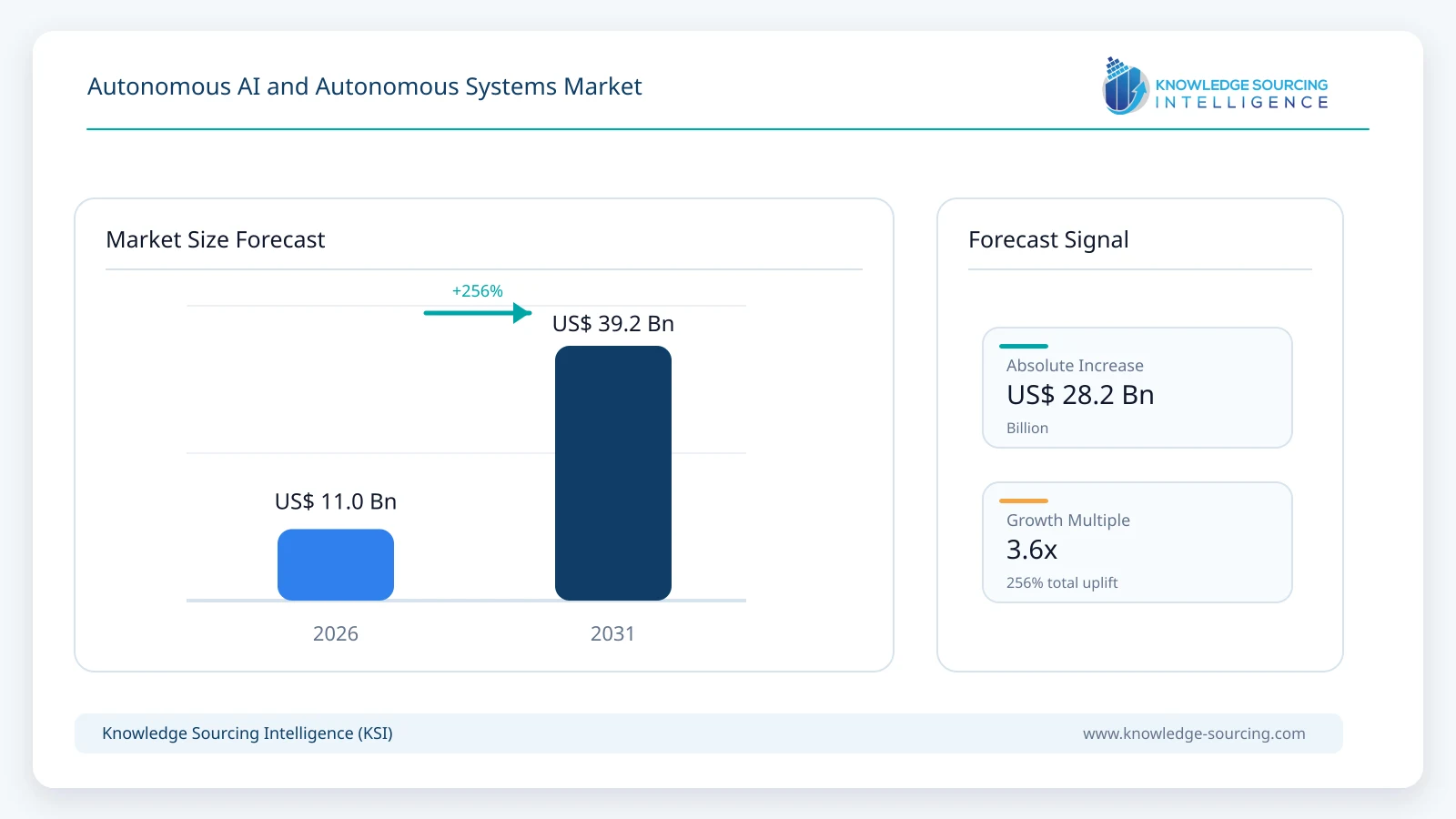
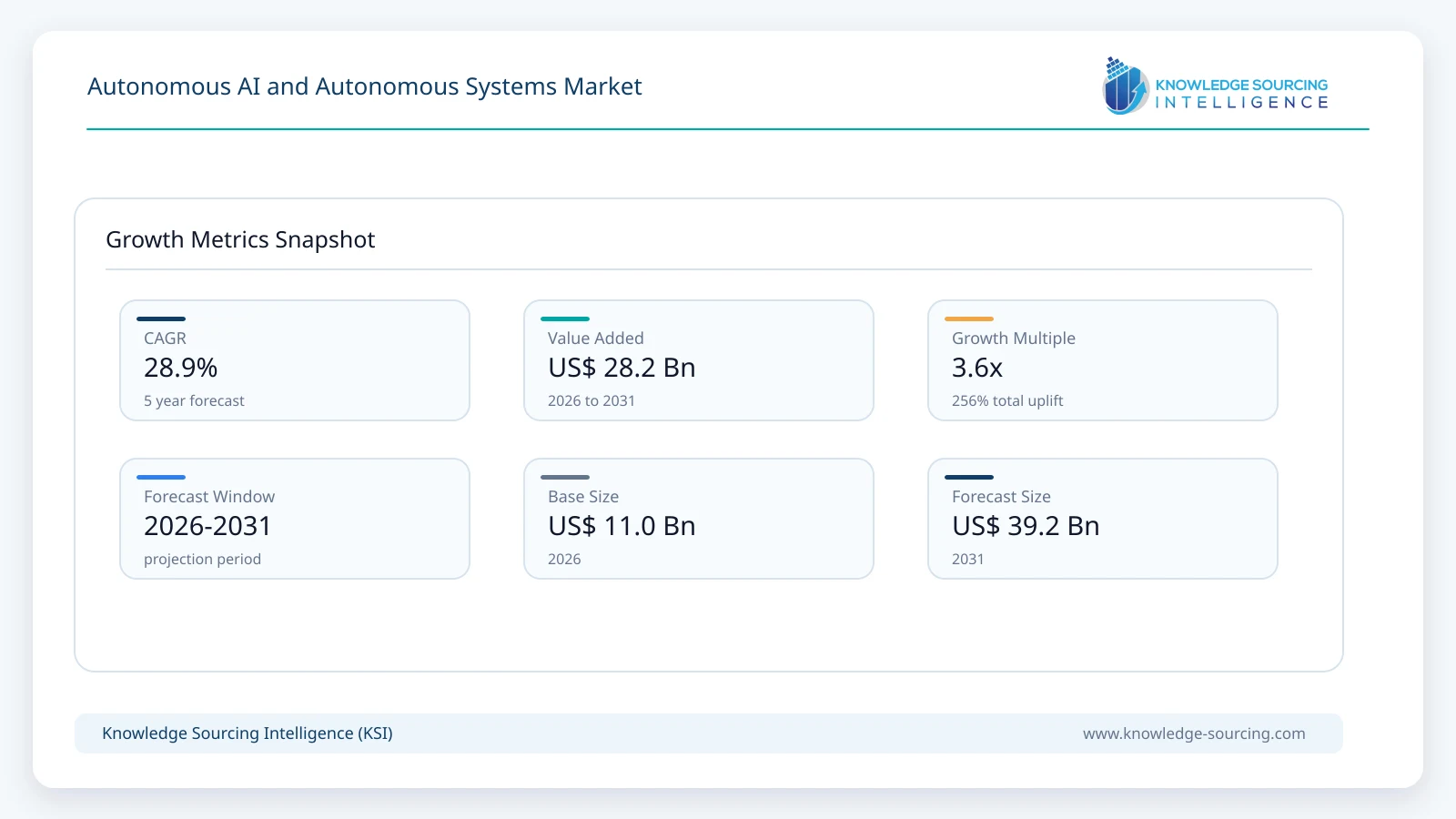
The autonomous AI and Autonomous Systems Market is forecast to grow at a CAGR of 28.9%, reaching USD 39.2 billion in 2031 from USD 11.0 billion in 2026.
Highlights:
- 1AI agents and autonomous machines are integrated such that the digital intelligence can manage physical actions.
- 2Machine learning and deep learning remain fundamentally capable of perception and prediction, classification, and optimization, and closed-loop decision-making for autonomous systems.
- 3Manufacturers are looking at a combination of robotics, computer vision, AI, sensors, and edge computing to build systems that can react dynamically to production conditions.
- 4Technologies related to autonomous driving, advanced driver-assistance systems, autonomous delivery, drones, and intelligent fleet management are witnessing rising demand.
The market comprises all technologies that enable software and physical machines to become independent of direct human control.
Autonomous systems differ from conventional automation by being able to process circumstances, decide how things should behave, learn through data, and adapt their behaviour. Autonomous AI systems are an extension of the automation offered by traditional software, with reasoning elements, planning features, context understanding, and adaptive decision-making elements.
This market encompasses AI agents, autonomous decision engines, intelligent workflow systems, autonomous cybersecurity platforms, and other software-based systems that can perform digital tasks. Physical systems are autonomous robots, mobile robots, autonomous vehicles, drones, and other intelligent equipment. Modern autonomous machines take advantage of AI models for perception and decision-making, while software agents leverage robotics, IoT devices, sensors, and connected machines to facilitate interactions with physical environments.
The market is thus transitioning to an autonomous integrated architecture where AI models, sensors, edge computing, communication network channels, control strategies, and physical machines operate as a unified system.
Autonomous AI and Autonomous Systems Market Key Highlights
Market Dynamics
Market Drivers
Increasing demand for autonomous operations: More manufacturers are using intelligent machines to improve productivity, consistency, quality control, and operational flexibility. In the industrial sector, modern autonomous systems integrate robotics and machine vision primarily with AI models, sensors such as LiDAR cameras, control loops from digital twins, and industrial control systems. Such technologies allow for identifying production problems, flexibly adjusting operating parameters, inspecting products, and coordinating the flow of materials.
Rise in Machine Learning and Deep Learning: Machine learning and deep learning provide the basic perception and decision-making mechanism for autonomous systems. Deep-learning models use lidar information, radar signals, audio, equipment data, and other sensor input to identify objects in the perception layer or scene understanding, recognize a pattern from video feed that predicts an event such as falling or near miss, or estimate environmental parameters. Physical autonomous systems increasingly integrate these capabilities with reinforcement learning and simulation environments, within which decision-making constantly changes based on new observations.
Generative AI and Large Language Models Expansion: Generative AI is pushing autonomous systems beyond traditional vision and classification. LLMs can parse natural-language instructions, reason about goals, summarize information about the environment, write plans, and interact with digital tools. This enables users to interact with the autonomous systems using natural language instead of highly structured commands. In the case of physical systems, generative AI can serve as a reasoning level above legacy robotics software. It could be that an operator gives a goal and the autonomous system breaks it down into a sequence of actions.
Labor Shortages and the need for 24/7 Operations: Labour shortages are prompting companies to automate repetitive, physically taxing, and unsafe tasks. Logistics, manufacturing, agriculture, and others are plagued by labor shortages and increasing wages. Autonomous bots and AI-enabled machines can work continuously for long periods doing repetitive tasks based on the same operating procedures. This is especially useful for warehouses and factories requiring constant material movement, inspection, sorting, and production.
Market Restraints & Opportunities
Autonomous systems demand highly advanced computing, sensors, robotics, software, connectivity, and safety systems, whch puts an obstacle for small and medium enterprises. Increasing modularity of autonomous platforms, the rise of robotics-as-a-service, commoditization, access to cloud-based AI, and growth in subscription-based fleet-management models could reduce upfront investment costs.
This implies that autonomous systems need thorough simulation, testing, redundancy, fail-fast mechanisms, controls, system monitoring, and human control.
These obstacles can generate opportunities for autonomous-system validation, simulation software, AI safety platforms, digital twins, cybersecurity, and real-time monitoring.
The cost of implementing autonomous systems may be high when a new solution must integrate with existing PLCs, SCADA systems, enterprise software, warehouse-management systems, vehicle fleets, and industrial networks.
This consequently presents a huge growth opportunity for companies that offer interoperability platforms, APIs, edge gateways, robotics orchestration, and/or system-integration services.
Key Developments
September 2026: Guardian, an artificial intelligence safety-intelligence platform for autonomous and complex systems, was released by Edge Case. It also linked safety analyses, engineering data, and operational signals to build a constantly evolving "Digital Safety Twin" on the platform.
September 2026: Sevii announced the addition of an AI Detection and Response module for threat modeling findings to their Autonomous Defense & Remediation platform. Detections are processed in real time by the module and Aegis AI Cyber Warrior agent, opening agentic investigation cases, hunting related threats, and adding operational context while remediating compromised systems.
Market Segmentation
The market is segmented by system type, technology, application, end user, and geography.
By System Type: Physical Autonomous Systems
The physical autonomous vehicle segment, such as the autonomous ground vehicles segment, is expected to remain a large part of the market, since autonomous machines will keep extending into manufacturing, logistics, transportation, agriculture, and other physical sectors. Examples of Physical Autonomous systems include autonomous mobile robots, industrial robots, Autonomous vehicles, drones, agricultural machinery, warehouse robots, and intelligent inspection equipment.
It integrates sensors and perception technologies with AI models, motion planning, control systems, and edge computing. Their main advantage is that they can turn AI-generated decisions into physical actions. This makes it a good fit for certain industrial and logistics applications, where the operating environment can be organized and quantified. With autonomous mobile robots, the automaton can travel between specific facilities, and with industrial robots work in defined production areas.
The field is additionally changing towards better flexibility. Recent autonomous machines are capable of more nuanced behavior, as they can take environmental information and allow their behaviors to change based on operational needs rather than a single predetermined action.
By Technology: Machine Learning
The machine learning portion is anticipated to retain a major share. Autonomous machines are supposed to be fed information through cameras, radar, lidar, microphones, and GPS-based industrial sensors. Further, machine-learning algorithms convert this data into predictions and decisions.
Models based on machine learning are especially significant because of their importance in visual processing, or the interpretation of sensor data, whilst those utilising reinforcement learning can aid decision-making through sequential control problems.
Generative AI and LLMs are also increasingly being combined with machine learning. In such hybrid architectures, traditional machine-learning systems are responsible for perception and low-level decisions while generative AI performs reasoning and planning at a higher level. It is an important layered architecture because high-level adaptive intelligence usually requires fast deterministic control and full autonomy.
By Application: Software Development
The industrial & manufacturing sector stands as one of the most significant applications, due to factories supplying organized environments in which autonomous systems can offer quantifiable productivity gains.
They are used in robotic applications like autonomous material handling, machine tending, inspection, and warehouse-to-production transport, predictive maintenance of equipment, quality control, and improved process optimization.
Computer vision-enabled AI enables machines to detect defects and deviations, while autonomous mobile robots can haul parts among production stations.
Robotics and generative AI are facilitating more seamless human-machine interaction. Operators are using increasingly sophisticated natural-language interfaces to state what they want performed, and AI systems translate this into machine action.
Regional Analysis
North America Market Analysis
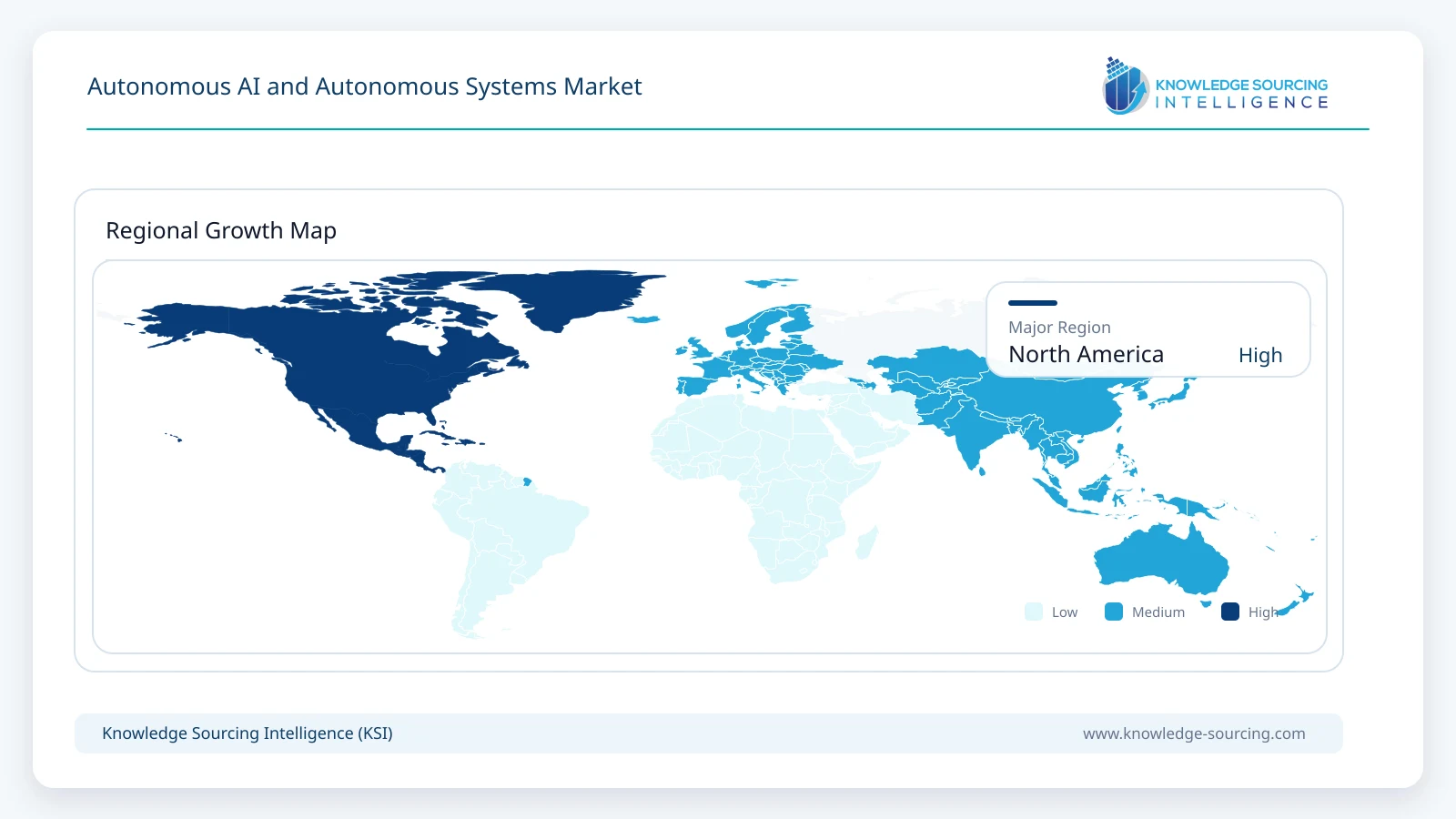
North America is one of the leading markets for autonomous AI and autonomous systems due to a robust ecosystem of AI, robotics industry, autonomous-vehicle development with strong cloud infrastructure and investment in advanced technologies. Major AI developers, autonomous-vehicle companies, and robotics companies are all based in the U.S., as are leading semiconductor manufacturers and cloud providers.
South America Market Analysis
South America is a growing market for autonomous systems with support from automation of agriculture, mining, logistics, manufacturing, and transportation. Brazil offers the greatest opportunity, given its large industrial and agricultural sectors.
Europe Market Analysis
Europe is deemed a vital market owing to its high-tech manufacturing industry, automotive industry, robotics ecosystem, logistics infrastructure, and demand for industrial automation. Countries such as Germany, France, Italy, the UK, and the Netherlands are important for robotics, industrial AI, autonomous mobility, and logistics.
Middle East and Africa Market Analysis
Middle East & Africa market is growing and transforming with investments in smart cities, logistics infrastructure, industrial automation, energy projects, autonomous mobility, and digital transformation. Saudi Arabia and the UAE have a particularly heavy focus on autonomous transportation, connected smart-city development, robotics, AI infrastructure, as well as logistics.
Asia Pacific Market Analysis
Asia Pacific is set to continue being one of the fastest-growing regions, owing to its diversified manufacturing base, large-scale robotics deployment, exploded e-commerce growth, and heavy investment in AI. China, Japan, South Korea, India, Singapore, and Australia are creating autonomous technology spanning industrial robotics, transportation, logistics, agriculture, and healthcare.
List of Companies
Expenzing Pvt. Ltd.
Zania AI
Magnitude
GeneralMind
Olivaw
Assail
Avemoy
Guidant
Stability AI
Zenity
Expenzing Pvt. Ltd.
Expenzing is an India-based enterprise SaaS company focused on automating financial and procurement processes. The relevance to the autonomous AI ecosystem pertains to the trend toward intelligent process automation for decision-making and execution of many enterprise workflows.
Zania AI
Zania AI is about AI-powered workspace and enterprise automation. Its technology direction continues to center on autonomous digital workers that interact with enterprise information and handle business processes.
GeneralMind
GeneralMind operates an autonomous AI ecosystem built around AI agents and autonomous digital work. The company is applicable in the software-only autonomous AI market, particularly with enterprise AI systems that are starting to shift down from multi-step tasks.
Analyst View
The autonomous AI and autonomous systems market is integrating software smarts with physical autonomy. As machine learning and deep learning continue to power perception and decision-making, generative AI and LLMs are providing a more complex layer of reasoning requiring natural language understanding, planning, and task decomposition. Physical autonomous systems provide quantifiable operational efficiencies and are well adopted in manufacturing, logistics, transportation, and agriculture. Unlike enterprise software counterparts, which can expand across workflows and decision systems. North America is a leading innovation zone, and Asia Pacific presents substantial deployment opportunities due to its fast-growing manufacturing, robotics, logistics, and technology ecosystem.
Autonomous AI and Autonomous Systems Market Scope:
| Report Metric | Details |
|---|---|
| Total Market Size in 2026 | USD 11.0 billion |
| Total Market Size in 2031 | USD 39.2 billion |
| Forecast Unit | USD Billion |
| Growth Rate | 28.9% |
| Study Period | 2021 to 2031 |
| Historical Data | 2021 to 2024 |
| Base Year | 2025 |
| Forecast Period | 2026 – 2031 |
| Segmentation | System Type, Technology, Application, End User, Geography |
| Companies |
|
Market Segmentation
By System Type
Software-Based Autonomous AI
Physical Autonomous Systems
By Technology
Machine Learning
Deep Learning
Generative AI
Large Language Models (LLMs)
Others
By Application
Industrial & Manufacturing
Transportation & Mobility
Logistics & Warehousing
Agriculture
Healthcare
Others
By End User
Automotive
Electronics & Semiconductors
Healthcare & Life Science
Logistics & Transportation
Others
By Geography
North America
USA
Canada
Mexico
South America
Brazil
Argentina
Others
Europe
United Kingdom
Germany
France
Others
Middle East and Africa
Saudi Arabia
UAE
Others
Asia Pacific
China
Japan
India
South Korea
Others
Table of Contents
1. EXECUTIVE SUMMARY
2. MARKET SNAPSHOT
2.1. Market Overview
2.2. Market Definition
2.3. Scope of the Study
2.4. Market Segmentation
3. MARKET DYNAMIC
3.1. Market Drivers
3.2. Market Restraints
3.3. Market Opportunities
3.4. Porter’s Five Forces Analysis
3.5. Industry Value Chain Analysis
4. BUSINESS LANDSCAPE
4.1. Regulatory, Safety, Standards and Certification Landscape
4.2. Autonomous Systems Investment, Procurement, Pricing and Commercialization Analysis
4.3. Autonomous AI and Physical Systems Ecosystem Analysis
4.4. Import- Export Analysis
4.5. Strategic Recommendations
5. TECHNOLOGICAL OUTLOOK
5.1. Autonomous Perception, Sensor Fusion and Environmental Intelligence Technologies
5.2. Autonomous Decision-Making, Planning, Navigation and Control Technologies
5.3. Embodied AI, Robotics, World Models and Physical AI Technologies
5.4. Edge AI, Real-Time Computing, Connectivity and Autonomous Fleet Technologies
6. AUTONOMOUS AI AND AUTONOMOUS SYSTEMS MARKET BY SYSTEM TYPE
6.1. Introduction
6.2. Software-Based Autonomous AI
6.3. Physical Autonomous Systems
7. AUTONOMOUS AI AND AUTONOMOUS SYSTEMS MARKET BY TECHNOLOGY
7.1. Introduction
7.2. Machine Learning
7.3. Deep Learning
7.4. Generative AI
7.5. Large Language Models (LLMs)
7.6. Others
8. AUTONOMOUS AI AND AUTONOMOUS SYSTEMS MARKET BY APPLICATION
8.1. Introduction
8.2. Industrial & Manufacturing
8.3. Transportation & Mobility
8.4. Logistics & Warehousing
8.5. Agriculture
8.6. Healthcare
8.7. Others
9. AUTONOMOUS AI AND AUTONOMOUS SYSTEMS MARKET BY END USER
9.1. Introduction
9.2. Automotive
9.3. Electronics & Semiconductors
9.4. Healthcare & Life Science
9.5.Logistics & Transportation
9.6. Others
10. AUTONOMOUS AI AND AUTONOMOUS SYSTEMS MARKET BY GEOGRAPHY
10.1. Introduction
10.2. North America
10.2.1. USA
10.2.2. Canada
10.2.3. Mexico
10.3. South America
10.3.1. Brazil
10.3.2. Argentina
10.3.3. Others
10.4. Europe
10.4.1. United Kingdom
10.4.2. Germany
10.4.3. France
10.4.4. Others
10.5. Middle East and Africa
10.5.1. Saudi Arabia
10.5.2. UAE
10.5.3. Others
10.6. Asia Pacific
10.6.1. China
10.6.2. Japan
10.6.3. India
10.6.4. South Korea
10.6.5. Others
11. COMPETITIVE ENVIRONMENT AND ANALYSIS
11.1. Major Players and Strategy Analysis
11.2. Market Share Analysis
11.3. Mergers, Acquisitions, Agreements, and Collaborations
11.4. Competitive Dashboard
12. COMPANY PROFILES
12.1. Expenzing Pvt. Ltd.
12.2. Zania AI
12.3. Magnitude
12.4. GeneralMind
12.5. Olivaw
12.6. Assail
12.7. Avemoy
12.8. Guidant
12.9. Stability AI
12.10. Zenity
13. APPENDIX
13.1. Currency
13.2. Assumptions
13.3. Base and Forecast Years Timeline
13.4. Key benefits for the stakeholders
13.5. Research Methodology
13.6. Abbreviations
Navigate
Trusted by the world's leading organizations











