
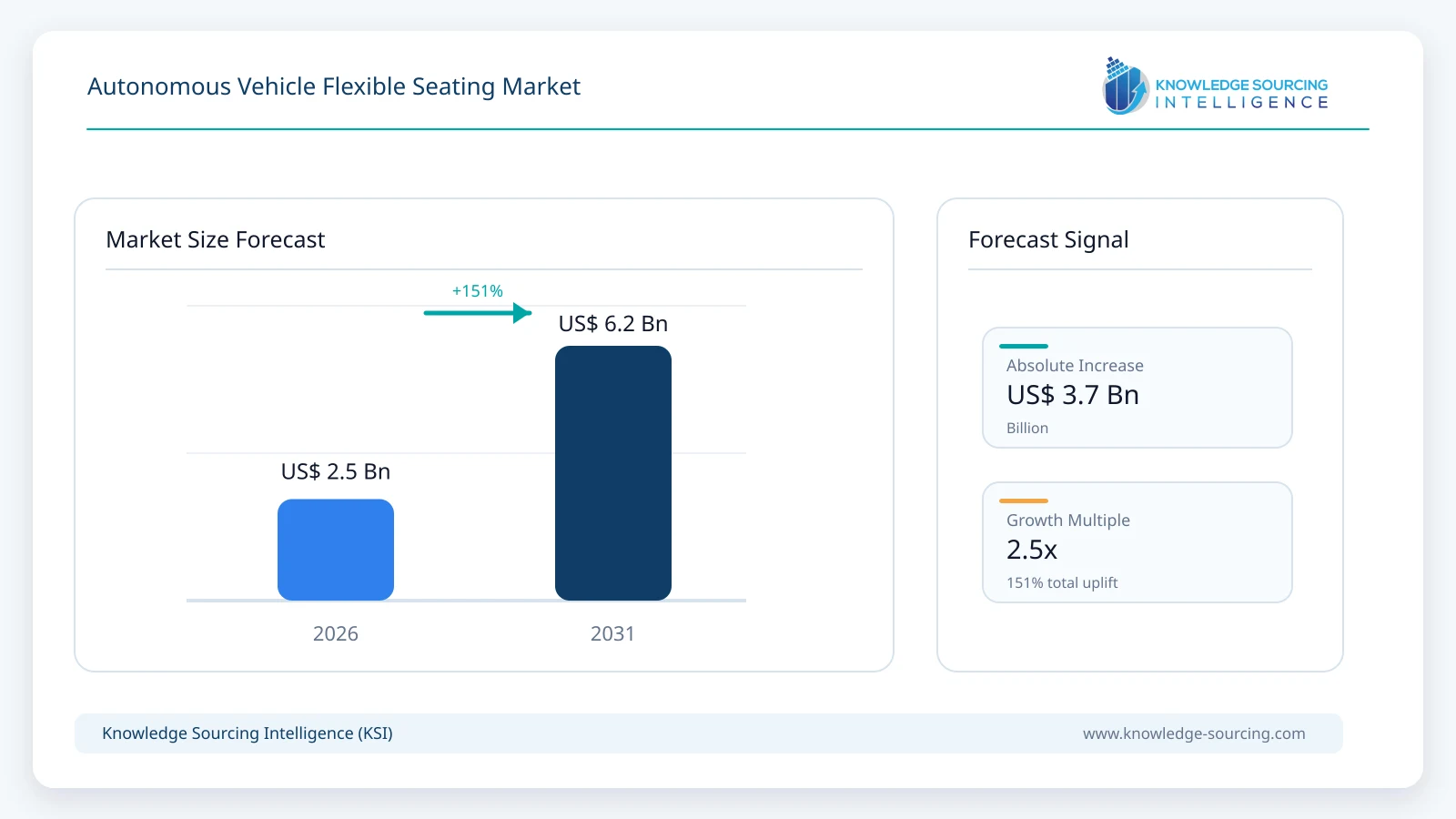
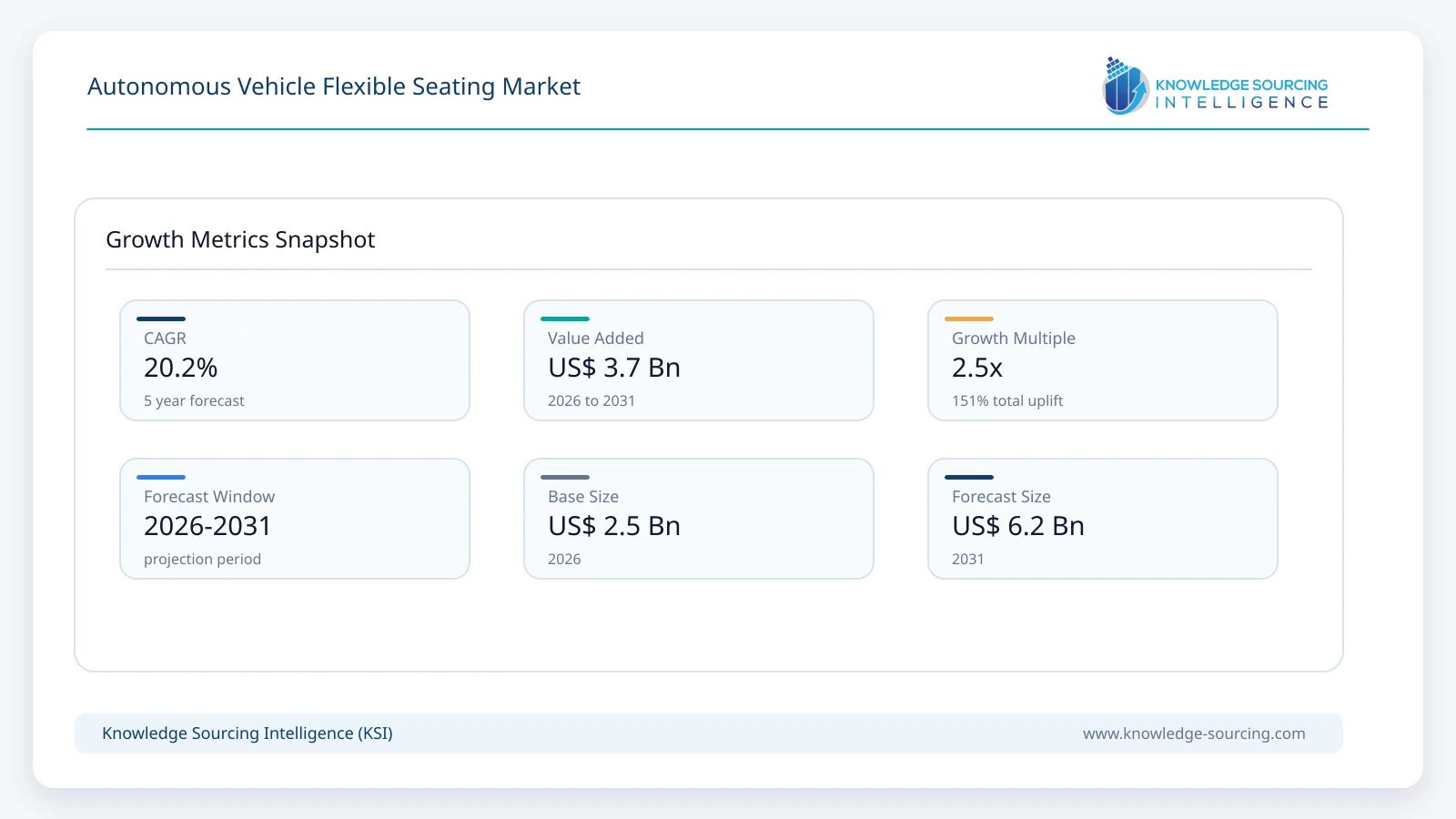
The autonomous vehicle flexible seating market is forecast to grow at a CAGR of 20.2%, reaching approximately USD 6.15 billion in 2031 from USD 2.45 billion in 2026.
Highlights:
- 1Long-rail and swivel seating systems account for approximately 44% of global market value in 2026, reflecting their central role in creating face-to-face, lounge and multi-position autonomous cabin layouts.
- 2Rear and multi-row flexible seating represents approximately 54% of market value in 2026 because second- and third-row seats carry a high concentration of fold, slide, stow and reconfiguration functions.
- 3SAE Level 3 applications account for approximately 60% of global market value in 2026, supported by the first production-scale automated-driving vehicles that require both conventional and non-driving seating modes.
- 4Personally owned autonomous passenger vehicles represent approximately 61% of market value in 2026, while robotaxi, shared mobility and autonomous shuttle applications are gaining rapidly.
- 5Battery electric vehicles account for approximately 74% of global market value in 2026 because flat floors and centralized electronics provide the strongest platform for long rails, swivels and powered seat movement.
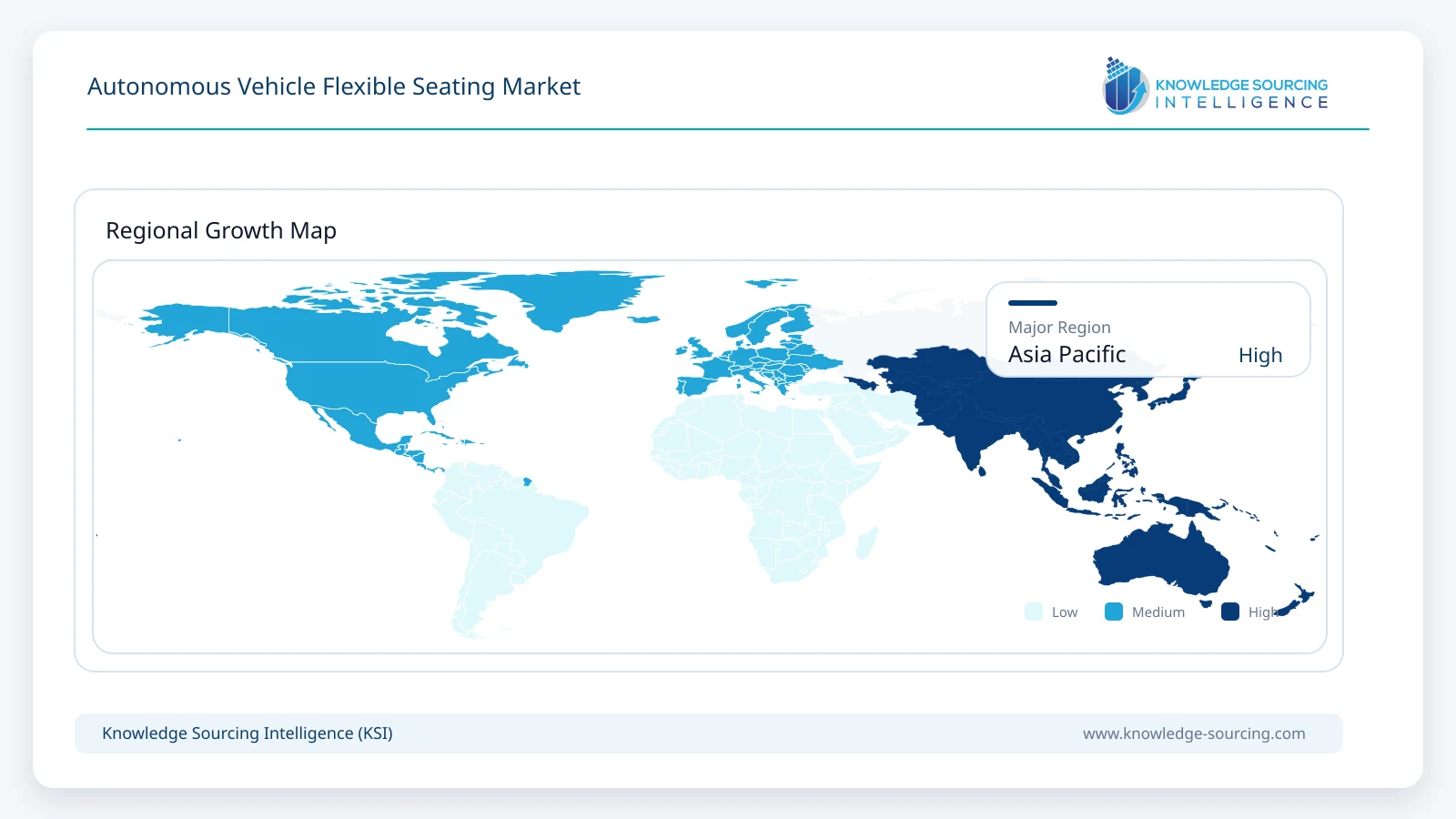
- 6Asia Pacific represents approximately 41% of global market value in 2026, supported by rapid EV, smart-cabin and flexible-seat development in China, Japan and South Korea.
Demand is being driven by seating systems that can support conventional driving positions while also enabling lounge, meeting, work, rest and cargo configurations during automated-driving periods.
Flexible autonomous seating is increasingly built around long-travel rails, swivel bases, powered repositioning, compact stowage and integrated restraints. Magna's Flexible Seating System uses long-travel rails and rotating bases as scalable building blocks, while Lear's Configure+ provides tetherless powered positioning and removal across multiple passenger and cargo layouts.
Yanfeng's XiM27 demonstrates production-ready multi-mode seating for Level 3 and higher automated mobility, including vis-à-vis lounge seating, a rocking seat, flat-bed second-row conversion and a flexible third row. Hyundai Transys, Adient and TACHI-S are also developing seating architectures centered on increased freedom of movement, ergonomic support and autonomous-driving use cases.
Market Overview
Flexible seating is becoming a foundational technology for autonomous interiors because occupants are expected to spend less time in a fixed forward-facing posture. The seat must support greater movement while preserving structural strength, comfort, usability and restraint performance.
Magna's reconfigurable seating portfolio combines power long rails, swivel mechanisms and stadium-style nesting functions. Its 2024 awarded Chinese OEM program includes fully rotating front seats and nearly two meters of powered rail travel shared across front and rear rows, demonstrating the production readiness of flexible seating at vehicle level.
Lear's Configure+ uses floor-mounted powered rails and tetherless seat electronics, allowing seats to be selectively positioned or removed while retaining functions such as recline, thermal comfort and device charging. The architecture was developed with autonomous and ride-sharing applications in mind and includes integrated seatbelt capability.
Hyundai Transys is developing seat frames with forward, rearward, lateral and rotational movement, along with integrated armrest controls for general driving, autonomous rest and communication modes. Adient's Autonomous Elegance combines flexible seating with integrated sensors, controls, airbags and belt-in-seat systems.
Market Trends
Flexible Seating Is Moving from Demonstration to Scalable Architecture
Seat suppliers are shifting from one-off concept mechanisms toward common architectures that can scale across vehicle programs. Magna's Flexible Seating System uses long-travel rails, rotating bases and adaptive support mechanisms as reusable building blocks rather than adding separate mechanisms for each cabin scenario.
Scalable architectures are important because OEMs need autonomous cabin flexibility without multiplying engineering and validation cost across every trim and platform.
Long Rails Are Becoming the Backbone of Autonomous Cabin Movement
Long-rail systems allow seats to move far beyond conventional adjustment ranges, creating space for face-to-face interaction, cargo expansion or reclined modes. Magna and Yanfeng both use extended rail architectures to increase the usable cabin envelope.
Integration with flat-floor EV structures is further improving packaging. Magna's Cell to Seat system integrates reconfigurable long-rail seating directly with the battery enclosure to reduce redundant structures and improve design flexibility.
Swivel Seating Is Increasing Social and Workspace Use
Rotating seat bases allow occupants to face other passengers, tables or cabin interfaces when automated driving reduces the need for continuous forward orientation. Yanfeng's XiM27 uses swivel seating to create vis-à-vis social layouts, while Magna has secured production business for fully rotating front-row seats.
The technology opportunity is strongest where integrated restraints and safety systems allow a wide movement range without compromising occupant protection.
Seat Electronics Are Enabling Automated Repositioning
Flexible seating increasingly combines mechanical freedom with sensors and software-controlled movement. Powered rails, electronic latches and centralized controllers allow seats to move between predefined modes with less physical effort and more consistent positioning.
Software coordination also supports automated return to safe travel positions and can link seat movement with vehicle automation status, restraint systems and occupant monitoring.
Purpose-Built Mobility Is Expanding Removable and Modular Seating
Purpose-built vehicles and autonomous shuttles require seating that can adapt to passenger count, cargo, accessibility and service-specific needs. Hyundai Transys's Switch Mobility Seat uses removable modular components and flexible seat layouts to increase space utilization across changing use cases.
This expands the market beyond premium passenger cars into mobility-service and fleet applications where interior flexibility directly influences vehicle utilization.
Segment Analysis
By Flexible Seating Type: Long-Rail and Swivel Systems
Long-rail and swivel seating systems are projected to reach approximately USD 2.46 billion by 2031. These systems create the largest increase in seating freedom by combining extended longitudinal travel with rotational movement, supporting face-to-face interaction, lounge modes and more efficient cargo or passenger configurations.
By Seat Position: Rear and Multi-Row Seating
Rear and multi-row flexible seating is projected to reach approximately USD 3.26 billion by 2031. Second- and third-row seats carry a high concentration of slide, fold, stow, removable and cargo-conversion functionality, making them an important foundation for flexible autonomous cabins.
By Automation Level: SAE Level 4 and Above
SAE Level 4 and above flexible seating is projected to reach approximately USD 3.38 billion by 2031. Higher automation allows occupants to spend longer periods away from driving responsibility, increasing the value of swivel, recline, social, rest and workspace-oriented seat configurations.
By Vehicle Application: Personally Owned Autonomous Passenger Vehicles
Personally owned autonomous passenger vehicles are projected to generate approximately USD 2.77 billion of flexible-seating market value by 2031. Premium SUVs, MPVs and electric passenger vehicles provide an important commercialization path for multi-mode seating used across commuting, family travel, work and leisure.
By Cabin Use Mode: Lounge and Social Interaction
Lounge and social-interaction seating is projected to reach approximately USD 1.97 billion by 2031. Swivel seats, extended rails and reclined positions allow occupants to face each other, use shared surfaces and convert the cabin into a more room-like passenger environment.
By Propulsion: Battery Electric Vehicles
Battery electric vehicles are projected to generate approximately USD 5.10 billion of flexible-seating market value by 2031. Flat floors, centralized electronics and the close alignment between EV and automated-driving development make battery-electric platforms the principal architecture for advanced seat movement and reconfiguration.
By Geography: Asia Pacific
Asia Pacific is projected to reach approximately USD 2.52 billion by 2031. China is the principal growth engine through rapid EV and smart-cabin development, while Japan and South Korea contribute established seating engineering and future-mobility programs.
Market Drivers
Expansion of SAE Level 3 and Level 4 Automated Driving
Higher levels of automation reduce the need for continuous fixed driving posture and increase the practical value of lounge, communication, work and rest seat modes. Flexible seating becomes more valuable as automated-driving time increases.
Electric-Vehicle Flat-Floor Architecture
Battery-electric platforms reduce drivetrain intrusions and can provide longer uninterrupted floor structures, supporting extended seat rails, swivels and movable seat positions. This packaging freedom is a major enabler of autonomous flexible seating.
Demand for Multi-Use Cabin Space
Consumers increasingly expect vehicle interiors to serve several purposes. Flexible seats allow the same cabin to support commuting, cargo, family travel, social interaction and rest without permanently sacrificing space.
Growth of Robotaxi and Purpose-Built Mobility
Autonomous ride-hailing and purpose-built mobility services benefit from adaptable passenger layouts, accessibility and more efficient space utilization. Flexible or removable seats can improve vehicle utilization across different rider and service requirements.
Advances in Powered Seat Mechanisms and Control
Compact motors, long rails, electronic locking and centralized controls are making complex seat movement easier to automate. These technologies support one-touch scenario changes and more repeatable positioning across the vehicle life cycle.
Market Restraints
Crash Safety Across Non-Traditional Positions
Swiveled, reclined and face-to-face seating changes occupant geometry relative to belts, airbags and crash structures. Flexible seating therefore requires integrated restraints, robust frames and extensive validation across approved positions.
Higher System Cost
Power rails, swivel mechanisms, integrated belts, electronic locks and sensing increase seat-system cost compared with conventional fixed or short-track seating. Early adoption remains concentrated in higher-value vehicles and future-mobility platforms.
Weight and Packaging Trade-Offs
Long rails, rotating bases and powered movement can add mass or compete with battery, floor and foot-space requirements. Suppliers must continuously reduce mechanism weight while preserving structural strength.
Durability and Noise Requirements
Flexible seats are expected to move across wider ranges and more complex mechanisms than conventional seats. Rails, bearings, motors and locks must retain low play, low noise and precise operation over long service lives.
Regulatory Uncertainty
Most current crash and seating regulations were developed around conventional forward-facing seat positions. Wider adoption of autonomous flexible seating will require continuing evolution in approved use conditions, restraint strategies and testing protocols.
Regional Outlook
Asia Pacific
Asia Pacific is the largest regional market and is expected to remain the strongest growth centre through 2031. China is driving rapid commercialization through premium EVs, smart cabins and flexible MPV architectures. Magna's awarded reconfigurable seating program with a Chinese OEM and Yanfeng's production-ready XiM27 demonstrate the region's role in moving long-rail and swivel seating toward production.
Japan and South Korea add strong supplier capabilities. Toyota Boshoku is developing adaptive mobility spaces and coordinated seating concepts, Hyundai Transys is advancing seat frames with extended movement and modular PBV seating, and TACHI-S is developing autonomous-driving seat experiences around Smart Shell.
Europe
Europe is the second major regional market, supported by premium vehicle production, early Level 3 commercialization and strong seating-supplier capabilities. Adient is developing autonomous-oriented seat structures with integrated electronics and belt systems, while Magna and Lear maintain substantial European seating operations.
The region's emphasis on occupant safety, premium cabin experience and automated-driving regulation is expected to support higher-value flexible seat systems that combine greater movement with integrated restraint and electronic control.
Competitive Landscape
The autonomous vehicle flexible seating market is led by complete-seat and mechanism suppliers with capabilities in long rails, swivels, powered movement, fold-and-stow functions, integrated restraints and autonomous-oriented seat control. Magna, Yanfeng, Lear, Hyundai Transys, Adient, Toyota Boshoku and TACHI-S are directly active in flexible future-mobility seating.
Magna differentiates through power long rails, swivel mechanisms, stadium/nesting functions and production-ready reconfigurable seat programs. Yanfeng combines ultra-long rails, independent seat movement and intelligent configuration in XiM27, while Lear's Configure+ provides tetherless powered repositioning and selective seat removal.
Hyundai Transys is developing seat frames with expanded directional movement and modular PBV seating. Adient integrates flexibility, sensors and safety systems in Autonomous Elegance and Pure Ergonomics, Toyota Boshoku develops coordinated future-mobility seating concepts, and TACHI-S is advancing autonomous seat experience through Smart Shell.
Recent Developments
July 2026: Yanfeng's XiM27 received the 2026 Red Dot Design Concept Award; the platform includes an intelligent seat configuration system for Level 3 and higher autonomous mobility.
June 2026: Yanfeng unveiled XiM27, a production-ready smart-cabin platform featuring vis-à-vis seating, a rocking seat, flat-bed second-row conversion, flexible third-row modes and ultra-long floor rails.
June 2026: Magna detailed its Flexible Seating System, built around long-travel rails, rotating bases and adaptive support mechanisms that can be reused across multiple vehicle programs.
May 2026: TACHI-S announced its Automotive Engineering Exposition 2026 program featuring Smart Shell, an autonomous-driving-oriented seat designed around relaxed posture and immersive in-cabin experience.
April 2026: Toyota Boshoku presented LOUNZE+ for Auto China 2026, coordinating seats with other interior components so the cabin can adapt to different passenger purposes and scenes.
September 2025: Adient presented Pure Ergonomics, a flexible seating concept derived from Autonomous Elegance that increases second-row space and improves occupant ergonomics across multiple seat positions.
Market Outlook
The autonomous vehicle flexible seating market is expected to expand rapidly through 2031 as higher automation increases demand for lounge, social, work, rest and cargo-oriented seat positions. Long-rail and swivel systems will remain the principal value pool, while powered and software-coordinated movement increases content per seat.
Development will focus on lighter mechanisms, integrated restraints, quieter powered motion and safe transitions between non-driving and travel-ready positions. Asia Pacific is expected to lead commercialization, while Europe remains a major market for premium autonomous seating and safety integration.
Autonomous Vehicle Flexible Seating Market Scope
| Report Metric | Details |
|---|---|
| Total Market Size in 2026 | USD 2.45 billion |
| Total Market Size in 2031 | USD 6.15 billion |
| Forecast Unit | Billion |
| Growth Rate | 20.2% |
| Study Period | 2021 to 2031 |
| Historical Data | 2021 to 2024 |
| Base Year | 2025 |
| Forecast Period | 2026 – 2031 |
| Segmentation | Flexible Seating Type, Seat Position, Automation Level, Vehicle Application, Cabin Use Mode, Propulsion, Geography |
| Companies |
|
Market Segmentation
By Flexible Seating Type
Long-Rail and Swivel Systems
Fold, Stow and Nesting Systems
Tetherless and Removable Seating
Adaptive Powered Positioning
By Seat Position
Front Row
Rear and Multi-Row Seating
By Automation Level
SAE Level 3
SAE Level 4 and Above
By Vehicle Application
Personally Owned Autonomous Passenger Vehicles
Robotaxi and Shared Autonomous Mobility
Autonomous Shuttle and Purpose-Built Mobility
By Cabin Use Mode
Lounge and Social Interaction
Work and Productivity
Rest and Sleep
Passenger and Cargo Conversion
By Propulsion
Battery Electric Vehicles
Hybrid Electric Vehicles
Internal Combustion Engine Vehicles
By Geography
North America
United States
Canada
Mexico
South America
Brazil
Argentina
Others
Europe
Germany
United Kingdom
France
Italy
Spain
Others
Middle East and Africa
Saudi Arabia
UAE
South Africa
Others
Asia Pacific
China
Japan
South Korea
India
Singapore
Others
Table of Contents
1. INTRODUCTION
1.1. Market Overview
1.2. Market Definition
1.3. Scope of the Study
1.4. Market Segmentation
1.5. Currency
1.6. Assumptions
1.7. Base and Forecast Years
1.8. Key Benefits to Stakeholders
2. RESEARCH METHODOLOGY
2.1. Research Design
2.2. Secondary Research
2.3. Primary Research
2.4. Market Estimation
2.5. Segment Modelling
2.6. Data Triangulation and Validation
3. EXECUTIVE SUMMARY
3.1. Key Findings
3.2. Autonomous Vehicle Flexible Seating Market Size, 2026-2031
3.3. Flexible Seating Type Outlook
3.4. Seat Position Outlook
3.5. Automation Level Outlook
3.6. Vehicle Application Outlook
3.7. Cabin Use Mode Outlook
3.8. Propulsion Outlook
3.9. Regional Opportunity Summary
4. MARKET DYNAMICS
4.1. Market Drivers
4.1.1. Expansion of SAE Level 3 and Level 4 Automated Driving
4.1.2. Electric-Vehicle Flat-Floor Architecture
4.1.3. Demand for Multi-Use Cabin Space
4.1.4. Growth of Robotaxi and Purpose-Built Mobility
4.1.5. Advances in Powered Seat Mechanisms and Control
4.2. Market Restraints
4.2.1. Crash Safety Across Non-Traditional Positions
4.2.2. Higher System Cost
4.2.3. Weight and Packaging Trade-Offs
4.2.4. Durability and Noise Requirements
4.2.5. Regulatory Uncertainty
4.3. Market Opportunities
4.4. Porter's Five Forces Analysis
4.5. Industry Value Chain Analysis
4.6. Flexible Seating System Economics
4.7. Safety and Regulatory Environment
5. TECHNOLOGY OUTLOOK
5.1. Power Long-Rail Systems
5.2. Swivel and Rotating Seat Bases
5.3. Fold, Stow and Nesting Systems
5.4. Tetherless and Removable Seating
5.5. Powered Adaptive Positioning
5.6. Integrated Belt-in-Seat Systems
5.7. Electronic Locks and Position Sensing
5.8. Centralized Seat Control
5.9. Safe Repositioning and Pre-Crash Control
5.10. Lightweight and Battery-Integrated Rail Architectures
6. AUTONOMOUS VEHICLE FLEXIBLE SEATING MARKET BY FLEXIBLE SEATING TYPE
6.1. Introduction
6.2. Long-Rail and Swivel Systems
6.3. Fold, Stow and Nesting Systems
6.4. Tetherless and Removable Seating
6.5. Adaptive Powered Positioning
7. AUTONOMOUS VEHICLE FLEXIBLE SEATING MARKET BY SEAT POSITION
7.1. Introduction
7.2. Front Row
7.3. Rear and Multi-Row Seating
8. AUTONOMOUS VEHICLE FLEXIBLE SEATING MARKET BY AUTOMATION LEVEL
8.1. Introduction
8.2. SAE Level 3
8.3. SAE Level 4 and Above
9. AUTONOMOUS VEHICLE FLEXIBLE SEATING MARKET BY VEHICLE APPLICATION
9.1. Introduction
9.2. Personally Owned Autonomous Passenger Vehicles
9.3. Robotaxi and Shared Autonomous Mobility
9.4. Autonomous Shuttle and Purpose-Built Mobility
10. AUTONOMOUS VEHICLE FLEXIBLE SEATING MARKET BY CABIN USE MODE
10.1. Introduction
10.2. Lounge and Social Interaction
10.3. Work and Productivity
10.4. Rest and Sleep
10.5. Passenger and Cargo Conversion
11. AUTONOMOUS VEHICLE FLEXIBLE SEATING MARKET BY PROPULSION
11.1. Introduction
11.2. Battery Electric Vehicles
11.3. Hybrid Electric Vehicles
11.4. Internal Combustion Engine Vehicles
12. AUTONOMOUS VEHICLE FLEXIBLE SEATING MARKET BY GEOGRAPHY
12.1. North America
12.1.1. United States
12.1.2. Canada
12.1.3. Mexico
12.2. South America
12.2.1. Brazil
12.2.2. Argentina
12.2.3. Others
12.3. Europe
12.3.1. Germany
12.3.2. United Kingdom
12.3.3. France
12.3.4. Italy
12.3.5. Spain
12.3.6. Others
12.4. Middle East and Africa
12.4.1. Saudi Arabia
12.4.2. UAE
12.4.3. South Africa
12.4.4. Others
12.5. Asia Pacific
12.5.1. China
12.5.2. Japan
12.5.3. South Korea
12.5.4. India
12.5.5. Singapore
12.5.6. Others
13. COMPETITIVE ENVIRONMENT AND ANALYSIS
13.1. Major Players and Strategy Analysis
13.2. Market Share Analysis
13.3. Product and Technology Benchmarking
13.4. Production Awards and Development Activity
13.5. Competitive Dashboard
14. COMPANY PROFILES
14.1. Magna International Inc.
14.2. Yanfeng
14.3. Lear Corporation
14.4. Hyundai Transys Inc.
14.5. Adient plc
14.6. Toyota Boshoku Corporation
14.7. TACHI-S Co., Ltd.
15. APPENDIX
15.1. Currency
15.2. Assumptions
15.3. Base and Forecast Years Timeline
15.4. Key Benefits for Stakeholders
15.5. Research Methodology
15.6. Abbreviations
15.7. Data Sources
Navigate
Trusted by the world's leading organizations











