
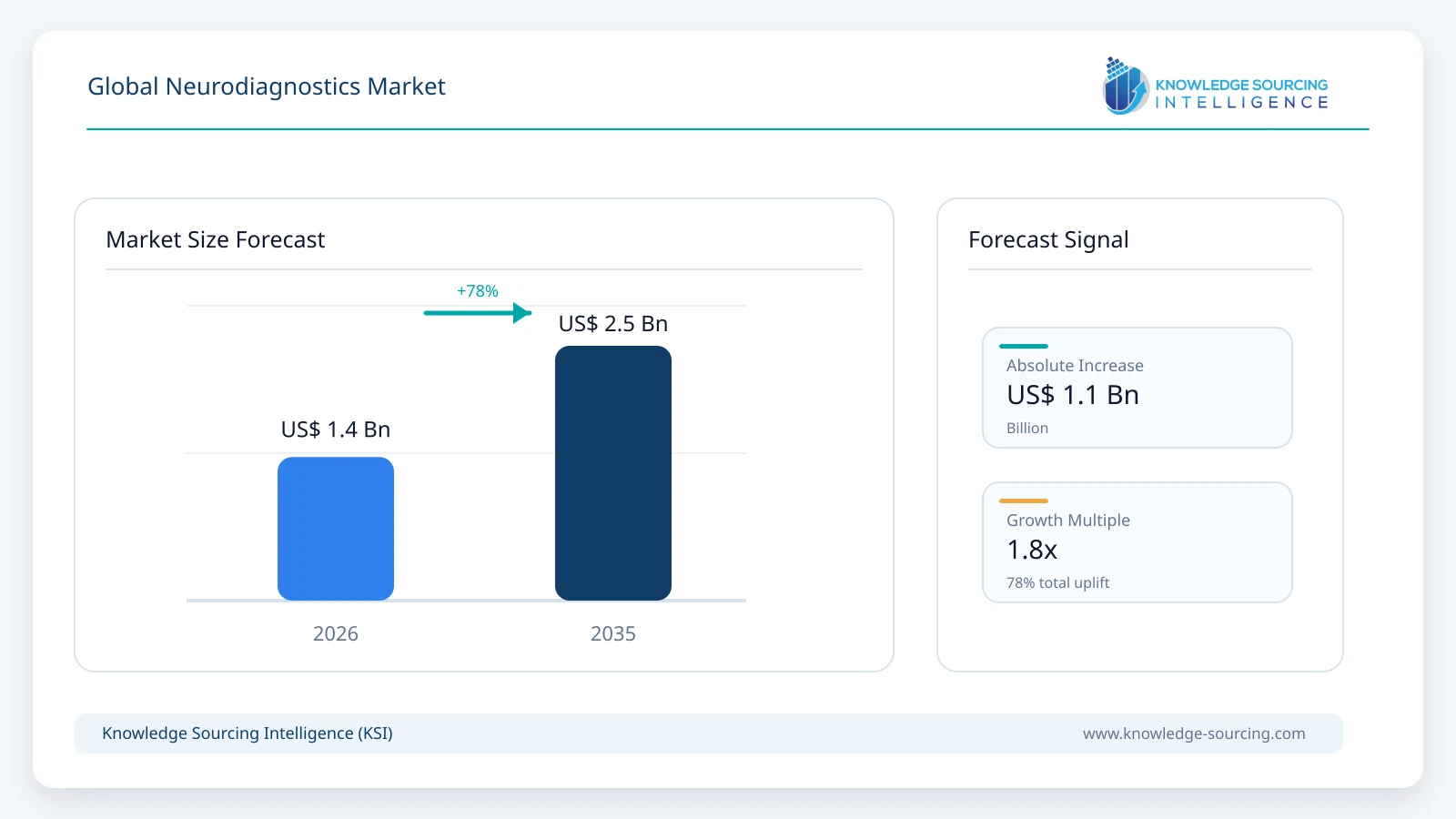
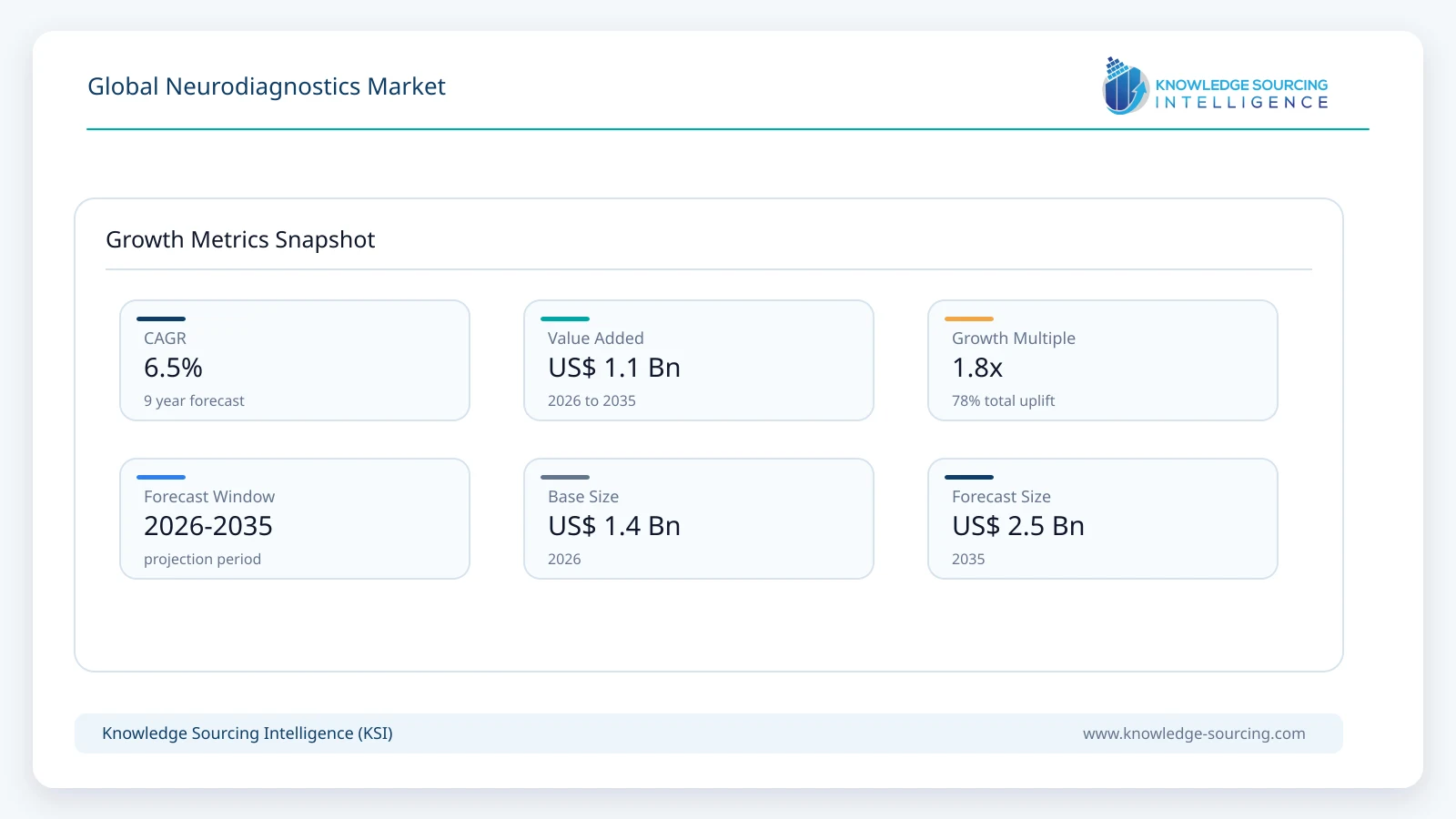
The Global Neurodiagnostics Market is set to reach USD 2.45 billion in 2035, growing at a CAGR of 6.5 % from USD 1.38 billion in 2026.
Highlights:
- 1Rising prevalence of neurodegenerative diseases is increasing demand for advanced neurodiagnostic technologies.
- 2Precision medicine initiatives are accelerating adoption of multimodal neurological assessment tools.
- 3Artificial intelligence is improving the efficiency of neurodiagnostic workflows and the accuracy of interpretation.
- 4Healthcare providers are expanding early disease detection programs through advanced diagnostics
Neurodiagnostics encompasses technologies that evaluate neurological structure and function across a broad range of disorders affecting the brain, spinal cord, peripheral nerves, and neuromuscular systems. Healthcare professionals utilize these technologies because neurological symptoms frequently require objective diagnostic confirmation before treatment decisions can be made.
Neurological disease management increasingly depends on early detection because many disorders demonstrate improved outcomes when intervention occurs during earlier disease stages. Neurodiagnostic systems support this objective because they provide physiological, anatomical, and molecular information that enhances clinical decision-making.
Healthcare systems are expanding neurodiagnostic capabilities because neurological disease prevalence continues to increase worldwide. Providers are strengthening diagnostic infrastructure because dementia, Parkinson’s disease, epilepsy, stroke, and neurodegenerative disorders create growing healthcare burdens.
Strategic importance continues increasing because precision neurology requires objective biomarkers that improve diagnosis, monitoring, and treatment selection. Neurodiagnostic technologies therefore occupy a central role within neurological healthcare delivery.
Market Dynamics
Market Drivers
Growing Burden of Neurodegenerative Disorders
Neurodegenerative diseases continue driving demand for neurodiagnostic technologies because healthcare providers require earlier and more accurate diagnoses. Clinicians increasingly utilise advanced imaging and electrophysiological assessment because disease-modifying therapies depend on timely intervention. This trend strengthens demand across the market.
Expansion of Precision Neurology
Precision neurology requires objective disease characterisation because neurological disorders often exhibit overlapping clinical symptoms. Healthcare organisations are adopting multimodal diagnostic approaches because integrated assessments improve diagnostic confidence. This transition supports broader technology adoption.
Increasing Diagnostic Technology Integration
Healthcare providers increasingly combine imaging, monitoring, and software analytics because comprehensive neurological evaluation requires multiple diagnostic perspectives. Technology vendors are developing integrated platforms because clinicians seek streamlined workflows and improved efficiency. This development accelerates market growth.
Growth in Neuroscience Research
Research institutions continue expanding neurological investigations because understanding disease mechanisms remains a scientific priority. Academic centers are increasing utilization of advanced neurodiagnostic technologies because biomarker discovery supports future therapeutic innovation. This trend supports continued demand expansion.
Market Restraints
Advanced neurodiagnostic systems require substantial capital investment and infrastructure resources.
Specialist workforce shortages limit interpretation capacity across some healthcare settings.
Reimbursement variability affects adoption of advanced diagnostic technologies in certain regions.
Market Opportunities
Expansion of AI-Driven Diagnostics
Healthcare organizations increasingly require efficient interpretation solutions because diagnostic data volumes continue growing. Technology developers are integrating artificial intelligence because automated analysis improves workflow performance and diagnostic consistency. This opportunity supports future innovation.
Growth of Biomarker-Based Neurology
Neurological care increasingly depends on objective biomarkers because disease-modifying therapies require precise patient identification. Providers are expanding advanced diagnostic capabilities because biomarker-driven treatment strategies continue emerging. This development creates significant opportunities.
Increasing Adoption of Digital Health Platforms
Healthcare systems continue digitizing neurological care pathways because integrated data management improves clinical efficiency. Diagnostic companies are strengthening software capabilities because clinicians require centralized access to patient information. This trend supports market expansion.
Expansion in Emerging Healthcare Markets
Developing healthcare systems continue investing in neurological diagnostics because disease burden continues increasing. Manufacturers are strengthening regional deployment strategies because healthcare modernization supports demand for advanced technologies. This opportunity contributes to long-term growth.
Disease & Epidemiology Analysis
Neurological disorders continue creating substantial demand for neurodiagnostic technologies because early and accurate diagnosis directly influences treatment outcomes. Healthcare providers increasingly rely on objective diagnostic tools because many neurological diseases demonstrate overlapping symptoms that complicate clinical evaluation.
Alzheimer’s disease and dementia represent major demand drivers because aging populations continue increasing disease prevalence. Clinicians utilize advanced imaging and electrophysiological assessment because early disease identification supports more effective management strategies.
Parkinson’s disease also contributes significantly to market demand because accurate diagnosis frequently requires multiple complementary diagnostic approaches. Research institutions continue expanding neurodiagnostic utilization because biomarker discovery remains essential for future therapeutic development.
According to the World Health Organization, neurological disorders remain among the leading causes of disability and mortality globally.
The Alzheimer's Association continues reporting growth in dementia prevalence, which is increasing demand for advanced diagnostic technologies and biomarker-based assessment tools.
Treatment Guidelines Landscape
Clinical Area | Current Direction | Demand Impact |
Alzheimer's Disease | Earlier biomarker-supported diagnosis | Expands advanced neurodiagnostic utilization |
Dementia Assessment | Multimodal diagnostic integration | Increases imaging and monitoring demand |
Parkinson’s Disease | Enhanced disease characterization | Supports multimodality assessment |
Neurodegenerative Disease Monitoring | Longitudinal biomarker evaluation | Strengthens diagnostic technology adoption |
Precision Neurology | Data-driven clinical decision making | Expands software and analytics demand |
Market Segmentation
By Product Type
Neuroimaging systems account for a significant share of market demand because clinicians require structural and functional visualization of neurological abnormalities. EEG systems continue expanding utilization because electrophysiological assessment remains essential for evaluating brain function. EMG systems support strong demand because neuromuscular disorders require objective nerve and muscle evaluation. MEG systems continue attracting research interest because high-resolution functional brain assessment supports neuroscience innovation. Sleep monitoring systems and neurological diagnostic software are gaining adoption because healthcare providers increasingly require integrated neurological evaluation and data management capabilities.
By Diagnostic Technology
MRI remains a cornerstone technology because clinicians require detailed visualization of neurological anatomy and pathology. CT systems continue supporting neurological diagnostics because rapid imaging remains essential in acute clinical settings. PET imaging is expanding because molecular biomarkers improve disease characterization and treatment selection. EEG and EMG technologies maintain strong demand because electrophysiological assessment provides functional information unavailable through imaging alone. Evoked potential testing continues supporting comprehensive neurological evaluation because clinicians require objective assessment of neural pathway function.
By Application
Alzheimer’s disease and dementia represent the largest application segment because aging populations continue increasing demand for early diagnosis and disease monitoring. Healthcare providers are adopting advanced neurodiagnostic technologies because biomarker-driven care pathways increasingly influence treatment decisions. Parkinson’s disease continues generating strong diagnostic demand because clinicians require objective tools that support accurate disease characterization and progression monitoring. These applications strengthen adoption of integrated neurodiagnostic platforms across healthcare systems.
Regional Analysis
North America
North America leads the neurodiagnostics market because healthcare systems maintain advanced neurological infrastructure and substantial research investment. Healthcare providers are expanding biomarker-based diagnostic programs because neurodegenerative disease prevalence continues increasing. Hospitals increasingly adopt integrated neurodiagnostic platforms because precision medicine initiatives require comprehensive neurological assessment. Academic institutions strengthen neuroscience research capabilities because neurological disease mechanisms remain major scientific priorities. Technology developers continue launching advanced imaging and monitoring solutions because healthcare organizations seek improved diagnostic accuracy. These factors support sustained regional leadership.
Europe
European healthcare systems continue expanding neurodiagnostic utilization because aging populations are increasing neurological disease burden. Hospitals strengthen multimodal diagnostic capabilities because clinicians require more comprehensive neurological evaluation. Research institutions invest heavily in biomarker discovery because precision neurology continues advancing across the region. Healthcare providers increasingly integrate imaging, electrophysiology, and software analytics because coordinated diagnostic pathways improve clinical outcomes. These developments support continued market growth throughout Europe.
Asia Pacific
Asia Pacific demonstrates strong growth potential because healthcare infrastructure investment continues accelerating across major economies. China, Japan, South Korea, and India are strengthening neurological care capabilities because demand for advanced diagnostics continues increasing. Hospitals adopt sophisticated neurodiagnostic systems because early disease detection is becoming a healthcare priority. Academic institutions expand neuroscience research programs because governments increasingly support innovation and healthcare modernization. Technology providers strengthen regional distribution networks because healthcare access continues improving. These factors create substantial growth opportunities.
Rest of the World
Healthcare systems across Latin America, the Middle East, and Africa continue improving access to neurological diagnostics because disease burden continues increasing. Governments invest in healthcare modernization because neurological disorders create growing economic and clinical challenges. Hospitals strengthen diagnostic capabilities because earlier detection improves patient outcomes. International manufacturers expand regional partnerships because demand for advanced neurological assessment technologies continues rising. These trends support gradual market development.
Regulatory Landscape
Regulatory agencies focus on diagnostic accuracy, software validation, patient safety, and interoperability because neurodiagnostic technologies directly influence clinical decision-making. Authorities increasingly evaluate artificial intelligence-enabled systems because digital diagnostics continue expanding throughout healthcare environments.
The U.S. Food and Drug Administration reviews neurological imaging systems, electrophysiological devices, and diagnostic software because innovation continues accelerating across neurodiagnostic technologies.
European regulatory authorities emphasize clinical evidence, cybersecurity, and performance validation because healthcare systems increasingly integrate connected diagnostic platforms. These requirements support technological advancement while maintaining safety and diagnostic reliability.
Pipeline Analysis
Manufacturers continue developing advanced neurodiagnostic systems because clinicians increasingly require earlier disease detection and improved diagnostic precision. Technology developers focus on multimodal integration because neurological assessment benefits from combining structural, functional, and molecular information.
Artificial intelligence remains a major area of innovation because healthcare providers require efficient interpretation of increasingly complex diagnostic datasets. Companies are enhancing automated image analysis and electrophysiological interpretation capabilities because workforce constraints create demand for workflow optimization.
Research organizations continue advancing biomarker-based diagnostics because precision neurology depends on objective disease characterization. These innovations are expanding clinical utility across neurodegenerative diseases, movement disorders, and broader neurological applications.
Reimbursement Landscape
Healthcare payers increasingly recognize the value of neurodiagnostic technologies because accurate diagnosis improves treatment selection and healthcare efficiency. Hospitals continue utilizing advanced diagnostics because established reimbursement pathways support many core neurological applications.
Coverage expansion is occurring for selected biomarker-based technologies because precision medicine approaches require objective disease confirmation. Reimbursement variability nevertheless remains a challenge because evidence requirements differ across technologies, indications, and healthcare jurisdictions.
Competitive Landscape
GE HealthCare Technologies Inc.
GE HealthCare maintains a strong neurodiagnostics position through advanced imaging technologies and integrated diagnostic solutions. The company expands neurological imaging capabilities because healthcare providers increasingly require comprehensive disease characterization.
Siemens Healthineers AG
Siemens Healthineers leverages advanced imaging expertise and artificial intelligence integration to strengthen neurodiagnostic capabilities. The company develops precision diagnostic solutions because neurological assessment increasingly depends on multimodal data analysis.
Koninklijke Philips N.V.
Philips focuses on connected diagnostic ecosystems that integrate imaging, monitoring, and healthcare informatics. The company strengthens neurological solutions because healthcare providers seek coordinated patient management platforms.
Nihon Kohden Corporation
Nihon Kohden specializes in electrophysiological monitoring technologies that support neurological diagnosis and critical care management. The company expands advanced monitoring capabilities because continuous neurological assessment demand continues increasing.
Natus Medical Incorporated
Natus Medical maintains strong expertise in neurodiagnostic and electrophysiological assessment technologies. The company enhances neurological monitoring solutions because providers increasingly require comprehensive brain function evaluation.
Canon Medical Systems Corporation
Canon Medical Systems strengthens neurodiagnostic capabilities through advanced imaging technologies and diagnostic software solutions. The company focuses on precision neurological assessment because biomarker-driven care continues expanding.
Compumedics Limited
Compumedics develops neurodiagnostic and sleep monitoring technologies supporting neurological assessment and research. The company enhances analytical capabilities because clinicians increasingly require efficient interpretation tools.
Medtronic plc
Medtronic leverages broad neuroscience expertise across neurological care pathways. The company strengthens diagnostic and therapeutic integration because precision neurology increasingly requires coordinated patient management.
Brainlab AG
Brainlab specializes in image-guided neurological technologies supporting diagnosis, planning, and intervention. The company advances precision neurological workflows because clinicians increasingly rely on integrated digital platforms.
Bruker Corporation
Bruker supports neuroscience innovation through advanced imaging and analytical technologies. The company strengthens research-focused neurodiagnostic capabilities because biomarker discovery remains essential for future neurological advances.
Key Developments
January 2026: Lantheus expanded neurological imaging initiatives supporting advanced PET diagnostics.
December 2025: Life Molecular Imaging strengthened commercial activities related to Alzheimer's disease imaging biomarkers.
November 2025: GE HealthCare enhanced molecular imaging software supporting neurological PET analysis.
October 2025: Siemens Healthineers expanded advanced PET imaging capabilities for precision neurology applications.
Strategic Insights and Future Market Outlook
Neurodiagnostics is becoming increasingly central to neurological healthcare because early disease detection and precise disease characterization directly influence clinical outcomes. Healthcare providers continue expanding advanced diagnostic capabilities because neurological disorders create growing global healthcare challenges.
Artificial intelligence, quantitative analytics, and multimodal diagnostic integration will shape future market development because clinicians require comprehensive and efficient assessment tools. Technology providers are strengthening software-driven platforms because data complexity continues to increase across neurological care pathways.
Biomarker-based neurology will remain a major growth catalyst because emerging therapies increasingly depend on objective diagnostic confirmation and treatment monitoring. Healthcare organizations continue investing in advanced neurodiagnostic infrastructure because precision medicine initiatives require reliable and scalable diagnostic capabilities.
The neurodiagnostics market will continue evolving toward integrated, data-driven, and biomarker-focused healthcare ecosystems. Advanced imaging, electrophysiological monitoring, molecular diagnostics, and artificial intelligence-enabled analytics will drive long-term demand across hospitals, specialty neurology centers, research institutions, and precision medicine programs worldwide.
Global Neurodiagnostics Market Scope:
| Report Metric | Details |
|---|---|
| Total Market Size in 2026 | USD 1.38 billion |
| Total Market Size in 2035 | USD 2.45 billion |
| Forecast Unit | USD Billion |
| Growth Rate | 6.5% |
| Study Period | 2021 to 2035 |
| Historical Data | 2021 to 2024 |
| Base Year | 2025 |
| Forecast Period | 2026 – 2035 |
| Segmentation | Product Type, Diagnostic Technology, Application, End User |
| Companies |
|
Market Segmentation
By Product Type
- Neuroimaging Systems
- Electroencephalography (EEG) Systems
- Electromyography (EMG) Systems
- Magnetoencephalography (MEG) Systems
- Sleep Monitoring Systems
- Neurological Diagnostic Software
By Diagnostic Technology
- Magnetic Resonance Imaging (MRI)
- Computed Tomography (CT)
- Positron Emission Tomography (PET)
- Electroencephalography (EEG)
- Electromyography (EMG)
- Evoked Potential Testing
By Application
- Alzheimer’s Disease and Dementia
- Parkinson’s Disease
- Epilepsy
- Stroke
- Multiple Sclerosis
- Neuromuscular Disorders
- Sleep Disorders
- Brain Tumors
By End User
- Hospitals
- Diagnostic Centers
- Neurology Clinics
- Academic and Research Institutes
- Ambulatory Care Centers
By Geography
- North America
- Europe
- Asia-Pacific
- Latin America
- Middle East & Africa
Table of Contents
1.EXECUTIVE SUMMARY
1.1 Global Neurodiagnostics Market Scope and Objectives
1.2 Key Market Insights and Strategic Highlights
1.3 Neurodiagnostic Procedure Volume and Adoption Trends
1.4 Market Growth Outlook and Revenue Forecast
1.5 Strategic Conclusions
2.Global Neurodiagnostics Market Overview
2.1 Definition and Scope of Global Neurodiagnostics Market
2.2 Global Neurodiagnostics Market Size Analysis 2021–2024
2.3 Global Neurodiagnostics Market Size Forecast 2025–2035
2.4 Market Drivers
2.4.1 Rising Prevalence of Neurological Disorders
2.4.2 Growing Demand for Early and Accurate Neurological Diagnosis
2.4.3 Technological Advancements in Neurodiagnostic Technologies
2.4.4 Increasing Aging Population and Neurological Disease Burden
2.5 Market Restraints
2.5.1 High Cost of Advanced Neurodiagnostic Systems
2.5.2 Limited Access to Specialized Neurology Centers
2.5.3 Reimbursement and Regulatory Challenges
2.6 Market Opportunities
2.6.1 Integration of Artificial Intelligence in Neurodiagnostics
2.6.2 Expansion of Portable and Remote Diagnostic Solutions
2.6.3 Growth in Emerging Healthcare Markets
2.7 Global Neurodiagnostics Market Segmentation
2.7.1 By Product Type
2.7.1.1 Neuroimaging Systems
2.7.1.2 Electroencephalography (EEG) Systems
2.7.1.3 Electromyography (EMG) Systems
2.7.1.4 Magnetoencephalography (MEG) Systems
2.7.1.5 Sleep Monitoring Systems
2.7.1.6 Neurological Diagnostic Software
2.7.2 By Diagnostic Technology
2.7.2.1 Magnetic Resonance Imaging (MRI)
2.7.2.2 Computed Tomography (CT)
2.7.2.3 Positron Emission Tomography (PET)
2.7.2.4 Electroencephalography (EEG)
2.7.2.5 Electromyography (EMG)
2.7.2.6 Evoked Potential Testing
2.7.3 By Application
2.7.3.1 Alzheimer's Disease and Dementia
2.7.3.2 Parkinson’s Disease
2.7.3.3 Epilepsy
2.7.3.4 Stroke
2.7.3.5 Multiple Sclerosis
2.7.3.6 Neuromuscular Disorders
2.7.3.7 Sleep Disorders
2.7.3.8 Brain Tumors
2.7.4 By End User
2.7.4.1 Hospitals
2.7.4.2 Diagnostic Centers
2.7.4.3 Neurology Clinics
2.7.4.4 Academic and Research Institutes
2.7.4.5 Ambulatory Care Centers
3.NEUROLOGICAL DISEASE EPIDEMIOLOGY AND DIAGNOSTIC DEMAND ANALYSIS
3.1 Global Burden of Neurological Disorders
3.2 Alzheimer's Disease and Dementia Epidemiology
3.3 Parkinson’s Disease Epidemiology
3.4 Epilepsy Burden and Diagnostic Trends
3.5 Stroke and Neurovascular Disease Burden
3.6 Forecast of Neurodiagnostic Procedure Volumes
4.DISEASE AND UNMET NEED ANALYSIS
4.1 Need for Early Detection of Neurological Disorders
4.2 Challenges in Differential Diagnosis of Brain Diseases
4.3 Need for Precision Neurology and Biomarker-Based Diagnosis
4.4 Limitations of Conventional Diagnostic Approaches
4.5 Unmet Need in Resource-Limited Healthcare Settings
5.Technology and Innovation Landscape
5.1 Evolution of Neurodiagnostic Technologies
5.2 Neuroimaging Technology Analysis
5.3 Neurophysiology Diagnostic Technology Analysis
5.4 Digital Neurology and Remote Monitoring Trends
5.5 Artificial Intelligence and Machine Learning Applications
5.6 Biomarker and Precision Diagnostic Development Trends
5.7 Comparative Performance and Diagnostic Accuracy Analysis
6.CLINICAL AND COMMERCIAL INTELLIGENCE
6.1 Clinical Guideline Positioning
6.2 Neurodiagnostic Utilization Trends
6.3 Comparative Effectiveness Benchmarking
6.4 Pricing Trends and Reimbursement Dynamics
6.5 Market Share Analysis by Technology
6.6 Hospital Procurement and Purchasing Trends
6.7 Lifecycle Management Strategies
6.8 Regulatory Approval and Compliance Analysis
7.PRODUCT BENCHMARKING
7.1 Neuroimaging Platform Benchmarking
7.2 EEG System Benchmarking
7.3 EMG System Benchmarking
7.4 MEG System Benchmarking
7.5 Neurological Diagnostic Software Benchmarking
7.6 Competitive Differentiation Analysis
8.Market Forecast and Risk Analysis
8.1 Revenue Forecast Modeling
8.2 Neurodiagnostic Procedure Volume Forecast
8.3 Technology Adoption Forecast
8.4 Pricing and Reimbursement Sensitivity Analysis
8.5 Key Risk Factors
8.5.1 Regulatory and Compliance Risks
8.5.2 Technology Adoption Risks
8.5.3 Reimbursement Risks
8.5.4 Healthcare Infrastructure Risks
8.6 Sensitivity and Scenario Analysis
9.COMPETITIVE LANDSCAPE
9.1 Market Share by Manufacturer
9.2 Competitive Positioning of Neurodiagnostic Technologies
9.3 Innovation and Patent Landscape Analysis
9.4 Product Portfolio Breadth Analysis
9.5 Strategic Collaborations and Partnerships
9.6 Mergers, Acquisitions, and Investment Activity
10.GEOGRAPHIC ANALYSIS
10.1 North America
10.2 Europe
10.3 Asia-Pacific
10.4 Latin America
10.5 Middle East and Africa
11.KEY COUNTRIES ANALYSIS
11.1 United States
11.2 Canada
11.3 Germany
11.4 United Kingdom
11.5 France
11.6 Italy
11.7 Spain
11.8 China
11.9 Japan
11.10 India
11.11 South Korea
11.12 Australia
11.13 Brazil
11.14 Mexico
11.15 Saudi Arabia
11.16 South Africa
12.Company Profiles
12.1 GE HealthCare Technologies Inc.
12.1.1 Overview
12.1.2 Financials
12.1.3 Product Portfolio
12.1.4 Recent Developments
12.2 Siemens Healthineers AG
12.2.1 Overview
12.2.2 Financials
12.2.3 Product Portfolio
12.2.4 Recent Developments
12.3 Koninklijke Philips N.V.
12.3.1 Overview
12.3.2 Financials
12.3.3 Product Portfolio
12.3.4 Recent Developments
12.4 Nihon Kohden Corporation
12.4.1 Overview
12.4.2 Financials
12.4.3 Product Portfolio
12.4.4 Recent Developments
12.5 Natus Medical Incorporated
12.5.1 Overview
12.5.2 Financials
12.5.3 Product Portfolio
12.5.4 Recent Developments
12.6 Canon Medical Systems Corporation
12.6.1 Overview
12.6.2 Financials
12.6.3 Product Portfolio
12.6.4 Recent Developments
12.7 Compumedics Limited
12.7.1 Overview
12.7.2 Financials
12.7.3 Product Portfolio
12.7.4 Recent Developments
12.8 Medtronic plc
12.8.1 Overview
12.8.2 Financials
12.8.3 Product Portfolio
12.8.4 Recent Developments
12.9 Brainlab AG
12.9.1 Overview
12.9.2 Financials
12.9.3 Product Portfolio
12.9.4 Recent Developments
12.10 Bruker Corporation
12.10.1 Overview
12.10.2 Financials
12.10.3 Product Portfolio
12.10.4 Recent Developments
13.FUTURE OUTLOOK AND STRATEGIC INSIGHTS
13.1 Expansion of AI-Powered Neurodiagnostic Solutions
13.2 Growth of Precision Neurology and Biomarker-Based Diagnostics
13.3 Increasing Adoption of Portable and Remote Monitoring Technologies
13.4 Opportunities in Digital Neurology and Integrated Diagnostic Platforms
13.5 Strategic Recommendations
14.METHODOLOGY AND DATA FRAMEWORK
14.1 Data Sources
14.2 Epidemiology and Procedure Volume Modeling Approach
14.3 Market Sizing and Forecasting Methodology
14.4 Competitive Benchmarking Framework
14.5 Assumptions and Limitations
Navigate
Trusted by the world's leading organizations











