
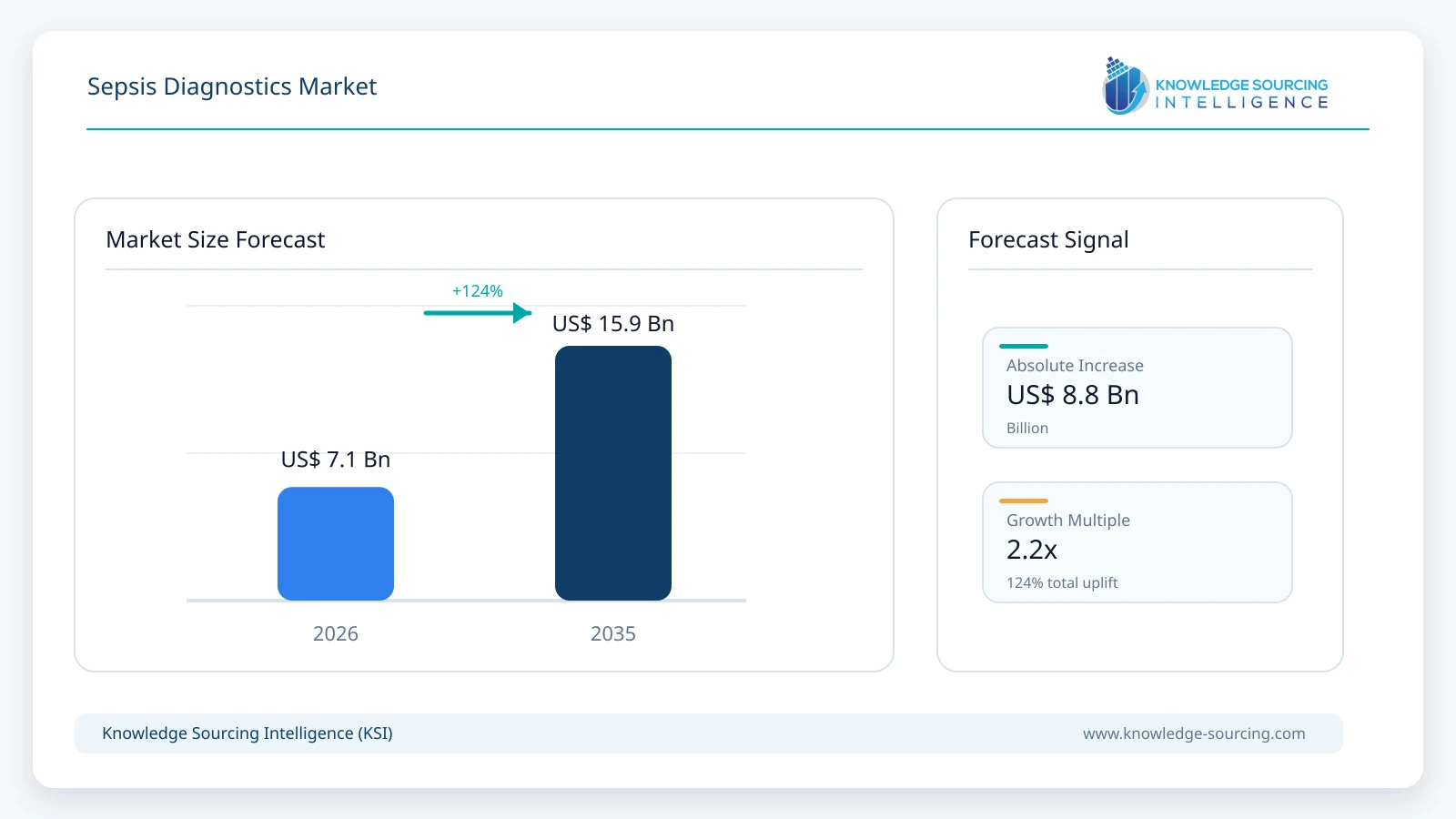
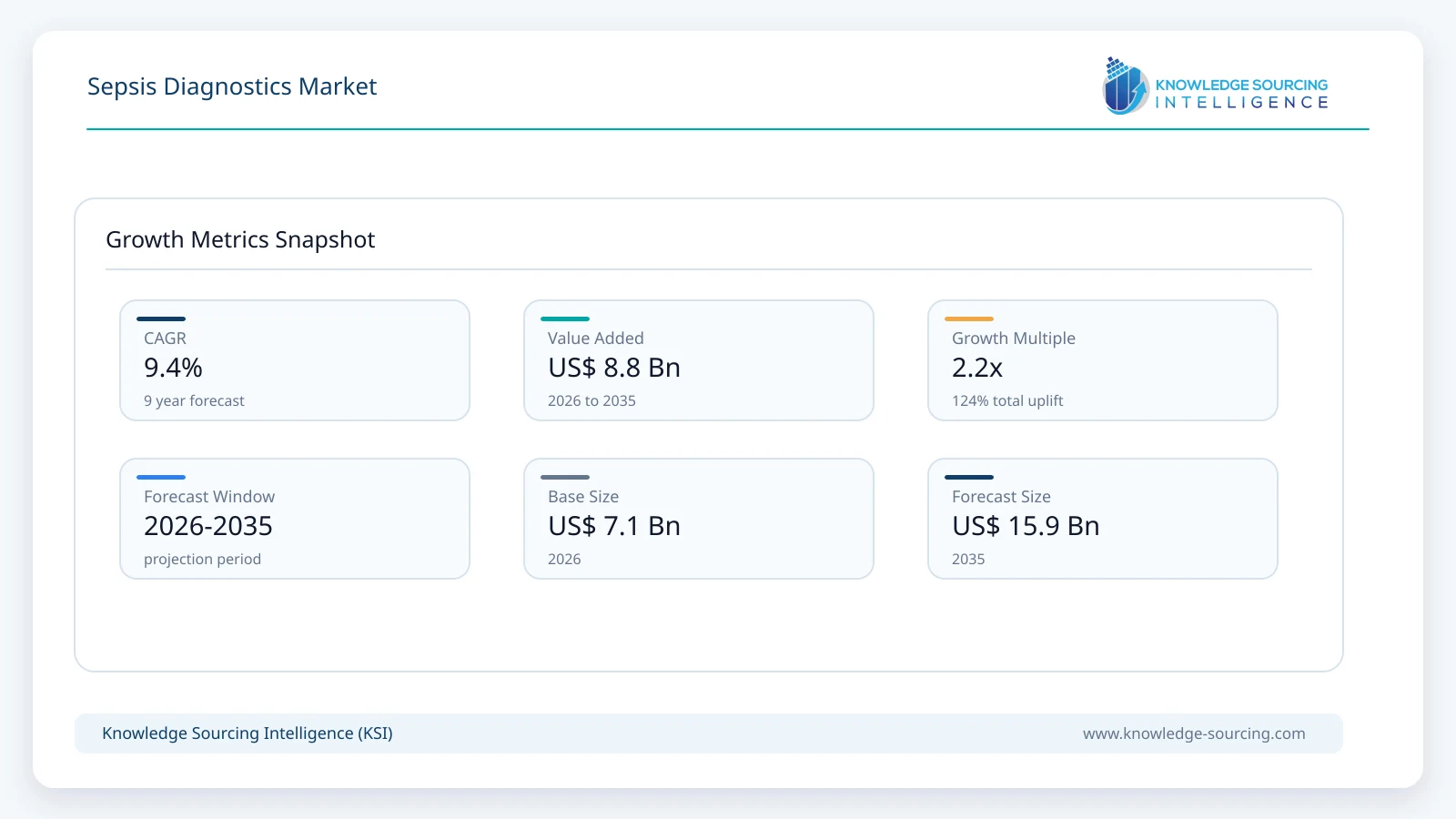
The Sepsis Diagnostics Market is anticipated to grow at a CAGR of 9.4% from USD 7.10 billion in 2026 to USD 15.93 billion in 2035.
Highlights:
- 1Rising emphasis on early sepsis intervention is increasing demand for rapid diagnostics because treatment delays significantly affect clinical outcomes.
- 2Expansion of antimicrobial stewardship programs is strengthening demand for pathogen identification technologies because healthcare systems seek more targeted antibiotic use.
- 3Increasing utilization of biomarker-guided decision-making is raising demand for PCT and multi-biomarker testing because clinicians require greater diagnostic confidence.
- 4Growth of molecular diagnostics is increasing adoption because conventional culture-based workflows often require longer turnaround times.
Sepsis diagnosis depends on timely clinical and laboratory evidence because treatment effectiveness declines as disease progression accelerates. Demand is increasing for rapid diagnostic solutions because clinicians seek to reduce delays in pathogen identification and therapeutic intervention. This requirement elevates the importance of molecular testing, biomarker analysis, and automated microbiology platforms. Healthcare providers are expanding diagnostic capabilities to support early recognition programs. The result is increasing utilization of advanced sepsis diagnostics.
Antimicrobial stewardship initiatives rely on accurate diagnostic information because inappropriate antibiotic use contributes to resistance and resource burden. Demand is shifting toward diagnostics that provide earlier confirmation of infection because clinicians require greater confidence in treatment decisions. This expectation raises the value of technologies capable of identifying pathogens and host-response patterns simultaneously. Diagnostic manufacturers are developing integrated testing solutions to address these needs. The outcome is broader adoption of multi-modal diagnostic approaches.
Regulatory agencies emphasize clinical performance because diagnostic outcomes directly influence patient management in critical care environments. Demand is increasing for validated diagnostic systems because hospitals require evidence of analytical accuracy and clinical utility. Diagnostic companies are strengthening validation programs and real-world evidence generation to support adoption. This response reinforces the strategic importance of diagnostics within sepsis management.
Market Dynamics
Market Drivers
Increasing Focus on Early Sepsis Recognition: Early intervention improves outcomes because sepsis progression frequently leads to severe complications when diagnosis is delayed. Demand is increasing for rapid testing because clinicians require actionable information during the earliest stages of patient assessment. This need creates pressure on healthcare systems to reduce diagnostic turnaround times. Hospitals are implementing accelerated sepsis protocols supported by advanced diagnostics. The outcome is stronger adoption of rapid diagnostic technologies.
Expansion of Antimicrobial Stewardship Programs: Antibiotic stewardship depends on accurate infection identification because empirical treatment strategies can contribute to resistance and unnecessary healthcare costs. Demand is increasing for diagnostic tools that differentiate infectious and non-infectious conditions because clinicians seek more targeted treatment approaches. This requirement expands interest in molecular diagnostics and biomarker testing. Healthcare organizations are integrating diagnostic data into stewardship initiatives. The result is increasing utilization of advanced sepsis diagnostics.
Rising Adoption of Biomarker-Based Testing: Biomarkers support clinical decision-making because physiological responses frequently provide early evidence of infection severity. Demand is increasing for PCT, CRP, and multi-biomarker testing because healthcare providers require greater diagnostic confidence. This requirement creates opportunities for expanded biomarker utilization. Diagnostic developers are advancing assay performance and accessibility to support broader adoption. The outcome is stronger integration of biomarker testing within sepsis management pathways.
Growth of Molecular Diagnostic Technologies: Molecular diagnostics enable rapid pathogen detection because traditional culture-based approaches may require extended processing times. Demand is increasing for PCR and multiplex molecular testing because clinicians seek earlier treatment guidance. This expectation raises the value of technologies capable of accelerating diagnostic workflows. Diagnostic companies are expanding molecular testing portfolios to address these needs. The result is increasing adoption of advanced molecular diagnostics.
Market Restraints
High implementation costs limit adoption because advanced molecular and automated diagnostic systems require significant capital investment.
Variability in reimbursement policies constrains utilization because healthcare providers often face uncertainty regarding diagnostic coverage.
Clinical workflow integration challenges restrict deployment because hospitals must adapt existing processes to accommodate new diagnostic technologies.
Market Opportunities
Expansion of Point-of-Care Diagnostics: Point-of-care testing improves accessibility because clinical decisions often require immediate diagnostic information. Demand is increasing for decentralized diagnostic solutions because emergency and critical care environments prioritize rapid intervention. This need creates opportunities for compact and automated testing platforms. Diagnostic developers are advancing portable technologies to support bedside decision-making. The outcome is growing commercial potential for point-of-care diagnostics.
Growth of AI-Assisted Sepsis Detection: Clinical datasets continue expanding because healthcare systems increasingly capture real-time patient information. Demand is increasing for predictive analytics because clinicians seek earlier recognition of sepsis risk. This expectation encourages development of AI-enabled diagnostic algorithms. Technology providers are integrating machine learning into clinical workflows to improve decision support. The result is expanding adoption of AI-assisted diagnostics.
Increasing Adoption of Multiplex Molecular Testing: Infection management depends on accurate pathogen identification because treatment effectiveness improves when causative organisms are rapidly detected. Demand is increasing for multiplex testing because clinicians seek broader diagnostic coverage from a single assay. This requirement supports investment in advanced molecular platforms. Diagnostic companies are expanding multiplex capabilities to improve clinical utility. The outcome is stronger demand for molecular sepsis diagnostics.
Development of Host-Response Diagnostics: Sepsis diagnosis frequently involves differentiating infection from other inflammatory conditions because clinical presentations often overlap. Demand is increasing for host-response testing because clinicians require additional evidence beyond pathogen detection. This challenge supports innovation in biomarker and cellular response analysis. Diagnostic developers are advancing novel host-response technologies to address diagnostic uncertainty. The result is growing interest in next-generation sepsis diagnostics.
Supply Chain Analysis
The sepsis diagnostics supply chain begins with manufacturers of microbiology systems, molecular testing platforms, reagents, assay kits, biomarkers, software solutions, and laboratory consumables. Demand is increasing because healthcare providers require faster and more comprehensive diagnostic capabilities. This dependence raises the importance of supply reliability and regulatory compliance. Manufacturers are expanding production and innovation efforts to support growing clinical requirements. The outcome is continued investment across the diagnostic ecosystem.
Patient samples move through emergency departments, intensive care units, clinical laboratories, and microbiology facilities because sepsis diagnosis often requires multiple analytical stages. Demand is increasing for streamlined workflows because treatment decisions depend on rapid diagnostic turnaround times. This expectation creates pressure for operational efficiency and automation. Healthcare organizations are implementing integrated laboratory systems to improve diagnostic performance. The result is stronger connectivity throughout the diagnostic pathway.
Diagnostic results influence antimicrobial stewardship, treatment selection, and patient monitoring because clinical outcomes depend on timely intervention. Demand is increasing for comprehensive testing because healthcare providers seek greater diagnostic confidence. This requirement strengthens the value of advanced diagnostic technologies. The outcome is sustained expansion of the sepsis diagnostics value chain.
Government Regulations
Region | Regulatory Authority | Regulatory Focus |
United States | FDA, CMS, CLIA | Diagnostic approvals, laboratory quality standards, molecular testing compliance |
European Union | European Commission, National Authorities | IVDR compliance, clinical evidence requirements |
United Kingdom | MHRA | Diagnostic performance and laboratory oversight |
Japan | PMDA | Infectious disease diagnostic approvals |
Market Segmentation
By Diagnostic Type
Diagnostic type segmentation reflects the need for faster and more accurate clinical decision-making because sepsis progression can rapidly worsen patient outcomes. Demand is increasing for molecular diagnostics because clinicians seek earlier pathogen identification than conventional culture methods often provide. This expectation supports continued utilization of blood culture diagnostics while increasing interest in automated and microbiology-based systems. Point-of-care diagnostics are gaining relevance because emergency settings require immediate clinical information. Healthcare providers are adopting multiple diagnostic approaches to improve accuracy and speed. The outcome is growing demand across diverse diagnostic categories.
By Biomarker Type
Biomarker testing supports clinical confidence because sepsis diagnosis often requires evidence beyond observable symptoms. Demand is increasing for PCT testing because clinicians seek improved differentiation between bacterial infection and other inflammatory conditions. This requirement strengthens utilization of CRP, lactate, and multi-biomarker panels. Presepsin and interleukin-based testing are gaining attention because healthcare providers seek additional predictive information regarding disease severity. Diagnostic developers are expanding biomarker capabilities to address these needs. The result is increasing integration of biomarker testing within sepsis management.
By Technology
Technology adoption reflects changing clinical priorities because healthcare providers require faster and more actionable diagnostic information. Demand is increasing for PCR and multiplex molecular testing because rapid pathogen identification improves treatment decisions. This requirement raises interest in next-generation sequencing and advanced immunoassays. Flow cytometry and mass spectrometry technologies are gaining importance because laboratories seek more comprehensive microbial and host-response analysis. Diagnostic companies are investing in automated and integrated testing platforms to improve efficiency. The outcome is expanding utilization of advanced diagnostic technologies.
Regional Analysis
North America
North America leads adoption of advanced sepsis diagnostics because healthcare systems place significant emphasis on early sepsis recognition and rapid intervention. Demand is increasing for molecular diagnostics and biomarker-based testing because hospitals face growing pressure to reduce mortality and improve critical care outcomes. This pressure increases investment in rapid pathogen identification technologies and automated laboratory systems. Healthcare providers are integrating sepsis screening protocols into emergency departments and intensive care units to accelerate treatment decisions. The region also benefits from strong reimbursement infrastructure, extensive critical care capacity, and widespread adoption of antimicrobial stewardship programs. Demand continues shifting toward AI-assisted diagnostic platforms because clinicians seek earlier risk stratification and predictive insights. The result is sustained utilization of advanced sepsis diagnostic technologies across major healthcare networks.
Europe
Europe maintains strong demand for sepsis diagnostics because healthcare authorities continue prioritizing antimicrobial stewardship and infection management programs. Demand is increasing for rapid microbiology and molecular testing because clinicians seek to reduce inappropriate antibiotic use and improve treatment precision. This objective increases adoption of automated microbiology systems and biomarker-based diagnostic approaches. Healthcare providers are expanding utilization of PCT-guided testing strategies to support antibiotic management decisions. Regulatory requirements under the In Vitro Diagnostic Regulation (IVDR) create additional emphasis on diagnostic quality and clinical validation. Diagnostic manufacturers are investing in compliance and evidence-generation initiatives to maintain market access. The outcome is growing adoption of validated diagnostic technologies throughout European healthcare systems.
Asia Pacific
Asia Pacific represents a significant growth opportunity because rising healthcare investment is improving access to advanced diagnostic technologies. Demand is increasing for sepsis diagnostics because population growth, expanding hospital infrastructure, and rising critical care utilization are increasing diagnostic requirements. This trend creates demand for both conventional microbiology and advanced molecular testing platforms. Healthcare systems are strengthening infectious disease management capabilities to address growing clinical burdens. Diagnostic companies are expanding regional partnerships and laboratory infrastructure to improve accessibility. Demand is also increasing for automated diagnostic systems because healthcare providers seek to manage growing patient volumes efficiently. The result is accelerating adoption of sepsis diagnostics across major Asia-Pacific markets.
Rest of the World
The Rest of the World region demonstrates increasing demand for sepsis diagnostics because healthcare systems are strengthening critical care capabilities and infection management programs. Demand is increasing for cost-effective and scalable diagnostic solutions because resource limitations often restrict access to advanced technologies. This challenge creates opportunities for simplified molecular platforms, biomarker testing, and automated microbiology systems. Healthcare providers are seeking faster diagnostic pathways to improve treatment outcomes while optimizing resource utilization. International collaborations and healthcare modernization initiatives are supporting broader adoption of advanced diagnostics. The outcome is gradual expansion of sepsis diagnostic capabilities across emerging healthcare markets.
Regulatory Landscape
Regulatory oversight focuses heavily on diagnostic accuracy because sepsis management depends on timely and reliable clinical information. Demand is increasing for validated diagnostic technologies because healthcare providers require confidence when making treatment decisions in high-acuity environments. This expectation strengthens regulatory scrutiny surrounding analytical performance, clinical utility, and quality management systems. Diagnostic manufacturers are investing in validation studies to satisfy evolving regulatory requirements. The outcome is greater emphasis on evidence-based adoption of sepsis diagnostic technologies.
Molecular diagnostics and AI-enabled diagnostic tools are receiving increased regulatory attention because these technologies are becoming more influential in clinical decision-making. Demand is increasing for rapid and predictive diagnostic solutions because healthcare systems seek earlier intervention opportunities. This requirement encourages regulatory agencies to develop frameworks that balance innovation with patient safety. Diagnostic developers are expanding clinical evidence generation programs to support regulatory approvals. The result is a progressively structured environment for advanced diagnostic commercialization.
Data governance requirements continue expanding because digital diagnostics and AI platforms increasingly rely on patient-specific clinical information. Demand is increasing for secure and compliant diagnostic ecosystems because healthcare providers and regulators prioritize patient privacy and data integrity. Diagnostic companies are strengthening cybersecurity, compliance, and quality assurance capabilities to address these expectations. The outcome is a growing intersection between diagnostic innovation and digital health governance.
Pipeline Analysis
The sepsis diagnostics pipeline increasingly focuses on reducing diagnostic turnaround times because delayed treatment remains a major contributor to adverse clinical outcomes. Demand is increasing for molecular testing platforms capable of identifying pathogens directly from patient samples because conventional culture methods often require extended processing periods. This limitation drives continued investment in PCR-based, multiplex molecular, and next-generation sequencing technologies. Diagnostic developers are advancing rapid detection systems to improve clinical responsiveness. The outcome is a growing pipeline of technologies designed to accelerate sepsis diagnosis.
Host-response diagnostics are gaining prominence because clinicians frequently require additional evidence beyond pathogen identification. Demand is increasing for biomarker panels and cellular response technologies because sepsis often presents with symptoms that overlap other inflammatory conditions. This diagnostic challenge encourages development of multi-biomarker approaches capable of improving diagnostic confidence. Companies are expanding research programs focused on immune response assessment and disease severity prediction. The result is increasing diversification within the sepsis diagnostics pipeline.
Artificial intelligence is becoming an important development area because healthcare systems generate large volumes of clinical and laboratory data. Demand is increasing for predictive diagnostic tools because clinicians seek earlier recognition of sepsis risk before clinical deterioration occurs. This expectation supports the development of AI-enabled diagnostic platforms and decision-support systems. Companies such as Prenosis and Cytovale are contributing to innovation in this area through technologies focused on rapid risk assessment and host-response evaluation. The outcome is a pipeline increasingly oriented toward predictive and precision diagnostics rather than solely pathogen detection.
Competitive Landscape
bioMérieux
bioMérieux remains strategically distinct because it combines leadership in clinical microbiology with a strong focus on infectious disease diagnostics and antimicrobial stewardship. Demand is increasing for rapid pathogen identification because clinicians require earlier treatment decisions in critically ill patients. This requirement strengthens the relevance of bioMérieux’s blood culture systems, molecular diagnostic platforms, and microbiology workflow solutions. Healthcare providers seek diagnostic approaches that shorten the interval between sample collection and therapeutic intervention. The company continues expanding automated microbiology capabilities because hospitals are pursuing faster and more standardized diagnostic pathways. This investment improves laboratory efficiency while supporting stewardship objectives. Demand is also increasing for integrated microbiology ecosystems because laboratories seek seamless connectivity between detection, identification, and susceptibility testing. bioMérieux is strengthening software and laboratory informatics offerings to address this requirement. The outcome is a competitive position supported by comprehensive microbiology expertise and extensive global adoption across hospital laboratories.
Becton Dickinson and Company
Becton Dickinson and Company remains strategically distinct because its blood culture technologies occupy a central role in sepsis diagnosis across healthcare systems. Demand is increasing for earlier bloodstream infection detection because delayed identification frequently contributes to poorer clinical outcomes. This expectation supports continued utilization of BD’s blood culture systems and microbiology platforms. Hospitals increasingly require diagnostic workflows that balance speed with diagnostic reliability. The company is enhancing automation and laboratory efficiency because healthcare providers seek to reduce manual intervention and improve consistency. Demand is also increasing for antimicrobial stewardship support because institutions face growing pressure to optimize antibiotic utilization. BD continues developing solutions that improve pathogen detection and susceptibility assessment. This approach strengthens its relevance within sepsis management programs. The result is a strong market position built on established microbiology infrastructure, extensive laboratory relationships, and ongoing innovation in infectious disease diagnostics.
Danaher Corporation
Danaher Corporation remains strategically distinct because its healthcare businesses provide technologies spanning molecular diagnostics, microbiology, life sciences, and laboratory automation. Demand is increasing for integrated diagnostic workflows because clinicians require comprehensive information from multiple diagnostic modalities. This need increases the value of Danaher-associated platforms supporting molecular testing and microbiological analysis. Healthcare providers are pursuing workflow efficiency because diagnostic delays directly affect patient outcomes in sepsis management. The company continues investing in automation and advanced diagnostic technologies to address these requirements. Demand is also increasing for scalable laboratory systems because healthcare institutions face rising testing complexity and operational pressures. Danaher’s diversified technology portfolio supports adoption across multiple stages of the sepsis diagnostic pathway. The outcome is a competitive advantage created by broad technological capabilities and participation across several critical segments of the diagnostic value chain.
F. Hoffmann-La Roche
F. Hoffmann-La Roche remains strategically distinct because it combines extensive expertise in molecular diagnostics, laboratory testing, and healthcare innovation. Demand is increasing for biomarker-guided clinical decision-making because physicians require more precise information regarding infection severity and progression. This requirement supports continued utilization of Roche’s diagnostic platforms and biomarker testing solutions. Healthcare organizations increasingly seek diagnostic systems capable of integrating laboratory results into broader patient management strategies. The company continues advancing molecular and laboratory technologies because providers require improved diagnostic speed and reliability. Demand is also increasing for automated testing environments because healthcare systems face staffing pressures and rising patient volumes. Roche is strengthening laboratory automation capabilities to support these needs. The result is a strong position within the sepsis diagnostics market supported by technological breadth, global healthcare relationships, and a longstanding focus on diagnostic innovation.
QIAGEN
QIAGEN remains strategically distinct because it possesses extensive expertise in molecular diagnostics and sample-to-result workflow technologies. Demand is increasing for multiplex molecular testing because clinicians require broader pathogen coverage within limited diagnostic windows. This need supports adoption of QIAGEN's molecular diagnostic platforms and consumables. Healthcare providers are integrating molecular testing earlier in clinical workflows to improve treatment precision. The company continues strengthening infectious disease diagnostic capabilities through technological innovation and strategic collaborations. The result is a growing role in molecular sepsis diagnostics.
Siemens Healthineers
Siemens Healthineers remains strategically distinct because it combines laboratory diagnostics, biomarker testing, and healthcare informatics capabilities. Demand is increasing for biomarker-based clinical decision support because sepsis diagnosis often requires rapid differentiation between infection severity levels. This requirement increases utilization of laboratory testing platforms capable of delivering timely results. Healthcare systems are adopting integrated diagnostic solutions to support critical care workflows. The company continues expanding diagnostic offerings designed to improve clinical efficiency and patient management. The outcome is sustained relevance within the sepsis diagnostics market.
Sysmex Corporation
Sysmex Corporation remains strategically distinct because it integrates hematology expertise with expanding infectious disease diagnostic capabilities. Demand is increasing for host-response analysis because clinicians seek additional information beyond conventional pathogen identification methods. This need supports interest in cellular and biomarker-based diagnostic approaches. Healthcare providers are incorporating broader diagnostic perspectives into sepsis management strategies. The company continues advancing technologies that support rapid clinical assessment and laboratory efficiency. The result is increasing participation in the evolving sepsis diagnostics landscape.
Future Market Outlook
The future of sepsis diagnostics increasingly depends on speed because clinical outcomes deteriorate as delays in diagnosis and treatment accumulate. Demand is increasing for technologies capable of delivering actionable information within hours rather than days. This expectation creates pressure on diagnostic developers to reduce turnaround times while maintaining analytical accuracy. Healthcare systems are prioritizing investments in rapid testing platforms to improve patient outcomes. The result is continued migration toward accelerated diagnostic workflows.
Molecular diagnostics are becoming increasingly important because conventional microbiology approaches often struggle to meet evolving clinical expectations for rapid pathogen identification. Demand is increasing for multiplex testing because clinicians require broader diagnostic coverage during the initial stages of patient management. This need strengthens investment in advanced molecular technologies and automation platforms. Diagnostic manufacturers are expanding innovation efforts to improve sensitivity, specificity, and workflow efficiency. The outcome is sustained growth in molecular diagnostic adoption.
Sepsis Diagnostics Market Scope:
| Report Metric | Details |
|---|---|
| Total Market Size in 2026 | USD 7.10 billion |
| Total Market Size in 2035 | USD 15.93 billion |
| Forecast Unit | USD Billion |
| Growth Rate | 9.4% |
| Study Period | 2021 to 2035 |
| Historical Data | 2021 to 2024 |
| Base Year | 2025 |
| Forecast Period | 2026 – 2035 |
| Segmentation | Diagnostic Type, Biomarker Type, End User, Geography |
| Companies |
|
Market Segmentation
Diagnostic Type
Biomarker Type
End User
Geography
- North America
- South America
- Europe
- Middle East and Africa
- Asia Pacific
Table of Contents
1. EXECUTIVE SUMMARY
1.1 Market Snapshot
1.2 Key Findings
1.3 Analyst Insights
1.4 Strategic Recommendations
2. RESEARCH METHODOLOGY
2.1 Research Design
2.2 Data Collection Methodology
2.3 Market Size Estimation
2.4 Forecasting Model
2.5 Assumptions & Limitations
3. SEPSIS DIAGNOSTICS MARKET OVERVIEW, SIZE & FORECAST
3.1 Market Definition & Scope
3.2 Sepsis Diagnostics Industry Overview
3.3 Industry Evolution
3.4 Key Market Trends
3.5 Historical Market Size Analysis (2021–2025)
3.6 Market Forecast Analysis (2026–2035)
3.7 Sepsis Disease Burden Analysis
3.8 Sepsis Incidence and Diagnosed Patient Population Analysis
3.9 Intensive Care Unit (ICU) Patient Population Analysis
3.10 Sepsis Testing Volume Analysis
3.11 Clinical Pathway and Patient Journey Analysis
3.12 Antimicrobial Stewardship and Diagnostic Utilization Trends
4. MARKET DYNAMICS
4.1 Market Drivers
4.2 Market Restraints
4.3 Market Opportunities
4.4 Market Challenges
5. INDUSTRY LANDSCAPE
5.1 Industry Value Chain Analysis
5.2 Pricing Analysis
5.3 Reimbursement Landscape
6. INNOVATION LANDSCAPE
6.1 Emerging Technologies in Sepsis Diagnostics
6.2 Product Innovation
6.3 Clinical Trial Analysis
6.4 Pipeline Analysis
6.5 Technology Roadmap
6.6 AI Integration in Sepsis Detection and Clinical Decision Support
6.7 Digital Health Integration and Automated Diagnostic Workflows
7. REGULATORY LANDSCAPE
7.1 Regulatory Framework
7.2 Approval Pathways
7.3 Compliance Requirements
8. SEPSIS DIAGNOSTICS MARKET LANDSCAPE ANALYSIS
8.1 Analysis by Technology Platform
8.2 Analysis by Biomarker Type
8.3 Analysis by Sample Type
8.4 Analysis by Clinical Application
8.5 Analysis by Testing Methodology
9. SEPSIS DIAGNOSTICS MARKET SEGMENT ANALYSIS (2021–2035)
9.1 By Diagnostic Type
9.1.1 Blood Culture Diagnostics
9.1.2 Molecular Diagnostics
9.1.3 Biomarker-Based Diagnostics
9.1.4 Point-of-Care Diagnostics
9.1.5 Microbiology-Based Diagnostics
9.1.6 Automated Diagnostic Systems
9.2 By Biomarker Type
9.2.1 Procalcitonin (PCT) Testing
9.2.2 C-Reactive Protein (CRP) Testing
9.2.3 Interleukin-Based Biomarker Testing
9.2.4 Lactate Testing
9.2.5 Presepsin Testing
9.2.6 Multi-Biomarker Panels
9.3 By Technology
9.3.1 Polymerase Chain Reaction (PCR)
9.3.2 Multiplex Molecular Testing
9.3.3 Next-Generation Sequencing (NGS)
9.3.4 Immunoassays
9.3.5 Flow Cytometry
9.3.6 Mass Spectrometry-Based Diagnostics
9.4 By End User
9.4.1 Hospitals
9.4.2 Intensive Care Units
9.4.3 Diagnostic Laboratories
9.4.4 Academic and Research Institutes
9.4.5 Emergency Care Centers
10. SEPSIS DIAGNOSTICS MARKET GEOGRAPHICAL ANALYSIS (2021–2035)
10.1 North America
10.2 Europe
10.3 Asia-Pacific
10.4 South America
10.5 Middle East & Africa
11. SEPSIS DIAGNOSTICS MARKET COUNTRY ANALYSIS (2021–2035)
11.1 United States
11.2 Canada
11.3 Germany
11.4 United Kingdom
11.5 France
11.6 Italy
11.7 Spain
11.8 Japan
11.9 China
11.10 India
11.11 South Korea
11.12 Australia
11.13 Brazil
11.14 Saudi Arabia
11.15 South Africa
12. COMPETITIVE LANDSCAPE
12.1 Market Share Analysis
12.2 Strategic Developments
12.3 Mergers & Acquisitions, Partnerships & Collaborations
12.4 Product Launches
13. COMPANY PROFILES
13.1 bioMérieux
13.2 Becton Dickinson and Company
13.3 Danaher Corporation
13.4 F. Hoffmann-La Roche
13.5 Abbott Laboratories
13.6 Thermo Fisher Scientific
13.7 QIAGEN
13.8 Siemens Healthineers
13.9 Sysmex Corporation
13.10 Bruker Corporation
13.11 Accelerate Diagnostics
13.12 T2 Biosystems
13.13 OraSure Technologies
13.14 Cytovale
13.15 Prenosis
14. SEPSIS DIAGNOSTICS MARKET COMMERCIAL FORECAST ANALYSIS
14.1 Blood Culture Diagnostics Forecast
14.2 Molecular Sepsis Diagnostics Forecast
14.3 Biomarker-Based Diagnostics Forecast
14.4 Point-of-Care Sepsis Diagnostics Forecast
14.5 Procalcitonin Testing Forecast
14.6 Multiplex Molecular Testing Forecast
14.7 Rapid Pathogen Identification Systems Forecast
14.8 AI-Enabled Sepsis Diagnostic Platforms Forecast
15. INVESTMENT & FUNDING ANALYSIS
15.1 Venture Capital Trends
15.2 Government Funding
15.3 R&D Investments
16. FUTURE OUTLOOK
16.1 Key Growth Opportunities
16.2 Future Industry Trends
Navigate
Trusted by the world's leading organizations











