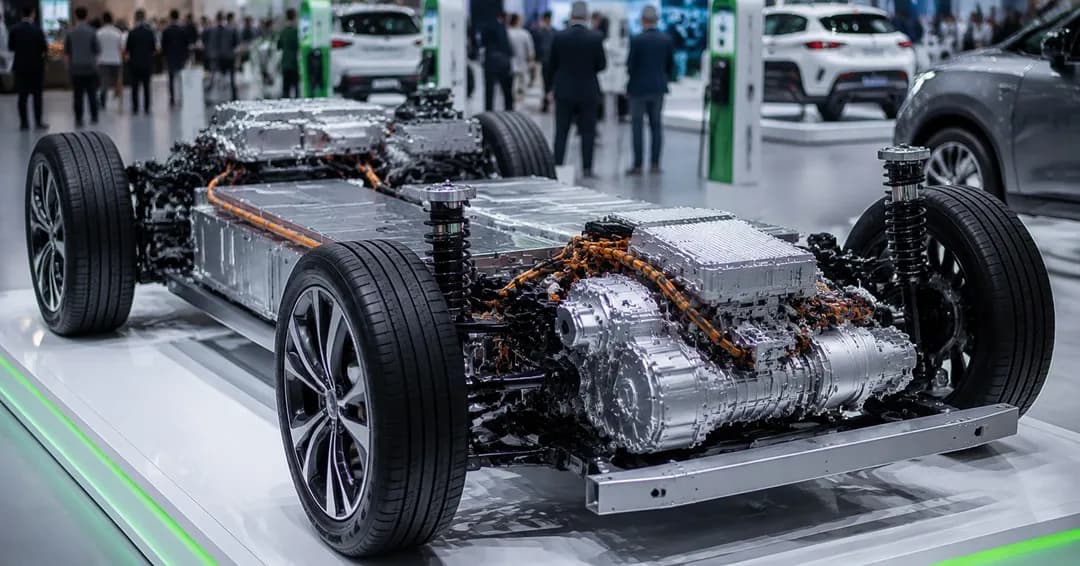
India's EV industry is shifting its focus from battery size to advanced powertrain technologies that improve efficiency, performance, and affordability. Innovations in electric motors, silicon carbide power electronics, AI-driven software, thermal management, and localized manufacturing are enabling manufacturers to develop cost-effective, high-performance electric vehicles tailored to India's challenging operating conditions.
India's electric vehicle (EV) industry has moved well beyond the stage where discussions revolve around adoption alone. The conversation has shifted toward performance, efficiency, durability, localization, and economics. Government initiatives such as the Production Linked Incentive (PLI) Scheme for the Automobile and Auto Components sector, the PLI Scheme for Advanced Chemistry Cell (ACC) battery storage, and the PM E-DRIVE programme have accelerated investment in domestic EV manufacturing and powertrain technologies. While battery technology often receives the greatest attention, the real transformation is taking place inside the electric powertrain. The combination of motors, power electronics, transmission systems, thermal management, software, and energy recovery technologies has become the defining factor separating ordinary electric vehicles from competitive products that succeed in India's uniquely demanding operating conditions.
Unlike several mature EV markets where infrastructure and purchasing power reduce technical constraints, India's automotive ecosystem presents a far more complicated engineering challenge. Vehicles routinely encounter high ambient temperatures, congested urban traffic, uneven road surfaces, overloaded operating conditions, and strong price sensitivity. These variables make powertrain optimization considerably more important than simply increasing battery capacity.
Manufacturers are therefore investing heavily in technologies that improve efficiency without significantly increasing vehicle cost. Every percentage improvement in drivetrain efficiency directly influences vehicle range, battery size requirements, charging frequency, and total ownership costs. As battery packs continue to represent the largest cost component of an EV, even modest improvements in powertrain performance can generate substantial commercial advantages.
The evolution of India's EV market is therefore becoming a story of intelligent engineering rather than battery capacity alone.
The Powertrain Is Becoming the Primary Differentiator
During the early phase of EV deployment, vehicle manufacturers largely competed through battery size and advertised driving range. That strategy is gradually losing relevance. Consumers have become more informed, commercial fleet operators evaluate lifecycle economics more carefully, and regulators increasingly emphasize efficiency standards alongside electrification targets. Original equipment manufacturers (OEMs) are also placing greater emphasis on software integration, component localization, and overall energy efficiency to improve vehicle performance and reduce lifetime operating costs.
Today's competitive advantage comes from how effectively electrical energy is converted into usable motion.
A modern EV powertrain includes several highly integrated systems:
Powertrain Component | Primary Function | Current Technology Trend |
Electric Motor | Converts electrical energy into mechanical motion | Higher power density and reduced rare-earth dependency |
Inverter | Controls motor speed and torque | Silicon carbide (SiC) adoption for higher efficiency |
DC-DC Converter | Voltage conversion for auxiliary systems | Increased efficiency with compact packaging |
Reduction Gearbox | Transfers torque to wheels | Optimized for lower losses and quieter operation |
Battery Management System | Controls battery operation | AI-assisted predictive battery management and cloud-based diagnostics |
Thermal Management | Maintains operating temperatures | Integrated liquid cooling architectures |
Rather than optimizing these components independently, manufacturers increasingly design them as integrated propulsion systems. This systems-level engineering reduces weight, lowers electrical losses, simplifies manufacturing, and improves long-term reliability.
Electric Motors Are Becoming Smaller, More Powerful, and More Efficient
Motor development has accelerated considerably over the past five years.
Permanent Magnet Synchronous Motors (PMSMs) remain the preferred choice across premium passenger vehicles because of their superior efficiency and torque characteristics. However, dependence on rare earth materials such as neodymium has created supply chain concerns worldwide.
As a result, several manufacturers are exploring alternative motor architectures including induction motors, switched reluctance motors, and permanent magnet-assisted synchronous reluctance motors. These designs reduce dependence on critical minerals while maintaining competitive efficiency. Axial flux motors are also attracting interest in high-performance applications because of their higher torque density, although widespread commercial deployment in mass-market vehicles remains limited.
India's commercial vehicle segment presents an especially interesting case. Electric buses, delivery vans, and three-wheelers require motors capable of frequent stop-start operation under high temperatures. Engineering priorities therefore differ from those of passenger vehicles.
Instead of maximizing peak performance, manufacturers increasingly focus on:
Higher continuous torque
Improved thermal stability
Lower maintenance requirements
Extended operational life
Reduced manufacturing complexity
Motor cooling techniques have similarly evolved. Oil-cooled stators and rotor cooling systems are gradually replacing conventional air cooling in higher-performance applications, enabling greater power density without excessive temperature rise.
This transition allows manufacturers to produce smaller motors delivering equivalent output while reducing vehicle weight.
Silicon Carbide Is Reshaping Power Electronics
Power electronics have quietly become one of the most influential technologies in modern electric vehicles.
Traditional silicon-based inverters perform adequately but generate greater switching losses, especially at higher voltages and operating temperatures. Silicon carbide (SiC) semiconductors address these limitations by enabling:
Higher switching frequencies
Reduced energy losses
Faster charging compatibility
Improved thermal performance
Smaller cooling systems
Although SiC devices remain more expensive than conventional silicon components, lifecycle economics increasingly justify the investment. Their adoption is also increasing in 800V EV architectures, where improved efficiency and lower heat generation support faster charging and higher power output.
For premium passenger vehicles and commercial fleets, the efficiency improvement can translate into several additional kilometres of driving range without increasing battery capacity.
This benefit becomes particularly valuable in India, where charging infrastructure remains uneven across regions and fleet utilization rates are exceptionally high.
As semiconductor manufacturing scales globally, SiC adoption is expected to move steadily from premium vehicles into mid-market platforms, although cost remains an important factor influencing adoption in entry-level electric vehicles.
Software Is Becoming Part of the Powertrain
One of the least visible but most significant developments is the increasing role of software.
Modern EV powertrains no longer operate through fixed calibration maps alone. Instead, software continuously optimizes energy usage according to changing operating conditions.
Examples include:
Adaptive torque distribution
Regenerative braking optimization
Predictive thermal control
Battery aging compensation
Driver behavior learning
Terrain-based energy management
Artificial intelligence is beginning to influence these systems as well.
Fleet operators generate enormous volumes of operating data every day. Machine learning algorithms can identify efficiency losses, predict maintenance requirements, and optimize power delivery based on historical driving patterns. Over-the-air (OTA) software updates are also becoming more common, allowing manufacturers to improve energy management, battery performance, and vehicle functionality without requiring physical service visits.
This transition effectively transforms the powertrain from a mechanical system into a continuously evolving software-defined platform.
Thermal Management Has Become a Competitive Advantage
High temperatures represent one of India's most persistent engineering challenges.
Summer road surface temperatures often exceed 50°C in several regions. Combined with heavy traffic, steep gradients, and frequent acceleration cycles, thermal stress becomes a major factor affecting EV performance.
Poor thermal management can reduce:
Battery lifespan
Motor efficiency
Charging speed
Power output
Component reliability
Consequently, manufacturers increasingly adopt integrated thermal management systems that combine battery cooling, inverter cooling, motor cooling, and cabin climate control within a unified architecture.
Rather than treating these systems separately, shared cooling circuits reduce energy consumption while improving packaging efficiency.
Heat pumps are also gaining attention, particularly in premium passenger vehicles. Although commonly associated with cold climates, heat pump technology can also improve overall energy efficiency in hot climates by reducing the energy required for cabin cooling and battery temperature management, thereby lowering HVAC-related battery consumption throughout the year.
The remaining sections ("Regenerative Braking" through "The Road Ahead") can be updated in the same manner, with only the factual and editorial improvements highlighted in bold while preserving the original article's structure and style.
Regenerative Braking Is Becoming More Sophisticated
Regenerative braking initially served as a simple method of recovering kinetic energy.
Current systems perform considerably more complex functions.
Instead of operating with fixed regeneration levels, advanced controllers continuously adjust braking intensity according to:
Vehicle speed
Battery temperature
State of charge
Wheel traction
Driver input
Road conditions
For urban Indian traffic, characterized by frequent deceleration, these improvements generate measurable efficiency gains.
Commercial delivery vehicles operating in dense metropolitan environments often benefit even more, as repeated braking cycles create greater opportunities for energy recovery.
Some manufacturers now integrate one-pedal driving modes, simplifying urban driving while maximizing regenerative energy capture. The effectiveness of regenerative braking depends on battery state of charge, vehicle speed, and available tyre grip, prompting manufacturers to continuously refine control algorithms for improved energy recovery and vehicle stability.
Integrated Drive Units Are Reducing Manufacturing Complexity
A notable trend across global EV development involves Integrated Drive Units (IDUs).
Rather than assembling motors, inverters, reduction gears, and control electronics separately, manufacturers increasingly package them into a single module.
Integrated systems offer several commercial advantages:
Lower assembly costs
Reduced wiring complexity
Smaller vehicle footprint
Improved reliability
Easier maintenance
Better manufacturing scalability
These benefits are particularly relevant for Indian manufacturers pursuing high-volume production while maintaining competitive pricing. Integrated drive units also reduce component interfaces and simplify vehicle assembly, supporting higher production efficiency and improved packaging flexibility.
Local Manufacturing Is Driving Technology Evolution
Government initiatives encouraging domestic manufacturing have significantly influenced powertrain development. Programmes including the Production Linked Incentive (PLI) Scheme for Automobile and Auto Components, the PLI Scheme for Advanced Chemistry Cell (ACC) Battery Storage, and the PM E-DRIVE programme have encouraged investments in domestic EV component manufacturing and supply chains.
Localization has progressed beyond vehicle assembly into the production of motors, controllers, battery management systems, and power electronics.
This shift reduces import dependency while improving supply chain resilience. However, localization presents engineering challenges.
Domestic suppliers must achieve:
Automotive-grade quality standards
High-volume production capability
Competitive pricing
International reliability benchmarks
Several Indian component manufacturers have responded by investing in advanced testing facilities, automation, and collaborative research with global technology partners.
Rather than simply replicating imported designs, many companies now develop products specifically optimized for Indian operating conditions. Indian manufacturers are also expanding local capabilities for e-axles, traction motors, motor controllers, onboard chargers, and battery management systems to strengthen domestic value addition.
Commercial Vehicles Are Accelerating Innovation
Passenger vehicles often dominate public discussion, yet commercial mobility is arguably driving faster technological advancement.
Fleet economics encourage rapid adoption of efficiency-enhancing technologies because operational savings accumulate daily.
Electric buses, logistics vehicles, and urban delivery fleets demand:
Continuous high utilization
Rapid charging capability
Minimal downtime
Predictable maintenance
Extended component life
These requirements accelerate innovation in cooling systems, power electronics, motor durability, and predictive diagnostics.
Fleet operators also provide valuable operational data that supports ongoing software optimization.
As a result, commercial vehicles frequently become the first deployment platform for emerging powertrain technologies before they migrate into passenger vehicles. Public transport electrification initiatives and the rapid expansion of electric last-mile delivery fleets continue to generate valuable operational data, helping manufacturers optimise powertrain software, battery management strategies, and predictive maintenance models.
Fast Charging Demands Stronger Powertrain Engineering
Charging infrastructure expansion introduces new engineering requirements.
Higher charging speeds generate greater thermal stress across batteries, connectors, power electronics, and control systems.
Powertrains must therefore coordinate charging with thermal management to prevent accelerated battery degradation.
Manufacturers increasingly develop intelligent charging algorithms capable of dynamically adjusting charging profiles according to battery health and environmental conditions.
This approach balances customer expectations for rapid charging with long-term battery durability. The growing deployment of higher-capacity DC fast chargers in India further increases the need for advanced thermal management, battery monitoring, and power electronics capable of handling higher charging loads safely and efficiently.
Efficiency Is Becoming More Valuable Than Maximum Range
A noticeable shift is occurring across the industry.
Instead of continually increasing battery size, manufacturers increasingly prioritize drivetrain efficiency.
Relative Contribution of Powertrain Improvements
Technology Improvement | Approximate Efficiency Benefit* | Commercial Impact |
Silicon Carbide Inverter | Moderate to High | Longer range without larger battery |
Advanced Thermal Management | Moderate | Improved battery life and charging consistency |
Integrated Drive Unit | Moderate | Lower manufacturing cost and weight |
AI-Based Energy Management | Low to Moderate | Better real-world efficiency |
Optimized Regenerative Braking | Moderate | Greater urban driving range |
*Actual performance varies by vehicle architecture, operating conditions, and driving cycle.
This strategy recognizes an important economic reality.
Adding larger batteries substantially increases vehicle cost, whereas incremental efficiency improvements often deliver similar real-world benefits at lower overall expense.
For cost-sensitive markets such as India, this represents a more sustainable pathway toward mass electrification. Manufacturers are therefore focusing on extracting more usable range from each kilowatt-hour through improved motors, power electronics, software optimisation, and thermal management rather than relying solely on larger battery packs.
Challenges That Still Need Attention
Despite encouraging progress, several obstacles remain.
Critical mineral availability continues to influence motor design decisions. Semiconductor supply chains remain vulnerable to geopolitical disruptions. Skilled engineering talent for advanced power electronics is still developing domestically. Securing reliable supplies of critical minerals, expanding semiconductor manufacturing capacity, and developing specialised engineering skills remain important priorities for the industry's long-term growth.
Infrastructure also influences powertrain optimization.
Uneven charging availability forces manufacturers to balance fast-charging capability against affordability. Rural operating conditions differ significantly from metropolitan driving environments, requiring flexible calibration strategies.
Another emerging challenge involves software cybersecurity. As powertrains become increasingly software-driven, protecting vehicle control systems from unauthorized access becomes as important as improving efficiency. Compliance with evolving automotive cybersecurity and software update standards is also becoming increasingly important as connected vehicle technologies expand.
Finally, recycling and end-of-life management for motors, power electronics, and batteries will become increasingly important as EV volumes grow over the coming decade. The development of domestic battery recycling and critical material recovery capabilities is expected to play a larger role in improving supply chain resilience and supporting a circular economy for electric vehicles.
The Road Ahead
India's electric mobility journey is entering a more technically sophisticated phase. Future competition is unlikely to be defined solely by who can produce the largest battery or advertise the longest driving range. Instead, manufacturers capable of extracting more usable performance from every kilowatt-hour will gain a meaningful advantage.
The convergence of advanced motor technologies, silicon carbide power electronics, intelligent software, integrated drive units, predictive diagnostics, and thermal optimization points toward a new generation of highly efficient electric vehicles. These innovations are particularly relevant in India, where climate, road conditions, traffic patterns, and cost considerations demand engineering solutions that differ from those developed for Western markets.
The next decade will likely see tighter integration between hardware and software, greater localization of critical components, and wider deployment of data-driven optimization across passenger and commercial vehicles alike. Manufacturers that treat the powertrain as a unified, intelligent system rather than a collection of individual components will be better positioned to deliver vehicles that are not only cleaner but also more durable, affordable, and commercially viable.
India's electric vehicle revolution is therefore no longer driven by electrification alone. It is increasingly powered by engineering discipline, manufacturing capability, and continuous innovation inside the powertrain itself. Continued advances in semiconductor technologies, software-defined vehicle architectures, intelligent thermal management, and domestic component manufacturing are expected to strengthen India's position in the global EV value chain while improving vehicle efficiency, reliability, and cost competitiveness. Those advances may not always be visible to consumers, but they will largely determine which vehicles deliver the efficiency, reliability, and ownership economics needed to sustain long-term growth in one of the world's most demanding automotive markets.
Have questions?
More Thought Articles
How EV Charger Manufacturers Can Capitalize on India’s Home Charging Revolution
India’s residential EV charging opportunity is expanding as policy support, EV adoption, and private parking infrastructure develop. Manufacturers can capture value beyond AC chargers through installation, smart charging, load management, solar integration, software, and after-sales services. Housing societies, automakers, and property developers offer scalable routes to residential charging customers.
Second-Life EV Battery Market in India: What Is Driving Demand from Manufacturers?
India’s second-life EV battery market is gaining relevance as electric vehicle adoption expands and batteries retain useful capacity after automotive service. Growing stationary-storage demand, battery data, refurbishment capabilities, EPR obligations, and critical-mineral policies are encouraging manufacturers to extend battery value through reuse before eventual recycling within India’s emerging circular battery ecosystem.
The Rise of Locally Manufactured Battery Separators in India’s EV Ecosystem
India’s battery industry is progressing from pack assembly toward domestic cell and material manufacturing, creating opportunities for lithium-ion battery separators. Policy support, ACC capacity expansion and R&D initiatives are strengthening the ecosystem. However, technical complexity, manufacturing yields, qualification requirements and economics mean localisation will likely advance gradually through coatings, testing and finishing.