
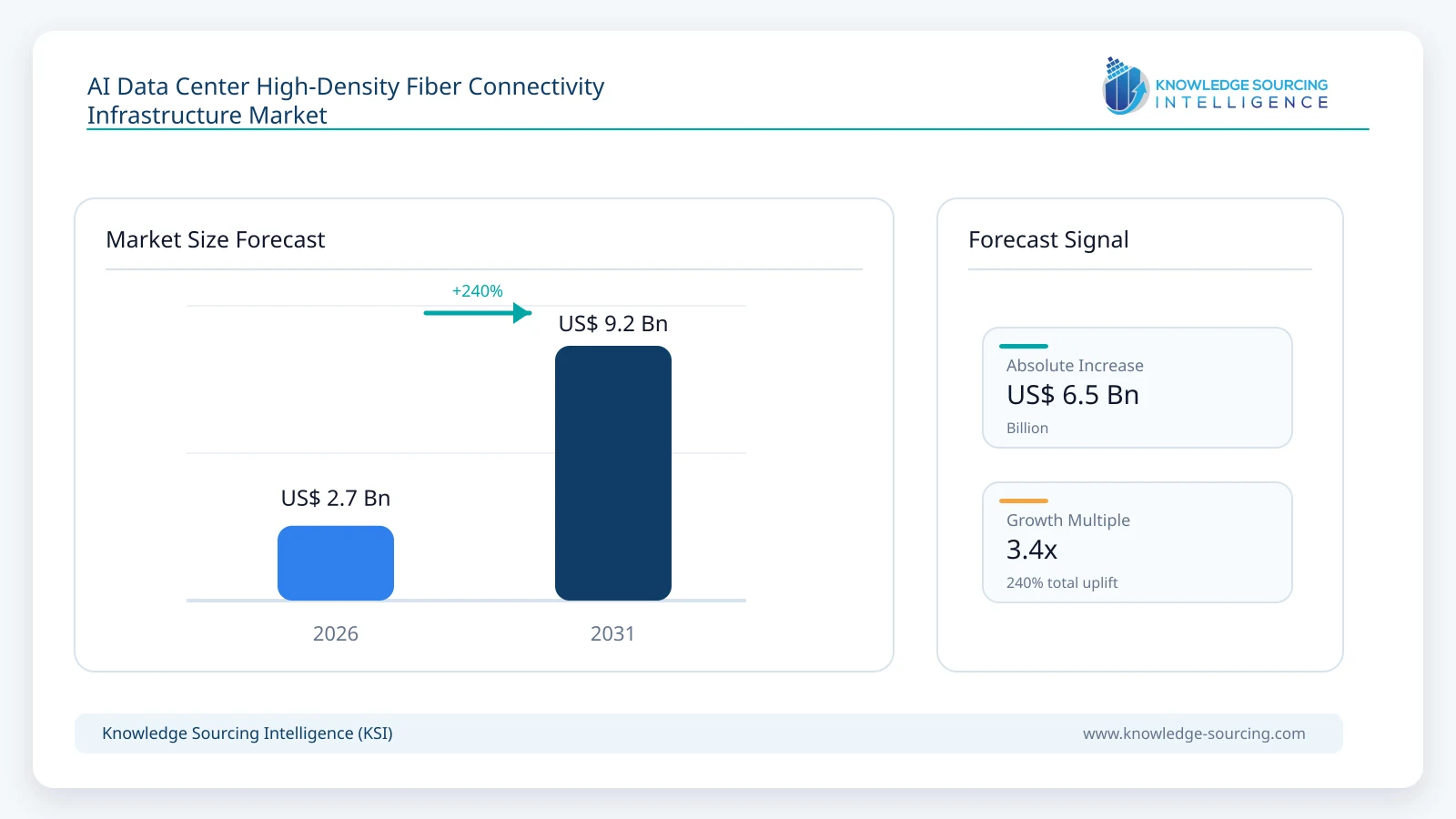
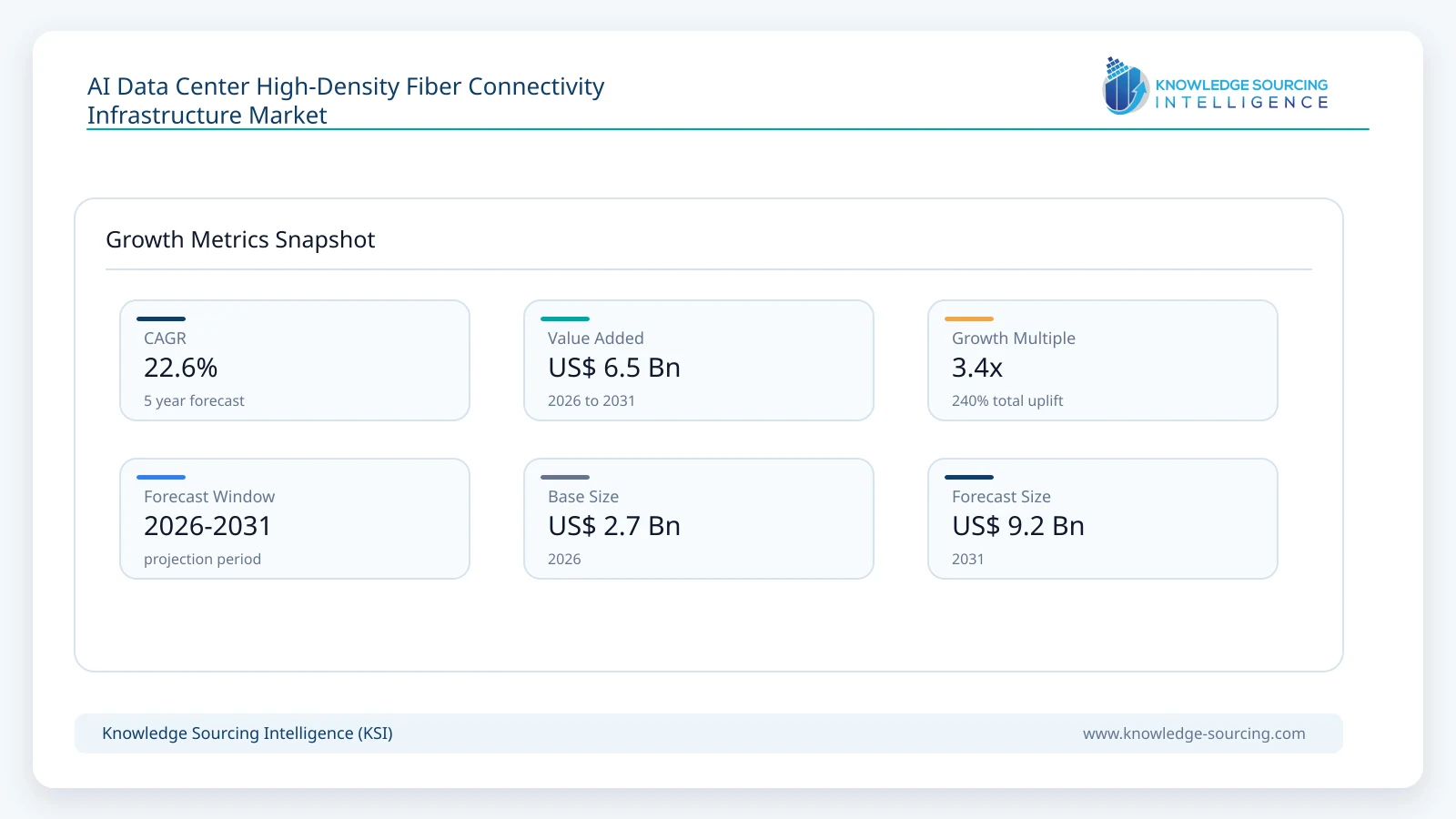
The AI Data Center High-Density Fiber Connectivity infrastructure Market is estimated at USD 2.70 billion in 2026 and is projected to reach USD 9.19 billion by 2032, representing a CAGR of 22.6% during the forecast period.
Key Highlights
· AI racks are moving beyond one thousand fiber connections as cluster scale increases.
· Future rack architectures may approach five thousand fibers in the densest deployments.
· Pre-terminated trunks and factory-integrated cabling reduce site labor on accelerated AI builds.
· High-fiber-count connectors are gaining share as patch-panel and pathway density becomes constrained.
· Single-mode fiber expands with 800G, 1.6T and longer AI campus interconnects.
· Multimode fiber remains relevant for selected short-reach and installed-base environments.
· Rack and row fiber management becomes more valuable as cable counts rise sharply.
· Optical backplanes and blind-mate connectors support serviceable high-density AI architectures.
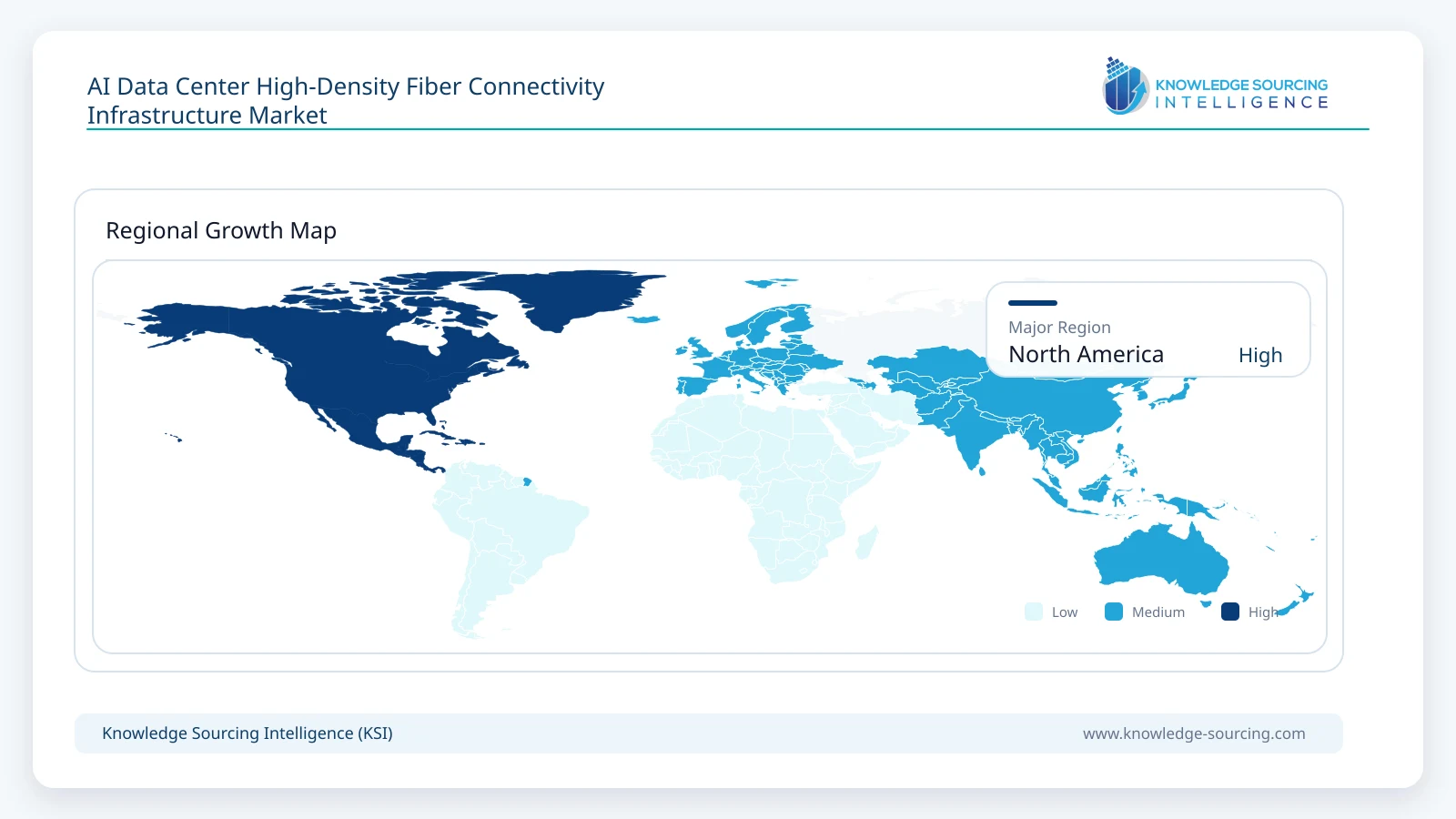
· North America leads demand through hyperscale AI investment and U.S. manufacturing expansion.
· Asia Pacific remains central to connector, cable-assembly and electronics manufacturing capacity.
· Connector cleaning and inspection automation is becoming important at very high fiber counts.
· Passive fiber content grows faster than rack count as more scale-up connectivity moves optical.
Market Overview
AI networking is increasing passive optical content in three ways. First, larger scale-out fabrics require more links between leaf, spine and core switching layers. Second, higher port speeds encourage migration from copper toward fiber at shorter distances because signal loss and thermal limits become harder to manage electrically. Third, scale-up networks inside and across racks are beginning to use optical paths for accelerator-to-accelerator communication. Each transition increases the number of fiber terminations, trunks, panels and management points required per deployed megawatt, even before active transceiver value is considered.
The physical layer is also becoming denser. Conventional MPO and LC connectivity remains widely deployed, but AI networks are driving smaller multi-fiber and very-small-form-factor interfaces that can place more fibers within the same faceplate or rack space. SENKO positions its SN-MT16 as having a footprint materially smaller than MPO while supporting 16 to 32 fibers. Molex's VersaBeam Mini supports 3,456 fibers within a 1RU panel, while CommScope's FastSelfClean technology is being introduced initially in a 144-fiber format. These designs target the operational problem created when hundreds or thousands of fibers must be installed, inspected, cleaned and serviced in a confined rack environment.
Deployment method is changing alongside connector density. Corning notes that hyperscalers are moving toward factory-built integration in which racks arrive with large numbers of fibers pre-installed, labeled, tested and documented. This shifts labor away from the construction site and improves repeatability across multi-building AI campuses. Pre-terminated trunks, modular panels, high-density cassettes and factory-assembled fiber harnesses therefore capture a larger share of connectivity value than traditional field termination, especially in standardized rack-scale and pod-level architectures.
Market Drivers
Fiber content per AI rack is increasing faster than rack count
The strongest structural driver is the rise in optical links attached to each high-density rack. Corning's 2026 outlook indicates that fiber density is moving above 1,000 fibers per rack and could eventually approach 5,000 in the most demanding designs. This reflects both higher switch port counts and the movement of optical connectivity closer to compute. A rack therefore creates more passive-connectivity revenue even if the number of deployed racks grows more slowly, because each rack requires more trunks, connectors, patching positions and managed fiber pathways.
1.6T and future 3.2T architectures increase single-mode fiber demand
Optical interconnect speeds are moving from 800G toward 1.6T and later 3.2T, increasing the importance of low-loss, high-density single-mode fiber paths. Faster links do not always require more physical fibers per connection, but larger AI clusters add more ports and extend optical reach into network locations previously served by copper. The result is higher fiber count across scale-out, campus and emerging scale-up domains. High-density connectors and reduced-diameter micro-cables become more valuable because operators must fit this additional capacity within finite rack, tray and conduit space.
Factory-integrated rack construction favors pre-terminated connectivity
AI deployments are increasingly built from repeatable racks, pods and infrastructure blocks rather than fully field-assembled networks. Factory integration allows fiber harnesses, patching and labeling to be installed and tested before equipment reaches the data center. This reduces field labor, connector contamination risk and commissioning time. Suppliers that can provide pre-engineered trunks, cassettes, backplanes and high-count connector systems therefore capture additional value beyond commodity bulk fiber, particularly where hyperscalers repeat the same architecture across multiple sites.
Supply-chain expansion confirms structural demand
Capacity investment is unusually visible in 2026. NVIDIA and Corning's partnership calls for a tenfold increase in U.S. optical-connectivity manufacturing capacity and more than 50% additional U.S. fiber production. Molex entered a long-term optical-cable supply agreement with Prysmian to support data-center growth, while Corning's agreements with major network operators also indicate broader pressure on fiber availability. These commitments support a forecast in which passive connectivity grows as a critical physical input rather than a low-value accessory to active optical equipment.
Restraints and Adoption Challenges
The main restraint is continuing cost reduction per fiber and connector as high-volume manufacturing improves. Hyperscale buyers exert strong pricing pressure and increasingly standardize passive connectivity across repeatable rack designs. Very high fiber counts also create installation and service complexity: dirty or damaged connector end faces, labeling errors, bend-radius violations and routing congestion can create difficult-to-diagnose failures. New connector formats may reduce density constraints but can fragment the ecosystem if operators adopt incompatible designs. Multicore fiber and optical backplanes offer substantial density gains, yet qualification, field serviceability and interoperability will determine how quickly they displace conventional single-core fiber and standardized connector systems.
Segment Analysis
By Product Type
Fiber cable and pre-terminated trunk assemblies represent the largest 2026 revenue pool because every AI fabric requires large quantities of backbone and distribution fiber across racks, rows, data halls and campus buildings. The category includes high-count indoor cable, micro-cable, ribbon and rollable-ribbon designs, breakout assemblies and factory-terminated trunks. High-density connector and patching systems are expected to grow faster as operators attempt to compress more fiber into the same rack footprint and reduce installation time.
Fiber-management and optical-backplane systems form a smaller but increasingly strategic category. These systems organize large numbers of fibers, preserve bend radius, support blind-mate serviceability and reduce the operational complexity of rack-scale integration. Factory-integrated assemblies are also expanding because they shift installation and testing upstream into controlled manufacturing environments. This segment grows particularly quickly in standardized AI racks and pods where every deployed unit can repeat the same cabling architecture.
Product / System | Revenue Contribution | Growth Direction | Primary AI Data Center Application |
Fiber cable and pre-terminated trunks | Largest revenue pool | Strong | Backbone, row and rack optical distribution |
High-density multi-fiber connectors | Large and expanding | Fast | Increase fiber count within constrained rack and panel space |
Patch panels, cassettes and distribution frames | Core installed layer | Strong | Termination, organization and change management |
Rack/row fiber management | Established support layer | Above average | Routing, bend-radius control and serviceability |
Optical backplane / blind-mate connectivity | Smaller 2026 base | Fastest emerging | Factory-integrated rack-scale optical architectures |
Installation, testing and factory integration | Recurring service layer | Strong | Pre-termination, labeling, inspection and commissioning |
Market and Technology Indicators
Indicator | Latest Development | Market Impact |
Fiber density per rack | Corning expects AI racks to exceed 1,000 fibers, with future designs potentially approaching 5,000. | Raises passive-connectivity content per rack materially. |
U.S. manufacturing expansion | NVIDIA-Corning partnership targets 10x optical-connectivity capacity and >50% more U.S. fiber capacity. | Confirms structural demand and supply-chain investment. |
Ultra-dense rack connectivity | Molex VersaBeam Mini supports up to 3,456 fibers in a 1RU panel. | Shows connector density becoming a primary design variable. |
Multi-fiber connector evolution | SENKO SN-MT16 supports 16-32 fibers in a footprint smaller than MPO. | Supports more ports per panel and smaller trunk assemblies. |
AI fiber supply agreements | Molex signed a long-term Prysmian cable-supply agreement for data-center demand. | Demonstrates procurement focus on fiber availability and capacity. |
High-density cleaning/serviceability | CommScope introduced a 144-fiber FastSelfClean connector concept for future AI racks. | Addresses maintenance and contamination risk as fiber counts increase. |
Regional Opportunity
North America
North America is the largest demand center for high-density AI data-center fiber connectivity because the United States combines the world's largest hyperscale and neocloud buildout with rapid deployment of 800G and 1.6T optical networking. Large campuses in Northern Virginia, Texas, the Midwest, the Pacific Northwest and other emerging hubs require fiber at several layers: within racks, between rows, across data halls, between campus buildings and into regional interconnect networks. As AI clusters expand, the passive fiber network becomes one of the largest repetitive physical components installed across each new phase.
The region is also seeing unusually visible localization investment. NVIDIA and Corning's 2026 partnership includes three new U.S. manufacturing facilities and a tenfold expansion in optical-connectivity capacity. Corning is simultaneously increasing domestic fiber output by more than 50%. Molex and Prysmian are scaling cable-assembly supply for data-center demand, while TE Connectivity, CommScope, US Conec and other suppliers maintain substantial engineering, connector and manufacturing activity supporting hyperscale programs. These investments reduce some supply risk but also signal that passive optical materials are becoming a critical path item for AI infrastructure.
Deployment practice favors higher-value pre-engineered systems. Hyperscalers increasingly standardize AI rack and pod designs and use pre-terminated fiber trunks, cassettes and harnesses to reduce on-site labor. The densest architectures also require smaller connectors, automated inspection and better routing because conventional patching becomes difficult at thousands of fibers per rack. Through 2032, North American growth is expected to be driven by new-build AI factories, repeated campus expansions and the replacement of copper with optical scale-up connectivity inside existing facilities.
Asia Pacific remains the principal manufacturing center for many connector, cable-assembly and electronics supply chains and is also a major deployment region across China, Japan, South Korea, Singapore, Malaysia, India and Australia. Europe combines hyperscale and sovereign-AI demand with a mature structured-cabling ecosystem. The Middle East is emerging as a large greenfield market where high-density fiber infrastructure can be integrated into AI campuses from initial design rather than retrofitted into constrained legacy pathways.
Competitive Landscape
The market includes global fiber manufacturers, structured-cabling companies, connector specialists and high-density interconnect suppliers. Corning has the broadest position across optical fiber, cable, connectors, data-center systems and emerging multicore-fiber solutions. CommScope, Leviton, Belden and Panduit participate strongly in structured cabling, panels and fiber management. Molex and TE Connectivity are expanding from connector and cable-assembly platforms into higher-density optical backplanes, blind-mate connectivity and near-chip optical interfaces.
Connector specialization is increasingly important. SENKO Advanced Components and US Conec develop multi-fiber and very-small-form-factor interfaces used across high-density data-center architectures, while Amphenol and Rosenberger provide broad connector and cable-assembly portfolios. Prysmian, Sumitomo Electric, Furukawa Electric / OFS, Fujikura and AFL contribute fiber, cable and connectivity manufacturing at scale. R&M and HUBER+SUHNER participate in high-density data-center cabling and optical-distribution systems. Competitive advantage depends on fiber density, insertion loss, connector reliability, ease of cleaning, automation compatibility, bend performance, factory integration and global manufacturing capacity.
Major companies and ecosystem participants covered: Corning, CommScope, Molex, TE Connectivity, SENKO Advanced Components, US Conec, Prysmian, Sumitomo Electric, Furukawa Electric / OFS, Fujikura, Leviton Network Solutions, Belden, Panduit, Amphenol, AFL, HUBER+SUHNER, R&M and Rosenberger.
Recent Developments
· September 2026: Molex introduced VersaBeam Mini, an ultra-dense 16-fiber expanded-beam connector supporting up to 3,456 fibers in a one-rack-unit panel.
· September 2026: Corning introduced additional AI-network cable and connectivity products including Contour Form Micro Cable, multicore fiber and high-density MMC connectivity.
· August 2026: Zayo and Corning expanded a long-term fiber-supply agreement supporting Zayo's plan to add 15,000 route miles by 2030 for AI and network demand.
· July 2026: Molex and Prysmian signed a long-term optical-cable supply agreement to expand capacity for AI-driven data-center deployments.
· June 2026: CommScope previewed FastSelfClean connector technology, initially targeting 144-fiber interfaces for ultra-dense AI racks.
· May 2026: NVIDIA and Corning announced a multiyear partnership covering a tenfold expansion of U.S. optical-connectivity manufacturing capacity.
· March 2026: Corning expanded its AI data-center portfolio with PRIZM TMT ferrule technology licensed from US Conec for higher-density fiber connectivity.
· March 2026: TE Connectivity showcased high-density fiber-array units, optical backplanes and blind-mate connectivity for next-generation AI data centers at OFC 2026.
AI Data Center High-Density Fiber Connectivity Infrastructure Market Scope:
| Report Metric | Details |
|---|---|
| Total Market Size in 2026 | USD 2.70 billion |
| Total Market Size in 2032 | USD 9.19 billion |
| Forecast Unit | USD Billion |
| Growth Rate | 22.6% |
| Study Period | 2021 to 2032 |
| Historical Data | 2021 to 2024 |
| Base Year | 2025 |
| Forecast Period | 2026 – 2032 |
| Segmentation | Product Type, Fiber Type, Connector Architecture, Deployment Layer, Customer Type, Geography |
| Companies |
|
Market Segmentation
By Product Type
Fiber Cable and Pre-Terminated Trunks
High-Density Multi-Fiber Connectors
Patch Panels, Cassettes and Distribution Frames
Rack and Row Fiber-Management Systems
Optical Backplane and Blind-Mate Connectivity
Installation, Testing and Factory Integration Services
By Fiber Type
Single-Mode Fiber
Multimode Fiber
Multicore and Emerging Fiber Architectures
By Connector Architecture
MPO / MTP
LC and Duplex Connectivity
VSFF Connectors
Expanded-Beam and Contactless Multi-Fiber Connectors
Blind-Mate / Backplane Optical Interfaces
By Deployment Layer
Within-Rack Connectivity
Rack-to-Rack / Row Connectivity
Data Hall Backbone
Campus Inter-Building Connectivity
Factory-Integrated AI Racks and Pods
By Customer Type
Hyperscale Cloud Providers
Neocloud and GPU-Cloud Operators
Colocation Providers
Sovereign AI Infrastructure
Enterprise and High-Performance Computing
By Geography
North America
United States
Canada
Europe
Asia Pacific
Middle East and Rest of World
Table of Contents
1. EXECUTIVE SUMMARY
1.1. Market Opportunity and Key Findings
1.2. Fiber-Density Evolution in AI Racks
1.3. Principal Revenue Pools
2. MARKET OVERVIEW
2.1. AI Network Topology and Passive Fiber Requirements
2.2. Transition from Copper to Fiber
2.3. High-Density Rack and Pod Connectivity
2.4. Factory-Integrated versus Field-Installed Cabling
2.5. Serviceability, Cleaning and Fiber Management
3. MARKET SIZE AND FORECAST, 2026-2032
3.1. Global Market Revenue
3.2. Annual Growth Analysis
3.3. Fiber Content per AI Rack and MW
3.4. Greenfield versus Retrofit Demand
4. MARKET BY PRODUCT TYPE
4.1. Fiber Cable and Pre-Terminated Trunks
4.2. High-Density Multi-Fiber Connectors
4.3. Patch Panels, Cassettes and Distribution Frames
4.4. Rack and Row Fiber-Management Systems
4.5. Optical Backplane and Blind-Mate Connectivity
4.6. Installation, Testing and Factory Integration Services
5. MARKET BY FIBER TYPE
5.1. Single-Mode Fiber
5.2. Multimode Fiber
5.3. Multicore and Emerging Fiber Architectures
6. MARKET BY CONNECTOR ARCHITECTURE
6.1. MPO / MTP
6.2. LC and Duplex Connectivity
6.3. VSFF Connectors
6.4. Expanded-Beam and Contactless Multi-Fiber Connectors
6.5. Blind-Mate / Backplane Optical Interfaces
7. MARKET BY DEPLOYMENT LAYER
7.1. Within-Rack Connectivity
7.2. Rack-to-Rack / Row Connectivity
7.3. Data Hall Backbone
7.4. Campus Inter-Building Connectivity
7.5. Factory-Integrated AI Racks and Pods
8. MARKET BY CUSTOMER TYPE
8.1. Hyperscale Cloud Providers
8.2. Neocloud and GPU-Cloud Operators
8.3. Colocation Providers
8.4. Sovereign AI Infrastructure
8.5. Enterprise and High-Performance Computing
9. REGIONAL MARKET
9.1. North America
9.1.1. United States
9.1.2. Canada
9.2. Europe
9.3. Asia Pacific
9.4. Middle East and Rest of World
10. MARKET DYNAMICS
10.1. Drivers
10.1.1. Increasing Fiber Content per AI Rack
10.1.2. 1.6T and 3.2T Optical Network Transition
10.1.3. Factory-Integrated Rack Construction
10.1.4. Optical Connectivity Manufacturing Expansion
10.2. Restraints
10.2.1. Falling Cost per Fiber and Hyperscale Pricing Pressure
10.2.2. Connector Cleaning and Maintenance Complexity
10.2.3. Connector-Format Fragmentation
10.2.4. Qualification of Multicore and New Optical Interfaces
11. COMPETITIVE LANDSCAPE
11.1. Value Chain
11.2. Fiber and Cable Manufacturers
11.3. High-Density Connector Suppliers
11.4. Structured Cabling and Fiber-Management Providers
11.5. Optical Backplane and Rack-Integration Suppliers
11.6. Manufacturing Capacity and Strategic Supply Agreements
12. COMPANY PROFILES
12.1. Corning
12.2. CommScope
12.3. Molex
12.4. TE Connectivity
12.5. SENKO Advanced Components
12.6. US Conec
12.7. Prysmian
12.8. Sumitomo Electric
12.9. Furukawa Electric / OFS
12.10. Fujikura
12.11. Leviton Network Solutions
12.12. Belden
12.13. Panduit
12.14. Amphenol
12.15. AFL
12.16. HUBER+SUHNER
12.17. R&M
12.18. Rosenberger
13. RECENT DEVELOPMENTS
14. APPENDIX
14.1. Definitions and Abbreviations
14.2. Fiber and Connector Architecture Classification
14.3. Rack and Campus Connectivity Framework
14.4. Source and Data Notes
Navigate
Trusted by the world's leading organizations











