
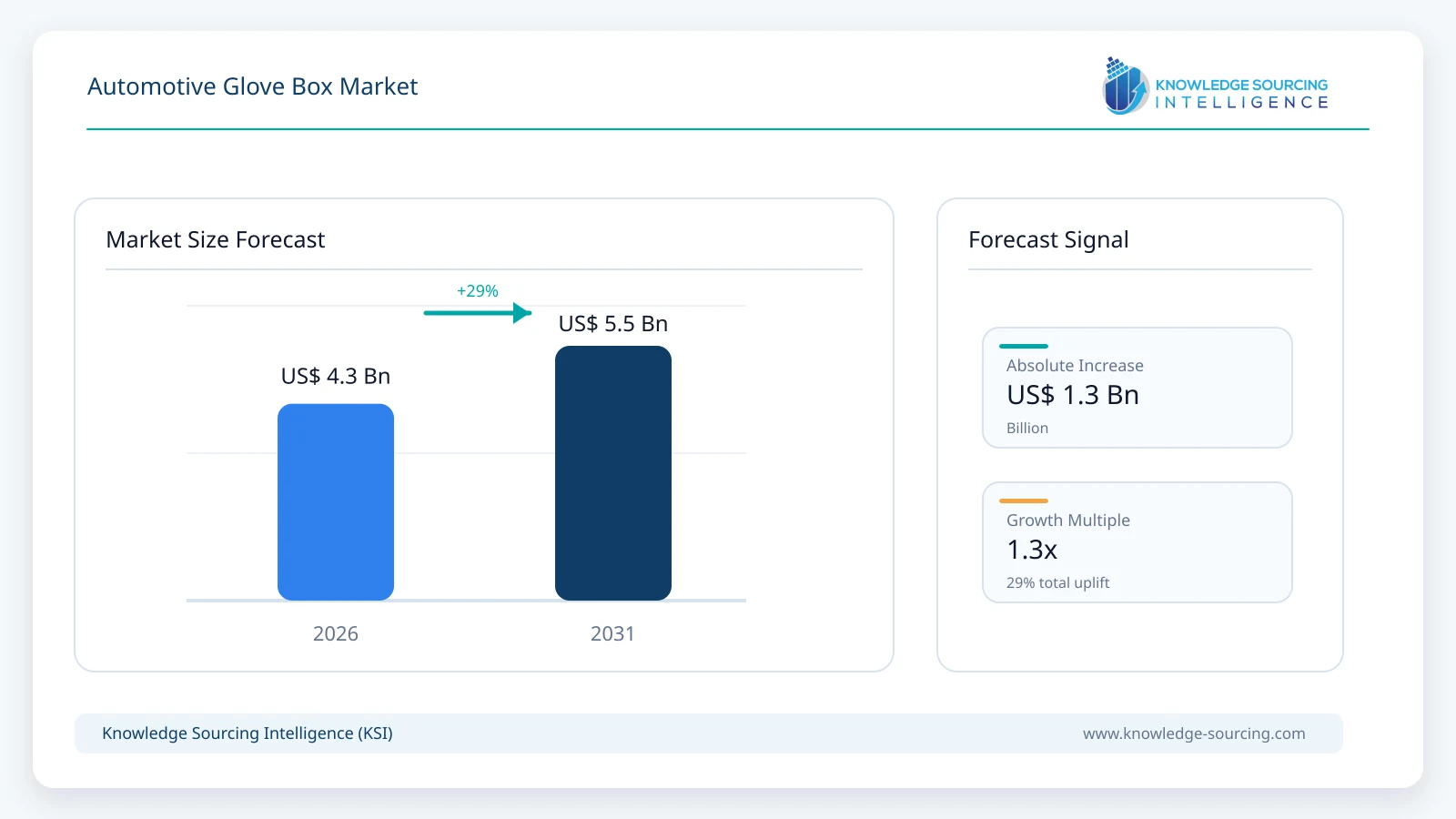
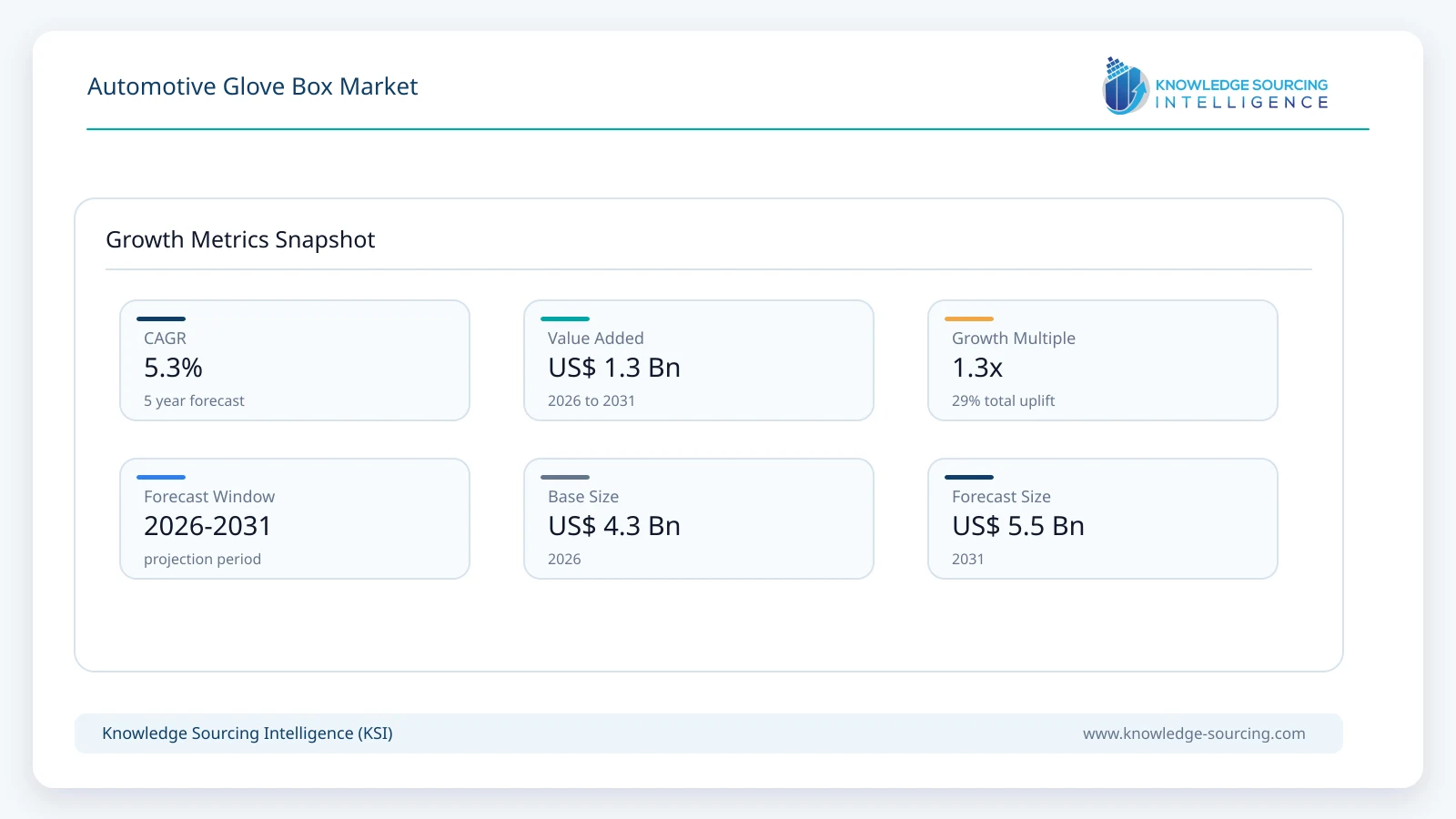
The automotive glove box market is estimated at approximately USD 4.25 billion in 2026 and is projected to reach about USD 5.50 billion by 2031, representing a CAGR of 5.3% during the forecast period.
Highlights:
- 1Conventional mechanical pull-handle and damped glove boxes account for approximately 78% of global market value in 2026 because they remain the dominant architecture across mass-market passenger vehicles.
- 2Standard non-cooled storage represents approximately 68% of 2026 market value, while cooled or ventilated glove boxes account for approximately 24% and continue to gain penetration in warm-climate and higher-trim vehicles.
- 3Electronic, lockable, sanitizing and other multifunction glove-box systems represent approximately 8% of 2026 market value but carry materially higher value per vehicle than a basic storage bin.
- 4Single-compartment glove boxes account for approximately 84% of 2026 market value, while dual or upper/lower layouts represent approximately 16%, concentrated in utility vehicles, MPVs and selected premium platforms.
- 5Polypropylene-dominant molded assemblies represent approximately 82% of market value in 2026 because PP provides the best balance of low cost, low mass, stiffness, processability and interior-grade surface performance.
- 6Asia Pacific represents approximately 46% of global market value in 2026, supported by vehicle-production scale and strong adoption of cooled and dual-storage configurations in China, India, Japan and Southeast Asia.
The market remains highly volume-driven because most passenger vehicles and a large proportion of commercial vehicles use at least one enclosed glove compartment, but the value mix is gradually shifting from a simple molded bin and latch toward damped, illuminated, cooled, lockable and electronically released assemblies.
Glove-box value increasingly depends on how effectively the assembly is integrated with the wider instrument panel, where passenger-airbag packaging, HVAC ducts, displays, wiring and knee-clearance zones compete for space. Antolin and Motherson both position glove boxes within broader cockpit and instrument-panel portfolios, while Nifco supplies motion-control dampers used in glove compartments, illustrating the combination of molded interior integration and specialist mechanism content. Feature intensity then varies by vehicle class and region: mainstream vehicles increasingly use damped doors and illumination, warm-climate markets support HVAC-fed cooling, premium and commercial applications add secure locking or electronic release, and taller dashboard architectures can accommodate dual upper/lower compartments without compromising airbags, displays or passenger knee space.
Market Overview
A conventional automotive glove box combines an injection-molded storage bin and visible door with hinges, a latch or handle, stop features and increasingly a rotary or linear damper that controls opening speed and perceived motion quality. Illumination, felt lining, dividers and document holders can be added according to vehicle class, while cooled configurations route conditioned HVAC air through a small duct and valve into the compartment. Because the cooling architecture reuses the vehicle climate system, engineering attention centers on airflow, shut-off control, condensation management and packaging rather than an independent refrigeration loop; Nissan, Renault, Mahindra, Hyundai and other OEMs continue to use this approach as a convenience feature in warm-weather markets.
Higher-content glove-box systems are extending the basic storage function through secure access, electronic interfaces and selected multifunction features. Mechanical keys, central-locking interfaces, electronic actuators and valet-mode logic support document and personal-item security in premium, rental, fleet, convertible and commercial-vehicle applications, while closed compartments also provide a practical location for USB-C power, sensors, electronic release and historical UV-C sanitizing concepts. These features are expected to remain concentrated in higher-value applications through the forecast period, but they increase the engineering content of the glove-box assembly and strengthen its role within the connected cockpit rather than as a simple molded storage bin.
Market Trends
Cooled Glove Boxes Are Moving into Higher-Volume Vehicle Segments
HVAC-fed glove-box cooling was once concentrated in premium vehicles but is increasingly offered in compact SUVs, crossovers and MPVs. The 2026 Mahindra XUV 3XO EV and Nissan Gravite both include cooled glove-box configurations, while Renault and Nissan continue to use the feature in mainstream compact vehicles. The function is becoming a visible convenience differentiator in hot-climate markets.
The architecture remains cost-effective because it can reuse conditioned cabin air rather than requiring an independent refrigeration loop. Suppliers therefore compete on duct packaging, valve design, insulation and condensation control rather than on complex thermal hardware, allowing the feature to expand without a large cost penalty.
Damped Soft-Open Motion Is Becoming the Expected Baseline
Rotary and linear dampers are increasingly used to slow the glove-box door and prevent a sudden drop when the latch is released. Nifco identifies glove compartments as a core application for its motion-control dampers, reflecting the importance of controlled movement in perceived interior quality.
Although a glove-box damper adds little visible hardware complexity, controlled opening speed materially improves perceived interior quality by replacing abrupt door drop with quieter and more consistent motion. As hard slam-open doors disappear from higher-volume passenger vehicles, the competitive focus shifts to low noise, stable opening behavior across temperature extremes, minimal free play and durability across tens of thousands of operating cycles.
Dual and Layered Storage Layouts Are Returning with Utility-Focused Interiors
Vehicle designers are using upper and lower glove compartments, shallow open shelves and divided bins to increase usable cabin storage without enlarging the instrument panel. Nissan Gravite combines an upper glove box with a lower cooled compartment, illustrating how layered storage can serve documents, small electronics and temperature-sensitive items separately.
Dual-compartment systems are most practical in MPVs, SUVs and commercial vehicles where the instrument panel is taller and passenger packaging provides more vertical space. Their expansion is constrained by passenger airbags, displays and knee-impact zones, so adoption remains architecture-specific rather than universal.
Secure and Electronically Released Storage Is Gaining Relevance
Lockable glove compartments remain valuable where users leave documents, wallets or devices in the vehicle. Premium vehicles often connect the glove-box lock to central locking or valet functions, while commercial vehicles continue to use robust mechanical locks because the cabin doubles as a mobile workplace.
Electronic release can remove visible handles and improve surface cleanliness, particularly in minimalist instrument panels. It also enables software-controlled access, but the system requires a mechanical fallback or reliable fail-safe strategy in the event of low-voltage power loss, adding complexity compared with a traditional latch.
Sanitizing, Charging and Smart Utility Functions Are Emerging
Closed glove compartments provide a controlled environment for functions that are difficult to use safely in the open cabin. Conventional UVC has historically been restricted to enclosed areas such as glove boxes because direct exposure can be harmful, and Hyundai Motor and Kia referenced this use case when introducing their Far-UVC cabin technology in June 2026.
USB-C charging, device storage, sensors and controlled illumination are also technically straightforward to package inside the compartment. These functions are unlikely to become standard across entry vehicles, but they create higher-value opportunities in premium, fleet and technology-focused models.
Segment Analysis
By Functional Configuration: Standard Storage Glove Boxes
Standard storage glove boxes remain the largest functional segment because the primary role of the assembly is still to provide enclosed passenger-side storage for vehicle documents, small personal items and accessories. Most systems include a molded bin, mechanical latch, hinge and increasingly a damper, with illumination added on mid- and upper-level trims.
Standard non-cooled systems represent approximately USD 2.89 billion in 2026 and could approach USD 3.60 billion by 2031. Their value share will decline gradually as cooled, lockable and electronic features grow faster, but basic enclosed storage will remain nearly universal across conventional passenger-vehicle interiors.
By Opening Mechanism: Pull-Handle Mechanical Latch with Damped Opening
Pull-handle mechanical latches combined with damped opening dominate because they are inexpensive, intuitive and mechanically robust. The user pulls a handle or lever to release the latch, while a rotary or linear damper controls the descent of the door. The architecture requires no vehicle-network connection and remains functional when the electrical system is disabled.
Pull-handle mechanical latches with damped opening account for approximately USD 3.32 billion in 2026, reflecting their combination of low cost, intuitive operation, mechanical robustness and independence from the vehicle electrical system. Electronic and push-to-open systems will gain share in premium minimalist dashboards, but mechanical damped designs will remain the volume standard because they combine low warranty risk with acceptable perceived quality.
By Compartment Architecture: Single-Compartment Glove Boxes
Single-compartment glove boxes are the dominant architecture because they provide the highest usable volume for a given opening and minimize tooling, latch and trim complexity. They can still incorporate internal shelves, document slots, cooling ducts or removable dividers without creating a second external door.
Single-compartment designs represent approximately USD 3.57 billion of market value in 2026. Dual and upper/lower layouts will gain selectively in SUVs, MPVs and commercial vehicles, but the single-door format remains easiest to package around airbags, HVAC and passenger knee-clearance requirements.
By Material: Polypropylene-Dominant Assemblies
Polypropylene is the dominant material for glove-box bins and many doors because it is light, economical, chemically resistant and well suited to high-volume injection molding. Talc-filled and modified PP grades improve stiffness and dimensional stability, while visible doors can receive skins, paints, films or soft-touch coverings to match the instrument panel.
PP-dominant assemblies represent approximately USD 3.49 billion in 2026 and will retain the largest material share through 2031 because polypropylene continues to balance cost, low mass, moldability and interior-grade durability. Recycled-content PP and lower-mass compounds will increase as interior suppliers pursue lifecycle-emissions reductions, but material substitution must preserve hinge durability, latch retention, dimensional accuracy and low-temperature impact performance.
By Vehicle Type: Passenger Vehicles
Passenger cars, SUVs, crossovers and MPVs dominate the market because a glove compartment is standard in almost every platform and because premium convenience features are concentrated in passenger interiors. SUVs and MPVs often carry larger bins, dual compartments or cooled systems, increasing average value per vehicle.
Passenger vehicles account for approximately USD 4.00 billion in 2026 and could exceed USD 5.15 billion by 2031. Commercial vehicles remain relevant for large, lockable and utility-focused storage but represent a smaller share of global value due to lower production volume and simpler trim content.
Market Drivers
Persistent Demand for Enclosed In-Cabin Storage
Even as open shelves, center-console bins and door pockets expand, drivers still need a closed compartment for documents, sunglasses, cables and personal items that should remain out of view. The glove box remains one of the few storage locations that can be enclosed without occupying center-console space.
Enclosed passenger-side storage is especially important in compact vehicles where total cabin-storage volume is limited and the glove box can provide concealed capacity without consuming center-console space. OEMs therefore continue to preserve usable glove-box volume even as instrument panels accommodate larger displays, hidden HVAC outlets and more electronic content.
Growth of Cooled Storage in Warm-Climate Markets
Cooled glove boxes provide visible everyday utility with relatively low hardware cost because they reuse HVAC airflow. The feature is increasingly common in India, the Middle East and other warm markets and is spreading into compact SUVs and mainstream crossovers.
Vehicle launches from Mahindra, Nissan and Renault show continued use of cooled glove boxes as a trim-level differentiator. This supports demand for HVAC ducts, valves, insulation and tighter compartment sealing within the glove-box assembly.
Premiumization of Small Interior Mechanisms
Customers increasingly notice motion quality, gap consistency, lighting and tactile response in small interior components. A damped soft-open door, low-noise latch and precisely aligned surface can materially improve the perceived quality of the full instrument panel.
Demand for higher-specification dampers, hinges, latches and covered doors rises as customers place greater emphasis on motion quality, tactile response and fit-and-finish even when the underlying storage volume does not change. Premiumization therefore increases content per vehicle without requiring a fundamentally different glove-box architecture.
Secure Storage Requirements in Premium, Fleet and Commercial Vehicles
Lockable glove boxes provide secure storage for documents, small electronics and valuables when occupants leave the vehicle. The function is valuable in convertibles, rental fleets, service environments and commercial vehicles where cabin storage may remain exposed for long periods.
Electronic locking and valet integration increase the value of the assembly and can be linked to vehicle access control. Mechanical lockable systems remain important where simplicity and resilience are prioritized over software integration.
Integration with Instrument-Panel and Smart-Cabin Platforms
Glove boxes are usually sourced as part of an instrument-panel or cockpit program rather than as an isolated commodity. Suppliers such as Antolin and Motherson manufacture glove boxes within broader dashboard and cockpit portfolios, enabling shared tooling, surface technologies and assembly processes.
Integration with the wider cockpit module supports higher-value glove-box features such as hidden release, illumination and coordinated trim while reducing the number of separate interfaces that the OEM must manage. As cockpit suppliers take on more complete instrument-panel modules, glove-box content can be optimized at system level rather than purchased and engineered as a stand-alone bin.
Market Restraints
Competition for Instrument-Panel Packaging Space
The passenger side of the instrument panel must package airbags, ducts, displays, wiring, structural beams and knee-clearance zones in addition to the glove box. Larger screens and hidden HVAC outlets can reduce the volume available for storage or force the compartment into a more complex geometry.
Competition for instrument-panel package space directly limits glove-box capacity and can eliminate upper storage in low-profile dashboards where airbags, displays, ducts and passenger knee-clearance zones take priority. Engineers must therefore balance storage utility against safety and electronics packaging, particularly in EVs with minimalist front-cabin design.
Low Unit Value and Continuous OEM Cost Pressure
A basic glove box is a mature high-volume assembly with relatively low unit value. OEMs expect annual productivity improvements, creating strong pressure on polymer cost, cycle time, part count and assembly labor.
Higher-value features such as cooling or electronic release improve content but also add warranty exposure. Suppliers must therefore justify each feature through shared hardware, modularity or premium trim differentiation rather than simply increasing component complexity.
Latch, Hinge and Damper Durability Requirements
Glove-box doors are opened and closed thousands of times and must retain consistent gap, latch effort and opening speed across hot and cold cabin conditions. Plastic creep, hinge wear and damper viscosity changes can create rattles, slow opening or failure to remain closed.
Durability failures in the latch, hinge or damper are especially visible because the glove-box door sits directly in front of the passenger and any rattle, misalignment or inconsistent motion can affect perceived interior quality. Long lifecycle validation and tight dimensional control are therefore necessary even for a relatively simple storage assembly.
Cooling Performance, Condensation and Energy Trade-Offs
HVAC-fed cooling is inexpensive but depends on the climate system operating and generally cannot maintain refrigerator-level temperatures. Airflow diverted to the glove box can also reduce available cabin cooling slightly, while cold surfaces can create condensation in humid conditions.
Maintaining useful glove-box cooling without creating condensation or reducing cabin-airflow performance requires careful duct sizing, shut-off control and drainage or moisture management. Poorly engineered systems can create user dissatisfaction when the compartment does not achieve the expected cooling effect or moisture accumulates around stored items.
Substitution by Open Storage and Reconfigurable Consoles
Modern cabins increasingly use open shelves, large center-console bins, door storage and movable console systems. These alternatives can provide more accessible storage and may reduce the relative importance of a large passenger-side compartment.
Substitution pressure is strongest in minimalist EV interiors where designers prioritize visual openness, large displays, open shelves and reconfigurable center-console storage over a large passenger-side compartment. However, continued demand for enclosed, hidden and sometimes lockable storage should prevent broad elimination of the glove box during the forecast period.
Regional Outlook

Asia Pacific
Asia Pacific is the largest automotive glove box market, supported by vehicle-production scale in China, Japan, South Korea, India and Southeast Asia. India is especially relevant to feature growth because cooled glove boxes have moved into compact SUVs and mainstream vehicles, with 2026 launches from Mahindra and Nissan reinforcing this trend.
Asia Pacific also has a deep interior-component and mechanism supply base that supports localized glove-box engineering and manufacturing across major vehicle-producing markets. Antolin, Motherson, Yanfeng, Toyota Boshoku, Toyoda Gosei, Kasai Kogyo and Nifco all maintain significant Asian capability; Nifco specifically identifies glove-compartment dampers as a core automotive application, while Motherson lists glove boxes within its polymer interior portfolio.
Growth through 2031 will be driven by both production volume and rising feature content. China will contribute smart-cabin and premium integration, India and Southeast Asia will support cooled-storage penetration, and Japan and South Korea will remain important for high-quality motion-control and molded-interior technologies.
North America
North America is a major value market because SUVs, pickups and large crossovers often use large glove compartments, damped doors, dual storage layouts and lockable configurations. The 2026 Nissan Rogue specification includes an oversized bucket-style glove compartment with a damper, while large pickups continue to use dual glove-box arrangements on selected trims.
Premium vehicles also support lockable and climate-controlled storage, particularly where valet use and personal-item security are emphasized. Large instrument panels provide more packaging freedom than compact cars, allowing higher average compartment volume and more elaborate trim or latch mechanisms.
North American market growth will depend more on increasing content per vehicle than on further expansion of basic glove-box penetration, which is already near saturation across mainstream platforms. Higher-quality damping, illumination, electronic release and secure storage should therefore raise average system value even if regional vehicle-production growth remains moderate.
Competitive Landscape
The automotive glove box market is fragmented across large cockpit and instrument-panel suppliers and specialist mechanism companies. Antolin and Motherson explicitly include glove boxes within their interior product portfolios, while Yanfeng, FORVIA, IAC, Toyota Boshoku and other Tier 1 suppliers integrate passenger-side storage as part of complete instrument-panel and cockpit programs.
Specialist mechanism suppliers form an important competitive layer alongside complete cockpit and instrument-panel integrators because glove-box motion quality depends heavily on compact dampers, latches and small plastic control components. Nifco supplies dampers used in glove compartments and competes on motion feel, packaging size, temperature stability, cycle life and cost rather than on the complete molded bin.
Competitive advantage at the system level depends on integration with the instrument panel. Suppliers that control injection molding, foaming, covering, welding, surface finishing and final assembly can deliver a glove-box door that matches surrounding trim and can incorporate cooling, illumination or electronic functions without adding separate OEM interfaces.
Future differentiation will center on low-cost premium motion, recycled polymers, compact HVAC interfaces, electronic release and secure or multifunction storage. The market will remain highly price-sensitive, so successful technologies will be those that add user value without materially increasing part count or assembly complexity.
Recent Developments
24 June 2026: Hyundai Motor and Kia unveiled Plasma Care UVC cabin sanitization technology and noted that conventional UVC is generally restricted to enclosed spaces such as vehicle glove boxes, reinforcing the engineering role of closed storage for sanitizing small personal items.
20 June 2026: Range Rover Velar 2026 configuration materials listed a lockable cooled glove box that can route conditioned air into the compartment, illustrating continued premium demand for combined security and thermal functionality.
17 February 2026: Nissan launched the all-new GRAVITE in India with an upper glove box and a separate lower cooled glove box, demonstrating a dual-compartment architecture in a high-volume family vehicle.
6 January 2026: Mahindra launched the XUV 3XO EV with a cooled glove box and illumination on the higher AX7L variant, extending the feature into an affordable electric compact SUV.
17 July 2025: Nissan detailed the 2026 Rogue with an oversized bucket-style glove compartment incorporating a damper, highlighting continued use of controlled soft-opening mechanisms in mainstream SUVs.
Market Outlook
The automotive glove box market is expected to expand from approximately USD 4.250 billion in 2026 to about USD 5.502 billion by 2031. Growth will be moderate because penetration of basic enclosed storage is already high, but value per vehicle will increase through damping, illumination, cooling, locking and selected electronic functions.
Standard mechanically latched glove boxes will remain the largest architecture because they meet the core storage requirement at low cost, while cooled and secure systems should grow faster from a smaller installed base as convenience and security content expands. Electronic release and sanitizing functions will remain niche but can support premium minimalist interiors and selected fleet or hygiene-oriented use cases.
Asia Pacific will remain the largest regional market, while North America continues to generate high value per vehicle through large SUVs, pickups and premium storage configurations. Supplier success will depend on delivering reliable motion, tight fit and finish, low cost, sustainable materials and seamless integration with the surrounding instrument-panel architecture.
Automotive Glove Box Market Scope
| Report Metric | Details |
|---|---|
| Total Market Size in 2026 | USD 4.25 billion |
| Total Market Size in 2031 | USD 5.50 billion |
| Forecast Unit | Billion |
| Growth Rate | 5.3% |
| Study Period | 2021 to 2031 |
| Historical Data | 2021 to 2024 |
| Base Year | 2025 |
| Forecast Period | 2026 – 2031 |
| Segmentation | Functional Configuration, Opening Mechanism, Compartment Architecture, Material, Vehicle Type, Geography |
| Companies |
|
Market Segmentation
By Functional Configuration
Standard Storage Glove Boxes
Cooled and Ventilated Glove Boxes
Lockable and Secure Glove Boxes
Sanitizing and Multi-Function Glove Boxes
By Opening Mechanism
Pull-Handle Mechanical Latch Systems
Push-to-Open and Touch-Latch Systems
Electronic Release Systems
Premium Motorized and Assisted Systems
By Compartment Architecture
Single-Compartment Glove Boxes
Dual and Upper/Lower Glove Boxes
Divided and Modular Internal Storage Systems
By Material
Polypropylene-Dominant Assemblies
ABS and PC/ABS Assemblies
Sustainable and Recycled Polymer Assemblies
Premium Covered and Multi-Material Doors
By Vehicle Type
Passenger Vehicles
Light Commercial Vehicles
Medium and Heavy Commercial Vehicles
Buses and Specialty Vehicles
By Geography
North America
United States
Canada
Mexico
South America
Brazil
Argentina
Others
Europe
Germany
United Kingdom
France
Italy
Spain
Others
Middle East and Africa
Saudi Arabia
UAE
South Africa
Others
Asia Pacific
China
Japan
South Korea
India
Indonesia
Thailand
Others
Table of Contents
1. INTRODUCTION
1.1. Market Overview
1.2. Market Definition
1.3. Scope of the Study
1.4. Market Segmentation
1.5. Currency
1.6. Assumptions
1.7. Base and Forecast Years
1.8. Key Benefits to Stakeholders
2. RESEARCH METHODOLOGY
2.1. Research Design
2.2. Secondary Research
2.3. Primary Research
2.4. Market Estimation
2.5. Segment Modelling
2.6. Data Triangulation and Validation
3. EXECUTIVE SUMMARY
3.1. Key Findings
3.2. Automotive Glove Box Market Size, 2026-2031
3.3. Functional Configuration Outlook
3.4. Opening Mechanism Outlook
3.5. Compartment Architecture Outlook
3.6. Material Outlook
3.7. Vehicle Type Outlook
3.8. Regional Opportunity Summary
4. MARKET DYNAMICS
4.1. Market Drivers
4.1.1. Persistent Demand for Enclosed In-Cabin Storage
4.1.2. Growth of Cooled Storage in Warm-Climate Markets
4.1.3. Premiumization of Small Interior Mechanisms
4.1.4. Secure Storage Requirements in Premium, Fleet and Commercial Vehicles
4.1.5. Integration with Instrument-Panel and Smart-Cabin Platforms
4.2. Market Restraints
4.2.1. Competition for Instrument-Panel Packaging Space
4.2.2. Low Unit Value and Continuous OEM Cost Pressure
4.2.3. Latch, Hinge and Damper Durability Requirements
4.2.4. Cooling Performance, Condensation and Energy Trade-Offs
4.2.5. Substitution by Open Storage and Reconfigurable Consoles
4.3. Market Opportunities
4.4. Porter's Five Forces Analysis
4.5. Industry Value Chain Analysis
4.6. Glove Box Content, Mechanism and Tooling Economics
4.7. Interior Safety, Material and Durability Requirements
5. TECHNOLOGY OUTLOOK
5.1. Injection-Molded Glove Box Bins and Doors
5.2. Rotary and Linear Dampers
5.3. Mechanical Latches and Pull-Handle Systems
5.4. Push-to-Open and Touch-Latch Mechanisms
5.5. Electronic Release and Central-Locking Integration
5.6. HVAC-Fed Cooled and Ventilated Glove Boxes
5.7. Illumination and Interior Lighting Integration
5.8. Lockable and Valet-Mode Storage
5.9. Dual and Upper/Lower Compartment Architectures
5.10. USB-C, Power and Device-Storage Integration
5.11. UVC and Sanitizing Storage Concepts
5.12. Recycled Polymer and Lightweight Glove Box Structures
6. AUTOMOTIVE GLOVE BOX MARKET BY FUNCTIONAL CONFIGURATION
6.1. Introduction
6.2. Standard Storage Glove Boxes
6.3. Cooled and Ventilated Glove Boxes
6.4. Lockable and Secure Glove Boxes
6.5. Sanitizing and Multi-Function Glove Boxes
7. AUTOMOTIVE GLOVE BOX MARKET BY OPENING MECHANISM
7.1. Introduction
7.2. Pull-Handle Mechanical Latch Systems
7.3. Push-to-Open and Touch-Latch Systems
7.4. Electronic Release Systems
7.5. Premium Motorized and Assisted Systems
8. AUTOMOTIVE GLOVE BOX MARKET BY COMPARTMENT ARCHITECTURE
8.1. Introduction
8.2. Single-Compartment Glove Boxes
8.3. Dual and Upper/Lower Glove Boxes
8.4. Divided and Modular Internal Storage Systems
9. AUTOMOTIVE GLOVE BOX MARKET BY MATERIAL
9.1. Introduction
9.2. Polypropylene-Dominant Assemblies
9.3. ABS and PC/ABS Assemblies
9.4. Sustainable and Recycled Polymer Assemblies
9.5. Premium Covered and Multi-Material Doors
10. AUTOMOTIVE GLOVE BOX MARKET BY VEHICLE TYPE
10.1. Introduction
10.2. Passenger Vehicles
10.3. Light Commercial Vehicles
10.4. Medium and Heavy Commercial Vehicles
10.5. Buses and Specialty Vehicles
11. AUTOMOTIVE GLOVE BOX MARKET BY GEOGRAPHY
11.1. North America
11.1.1. United States
11.1.2. Canada
11.1.3. Mexico
11.2. South America
11.2.1. Brazil
11.2.2. Argentina
11.2.3. Others
11.3. Europe
11.3.1. Germany
11.3.2. United Kingdom
11.3.3. France
11.3.4. Italy
11.3.5. Spain
11.3.6. Others
11.4. Middle East and Africa
11.4.1. Saudi Arabia
11.4.2. UAE
11.4.3. South Africa
11.4.4. Others
11.5. Asia Pacific
11.5.1. China
11.5.2. Japan
11.5.3. South Korea
11.5.4. India
11.5.5. Indonesia
11.5.6. Thailand
11.5.7. Others
12. COMPETITIVE ENVIRONMENT AND ANALYSIS
12.1. Major Players and Strategy Analysis
12.2. Market Share Analysis
12.3. Glove Box Architecture and Packaging Benchmarking
12.4. Latch, Hinge and Damper Benchmarking
12.5. Cooling, Lighting and Electronic Integration Benchmarking
12.6. Material and Lightweighting Benchmarking
12.7. OEM Programs, Manufacturing Footprint and Production Readiness
12.8. Competitive Dashboard
13. COMPANY PROFILES
13.1. Antolin
13.2. Motherson Group
13.3. Yanfeng Automotive Interiors
13.4. FORVIA
13.5. International Automotive Components (IAC) Group
13.6. Toyota Boshoku Corporation
13.7. Toyoda Gosei Co., Ltd.
13.8. Kasai Kogyo Co., Ltd.
13.9. Nifco Inc.
13.10. Nihon Plast Co., Ltd.
13.11. Marelli
13.12. Hyundai Mobis
14. APPENDIX
14.1. Currency
14.2. Assumptions
14.3. Base and Forecast Years Timeline
14.4. Key Benefits for Stakeholders
14.5. Research Methodology
14.6. Abbreviations
14.7. Data Sources
Navigate
Trusted by the world's leading organizations











