
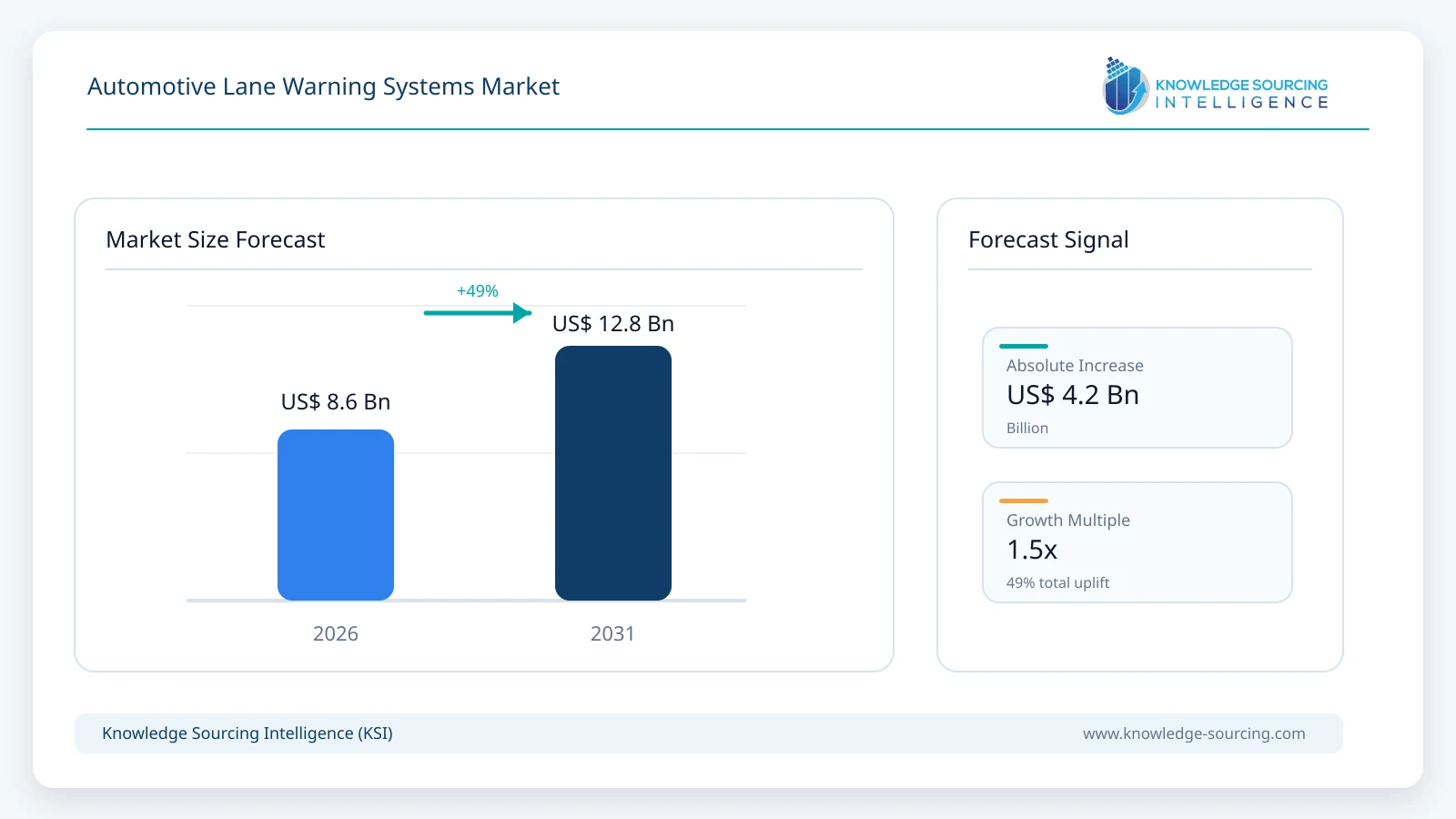
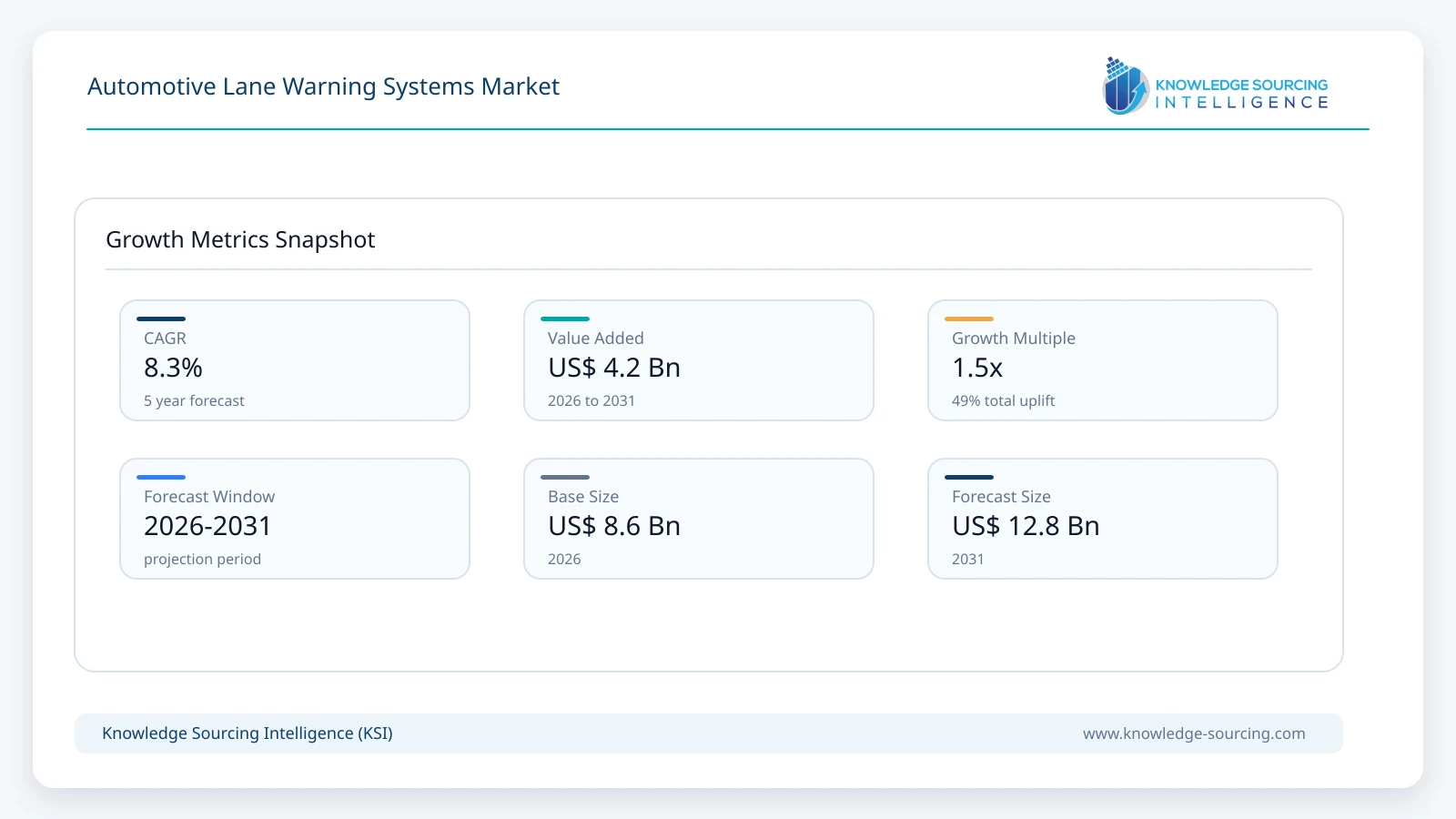
The Global automotive Lane Warning Systems market is forecast to grow at a CAGR of 8.3%, reaching USD 12.8 billion in 2031 from USD 8.6 billion in 2026.
Highlights:
- 1Manufacturers are integrating lane warning systems into vehicles to enhance driver safety and prevent unintentional lane departures.
- 2Governments are imposing stricter safety regulations that are promoting the adoption of lane warning systems worldwide.
- 3Technological advancements in sensors and AI are improving the reliability and effectiveness of lane warning systems.
- 4Electric and self-driving vehicles are increasingly featuring lane warning systems to support advanced driver assistance.
Market Overview
Automotive lane warning systems cover technologies that detect unintended lane departure, warn the driver, or apply steering or braking inputs to keep the vehicle within its intended path. The market spans Lane Departure Warning, Lane Keeping Assist, Lane Centering Assist, and Emergency Lane Keeping functions, supported mainly by cameras, radar, and sensor-fusion architectures. Demand is closely tied to new-vehicle safety content because these functions are increasingly specified as part of broader advanced driver assistance system packages rather than sold as isolated options.
Regulation is also moving the technology from optional equipment toward standard vehicle content. In the European Union, the General Safety Regulation requires lane-keeping systems on new cars and vans sold from July 7, 2024. The European Commission expects the wider package of mandatory driver-assistance systems to help prevent more than 140,000 serious injuries and save more than 25,000 lives by 2038. This creates a relatively direct procurement channel for camera, radar, electronic control, steering, and software suppliers.
Buyer requirements are shifting beyond basic lane-departure alerts. Vehicle manufacturers increasingly seek scalable ADAS platforms that can support several functions through common sensors, electronic control units, and software. This favors suppliers able to combine perception, computing, steering control, validation, cybersecurity, and software updates while meeting vehicle-level cost targets.
The commercial value is therefore distributed across several layers of the supply chain. Sensor suppliers capture value through cameras and radar, semiconductor and computing suppliers provide processing capability, Tier 1 suppliers integrate perception and control, and OEMs determine feature content, vehicle pricing, and system availability. Aftermarket demand is more constrained because lane-support functions often require vehicle-specific calibration, electronic integration, and access to original vehicle architecture.
U.S. regulatory activity provides another demand signal. The National Highway Traffic Safety Administration added Lane Keeping Assist to the New Car Assessment Program and established a roadmap for further NCAP updates through 2033. In April 2025, NHTSA also continued work on collecting evidence on the effectiveness of Lane Departure Warning and Lane Keep Assist systems. The direction of travel favors suppliers that can document system performance under defined test conditions rather than simply offer the underlying sensor hardware.
Key Market Indicators
Indicator | Latest Evidence | Commercial Meaning |
|---|---|---|
EU new car registrations | 13.7 million-class market in 2025, up 1.8% year over year | Provides a large annual pool of new vehicles into which regulated ADAS content can be incorporated. |
EU battery-electric share | 17.4% in 2025 | Higher electronic content in electrified vehicles supports demand for integrated sensing and control systems. |
EU hybrid share | 34.5% in 2025 | ADAS demand is not limited to battery-electric vehicles and extends across high-volume hybrid platforms. |
EU lane-keeping requirement | All new cars and vans from July 2024 | Converts lane-support technology into a regulatory-driven OEM specification in a major automotive region. |
Mobileye 2025 revenue | US$1.894 billion, +15% year over year | Indicates continued commercial demand for ADAS computing and software across OEM programs. |
Mobileye future automotive revenue pipeline | US$24.5 billion at year-end 2025 | Shows the scale of forward OEM commitments around ADAS and automated-driving platforms. |
Market Drivers
Mandatory safety content in new vehicles. European regulation has materially changed the purchasing case for lane-support systems. From July 2024, all new vehicles sold in the EU must include the relevant General Safety Regulation features, with lane keeping required for cars and vans. OEMs therefore need compliant hardware and software within vehicle development programs, reducing reliance on discretionary consumer demand. Suppliers that can provide validated systems across vehicle platforms have an advantage because the purchasing decision increasingly occurs at the vehicle-program level.
Higher ADAS content per vehicle. Lane keeping is increasingly packaged with adaptive cruise control, automated emergency braking, traffic-sign recognition, driver monitoring, and parking functions. This raises the value of shared perception and computing architectures. The commercial opportunity is consequently moving toward platforms that reuse cameras, radar, electronic control units, and software across several safety functions. Suppliers can gain from higher content per vehicle, while OEMs seek common hardware to reduce engineering and validation costs.
Expansion of software-defined vehicle architectures. New vehicle programs increasingly separate hardware from software functions, allowing manufacturers to add or modify assistance features without replacing the complete sensing architecture. This creates demand for lane-support systems that can be updated, scaled across vehicle trims, and connected to centralized computing. It also shifts competition toward software capability, system validation, cybersecurity, and lifecycle support rather than sensor performance alone.
Growth of integrated camera and radar architectures. Camera systems remain central to lane-marking recognition, while radar adds information about surrounding objects and operating conditions. ZF's current ADAS platform combines camera and radar inputs with central computing for functions including Lane Departure Warning, Lane Keeping Assist, and Lane Centering. The shift toward sensor fusion creates opportunities for suppliers that can combine perception and control without imposing excessive hardware cost or power consumption.
Higher safety content in electrified vehicle programs. Electrified vehicles are not inherently dependent on lane warning systems, but new EV platforms often carry greater electronic and software content. In 2025, battery-electric vehicles represented 17.4% of EU new-car registrations, while hybrids accounted for 34.5%. Suppliers that can integrate lane support into common electronic architectures can therefore address EV, hybrid, and internal-combustion platforms rather than relying on one powertrain category.
Market Restraints and Challenges
System cost pressure in mass-market vehicles. Lane support must meet strict safety and reliability targets while remaining affordable on high-volume vehicle platforms. The cost challenge extends beyond the camera or radar itself because OEMs must account for electronic control, software, calibration, testing, steering interfaces, cybersecurity, and after-sales support. Suppliers therefore face pressure to increase function coverage without proportionally increasing bill-of-material cost.
Road and weather conditions limit system performance. Lane markings can become difficult to detect when they are faded, obscured by snow, damaged road surfaces, construction zones, or poor lighting. UNECE's 2025 ELKS regulation explicitly recognizes that vehicle condition, road adhesion, weather, infrastructure quality, and traffic scenarios can affect system performance. These conditions increase validation requirements and make false warnings or unwanted steering interventions a commercial concern because poor system behavior can reduce driver trust.
Long vehicle qualification cycles. Automotive safety systems require extensive validation before entering series production. Changes to sensors, perception software, steering control, or computing architecture can trigger additional testing because the system interacts with vehicle dynamics and other safety functions. This raises development costs and favors suppliers with established OEM relationships, validation infrastructure, and production experience.
Regulatory fragmentation outside harmonized markets. The EU has moved toward broad mandatory ADAS content, while the United States is using NCAP and separate rulemaking activities to evaluate and encourage lane-support technology. NHTSA's work on minimum performance standards for Lane Departure Warning and Lane Keeping Assist remained active in its rulemaking program. Differences in test procedures and regulatory timing can increase engineering work when suppliers develop one platform for several regions.
Driver acceptance and system behavior. Lane-support functions must assist without creating excessive steering corrections or warnings. NHTSA describes Lane Keeping Assistance as a system that can use information from lane-departure sensors to determine when an unintended departure is occurring and then correct the vehicle through steering, braking, or both. The distinction between assistance and automation also matters for human-machine interface design, driver monitoring, liability, and customer education.
Major Segment Analysis
Lane Keeping Assist System
Lane Keeping Assist is commercially important because it moves the product from warning-only functionality toward active vehicle control. Unlike Lane Departure Warning, which primarily alerts the driver, LKA can provide corrective steering or other vehicle-control inputs when unintended lane departure is detected. NHTSA classifies LKA as a continuous Level 1 steering-assistance function when the system is active, while Lane Centering Assistance provides more continuous steering to keep the vehicle centered.
OEM purchasing decisions for LKA depend on more than detection accuracy. The system must work with the vehicle's steering architecture, maintain predictable behavior across road conditions, meet regulatory and consumer-test requirements, and fit within the OEM's target cost. This favors Tier 1 suppliers with access to cameras, radar, electronic control, software, and steering systems. ZF Friedrichshafen AG, for example, is positioning scalable ADAS solutions around central computing and software functions, while Valeo SE is developing radar platforms that support LKA alongside other safety functions.
LKA also provides a bridge toward higher levels of driving assistance. Volkswagen Group's March 2025 collaboration with Valeo and Mobileye covers Level 2+ ADAS for future high-volume MQB vehicles and combines hardware and software sourcing to reduce procurement complexity. The direction supports suppliers that can move from an individual lane function toward broader ADAS packages while maintaining cost control across high-volume vehicle platforms.
Regional Analysis
Region | Main Demand Signal | Principal Constraint |
|---|---|---|
North America | NCAP development, OEM ADAS programs, and growing integration of camera and radar systems | Regulatory uncertainty around performance standards and system testing |
Europe | Mandatory lane-keeping content under the General Safety Regulation | High validation requirements and pressure on vehicle affordability |
Asia Pacific | Large vehicle production base, expanding ADAS content, and localization of sensing technologies | Wide variation in vehicle segments, road conditions, and regulatory adoption |
South America | Increasing penetration of electronically equipped passenger vehicles | Lower ADAS fitment rates in price-sensitive vehicle segments |
Middle East and Africa | Premium vehicle demand and selected fleet applications | Uneven infrastructure and limited regulatory harmonization |
North America
U.S. policy is increasing the importance of measurable ADAS performance. NHTSA's updated NCAP includes Lane Keeping Assist, while the agency continues research into the effectiveness of Lane Departure Warning and Lane Keep Assist. The region also supports technology development through large OEM programs. In 2026, Valeo announced a contract with a North American EV manufacturer for next-generation corner radar supporting L2+ and L3 systems, including LKA.
Europe
Europe has the clearest regulatory demand mechanism. Lane-keeping systems became required equipment on new cars and vans under the General Safety Regulation from July 2024. At the same time, 2025 EU registrations increased 1.8%, while battery-electric vehicles reached 17.4% and hybrids 34.5% of the market. Suppliers must therefore serve a broad vehicle mix while meeting tighter safety and testing expectations.
Asia Pacific
Asia Pacific combines large vehicle production with growing local ADAS development. India is becoming an important manufacturing base for lower-cost ADAS systems. In May 2026, Valeo announced that its VSS360 system had been selected by an Indian OEM for commercial vehicles, with production planned at its Sanand, Gujarat facility. The system includes Lane Departure Warning and driver drowsiness and attention warning functions. Local production can reduce logistics exposure and allow suppliers to adapt system specifications to regional vehicle platforms.
South America, Middle East and Africa
Demand in these regions is more dependent on vehicle mix, import patterns, premium vehicle penetration, fleet procurement, and local safety rules. Higher-cost ADAS packages face greater adoption barriers in entry-level vehicles, particularly where customers prioritize vehicle purchase price over optional safety content. Commercial opportunities are therefore more likely to develop first through OEM programs, premium models, fleet vehicles, and imported platforms that already include lane-support functions.
Competitive Landscape
Competition is shifting from individual sensors toward complete ADAS architectures. Robert Bosch GmbH, ZF Friedrichshafen AG, Valeo SE, Continental AG, DENSO Corporation, Aptiv PLC, Mobileye Global Inc., Magna International Inc., Hyundai Mobis Co., Ltd., and Bendix Commercial Vehicle Systems LLC compete across different portions of the ADAS value chain.
Mobileye reported 2025 revenue of US$1.894 billion, up 15% from the previous year, and reported an eight-year expected automotive revenue pipeline of US$24.5 billion at year-end 2025. Its pipeline reflects continued OEM commitments to ADAS platforms, including newer surround-sensing systems. This points to the growing importance of long-duration OEM design wins rather than short-cycle component sales.
System scalability is becoming a central competitive factor. ZF states that its ADAS portfolio ranges from cost-focused systems to higher-performance Level 2+ platforms, while its OnGuardMAX commercial-vehicle system combines camera and radar inputs and supports Lane Departure Warning, Lane Keeping Assist, and Lane Centering. Suppliers can therefore increase revenue per vehicle by combining lane support with braking, cruise control, blind-spot, and other safety functions.
Sensor capability is also moving toward higher resolution and broader operating domains. Mobileye announced in May 2025 that a global automaker had selected its Imaging Radar for an eyes-off, hands-off system planned for production from 2028. Such programs raise the technical threshold for suppliers, but they also create opportunities for companies with validated sensing, computing, software, and vehicle-control capabilities.
Recent Developments
July 2026: Nissan Motor Corporation expanded the availability of its ProPILOT Assist 2.1 technology for 2026 model year vehicles, supporting lane-centering, lane-change assistance, and hands-off single-lane driving on compatible highways through enhanced driver-assistance capabilities.
June 2026: Valeo secured a North American OEM contract for next-generation corner radar technology supporting L2+ and L3 systems, strengthening advanced safety and lane-assistance capabilities.
April 2026: Valeo inaugurated a new HD Surround-View Camera production line at its Sanand, India facility, expanding localized manufacturing of advanced vision systems for driver assistance.
February 2026: Bendix Commercial Vehicle Systems announced its 2026 technical training program featuring AutoVue Lane Departure Warning, reflecting continued deployment and service requirements for commercial-vehicle safety systems.
Regulatory and Policy Environment
European regulation is currently the clearest direct market driver. The General Safety Regulation requires lane-keeping systems on new cars and vans sold in the EU and forms part of a wider package covering automated braking, intelligent speed assistance, driver attention systems, reversing detection, cybersecurity, and event data recording. The regulatory framework increases the addressable vehicle base for suppliers while also raising compliance and validation costs.
UNECE adopted a new Emergency Lane Keeping System regulation on June 26, 2025. The regulation covers M1 and N1 vehicles and defines ELKS around detection of unintended lane departure, driver warning, and corrective vehicle trajectory control. It also recognizes that weather, road adhesion, infrastructure condition, and traffic conditions can affect system performance. This places greater emphasis on robust testing and controlled intervention.
In the United States, NHTSA's updated NCAP framework added LKA alongside blind-spot warning, blind-spot intervention, and pedestrian automatic emergency braking. The agency is also examining the effectiveness of lane-departure and lane-keeping technologies. Suppliers therefore face a market where consumer testing, federal research, and future performance rules may influence OEM specifications even when a technology is not yet universally mandated.
Outlook and Strategic Implications
Over 2026-2031, market performance will depend less on standalone warning devices and more on the spread of integrated ADAS architectures. Regulatory mandates will provide a stable base in Europe, while NCAP development and OEM safety programs will influence adoption in North America. Asia Pacific should remain important because vehicle production, local electronics manufacturing, and expanding ADAS content create a large potential installation base.
The commercial advantage will increasingly sit with suppliers that can reduce the cost and complexity of adding multiple safety functions to one vehicle platform. Camera suppliers, radar companies, computing providers, software developers, steering-system suppliers, and Tier 1 integrators will compete for a larger share of system value as OEMs consolidate hardware and software sourcing. Programs such as Volkswagen's collaboration with Valeo and Mobileye illustrate the preference for integrated supply arrangements in high-volume platforms.
For buyers, system reliability, validation evidence, lifecycle software support, cybersecurity, and compatibility with existing electronic architectures will remain central purchasing criteria. For suppliers, the priority will be scalable architectures that can support different vehicle trims and automation levels without requiring a separate hardware platform for every function. Regulatory compliance will remain a market-entry condition, while cost control and real-world performance will determine whether suppliers can convert regulatory demand into durable OEM contracts.
Automotive Lane Warning Systems Market Scope
| Report Metric | Details |
|---|---|
| Total Market Size in 2026 | USD 8.6 billion |
| Total Market Size in 2031 | USD 12.8 billion |
| Forecast Unit | Billion |
| Growth Rate | 8.3% |
| Study Period | 2021 to 2031 |
| Historical Data | 2021 to 2024 |
| Base Year | 2025 |
| Forecast Period | 2026 – 2031 |
| Segmentation | Function Type, Sensor Type, Sales Channel, Vehicle Type |
| Companies |
|
Market Segmentation
By Function Type
Lane Departure Warning System
Lane Keeping Assist System
Lane Centering Assist System
Emergency Lane Keeping System
By Sensor Type
Camera-Based Sensors
Radar Sensors
Camera-Radar Sensor Fusion
Other Sensors
By Sales Channel
OEM
Aftermarket
By Vehicle Type
Passenger Cars
Light Commercial Vehicles
Heavy Commercial Vehicles
By Geography
North America
United States
Canada
Mexico
South America
Brazil
Argentina
Others
Europe
United Kingdom
Germany
France
Italy
Spain
Others
Middle East and Africa
Saudi Arabia
UAE
South Africa
Others
Asia Pacific
Japan
China
India
South Korea
Taiwan
Thailand
Indonesia
Others
Table of Contents
1. INTRODUCTION
1.1. Market Overview
1.2. Market Definition
1.3. Scope of the Study
1.4. Market Segmentation
1.5. Currency
1.6. Assumptions
1.7. Base Year and Forecast Period
1.8. Key Benefits to Stakeholders
2. RESEARCH METHODOLOGY
2.1. Research Design
2.2. Research Process
3. EXECUTIVE SUMMARY
3.1. Key Findings
3.2. Analyst View
4. MARKET DYNAMICS
4.1. Market Drivers
4.2. Market Restraints
4.3. Porter’s Five Forces Analysis
4.3.1. Bargaining Power of Suppliers
4.3.2. Bargaining Power of Buyers
4.3.3. Threat of New Entrants
4.3.4. Threat of Substitutes
4.3.5. Competitive Rivalry
4.4. Industry Value Chain Analysis
4.5. Analyst View
5. AUTOMOTIVE LANE WARNING SYSTEM MARKET, BY FUNCTION TYPE
5.1. Introduction
5.2. Lane Departure Warning System
5.2.1. Market Trends and Opportunities
5.2.2. Growth Prospects
5.2.3. Regional Growth Opportunities
5.3. Lane Keeping Assist System
5.3.1. Market Trends and Opportunities
5.3.2. Growth Prospects
5.3.3. Regional Growth Opportunities
5.4. Lane Centering Assist System
5.4.1. Market Trends and Opportunities
5.4.2. Growth Prospects
5.4.3. Regional Growth Opportunities
5.5. Emergency Lane Keeping System
5.5.1. Market Trends and Opportunities
5.5.2. Growth Prospects
5.5.3. Regional Growth Opportunities
6. AUTOMOTIVE LANE WARNING SYSTEM MARKET, BY SENSOR TYPE
6.1. Introduction
6.2. Camera-Based Sensors
6.2.1. Market Trends and Opportunities
6.2.2. Growth Prospects
6.2.3. Regional Growth Opportunities
6.3. Radar Sensors
6.3.1. Market Trends and Opportunities
6.3.2. Growth Prospects
6.3.3. Regional Growth Opportunities
6.4. Camera-Radar Sensor Fusion
6.4.1. Market Trends and Opportunities
6.4.2. Growth Prospects
6.4.3. Regional Growth Opportunities
6.5. Other Sensors
6.5.1. Market Trends and Opportunities
6.5.2. Growth Prospects
6.5.3. Regional Growth Opportunities
7. AUTOMOTIVE LANE WARNING SYSTEM MARKET, BY SALES CHANNEL
7.1. Introduction
7.2. OEM
7.2.1. Market Trends and Opportunities
7.2.2. Growth Prospects
7.2.3. Regional Growth Opportunities
7.3. Aftermarket
7.3.1. Market Trends and Opportunities
7.3.2. Growth Prospects
7.3.3. Regional Growth Opportunities
8. AUTOMOTIVE LANE WARNING SYSTEM MARKET, BY VEHICLE TYPE
8.1. Introduction
8.2. Passenger Cars
8.2.1. Market Trends and Opportunities
8.2.2. Growth Prospects
8.2.3. Regional Growth Opportunities
8.3. Light Commercial Vehicles
8.3.1. Market Trends and Opportunities
8.3.2. Growth Prospects
8.3.3. Regional Growth Opportunities
8.4. Heavy Commercial Vehicles
8.4.1. Market Trends and Opportunities
8.4.2. Growth Prospects
8.4.3. Regional Growth Opportunities
9. AUTOMOTIVE LANE WARNING SYSTEM MARKET, BY GEOGRAPHY
9.1. Introduction
9.2. North America
9.2.1. By Function Type
9.2.2. By Sensor Type
9.2.3. By Sales Channel
9.2.4. By Vehicle Type
9.2.5. By Country
9.2.5.1. United States
9.2.5.1.1. Market Trends and Opportunities
9.2.5.1.2. Growth Prospects
9.2.5.2. Canada
9.2.5.2.1. Market Trends and Opportunities
9.2.5.2.2. Growth Prospects
9.2.5.3. Mexico
9.2.5.3.1. Market Trends and Opportunities
9.2.5.3.2. Growth Prospects
9.3. South America
9.3.1. By Function Type
9.3.2. By Sensor Type
9.3.3. By Sales Channel
9.3.4. By Vehicle Type
9.3.5. By Country
9.3.5.1. Brazil
9.3.5.1.1. Market Trends and Opportunities
9.3.5.1.2. Growth Prospects
9.3.5.2. Argentina
9.3.5.2.1. Market Trends and Opportunities
9.3.5.2.2. Growth Prospects
9.3.5.3. Others
9.3.5.3.1. Market Trends and Opportunities
9.3.5.3.2. Growth Prospects
9.4. Europe
9.4.1. By Function Type
9.4.2. By Sensor Type
9.4.3. By Sales Channel
9.4.4. By Vehicle Type
9.4.5. By Country
9.4.5.1. United Kingdom
9.4.5.1.1. Market Trends and Opportunities
9.4.5.1.2. Growth Prospects
9.4.5.2. Germany
9.4.5.2.1. Market Trends and Opportunities
9.4.5.2.2. Growth Prospects
9.4.5.3. France
9.4.5.3.1. Market Trends and Opportunities
9.4.5.3.2. Growth Prospects
9.4.5.4. Italy
9.4.5.4.1. Market Trends and Opportunities
9.4.5.4.2. Growth Prospects
9.4.5.5. Spain
9.4.5.5.1. Market Trends and Opportunities
9.4.5.5.2. Growth Prospects
9.4.5.6. Others
9.4.5.6.1. Market Trends and Opportunities
9.4.5.6.2. Growth Prospects
9.5. Middle East and Africa
9.5.1. By Function Type
9.5.2. By Sensor Type
9.5.3. By Sales Channel
9.5.4. By Vehicle Type
9.5.5. By Country
9.5.5.1. Saudi Arabia
9.5.5.1.1. Market Trends and Opportunities
9.5.5.1.2. Growth Prospects
9.5.5.2. UAE
9.5.5.2.1. Market Trends and Opportunities
9.5.5.2.2. Growth Prospects
9.5.5.3. South Africa
9.5.5.3.1. Market Trends and Opportunities
9.5.5.3.2. Growth Prospects
9.5.5.4. Others
9.5.5.4.1. Market Trends and Opportunities
9.5.5.4.2. Growth Prospects
9.6. Asia Pacific
9.6.1. By Function Type
9.6.2. By Sensor Type
9.6.3. By Sales Channel
9.6.4. By Vehicle Type
9.6.5. By Country
9.6.5.1. Japan
9.6.5.1.1. Market Trends and Opportunities
9.6.5.1.2. Growth Prospects
9.6.5.2. China
9.6.5.2.1. Market Trends and Opportunities
9.6.5.2.2. Growth Prospects
9.6.5.3. India
9.6.5.3.1. Market Trends and Opportunities
9.6.5.3.2. Growth Prospects
9.6.5.4. South Korea
9.6.5.4.1. Market Trends and Opportunities
9.6.5.4.2. Growth Prospects
9.6.5.5. Taiwan
9.6.5.5.1. Market Trends and Opportunities
9.6.5.5.2. Growth Prospects
9.6.5.6. Thailand
9.6.5.6.1. Market Trends and Opportunities
9.6.5.6.2. Growth Prospects
9.6.5.7. Indonesia
9.6.5.7.1. Market Trends and Opportunities
9.6.5.7.2. Growth Prospects
9.6.5.8. Others
9.6.5.8.1. Market Trends and Opportunities
9.6.5.8.2. Growth Prospects
10. COMPETITIVE ENVIRONMENT AND ANALYSIS
10.1. Major Players and Strategy Analysis
10.2. Market Share Analysis
10.3. Mergers, Acquisitions, Agreements, and Collaborations
10.4. Competitive Dashboard
11. COMPANY PROFILES
11.1. Robert Bosch GmbH
11.2. ZF Friedrichshafen AG
11.3. Valeo SE
11.4. Continental AG
11.5. DENSO Corporation
11.6. Aptiv PLC
11.7. Mobileye Global Inc.
11.8. Magna International Inc.
11.9. Hyundai Mobis Co., Ltd.
11.10. Bendix Commercial Vehicle Systems LLC
LIST OF TABLES
LIST OF FIGURES
Navigate
Trusted by the world's leading organizations











