
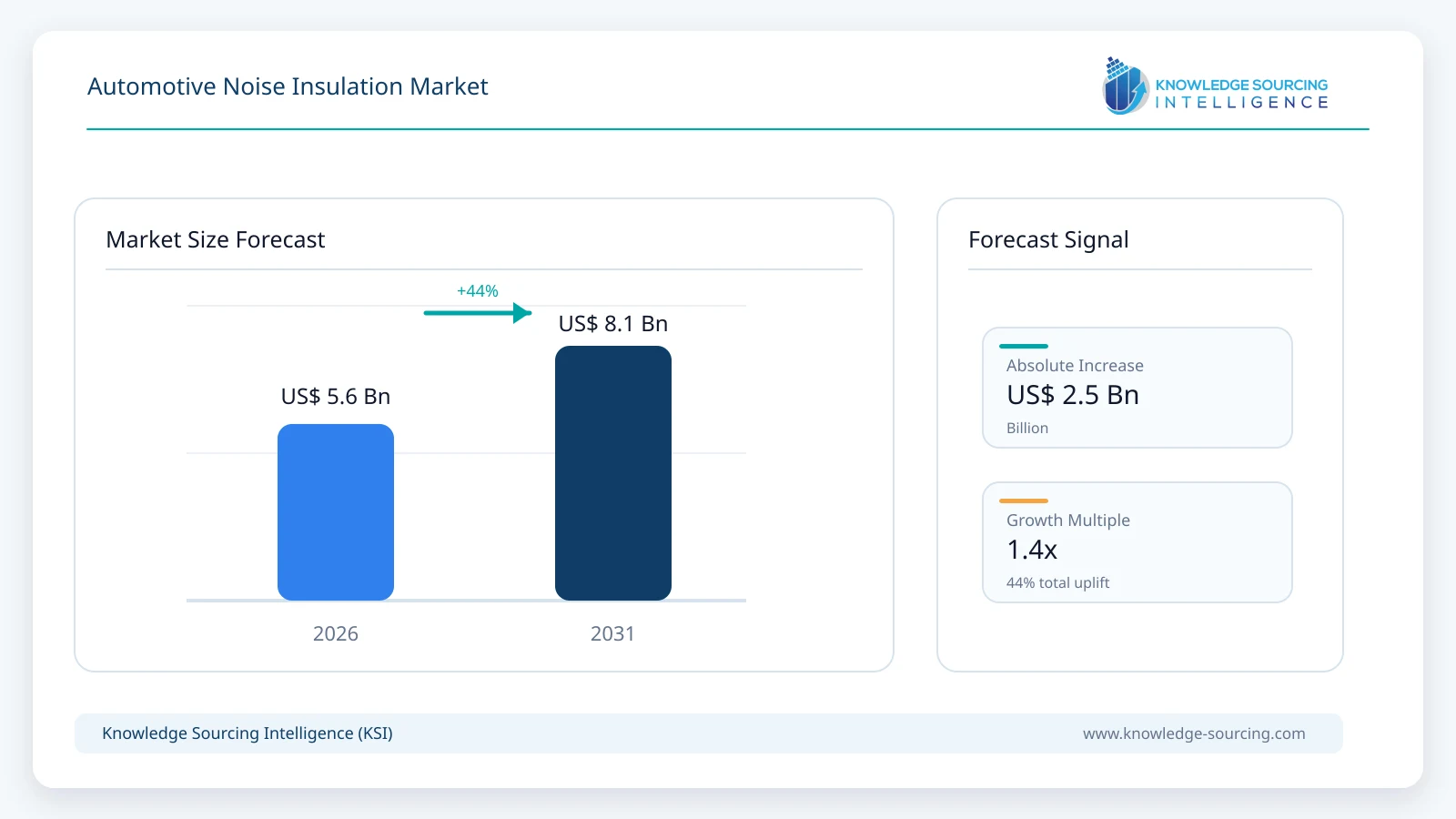
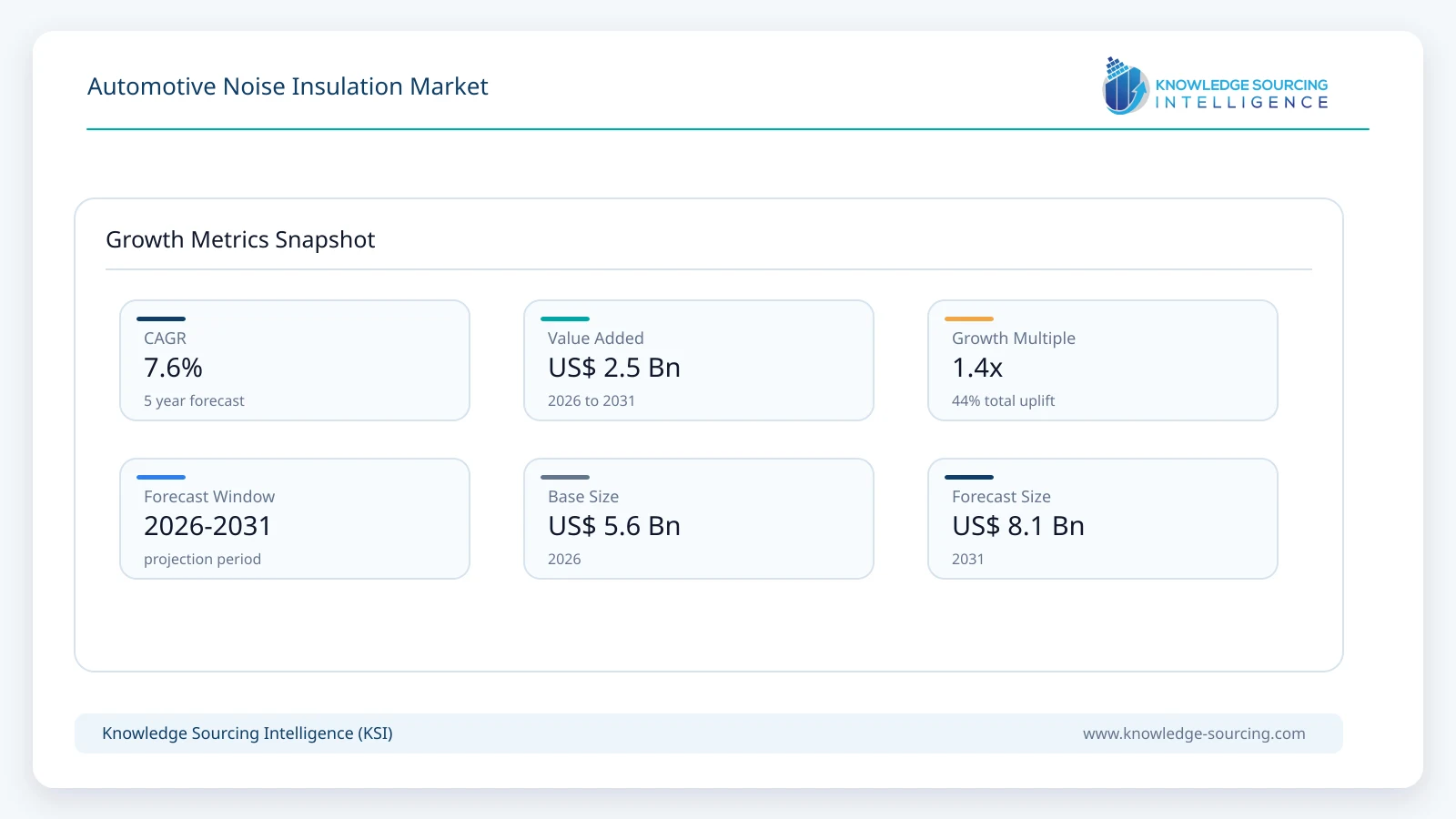
The automotive noise insulation market is estimated at approximately USD 5.60 billion in 2026 and is projected to reach about USD 8.08 billion by 2031, representing a CAGR of 7.6% during the forecast period.
Highlights:
- 1Molded and formed noise-insulation components account for approximately 40% of global market value in 2026 because dash, floor, wheelhouse and luggage applications increasingly use vehicle-specific three-dimensional parts.
- 2Fiber- and nonwoven-dominant constructions represent approximately 34% of 2026 market value and are gaining share as PET and recycled-fiber systems replace heavier foam or mixed-material packages.
- 3Floor and carpet insulation systems account for approximately 30% of 2026 market value, reflecting their large surface area and direct exposure to road, tire and driveline excitation.
- 4Battery-electric vehicles represent approximately 22% of 2026 demand and are the fastest-growing propulsion segment as road and tire noise become more prominent without continuous combustion masking.
- 5Passenger vehicles account for approximately 88% of global market value in 2026, supported by high production volumes and stronger quiet-cabin expectations across SUVs, crossovers and premium models.
- 6Asia Pacific represents approximately 45% of global market value in 2026 and is expected to expand its share through 2031 as China and other regional markets increase acoustic content per vehicle.
The valuation covers the finished or converted passive insulation component supplied into the vehicle, including forming, lamination, cutting and component integration where these activities are part of the noise-insulation system.
The market is shifting from broad-area, mass-intensive packages toward lighter components that combine shaped fiber structures, thin barriers, decoupling layers and localized acoustic treatment. OEMs increasingly specify the insulation part around measured transfer paths, allowing suppliers to reduce weight while improving the isolation of road, tire and auxiliary noise that is especially noticeable in electrified vehicles.
Noise insulation is applied across the floor, dash, tunnel, doors, pillars, luggage area, wheelhouses, underbody, hood and selected powertrain or e-drive enclosures. The market excludes raw acoustic materials sold independently, the full value of carpets or decorative trim modules, standalone vibration-damping sheets where structural damping is the primary function, acoustic glazing and active noise cancellation systems.
Market Overview
Noise-insulation components are engineered around the vehicle surfaces and cavities through which unwanted sound enters the cabin. A typical part combines a shaped carrier or porous layer with a decoupler, barrier, scrim or surface treatment so the component can both fit the body geometry and deliver the required insertion loss in production conditions.
The largest components are floor and carpet insulators, dash and firewall assemblies, tunnel pieces, wheelhouse and luggage-area liners, and molded door or pillar pads. Unlike raw acoustic materials, these parts are supplied in vehicle-specific shapes with holes, local thickness changes, fasteners and assembly features already engineered into the component.
The commercial direction is toward multifunctional lightweight parts. Recycled PET felts, thermoformable fibers and thin hybrid laminates are increasingly used to combine noise isolation, sound absorption, thermal management, splash resistance and structural handling in a single component while simplifying assembly.
Market Trends
Molded Fiber Insulators Are Replacing Flat Cut-and-Fit Treatments
Thermoformable PET and mixed-fiber structures can be shaped around floor stampings, wheelhouses, dashes and trunk geometries, reducing the need for multiple flat pads and secondary fastening operations.
Three-dimensional forming also lets suppliers place thickness only where the acoustic transfer path requires it, supporting lower mass and cleaner assembly without sacrificing local insulation performance.
Recyclable PET Systems Are Expanding across Cabin and Exterior Insulation
Polyester-based insulators are gaining share because they can combine low mass, moldability and sound-control performance with high recycled content. Autoneum’s Flexi-Light PET is one example of a shapeable recycled-PET insulation technology for carpets and inner dashes.
Using compatible polyester constructions across adjacent carpet, trunk and liner components also improves production-scrap recovery and creates a clearer route toward end-of-life recyclability.
Wheelhouse and Underbody Insulation Is Becoming More Important in EV Platforms
Battery-electric vehicles remove much of the continuous engine masking that previously covered road texture and tire excitation. This increases the value of wheelhouse liners, underbody absorptive shields, rear-body insulators and floor treatments.
Suppliers are therefore extending noise-insulation expertise beyond the traditional cabin package into exterior textile and fiber components that control both transmitted and radiated road noise.
Noise-Insulation Components Are Becoming Multi-Functional
A molded insulator increasingly has to do more than reduce noise. Depending on location, the same part may provide thermal insulation, splash protection, stone-chip resistance, storage support or aerodynamic shaping.
This favors engineered fiber and composite components that can replace several separate parts, particularly in BEV frunks, underbody zones and luggage compartments where package efficiency and recyclability carry high value.
Simulation Is Moving the Market toward Localized Treatment
Vehicle-level transfer-path analysis allows OEMs and suppliers to identify the body panels, cavities and openings that contribute most to cabin noise. Component geometry, density and thickness can then be varied locally instead of applying a uniform treatment.
The result is lower material consumption but higher engineering content. Suppliers with strong acoustic simulation, tooling and vehicle-validation capability can capture more value even when the kilograms of insulation per vehicle decline.
Segment Analysis
By Product Form: Molded and Formed Noise Insulators
Molded and formed noise insulators are the largest product group because most high-value applications require a part that follows complex vehicle geometry. Dash, floor, tunnel, wheelhouse and luggage components are commonly thermoformed or compression-molded with integrated local reinforcements and attachment features.
The segment is estimated at approximately USD 2.24 billion in 2026 and could reach about USD 3.07 billion by 2031. Its share is expected to ease from roughly 40% to 38% as flexible cavity pads and lightweight exterior liners grow faster.
By Material Construction: Fiber and Nonwoven-Dominant Systems
Fiber and nonwoven-dominant systems are gaining importance because they provide sound absorption, decoupling and shapeability at lower mass than many conventional foam-heavy or mineral-filled constructions. PET-based systems are particularly attractive where circularity is a program requirement.
The construction class accounts for approximately USD 1.90 billion in 2026 and is projected to reach about USD 3.15 billion by 2031. Share rises as recycled-fiber molded parts expand across carpets, trunks, wheelhouses, frunks and interior cavities.
By Application: Floor and Carpet Insulation Systems
Floor and carpet insulation is the largest application because the floor is exposed to broad-area road, tire, suspension and driveline excitation. Production parts combine local barriers, decoupling layers and shaped backing around footwells, seat mounts, tunnels and rear-wheelhouse interfaces.
The application is valued at approximately USD 1.68 billion in 2026 and could reach about USD 2.50 billion by 2031. EV platforms support growth because road noise becomes more prominent while flat floors create new packaging opportunities for integrated insulation.
By Propulsion: Internal-Combustion Engine Vehicles
Internal-combustion vehicles remain the largest propulsion segment in 2026 because they require insulation against engine, exhaust and driveline noise in addition to road inputs. Dash, firewall, tunnel and hood-related components therefore carry relatively high passive-noise content.
ICE vehicles account for approximately USD 3.25 billion in 2026, but their share is expected to decline from about 58% to 43% by 2031. Battery-electric vehicles grow much faster as OEMs redirect insulation toward floor, wheelhouse, door, rear-body and e-drive noise paths.
By Vehicle Type: Passenger Vehicles
Passenger vehicles dominate demand because quietness is a major perceived-quality attribute and because passenger cars, SUVs and MPVs use extensive molded floor, dash, luggage and cavity insulation. Premiumization and electrification further increase content per vehicle.
Passenger vehicles represent approximately USD 4.93 billion in 2026 and are expected to reach about USD 7.03 billion by 2031. Commercial vehicles grow from a smaller base as electric vans and higher-specification fleet vehicles adopt better cabin isolation.
Market Drivers
Higher Quiet-Cabin Expectations across Mainstream Vehicle Segments
Refinement targets have moved beyond luxury vehicles. Better powertrains, stronger sealing and improved audio systems make residual road and body noise more noticeable, increasing the value of passive insulation even in high-volume models.
OEMs therefore continue to add or upgrade floor, dash, door and rear-body insulation while demanding lower weight and simpler assembly.
Electrification Shifts Attention toward Road, Tire and Auxiliary Noise
BEVs remove much of the combustion masking that previously dominated the cabin sound field. Tire-road excitation, suspension impacts, pumps, compressors and electric-drive tones become easier for occupants to perceive.
This changes where insulation is placed, increasing demand around the floor, wheelhouses, doors, luggage area and e-drive zones while reducing dependence on traditional engine-side packages.
Lightweighting Favors Engineered Components over Uniform Heavy Coverage
Heavy barriers can improve sound isolation but directly conflict with vehicle mass and EV-range targets. OEMs increasingly prefer locally tuned molded insulators, shaped fiber parts and hybrid stacks that deliver similar cabin benefit with less material.
The trend supports suppliers that combine acoustic simulation with forming, lamination and component engineering rather than competing only on commodity material cost.
Circularity Targets Accelerate Recycled Fiber and Mono-Material Designs
Mixed foam, barrier, adhesive and textile assemblies are difficult to recycle. PET-based components and simplified fiber constructions create a clearer path to production-scrap reuse and eventual end-of-life recovery.
European circularity policy and OEM decarbonization targets are therefore influencing component architecture alongside conventional NVH, durability and cost requirements.
Vehicle Production and Higher Content per Vehicle Support a Stable Demand Base
Nearly every light vehicle requires some passive noise insulation, even when active noise cancellation is fitted. Global production therefore provides a broad baseline of demand across passenger and commercial platforms.
Market growth is expected to come mainly from higher-value molded and multifunctional parts rather than from vehicle volume alone.
Market Restraints
Cost Pressure on Hidden Components Remains Intense
Most noise-insulation parts sit behind carpet, trim or body panels and are not visible to the buyer. Purchasing teams therefore place strong pressure on price even when the component has a measurable impact on perceived vehicle quality.
Suppliers must justify higher content through weight reduction, assembly savings, recycled content or multi-function integration in addition to acoustic performance.
Weight Reduction Can Undermine Low-Frequency Isolation
Low-frequency transmission control often benefits from mass and mechanical separation. Aggressive weight removal can expose boom, road rumble and powertrain tones that porous absorbers alone cannot solve.
This forces more sophisticated local tuning of barrier mass, decoupler stiffness and body leakage paths rather than simple part thinning.
Vehicle-Specific Tooling Limits Cross-Platform Standardization
Molded insulators are closely tied to floor stampings, firewall geometry, wheelhouse shapes, seat mounts and trim clearances. A part designed for one platform usually cannot be transferred directly to another vehicle.
Program-specific tooling and validation reduce economies of scale and can make launch execution as important as the underlying acoustic material.
Moisture, Heat and Contamination Create Durability Constraints
Wheelhouse, underbody, floor and engine-bay insulators can be exposed to water, road debris, oils, heat and repeated compression. Performance must remain stable after aging and environmental cycling.
This raises the qualification burden for lightweight fibers and foams, particularly when they replace long-established dense or molded polymer systems.
Recyclability Can Conflict with Multi-Layer Functional Performance
Noise-insulation components often combine carriers, barriers, fibers, adhesives, scrims and fasteners selected for different mechanical and acoustic functions. Simplifying the stack can improve recyclability but reduce formability or durability.
OEMs and suppliers must therefore balance circularity targets with proven acoustic and production performance over the full vehicle life.
Regional Outlook
Asia Pacific
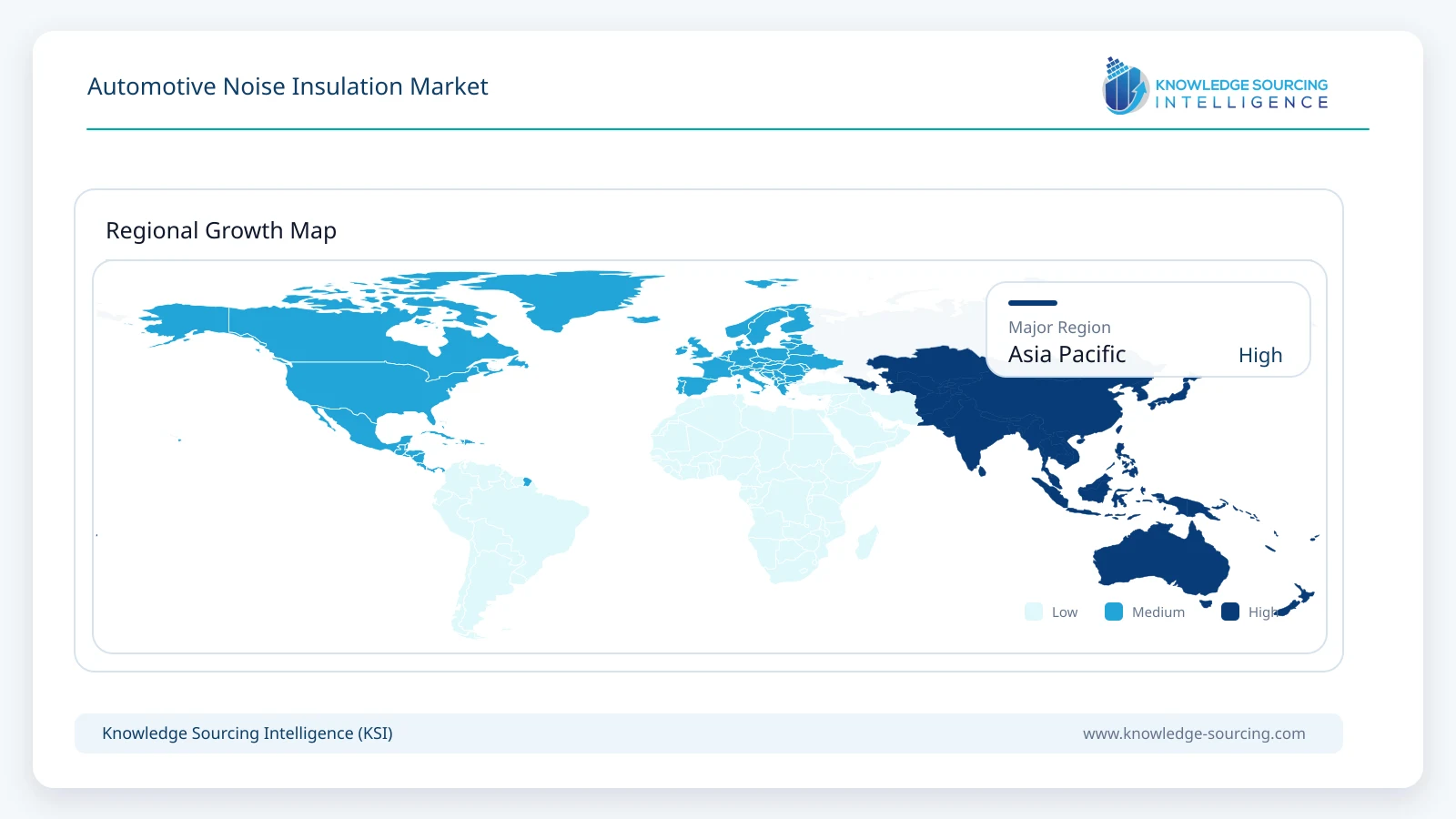
Asia Pacific is the largest automotive noise-insulation market in 2026, supported by vehicle-production scale in China, Japan, South Korea and India. China is particularly important as domestic EV and premium brands compete on quiet-cabin performance while larger wheels and low-profile tires increase road-noise challenges.
Growth through 2031 will be supported by higher acoustic content per vehicle and rapid adoption of molded fiber and recyclable PET components. Localized production is important because insulation parts are bulky, vehicle-specific and closely linked to OEM assembly plants.
Europe
Europe remains a high-value market because premium vehicle production, aggressive mass targets and strong circularity requirements favor lightweight, highly engineered noise-insulation components. The region is also an important development base for mono-material polyester and optimized molded-fiber systems.
Growth will be driven more by technology substitution than by unit production. Recycled-content floor systems, localized barrier packages and multi-function exterior liners are expected to gain share as OEMs cut mass without relaxing acoustic targets.
Competitive Landscape
The automotive noise-insulation market is led by suppliers that combine acoustic engineering with component forming, lamination, conversion and local manufacturing. Autoneum, Adler Pelzer and Auria Solutions have broad positions across floor, dash, wheelhouse and exterior acoustic parts, while Toyota Boshoku, Hayashi Telempu and Sumitomo Riko add strong regional OEM integration. Freudenberg and 3M contribute specialist nonwoven and lightweight acoustic technologies.
Competitive differentiation increasingly depends on acoustic performance per kilogram, three-dimensional formability, recycled content, moisture resistance and the ability to integrate insulation with carpets, wheelhouse liners, frunks or adjacent trim. Multi-function components can command higher value when they remove separate parts or assembly steps.
Production footprint remains a structural advantage because many insulators are bulky, platform-specific and sequenced closely to OEM plants. Suppliers with vehicle-level simulation, tooling capability and consistent regional manufacturing are better positioned for global platform awards.
Recent Developments
25 June 2026: Sumitomo Riko announced a new automotive R&D base in India to strengthen local design, evaluation and technical-service capability for polymer-based automotive products, supporting regional development of sound-control and insulation systems.
4 February 2026: Autoneum introduced its polyester-based Ultra-Silent Frunk for BEVs, combining acoustic and thermal insulation with a one-piece lightweight construction and up to 70% recycled material.
16 December 2025: Autoneum detailed a recyclable polyester component package for the Polestar 5, including frunk, outer-dash and underbody technologies designed for acoustic performance with lower material complexity.
8 July 2025: Autoneum introduced Flexi-Light PET, a shapeable polyester felt sound-insulation system using up to 90% recycled content for automotive carpets and inner-dash applications.
Market Outlook
The automotive noise-insulation market is expected to expand from approximately USD 5.600 billion in 2026 to about USD 8.077 billion by 2031. Molded and formed insulators will remain the largest product group, while fiber-based liners, cavity pads and multi-function exterior components grow faster.
The central structural change will be the move from broad-area heavy treatment toward localized, shaped and recyclable components. PET felts, lightweight hybrid stacks and molded fiber systems will allow suppliers to reduce part mass while maintaining isolation across floor, dash, door, wheelhouse and rear-body noise paths.
Asia Pacific will remain the largest regional market, while Europe continues to influence lightweight and circular component design. Supplier success will depend on acoustic isolation per kilogram, component integration, vehicle-specific simulation, production consistency and the ability to deliver recyclable parts at automotive scale.
Automotive Noise Insulation Market Scope
| Report Metric | Details |
|---|---|
| Total Market Size in 2026 | USD 5.60 billion |
| Total Market Size in 2031 | USD 8.08 billion |
| Forecast Unit | Billion |
| Growth Rate | 7.6% |
| Study Period | 2021 to 2031 |
| Historical Data | 2021 to 2024 |
| Base Year | 2025 |
| Forecast Period | 2026 – 2031 |
| Segmentation | Product Form, Material Construction, Application, Propulsion, Vehicle Type, Geography |
| Companies |
|
| Customization Scope | 15% Free Customization included with purchase — Request Custom Breakdown → |
| Sample & Data Access | PDF Sample, Excel Databook & Analyst Briefing — Download Free Sample → |
Market Segmentation
By Product Form
Molded and Formed Noise Insulators
Flexible Barrier and Decoupler Assemblies
Acoustic Liners and Cavity Pads
Wheelhouse, Underbody and Specialty Insulators
By Material Construction
Fiber and Nonwoven-Dominant Systems
Foam-Dominant Systems
Heavy Barrier and Composite Systems
Hybrid and Multi-Material Systems
By Application
Floor and Carpet Systems
Dash, Firewall and Tunnel
Door, Pillar and Body Cavities
Wheelhouse, Luggage and Underbody
Roof, Hood and Other Body Areas
Engine and E-Drive Enclosures
By Propulsion
Internal-Combustion Engine Vehicles
Hybrid and Plug-In Hybrid Vehicles
Battery Electric Vehicles
By Vehicle Type
Passenger Vehicles
Light Commercial Vehicles
Medium and Heavy Commercial Vehicles and Buses
By Geography
North America
United States
Canada
Mexico
South America
Brazil
Argentina
Others
Europe
Germany
United Kingdom
France
Italy
Spain
Others
Middle East and Africa
Saudi Arabia
UAE
South Africa
Others
Asia Pacific
China
Japan
South Korea
India
Indonesia
Thailand
Others
Table of Contents
1. INTRODUCTION
1.1. Market Overview
1.2. Market Definition
1.3. Scope of the Study
1.4. Market Segmentation
1.5. Currency
1.6. Assumptions
1.7. Base and Forecast Years
1.8. Key Benefits to Stakeholders
2. RESEARCH METHODOLOGY
2.1. Research Design
2.2. Secondary Research
2.3. Primary Research
2.4. Market Estimation
2.5. Segment Modelling
2.6. Data Triangulation and Validation
3. EXECUTIVE SUMMARY
3.1. Key Findings
3.2. Automotive Noise Insulation Market Size, 2026-2031
3.3. Product Form Outlook
3.4. Material Construction Outlook
3.5. Application Outlook
3.6. Propulsion Outlook
3.7. Vehicle Type Outlook
3.8. Regional Opportunity Summary
4. MARKET DYNAMICS
4.1. Market Drivers
4.1.1. Higher Quiet-Cabin Expectations across Mainstream Vehicle Segments
4.1.2. Electrification Shifts Attention toward Road, Tire and Auxiliary Noise
4.1.3. Lightweighting Favors Engineered Components over Uniform Heavy Coverage
4.1.4. Circularity Targets Accelerate Recycled Fiber and Mono-Material Designs
4.1.5. Vehicle Production and Higher Content per Vehicle Support a Stable Demand Base
4.2. Market Restraints
4.2.1. Cost Pressure on Hidden Components Remains Intense
4.2.2. Weight Reduction Can Undermine Low-Frequency Isolation
4.2.3. Vehicle-Specific Tooling Limits Cross-Platform Standardization
4.2.4. Moisture, Heat and Contamination Create Durability Constraints
4.2.5. Recyclability Can Conflict with Multi-Layer Functional Performance
4.3. Market Opportunities
4.4. Porter's Five Forces Analysis
4.5. Industry Value Chain Analysis
4.6. Component Weight, Acoustic Performance and Cost Trade-Offs
4.7. Recycled Content, VOC and End-of-Life Requirements
5. TECHNOLOGY OUTLOOK
5.1. Molded Fiber Noise Insulation
5.2. Decoupled Barrier and Mass-Spring Components
5.3. Polyester/PET Felt Insulators
5.4. Polyurethane and Specialty Foam Insulators
5.5. Lightweight Hybrid Absorber-Barrier Components
5.6. Molded Dash, Firewall and Tunnel Insulators
5.7. Floor and Carpet-Backed Insulation Systems
5.8. Door, Pillar and Body-Cavity Noise Pads
5.9. Wheelhouse, Underbody and Luggage-Area Insulation
5.10. Hood, Engine and E-Drive Encapsulation Insulation
5.11. Mono-Material and Recyclable Insulation Components
5.12. Insertion-Loss Testing and Transfer-Path Optimization
6. AUTOMOTIVE NOISE INSULATION MARKET BY PRODUCT FORM
6.1. Introduction
6.2. Molded and Formed Noise Insulators
6.3. Flexible Barrier and Decoupler Assemblies
6.4. Acoustic Liners and Cavity Pads
6.5. Wheelhouse, Underbody and Specialty Insulators
7. AUTOMOTIVE NOISE INSULATION MARKET BY MATERIAL CONSTRUCTION
7.1. Introduction
7.2. Fiber and Nonwoven-Dominant Systems
7.3. Foam-Dominant Systems
7.4. Heavy Barrier and Composite Systems
7.5. Hybrid and Multi-Material Systems
8. AUTOMOTIVE NOISE INSULATION MARKET BY APPLICATION
8.1. Introduction
8.2. Floor and Carpet Systems
8.3. Dash, Firewall and Tunnel
8.4. Door, Pillar and Body Cavities
8.5. Wheelhouse, Luggage and Underbody
8.6. Roof, Hood and Other Body Areas
8.7. Engine and E-Drive Enclosures
9. AUTOMOTIVE NOISE INSULATION MARKET BY PROPULSION
9.1. Introduction
9.2. Internal-Combustion Engine Vehicles
9.3. Hybrid and Plug-In Hybrid Vehicles
9.4. Battery Electric Vehicles
10. AUTOMOTIVE NOISE INSULATION MARKET BY VEHICLE TYPE
10.1. Introduction
10.2. Passenger Vehicles
10.3. Light Commercial Vehicles
10.4. Medium and Heavy Commercial Vehicles and Buses
11. AUTOMOTIVE NOISE INSULATION MARKET BY GEOGRAPHY
11.1. North America
11.1.1. United States
11.1.2. Canada
11.1.3. Mexico
11.2. South America
11.2.1. Brazil
11.2.2. Argentina
11.2.3. Others
11.3. Europe
11.3.1. Germany
11.3.2. United Kingdom
11.3.3. France
11.3.4. Italy
11.3.5. Spain
11.3.6. Others
11.4. Middle East and Africa
11.4.1. Saudi Arabia
11.4.2. UAE
11.4.3. South Africa
11.4.4. Others
11.5. Asia Pacific
11.5.1. China
11.5.2. Japan
11.5.3. South Korea
11.5.4. India
11.5.5. Indonesia
11.5.6. Thailand
11.5.7. Others
12. COMPETITIVE ENVIRONMENT AND ANALYSIS
12.1. Major Players and Strategy Analysis
12.2. Market Share Analysis
12.3. Molded Fiber versus Barrier-Heavy Insulation Benchmarking
12.4. Insertion Loss, Weight and Package-Thickness Comparison
12.5. Moisture, Compression and Durability Benchmarking
12.6. Recycled Content and Circularity Benchmarking
12.7. OEM Qualification and Production Readiness
12.8. Competitive Dashboard
13. COMPANY PROFILES
13.1. Autoneum Holding Ltd.
13.2. Adler Pelzer Group
13.3. Auria Solutions Ltd.
13.4. 3M Company
13.5. Sumitomo Riko Company Limited
13.6. Toyota Boshoku Corporation
13.7. Hayashi Telempu Corporation
13.8. Freudenberg Performance Materials
14. APPENDIX
14.1. Currency
14.2. Assumptions
14.3. Base and Forecast Years Timeline
14.4. Key Benefits for Stakeholders
14.5. Research Methodology
14.6. Abbreviations
14.7. Data Sources





Frequently asked questions
What is the projected market size of automotive noise insulation by 2031?
The Automotive Noise Insulation Market is projected to reach USD 8.08 billion by 2031.
What is the Compound Annual Growth Rate (CAGR) forecast for 2026-2031?
The Automotive Noise Insulation Market is projected to grow at a 7.6% CAGR.
Which region holds the largest share in the Automotive Noise Insulation Market?
Asia Pacific represents approximately 45% of the 2026 market value.
Which vehicle propulsion segment is the fastest-growing in this market?
Battery-electric vehicles are the fastest-growing propulsion segment.
What are the leading component types or application areas in this market?
Molded components and floor/carpet insulation systems are key segments.
What is a key trend or shift observed in the noise insulation market?
The Automotive Noise Insulation Market is shifting towards lighter, shaped fiber structures and thin barriers.
Cite this report
Knowledge Sourcing Intelligence. (Oct 2026). Automotive Noise Insulation Market Size, Share & Growth Forecast (2026-2031). https://www.knowledge-sourcing.com/report/automotive-noise-insulation-market